
 menu icon in the top, right corner of the screen.
 icon above to close this box.
 icon at the bottom of the screen below the browser—if you don't see it, swipe up to unhide it.
Building Up the Kingdom
Kyle R. Walker, "Building Up the Kingdom," in Sister to the Prophet: The Life of Katharine Smith Salisbury (Provo, UT: Religious Studies Center, Brigham Young University; Salt Lake City: Deseret Book), 57–70.
While we lived in Kirtland, . . . my mother and myself spent our whole time in waiting upon the comers and goers in cooking and washing.
—Katharine Smith Salisbury
UPON HER ARRICAL IN OHIO, Katharine resided with her parents at the home of forty-five-year-old Isaac Morley, a well-to-do farmer and recent convert who resided in Kirtland. Several weeks later, the Smiths removed to the farm of Frederick G. Williams.[1] Katharine remained with her parents on Williams’s farm for less than a month. Family tradition holds that Jenkins and Katharine had discussed marriage before they left New York but was possibly not yet common knowledge among the Smith family.[2] Whether her parents knew or not, their bond deepened in the weeks after arriving in Ohio. Because she was a month shy of her eighteenth birthday, Katharine had to obtain permission from her father before she could marry. Ohio law stipulated that women between the ages of fourteen and eighteen, could be married only if they “first obtain the consent of their fathers, respectively; or in the case of the death or incapacity of their fathers, then of their mothers or guardians.”[3] Jenkins accordingly spoke with Katharine’s parents about their intention of marriage, and procured a statement signed by both Joseph Sr. and Lucy confirming their consent for their daughter’s marriage. The couple presented this certificate to Geauga County clerk D. D. Aiken, from whom they obtained a marriage license in early June. They then sought out the celebrated reformed Baptist preacher and recent Ohio convert, Sidney Rigdon, who performed Katharine and Jenkins’s wedding ceremony at Kirtland, on Wednesday, June 8, 1831.[4]
 Sidney Rigdon, ca. 1873. Photograph of original by Fox & Symonds, Salt Lake City, ca. 1900. Courtesy of Church History Library.
The couple settled in Chardon, Ohio, ten miles southeast of Kirtland, to live near Katharine’s eldest sister Sophronia. Jenkins presumably found work as a blacksmith in the area. The wedding celebration did not last long among the Smith clan, as just two weeks later Sophronia’s one-year-old daughter Eunice passed away on June 24, 1831.[5] Katharine’s brother Joseph and his wife Emma also lost twins earlier in March, just hours after they were born. Their grief was somewhat assuaged two weeks later when widower John Murdock asked Joseph and Emma to raise his twins as their own after Murdock’s wife Julia died in childbirth.[6] Katharine played the role of comforter to both women during those early months in Kirtland, most especially to Sophronia due to her living so close.
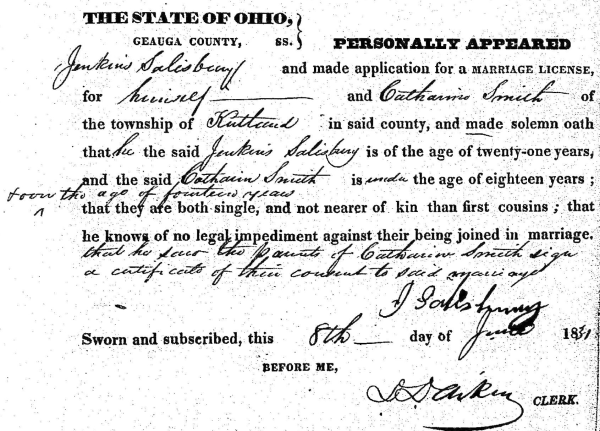 Jenkins Salisbury and Katharine Smith Marriage License Application, June 8, 1831, Geauga County, Ohio, Probate Court, Marriage Records. The clerk D. D. Aiken recorded that “he saw the parents of Catherine Smith sign a certificate of their consent to said marriage."
Sophronia’s health had always been fragile, having nearly died from typhoid fever during her youth.[7] On April 12, 1832, Calvin and Sophronia welcomed another baby girl to their home, their last and only surviving child, whom they named Mariah.[8] It appears that Sophronia continued in poor health in the months following Mariah’s birth, requiring the assistance of both Katharine and their younger sister Lucy. Just eleven years old at the time, Lucy moved to Chardon sometime in the period of 1832–33 to assist her eldest sister during her prolonged illness in managing her home and in caring for her infant daughter.[9] Similar to her experience with typhoid fever in her youth, doctors attended Sophronia for a time but eventually declared that she was “beyond the reach of medicine.” Both doctors and family members felt she had only days to live as she lay motionless on her bed. According to her mother, Lucy, divine intervention once again spared her life. After Jared Carter, Joseph Sr., and several Smith brothers jointly blessed her by the laying on of hands, Sophronia’s health began to improve, and she was back on her feet again within days.[10]
In contrast to her older sister, Katharine’s health was vigorous and surviving descriptions often noted her exceptional strength. A newspaper reporter who interviewed Katharine thought, in later life she “resembled her noted brother [Joseph] very little save in stature.” He thought that she instead looked most like her nephew, Joseph Smith III. Among her siblings, she most resembled her brother William, though he had brown hair and Katharine’s hair was blonde. Both had deep-set blue eyes, thin lips, and a prominent broad nose, more characteristic of the Mack side of the family. Repeatedly noteworthy in surviving accounts was her uncommon height, a generational Smith family trait.[11] She was reportedly six inches taller than the average woman of her day, around five feet ten inches tall, and capable of performing the work of most men. One descendant thought that her large hands were also conspicuous, remembering Katharine as “unusually rugged and strong for a female.”[12] Her stature would serve her well as the Saints located in frontier settlements in Ohio, Missouri, and Illinois.
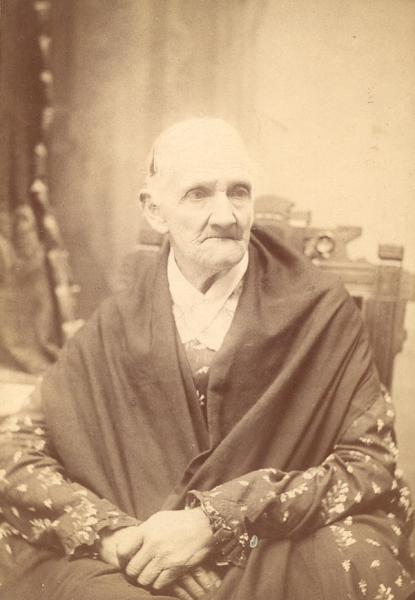 Katharine Smith Salisbury, ca. 1880. Photographer unknown. Courtesy of Community of Christ Library-Archives. Note Katharine’s hair, “parted in the middle, combed back and done up in a coil and fastened with a comb” and “combed smooth behind the ears” just as she had instructed Saints.
Just three days before Sophronia gave birth to Mariah, Katharine and Jenkins welcomed their first child into their home on April 9, 1832, a baby girl they named Elizabeth. During pregnancy and in those first months after their girls were born, Sophronia and Katharine unitedly looked forward to the bond these cousins would share throughout their lives. Tragically, the Salisburys’ daughter, Elizabeth, would not survive the summer, passing away just three months after she was born, on July 15.[13] Watching Sophronia raise Mariah in the latter part of 1832 may have initially brought painful reminders of the loss of her own daughter, but assisting with Mariah’s care the following year during Sophronia’s lengthy illness probably provided some purpose for her grief. The three Smith sisters bonded through these challenging times during those early years in Ohio.
Once Sophronia’s health had fully recovered, Katharine turned her focus to building up the burgeoning church. Lucy Mack Smith had successfully transmitted traditional Christian virtues into the minds of her daughters. This included everything from attitudes about childrearing, their manner of worship, habits of Bible study and prayer, and even such everyday practices as frugality and their manner of dress. Katharine’s surviving letters are filled with references to such values. One example that is repeated in her writings was her belief in dressing simple, and in later life she often remonstrated with those who were caught up in the ever-changing fashions she had witnessed during her lifetime, which spanned the entire nineteenth-century. Many of the religions of the day, including some that the Smith family had affiliated with during Katharine’s youth, emphasized keeping dress and appearance simple. These denominations instructed that simplifying material needs demonstrated a willingness to sacrifice their means to spiritual purposes, such as missionary work, while others stressed that dressing plain indicated a preparedness to work and serve.[14] “In the old church we all dressed plain,” described Katharine in a letter to her sister-Saints. “For my part I think it a shame to follow the fashions of the world. We all wore our hair plain in the old church, parted in the middle, combed back and done up in a coil and fastened with a comb,” and “combed smooth behind the ears.”[15] She stressed the importance of the “plainness” of bonnets and dresses, that she felt should be designed “for comfort and not for show.” A bonnet, she instructed, should be no bigger than your hand, and felt it was excessive for women to “load their hats with ribbons, and artificial flowers, and feathers.”[16] She held to these strict guidelines throughout her life, which reflected one aspect of her religious devotion.
Temple Construction and Work Efforts in Kirtland
Katharine also clung to the value of hard work, something she had also learned during her upbringing when the Smith family made their one-hundred-acre farm prosper during the decade of the 1820s. Her parents’ home in Kirtland became a way station of sorts for missionaries and converts who were constantly moving in and out of the community. Though likely unconsciously assigned and certainly because of her connection to the church’s founder, Mother Lucy embraced the role of housing, feeding, and mending clothes for the Saints who were coming and going during those early years in Kirtland. In her writings, Lucy often stressed the importance of building up the kingdom of God over personal comforts. “How often I have parted every bed in the house for the accommodation of the brethren,” recalled Lucy of her time in Kirtland, “and then laid a single blanket on the floor for my husband and myself.” More than a decade later, when dictating her biography to scribe Martha Jane Coray, Lucy mused, “I often wonder, when I hear brethren and sisters complain at the trifling inconveniences which they have to suffer in these days . . . [whether] salvation is worth as much now as it was in the commencement of the work.”[17]
Katharine adopted her mother’s mindset of sacrificing personal desires for the greater good of the community of Saints. It was one the primary reasons she felt that sisters should be modest in dress, so that the “money which all those needless trimmings cost could be saved to help spread the gospel.”[18] Her writings evidence the value she placed on sacrifice. She often recounted the example of her brothers and other early missionaries during the Saints stay in New York and Ohio, who often traveled with no money in their pocket and made great sacrifices to win new converts to the early church. Writing to members decades later, Katharine underscored these early missionaries’ sacrifice and probed contemporary Saints as to “how many would respond to the call today if they had to go on foot without money?”[19] Her narrative of her efforts in Kirtland, and especially her extolling the value of sacrifice, precisely mirrored her mother’s.
Katharine’s efforts, though they did not include traveling abroad to spread the gospel message, differed in kind from the sacrifice made by her brothers. One summary of women’s work efforts in the early church emphasized how their roles during that period were often connected to their husband’s callings and missionary assignments. “Organized missionary work was a man’s calling, except for contacts made by women among local family and friends. But the support—more often encouragement than cash—came from the women left at home. It was regarded as an act of faith to stay behind, maintain the home, and rear the children. It was also an act of sacrifice and love. . . . It appears that, for a woman, sending a man into the mission field was a vicarious religious experience.”[20]
Yet sisters found practical ways to contribute their efforts in supporting missionary work while remaining at home. Katharine underscored her continual effort to clothe the traveling missionaries and care for the influx of converts who came to Kirtland. She recalled that “while we lived in Kirtland, my mother and myself spent our whole time in waiting upon the comers and goers in cooking and washing.”[21] Women also worked behind the scenes to ensure meetings ran smoothly, such as baking bread for the sacrament or preparing food for feasts associated with sacred ceremonies leading up to the Kirtland Temple dedication.[22] While there was a noted distinction between male and female efforts to build up the kingdom, in Katharine’s view they were all efforts to the same end.
Two years after settling in Ohio much of the focus of the Saints’ work efforts shifted to the construction of the temple. While temple construction was first proposed in 1831, it wasn’t until the Saints were rebuked through a revelation received by Joseph Smith on June 1, 1833, that enthusiasm increased. The latter revelation admonished the Saints for their failure to consider “the great commandment . . . that I have given unto you concerning the building of mine house.”[23] Such a vast undertaking required the joint labors of the entire community of Saints. It also meant an increased workload for the greater Smith family. Hyrum, for one, felt impelled to get started on the construction immediately after the divine mandate was communicated to the Saints. After listening to Joseph describe his scope of the proposed structure, which he said had been shown to him in vision, Hyrum ran to his parents’ home, grabbed a scythe, and began clearing weeds off the proposed temple site. Lucy remembered his eagerness at the time, recording that Hyrum told her that he was determined “that he would strike the first blow upon the house.” He then grabbed a shovel and began digging a foundational trench for the walls of the temple. Such enthusiasm led to Hyrum being appointed one of three members who oversaw the temple’s construction.[24] Because of the lack of financing and the difficulties the Saints were experiencing in Missouri, temple plans in Kirtland took time to materialize.
 Interior of the Kirtland Temple, showing the curtains that were used to partition areas of the temple. Date and photographer unknown.
Hyrum’s initial excitement was representative of the entire Smith family. Lucy recalled, “There was but one mainspring to all our thoughts and actions, and that, was, the building of the Lord’s house.”[25] Joseph Sr., with Lucy’s assistance, was appointed to oversee the sisters’ work efforts. Once work efforts began in earnest on the construction of the Kirtland Temple, the Smith home became a hotbed of activity. While Jenkins and the Smith brothers began cutting and hauling stone for the temple’s foundation and walls, Joseph Sr. supervised women’s work contributions, including the making of carpets and curtains for the temple.[26] Katharine and Sophronia assisted in these tasks and produced clothing items for the men laboring on the temple. The Smith sisters accomplished this service by forming weaving clubs throughout the city wherever there were clusters of Saints, where looms were set up for weaving. Other groups of women were organized where they would gather to spin, knit, and card wool.[27] At one such gathering of sisters, Polly Angell, who was Katharine’s age, remembered that while they were working on the veils of the temple, Joseph Smith and Sidney Rigdon stopped by the home while they were busily engaged. “Well sisters, you are always on hand,” Joseph declared, “the sisters are always first and foremost in all good works. Mary was the first at the resurrection; and the sisters now are the first to work on the inside of the temple.”[28]
Lucy grew frustrated at times with sisters who complained of what she considered trivial matters that prevented their work efforts during the time of the temple’s construction.[29] Katharine noticed her mother’s frustrations and similarly grew impatient with sisters who seemed more concerned with their appearance than in contributing their time and efforts. “Mother Smith, I would help you but I am afraid I will soil my dress,” Katharine recalled of the sisters’ complaints, “and this too when our tired limbs were about to fail us.” Katharine had little patience for such excuses, recommending that when there was church work to be completed sisters should bring a calico dress with them so they could be fully engaged in such labor.[30]
The work was demanding and relentless, and Lucy enlisted the assistance of her daughters and other single or newlywed sisters to help her with the load. Twenty-four-year-old Mary Bailey and twenty-one-year-old Agnes Coolbrith, recent converts Samuel Smith baptized the previous summer in Boston, were two examples.[31] After they gathered with the Saints in Kirtland, the two lived with Joseph Sr. and Lucy during this period. Lucy remembered that Mary and Agnes “devoted their whole time to making and mending clothes for the men who were employed on the house.”[32] Their closeness to the Smiths eventually led to romance, as Mary wed her missionary Samuel the following summer on August 13, 1834, and Agnes married the youngest Smith brother, Don Carlos, on July 30, 1835.[33]
Katharine bonded with her future sisters-in-law during this time, as she made the twenty-mile round trip from Chardon to Kirtland with regularity, likely remaining at her parents’ home for days, perhaps even weeks or months when Jenkins was absent on his mission. She and Sophronia spent considerable time at their parent’s home working alongside their mother, while they continued to be influenced by their mother’s example and teachings. The greater Smith family excitedly anticipated the completion of the temple and the expansion of the church in the bustling community.
Notes
[1] Michael Hubbard MacKay et al., eds., Documents, Volume 1: July 1828–June 1831, vol. 1 of the Documents series of The Joseph Smith Papers, ed. Dean C. Jessee et al. (Salt Lake City: Church Historian’s Press, 2013), 311; Lucy Mack Smith, Biographical Sketches of Joseph Smith the Prophet and His Progenitors for Many Generations (Liverpool: S. W. Richards, 1853), 184.
[2] Warren L. Van Dine, “Statement about His Salisbury Family,” 1975, 9, typescript, Hancock County Historical Society, Carthage, IL.
[3] Act Regulating Marriages, January 6, 1824, in Acts of a General Nature [. . .] of the State of Ohio, vol. 29 (Columbus: Olmsted & Bailhache, 1831), 429.
[4] Ohio, United States, Geauga County Marriage Records, 1774–1993, Application for Marriage License, Jenkins Salisbury and Catharine Smith, June 8, 1831; Marriage License for Jenkins Salisbury and Catharine Smith, June 8, 1831, Probate Court, Marriage Records, vol. B, 196, both available on Ancestry.com. Four years after he married Jenkins and Katharine, Sidney Rigdon was prosecuted in 1835 for illegally performing a marriage in the year 1834, because Judge Mathew Birchard determined he was not a “regularly ordained minister of the gospel.” The charges were later dismissed. After examining Ohio law and the evidence in Rigdon’s case, legal historian M. Scott Bradshaw concluded that the lawsuit appears to have been both politically and religiously motivated to curtail the Church of Christ’s expanding influence in Geauga County, Ohio. M. Scott Bradshaw, “Joseph Smith’s Performance of Marriages in Ohio,” BYU Studies Quarterly 39, no. 4 (2000): 23–69.
[5] Stoddard Family Bible, photographs of original courtesy of Reid Moon, original in possession of Reid Moon, Provo, UT.
[6] Karen Lynn Davidson, David J. Whittaker, Mark Ashurst-McGee, and Richard L. Jensen, eds., The Joseph Smith Papers, Histories, Volume 1, Joseph Smith Histories, 1832–1844, vol. 1 of the Histories Series of The Joseph Smith Papers, ed. Dean C. Jessee, Ronald K. Esplin, and Richard Lyman Bushman (Salt Lake City: Church Historian’s Press, 2012), 30; S. Reed Murdock, Joseph and Emma’s Julia: The Other Twin (Salt Lake City: Eborn Books, 2004), 9–12.
[7] Lucy Mack Smith, Biographical Sketches, 60–61.
[8] Stoddard Family Bible.
[9] Mary Salisbury Hancock, “The Three Sisters of the Prophet Joseph Smith, Part II,” Saints’ Herald 101, no. 3 (January 18, 1954): 10.
[10] Lucy Mack Smith, Biographical Sketches, 204.
[11] “Sister of a Prophet,” Saints’ Herald 40, no. 36 (September 9, 1893): 565; Interview with Catherine Salisbury, as reported in Gay Davidson, “Anniversary of Carthage,” Salt Lake Tribune 44, no. 57 (June 24, 1894): 16.
[12] Warren L. Van Dine, “Catherine Smith Salisbury, Sister of Joseph Smith,” Saints’ Herald 90, no. 32 (August 7, 1943): 24; Warren L. Van Dine, “Information on the Smith and Salisbury Families, 1966–1975,” typescript of taped interview conducted by Norma Hiles, Burnside, IL, 1975, 27, CHL.
[13] In the year 1865 Katharine sent genealogical information to her cousin George A. Smith in a letter per his request. Though her original letter has not been located, Smith recorded the information contained in the letter in his father’s (John Smith) journal. George A. Smith (Salt Lake City) to Cousin Catherine [Salisbury], August 17, 1865, Historian’s Office letterpress copybooks, 1854–79, vol. 2, 1859–69, CHL; John Smith Papers, 1833–54, Journal, 1846 February–1854 May, CHL. The author wishes to acknowledge Mark L. Staker for his assistance in locating this source. For further confirmation on Elizabeth’s birth and death dates, see Lucy Mack Smith, Biographical Sketches, 43; Dorothy D. Dean, handwritten family group sheet, copy of original in author’s possession.
[14] Mary Anne Caton, “The Aesthetics of Absence: Quaker Women’s Plain Dress in the Delaware Valley, 1790–1900,” in Quaker Aesthetics: Reflections on a Quaker Ethic in American Design and Consumption, ed. Emma Jones Lapsansky and Anne A. Verplanck (Philadelphia: University of Pennsylvania Press, 2003), 257–58; Matthew Simpson, Cyclopedia of Methodism (Philadelphia: Everts & Stewart, 1878), 311; William B. Sprague, Annals of the American Pulpit (New York: Robert Carter & Brothers, 1858), 139; Norman Fox, “George Fox and the Early Friends,” Baptist Quarterly 11, no. 4 (October 1877): 437.
[15] Katherine Salisbury (n.p.) to Sister Frances, December 24, 1886, Saints’ Herald 34, no. 6 (February 5, 1887): 84.
[16] Katharine Salisbury (n.p.) to Dear Sisters, July 2, 1895, Saints’ Herald 42, no. 30 (July 24, 1895): 473. In another account, Katharine reiterated, “I think it is a sin to follow the fashions of the world. We are commanded to come out from the world, and be separate. Let us make our garments plain, as we are commanded to do, and not put two or three yards in a hump on the back. I think that needless expense could be put to better use.” Katherine Salisbury (Fountain Green, IL) to Dear Sister Walker, December 29, 1888, Saints’ Herald 36, no. 4 (January 26, 1889): 53.
[17] Lucy Mack Smith, Biographical Sketches, 203–4.
[18] Salisbury to Dear Sisters, July 2, 1895.
[19] Katherine Salisbury (Fountain Green, IL) to Dear Sister Walker, February 27, 1888, Saints’ Herald 35, no. 11 (March 17, 1888): 164.
[20] Linda King Newell and Valeen Tippetts Avery, “Sweet Counsel and Seas of Tribulation: The Religious Life of the Women in Kirtland,” BYU Studies 20, no. 2 (Winter 1980): 154.
[21] Salisbury to Sister Frances, December 24, 1886.
[22] Nancy A. Tracy reminiscences and diary, 1896 May–1899 July, typescript, 9, CHL; Kristine Wright, “‘We Baked a Lot of Bread’: Reconceptualizing Mormon Women and Ritual Objects,” in Women and Mormonism: Historical and Contemporary Perspectives, ed. Kate Holbrook and Matthew Bowman (Salt Lake City: University of Utah Press, 2016), 84–85.
[23] Gerrit J. Dirkmaat et al., eds., Documents, Volume 3: February 1833–March 1834, vol. 3 of the Documents series of The Joseph Smith Papers, ed. Ronald K. Esplin and Matthew C. Grow (Salt Lake City: Church Historian’s Press, 2014), 105.
[24] Lucy Mack Smith, Biographical Sketches, 203; Jeffrey S. O’Driscoll, Hyrum Smith: A Life of Integrity (Salt Lake City: Deseret Book, 2003), 86.
[25] Lucy Mack Smith, Biographical Sketches, 203.
[26] Cleveland Herald report reproduced in “General Conference,” Saints’ Herald 30, no. 16 (April 21, 1883): 242–43; Milton V. Backman Jr., The Heavens Resound: A History of the Latter-day Saints in Ohio, 1830–1838 (Salt Lake City: Deseret Book, 1983), 158–59.
[27] Hancock, “Three Sisters, Part II,” 10.
[28] Edward Tullidge, The Women of Mormondom (New York: Tullidge & Crandall, 1877), 76. Polly Angell was born at Riga, Monroe County, New York, on June 4, 1813, and was married to church architect Truman O. Angell.
[29] Lucy Mack Smith, Biographical Sketches, 203.
[30] Salisbury to Sister Frances, December 24, 1886.
[31] Samuel Harrison Smith diary, 1832 February–1833 May, see entries for June 26, 1832, and July 30, 1832, CHL.
[32] Lucy Mack Smith, Biographical Sketches, 203.
[33] Sidney Rigdon also performed the marriage of Samuel Smith and Mary Bailey, while Seymour Brunson officiated at the wedding of Don Carlos Smith and Agnes Coolbrith. Ohio, United States, Geauga County Marriage Records, 1774–1993, vol. C, 60, 108, copy of originals available at Ancestry.com.
