
 menu icon in the top, right corner of the screen.
 icon above to close this box.
 icon at the bottom of the screen below the browser—if you don't see it, swipe up to unhide it.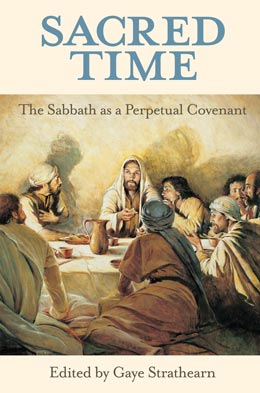
The Decline of Sabbath Observance in an Increasingly Secular Society
Twenty-First Century Efforts to Reclaim the Lord's Day
Brent L. Top
Brent L. Top, "The Decline of Sabbath Observance in an Increasingly Secular Society: Twenty-First Century Efforts to Reclaim the Lord's Day," in Sacred Time: The Sabbath as a Perpetual Covenant, ed. Gaye Strathearn (Provo, UT: Religious Studies Center, Brigham Young University; Salt Lake City: Deseret Book), 295–312.
The latter part of the twentieth century brought major developments affecting not only American society and institutions in general, but also individuals and families in particular. The post-World War II booming economy enabled millions to realize the “American Dream”—moving to the quiet, clean suburbs and into modern, comfortable single-family houses. Soon every home had a color television and many people had extra money in their pockets, allowing them more time for leisure, recreation, and travel. Supermalls competed for those extra dollars of virtually every person, not just the uber-rich. This growing middle class had a new view of shopping. No longer was it merely what their parents and grandparents had done at the neighborhood grocery store for those commodities needed to sustain life. Shopping became more than just necessity or even luxury; it was a new form of entertainment. In addition to commerce, the advancements of the past century in the fields of medicine, communication, travel, and information have been mind-boggling. Quality of life and standard of living have risen dramatically, and with more disposable income and leisure time available, families and individuals have more freedom to look to the many available entertainment and recreation options. With all these improvements to life, what, if any, downside could there be?
There is, as it turns out, at least one major drawback. The dawning of the twenty-first century saw a rising level of secularism in American society. Although it is difficult, if not impossible, to draw exact cause-and-effect conclusions, the decline of religiosity in society certainly follows the trends of rising consumerism, leisure, entertainment, and recreation. Arguably the most significant “downside” of the advancements of the late twentieth and early twenty-first centuries has been the decline of faith, as evidenced by decreased religious affiliation in general and regular attendance at church meetings specifically.[1] Research conducted by the Barna Group found that in the last twenty years the percent of U.S. adults that identify as Christians has declined by 20 percent. Barna further reported that in 2020, 36 percent fewer Americans regularly attended religious services than in 1993.[2] In the annual “Ten Today” survey that examines the relevance of the Ten Commandments in modern life, Americans likewise reported a dramatic decline in church attendance and Sabbath day observances since 1978. Yet even with the decline, 62 percent of respondents felt that a day of “religious rest” is important to society.[3]
In a “Saturday Essay” for the the Wall Street Journal, noted author Sohrab Ahmari stated:
The 20th century saw the death of the American Sabbath by a thousand cuts. . . . Judaism, Christianity and Islam all appreciated the bond between Sabbath restrictions and human freedom, even as they designated different days to be holy. Across the West today, however, the drive toward maximal market liberty has squeezed out the liberty of the Sabbath. We have banished it in the name of “choice.” And some choice we have: Working-class families are denied even a half-day of rest together, yet we are puzzled by astronomical divorce rates, abysmally low rates of family formation, alienation and drug abuse. We have cashiered the Sabbath for algorithmic human-resources scheduling—computer code designed to minimize labor costs, regardless of the impact on families and communities.[4]
No wonder one American noted, “Our forefathers called it the Holy Sabbath; our fathers called it Sunday; we call it the week-end.”[5] In a more serious vein, in his book The Day of Worship, Calvinist pastor Ryan M. McGraw raised an alarm concerning secularism’s “war” with faith, worship, and observance of the Sabbath day: “We live in a time of crisis with respect to Sabbath-keeping.”[6] More recently, President Dallin H. Oaks expressed similar concerns about the secularization of society and the decline of Sabbath observance:
Today, my message concerns such good and religious-minded people who have stopped attending or participating in their churches. When I say “churches,” I include synagogues, mosques, or other religious organizations. We are concerned that attendance in all of these is down significantly, nationwide. If we cease valuing our churches for any reason, we threaten our personal spiritual life, and significant numbers separating themselves from God reduce His blessing to our nations.[7]
Theological Factors Contributing to the Decline of Sabbath Observance in Contemporary Christianity
Undoubtedly there are many factors at play in the decline of religiosity and Sabbath observance in contemporary society generally and Christianity specifically, but they all seem to fall into two main categories: cultural and theological. Many of the cultural factors within the United States have already been discussed.[8] In many respects, Christian theology has sown the seeds for the cultural decline of attitudinal and behavioral commitment to keeping the Sabbath day holy. Two general examples can highlight this.
The Law of Moses versus “Christian Liberty”
Many theologians throughout the history of Christianity have taught that the Old Testament laws and commandments (including the Ten Commandments) are superseded by Christ and, thus, keeping a formal Sabbath day constitutes a “work” that minimizes the grace of Christ.[9] This view can be traced to the writings of second century Christian leaders and thinkers who sought to more clearly differentiate Christianity from Judaism.[10] A previous chapter in this volume more fully recounts this movement and cites many of these early Christian sources.[11] It is important, however, for this present discussion, to cite Justin Martyr, who taught that there was no “keeping” of the Sabbath by Old Testament patriarchs and peoples prior to Moses.[12] Thus, the Sabbath, as a commandment of the Law of Moses, was fulfilled in Christ’s death and resurrection:
Is it not evident to you that the elements do not refrain from work, and that they do not observe the Sabbaths? Stay as you were at birth. For if circumcision was not required before the time of Abraham, and if there were no need of Sabbaths, festivals, and sacrifices before Moses, they are not needed now, when, in accordance with the will of God, Jesus Christ, his Son, has been born of the Virgin Mary, a descendant of Abraham.[13]
Like many of the early Christian fathers before them, many Protestant theologians today point to the New Testament teachings of the Apostle Paul regarding what has been called “Christian liberty.” They use the “deadness” of the Mosaic law as evidence that keeping the Sabbath is not a requirement of the Christian faith.[14] This theological teaching has produced a “casualty” in contemporary Christianity and has influenced the decline of the spiritual significance of the sacrament of the Lord’s Supper in formal worship. Since the Eucharist or Communion (other words for the sacrament) is not viewed by Protestants as a salvific ordinance essential to the faith, it need not be observed weekly or regularly. The less frequent celebration of Communion became much more common in Protestant churches in the twentieth century. Different denominations adopted their own approach to the frequency of the administration of Communion. While for centuries it was common for Christians to partake of the Eucharist regularly as part of their weekly (and sometimes more frequent) worship service, today it is less so. Some churches have moved toward a monthly or quarterly Communion. Others celebrate the sacrament of the Lord’s Supper only at Easter and Christmas. Still others have completely abandoned the practice as part of their worship.
Sabbath as Perpetual Worship of Christ, Not a Weekly Day of Rest
A second theological teaching that affects the decline of Sunday worship is that the Sabbath day is not a “day” of rejoicing in Christ but a perpetual daily praise of the Lord. As has been addressed in previous chapters, in their effort to distinguish themselves from Jews, Christians of the first and second centuries viewed the Jewish Sabbath “day of rest” as idleness.[15] Thus rejoicing in Christ replaced rest from labors, and by extension, such rejoicing and worship could be done at any time and in any place. In fact, according to this view, any devoted Christian who loved the Lord was keeping the Sabbath holy continuously.
In his work A Brief History of Sunday from the New Testament to the New Creation, Justo L. González identifies some of the key passages from the Church Fathers that suggest this move away from the Sabbath as a specific day to an emphasis on the relationship a person has with God.[16] According to González, in the second century, early Christian father Irenaeus “would say that a Christian who speaks directly with the Father, does not need to be reminded of what they ought to do.”[17] Then, quoting Irenaeus, “nor will he be commanded to leave idle one day of rest, who is constantly keeping sabbath, that is giving homage to God in the temple of God, which is man’s body, and at all times doing works of justice.”[18]
Other early theologians and Christian leaders, such as Ambrose and Augustine, likewise spoke of a “second Sabbath” that was “kept holy” through one’s relationship with God. According to González, Ambrose viewed the Sabbath “as being superseded, not by another weekly observance, but rather by a different relationship with God.”[19] He said, “Thus, the work of the Sabbath is the sign of a future, because all who have fulfilled the Law and Grace are stripped of the vexations of corporeal frailty through the mercy of Christ.”[20]
Years later Augustine wrote:
Afterall, Christ removed from us that very heavy burden with its many prescriptions so that we are not circumcised in the flesh, we do not sacrifice animal victims, and we do not rest even from necessary work on the Sabbath every seven days, and the all the many other things like these. But we are to keep them when they are understood spiritually, once the shadows which served as signs have been removed. . . . The carnal observance of the Sabbath, which is a sign of spiritual sanctification and rest, is an exception.[21]
For centuries Christians viewed the “day of rest” as a symbol of the liberation from sin afforded mankind through Christ’s atoning sacrifice. Christians did not interpret it as physical rest, as practiced in Judaism; instead they viewed it as a type and shadow of the ultimate “day of rest” with Christ. González writes, “The day of rest was often seen as a sign and a reminder that no human work can merit the grace of God. By resting from all our works we acknowledge that even our best works of charity and obedience are nothing compared to the work of God’s grace. Luther and others feared that too much stress on the legal observation of Sunday rest would lead to legalism, and therefore back again to salvation by works.”[22] Ironically, today “rest”—be it mental, physical, or emotional—is viewed even among devout Christians as the primary reason for their allowance of Sunday recreation, sports, shopping, etc.
So how have these centuries-long theological discussions and debates affected contemporary Christian views and practices regarding the Sabbath day? One major evangelical leader bemoaned that the evangelical church has “capitulated to the marketing model”—the need to attract “modern church goers” and particularly millennials who are more interested in inclusivity and connection than doctrinal “purity” and traditional religious practices. In his estimation, the rise of the “contemporary church,” or what is sometimes referred to as “relevant worship” with its “come as you are” and “come when you can” approach to religion, is a major factor in the decline of Sunday worship.[23]
The twentieth-century rise of Evangelicalism, with its transdenominational nature, has had a cultural impact on the very nature of what constitutes worship. Arguably, the typical evangelical churchgoer today has little knowledge of or attachment to the rich traditions and Sabbath theology of the past. As a result, there is a growing trend toward a more “casual Christianity,” as evidenced in the ministry, music, and approach to religious teaching in Sunday worship services. While such an approach is very appealing to some, others long for more formality and tradition. But a growing number view Sunday as the last day of the weekend, where play has replaced prayer and work has replaced worship.
Institutional Efforts to “Reclaim” the Sabbath as the Lord’s Day
Although it may seem like they are swimming upstream against the strong currents of secularism, many Christian institutions and their respective religious leaders have been seeking to reenthrone Sunday as a holy day, one that is a sacred time dedicated to God[24] and not just a holiday.[25] During the last decades of the twentieth century and now in the new century, efforts by Catholics, Protestants, and Latter-day Saints, in their own unique ways and within their own congregations, have placed greater emphasis on keeping the Sabbath day holy.
The Catechism of the Catholic Church teaches that “on Sundays and other holy days of obligation, the faithful are to refrain from engaging in work or activities that hinder the worship owed to God, the joy proper to the Lord’s Day, the performance of the works of mercy, and the appropriate relaxation of mind and body.”[26] The rise of secularism in society in the latter half of the twentieth century, and its accompanying decline of attendance at Sunday worship services, affected not only Catholics but also many other religious communities. Efforts both large and small, local and from the Vatican, were made to stem the tide of religious decline, as manifested by the growing disregard for the “obligations” of proper Sunday worship. The second Vatican Council, convened by Pope John XXIII in 1962 and culminated in 1965 in sixteen monumental documents intended to reform and “renew” the Catholic Church, did much to revitalize and refocus worship within Catholicism. As González writes:
In brief, the [second Vatican] council emphasized the renewal of worship—particularly Sunday worship—by encouraging the participation of the laity. This was done, first, by the use of the vernacular; second, by giving the laity an active role in worship; third, by providing a homily which would connect the biblical text with the sacrament itself; fourth, by encouraging the use of music and other cultural elements that are expressive of the idiosyncrasies and experiences of the people; and finally, by recalling that Sunday is a feast day, and that therefore the Mass, rather than a lugubrious remembrance of the death of Christ, is a celebration of his victorious resurrection.[27]
Subsequent Popes John Paul II, Benedict XVI, and Francis have likewise called upon believers to more fully return to what has been characterized as “divine worship” on Sunday. In 1998, in an apostolic letter entitled Dies Domini (on keeping the Lord’s day holy), Pope John Paul II wrote that “Sunday is a day which is at the very heart of the Christian life.”[28]
The disciples of Christ . . . are asked to avoid any confusion between the celebration of Sunday, which should truly be a way of keeping the Lord’s Day holy, and the ‘weekend,’ understood as a time of simple rest and relaxation. This will require a genuine spiritual maturity, which will enable Christians to “be what they are,” in full accordance with the gift of faith, always ready to give an account of the hope which is in them (cf. 1 Pt 3:15). In this way, they will be led to a deeper understanding of Sunday, with the result that, even in difficult situations, they will be able to live it in complete docility to the Holy Spirit.[29]
The Pope further warned that “when Sunday loses its fundamental meaning and becomes merely part of a ‘weekend,’ it can happen that people stay locked within a horizon so limited that they can no longer see ‘the heavens.’”[30]
Pope Benedict XVI in his 2007 Apostolic Exhortation Sacramentum Caritatis likewise taught Catholics that participating in the Eucharist at Sunday Mass and maintaining the proper approach to the Lord’s Day is the means whereby one can have a regular “encounter” with Christ which can fortify the believers and keep them on the path of Christian discipleship.[31]
The extensive teachings of these respective pontiffs and other clergy and scholars remind Catholics of their fundamental obligations of “divine worship” as stated in the Catholic Catechism—first, devoutly and regularly partaking of communion; second, refraining from “activities that hinder the worship owed to God” on Sunday; and third, reflecting on the mercy and grace of Christ, which is what is to be commemorated at Mass and in one’s Sunday worship, by rendering greater compassionate service and mercy toward others. [32]
With the secularization of society has come the “casualization” of religion and Sunday worship. Some Catholic leaders (as well as leaders from other denominations) have called for a return to “Sunday best” in both attire and attitude. “Dressing up,” wrote Monsignor Francis Mannion of Salt Lake City, “will help Christians recognize their baptismal dignity. It will say that the presence of God in our midst is worth our best.”[33]
Founded in 1888 by representatives of several mainline Protestant denominations, the Lord’s Day Alliance (originally known as the American Sabbath Union) sought to “maintain and cultivate the first day of the week as a time for rest, worship, Christian education and spiritual renewal.”[34] Today the Lord’s Day Alliance (hereafter LDA) is a national organization that boasts representation from clergy and laity all across the spectrum of Christianity, including Orthodox, Catholics, Baptists, Episcopalians, Lutherans, Methodists, Presbyterians, nondenominational churches, and reformed traditions. One of the stated purposes of the LDA is to “gather and diffuse information, to publish documents, to use the press, to cause public addresses to be made and to use other means as shall be expedient and proper to the end that the blessings of the Lord’s Day and the benefits of Sabbath rest shall be secured for all people.”[35] The flagship publication of the LDA is Sunday Magazine, which is published twice yearly and contains articles and perspectives from a wide array of scholars, clergy, and believers who are united in the mission of encouraging “all people to recognize and observe a day of Sabbath rest” and “to worship the risen Lord Jesus Christ, on the Lord’s Day, Sunday.”[36] In addition to Sunday Magazine, the LDA promotes conferences, lectures, and programs to further “keeping the Sabbath Day holy” as a means of spiritual, physical, and emotional renewal. At its nineteenth-century founding, the LDA sought to promote change in the public sphere by lobbying for “Sunday-rest laws.” The original purpose was to benefit postal unions specifically, but it expanded to include all workers who were compelled to work on Sundays.[37]
Today, however, the LDA seeks to promote change in personal lives rather than in societal laws, advocating the importance of the Sabbath as a means of “spiritual renewal and personal well-being in this fast-paced 24/
The Church of Jesus Christ of Latter-day Saints, like its Catholic and Protestant counterparts, has also felt the impact of modern-day secularism. In 2015, the Pew Research Center reported that there was a marked decline in religious affiliation and intensity of religious beliefs and practices.[39] The Church doesn’t publish statistics of those who stop participating on Sundays with their local congregations or those who lose their faith and leave the Church altogether. Yet much anecdotal evidence at the end of the twentieth and into the twenty-first century has caused concern among the leading quorums of the leadership of the Church. One prominent Latter-day Saint leader observed that “attrition [those leaving the Church and abandoning religion in general] has accelerated in the last five to ten years, reflecting the greater secularization in society.”[40]
Understandably, Church leaders have looked for ways to stay the tide of secularism and promote greater faith and devotion. The primary focus of the training meetings of Church general authorities and officers associated with the general conferences of the Church in 2015 was honoring the Sabbath day. “Of all the organization or policy changes or doctrinal training that could hasten the work of salvation at this time,” said Elder M. Russell Ballard, speaking on behalf of the senior leadership of the Church, “elevating the spirit and power of the Sabbath day would be most influential in drawing members and families to the Lord Jesus Christ.”[41]
This renewed emphasis on the Sabbath as a means of spiritual strength, given in the general conference leadership training meeting, was delivered to local congregations throughout the world. Videos of the training meetings were shown to local leaders and members. Making the Sabbath a delight, as Isaiah admonished anciently (see Isaiah 58:13–14), became the topic for sermons in worship services and conferences, instruction in classes and groups, and discussions among members and families. Six months later additional training was provided to Church leaders and members in the same manner. The focus on keeping the Sabbath holy was sharpened: “In the natural revelatory process the Lord made known His wish that His ancient commandment regarding the Sabbath, or as the scriptures describe, ‘His perpetual covenant with His people,’ be brought to the fore,” Elder D. Todd Christofferson stated on behalf of the First Presidency and Quorum of the Twelve Apostles.[42] He further stated:
We realize that a deeper understanding of the meaning and purposes of the Sabbath day would bring to the Latter-day Saints a profound faith in God and in His Son Jesus Christ, and the Atonement of Christ. This would build strength in the members of the Church far greater than could be achieved by any programmatic means. We saw that observing the Sabbath could lead to full conversion and spiritual resilience in the Saints.[43]
Other important changes in the Church meeting structure and church and family gospel-study curriculum, coupled with renewed emphasis on Sabbath observance, came in the October 2018 General Conference. In his talk announcing these changes, Elder Quentin L. Cook stated:
World conditions increasingly require deepening individual conversion to and strengthening faith in Heavenly Father and Jesus Christ and His Atonement. . . . What do these adjustments mean for members of The Church of Jesus Christ of Latter-day Saints? We are confident that members will be blessed in extraordinary ways. Sunday can be a day of gospel learning and teaching at church and in the home. As individuals and families engage in family councils, family history, ministering, service, personal worship and joyful family time, the Sabbath day will truly be a delight.[44]
Another change was implemented in 2019: the reduction of the Sunday meeting schedule from the three-hour block established in 1980 to a two-hour block—one hour for a worship service and one hour for instruction. This development, President Russell M. Nelson explained, was a direct outgrowth from and augmentation of “our efforts over these recent years to hallow the Sabbath—to make it a delight and a personal sign to God of our love for Him.”[45]
In many ways this intensive emphasis on honoring, remembering, and keeping the Lord’s day spiritually prepared members of the Church for the effects of the COVID-19 worldwide pandemic on religious institutions, which included temporary suspension of in-person worship services and the normal routine workings of ministry and fellowship. Almost immediately upon receiving governmental and health organizations’ warnings concerning the seriousness of the coronavirus, the Church suspended all religious gatherings. Sacrament meetings and other Church meetings were cancelled. Many of the typical Sunday (and weekday) activities suddenly ceased, but God’s commandment to keep the Sabbath day holy was not “put on hold.” The Lord’s expectation that disciples remember him on that sacred day remained in force. With the worldwide pandemic, however, obeying that commandment required internal worship and devotion, not just external observance such as attending church meetings. Church leaders not only clearly taught this principle in the five years prior to the pandemic but also made curricular and organizational changes that placed greater responsibility for Sunday worship on individuals and families instead of solely on congregations and their leaders.
Certainly, the consequences of the pandemic on the Church were less than desirable. Yet there were indeed many opportunities to learn from and adapt to these challenges. Many anecdotal accounts highlight that individuals and families felt closer to the Lord and that their Sunday worship was more meaningful during the “lockdown” months of the pandemic. One important anecdotal account is that of Elder Ulisses Soares of the Quorum of the Twelve Apostles. He stated that the challenges posed by the COVID-19 pandemic forced him to look at the Sabbath day in a new way—a holier way—and explained that the pandemic can give us the opportunity “to elevate the power of the Sabbath day in our lives.”[46] The full story of the impact of the pandemic on Latter-day Saint Sundays—both empirical and anecdotal—is yet to be told. But it does appear that attendance at Sunday meetings, whether they be in person or via online streaming, has not yet rebounded to pre-pandemic levels. Certainly this is not unique to The Church of Jesus Christ of Latter-day Saints. Virtually all denominations are facing similar challenges in getting congregants back in the pews. As noted above, President Dallin H. Oaks called upon all people, not just Latter-day Saints, to recognize the individual and institutional benefits of regular attendance at worship services and to return to church, synagogue, mosque and other places of worship. Then he continued:
Attendance and activity in a church help us become better people and better influences on the lives of others. In church we are taught how to apply religious principles. We learn from one another. A persuasive example is more powerful than a sermon. We are strengthened by associating with others of like minds. In church attendance and participation, our hearts are, as the Bible says, “knit together in love” (Colossians 2:2). . . . Church attendance can open our hearts and sanctify our souls.[47]
Conclusion
González perhaps best captured the “state of affairs” concerning the challenges facing Christians today and their efforts to keep the Sabbath day holy. There are dark clouds, so to speak, with regards to religious worship in an increasingly irreligious contemporary society. Yet, González identifies a silver lining in those dark clouds that gives hope to believers for some degree of a “Sabbath-day renaissance.” He wrote:
Seventeen centuries after Constantine, Christians find themselves once again in the midst of a society that is indifferent and sometimes even hostile to their values and beliefs, and have to find ways to live those values, proclaim those beliefs, and worship their God with diminishing support. For all but them, Sunday is just another day—a day of leisure, and football, and trips to the beach.
But despite their nostalgic yearning for a bygone time of legal and social support, many Christians have responded to the secularization of Sunday in society at large with a renewed and deeper understanding of Sunday and its meaning.[48]
Although the conditions of an increasingly secular society have taken and will continue to take a toll on religious institutions and individuals, it is heartening to see the many efforts of Catholics, Protestants, and Latter-day Saints in congregations around the world to reclaim the Sabbath as a day of worship, rest, service, and sacramental communion with God. These efforts may seem like a drop in the bucket in comparison to the secular tsunami of today’s society; yet each drop in the bucket is vital. Each drop of faith in an individual’s heart yields more light in a darkening world. McGraw wrote beautifully of why the Sabbath is worth remembering, honoring, observing, and defending:
If a man spent one-seventh of his life in a foreign culture, eventually aspects of that culture would become indistinguishable from his own customs, clothing, speech, and thoughts. He could not return to his own country without weaving something foreign into all he said and did. We ought to regard the Sabbath in the same manner. By virtue of our citizenship in heaven, we are pilgrims and strangers on the earth. On the Lord’s Day, our transactions should be almost exclusively with the heavenly country to which we belong. As we engage in the joys of worship for one whole day in seven, we will live in this world, bringing something “foreign” into everything we do. If heaven consists primarily of communion with God, then to the extent that we enjoy communion with God on earth, we already begun to enjoy the glories of heaven. On the Sabbath day, God has commanded us to spend the whole day in heaven, so to speak. While we are at home in the body, we are absent from the Lord (2 Cor. 5:6). We have not yet received our permanent dwelling place in our eternal homeland, yet on the Sabbath God allows us to visit heaven and return to this world with the glory of His presence shining in our faces.[49]
Notes
[1] “America’s Changing Religious Landscape,” Pew Research Center, May 12, 2015, https://
[2] “Signs of Decline & Hope Among Key Metrics of Faith,” State of the Church 2020, Barna Group, https://
[3] Kelsey Davis, “New Poll Finds Americans Less Likely to Keep Sabbath Than in 1978, but Majority Still Say It’s Important to Society,” Deseret News, April 27, 2016, https://
[4] Sohrab Amari, “What We’ve Lost in Rejecting the Sabbath,” Wall Street Journal, May 7, 2021, https://
[5] Anonymous, quoted in Craig Harline, Sunday: A History of the First Day from Babylonia to the Super Bowl (New Haven and London: Yale University Press, 2011), 285.
[6] Ryan M. McGraw, The Day of Worship: Reassessing the Christian Life in Light of the Sabbath (Grand Rapids, MI: Reformation Heritage Books, 2011), 7.
[7] Dallin H. Oaks, “The Need for a Church,” Liahona, November 2021, 24. To support his statement concerning nationwide decline in church attendance he cited Jeffrey M. Jones, “U.S. Church Membership Falls below Majority for First Time,” Gallup, March 29, 2021, https://
[8] Ronald F. Inglehart argues that “from 1981 to 2007, most countries became more religious—but from 2007 to 2020, the overwhelming majority became less religious.” Inglehart based this conclusion on data collected from the World Values Survey (WVS) and the European Values Study (EVS): “423 surveys [were] carried out in successive waves from 1981 to 2020 in 112 countries and territories containing over 90 percent of the world’s population.” He argues: “For many years, the U.S. has been cited as the key piece of evidence demonstrating that even highly modernized countries can be strongly religious. But since 2007, the U.S. has been secularizing more rapidly than any other country for which we have data. Its level has fallen substantially by virtually every measure of religiosity, and by one widely recognized criterion it now ranks as the 12th least religious country in the world.” Religion’s Sudden Decline: What’s Causing It, and What Comes Next? (Oxford: Oxford University Press, 2021), ix, xii, 1.
[9] See Ignatius, To the Magnesians 8.1, 10.3. For a sample of the various Christian views of the Sabbath, some of which do hold supersessionist views of the Sabbath laws, see Christopher John Donato, ed., Perspectives on the Sabbath: 4 Views (Nashville: B&H, 2011).
[10] Some authors have noted that, particularly in the second century CE debates and discussions, much conflict existed within Christianity itself, not just between the Jewish and Christian communities. Many manifestations of anti-Judaism—such as the debates of Justin Martyr, Marcion, and others—were not the result of real issues Christians had with Jews; rather, they reflected modes of defending particular Christian ideas against other Christians. David Nirenberg, Anti-Judaism: The Western Tradition (New York: Norton, 2013), 100. Other studies that offer important insights into the history of Christian thought about the Sabbath include Samuele Bacchiocchi, From Sabbath to Sunday: A Historical Investigation of the Rise of Sunday Observance in Early Christianity (Rome: Pontifical Gregorian University Press, 1977); and Willy Rordorf, Sunday: The History of the Day of Rest and Worship in the Earliest Centuries of the Christian Church, trans. A. A. K. Graham (London: SCM Press, 1968).
[11] See Jason R. Combs, “Sabbath and Sunday in Ancient Christianity: Second through Sixth Centuries,” in this volume.
[12] Justin Martyr, Dialogue with Trypho (Dial.) 23.1–2. Dialogue with Trypho is an important early Christian text. It was written sometime between AD 160 and 165—a time when Christians were trying to establish their identity vis-à-vis Judaic and Greco-Roman philosophical schools. Although Justin portrays Christianity as a unified group, the reality is that in his time there were many interpretations about what it meant to be a follower of Jesus. Scholars often talk of “Christianities” during this time, rather than a singular Christianity. For some discussions on the complex relationships between Christians and Jews in the early Christian Church, see Matthijs den Dulk, Between Jews and Heretics: Refiguring Justin Martyr’s Dialogue with Trypho (London and New York: Routledge, 2018); Amy-Jill Levine, The Misunderstood Jew: The Church and the Scandal of the Jewish Jesus (New York: HarperOne, 2006), 29–33;and Marcel Simon, Verus Israel: A Study of the Relations between Christians and Jews in the Roman Empire AD 135–425, trans. Henry McKeating (Liverpool, UK: The Littman Library of Jewish Civilization in association with Liverpool University Press, 1996), 135–55. In Dialogue, particularly for this study, Justin’s statements about the Sabbath should be understood as pertaining to his Sabbath experience in Rome rather than as a general description of Christianity.
[13] Justin Martyr, Dial. 23.3, ed. Michael Slusser, trans. Thomas B. Falls, Selections from the Fathers of the Church, vol. 3 (Washington, DC: The Catholic University of America Press, 2003), 37–38.
[14] As examples of some of Paul’s teachings that are most often cited in this argument, see Romans 10:3–6; Galatians 3:23–25; and Ephesians 2:14–15.
[15] Roman texts also described the Jewish Sabbath as a time of laziness. For examples, see Juvenal, Satires 14.96, 106; Tacitus, History 5.4; and Cassius Dio, Roman History 37.17.3. See also Gaye Strathearn, “Keeping the Sabbath Relevant in Some Late Second Temple Jewish Texts,” in this volume.
[16] González, Brief History of Sunday, 57–66.
[17] González, Brief History of Sunday, 59. See also Irenaeus, Proof of the Apostolic Preaching, trans. Joseph P. Smith (New York: Newman, 1952), 106.
[18] Irenaeus, Proof of the Apostolic Preaching, 106.
[19] González, Brief History of Sunday, 63.
[20] Ambrose of Milan, Exposition of the Holy Gospel According to Saint Luke with Fragments on the Prophecy of Isaias, trans. Theodosia Tomkinson, 2nd ed. (Etna, CA: Center for Traditionalist Orthodox Studies, 2003), 306. See also González, Brief History of Sunday, 63.
[21] Augustine, Answer to the Pelagians, II: Marriage and Desire, Answer to the Two Letters of the Pelagians, Answer to Julian, trans. Roland J. Teske, ed. John E. Rotelle (Hyde Park, NY: New City Press, 1990), 167. See also González, Brief History of Sunday, 63–64.
[22] González, Brief History of Sunday, 113.
[23] Richard Mouw, personal correspondence to Robert L. Millet, 2015.
[24] See Dana M. Pike’s chapter in this volume.
[25] For a discussion, see Harline, Sunday, ix–xv.
[26] Catechism of the Catholic Church, 3.2.1.3.2185, https://
[27] González, Brief History of Sunday, 145.
[28] John Paul II, Dies Domini, apostolic letter, May 31, 1998, 7, https://
[29] John Paul II, Dies Domini, 4.
[30] John Paul II, Dies Domini, 4.
[31] Benedict XVI, Sacramentum Caritatis, post-synodal apostolic exhortation, https://
[32] Catechism of the Catholic Church, 3.2.1.3.2182, 2185–86.
[33] M. Francis Mannion, “In Favor of the Restoration of ‘Sunday Best,’” blog post, Pray Tell, February 3, 2014, https://
[34] “About,” Lord’s Day Alliance of the U.S., http://
[35] “About,” Lord’s Day Alliance.
[36] “About,” Lord’s Day Alliance.
[37] Richard R. John, “Taking Sabbatarianism Seriously: The Postal System, The Sabbath, and the Transformation of American Political Culture,” Journal of the Early Republic 10, no. 4 (Winter 1990): 517–67; Wayne E. Fuller, Morality and the Mail in Nineteenth-Century America (Urbana and Chicago, IL: University of Illinois Press, 2010), 93.
[38] “About,” Lord’s Day Alliance.
[39] “America’s Changing Religious Landscape,” Pew Research Center.
[40] “Elder Marlin K. Jensen Questions and Answers,” interview by Philip Barlow, November 11, 2011, https://
[41] M. Russell Ballard, “Sabbath Day Observance” (general conference leadership training meeting, April 2015), https://
[42] D. Todd Christofferson, “Sabbath Day Observance” (general conference leadership training meeting, October 2015), https://
[43] Christofferson, “Sabbath Day Observance.”
[44] Quentin L. Cook, “Deep and Lasting Conversion to Heavenly Father and the Lord Jesus Christ,” Ensign or Liahona, November 2018, 10–11.
[45] Russell M. Nelson, “Opening Remarks,” Ensign or Liahona, November 2018, 8.
[46] Quoted in Lindsey Williams, “Making the Sabbath a Delight, Even during a Pandemic: Counsel from Elder Soares,” LDS Living, July 8, 2020, https://
[47] Dallin H. Oaks, “The Need for a Church,” Liahona, November 2021, 24–25.
[48] González, Brief History of Sunday, 141.
[49] McGraw, Day of Worship, 145.
