
 menu icon in the top, right corner of the screen.
 icon above to close this box.
 icon at the bottom of the screen below the browser—if you don't see it, swipe up to unhide it.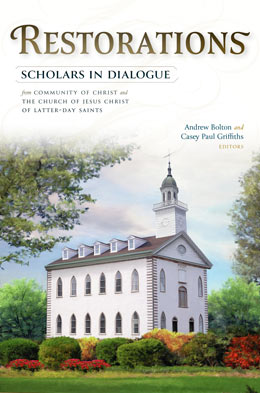
Shared Sacred Space
Scott C. Esplin and Katherine Hill
Scott C. Esplin and Katherine Hill, "Shared Sacred Space," in Restorations: Scholars in Dialogue from Community of Christ and the Church of Jesus Christ of Latter-Day Saints, ed. Andrew Bolton and Casey Paul Griffiths (Provo, UT: Religious Studies Center, Brigham Young University; Salt Lake City: Deseret Book), 175‒92.
Scott C. Esplin is a professor of church history and doctrine and dean of Religious Education at Brigham Young University.
Katherine Hill is a member of Community of Christ and a professional historian who currently lives in Iceland.
Many chapters in this volume focus on doctrinal beliefs of The Church of Jesus Christ of Latter-day Saints and Community of Christ. While the two faiths have much in common theologically, it may be their history that most unites them. In their respective beginnings, they share a common heritage. Stories about individuals including Joseph and Emma Smith or locations like Kirtland and Nauvoo are familiar to members of both faiths. Furthermore, after the two churches took their divergent paths in the mid-1800s, their histories continued to intersect, as did their mutual interest in specific sacred spaces. Because of the overlap, however, the study, interpretation, and celebration of their common history has also significantly divided the faiths. Among the most frequent points of contact, and occasionally conflict, have been their sacred spaces and historic sites. The history of competing and sharing the sacred space of the Restoration may reveal as much about both faiths as does a study of their theological tenets.
Sacred Space in The Church of Jesus Christ of Latter-day Saints
Scott C. Esplin
History and, by association, historical sites and sacred space are inseparable from the teachings and beliefs of The Church of Jesus Christ of Latter-day Saints because its truth claims are rooted in a belief in divine historical episodes. These generally center around the founding events of the church, including the theophany of Joseph Smith and his translation of the Book of Mormon. Professor Sara M. Patterson concludes that for Latter-day Saints, “place, material objects, and theological claims . . . [are] inextricably tied to one another.”[1]
With this reliance upon history, The Church of Jesus Christ of Latter-day Saints seeks to leverage the advantage of being able to trace its story to identifiable, verifiable, and often surviving sacred spaces. However, with the exception of its temples, it does not generally ascribe salvific significance to worshipping in revered sacred space. Elder Bruce R. McConkie once emphatically wrote, “Neither shrines nor pilgrimages are a part of true worship as practiced by the true saints. . . . There is no thought that some special virtue will attach to worship by performing it at [historic sites].”[2] Instead, church leaders emphasize that its temples, meetinghouses, and homes are sacred sites, sanctified by the Spirit of the Lord that can dwell therein.[3] A Bible Dictionary entry for the church concludes, “A temple is literally a house of the Lord . . . . It is the most holy of any place of worship on the earth. Only the home can compare with the temple in sacredness.”[4]
As indicated by these sources, temples occupy prime sacred space within Latter-day Saint theology and practice. This was true historically as well as in present practice. Joseph Smith taught, “What was the object of Gathering . . . the people of God in any age of the world[?] The main object was to build unto the Lord an house whereby he Could reveal unto his people the ordinances of his house and glories of his kingdom & teach the people the ways of salvation.”[5] Early members sacrificed to build the Kirtland and Nauvoo Temples in the 1830s and 1840s, and the Church of Jesus Christ continues to emphasize temple building to the present. Relocating to Utah, Latter-day Saints labored to construct three additional temples in the nineteenth century (St. George, Logan, and Manti). Over the past fifty years, the pace of temple construction has increased dramatically. At present, the church operates more than 160 temples, with as many as 80 others announced or under construction. Worthy members visit these structures as frequently as personal circumstances allow, receiving instruction and making sacred covenants, including being married for eternity. They also perform proxy ordinances such as baptisms for the dead and marriage sealings for deceased ancestors. The work performed in these sacred spaces, in the words of President Boyd K. Packer, are “the ultimate end of all we do in the Church,” which “is to see that parents and children are happy at home and sealed together in the temple.”[6]
In addition to its temples, the church also formally supports more than two dozen historic sites that its members, in informal ways, visit in droves, treating them as sacred spaces. These include sites in Palmyra, New York; Kirtland and Hiram, Ohio; Far West and Liberty, Missouri; and Nauvoo and Carthage, Illinois. Jennifer Lund, director of the Historic Sites division of the church, concludes, “For many people, these sites are sacred, evoking a sense of awe, reverence, and personal connection.”[7] Because the operating temples of the church are only open to active members, they have limited impact on interfaith relations like those with members of Community of Christ.[8] At historic sites that host member and visitor alike, there is more frequent interaction because of the shared history between the faiths.
Rival Interpretations at Historic Sites
The story of how the Church of Jesus Christ acquired and developed its public sacred sites and the interactions with Community of Christ that occurred as a result mirrors their relationship, alternating between contentious and cooperative. Throughout the twentieth century, The Church of Jesus Christ of Latter-day Saints slowly returned to the sites that were once central to it. In 1903, it purchased the Carthage Jail, the first historic structure acquired from the earlier Joseph Smith era of its history.[9] Through intermediaries and eventually as a church itself, the organization steadily secured additional historical sites including the birthplace of Joseph Smith Jr. in Vermont (1905), the Smith family farm (1907) and Hill Cumorah (1923–28) in western New York, the John and Elsa Johnson Home (1956) and Newel K. Whitney Store (1965) in Ohio, a portion of the Independence temple lot (1904), the Far West temple site (1909), Liberty Jail (1939), and the property of Adam-ondi-Ahman (1944) in Missouri, and the temple lot (1937–1962) as well as homes and buildings in Nauvoo (1930s–80s).[10] In many of these locations, missionaries were eventually stationed, tasked with recounting and interpreting history to visitors.
The church’s emergence from what Kathleen Flake called its “mountain barrier” to “claim a place in America at large” placed it in direct interaction and competition with the Reorganized Church of Jesus Christ of Latter Day Saints, who had long maintained a religious presence in several of these locations.[11] Chief among them were Kirtland, where Community of Christ conducted tours and worshipped in the House of the Lord, and Nauvoo, where they guided visitors through the Smith home, mansion house, and family cemetery. Community of Christ reaction was swift to the return of the sister faith to these communities. The impact of the stream of visitors from both faiths was reflected by one Reorganized Church guide, “They desire to know what we teach and the main difference between us and the Utah church. We also have many visitors from the Utah people and we treat them kindly, and hope someday they will see the error of their ways and return to the true church.”[12]
Beginning in the 1960s, the Church of Jesus Christ began robustly expanding the visitor experience at its sites. Commencing in Nauvoo, church leadership outlined a program of site acquisition and development that would “perpetuate in history the part played by the Mormon Pioneers in the building of the West.”[13] Over time, the vision of telling the Latter-day Saint story to interested visitors expanded beyond recounting participation in western settlement to encompass sites across the United States and include faith building and proselytizing goals as well. J. LeRoy Kimball, visionary founder of restored Nauvoo, summarized, “You are still telling the story in terms of history, but at the same time you are satisfying the desire of the brethren to preach the Gospel.”[14]
Property acquisitions and expanded interpretive offerings, especially in Nauvoo, did not go unnoticed. Kenneth E. Stobaugh, Community of Christ historical director, recalled that an aim in these years as a guide was “to spoil some Mormons’ vacation,” something he noted, “unfortunately . . . was not a one-way street,” as “similar episodes were taking place in the LDS section of Nauvoo as well.”[15] Indeed, as an example, Latter-day Saint director of Nauvoo projects counseled, “I think it is very important that we emphasize the Prophet’s prediction that the saints would go to the Rocky Mountains in view of the fact that the Reorganites make the claim that he did not. This pins the label of authenticity upon the Utah Church.”[16] Interpretive tension like this, followed by competitive construction programs, consumed Kirtland and Nauvoo as the two faiths sought to outbuild each other in rival restoration programs.
Sharing a Story
Competitive historic site interpretation dominated rival sites for decades throughout the twentieth century. However, eventually, “the apologetic curtain that divided” them came down. As Stobaugh described it, “Now . . . both LDS and RLDS churches are more kindly toward each other and strive to present historical information that is as accurate as possible.”[17] Ironically, much of this came because of the sacred spaces and shared history that had sometimes divided the two faiths.
The détente developed, in part, through friendships established between scholars in historical associations like the Mormon History Association and John Whitmer Historical Association and, later, through the sharing of documents by scholars and church leaders.[18] Richard Howard, historian emeritus for Community of Christ described coming to the realization “how useful it would be if scholars from Utah did not have to travel . . . to Mecca Midwest [Independence, Missouri] to do their research in our scriptural and historical sources, and scholars from here did not have to travel clear out to Mecca West [Salt Lake City, Utah] to study important sources on early Mormon history.”[19] The faiths also began partnering at the overlapping historic sites themselves. In Nauvoo, for example, property transactions created clearer delineations between the property boundaries.[20] Later, family members from both faith traditions cooperated to beautify the Smith family cemetery, eventually forming the Joseph Smith Sr. and Lucy Mack Smith Family Foundation. At the dedication of the cemetery in 1991, Community of Christ president Wallace B. Smith (great-grandson of Joseph Smith Jr.) and Latter-day Saint apostle Elder M. Russell Ballard (great-great-grandson of Hyrum Smith) participated.[21] Two years later, Community of Christ leadership generously allowed Latter-day Saint leaders to hold a worship service in the Kirtland Temple, an example of the shared use of sacred space that continues to the present.[22]
In Nauvoo, the cooperation evident at historic sites was on public display in 2002 when The Church of Jesus Christ of Latter-day Saints dedicated the reconstructed Nauvoo Temple. At a wreath-laying ceremony in the Smith family cemetery, church presidents from both faiths met for the first time in more than a decade. “We are together on this day because we share an important slice of history,” Community of Christ president Grant McMurray remarked. “We share a foundation in our respective faith journeys.”[23]
Sacred Space in Community of Christ
Katherine Hill
Within the Community of Christ there are many sacred spaces, but places are made sacred not by where they are but by the presence of people seeking the sacred. As prophet-president Stephen M. Veazey put it in a 2018 challenge to the church, “Sacred community can be relatively uncomplicated and take place in many settings. It can happen in small groups, congregational groups, and online connections with occasional gatherings. It can happen in homes, storefronts, church buildings, and offices. It can occur at parks, on hiking trails, around dinner tables, in the Temple, and any combination of these.”[24] With this in mind, this section will focus on Community of Christ reunion grounds and the Temple in Independence, Missouri.
Reunions
Reunions in Community of Christ are family camps that typically occur for a week in the summer. All ages are welcome and each day church services are held in addition to Sunday school–style classes. Reunions also feature many recreational activities, including campfires where participants sing both secular and sacred songs. Although this is the general model of a reunion, there are many reunions that do not fit this description precisely. Reunions can happen any time of year and for any number of days at locations ranging from campgrounds to event centers. The defining hallmarks of a reunion are the sense of community and the intergenerational nature of these events.
Before 1883, Community of Christ had one church conference each year in either Kirtland, Ohio, or Plano, Illinois, and a second in southwestern Iowa. Church leaders recognized that this was leading to a disconnect in the church as part of the church went to one conference and the other part went to the other. Charles Derry proposed having a reunion in the western region in place of the second conference. This first official reunion took place in the fall of 1883. Reunions were so popular the events immediately spread to other locations.[25]
The first reunions were primarily preaching focused, but over time Sunday school–type classes were incorporated and more and more recreation elements were added. In 1959 the church began putting out thematic and class materials that reunions all over the world could use each year. Reunions were not (and are not) required to use these materials, but the majority of reunions rely on these materials as a basis for camp planning. [26] As with most activities within Community of Christ, each area has its own method or flavor for activities, but a church member could attend a reunion in any part of the world and find familiar elements.
Today Community of Christ owns approximately three dozen campgrounds in the US and about a dozen internationally.[27] The campgrounds are used not only for Reunions, but also for youth camps in addition to being rented out for other events. Reunion grounds and reunion events (wherever they take place) are sacred events, and the places become sacred from the community experiences. Some people are so connected to the reunion grounds and the sacredness of the place that they further sanctify the grounds by being married there. In fact, any of the sacraments can be practiced at a reunion or camp.
The Temple
On April 1, 1968, President W. Wallace Smith (grandson of Joseph Smith Jr.) presented a new revelation to Community of Christ. The revelation concluded with directions for the church to start work on a temple: “The time has come for a start to be made toward building my temple in the Center Place. It shall stand on a portion of the plot of ground set apart for this purpose many years ago by my servant Joseph Smith, Jr. The shape and character of the building is to conform to ministries which will be carried out within its walls. These functions I will reveal through my servant the prophet and his counselors from time to time, as need for more specific direction arises” (CofChrist Doctrine and Covenants 149:6a).
The exact purposes of the temple were revealed when W. Wallace’s son Wallace B. Smith was president of the church. On April 3, 1984, President Wallace B. Smith presented section 156 to the church. A portion of this revelation reads:
The temple shall be dedicated to the pursuit of peace. It shall be for reconciliation and for healing of the spirit. It shall also be for a strengthening of faith and preparation for witness. By its ministries an attitude of wholeness of body, mind, and spirit as a desirable end toward which to strive will be fostered. It shall be the means for providing leadership education for priesthood and member. And it shall be a place in which the essential meaning of the Restoration as healing and redeeming agent is given new life and understanding, inspired by the life and witness of the Redeemer of the world. (CofChrist Doctrine and Covenants: 156:5a–e)[28]
The pursuit of peace is practiced in the Temple through events such as the Community of Christ International Peace Award, given annually from 1993 to 2019, and the Community of Christ Peace Colloquy.[29] Each day in the sanctuary, a prayer for peace is offered for a particular country. These prayers are written and submitted by people from all over the world.
The artwork of the temple exemplifies peace. For example, outside on the temple grounds stands a statue representing Isaiah 2:4: “They shall beat their swords into plowshares and their spears into pruning hooks.” In the atrium hang mobiles of paper cranes, and the door handles of the building have peace doves in flight.
The groundbreaking for the Community of Christ Temple was on April 6, 1990, and in April 1994 the dedication services were held. The Temple holds the world church administrative offices and the official archives for the church. The Temple is across the street from the Auditorium, and the two buildings are connected by an underground tunnel that allows the buildings to work in conjunction for hosting large gatherings like the World Conferences, which are held every three years. World Conferences are cherished events that allow people from all over the world to come together and share in community. Old friends across the globe reconnect, and many new national and international bonds of community form. Yes, World Conferences include business meetings, but the true spiritual power is in the sacred space that the Temple and Auditorium become through the gathered community.
The Temple is open for anyone who wants to visit. Any person can walk in and go on a tour of the building, request administration for the sick, or participate in a worship service (including participating in the sacrament of the Lord’s Supper). Regardless of religious views or beliefs, all are welcome.
The sacraments of baptism, confirmation, blessing of children, and marriage are not practiced in either of the Community of Christ temples. Neither the Temple in Independence, Missouri, nor the Kirtland Temple have a baptismal font. Although only half of the sacraments are practiced in the two temples of the church, all eight sacraments are regularly practiced in local congregations and at reunions.[30]
Temple Sanctuary
There are two ways to enter the sanctuary in the Community of Christ Temple. There are grand doors that lead directly into the sanctuary up above the atrium, but these are rarely used by people entering for worship. The primary way to enter the sanctuary is to take the Worshiper’s Path. This path provides a deep meditative experience and prepares all (no matter how many times they have traveled it before) to be ready for worship. The first phase of the Worshiper’s Path is to enter through the sacred grove doorway of etched glass, which represents both the literal sacred grove that Joseph Smith Jr. entered and the metaphorical sacred grove of all seeking God. Directly through the doorway hangs a tapestry of the burning bush Moses encountered. Next is a depiction of the return of the prodigal son, with the father figure stretching out his arms to welcome his child back. Then the worshiper has a truly humbling experience of seeing the cross and then stepping through its shadow. Next is a sculpture, designed by a Muslim artist, of the tree of life. Continuing on the path leads to the ikebana flower arrangement. Ikebana is a Japanese flower arrangement style with Buddhist influences.[31] The ikebana arrangements represent “heaven, humanity, and earth.”[32] Several florists have been specially trained to provide fresh ikebana arrangements. The “dark night of the soul” statues come next. These statues represent a person in states of despair, then turning to God. The first figure is huddled on the ground, the second on his knees clutching his chest, and the third is raising his arms in a worshipful manner. The final stop on the Worshiper’s Path is a shallow waterfall fountain with the words from John 4:14: “Whoever drinks of the water I give . . . will never thirst.”[33]
Like reading a scripture again, each journey on the Worshiper’s Path is unique. Perhaps a traveler needs reminded to drink of the living water of Christ, or maybe they feel they are the prodigal child. Regardless of the journey that has brought them there, every traveler goes from the dimly lit and meditative Worshiper’s Path into the bright light of the sanctuary. The sanctuary is the very center of the nautilus shape of the Temple.
Worshipers can exit the sanctuary through the peace doors embossed with the church peace seal onto the World Plaza—a map of the world created in bricks. Exiting onto the plaza metaphorically and literally has a person going outward into the world from their inner sacred journey.
The sacred space of the Temple pushes and encourages the people of Community of Christ as described in Doctrine and Covenants section 161: “Become a people of the Temple—those who see violence but proclaim peace, who feel conflict yet extend the hand of reconciliation, who encounter broken spirits and find pathways for healing. Fulfill the purposes of the Temple by making its ministries manifest in your hearts. It was built from your sacrifices and searching over many generations. Let it stand as a towering symbol of a people who knew injustice and strife on the frontier and who now seek the peace of Jesus Christ throughout the world” (CofChrist Doctrine and Covenants 161:2a–b).
John G. VanDerWalker II, Inland Northwest Mission Center president, explained how in Community of Christ “spaces become sacred through experiences that shape our lives and guide our actions. Historic buildings and places are treasured, congregational buildings are carefully cared for and maintained, and campgrounds are celebrated as holy ground.”[34] Community of Christ has physical spaces that are considered sacred, but what truly makes a space sacred in Community of Christ is the experiences and community that are cultivated there.
Response to Katherine Hill
As another of the many things that we share, The Church of Jesus Christ of Latter-day Saints and Community of Christ embrace similar views regarding sacred space. In her analysis, Katherine Hill emphasizes that within Community of Christ, space is sacralized by the people who occupy it and the experiences they create therein. True to their name, community development and seeking Christ are central to their view of place.
Latter-day Saints likewise highlight that space becomes sacred because of holy people and holy experiences. Elder Dennis B. Neuenschwander, a former member of the Presidency of the Seventy, taught, “Holy places have always been essential to the proper worship of God. For Latter-day Saints, such holy places include venues of historic significance, our homes, sacrament meetings, and temples. . . . The faith and reverence associated with them and the respect we have for what transpires or has transpired in them make them holy. The importance of holy places and sacred space in our worship can hardly be overestimated.”[35]
Community of Christ places special emphasis on reunion grounds and reunion experiences. With the exception of youth camps, there is not a direct analog to reunions for Latter-day Saints. However, because reunions are “intergenerational,” as Hill describes, Latter-day Saint historic sites may serve a comparative purpose. Church groups and families often visit these locations, seeking the “sense of community,” spiritual uplift, and retrenchment evident in the reunion model. Parents and youth leaders take their children to the locations of earlier sacred experiences, hoping they will foster them anew in the rising generation. Elder Neuenschwander continues, “For Latter-day Saints, such holy places include venues of historic significance, our homes, sacrament meetings, and temples. . . . In holy places and in sacred space we find spiritual refuge, renewal, hope, and peace.”[36] Furthermore, it is in these historic sites, especially in the temple cities of Kirtland and Nauvoo, where the two faiths most interact in sacred space.
The most obvious sacred space comparison between the two faiths is in the place of the temple within the respective theologies. While both operate temples, including placing them at the center of the respective church headquarters, they differ significantly in operation and theological significance. As Hill notes, Community of Christ operates two temples, both of which are open to public tours and participation in worship services. Sacraments like baptism, confirmation, and marriage, however, do not occur therein. This differs dramatically for Latter-day Saints, who limit access to their more than one hundred temples worldwide. Additionally, ordinances for both the living and the dead occur therein, with the theological import that entrance into the highest level of the celestial kingdom is conditioned on one of those ordinances (marriage) occurring in a house of the Lord (see LDS Doctrine and Covenants 124:39; 131:1–4).
Response to Scott C. Esplin
It is easy to see that temples are understood very differently theologically and practically in the two traditions. Community of Christ’s temples are not necessary for salvation, and the church has no plans to build any more. The Temple, for Community of Christ, is a center place for gathering, connecting, and going out into the world to promote Christ’s mission—the pursuit of peace, reconciliation, and healing of the spirit.
Scott Esplin highlighted historic sites as sacred space for the Church of Jesus Christ. This is an area where he noted that the two churches share much in common, but I would like to note some differences as well. The two churches have corporately solved many of their old disputes and now can work together peacefully, but it is worth mentioning that all tension has not come to an end on the individual level. Some of the disputes encountered at historical sites between members of the two churches are the result of Latter-day Saint individuals being upset that their church does not own, for instance, the Kirtland Temple. Other conflicts are from disagreements over how sites should be interpreted.
Before diving into the different viewpoints on interpretation of the sites, it is worth explaining staffing. The sites belonging to the Church of Jesus Christ are staffed by senior missionaries (usually retired couples serving six to eighteen months) and young missionaries (completing their eighteen- to twenty-four-month mission). Community of Christ sites are staffed by a few paid staff, but mostly retired volunteers, local volunteers, and, in the summer, a group of college-aged summer interns who receive a stipend and college credit. All staff at Latter-day Saint sites are Latter-day Saints and are missionaries, whereas the Community of Christ staff are not missionaries and are not necessarily members.
The Community of Christ interpretation in Nauvoo and Kirtland is historically focused. Guides are trained only to make statements for which they have a verifiable source and to honestly say, “I don’t know,” if they do not know the answer to a guest’s question. Latter-day Saint sites use historical interpretation, but there is a missionary or faith-promoting message as well. Community of Christ guides might answer religious questions, but they do not bear testimony or directly promote a theological view. This difference in interpretation at times causes conflict. Latter-day Saint guests are at times confused by the lack of testimony in a Community of Christ site. Community of Christ guides are not out to ruin Latter-day Saint vacations, but many families leave having been confronted with the knowledge that what they thought was a fact was, in fact, folklore. As examples, Emma Smith did not regret staying in Nauvoo, and the Kirtland Temple plaster was made with already broken dishes, not ladies’ finest china.
Conclusion
A historical and doctrinal thread regarding sacred space connects The Church of Jesus Christ of Latter-day Saints and Community of Christ. This thread includes the prominence of temples within faith practices, albeit with differences in access and function. Both utilize sacred spaces, including temples, recreation grounds, and historic sites, to build faith and foster community. Because of their mutual interest in several of the same historically sacred spaces, they interact in direct ways through site visits and a common desire to preserve, understand, and celebrate reminders of their past.
As with any relationship, the interactions at sacred spaces between the Church of Jesus Christ and Community of Christ are in constant need of being nourished. “Even though that relationship has significantly improved in recent years,” one scholar of the faiths has noted, “unfounded rumors and hearsay still fuel misconceptions and hinder understanding between members of the two organizations.”[37] Furthermore, from a practical standpoint, the turnover in site interpreters necessitates consistently forming new connections. David J. Howlett, a longtime student of the interactions between the faiths, rightly describes “a far more complicated story than a narrative of rivals becoming friends at Kirtland—a popular notion upheld by contemporary LDS and Community of Christ. Instead,” Howlett continues, “the . . . changing proximities reveal ever-changing forms of contestation and new avenues of cooperation.” The same may be said of the interactions and perspectives regarding historic sites among the faiths generally. While “deep differences persist,” these historic sites are “contact zone[s] for trans denominational cooperation.”[38]
Notes
[1] Sara M. Patterson, Pioneers in the Attic: Place and Memory along the Mormon Trail (New York City: Oxford University Press, 2020), xvi.
[2] Bruce R. McConkie, Mormon Doctrine, 2nd ed. (Salt Lake City: Bookcraft, 1966), 574.
[3] Gary E. Stevenson, “Sacred Homes, Sacred Temples,” Ensign, May 2009, 101–3.
[4] “Temple,” Bible Dictionary (Salt Lake City: The Church of Jesus Christ of Latter-day Saints, 2013).
[5] Joseph Smith, cited in Wilford Woodruff Journal, ed. Scott G. Kenney (Midvale, UT: Signature Books, 1983), 2: 240 (June 11, 1843).
[6] Boyd K. Packer, cited in “‘Gathering Spirit’ Still Continues,” Deseret News, July 8, 2006.
[7] Jennifer Lund, “Why Historic Sites?,” February 1, 2020, https://
[8] To be consistent with the rest of the volume, the authors use the current name of the church, Community of Christ, rather than Reorganized Church of Jesus Christ of Latter day Saints, even when referring to events or activities conducted prior to the 2001 name change.
[9] Scott C. Esplin, “Dark Tourism: Healing at Historic Carthage Jail,” Journal of Mormon History 46, no. 1 (January 2020): 85–116.
[10] Jennifer L. Lund, “Joseph F. Smith and the Origins of the Church Historic Sites Program,” in Joseph F. Smith: Reflections on the Man and His Times, ed. Craig K. Manscill, Brian D. Reeves, Guy L. Dorius, and J. B. Haws (Provo, UT: Religious Studies Center; Salt Lake City: Deseret Book, 2013), 345; Cameron J. Packer, “A Study of the Hill Cumorah: A Significant Latter-day Saint Landmark in Western New York” (master’s thesis, Brigham Young University, 2002); Lisle G. Brown, “Nauvoo’s Temple Square,” Brigham Young University Studies 41, no. 4 (2002): 5–45; Kenneth R. Mays, “A Man of Vision and Determination: A Photographic Essay and Tribute to Wilford C. Wood,” Mormon Historical Studies 10, no. 1 (Spring 2009): 154–73; Scott C. Esplin, Return to the City of Joseph: Modern Mormonism’s Contest for the Soul of Nauvoo (Urbana, IL: University of Illinois Press, 2018).
[11] Kathleen Flake, “Re-placing Memory: Latter-day Saint Use of Historical Monuments and Narrative in the Early Twentieth Century,” Religion and American Culture: A Journal of Interpretation 13, no. 1 (Winter 2003): 80.
[12] P. R. Burton, “Old Nauvoo,” Zion’s Ensign 32, no. 45 (November 4, 1920): 795.
[13] “LDS Church Forms Corporation to Restore Historic Nauvoo,” Deseret News Telegram, June 28, 1962, in Journal History of the Church, June 28, 1962, 4, Church History Library, Salt Lake City.
[14] J. LeRoy Kimball to missionary couple, circa 1971, Nauvoo Restoration, Incorporated historical files, Nauvoo, IL.
[15] Kenneth E. Stobaugh, “The Development of the Joseph Smith Historic Center in Nauvoo,” BYU Studies Quarterly 32, nos. 1–2 (1992): 38; Kenneth E. Stobaugh. “Getting a Foothold Again: The Development of the Joseph Smith Historic Center in Nauvoo,” UP S6100.1, Community of Christ Archives, Independence, MO.
[16] J. LeRoy Kimball to missionary couple, circa 1971, Nauvoo Restoration, Incorporated historical files, Nauvoo, IL.
[17] Stobaugh, “Development of the Joseph Smith Historic Center,” 38–39.
[18] William D. Russell, “The LDS Church and Community of Christ: Clearer Differences, Closer Friends,” Dialogue 36, no. 4 (Winter 2003): 185.
[19] Richard P. Howard, “The Beginning of the Sharing of Historical Sources between the LDS and the RLDS Churches, November 20, 1974,” John Whitmer Historical Association Journal 36, no. 1 (Spring/
[20] Esplin, Return to the City of Joseph, 116–17.
[21] Lachlan Mackay, “A Brief History of the Smith Family Nauvoo Cemetery,” Mormon Historical Studies 3, no. 2 (Fall 2002): 245.
[22] David J. Howlett, Kirtland Temple: The Biography of a Shared Mormon Sacred Space (Urbana, IL: University of Illinois Press, 2014), 199–204.
[23] Stephen A. Martin, “Church Leaders Make Rare Joint Appearance,” Burlington Hawk Eye, June 28, 2002.
[24] Steve Veazey, “President’s Challenge: “Hope Rising,” Saints’ Herald, May/
[25] Richard P. Howard, “Reunions: Part of our Common Story,” Saints’ Herald, February 1973, 16.
[26] Howard, “Reunions,” 16–18.
[27] “Campgrounds,” Community of Christ, https://
[28] Section 156 is famous in RLDS and Community of Christ circles for opening priesthood to women.
[29] “International Peace Award,” Community of Christ, https://
[30] The eight sacraments in Community of Christ are marriage, baptism, confirmation, Communion, evangelist blessing, laying on of hands for the sick, blessing of children, and ordination.
[31] Community of Christ: A People on the Move, directed by Elray Henriksen (2019), https://
[32] Community of Christ, The Worshiper’s Path (pamphlet).
[33] Community of Christ: A People on the Move.
[34] John G. VanDerWalker II, “Holy Spaces” (guiding document for Samish Island Board of Directors, Samish Island, WA, [2010s?]), 1.
[35] Dennis B. Neuenschwander, “Holy Place, Sacred Space,” Ensign, May 2003, 71.
[36] Neuenschwander, Ensign, May 2003, 71–72.
[37] Richard G. Moore, “LDS Misconceptions about the Community of Christ,” Mormon Historical Studies 15, no. 1 (2014): 18.
[38] Howlett, Kirtland Temple, 213, 216–17.
