
 menu icon in the top, right corner of the screen.
 icon above to close this box.
 icon at the bottom of the screen below the browser—if you don't see it, swipe up to unhide it.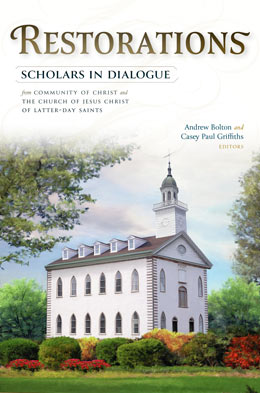
Scripture
Kat Goheen and Joshua M. Sears
Kat Goheen and Joshua Sears, "Scripture," in Restorations: Scholars in Dialogue from Community of Christ and the Church of Jesus Christ of Latter-Day Saints, ed. Andrew Bolton and Casey Paul Griffiths (Provo, UT: Religious Studies Center, Brigham Young University; Salt Lake City: Deseret Book), 33‒50.
Kat Goheen, ThM, is an academic, a minister, a mother, a musician, and a spiritual director serving in Vancouver, British Columbia, Canada, in Community of Christ.
Joshua Sears, PhD, is an assistant professor of ancient scripture at Brigham Young University.
Scripture in Community of Christ
Kat Goheen
Scripture evokes so much for me, yet never did I imagine as a young person that I would pursue being a biblical scholar. I remember memorizing verses of the Bible as a young girl and learning the chronology of the events in I and II Nephi by heart in our Community of Christ church basement in summer Sunday School. Moving from Missouri to Vancouver, British Columbia, Canada, as a young adult was a culture shock in more ways than one. Perhaps it was the flexibility with which my new community held scripture that pulled me to seminary to study the Hebrew Bible and New Testament.
Scripture is essential to the life of Community of Christ. It is our witness of Jesus Christ, the basis of our worship services, and the way we understand our identity and mission in the world. Our scripture statement explains our relationship with scripture:
With other Christians, we affirm the Bible as the foundational scripture for the church. In addition, Community of Christ uses the Book of Mormon and the Doctrine and Covenants as scripture. We do not use these sacred writings to replace the witness of the Bible or improve upon it, but because they confirm its message that Jesus Christ is the Living Word of God.[1]
The foundational book of scripture in Community of Christ is the Bible. While there are different translations favoured in different areas, the most common is the New Revised Standard Version because of its excellent scholarship and the interpretive principle of inclusion that guides its work. Jesus Christ is the lens for all our interpretation because Jesus is our Good News, so the Bible is our primary witness. Scripture guides our discernment as it did for Joseph Smith Jr., who took James 1:5 seriously when it counseled him to ask God for wisdom.
The beauty of worshipping in a noncreedal church is diversity, and I suppose if you visited with five Community of Christ members about their relationship with scripture, then you would receive five different flavours of response! There is no better example of this than the Book of Mormon. While it is an official book of scripture in Community of Christ, for many of us it is silent because of issues around its provenance and content and because in some areas it precludes us from joining ecumenical organizations. For others, it is beloved. Some hold the Book of Mormon as a record of ancient peoples who traveled to North America, while some believe it is a product of the nineteenth century.[2] The fact that there is room at the table for all who hold these beliefs is testament to our Enduring Principle of Unity in Diversity.[3]
 Courtesy of Jeff Piedimonte.
The Doctrine and Covenants shows us God’s interaction with our movement from 1830 to the present. We added Section 114 to the Doctrine and Covenants in 1861 and have continued to receive direction from God through to our adoption of Section 165 in 2016, which counsels us, “Beloved Community of Christ, do not just speak and sing of Zion. Live, love, and share as Zion: those who strive to be visibly one in Christ.” The Doctrine and Covenants helps us shape our sacramental life, understand our history, and imagine our future through poetic prophecy.
There are golden threads that run through our relationship with scripture. These six lenses describe how we discern and interpret textual meanings for today. Community of Christ President Stephen Veazey explains this model: “This model guides exploration of God’s will based on the Wesleyan Quadrilateral with additional elements drawn from the Community of Christ expression of the Restoration Movement.”[4]
We use all of these lenses to interpret and receive scripture. For example, Doctrine and Covenants 163:7 teaches us, “Scripture is an indispensable witness to the Eternal Source of light and truth, which cannot be fully contained in any finite vessel or language.” It continues: “Scripture is not to be worshiped or idolized. Only God, the Eternal One of whom scripture testifies, is worthy of worship.” This passage saves us from a literalism that would trap us in false dualisms such as “true or false” and “faithful or unfaithful.”
Reason is also a firm basis of our relationship with scripture. If all our vessels are limited in containing and describing the holy, then we are called on to use our intellect to discern the wisdom and instruction contained therein. Community of Christ has a tradition of informal educational opportunities through Temple School and various seminar offerings, and it now has a seminary through Graceland University focused on stimulating the faith and reasoning of all who study there.[5] Most exciting, many different tools are encouraged for understanding scripture, from historical criticism to theologies of liberation. God is truth and so is not threatened by vigorous inquiry. In the same way, we believe that our relationship with scripture is not harmed by inquiry but is enhanced. All scripture is translation—between languages or from experience into words—so we bring our best selves to this work of translation.
Tradition is a lens that holds us in our relationship with scripture, from the writings of the ancient church fathers all the way through the long development of Christian theology and to the Restoration testimonies of Joseph Smith Jr. and the faithful who started this movement. All those seekers and settlers who lived into the truth of those initial sparks of brilliance have brought us where we are today. Our tradition includes the wisdom of the larger ecumenical church. Our use of the Revised Common Lectionary in our worship services, along with the Christian year that includes Advent and Lent, shows our participation in this larger experience of tradition. Our spirit of the Restoration follows the currents of aliveness of the Holy Spirit wherever they lead, so tradition serves as both a balancing and destabilizing agent in our work of interacting with scripture.
Experience touches our relationship with scripture as well. Our spiritual practice of lectio divina, practiced in many parts of Community of Christ, takes us into the world of scripture.[6] We are Bartimaeus, standing by the road, feeling sight return to our eyes (see Mark 10:46–52). We become the woman reaching for the hem of Jesus’s robe, feeling our faith bloom into heath in our bodies (see Mark 5:25–34). We read the prayers of Enos in the Book of Mormon and remember our own history of intercessory prayer. The stories of scripture serve the function of testimonies at prayer meetings, edifying each of us with examples of courage and obedience. And sometimes serving as cautionary tales! We engage with scripture with the senses of our own bodies and feel God’s redeeming work in our discipleship.
Experience also helps us navigate the many challenges of responsibly interpreting scripture. Since we accept that scripture is not infallible, when we encounter passages that give us pause, we look to our experience and ask, “Does this portrayal of God fit with what I have experienced in my life, or is it more a product of a specific time and place?” We look inward and outward in our journey with scripture.
Experience with scripture is related to our experience with hymns. We sing many of our scriptures in our hymn texts, and our hymnal is often revered as a fourth book of scripture, since it has a similar level of influence in our discipleship. Our hymns help us focus our interpretive lenses (such as the song “We Limit Not the Truth of God”); they remind us that we worship God in many different languages and cultures (“Kanisa Litajengwa”); and they sing us into new understandings of scripture and mission: “For Everyone Born, a Place at the Table.”[7] Our hymns offer us a meditative and challenging engagement with our core beliefs, along with the entrainment of sharing the gospel message with our beloved brothers and sisters in real time, in full harmonies.
An important lens for us is that of continuing revelation. There are times when God calls us to live into new understandings of the gospel through revelations we receive in our Doctrine and Covenants. These new interpretive principles call us to change our hearts and our behaviours. For example, Doctrine and Covenants 163:7c proclaims: “It is not pleasing to God when any passage of scripture is used to diminish or oppress races, genders, or classes of human beings.” This passage becomes a new lens to use in reading about women in some New Testament letters, about race in I and II Nephi, and about the emergence of the Israelite people in Canaan. It prevents us from reacting against perceived differences and challenges us to question our implicit biases and complicity in structures of oppression in the world.
A final lens is that of common consent. We live in the beautiful tension of a hierarchical church structure that simultaneously values the voice of each member: a theocratic democracy. There is a dynamic interaction and dialogue when we encounter new revelation that calls forth the best interpretation of each person. Common consent has been described as “open consideration of issues, in a spirit of worship, during which all opinions may be voiced.”[8] This lens reminds us of the prayerful attention given to receiving our modern revelations, which is so similar to the careful reception over time of the tradition that transmits the Bible to us. It is a caution against individualistic Christianity or atomistic interpretations that break down the body of Christ. We have been drawn together, and we are in it together: the good, the bad, and the interesting.
Scripture tells us who we are in Community of Christ. It shows us where we have been and where we might dream to go. It awakens our best selves and draws us into community with all those who also work for the good. It brings us into relationship with the One who loves and gives so freely and teaches us how to follow the leadings of the Holy Spirit, always with our hearts focused on Jesus Christ. We give thanks for the richness and complexity of scripture and bring our best selves to journey with it.
Scripture in The Church of Jesus Christ of Latter-day Saints
Joshua Sears
As Joseph Smith experienced his First Vision of the Father and the Son, he “found the testimony of James to be true.” Deciding that a passage from the Bible was “true” was not a particularly surprising interpretation for a believing Christian, but the visit from the heavenly messenger three years later would sow the seeds of a dramatically different use of scripture. First, that messenger “said there was a book deposited written upon gold plates, . . . [and] that the fullness of the everlasting Gospel was contained in it.” New, extrabiblical scripture was coming. Second, the messenger quoted biblical texts, “though with a little variation from the way it reads in our Bibles.” The Bible was not just insufficient, it was subject to revision. Third, the messenger declared that these biblical prophecies were “about to be fulfilled” and were “soon to come in.”[9] Ancient scripture was crashing into the modern world, with urgent and immediate relevance. For Latter-day Saints today, understanding our relationship with scripture requires exploring these seeds and how they have grown, as well as the productive tensions they create.
Joseph Smith’s prophetic career was saturated with the production of scripture and scripture-related texts, including his translation and publication of the Book of Mormon, his new translation of the Bible, his work on the Egyptian papyri, and the publication of numerous revelations in the Doctrine and Covenants. After Joseph’s death in 1844, Brigham Young and other church leaders who immigrated to Utah saw themselves as custodians of Joseph’s scriptural legacy. A new edition of the Doctrine and Covenants in 1876 added twenty-six new sections, one of which contained a Brigham Young revelation, marking the first expansion of the canon beyond Joseph’s work.[10] In 1880 the church canonized the Pearl of Great Price, an anthology of Joseph Smith texts. Among other items, it contained extracts from the Prophet’s new translation of the Bible (covering Genesis 1:1–6:13 and Matthew 23:39–24:51), the texts of the Book of Abraham that had been published during Joseph’s lifetime, extracts from his personal history, and thirteen statements of belief he had penned for a newspaper article.[11]
The twentieth century saw two major periods of canonical development. In a rare example of decanonization, the 1921 edition of the Doctrine and Covenants removed the Kirtland-era Lectures on Faith,[12] while the Pearl of Great Price dropped several short texts. Wilford Woodruff’s 1890 manifesto ending plural marriage, which had appeared as an appendix since 1908, was also definitively added to the Doctrine and Covenants as an “Official Declaration.” The late 1970s saw the canonization of three texts—Joseph Smith’s 1836 vision of the celestial kingdom, Joseph F. Smith’s 1918 vision of the redemption of the dead, and the 1978 announcement that all worthy men could be ordained to the priesthood “without regard for race or color.” In 1979 the church published the first-ever Latter-day Saint edition of the Bible, which paired the traditional King James text with interpretive chapter headings, cross-references to Restoration scripture, explanatory footnotes, and appendices, all of which provided Bible readers with a uniquely Latter-day Saint reading experience.[13] Most significantly, and thanks to the generosity and support of President W. Wallace Smith and other leaders of the Reorganized Church of Jesus Christ of Latter Day Saints, this edition included hundreds of quotations from Joseph Smith’s Bible revision (now dubbed “the Joseph Smith Translation”), bringing that work into serious use by Latter-day Saints for the first time since Joseph’s lifetime.[14]
Scriptural publication in the twenty-first century has thus far focused on helping more people feast upon the testimony of Christ found in the scriptures. Digital versions are freely available online and in apps. Latter-day Saint editions of the Bible have been published in Spanish and Portuguese, with additional foreign languages in development. Apostles constantly encourage a habit of daily scripture study: “The Lord is telling us that our need for constant recourse to the scriptures is greater than in any previous time.”[15]
This history of the Latter-day Saint scriptural canon allows us to now explore various tensions that exist because of it. To say that different principles are in “tension” is not to suggest that something is wrong. Harvard Divinity School professor David Holland argues that, like the individual brushstrokes of a painting, Latter-day Saints’ numerous and often contradictory impulses with regard to revelation actually produce cohesion because of, not in spite of, their differences. Lines and colors that are at odds in isolation produce masterful, even beautiful complexity when one steps back and takes in the whole canvas.[16] I will highlight three such productive tensions that emerge from our approach to scripture.
The first tension is the relative authority of the established, written word of God and the contemporary, charismatic voice of living prophets. Church leaders have varied in their approach to this issue. Brigham Young recalled that after Hyrum Smith preached the sufficiency of the published revelations, a distraught Joseph Smith urged Brigham to stand and speak. “I would not give the ashes of a rye straw for these 3 books [the Bible, the Book of Mormon, and the Doctrine and Covenants] for the salvation of any man,” Brigham had told the assembly, declaring that “if we had not living oracles in our midst we had nothing.”[17] Brigham continued to prioritize the “living oracles” over written scripture throughout his life, although other contemporary leaders, such as Orson Pratt, showed different propensities in this regard.[18] In the twentieth century, Joseph Fielding Smith notably advocated that “it makes no difference what is written or what anyone has said, if what has been said is in conflict with what the Lord has revealed [in the scriptures], . . . then every member of the Church is duty bound to reject it.”[19] In the twenty-first century, church leadership has usually tipped the scales in favor of living apostles. “The scriptures are not the ultimate source of knowledge for Latter-day Saints,” Elder Jeffrey R. Holland declared, stressing the primacy of “living, vibrant, divine revelation” communicated from “the living God.”[20] A 2013 compendium of Joseph Fielding Smith’s teachings left out his views of scripture vis-à-vis prophets,[21] and when the church published a new history in 2018, it tellingly included the story of Brigham’s correction of Hyrum.[22]
A second area of tension is the relative priority that Latter-day Saints place on different books in the scriptural canon. Although the Book of Mormon played an important role in shaping priesthood organization and ordinances in the early church,[23] Joseph Smith overwhelmingly preferred to use and quote from the Bible throughout his life, and this same preference for traditional Christian scripture continued with other church leaders throughout the nineteenth century.[24] Although the Book of Mormon served as an important missionary tool—a sign that God had restored his covenant (see 3 Nephi 21:1–7)—it was relatively neglected by Latter-day Saints as a source for doctrine and inspiration until the second half of the twentieth century.[25] Perhaps the single greatest catalyst for renewed focus on the Book of Mormon was the emphatic attention it received under the leadership of Ezra Taft Benson in the 1980s.[26] Since then, church members have responded to this call from their leaders, such that “in LDS worship services, Sunday Schools, and family devotionals, the Book of Mormon is [now] fully central.”[27] So far has the pendulum swung that some have claimed that “Mormons have developed a kind of amnesia towards the Bible,”[28] with even an apostle counseling that we must do better to “help all people, including our own members, understand the power and importance of the Holy Bible” and calling on members to “balance” their study “in order to love and understand all scripture.”[29] Regardless of what “balance” individual members find in their private devotion, church curriculum remains committed to taking time for each part of the canon, with classes and the family study curriculum rotating through the Old Testament, the New Testament, the Book of Mormon, and the Doctrine and Covenants every four years.
A third tension is the pull of traditional approaches to scripture set against the pull of modern academic interpretations. In recent years, the church has modified its approach on some issues. For example, in light of the fact that no text from the Book of Abraham can be located on any of the surviving Joseph Smith papyri, a church essay from 2014 presented—as two alternative possibilities to explain the text’s origin—both the traditional idea that Joseph translated directly from (now missing) papyri and the newer theory that the papyri simply served as a “catalyst” for revelation.[30] The Joseph Smith Papers Project has demonstrated that, contrary to popular notions of a prophet transcribing God’s voice like a stenographer, Joseph’s revelations often came as a process of inspiration, with corrections and expansions possible as new understanding came.[31] Church-sponsored editions of the Bible in foreign languages have updated archaic language and incorporated non-KJV readings based on the results of textual criticism.[32]
With other issues, however, Latter-day Saint approaches remain rooted in tradition. Despite the proliferation of modern Bible translations and the declining use of the King James Version among English-speaking Christians, the KJV remains the official Bible of English-speaking Latter-day Saints.[33] Church curriculum has striven to update Doctrine and Covenants manuals to align with current scholarship, but manuals on the Old and New Testaments remain conservative in their approach (Moses wrote the Pentateuch, the Flood covered the earth, Paul wrote all the epistles attributed to him, and so forth). The church has remained institutionally committed to the historicity of the Book of Mormon, and relatively few members find theories of nineteenth-century pseudepigrapha to be compatible with their faith.[34]
Notwithstanding the occasional complexity of these tensions, we turn to the scriptures because through them we find God. As a young missionary in southern Chile, I was walking down the street with my companion one day when a woman suddenly burst out of her home sobbing that her father was dead. We joined her in her home, but as I watched her tears and trembling frame I felt completely inadequate to address her unexpected bereavement. Suddenly a thought came into my mind (I identify it as the Holy Spirit) to “read Abinadi’s testimony.” I flipped open my Libro de Mormón and read her these words in Spanish:
If Christ had not come into the world, . . . there could have been no redemption. And if Christ had not risen from the dead, . . . there could have been no resurrection. But there is a resurrection, therefore the grave hath no victory, and the sting of death is swallowed up in Christ. He is the light and the life of the world; yea, a light that is endless, that can never be darkened; yea, and also a life which is endless, that there can be no more death. (Mosiah 16:6–9)
As I read, scripture succeeded where my own efforts fell short. She felt peace; her weeping ceased. We talked at length about God’s plan for his children. As happens to Latter-day Saints across the globe every day, I found that “the word of God is quick, and powerful” (Hebrews 4:12), leading us “to . . . the love of God” (1 Nephi 11:25), because in his word we find “the power of God unto salvation” (Doctrine and Covenants 68:4).
Response to Joshua Sears
It is a deep work to consider together the ways in which Community of Christ and The Church of Jesus Christ of Latter-day Saints live with scripture. What is obvious from a first read is that scripture forms and influences both traditions in an important way, while we have different ways of interacting with our sacred books. There is no easy way to summarize this difference, other than to suggest that Latter-day Saints use scripture often and are quite familiar with it, while Community of Christ members appreciate the critique and encouragement scripture offers us.
We have been offered a candid view of the use of scripture over time among the Latter-day Saints. The movement from their near amnesia of the Book of Mormon to their prioritizing its use over the Bible in one lifetime is fascinating. This causes me to reflect on the Community of Christ relationship with scripture. I would observe that the informal scriptural authority for Community of Christ today, at least in Western countries, leans toward the narratives and wisdom writings in the Hebrew Bible, the Gospels of the New Testament, and the most recent revelations in the Doctrine and Covenants. There are other parts of our scriptures, such as the more Deuteronomistic texts of the Hebrew Bible, the Book of Mormon, and the beginning of the Doctrine and Covenants, that are in shadow for us. Like all shadow content, they hold gifts as well as stumbling blocks when held to the light in love.
The question of the balance of authority between written scripture and living oracles is an interesting one for Community of Christ. Charisma was one of Joseph Smith Jr.’s gifts, and Community of Christ has an ambivalent relationship with parts of his legacy. We love charisma, yet we are wary of it. For this reason, written scripture appears to hold more sway than the spontaneous offerings of our leaders, perhaps because of the safeguard of the church’s Enduring Principle of Common Consent.
I do admire the cherishing of Restoration history evidenced in Josh’s essay. There is a beauty in honoring your mothers and fathers evidenced there and in the solidity that comes from embracing your roots. However, I don’t believe that this cherishing is an ideal model for Community of Christ because of our outlook on the history we share. We are still living through our relationship with the past, much as individuals work through painful chapters of their growing-up phase. I believe we carry a healthy perspective, aided by distance, that allows us to look to the present and to the future as we continue to come to terms with our past.
An area in Josh’s chapter that is helpful for Community of Christ is the strong value that Latter-day Saint leadership places on scripture. From President Ezra Taft Benson’s emphasis on the Book of Mormon to the current exhortation their apostles offer to spend time reading scripture, these words from leadership show that scripture is highly valued in their church. In Community of Christ, scripture is also valued, but I believe experience is a more privileged lens overall, evidenced in part by the size of the experience-lens section in my article! Another way of saying this is that scripture becomes important to us where it intersects with our experience. While we acknowledge and appreciate the gifts of rational arguments, scripture, and tradition, in the end we trust more what we and others have witnessed.
There is so much life in this conversation about the importance of scripture in The Church of Jesus Christ of Latter-day Saints and in Community of Christ. We have gone in different directions from our shared beginnings, but we honor those beginnings in our own ways and show signs of following the Holy Spirit in good faith. May we seek to live from the best we know, and may there always be more light and truth in our explorations and understanding.
Response to Kat Goheen
I enjoyed so much learning from Kat’s experience with scripture in Community of Christ. Her story, and the experience of Community of Christ more broadly, resonates deeply with my love for the Savior and the ways I have drawn closer to him through scripture. It is apparent that Community of Christ and The Church of Jesus Christ of Latter-day Saints share several fundamental uses of scripture, even with a few important differences.
Classifying extrabiblical books as “scripture” sets us both apart from many of our fellow Christians, for whom the Bible is categorically unique. We can certainly relate to the difficulty this can sometimes create for ecumenical relations! I also loved Kat’s description of the hymnal as a somewhat official book of scripture, and given the role that sacred music plays in our worship, I’m sure we could say the same. And while the contents of our respective versions of the Doctrine and Covenants obviously took different paths some time ago, it is beautiful to see how for each community that volume manifests God’s continued involvement in our lives.
One difference that has emerged between us is the conceptualization of the Book of Mormon. Kat celebrates the diversity in Community of Christ, where some maintain that the Book of Mormon is a record of ancient people and some look for an origin in the nineteenth century. In principle I admire this commitment to diversity, but I do not believe it would work for our approach to the Book of Mormon. Church leaders have consistently linked the Book of Mormon’s spiritual and historical claims, and when our missionaries bear testimony that the Book of Mormon is “true,” they similarly imply no distinction. A recent intensified refocus on early church history has only affirmed the significance in our founding narratives of the visit of Moroni, the existence of the gold plates, and the witnesses who supported Joseph’s account of each. As Latter-day Saints have studied the Book of Mormon in greater depth, we have also been struck by the book’s own remarkable self-referential awareness—its clear vision of its own role in preserving the ancient words of Jesus so that those words could come forth in the latter days to restore lost truth, confirm the testimony of the Bible, enact the gathering of Israel, and turn Christianity away from secularization and back toward a “God of miracles.”
I also find it interesting that Kat’s survey omits any role for Joseph Smith’s new translation of the Bible, which for more than a century was published and used only by Community of Christ, with the title “Inspired Version” suggestive of its role. During that same period, most Latter-day Saints had no idea Joseph had even produced such a work, notwithstanding the two canonized excerpts in the Pearl of Great Price. But ever since thousands of excerpts were incorporated into the Latter-day Saint Bible in 1979, Joseph’s work has become extremely influential in Latter-day Saint readings of the Old and New Testaments, and Brigham Young University continues to turn out articles and books on its production, textual history, and theological value. It appears our two communities have swapped places on this issue.
One principal that Kat emphasized that I believe we could learn from is the openness to different ways of approaching biblical scripture. There are certain reasons why the King James Version will always remain embedded in our biblical praxis, but even supplementary use of additional translations would provide the additional benefits of modern scholarship and inclusive language that Kat mentioned. And while certain true/
It is clear that despite some significant differences in how our approaches to scripture have developed, our communities share a dedication to Jesus Christ, to whom all scripture points us.
Conclusion
We both appreciate the opportunity to learn from each other, to learn about each other’s traditions, and to have a fresh appreciation for our own. Both of our churches share a fundamental lens of seeing Jesus as the sum of all scripture, and in our canon that includes books beyond the Bible. Our open canon also is a distinctive similarity. One key difference between us is the relative weight given to the Book of Mormon. The contents of our canon of scripture from Joseph Smith are different, like the Book of Abraham and specific inclusions from the Doctrine and Covenants. We also interpret what we have received in these books differently, such as the ways we use the Inspired Version of the Bible given by Joseph Smith. Ultimately, we both agree with John 20:31 that scripture is written so that we can believe Jesus is the Son of God and that through believing we can have life in him.
Notes
[1] “Scripture in Community of Christ,” Community of Christ, https://
[2] Some Community of Christ members look for themes of peace and justice in the Book of Mormon’s pages to inform their identity, regardless of the book’s provenance. For example, see Andrew Bolton, “Utopian Vision and Prophetic Imagination: Reading the Book of Mormon in a Nineteenth-Century Context,” Restoration Studies 10 (2009): 142–53.
[3] Our Enduring Principles are explored at https://
[4] Stephen Veazey, email to author, January 28, 2021. For an explanation of the Wesleyan Quadrilateral, see “Glossary: Wesleyan Quadrilateral, the,” United Methodist Church, May 26, 2015, https://
[5] The Community of Christ Seminary offers a two-year master of arts in religion degree.
[6] For more on how lectio divina is used in Community of Christ, see “Lectio Divina,” https://
[7] Community of Christ Sings (Independence, MO: Herald Publishing House, 2013), hymn nos. 69, 338, and 285.
[8] Stephen M. Veazey, “Ways of Discovering God’s Will,” script of video presentation, https://
[9] Joseph Smith, “History, 1838–1856, volume A-1 [23 December 1805–30 August 1834],” pp. 4–6, The Joseph Smith Papers, https://
[10] See Richard E. Turley Jr. and William W. Slaughter, How We Got the Doctrine and Covenants (Salt Lake City: Deseret Book, 2012), 80–89.
[11] See Terryl L. Givens with Brian M. Hauglid, The Pearl of Greatest Price: Mormonism’s Most Controversial Scripture (New York: Oxford University Press, 2019).
[12] See Noel B. Reynolds, “The Case for Sidney Rigdon as Author of the Lectures on Faith,” Journal of Mormon History 32, no. 3 (2005): 1–41.
[13] See Fred E. Woods, “The Latter-day Saint Edition of the King James Bible,” in The King James Bible and the Restoration, ed. Kent P. Jackson (Provo, UT: Religious Studies Center, Brigham Young University; Salt Lake City: Deseret Book, 2011), 260–80.
[14] See Thomas E. Sherry, “Robert J. Matthews and the RLDS Church’s Inspired Version of the Bible,” BYU Studies 49, no. 2 (2010): 93–119. The published version of Joseph Smith’s work had been known as the “Inspired Version” in the Reorganized Church, but the editors of the 1979 Latter-day Saint Bible coined the term “Joseph Smith Translation” (JST) because they believed the abbreviation “IV” would be mistaken for a Roman numeral.
[15] D. Todd Christofferson, “The Blessing of Scripture,” Ensign, May 2010, 35.
[16] See David F. Holland, “Revelation and the Open Canon in Mormonism,” in The Oxford Handbook of Mormonism, ed. Terryl L. Givens and Philip L. Barlow (Oxford: Oxford University Press, 2015), 149–63.
[17] Brigham Young, discourse, October 8, 1866, as found in shorthand notes in the George D. Watt Papers, https://
[18] Philip L. Barlow, Mormons and the Bible: The Place of the Latter-day Saints in American Religion, Religion in America (New York: Oxford University Press, 1991), 77–94.
[19] Doctrines of Salvation: Sermons and Writings of Joseph F. Smith, ed. Bruce R. McConkie (Salt Lake City: Bookcraft, 1954–56), 3:203–4.
[20] Jeffrey R. Holland, “My Words . . . Never Cease,” Ensign, May 2008, 93.
[21] See Teachings of Presidents of the Church: Joseph Fielding Smith (Salt Lake City: The Church of Jesus Christ of Latter-day Saints, 2013).
[22] See Saints: The Story of the Church of Jesus Christ in the Latter Days, vol. 1, The Standard of Truth, 1815–1846 (Salt Lake City: The Church of Jesus Christ of Latter-day Saints, 2018), 484–86.
[23] See Gerald E. Smith, Schooling the Prophet: How the Book of Mormon Influenced Joseph Smith and the Early Restoration (Provo, UT: Neal A. Maxwell Institute for Religious Scholarship, Brigham Young University, 2016).
[24] See Barlow, Mormons and the Bible, 43–46, 74–102.
[25] See Noel B. Reynolds, “The Coming Forth of the Book of Mormon in the Twentieth Century,” BYU Studies 38, no. 2 (1999): 6–47.
[26] See Casey Paul Griffiths, “The Book of Mormon among the Saints: Evolving Use of the Keystone Scripture,” in The Coming Forth of the Book of Mormon: A Marvelous Work and a Wonder, ed. Dennis L. Largey, Andrew H. Hedges, John Hilton III, and Kerry Hull (Provo, UT: Religious Studies Center, Brigham Young University; Salt Lake City: Deseret Book, 2015), 199–226.
[27] Terryl L. Givens, Feeding the Flock: The Foundations of Mormon Thought; Church and Praxis (Oxford: Oxford University Press, 2017), 269.
[28] Philip Barlow, as quoted in Peggy Fletcher Stack, “And It Came to Pass, One Day the Book of Mormon Overtook the Bible—in LDS Eyes,” Salt Lake Tribune, February 10, 2015, https://
[29] M. Russell Ballard, “The Miracle of the Holy Bible,” Ensign, May 2007, 82; emphasis added.
[30] Gospel Topics Essays, “Translation and Historicity of the Book of Abraham,” https://
[31] See Steven C. Harper, “‘That They Might Come to Understanding’: Revelation as Process,” in You Shall Have My Word: Exploring the Text of the Doctrine and Covenants, ed. Scott C. Esplin, Richard O. Cowan, and Rachel Cope (Provo, UT: Religious Studies Center, Brigham Young University; Salt Lake City: Deseret Book, 2012), 19–33.
[32] See Joshua M. Sears, “Santa Biblia: The Latter-day Saint Bible in Spanish,” BYU Studies Quarterly 54, no. 1 (2015): 42–75.
[33] See Daniel O. McClellan, “‘As Far as It Is Translated Correctly’: Bible Translation and the Church,” Religious Educator 20, no. 2 (2019): 52–83.
[34] See Terryl L. Givens, By the Hand of Mormon: The American Scripture That Launched a New World Religion (Oxford: Oxford University Press, 2002).
