
 menu icon in the top, right corner of the screen.
 icon above to close this box.
 icon at the bottom of the screen below the browser—if you don't see it, swipe up to unhide it.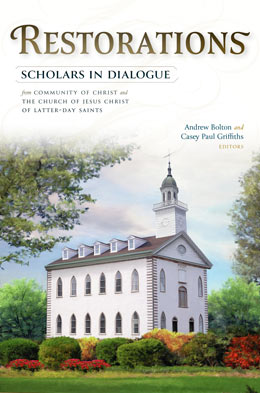
Salvation
Robert L. Millet and John Taylor
Robert L. Millet and John Taylor, "Salvation," in Restorations: Scholars in Dialogue from Community of Christ and the Church of Jesus Christ of Latter-Day Saints, ed. Andrew Bolton and Casey Paul Griffiths (Provo, UT: Religious Studies Center, Brigham Young University; Salt Lake City: Deseret Book), 51‒70.
Robert L. Millet is professor emeritus of religious education at Brigham Young University.
John Taylor, PhD, is pastor of the Community of Christ Drummoyne Congregation in Sydney, Australia, and an emeritus professor of taxation law at the University of New South Wales.
The Process of Salvation in The Church of Jesus Christ of Latter-day Saints
Robert L. Millet
It is not uncommon for a member of The Church of Jesus Christ of Latter-day Saints to be asked the following questions by a caring or curious Christian: “Are you a saved Christian?” or “Have you been saved?” While we may stumble over their words and wrestle with how to respond, we generally associate salvation with the life to come and believe that being saved has to do with gaining eternal life following death and eventual resurrection.
Here, as in other theological matters, we use the same or similar words as our Community of Christ neighbors to describe a Christian concept but discover on more serious investigation that what we mean is at least slightly different. In that vein, I would suggest that for members of the Church of Jesus Christ, being saved is a process, one that has something to do with what has been accomplished in the past, what is going on now, and what will yet take place in the future. Thus, our hesitation to respond to a rather straightforward question about being saved derives not from any effort to avoid the issue or to suggest that we do not believe in the saving role of Jesus Christ, but rather from the fact that the question is not easily answered.
To be sure, Joseph Smith taught that we are eternal beings. He declared that a person’s spirit “is not a created being: it existed from eternity, and will exist to eternity. Anything created cannot be eternal.”[1] Subsequent church leaders have explained that the attributes, powers, and capacities possessed by our Father in Heaven reside in men and women in rudimentary and thus potential form. There is a sense, then, in which we might say that men and women, being spiritual heirs to godliness, are good by nature; that is, they are good because they are related to and products of the Highest Good, a spark of divinity from the Father of lights (see James 1:17). As the scriptures declare, men and women are created in the image and likeness of God (see Genesis 1:26). God is good, even the embodiment and personification of all that is noble, upright, and edifying, and we are from him.
Fundamental to the plan of God is moral agency, the divine right and capacity to choose. Agency is a gift of God, one that comes through the blessings of the Atonement of Jesus Christ. A Book of Mormon prophet explained that “the Messiah cometh in the fulness of time, that he may redeem the children of men from the fall. And because that they are redeemed from the fall they have become free forever, knowing good from evil; to act for themselves and not to be acted upon. . . . Wherefore, men are free according to the flesh; . . . and they are free to choose liberty and eternal life, through the great Mediator of all men, or to choose captivity and death, according to the captivity and power of the devil” (LDS 2 Nephi 2:26–27; CofChrist II Nephi 1:116–20).
Jesus did what no other man or woman has ever done, could do, or will do—he lived a perfect life. He was tempted in all points just as we are, but he did not yield (see Hebrews 4:15; 1 Peter 2:22). Jesus was the Truth; he taught the truth, and his teachings stand as the formula for happiness and the guide for personal, interpersonal, and world peace. His words are timely and timeless; they are a treasure house of wisdom and divine direction for our lives. But other men and women have spoken the truth, have offered wise counsel for our lives, and have even provided profound insight as to who we are and what life is all about. However, Jesus did what no other person could do—he atoned for our sins and rose from the dead. Only a god, only a person with powers over life and death, could do such things.
How this took place is unknown. We believe in Christ and trust in his redeeming mercy and grace. We accept the word of scripture, both ancient and modern, in regard to the ransoming mission of Jesus the Christ. We know from personal experience—having been transformed from pain to peace, from darkness to light—of the power in Christ to renew the human soul. But, like the rest of the Christian world, we cannot rationally comprehend the work of a god. We cannot grasp how one person can assume the effect of another person’s error and especially how one person, even someone who possessed the power of God, can suffer for another’s sins. The Savior’s Atonement, the greatest act of mercy and love in all eternity, though real, is incomprehensible and unfathomable for now.
Though salvation is available to all through the goodness and grace of Christ, there are certain things that must be done in order for divine grace and mercy to be activated in the lives of Christians. People must come unto him, accept him as Lord and Savior, and have faith on his name. The products of that faith include repentance, baptism, reception of the Holy Spirit, and dedicated discipleship until the end of one’s life. Eternal life comes to those who believe and obey. Christ is “the author of eternal salvation unto all them that obey him” (Hebrews 5:9).
We believe that all men and women have the capacity to be saved. “We believe,” Joseph Smith wrote in 1842, “that through the Atonement of Christ, all mankind may be saved, by obedience to the laws and ordinances of the Gospel” (Articles of Faith 1:3). Stated another way, there is no person who comes to earth who is outside the reach of Christ’s power to save, no soul beyond the pale of mercy and grace. God is no respecter of persons, as Peter pointed out, “but in every nation he that feareth him, and worketh righteousness, is accepted with him” (Acts 10:35). Thus, Latter-day Saints do not believe in predestination, that men and women are chosen or elected unconditionally to salvation or damnation. Joseph Smith taught that “unconditional election of individuals to eternal life was not taught by the apostles. God did elect or predestinate, that all those who would be saved, should be saved in Christ Jesus, and through obedience to the gospel; but he passes over no man’s sins, but visits them with correction, and if his children will not repent of their sins, he will discard them.”[2]
We believe that the gospel is a gospel covenant. The Lord agrees to do for us what we could never do for ourselves—forgive our sins, lift our burdens, renew our souls and re-create our nature, raise us from the dead, and qualify us for glory hereafter—whereupon we strive to do what we can do: have faith in Christ, repent of our sins, be baptized, love and serve one another, and do all in our power to put off the natural man and deny ourselves of ungodliness. In short, we believe that more is required of men and women than a verbal expression of faith in the Lord, more than a confession with the lips that we have received Christ into our hearts. Without question, the power to save us, to change us, to renew our souls, is in Christ. True faith, however, always manifests itself in faithfulness (see John 14:15; James 1:22; 2:17–20). Thus, the real question is not whether one is saved by grace or by works but rather whom we trust and rely on. To exercise true faith in Christ is to have total trust in him, complete confidence in him, and a ready reliance on him.
As early as February 1832, Joseph Smith declared that the life beyond consists of more than heaven and hell. He recorded a revelation known as the vision of the three degrees of glory (see LDS and CofChrist Doctrine and Covenants 76). This vision serves as a type of commentary on the Master’s declaration that “in my Father’s house are many mansions” (John 14:2) and on the apostle Paul’s passing comment to the Corinthians about types of bodies in the Resurrection (see 1 Corinthians 15:40–42). The Prophet Joseph stated that God revealed to him the concept of three main divisions in the afterlife—in descending order (in terms of the greatest eternal reward), the celestial kingdom, terrestrial kingdom, and telestial kingdom, each of which is a kingdom of glory.
As for the fate of those who do not obey, in our faith we use the term hell to mean two things: (1) the division of the postmortal spirit world where those who lived wickedly and spurned morality and decency reside until the time of their resurrection; and ultimately (2) the final abode of those called the “sons of perdition,” people who deny and defy the truth, who come to know God and then fight against him and his plan of salvation (see LDS Doctrine and Covenants 76:31–35; CofChrist Doctrine and Covenants 76:4). Only the sons of perdition face the second death (meaning the second or final spiritual death). They inherit a kingdom of no glory. Everyone else will come forth from the grave to inherit a kingdom of glory.
In that sense, we believe in a type of universal salvation—not in the sense that everyone will one day dwell with God and be like God, but rather that all who do not defect to perdition will enjoy a measure of God’s goodness and grace through inheriting a heaven of some type.[3] For one thing, all people who have had a physical body will be resurrected, “for as in Adam all die, even so in Christ shall all be made alive” (1 Corinthians 15:22; see also LDS Alma 11:41; CofChrist Alma 8:97–98). As stated in the vision of the degrees of glory, “And this is the gospel, the glad tidings, . . . that he came into the world, even Jesus, to be crucified for the world, and to bear the sins of the world, and to sanctify the world, and to cleanse it from all unrighteousness; that through him all might be saved whom the Father had put into his power and made by him; who glorifies the Father, and saves all the works of his hands, except those sons of perdition who deny the Son after the Father has revealed him” (LDS Doctrine and Covenants 76:40–43; CofChrist Doctrine and Covenants 76:4g–h).
Once while I was sitting with a group of religious scholars, they commented to me that the problem with the Latter-day Saint conception of heaven is that everyone is saved. I thought of that conversation as I later read the following from Richard John Neuhaus, a Roman Catholic scholar: “The hope that all may be saved . . . offends some Christians. It is as though salvation were a zero-sum proposition, as though there is only so much to go around, as though God’s grace to others will somehow diminish our portion of grace. . . . If we love others, it seems that we must hope that, in the end, they will be saved. We must hope that all will one day hear the words of Christ, ‘Today you will be with me in paradise.’ Given the evidence of Scripture and tradition, we cannot deny that hell exists. We can, however, hope that hell is empty. We cannot know that, but we can hope it is the case.”[4]
While our faith and conduct in this mortal experience are vital, learning and growth and redemption continue well beyond the grave. “When you climb up a ladder,” Joseph Smith explained only two months before his death, “you must begin at the bottom, and ascend step by step, until you arrive at the top; and so it is with the principles of the gospel—you must begin with the first, and go on until you learn all the principles of exaltation. But it will be a great while after you have passed through the veil [of death] before you will have learned them. It is not all to be comprehended in this world; it will be a great work to learn our salvation and exaltation even beyond the grave.”[5]
I sat at lunch some time ago with a dear friend of mine who is an evangelical minister. On many occasions we have met to chat, to reflect on each other’s faith, to ask and respond to hard questions, to seek to better understand each other. On this particular occasion, we were discussing grace and works. I had assured my friend that Latter-day Saints do in fact believe in, accept, and rely on the saving mercy of Jesus. “But, Bob,” he said, “you folks believe you have to do so many things to be saved!”
“Like what?” I asked.
“Well,” he continued, “let’s just take baptism, for example. You believe that baptism is what saves you.”
“No, we don’t,” I responded.
“Yes, you do,” he followed up. “You believe baptism is essential for entrance into the celestial kingdom.”
“Yes,” I said, “while baptism and other ordinances are necessary as channels of divine power and grace, they are not what saves us. Jesus saves us!”
While Latter-day Saints believe and teach that the highest form of salvation comes to those who receive the blessings of our temples (see LDS Doctrine and Covenants 131:1–4), we do not in any way believe that it is the temple, or the ordinances contained there, that saves us. Salvation is in Christ.
We come to the earth to take a physical body, to be schooled, and to gain experiences that we could not have in the “first estate” (see Jude 1:6), the premortal life. We then strive to keep the commandments and grow in faith and spiritual graces until we are prepared to go where God and Christ are. The Doctrine and Covenants says, “That which is of God is light; and he that receiveth light, and continueth in God, receiveth more light; and that light groweth brighter and brighter until the perfect day” (LDS Doctrine and Covenants 50:24; CofChrist Doctrine and Covenants 50:6b). That “perfect day” is the Resurrection, the day when spirit and body are inseparably united in immortal glory. That is, those “who are quickened by a portion of the celestial glory [in this life] shall then [in the Resurrection] receive of the same, even a fulness” (LDS Doctrine and Covenants 88:29; CofChrist Doctrine and Covenants 85:6d). The Doctrine and Covenants also instructs that those who come unto Christ, follow his path to the Father, and thus realize the fruits of true worship are empowered to “come unto the Father in my name, and in due time receive of his fulness” (LDS Doctrine and Covenants 93:19; CofChrist Doctrine and Covenants 90:3b). This is what we fondly call gaining eternal life.
All men and women, like Christ, are made in the image and likeness of God (see Genesis 1:27; Moses 2:27), so we feel it is neither audacious nor heretical for the children of God to aspire to be like God (see Matthew 5:48; 1 John 3:2–3). Acquiring the attributes of godliness comes through overcoming the world through the Lord’s Atonement (see 1 John 5:4–5; Revelation 2:7, 11; LDS Doctrine and Covenants 76:51–60; CofChrist Doctrine and Covenants 76:5b–h); becoming heirs of God and joint heirs with Christ, the natural heir (see Romans 8:17; Galatians 4:7); becoming partakers of the divine nature (see 2 Peter 1:4); and thus inheriting all things, just as Jesus inherits all things (see 1 Corinthians 3:21–23; Revelation 21:7; LDS Doctrine and Covenants 76:55, 95; 84:38; 88:107; CofChrist Doctrine and Covenants 76:5f; 83:6e; 85:33b). In that glorified state, we will be conformed to the image of the Lord Jesus (see Romans 8:29; 1 Corinthians 15:49; 2 Corinthians 3:18; 1 John 3:2; LDS Alma 5:14; CofChrist Alma 3:28), receive his glory, and be one with him and with the Father (see John 17:21–23; Philippians 3:21).
To summarize, the doctrine of our church teaches that through the cleansing and transforming power of the blood of Jesus Christ, men and women may mature spiritually over time. That is, by and through his blood, they
have a forgiveness of sins, and also a sure reward laid up for them in heaven, even that of partaking of the fullness of the Father and the Son through the Spirit. As the Son partakes of the fullness of the Father through the Spirit, so the saints are, by the same Spirit, to be partakers of the same fullness, to enjoy the same glory; for as the Father and the Son are one, so, in like manner, the saints are to be one in them. Through the love of the Father, the mediation of Jesus Christ, and the gift of the Holy Spirit, they are to be heirs of God, and joint heirs with Jesus Christ.[6]
It is glorious and heartwarming to know that God our Father has a plan for his children, a plan of recovery, a plan of renewal and reconciliation, a plan of salvation, a plan by which those who wander—and that includes all of us—can pick themselves up, dust themselves off, and through the cleansing and enabling power of the Savior’s Atonement, return home. None of us is bright enough or powerful enough to do it alone; we must have help. And were it not for divine assistance, each of us would falter and fail, would lose the battle of life. “But thanks be to God, [who gives] us the victory through our Lord Jesus Christ” (1 Corinthians 15:57). Our God offers us “so great salvation” (Hebrews 2:3) through the infinite intercession of the only completely pure and perfect being to walk the earth, and we would be foolish and seriously shortsighted to refuse such an offering.
Salvation in Community of Christ
John Taylor
In 1965, when I was in my thirteenth year, I was baptized into Community of Christ. In that same year my maternal grandmother died. She was the first close relative of mine to die in my lifetime (an uncle had died a year or two before, but I had not known him well). I had been in prebaptismal classes for several years before I was baptized but made the decision to be baptized only after a local elder conducted a series of prebaptismal classes in my home. Looking back, I suspect that the death of a close relative and involvement in personalized classes on church doctrine before baptism made me think about questions concerning the meaning of life and eternity.
My maternal grandmother was a second-generation member of Community of Christ. Her parents had been early converts in Australia, having been baptized around 1880. Her brother had been mission president[7] and had written several books for the church. She had received what was then called her patriarchal blessing from Alexander H. Smith.[8] I remember her as someone not to argue with but do not remember deep and meaningful theological conversations with her. I do remember, though, my mother saying that my grandmother held the strong view that we are saved by our works, probably citing the letter of James to the effect that “faith without works is a dead thing”[9] and “I will show you my faith by my works.”[10]
My maternal grandfather had died six years before I was born, so I never knew him. He had been a builder and then a house painter and decorator. My mother told me that he used to preach the gospel to his customers (which probably accounted for his lack of success in business). One of his emphases was that the Community of Christ doctrine (in contrast to Catholicism and most of Protestantism) was that little children were born innocent and were “saved” without baptism. This, of course, was consistent with a view of salvation as deliverance from sin and death and eternal punishment. This view defined salvation as being achieved through compliance with the gospel plan, involving faith, repentance, and baptism once you had reached the age of accountability.
During the 1960s, a Basic Beliefs Committee was developing a Statement of Belief that, along with a commentary, was published in book form as Exploring the Faith in 1970. As paragraphs of the statement and commentary were developed, they were progressively published in the Saints’ Herald. Before this publication, Community of Christ used the document known as the Epitome of Faith, derived from Joseph Smith’s “Wentworth Letter,” as its official statement of belief. The paragraph on “The Gift of Salvation” in the 1970 statement clearly showed a significant shift in the church’s thinking. It read:
We believe that man cannot be saved in the Kingdom of God except by the grace of the Lord Jesus Christ, who loves us while we are yet in our sins, and who gave his life to reconcile us unto God. Through this atonement of the Lord Jesus Christ and by the gift of the Holy Spirit, men receive power to choose God and to commit their lives to him; thus are they turned from rebellion, healed from sin, renewed in spirit, and transformed after the image of God in righteousness and holiness.[11]
Thus, during a period when some living church members continued to see salvation as a product of works, here was a committee of church leaders stating that salvation was by the “grace of the Lord Jesus Christ.” The shift had begun earlier and can be detected in some of the writings of church leaders like F. Henry Edwards and Arthur Oakman, where there is sometimes a message both of God’s love and forgiveness and of the necessity for repentance and baptism.
All the earlier thinking tied in with the church’s exclusive claims to authority through the restoration of the priesthood. The period when Community of Christ theology shifted from a theology of works to a theology of grace was accompanied by an effective abandonment of exclusive claims to authority and a consequent reduction in emphasis on ordinances and sacraments as being essential to salvation. Over time, church thought saw authority as not being in the exclusive possession of Community of Christ and saw baptism as an expression of discipleship rather than as a passport to celestial glory. This was most clearly evident in the decision of Community of Christ to accept and confirm people as members who had been baptized as responsible believers by another faith.
Community of Christ thinking has shifted away from personal salvation and afterlife questions to an emphasis on salvation as the present and ongoing transformation of human beings and human society by the love of God. Just as discipleship has been seen increasingly as servanthood, so too has salvation been seen in the transformed lives of disciples in community. The origins of this development may be deeper and older than is sometimes supposed. The churches of the Joseph Smith Restoration movement have historically seen “the cause of Zion” and “the New Jerusalem” as a key focus of their mission. All things were seen as spiritual (see CofChrist Doctrine and Covenants 28:9; LDS Doctrine and Covenants 29:34–35). Personal and historical eschatologies were linked through Joseph Smith’s “millennialism of place,” which required the building of a “righteous” city to which Christ would return in glory.[12] The righteous city would be peopled by disciples who had been saved through compliance with the ordinances and sacraments of the restored faith.
Arguably the kingdom was always seen both as a present worldly reality and as a future hope both in and beyond time. The consummation of history was envisaged but so too was the present reality of an afterlife with kingdoms of glory. Joseph Smith sought guidance on eternal judgment because of his concern at the apparently arbitrary features of evangelical Calvinist personal eschatology and the experience of the Smith family with the death of Alvin.[13] The resulting revelations in Doctrine and Covenants section 76 (for both churches), LDS Doctrine and Covenants section 88, CofChrist Doctrine and Covenants section 85, and later Joseph’s 1836 vision of the celestial kingdom[14] amounted to something close to a universal salvation position with the possibility opened for further education and salvation after death.
Although I do not think that it has been explicitly stated, I do believe that Community of Christ has now moved to a position of universal salvation. This can be regarded as consistent with the move away from exclusive claims to authority and the shift from a works-based theology to a theology of grace. In one sense this is consistent with and an extension of the kingdoms-of-glory eschatology of Doctrine and Covenants section 76. More importantly, this position is a product of the emphasis on the love of God for all as revealed in the life, death, and Resurrection of Jesus Christ. An implicit belief in universal personal salvation through reliance on the love of God as revealed in Jesus Christ enables focus to be shifted from proselytizing based on the fear of eternal judgment to a mission focused on transforming human lives and human society into the peaceable kingdom of God. This shift is clearly evident in the current Community of Christ Statement of Belief on Salvation:
The gospel is the good news of salvation through Jesus Christ: forgiveness of sin, and healing from separation, brokenness, and the power of violence and death. This healing is for individuals, human societies, and all of creation. This new life is the loving gift of God’s grace that becomes ours through faith and repentance. Baptism is how we initially express our commitment to lifelong discipleship. As we yield our lives to Christ in baptism we enter Christian community (the body of Christ) and have the promise of salvation. We experience salvation through Jesus Christ, but affirm that God’s grace has no bounds, and God’s love is greater than we can know.[15]
Section 163, a recent revelation in Community of Christ Doctrine and Covenants, speaks of “all of the dimensions of salvation” (2a) and then calls for responses indicating that salvation involves personal, social, cultural, political, and ecological dimensions. Community of Christ proclaims a big on-this-earth salvation, far more than just heaven when we die.
Response to John Taylor
In our conversations about salvation, two things have stood out to me about the differences between The Church of Jesus Christ of Latter-day Saints and Community of Christ. First, in the last fifty years both churches have taken a serious look at their approach toward grace and works; consequently, both have emphasized the importance of the grace of Jesus Christ in the salvation of all people more. This is an encouraging point of harmony. Second, in the last few decades the two churches have followed different directions when it comes to the question of life after death. This is a point where the current directions of each faith will continue to diverge.
First, let’s address the role of grace. There is no question that the Latter-day Saints have been hesitant, even slow, to reflect on and teach what the Book of Mormon and latter-day revelation say about the grace of God. This is understandable when we remind ourselves that the early Saints viewed the restored gospel and church as major correctives to a Christian world that had gone off course. More especially, since the Restoration occurred in a largely Protestant America, it ought not surprise us that the Saints strongly emphasized the need to perform righteous works to qualify for salvation. Many early church members would have responded to any kind of “easy believism” or the accompanying antinomianism in much the same way the apostle Paul did: “What shall we say then? Shall we continue in sin, that grace may abound? God forbid” (Romans 6:1–2).
Striking the delicate balance between grace and works, between faith and discipleship, is a formidable challenge in today’s complex world. It seems to me that the Latter-day Saint way is quite different from monergism: our approach is called synergism—God and humanity are working together for the salvation of souls. Is this not what the apostle Paul wrote to the Philippian Saints? “Wherefore, my beloved, as ye have always obeyed, not as in my presence only, but now much more in my absence, work out your own salvation with fear and trembling” (Philippians 2:12). If we stop there, it appears that salvation is something that man himself is to “work out,” a process over which we as mortals have the greatest control. But we dare not stop there, for Paul adds, “For it is God which worketh in you both to will and to do of his good pleasure” (Philippians 2:13). Now it sounds like God is the principal, the initiator, the prompter and motivator, the conductor of our soul’s symphony.
Second, John mentioned that thinking in Community of Christ has shifted away from personal salvation and afterlife questions to an emphasis on salvation as the present and ongoing transformation of human beings by the love of God. Latter-day Saints feel that the grace of Christ is seen not only in this life and the joy we gain from it right now but also in the next life. All people must confront death, so why ignore that simple fact of life? In a world gripped by cynicism and strangled by hopelessness, the scriptures and revelations of the Restoration bear witness of a God of mercy and vision, of an Omnipotent One whose reach to his children is neither blocked by distance nor dimmed by death. And so, after the doctrinal foundation had been laid, God made known through the Prophet of the Restoration those ennobling truths that pertain to life and salvation, both here and hereafter. As Joseph Smith explained, “It is no more incredible that God should save the dead, than that he should raise the dead.”[16] Surely no work could represent a more noble cause, a more valiant enterprise. And no labor in time could have more eternal implications. The emphasis on the afterlife in our scriptures, ordinances, and temples is a further extension of the grace of Jesus Christ and the central position it occupies in our teachings and our practices.
Response to Robert L. Millet
Reading Brother Millet’s “The Process of Salvation” reminded me of Winston Churchill’s remark that the United Kingdom and the United States were divided by a common language. We use many of the same terms and refer to some of the same scriptures but appear to mean somewhat different things by them.
Some years ago, my late mother was invited by Latter-day Saint friends to a service featuring a member of their church’s First Presidency as a speaker. The service reminded my mother, then in her eighties, of Community of Christ services from her childhood. Perhaps the differences in understanding might not have been so apparent in the 1920s. My response tries to identify the core of the current differences and to explain why they have become more extreme. I believe that one key understanding is both the core and the explanation of the differences.
That key is the change in how Community of Christ has understood and emphasized Christ. The change is usually dated to the opening of the first Community of Christ mission in the Orient in 1960. Community of Christ found that distinctives relevant in a Western cultural and religious context were neither of interest nor meaningful in non-Christian cultures. This led to a de-emphasis on what had been seen as the five basic principles of the gospel and “distinctives.” The core of the faith was found to be the proclamation of Christ.[17]
Another 1960s influence was enrollment of Community of Christ paid ministers in the Methodist Saint Paul School of Theology programs. This led to greater awareness among the priesthood and membership of critical approaches to scripture, of the limitations of human understanding of God, and of attempts to record that understanding. Community of Christ had historically been suspicious of the integrity of records of Joseph Smith’s sermons at Nauvoo in the 1840s but largely had literally interpreted the Book of Mormon and the revelations in the Doctrine and Covenants up to the Nauvoo editions. The critical approach understood these and other scriptures as having been influenced by the culture of their time and place.[18]
The understanding of Christ that developed is primarily concerned with the historical Jesus. What we, members of the Community of Christ, have come to appreciate is Jesus’s spirituality, his concern for the poor and oppressed, and his sacrificial love. We have seen in “the crucified God”[19] the suffering and forgiving God. We share with our Latter-day Saint friends a belief in universal or near-universal salvation but draw different implications. This assurance of universal salvation has led us to be less concerned with questions about the afterlife and more concerned with finding our true selves and with disciples’ responsibilities to humanity and for nature. We now describe this process as taking “the path of the disciple.” We see atonement and sanctification in the lived experience of disciples as a way of life rather than a doctrine.[20] The passionate and just Jesus that Community of Christ sees in current research of New Testament scholars resonates with its historic sense of mission as expressed in gathering and the building of Zion.
The usual explanations are not quite sufficient, though. Other Western churches did not rework their whole approach to mission when they encountered non-Christian cultures. Many sects of equivalent size have neither embraced a critical approach to scripture nor been so concerned with current research into the historical Jesus.
Another explanation may be in the key differences in The Church of Jesus Christ of Latter-day Saints and Community of Christ that arose from their respective origins. Community of Christ emerged from a collection of small branches in the Midwest containing independent thinkers like Jason W. Briggs and Zenas H. Gurley. They needed to live alongside their other Christian neighbors. Local autonomy and independent critical thinking remain characteristics of many Community of Christ congregations. Church leaders are the products of this culture, and the leadership both influences it and is influenced by it. By contrast, a key formative experience for the Latter-day Saints was the pioneer trek and establishment of church headquarters in the Rocky Mountains. This required organization and a unified message expressed in logical propositions that could be understood and adhered to. Utah was remote, and the establishment of Deseret was seen as the literal expression of the kingdom of God on earth. There was less need to interact with and accommodate the beliefs of other Christians.[21]
A belief that we share with our Latter-day Saint friends is that God still speaks, but our processes for sharing new revelations with the membership differ. The ongoing process of canonizing of revelations received by prophet-presidents of Community of Christ has deepened our understanding of revelation and of the nature of Christ and of mission. Both traditions see salvation as a process.
Both the Church of Jesus Christ and Community of Christ genuinely seek to understand and do the will of God as expressed in Christ. We both seek to be followers of what we see as “the way of Jesus Christ.”[22] Our divergent histories necessarily mean that, at present, we express the product of that seeking differently.
Conclusion
From our exchange, it is clear that both churches have widely different approaches to the concept of salvation. However, an encouraging development is the increased focus in both churches on the faith that “redemption cometh in and through the Holy Messiah; for he is full of grace and truth” (LDS 2 Nephi 2:6; CofChrist II Nephi 1:71). The amplified emphasis on the grace of Jesus Christ as a transformative factor in our lives in both religions is an overwhelmingly positive development. Members of The Church of Jesus Christ of Latter-day Saints demonstrate this faith in Christ through their ongoing efforts to bring salvation to both the living and the dead, emphasizing a robust theology of the afterlife. Members of Community of Christ focus primarily on the here and now, emphasizing the joy and power of encountering the saving grace of Christ in this life. Both agree that Jesus Christ is central to our salvation. Expressions of how Christ carries out this great work of salvation differ greatly, but at the heart of both our faiths is a loving Savior, ready to offer his grace to us at every moment.
Notes
[1] Joseph Smith, in Journal of Discourses (London: Latter-day Saints’ Book Depot, 1859), 6:238. See “Account of Meeting and Discourse, 5 January 1841, as Reported by William P. McIntire,” The Joseph Smith Papers, https://
[2] Joseph Smith, Times and Seasons, June 1, 1841, 430.
[3] See John A. Widtsoe, Evidences and Reconciliations (Salt Lake City: Bookcraft, 1960), 198–201.
[4] Richard John Neuhaus, Death on a Friday Afternoon: Meditations on the Last Words of Jesus from the Cross (New York: Basic Books, 2000), 57, 61.
[5] Teachings of Presidents of the Church: Joseph Smith (Salt Lake City: The Church of Jesus Christ of Latter-day Saints, 2007), 268.
[6] Joseph Smith, Lectures on Faith (Salt Lake City: Deseret Book, 1985), 61.
[7] At the time, Community of Christ was organized into fields, each supervised by an apostle. Each field could contain several missions, each presided over by a mission president. Australia was one mission. Within the mission were several districts, each presided over by a district president. Within each district were several branches, each presided over by a branch president. The mission president was usually a full-time church employee. District presidents were often full-time church employees. Australia and French Polynesia, at that time, were the largest Community of Christ missions outside North America.
[8] The office of evangelist dates to Community of Christ Doctrine and Covenants 104:17 and Latter-day Saint Doctrine and Covenants 107 in 1835. Joseph Smith Sr. was the first person ordained to this office, and following his ordination he blessed his sons Joseph and Hyrum. Following the death of Joseph Smith Sr., Hyrum Smith was designated as patriarch to the church in Latter-day Saint Doctrine and Covenants 124 (formerly Community of Christ Doctrine and Covenants 107). The office was continued and expanded in Community of Christ with explanation of the role and function of the office being provided in Community of Christ Doctrine and Covenants section 125:3–6 in 1901 and subsequent sections. The functions specified in section 125 included “lay[ing] on hands for the conferment of spiritual blessing.” These blessings were referred to as patriarchal blessings. Following the ordination of women in 1984, the terminology for the office was changed from “patriarch-evangelist” to “evangelist,” and the term for the blessing was changed to “evangelist’s blessing.” Alexander H. Smith was one of Joseph Smith Jr.’s sons and, at the time, was presiding patriarch of the church.
[9] My grandmother would have been familiar with both the King James Version of the Bible and with the Joseph Smith Revision published at that time under the title “Holy Scriptures.” The
King James Version references are James 2:17 and 2:20. The references to the equivalent passages in the Joseph Smith Revision are James 2:17 and 2:18. James 2:18 in the Joseph Smith Revision is the equivalent to James 2:20 in the King James Version but, importantly in the context of the issue discussed here, reads, “Faith without works is dead and cannot save you.” The words in italics are an addition in the Joseph Smith Revision.
[10] The reference in the King James Version is James 2:18; the reference in the Joseph Smith Revision is James 2:15. It is likely that in conversation, and in writing, my grandmother, like the Joseph Smith Revision, would have modernized the “shew” of the King James Version to “show.”
[11] Exploring the Faith: A Series of Studies in the Faith of the Church Prepared by a Committee on Basic Beliefs (Independence, MO: Herald Publishing House, 1970), 11, 104.
[12] Robert Flanders made this observation in his article “Dream and Nightmare: Nauvoo Revisited,” in The Restoration Movement: Essays in Mormon History, ed. F. Mark McKiernan, Alma R. Blair, and Paul M. Edwards (Lawrence, KS: Coronado Press, 1973), 141–66. See also CofChrist Doctrine and Covenants 36:12c–14c; LDS Moses 7; and CofChrist Genesis 7:67–75, Joseph Smith Revision. I thank Matt Frizzell for drawing the Doctrine and Covenants, Pearl of Great Price, and Joseph Smith Revision reference to my attention.
[13] Richard L. Bushman makes this argument in Joseph Smith: Rough Stone Rolling (New York: Vintage Books, 2007), 195–214.
[14] The vision and the revelation concerning the presence of Alvin Smith in the celestial kingdom are recorded in Joseph Smith, “Journal, 1835–1836,” p. 134, The Joseph Smith Papers, https://
[15] “Basic Beliefs,” https://
[16] “Minutes and Discourse, 1–5 October 1841,” p. 577, The Joseph Smith Papers, https://
[17] This standard explanation is arguably oversimplified. President Frederick Madison Smith was said to be “big on the Christ,” and earlier church leaders such as F. Henry Edwards and Arthur Oakman were significantly influenced by William Temple and other Protestant theologians.
[18] Again, the standard explanation is probably oversimplified. As early as the 1870s, apostle Jason W. Briggs (who had been president pro tem of Community of Christ from 1852 to 1860) published articles reflecting a critical understanding of scripture.
[19] Jürgen Moltmann, The Crucified God (London: SCM Press, 1974). The phrase comes from the title of the book.
[20] Apologies to the late C. H. Dodd. I have a clear memory of reading in one of his writings, “Atonement was a way of life before it became a doctrine.” I have been unable to locate the precise reference, which may mean that I will have to read some of his books again.
[21] See the persuasive analysis to this effect in Douglas D. Alder and Paul M. Edwards, “Common
Beginnings, Divergent Beliefs,” Dialogue 6, no. 1 (Spring 1978): 18, 25–26.
[22] Jürgen Moltmann, The Way of Jesus Christ (London: SCM Press, 1990; Minneapolis, MN: Fortress Press, 1993). The phrase comes from the title of the book.
