
 menu icon in the top, right corner of the screen.
 icon above to close this box.
 icon at the bottom of the screen below the browser—if you don't see it, swipe up to unhide it.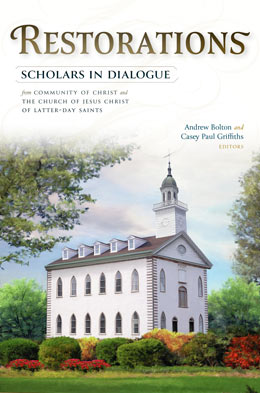
Personhood
Barbara Morgan Gardner and Christie Skoorsmith
Barbara Morgan Gardner and Christie Skoorsmith, "Personhood," in Restorations: Scholars in Dialogue from Community of Christ and the Church of Jesus Christ of Latter-Day Saints, ed. Andrew Bolton and Casey Paul Griffiths (Provo, UT: Religious Studies Center, Brigham Young University; Salt Lake City: Deseret Book), 111‒32.
Barbara Morgan Gardner is an associate professor of church history and Doctrine at Brigham Young University.
Christie Skoorsmith is the quality manager and international business manager for SPIO Inc., which manufactures medical devices for children with special needs.
Personhood in The Church of Jesus Christ of Latter-day Saints
Barbara Morgan Gardner
“I’m not Moana; I’m Elsa!” my dark-brown-curly-haired, brown-eyed, Polynesian four-year-old daughter declared. “You don’t want to be Elsa,” my dark-brown-straight-haired, brown-eyed, six-year-old daughter responded. “She’s selfish and mean and shoots ice out of her fingers. She even tries to freeze her sister’s heart.” “But she’s beautiful,” my four-year-old retorted. “Mom, can you straighten my hair, make it blonde, and make my skin white?” I went to my home office and brought downstairs a few items I’ve kept since I was a child and had, although never intentionally, made a collection of. These items were among my most prized possessions: my brown-skinned, dark-brown-haired (some curly and some straight), brown-eyed dolls.
 Barbara, Alli, Jane, and Dustin on the day the girls were adopted in July 2020. Photo by Celeste Olsen.
As a child, I hated dolls. In fact, I teased my sister relentlessly for playing with hers. I wanted nothing to do with them. “Who would waste time playing with dolls when you could play football?” I thought. “For that matter, why would anyone choose to wear a dress, braid their hair, or kiss a boy?” Things my sister and the girls in my neighborhood and school did simply did not interest me. Yet the dolls remained, and the collection grew.
These treasures didn’t seem to fit with who I was. As far as I was concerned, considering the things I liked to do, the way I dressed, and how I cut my hair, I was more like a boy than a girl. In my childhood and youth, I believed I was clearly more like my five brothers than my seven sisters. At times I even wondered if somehow someone had made a mistake, or, perhaps I was even in the wrong body. Being asked whether I was a boy or a girl was a question I became accustomed to. I don’t ever remember discussing the subject with my parents. They just loved me for being me. Unlike my daughter, I never asked to be someone else, I believe simply because I knew deep down who I really was. Intrinsically, I knew that although I didn’t fit the stereotypical cultural definition of a girl, I was still a daughter of God. Somehow, I knew that it was my relationship with God, not cultural norms or other people’s opinions about my gender, that determined who I was.
Fundamental to a Latter-day Saint understanding of personhood is a basic understanding of what Book of Mormon prophets titled “the great plan of happiness” (Alma 42:8). This plan contains the doctrine of where we came from, who we now are, and what we have the potential to become. Personhood, according to Latter-day Saints, is not understood in terms of cultural shifts, temporary status, scientific data, popular opinion, politics, individual choice, or traditional phenomenon but rather in the eternal doctrine of one’s relationship to heavenly parents: a father (God) and mother (Goddess) in heaven.
At the beginning of an official document of The Church of Jesus Christ of Latter-day Saints known as “The Family: A Proclamation to the World,” the Church’s highest two quorums unitedly declared, “All human beings—male and female—are created in the image of God. Each is a beloved spirit son or daughter of heavenly parents, and, as such, each has a divine nature and destiny. Gender is an essential characteristic of individual premortal, mortal, and eternal identity and purpose.”[1] Although this paragraph encompasses many fundamental truths, for the purposes of this essay, we will look more closely at the Latter-day Saint doctrine and its associated history regarding the divine nature and destiny of each individual, or, in other words, the Latter-day Saint perspective on personhood.
Divine Nature
For members of The Church of Jesus Christ of Latter-day Saints, the relationship between heavenly parents and spiritual offspring is literal. Just as mortal children are the offspring of earthly parents, so are all humans—whether black, brown, or white; female or male; asexual, bisexual, gay, straight, or transgender—spiritual offspring of our heavenly parents. Every individual is therefore divine, meaning each person literally has divine spiritual DNA in him or her. This reality transcends time, space, and human understanding. As C. S. Lewis boldly declared, “There are no ordinary people. You have never talked to a mere mortal. Nations, cultures, arts, civilizations—these are mortal, and their life is to ours as the life of a gnat. But it is immortals whom we joke with, work with, marry, snub, and exploit.”[2] Hopefully, regardless of our personal stance regarding personhood, we learn to love each of God’s children as he does.
In their heavenly parents, these spirits, or divine offspring, saw true joy and happiness, and desired to become like them. Becoming like our heavenly parents required a mortal experience. This mortal experience, provided by our heavenly parents, became a probationary period in which individuals could use their agency to exercise faith, make and keep sacred covenants, experience God’s love, and obey or disobey God’s laws. Included in these laws is the first commandment God gave to Adam and Eve, to multiply and replenish the earth.[3] To Joseph Smith, in this dispensation, the Lord also declared, “In the celestial glory, there are three heavens or degrees; and in order to obtain the highest, a man must enter into this order of the priesthood [meaning the new and everlasting covenant of marriage]” (LDS Doctrine and Covenants 131:1–2).
Through a line-upon-line process and through the grace of Christ, each individual is on a mortal path to perfection, a process of becoming like our heavenly parents. Knowing that no individual would become perfect on his or her own, and that, because of the Fall of Adam and Eve all people would physically die, God prepared a plan that included a Savior, who would redeem every individual from death and, for those who desire, from sin. “The worth of souls is great in the sight of God,” the Lord declared to Joseph Smith, Oliver Cowdery, and David Whitmer as they were called upon to organize the Quorum of the Twelve in the final dispensation. And what makes these souls worth so much? God explained, “For, behold, the Lord your Redeemer suffered death in the flesh; wherefore he suffered the pain of all men, that all men might repent and come unto him” (LDS Doctrine and Covenants 18:10, 11; CofChrist Doctrine and Covenants 16:3c).
The worth of a soul, therefore, is not determined by culture, color, sexual orientation, human laws, Church policies, socioeconomic status, roles, propensities, righteousness, or wickedness but rather by his or her connection with our heavenly parents and the Atonement of the Savior. This reality was clearly taught by the Prophet Joseph Smith. Joseph was far advanced in his respect for humanity regardless of cultural norms related to God’s laws. He taught and believed that all women and men, regardless of race, ordination, or any other mortal distinction, had divine nature and were of equal value to the Lord. It was the Lord himself who, against religious tradition, referred to the first woman as “glorious Mother Eve” (LDS Doctrine and Covenants 138:39). “All are alike unto God,” the Lord declared (LDS 2 Nephi 26:33; CofChrist II Nephi 11:115).
Perhaps basing human worth on legitimate mortal experiences or temporary policies, some believe that Latter-day Saint women are somehow demeaned by not being ordained to priesthood office. It is critical to understand, however, that the Church’s organizational structure is a temporary framework, not an eternal doctrine. Latter-day Saint women understand that in the temple, a most sacred place in mortality and a shadow of eternity, women are endowed with priesthood power, perform priesthood ordinances, are clothed in the garment of the holy priesthood, enter the highest order of the priesthood, are equal partners with their husbands in mortality and are promised the ability to rule and reign as equal partners with their husbands in eternity as goddesses and gods. Although it is difficult at times to separate experiences in mortality that could be perceived as demeaning, in the most sacred places on earth and in eternity, the doctrine of divine nature puts all our heavenly parents’ children at a value much higher than a mere mortal could perceive.
God’s value and definition of humankind is not affected by mortals’ moral relativism, politics, policies, or popular opinion but instead is founded on God’s truths, which never change. Although God has not revealed all truth, the truth regarding the eternal nature of gender is among the most important of God’s eternal truths. To the Prophet Joseph, God himself declared, “Truth is knowledge of things as they are, and as they were, and as they are to come” (LDS Doctrine and Covenants 93:24; CofChrist Doctrine and Covenants 90:4b). Truth—God’s eternal doctrine—does not change. Thus, although we do not have all truth regarding ethnicity, socioeconomic status, timing for mortality, gender dysphoria, and so on, we do know that all people are divine sons and daughters of God, and, as such, all mortals are eternal brothers and sisters. Perhaps this could answer the question asked of me by a navy chaplain at a conference I attended, “Why do Latter-day Saint chaplains treat all people, both enemies and friends, Black and White, atheist and Mormon, as if they were their own brothers and sisters?” My simple response was “Because they are.”[4]
Divine Destiny
This first eternal truth—the divine worth of all individuals—leads us to the second eternal truth, that every individual has a divine destiny. As the proclamation states, “Each is a beloved spirit son or daughter of heavenly parents, and, as such, each has a divine nature and destiny.”[5] Humankind is not merely a creation of heavenly parents but is their offspring and thus has an inherent ability to become like them. Latter-day Saints agree with the words penned by C. S. Lewis: “It is a serious thing to live in a society of possible gods and goddesses, to remember that the dullest and most uninteresting person you talk to may one day be a creature which, if you saw it now, you would be strongly tempted to worship.”[6]
Speaking at the funeral of his friend only two months before his own martyrdom, the Prophet Joseph Smith instructed the Saints, “You have got to learn how to be Gods yourselves; to be kings and priests to God, the same as all Gods have done; by going from a small degree to another, from grace to grace, from exaltation to exaltation, until you are able to sit in glory as doth those who sit enthroned in everlasting power.”[7]
As members of The Church of Jesus Christ of Latter-day Saints, we see all people, regardless of nationality, race, sexual orientation, socioeconomic status, gender, and so forth, as potential gods and goddesses. No individual has more divine potential than another. Realizing this divine potential depends not on what one is in mortality but rather on one’s choices, or use of agency. To become as God, we must do as God would have us do, and in fact, as God once did. As Lorenzo Snow wrote, “As man now is, God once was: As God now is, man may be.”[8]
While all people have equal divine potential, and equal opportunity in regard to that potential, perhaps not all have equal desire. As is taught by the Lord through the Prophet Joseph, all humankind will receive “that which they are willing to receive,” based on obedience to God’s “laws” (LDS Doctrine and Covenants 88:32–38; CofChrist Doctrine and Covenants 85:6g). Thus, the main purpose of the Restoration of the gospel of Jesus Christ, under the direction of the young Prophet Joseph, was to help God’s children to return to and live with and become like him. As President Spencer W. Kimball taught, “The whole intent of the gospel plan is to provide an opportunity for each of you to reach your fullest potential, which is eternal progression and the possibility of godhood.”[9] Not allowing for that possibility for their children would position our heavenly parents as stewards rather than parents. As author Henry Ward Beecher once declared, “Whatever is only almost true is quite false, and among the most dangerous of errors, because being so near truth, it is the more likely to lead astray.”[10]
My now six-year-old daughter, who would still rather be Elsa than Moana, may not understand social norms and the biology of race and gender, but she does understand her relationship to her heavenly parents. She is their daughter. And although I had no interest in dolls, it seems that my heavenly parents knew who I was better than society, politics, or popular culture did—even better than I did. They knew that someday, in spite of my childhood propensities and what society would teach, I would be grateful to be a mother of a beautiful Moana who thinks she’s Elsa. Whether my daughter is Moana, Elsa, or even Kristoff, her worth and my love for her do not change. In fact, regardless of her decisions, my love for her will increase as I draw closer to the Savior. My hope is that my daughter and I will both use our agency in such a way that it will bring us happiness now and in the eternities and that we will be instruments in God’s hands to help others have the same according to their righteous desires.
Personhood in Community of Christ
Christie Skoorsmith
What is a person? Personal attributes like race, gender, sexual orientation, religious beliefs, socioeconomic status, birth order, or physical characteristics can be used to define us as individuals and as different from one another. But do these attributes define our personhood? Or are certain attributes just the circumstances that arose from our particular birth, into a particular family, in a particular geographical location, at a particular time? We can call these attributes circumstantial characteristics.
Alternatively, we can think of the eternal characteristics of personhood that are universal to all people. These eternal characteristics could be defined as the divine part of us that is not tied to our circumstances of birth but that simply make each of us a child of God. This includes the capacity to relate, reason, feel empathy for another, know joy, and more. These attributes are the eternal “person-ness” of each human that has ever, or will ever, live, regardless of the circumstances of his or her birth.
When Community of Christ members talk about the worth of persons, it is this eternal characteristic that we refer to in defining personhood. First and foremost, we are human. No matter what the circumstances of our births happen to be, all of us are simply children of God, capable of relationships with the Divine and with one another.
However . . .
Discussing one’s circumstantial and eternal traits is all well and good when we are theorizing, but real life is so much more complicated than this academic exercise. So how do those terms measure up to our lived experience?
 Christie with her family - Christian, Eva, Adrien, and Leo Skoorsmith. Photo by Nate Gawdy.
I remember the moment my daughter told me she was a boy. Time slowed down, and I felt I was in an alternate reality. Even though I knew intellectually that gender was not fixed, emotionally I felt that my child was a girl. The confusion I experienced in that moment was real. But I chose to focus not on the physical, circumstantial aspects of my child —the fact that my child was born with female parts instead of male parts—but on the “eternalness” of who I knew my child to be—a beautiful, wonderful, child of God. My child’s physical body had no bearing on who he knew himself to be.
That was four years ago now, and when I look into the happy, shining eyes of my son, I know that I focused on the right thing. Because Community of Christ does not have different church roles based on gender, I am secure in knowing that whatever gender my children know themselves to be, they are equally accepted and able to participate in all aspects of church life and ministry.
Community of Christ through the Years
From the beginning of the Restoration movement, the idea of the worth of persons has been central to the teachings of Community of Christ. In June 1829, before the Church was even organized, came these words: “Remember the worth of souls is great in the sight of God” (LDS Doctrine and Covenants 18:10; CofChrist Doctrine and Covenants 16:3C) and “The one being is as precious in his sight as the other” (LDS Jacob 2:21; CofChrist Jacob 2:27).
However, the church’s way of expressing the worth of all persons has, at times, been complicated and less than ideal.[11] Joseph Smith III, the first prophet of the Reorganization, struggled with the balance between expressing his own beliefs and trying to preserve the peace in a church with members that were grappling with women’s right to vote and postslavery racial tensions.
Joseph Smith III authorized the ordination of Blacks in 1865 yet was cautious about interracial marriage and felt there was too much resistance from church members to ordain women to the priesthood (see Community of Christ Doctrine and Covenants 116). So, in many ways, Joseph Smith III’s actions simply reflected the cultural views of the time and his desire to act as a bridge between the more radical and the more conservative members of the church. For these and other reasons, some have called Joseph Smith III a “pragmatic prophet.”
It wasn’t until the 1930s, when Frederick Madison Smith was the president of the church, that the conversation about women’s ordination to the priesthood began to change. Frederick Madison stated that he believed that at some time in the future women would be ordained to the priesthood. Fifty years later he was proven right.
In 1984 the church received revelation through Wallace B. Smith, a great-grandson of Joseph Smith III, that women could be ordained to the priesthood because “all are called according to the gifts of God” to serve (CofChrist Doctrine and Covenants 156:9b). I was nine years old when this policy was changed. I remember the day my mother was ordained a teacher in my congregation. I remember feeling so happy and proud of her. She eventually became a priest, elder, high priest, and then apostle. Now, in retirement, she currently holds the office of evangelist. My mother has been a role model for me in my own path with the Church. I am not sure I would be the elder I am today without her influence in my life.
Over time, other policies have changed, such as recognizing the right of our LGBTQ+ members to hold the priesthood and be married, as well as recognizing that baptism in other denominations can serve as a path to membership in our church.[12]
The equal worth of all persons has been an increasing focus in Community of Christ over the last fifty years, both theologically and in practice (see CofChrist Doctrine and Covenants 151:9; 161; 163). First and foremost, we focus on people as individuals of great worth in the sight of God. Then we practice the full inclusion of all persons—no matter their race, sexual orientation, gender, physical ability, or religious background. And we ground this belief in how we see Jesus include all people, including the marginalized, and in the continuing guidance of the Holy Spirit in the church today.
The Worth of Persons
Today I continue to be grateful that I am the parent of two transgender children. They have brought such understanding and insight into my life just by being authentically and fully themselves. They have taught me so much about recognizing and listening to that eternal child of God that is in each of us, regardless of what our circumstances of birth happen to be. That divine spark is the essence of what personhood is for members of Community of Christ, no matter an individual’s race, gender, sexual orientation, religious beliefs, or physical characteristics and abilities. We all matter. We all are loved. We all are accepted as children of God. We are grateful for the apostle Paul’s argument that through baptism into Christ there is no slave or free, Jew or Gentile, male or female (see Galatians 3:28). We extend Paul’s argument to say that not only is gender abolished as a defining characteristic of what it means to be a person but so also is race and sexual orientation.
For Community of Christ, the thread of the inestimable worth of persons in the sight of God is strong, revealed in Christ, grounded in scripture, enhanced through modern-day revelation, enacted in our policies, and expressed in our lived experiences. In recent years that thread has intensified and become the heartbeat of our movement. As the Book of Mormon so robustly and wonderfully states, “The Lord inviteth them all to come unto him, and partake of his goodness; and he denieth none that come unto him, black and white, bond and free, male and female; and he remembereth the heathen, and all are alike to God, both Jew and Gentile” (LDS 2 Nephi 26:33; CofChrist II Nephi 11:113–15). We all come from God; we all are alike in God. In God we are all persons of worth.
Response to Christie Skoorsmith
Christie, I felt, through our phone conversation, dialogue, and your essay, a connection not only with our children and others that we love but also with each other. You have sons that you love regardless of their choices, and I have daughters that I love regardless of theirs. We both share a basic belief that we, and all people, are children of God and on that basis alone are worthy recipients of God’s love.
It seems that there is no question that we both, as individuals and as representatives of our faiths, have a deep love of people and a deep sense of their worth. It seems, as you state, that it is in the expression of that love or worth that we have philosophical differences. I appreciate how you explained that the expression of worth has been complicated in Community of Christ and then acknowledge that worth in your faith is demonstrated by authorizing priesthood ordination for both Blacks and women and in recognizing and giving rights to LGBTQ+ members. If I am understanding correctly, worth is demonstrated in the CofC, or atleast expressed by ordination, opportunity, and full inclusion.
In your article, you explained that you “focus on people as individuals of great worth in the sight of God. Then we practice the full inclusion of all persons—no matter their race, sexual orientation, gender, physical ability, or religious background. And we ground this belief in how we see Jesus include all people, including the marginalized.” It is in this demonstration of worth that perhaps we differ. I do believe, as I believe you do, that Christ loved all people and valued them and to have great worth, even infinite worth. I do not, however, believe that Christ therefore, was fully inclusive.
When Christ was on the earth, he did not ordain gentiles to priesthood offices. Does this mean that Christ valued the gentiles less than he did others? Was not ordaining the gentiles to priesthood offices, and therefore a lack of inclusion of all races, a demonstration that they were less worthy of Christ’s love? Does Christ’s calling of only men as his apostles, and therefore a lack of inclusion of all genders, demonstrate that he valued men over women? Was Christ’s command for the woman caught in adultery to “sin no more” (John 8:11), a demonstration that he values or loves her less based on her actions? To all these questions, I would give a resounding “No!” It seems that Christ clearly loved all people, but his love did not equal complete inclusion or lack of law.
Is it possible for us, as a people, to love and value individuals as Christ did without agreeing with popular or cultural shifts and demands? I believe there is a dangerous and false dichotomy in the world today that teaches that if you don’t give me what I want, or what popular culture says is right, then you don’t love or value me. Christ didn’t say, “If you love me, do whatever you want.” He said, “If ye love me, keep my commandments” (John 14:15). Many today are asking for a God of comfort rather than a God of love. It seems that the world does not want to love as Christ loved but rather to have Christ love as we love. As was prayed in one of W. H. Auden’s plays, “O God, put away justice and truth for we cannot understand them and do not want them. . . . Leave Thy heavens and come down to our earth. Become our uncle. Look after Baby, amuse Grandfather, escort Madam to the Opera, help Willy with his homework, introduce Muriel to a handsome naval officer. Be interesting and weak like us, and [then] we will love you as we love ourselves.”[13]
The scriptures teach us that “God is love” (1 John 4:8). If God truly is love, then perhaps we need to know more about God to understand love. As we understand God better, and try to become more like him, we will learn to love and perceive worth the way he does. “For God so loved the world, that he gave his only begotten Son” (John 3:16). God’s love required perfect obedience to law and the fulfillment of eternal suffering on the part of his Only Begotten Son. What kind of loving God would demand this kind of obedience and allow this kind of suffering? Our God! The God of love! Thus, one’s worth is tied to the Atonement of Jesus Christ and is understood only when one’s eye is single to his glory. God is a God of both love and law. Perhaps it is better said this way: God’s love includes, by his nature, his law.
Let me see if I can explain this idea in personal terms. I remember, shortly after adopting our oldest daughter, Alli, experiencing a difficult situation that others have likely experienced. I woke Alli up early in the morning for swim lessons, had her take a shower, and helped her wash her hair and get dressed. We had eggs and toast for breakfast, practiced her letters and numbers, and walked together to her school. After Alli arrived home from school that afternoon, I helped her learn to ride her bike, and she practiced the piano. Then we attended a play date with other mothers and kids from her school so we could get to know one another and provide friendship for our kids. After an enjoyable time for everyone, we went home and made and ate dinner. Alli even helped make and serve brownies, which she loved! After dinner, we cleaned up the dishes as a family and played a game of Spot It! And then we sent Alli upstairs to change into her pajamas and brush her teeth.
It was at this point that Alli completely lost it. With tears in her eyes, she vehemently cried, “My birth mom would never do this to me!” She went on, “My birth mom loved me more than you. She let me watch TV all day, never made me learn how to ride a bike. I could eat whatever I wanted, sleep all day, and never go to school. I didn’t have to play the piano, I didn’t have to brush my teeth, there was no bedtime.” She then began sobbing uncontrollably. “My birth mom let me do anything and gave me everything.” It became clear to me that in Alli’s little six-year-old mind, her worth and our love for her as parents was tied to letting her do whatever she wanted to do—and not making her do the things she didn’t want to do. Her understanding of love and worth was skewed by her experience with her birth mom.
I do not need to go into detail about how Alli was raised the first five years of her life for a mature reader to understand that even though I felt deeply for Alli, I wasn’t going to express my love to her and help her understand her worth by doing what she perceived was love, as demonstrated by her birth mother who abandoned her. No! I loved her too much for that. I saw in Alli a divine daughter of God, with the potential to become not only an incredible woman but a force for good now and throughout eternity. As a mother, I wanted and still want to give her what is best for her, and part of this means that Alli must follow family rules and meet expectations she does not yet understand. Do I value or love Alli less because I do not give her what she thinks is best at this time in her life?
When asked how he governed his people so effectively, Joseph Smith taught, “I teach them correct principles and they govern themselves.”[14] He also taught that “God himself finds himself in the midst of spirits and glory, because he was greater, and because he saw proper to institute laws, whereby the rest could have a privilege to advance like himself.”[15] The purpose of God’s laws is to help us become like him: happy, joyful, loving, kind, gentle, wise, omniscient. By following God’s laws, we become as he is. I believe that understanding and living correct principles brings the greatest amount of joy and happiness possible. Alli will be given agency to govern herself dependent on her grasping correct principles. I believe anything less would be hurtful, if not cruel. Perhaps my greatest expression of love for Alli is in helping her choose to use her God-given agency to show God how much she values and loves him; in so doing, I am helping her reach her divine potential. Will my love for Alli weaken or her worth diminish in my eyes or God’s eyes if she decides to choose otherwise? Of course not!
C. S. Lewis invited, “Imagine yourself as a living house.” He continued,
God comes in to rebuild that house. At first, perhaps, you can understand what He is doing. He is getting the drains right and stopping the leaks in the roof and so on; you knew that those jobs needed doing and so you are not surprised. But presently He starts knocking the house about in a way that hurts abominably and does not seem to make any sense. What on earth is He up to? The explanation is that He is building quite a different house from the one you thought of—throwing out a new wing here, putting on an extra floor there, running up towers, making courtyards. You thought you were being made into a decent little cottage: but He is building a palace. He intends to come and live in it Himself.[16]
The way God has loved for centuries may not always make sense, and may even, against mortal desires, “hurt abominably.” Christ himself understands that kind of suffering. In fact, I believe God’s suffering is inextricably tied to his love.
One of the ways God demonstrates his love for his children is by sending divinely called messengers to provide guidance. Both The Church of Jesus Christ of Latter-day Saints and Community of Christ believe in prophets and divine revelation. Members in both faiths believe that their prophet has received revelation on many topics, including that of personhood. To me, the topic of personhood is an absolute, unchanging truth. The prophet simply will not receive revelation that changes God’s eternal truths. Policies and procedures change, but doctrines, including God and his children and their divine nature and potential, will not. Thus, any man may now receive the priesthood as a matter of policy and procedure, but that man’s nature as a son of God will not change. My daughter may dress up as Elsa or even as Kristoff all she wants, but her eternal marriage to a man is still required for exaltation.
It seems, perhaps, that in Community of Christ there is no eternal or absolute doctrine of this nature. I am unsure. Can doctrine change? Are there eternal truths? Is there an eternal nature to God, or is he fluid? What is your personhood relationship to God? Is God changing? If so, does your relationship with him change as he changes? How does culture influence prophetic revelation? Would you stay in the Church if the prophet taught against your current belief in personhood?
I have no question that both of us, Christie, are living the best we can according to what we know. This dialogue has helped me not only understand better what you believe and why you do what you do but also what I believe and why I do what I do, and the significance of both. My holy envy for you as a member of Community of Christ is your ability to seemingly not judge but just love. Too often, members of the Church of Jesus Christ believe it is up to us to uphold God’s law, and we forget that we are neither the judge nor the gatekeeper. We focus so much on doctrine that we forget to be disciples! This caution by President James E. Faust in the October 1987 general conference is worth considering: “Let us not become so intense in our zeal to do good by winning arguments or by our pure intention in disputing doctrine that we go beyond good sense and manners, thereby promoting contention, or say and do imprudent things, invoke cynicism, or ridicule with flippancy.” He continued, “In this manner, our good motives become so misdirected that we lose friends and, even more serious, we come under the influence of the devil. I recently heard in a special place, ‘Your criticism may be worse than the conduct you are trying to correct.’”[17]
I appreciate your example of being a true Christian and a true disciple.
Response to Barbara Morgan Gardner
Barbara, reading your essay was very enjoyable and interesting. One of the things I enjoyed the most about our dialogue was connecting mother to mother. Raising a family in a secular world while holding on to your core values can be tricky for women of faith, as we are. I felt that tension in your piece, and I could really relate to the experience you shared of your daughter relating more to Elsa, a white girl, than to Moana, a Polynesian girl, as you hoped she would. I often find myself wishing my children could relate to the role models I choose for them instead of the ones they choose for themselves.
In your essay, you state that you feel Community of Christ’s beliefs and teachings have changed over the years to reflect changes in culture, that we do not stay fixed to absolute “truths” but that our “truth” changes as culture influences us. I can see how that critique makes sense coming from the perspective of a member of The Church of Jesus Christ of Latter-day Saints, but I see it a bit differently.
Another way to think of this concept is to see that the expression of our ancient core values of love, acceptance, and the worth of persons, which we trace back to the teachings of Jesus in the New Testament, adapt as we gain new knowledge of how people live in our modern world. A central value that Community of Christ holds dear is that any modern-day revelation and teaching must be measured against the ultimate love of Jesus. Does the teaching uphold the worth of persons and create a better, more loving world? If it passes that test, then it is more likely to be accepted as revelatory. An inclusive and accepting lens of gender seems to be more closely aligned with a loving, accepting God who wants to share that love with all people. Just because it took us a while to accept that idea does not mean we were swayed by modern culture. Indeed, it is the opposite. We are always learning to understand, embrace, and apply the truth, which sometimes our predecessors lived and practiced better than we have done. Some of these “new” insights are new to us, but they are not new to God. Indeed, some of these insights may have their roots in ancient cultures and religious traditions that predate the modern world. Since you mentioned Moana and Polynesian culture, I will take an example from that part of the world.
In 2007 I accompanied my mother on one of her trips to French Polynesia, where she was assigned as an apostle. When we were there, we learned that Polynesian culture recognizes people called mahu (which we might translate as “transgender”) and has for centuries, long before colonists came to the area. Mahu were not just tolerated but were regarded as legitimate and contributing members of ancient Polynesian communities. While we were in French Polynesia, we met two mahu from two different families that were important and successful members of Community of Christ and French Polynesian culture. One was a famous singer whose show we attended in a large stadium full of thousands of people. This is just one example of how Community of Christ is not just reacting to modern Western culture but is creating loving community and embracing the value of ancient beliefs in cultures around the world that uphold the worth of persons. We may be late in learning about these issues, but when we do, and when they correspond with Jesus’s teachings, we chose to embrace them and not fear them.
There are many examples, all over the world, of ancient and modern cultures upholding and valuing people that span the gender and sexual spectrum. One example, closer to home, is the “two spirit” people that many First Nations communities in the Americas have historically recognized and continue to recognize. These two-spirit individuals embody both feminine and masculine qualities. We might call them “nonbinary folx.” Because two-spirit persons express both the feminine and masculine, they are seen as being closer to the Great Spirit (which is a common way to speak of the Divine in many First Nations cultures and is understood to reflect all genders). As such, some First Nations communities have traditionally given two-spirit persons places of honor, elevating them to seers and wise counselors with important and sacred roles. Community members would often come to them for advice, guidance, blessings, and teachings. They acted in ways and roles that we give to our ministers today. The origins of both of our churches involved a profound appreciation of America’s First Nations people. Perhaps we should explore further how they treat and have treated, with great respect, those called “two spirit.”
In Community of Christ, we see God as embodying both the Divine Feminine and the Divine Masculine, a position attested in Genesis 1:26–27. We don’t see the Godhead as two separate people, Divine Mother and Divine Father, as the Church of Jesus Christ does, but as one loving, non-gender-specific being. This perspective helps us see that gender is a spectrum, not two fixed points, that is evidenced in our world, both modern and ancient.
Likewise, for members of Community of Christ, this spectrum view of gender is carried into the afterlife. We believe we are not bound by our physical reproductive anatomy in either the physical, mortal world or the spiritual, postmortal world, unlike what members of the Church of Jesus Christ believe. This belief allows us to listen to that still, small voice inside each of us that knows who we are, regardless of the physical anatomy we were born with. I wonder, has the Church of Jesus Christ set into rigid doctrine nineteenth-century American ideas of gender and patriarchy that were such a large part of Joseph Smith Jr.’s culture in his day? Does creating a strongly gendered theology of existence from Heavenly Father and Heavenly Mother, through premortal, mortal, and postmortal life, make it difficult for leaders of The Church of Jesus Christ of Latter-day Saints to hear with compassion the voices of the LGBTQ+ community asking for equal respect and full inclusion?
I was interested in your reference to the “new and everlasting covenant of marriage” and the idea that a man must enter into it to achieve the highest degree of celestial glory (LDS Doctrine and Covenants 131:1–2). Then in the Latter-day Saint Doctrine and Covenants 132 I read that the “new and everlasting covenant of marriage” includes polygamy. I’m surprised that this polygamy section is still part of the Church of Jesus Christ’s canon of scripture. Is polygamy abolished or only suspended by Wilford Woodruff’s official declaration of 1890? With polygamy, how can men and women be equal and full persons in the “new and everlasting covenant of marriage”? I also found the words directed to Emma Smith, coercing her to accept other women as Joseph’s wives, to be abusive and threatening (LDS Doctrine and Covenants 132:51–56).
As this relates to my family, my two transgender sons would not consider living in a female body for eternity—assigned to female roles and practicing polygamy (due solely to the body parts they were born with)—heaven or celestial glory. For them it would be the opposite, just as, one can imagine, it would be for a cisgender man in the Church of Jesus Christ if he were assigned the role of female for eternity.
From Genesis we know that God created the heavens and the earth, and it was good. If God created everything and it was good, Community of Christ members believe that God must have created gender diversity and nonbinary folx as well. If we believe that God created us in God’s image, then God’s image must include the six-year-old trans kid, the gender-exploring sixty-six-year-old, and the gay schoolteacher. If God created all people with loving intention, as Community of Christ members believe, then that means God created all people, and they are good, full stop. For Community of Christ members, this is a divine and eternal truth—that all are worthy, just as they are, no exceptions.
Therefore, it may be that expressing this diversity is one of the greatest, most religious, and sacred things we can do—to fully express who God created us to be, in all our qualities, creativity, and iterations. And it is good.
Conclusion
It’s incredible how quickly a friendship and bond can form between two individuals, regardless of their differences, if they are willing to listen and speak heart to heart. Prior to this dialogue about “personhood,” we did not know each other. As we spoke about our own children, families, and concerns, we quickly realized we were both speaking from a place of love and concern and were clearly trying to do what was best for those we loved with what we knew. Although on paper our religions may vary in their expressions of personhood, both the Community of Christ and The Church of Jesus Christ of Latter-day Saints are approaching this topic from a position of deeply grounded love for people.
During this dialogue, we recognized how important it is to stretch beyond our comfort levels and even force ourselves into the realms of others with whom we do not always see eye to eye. Loving others, letting them practice their faith, and supporting them in their faith, even when it differs from our own, is crucial in this divided world. For us, supporting each other in our own faith traditions became more important than trying to help the other person believe in ours. It was with true joy and excitement that we got to be neighbors for a while during this dialogue. If anything will change the world, it will be that people will sit down with their neighbor and, with open hearts, listen to each other and work to understand.
Notes
[1] “The Family: A Proclamation to the World,” Ensign, November 1995, 102.
[2] C. S. Lewis, The Weight of Glory (San Francisco: HarperCollins, 2001), 45–46.
[3] Recognizing that there are some exceptions for people to be able to do that, Latter-day Saint leaders have taught that no one will be kept from eternal life because of decisions out of their control in mortality.
[4] Notes from conversation kept by Barbara Gardner.
[5] “Family, A Proclamation,” paragraph 2.
[6] C. S. Lewis, Weight of Glory, 45–46.
[7] “Discourse, 7 April 1844, as Reported by Times and Seasons,” p. 614, The Joseph Smith Papers, https://
[8] Eliza R. Snow, Biography and Family Record of Lorenzo Snow (Salt Lake City: Deseret News Press, 1884), 46. The couplet, which has never been canonized, has been formulated in slightly different ways. See also The Teachings of Lorenzo Snow, ed. Clyde J. Williams (Salt Lake City: Bookcraft, 1984), 1–2.
[9] Spencer W. Kimball, “Privileges and Responsibilities of Sisters” (Women’s fireside address, September 16, 1978), https://
[10] Quoted in Harold E. Will, Will’s Commentary on the New Testament, vol. 5: Acts (Grafton, WV: Missionary Publications, 1976), 345.
[11] I am grateful for conversations with Community of Christ Church historians Barbara Walden, Lachlan Mackay, David Howlett, and Ron Romig.
[12] Baptism, Confirmation and Church Membership, Policy 10.01, 2011.
[13] W. H. Auden, For the Time Being (London: Faber and Faber, 1945).
[14] James R. Clark, comp., Messages of the First Presidency (Salt Lake City: Bookcraft, 1965–75), 3:54.
[15] “Minutes and Discourses, 6–7 April 1844, as Published by Times and Seasons,” p. 615, The Joseph Smith Papers, https://
[16] C. S. Lewis, Mere Christianity (New York: Touchstone, 1996), 175–76.
[17] James E. Faust, “The Great Imitator,” Ensign, November 1987, 35.
