
 menu icon in the top, right corner of the screen.
 icon above to close this box.
 icon at the bottom of the screen below the browser—if you don't see it, swipe up to unhide it.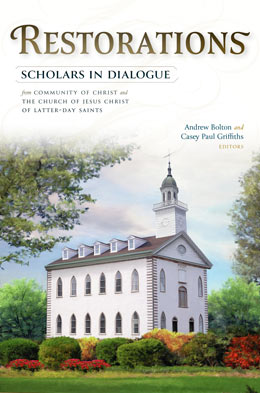
Ordinances and Sacraments
Eva M. Erickson and Casey Paul Griffiths
Eva M. Erickson and Casey Paul Griffiths, "Ordinances and Sacraments," in Restorations: Scholars in Dialogue from Community of Christ and the Church of Jesus Christ of Latter-Day Saints, ed. Andrew Bolton and Casey Paul Griffiths (Provo, UT: Religious Studies Center, Brigham Young University; Salt Lake City: Deseret Book), 71‒86.
Eva M. Erickson has served as the national coordinator for Community of Christ in Germany since 2013 and enjoys exploring the faith and culture of other communities.
Casey Paul Griffiths is an associate teaching professor of church history and doctrine at Brigham Young University in Provo, Utah.
Sacraments in Community of Christ
Eva M. Erickson
“The God who acts and the Christ who is present in the sacraments sustains the church and its members so that they in turn can reach out to others.”[1]
As a minister, I think that some of the most exciting and sacred moments can happen while administering a sacrament (or ordinance, a term perhaps better known to some readers). My favorite sacramental experience is probably the baptism of a young man a few years ago. We were at our church campground in Germany, and the campground did not have a baptismal font. Because of that, we used a local outdoor pool for the baptisms that day. It was pouring rain! But that did not deter the candidate. Baptisms often are somber, reflective moments, but after the young man came back up from the waters, he jumped and shouted with joy! What an experience that was, not just for me as the minister but for all in attendance, to see how this young man had been touched by the presence of God’s Spirit and by the story of Jesus as witnessed through this baptism.
Sacraments have been an integral part of church life in Community of Christ from the very beginning. Initially the term ordinance was used alongside the term sacrament. It is not clear exactly when or why Community of Christ moved away from using the term ordinance. In 1962 the authors Charles E. Brockway and Alfred H. Yale separated and defined the two terms in their book Ordinances and Sacraments of the Church.[2] Other publications used both terms, most often referring to marriage and the Lord’s Supper as sacraments and other ministries as ordinances.[3] In 1978, however, Peter Judd published the book The Sacraments and exclusively used the term “sacraments,” probably because of the increasing focus on God’s grace in Community of Christ theology. Today, Community of Christ uses only the term “sacraments” in all written and verbal communications.
Community of Christ defines sacraments as “special ministries given to the church to convey the grace of Jesus Christ to his followers and all those he yearns to touch with his compassion.”[4] When celebrating sacraments, we use common items in symbolic ways. That means tangible elements like water, bread, and our hands are used to convey sacred actions and meaning. We also use words (for instance, the words for a baptism or a blessing) and perform specific, defined actions.[5]
The eight sacraments celebrated by the church are baptism, confirmation, the Lord’s Supper (or Communion), marriage, blessing of children, laying on of hands for the sick, ordination to the priesthood, and the evangelist blessing (formerly known as the patriarchal blessing, but after the ordination of women to the priesthood, that term no longer seemed appropriate). All eight sacraments can be traced back to scripture references from the Bible, mostly the New Testament. This is a very important point for Community of Christ. Though we no longer claim to have reestablished the organizational pattern of the New Testament church, we do try to live according to our understanding of the gospel and of missional and sacramental activities as seen in the New Testament.
All sacraments except for the evangelist blessing and the laying on of hands for the sick are practiced primarily in the community, either in congregational settings or at campgrounds, sometimes on beaches or in private homes, or, as in the case I described above, in public pools rented for the occasion. Sacraments in Community of Christ are communal experiences, which ensure both the support of the community (for a newly blessed child, for instance, or for a baptismal candidate) and the common experience of a sacred act. This allows all participants to reconnect with God and their own faith journey. On the other hand, sacraments reach far wider than just the one worshipful experience as the church practices the idea of “sacramental living” in our daily lives. We see sacraments in connection with continuing revelation on a personal basis. Sacraments allow us to have fairly frequent experiences with God and help us shape our testimony of God’s grace and mercy. Suzanne McLaughlin says, “Does not our participation in the sacraments open us up to new understandings, open us to new experiences of the Divine, of God’s relationship with us, and our relationship with God and each other?”[6]
In the past half century, Community of Christ has developed from a very exclusive church (“We are the one true church” was a common statement up to the 1970s or so) to a very inclusive church, affirming the worth of all persons more thoroughly through its theology and Enduring Principles.[7] This changed self-image can also be seen in a transformation of some of the sacraments. In the 1980s, Community of Christ felt called to ordain not just men but also women to the priesthood and has gained valuable ministry because of this change. Vital to this new understanding was Doctrine and Covenants section 156, received in 1984, which gave guidance to the church on the calling of women to priesthood.[8]
Another sacrament that underwent changes is Communion (or the Lord’s Supper). The 1994 World Conference asked the First Presidency to develop new guidelines for the administration of communion. Whereas it used to be a sacrament open only to members of Community of Christ, it now can be served to “all who believe in Christ, which usually is expressed in water baptism, whether members of Community of Christ or not.”[9] Only ten years later, and in accordance with World Conference Resolution 1282,[10] the wording of the Communion prayers was expanded, giving ministers the option to use either the traditional wording or a more modern and gender-neutral version of the prayers, as well as a version in which bread and wine (really grape juice since 1913) were blessed within the same prayer. In alignment with several of Community of Christ’s Enduring Principles and by action of national or field conferences, the sacrament of marriage can now be offered in many nations to people of a same-sex orientation, allowing the blessing of the sacred vow to be present in marriage relationships that were not possible until a short time ago. Additionally, in many places members of the LGBT+ community living in committed marriage relationships can now be called to the priesthood.
Some might say that Community of Christ takes it upon itself to change ancient sacraments to fit a modern world. That may be so in some ways. The church, however, describes the sacraments as having some universals and some particulars in their procedures and executions. A universal can be described as “the broad principle that is being brought to life by the sacrament, and the particulars are the rituals or practices that enact this broad principle.”[11] In developing the sacraments to meet the needs of today’s world and especially to be inclusive and value the worth of all persons, some particulars of some sacraments have been changed. The universals, the original sense and meaning of a given sacrament, have remained the same.
Similarly, Community of Christ recently gave guidelines on administrating most of the sacraments in online settings.[12] The need arose out of the growing number of online groups with members who lived far away from each other yet met regularly for worship and fellowship. They are not able to celebrate such sacraments as the Lord’s Supper or ordinations in person, but they now can do so online. Again, particulars to the sacraments were adjusted, but the universals remain.
As much as I enjoy fellowship and worship on a regular basis, as much as I grow in my relationship with God through church life, sacraments are probably where I can experience God’s Spirit most vividly. Be it in an online setting, at a baptism during family camp, or maybe during a much more private sacrament of laying on of hands for healing, the sacraments are a very important part of church life as well as communal and personal sacramental living. As such, they enrich our common life as disciples and ministers in Christ.
Ordinances in The Church of Jesus Christ of Latter-day Saints
Casey Paul Griffiths
A revelation given in September 1832 to Joseph Smith declares that “in the ordinances thereof the power of Godliness is manifest and without the ordinances thereof, and the authority of the Priesthood, the power of Godliness is not manifest.”[13] Ordinances, usually called “sacraments” by our friends in Community of Christ, are central to our connection with each other as church members and essential in forming our relationship with God and seeing his grace made manifest in our lives. From the first time a baby receives a name to the time a person’s final resting place is dedicated, ordinances are one of the most important blessings that members of The Church of Jesus Christ of Latter-day Saints receive as part of their discipleship. Ordinances provide church members with opportunities to serve and bless one another and are one of the primary ways members seek to worship and emulate the Savior. When members engage in these ordinances, they are following Christ’s acts and are thus “put[ting] on Christ” (Galatians 3:27).
Latter-day Saints generally divide the ordinances of the church into two categories. First, ordinances of salvation and exaltation, wherein members make sacred covenants with God that facilitate deliverance from sin and death during and after this life. Other ordinances offered by the church are not essential for salvation but offer ways to receive renewal, comfort, guidance, and healing.[14] Ordinances of salvation and exaltation are generally available only to church members, beginning with baptism and confirmation, which signal entrance into the church. The other ordinances are offered to all people who ask for them. It is not uncommon for a priesthood holder in the church to use his authority to provide a blessing of healing or comfort to a person of another faith. Ordinances of salvation and exaltation are offered to any person who qualifies through righteous living and commitment to live the commandments. There is no worthiness condition or gospel commitment required for a person to receive the ordinances that offer comfort, guidance, or healing.
Latter-day Saints and members of Community of Christ share several of the ordinances of salvation and exaltation, such as baptism, confirmation, and the gift of the Holy Ghost. Other ordinances of salvation reflect the doctrinal and historical divergences of both traditions. Ordinances such as the temple endowment, eternal marriage, and the sealings of families find their origins in the later teachings of Joseph Smith. These ceremonies were further developed by such leaders as Brigham Young, John Taylor, and Wilford Woodruff after the church relocated its headquarters to the Intermountain West. During this period, we began to develop separately from the members who would eventually form the Community of Christ. Ordinances performed in temples represent one of the most significant differences in worship between the members of the two churches.
We honor the elegant temple that was built in Independence, Missouri, by Community of Christ and was dedicated as a monument to peace. We are deeply grateful for the love and care the members and leadership of Community of Christ have shown to the house of the Lord built by the Saints in Kirtland, Ohio. But temples built by The Church of Jesus Christ of Latter-day Saints serve a profoundly different role in our faith than the Independence and Kirtland temples do for members of Community of Christ. Temples, large and small, have been built throughout the world in diverse locations. One of our most important proclamations declares that “sacred ordinances and covenants available in holy temples make it possible for individuals to return to the presence of God and for families to be united eternally.”[15]
In dialogue with our sisters and brothers in Community of Christ, the largest gaps between our worldviews and cosmologies generally stem from misunderstandings over the nature of temple ordinances. This is due in part to the sacredness of these ordinances and some of the hesitancy that members of our church feel in discussing these ceremonies outside the hallowed walls of the temple itself. Over time, the church has led members to be more open about the ordinances of the temple, offering open houses before temples are dedicated that anyone can attend and producing videos explaining the clothing and ordinances of the temple.[16] But a large gulf in understanding these ordinances still remains between members of the two faiths.
In temples, men and women participate in and administer ordinances that provide instructions and allow them to make covenants that bring them closer to God. These ordinances culminate in promises given “to their exaltation and glory in all things, as hath been sealed upon their heads, which glory shall be a fulness and a continuation” (LDS Doctrine and Covenants 132:19). While members can receive ordinances such as baptism and confirmation as early as when they are eight years old, temple ordinances are reserved for church members when they are older. In many ways, the ceremonies of the temple represent the entrance into adulthood for church members. Temple ordinances can be broken down into several basic ceremonies: first, the initiatory ceremony; second, the endowment ceremony; and finally, the temple sealing. Within temples, Latter-day Saints also perform baptisms, confirmations, and all the ordinances of salvation and exaltation on behalf of the deceased. Because much of the confusion between our two faiths results in a lack of understanding about these ordinances, a moment to explain each is useful.
First, the initiatory ordinance consists of symbolic washings and anointings pronouncing blessings upon the receiver. These anointings are similar to those shared in the Old Testament when God directed that “Aaron and his sons thou shalt bring unto the door of the tabernacle of the congregation, and shalt wash them with water. . . . Then shalt thou take the anointing oil, and pour it upon his head, and anoint him” (Exodus 29:4, 7). These washings and anointings, once offered only to the sons of Aaron, are offered in temples to all worthy men and women. Women perform this ordinance for other women, while men perform this ordinance for other men. As part of this ceremony, men and women are given a sacred temple garment that they wear under their clothes inside and outside the temple. These garments perform a function similar to cassocks worn by Catholic priests, yarmulkes worn by some members of the Jewish faith, or headscarves worn by Muslim women.
Though technically the initiatory ceremonies are part of the endowment ordinance, they are treated separately. After a person has experienced the washings and anointings of the initiatory ordinance, he or she experiences the next ceremony, commonly called the endowment. The word endowment means “a gift,” and Latter-day Saints believe they are given several gifts from God through this ordinance. The endowment provides its recipients with greater knowledge of God’s purposes and teachings, increased power to carry out God’s will, comfort and peace, and promised blessings in this life and in the eternities.[17] Many Latter-day Saints count their participation in the endowment as one of the most sacred experiences of their lives.
Temple sealings are often associated with eternal marriage. Many couples in the Church of Jesus Christ are married “for time and eternity,” while others who previously entered civil marriages come to the temple to have their marriages solemnized for eternity. The phrase “till death do us part” is not uttered in temple sealings, because Latter-day Saints believe that their family relationships will last beyond this life. This includes not only marriage relationships but the relationships of parents and children. One of the most moving ceremonies I have witnessed in the temple happened when I saw a couple who had received an earlier civil marriage come to the temple to have an eternal sealing performed. After that ceremony, the door to the room was opened and their two-year-old son ambled into the room. All three were then sealed together as a family for eternity.
While members of other faiths often express concern over the mystery and exclusivity surrounding temple ordinances, Latter-day Saints see these ceremonies as sacred rather than mysterious and as inclusive rather than exclusive. All ordinances of salvation and exaltation can be performed on behalf of the living or by proxy for the dead. We believe that all people will have the opportunity to embrace or reject these covenants of their own volition in this life or the next. One of the presidents of our church, Joseph F. Smith (a cousin of the venerable Joseph Smith III, who was a president of Community of Christ), saw in a 1918 vision that people after this life are “taught faith in God, repentance from sin, vicarious baptism for the remission of sins, the gift of the Holy Ghost by the laying on of hands, and all other principles of the gospel” (LDS Doctrine and Covenants 138:33–34; emphasis added).
While I have confined most of my discussion to temple ordinances, a very meaningful part of my experiences has also come from ordinances that are not linked with salvation or exaltation. As the New Testament directs, “Is there any sick among you? let him call for the elders of the church; and let them pray over him, anointing him with oil in the name of the Lord” (James 5:14). On one occasion, I was given an opportunity to participate in this sacred ordinance. My next-door neighbors, a young couple in their twenties, asked me to come to their home to assist in giving a blessing of healing. Their first child was born only a few days before, and she was experiencing a mild case of jaundice. The mother held her baby while the young father and I carried out the blessing. I performed the first part of the ordinance by anointing the infant, placing a small drop of pure olive oil on her head. Then the father, his hands trembling and his voice nervously shaking, gently laid his hands on the baby’s head and pronounced a blessing. His voice became more calm as a spirit of peace pervaded the room. All of us joined in a sincere “amen” when the blessing was finished. Afterward we visited with one another for a time, and they shared the details of the birth while I shared stories about my own family and children.
It is perhaps in settings like these that the “power of godliness” is most evident in the ordinances of our faith. It can be felt in magisterial settings such as the temple or in simple settings within the home. In each place I have witnessed the influence of God “moving in his majesty and power” (LDS Doctrine and Covenants 88:47; CofChrist Doctrine and Covenants 85:12c). While I am profoundly grateful for the covenants that bring salvation, I am also thankful for the little moments of grace found in the ordinances of the gospel of Jesus Christ.
Response to Casey Paul Griffiths
Casey, I would like to start out by saying that I deeply appreciate this form of exchange. I find it fascinating to learn about the different understandings and interpretations of my sisters and brothers in the Restoration movement and how they arrived at their views. In reading your essay, it became immediately clear to me that the two churches base their interpretations on different sources and faith foundations. We differ in our understanding of the purpose of sacraments, the place where sacraments are to be served, and who may offer sacraments and who may receive them. But there also are similarities, which I find very reassuring.
From reading the description of the ordinances celebrated in The Church of Jesus Christ of Latter-day Saints, it appears that much of the basis of today’s ceremonies and sacraments stems from Joseph Smith Jr., particularly in his later years, as well as from his successors in the church. On the other hand, Community of Christ appears to rarely reference the church’s beginnings, relying much more on references to the New Testament. Interesting as well is the development of the ordinances and sacraments. Casey describes some of the ordinances that were further developed by church leaders like Brigham Young and Joseph F. Smith. These leaders were prophets in the 1800s, making it seem that the ordinances and sacraments have not changed significantly in more than a century. As described in my chapter, however, Community of Christ has authorized some changes and developed some sacraments in more recent years to meet the needs of today’s recipients and participants.
A large section of your essay describes ordinances performed in temples. I did not mention temples in my chapter, because there is no sacrament in Community of Christ that can be performed only in a temple, thus making temples not relevant to my essay. Also, temples are described and explained in detail in another chapter of this book. But it is apparent that the two churches place a different emphasis on the location where a sacrament can or should be performed. In Community of Christ, it does not matter where the sacrament is performed as long as the setting allows the participants to enter a worshipful atmosphere and be open for God’s Spirit to interact with them through the sacrament. In the Church of Jesus Christ, on the other hand, several of the ordinances can be performed only at a set location (that is, a temple).
Together with the difference in requirements for the location where ordinances/
Another major difference is that Community of Christ does not perform or allow any ceremonies on behalf of the dead. Initially, the Reorganization under Joseph Smith III took a passive stand. The early Community of Christ did not deny that the doctrine was taught and practiced under Joseph Smith Jr., but officially they did not adopt this practice for themselves. Eventually the doctrine was rejected, and in the 1960s the sections of the Doctrine and Covenants pertaining to this issue were removed.[19] I would question, “Who is to say that my deceased relatives actually want to have these ceremonies performed for them?” I wonder why such decisions are made pertaining to faith issues for people who are deceased and unable to let us know their preferences. Having said that, I also do not believe that only the faith, traditions, and sacraments of a specific church are able to make me a true believer and grant me salvation. I chose Community of Christ as the church where I want to live out my faith, but in my eyes, this is by no means the only church, nor do I believe that any church is actually necessary for my salvation.
In summary, I find it fascinating to read about the ordinances in The Church of Jesus Christ of Latter-day Saints. I do not understand all the reasoning, and I could not believe all the teachings, but everybody has a right to his or her own faith. By trying to learn about the faith of others, I can ponder my own beliefs and strengthen my faith. Thank you, Casey, for going on this journey of faith with me and helping me understand some aspects of your church better!
Response to Eva M. Erickson
Eva, I wasn’t surprised to find that both us were able to immediately call to mind experiences in which we had witnessed a sacred ordinance or sacrament. It seems that in both of our faiths, the ordinances and sacraments are one of the most vital ways to create experiences that allow all of us to feel close to God and see the divine presence in our lives. Religion is never more joyful than when we feel the grace of Jesus Christ in our experience, and these sacred ceremonies excel at creating moments when we can all connect over something larger than ourselves. There is so much to admire about these ceremonies in both of our faiths, and I have no doubt that God is pleased whenever anyone in any faith tradition sincerely reaches out for divine power.
At the same time, since this is a comparison between the two faiths and the way we do things, let’s compare! I offer first a few questions and then some holy envy for what I see among my friends in Community of Christ. My first question: Community of Christ has a wonderful tradition of focusing on connection to God in the here and now, but what about the hereafter? The ordinances Eva described allow a person to connect with God, but are they linked to an individual’s eternal salvation? What is the difference after this life if a person never receives these sacraments or makes covenants with God? Jesus taught, “He that believeth and is baptized shall be saved; but he that believeth not shall be damned” (Mark 16:16; LDS Ether 4:18; see also CofChrist Ether 1:115; LDS Doctrine and Covenants 68:9; CofChrist Doctrine and Covenants 68:1g). While I admire the focus on this life, what effect do ordinances have in the next life? In our faith tradition, ordinances are divided into those necessary for salvation (meaning after this life) and those that bless us in this life. Do ordinances and sacraments in Community of Christ affect someone only in this life, or do they also impact the life a person experiences after death?
It is clear that many of our differences center on two concepts. First, as Eva mentioned, Community of Christ does not claim to be “the only true and living Church upon the face of the whole earth” (LDS Doctrine and Covenants 1:30; CofChrist Doctrine and Covenants 1:5e). We believe that for ordinances to be efficacious, they must be performed by the proper priesthood authority. Second, in The Church of Jesus Christ of Latter-day Saints there is an extensive theology of the afterlife, including proxy ordinances for the deceased.
It is strange that we spring from the same source, since there is such a striking difference in the way we see the impact of how ordinances and sacraments affect an individual’s eternal salvation. Please do not interpret these inquiries as hostile. I am genuinely curious to know how members of your faith see the next life and its relationship to the covenants we make here. In our faith, the ordinances play a major role both in our mortal experience here on earth and in our experience in the eternities. It is so vital to us that in our temples we devote a considerable amount of our time and resources to ensure that every person, living or dead, has a chance to engage in them. Is there a common ground where the two faiths can meet on this point?
Now that I have raised my questions, let me express some holy envy. There is so much to admire about the way the members of Community of Christ work to make these sacred ordinances available to all of the church’s membership. One of the most meaningful experiences I have had with Community of Christ was in a meeting when church leaders discussed whether ordinances could be administered over distance using technology. In all my dealings with Community of Christ, there is a wonderful spirit of inclusiveness. When it comes to your ordinances and sacraments, the leadership and members genuinely do all in their power to make sure that all people, no matter where they are from or what their backgrounds are, have a chance to receive of the grace of Christ through these sacred ordinances and sacraments.
In all my dealings with members of Community of Christ, I have witnessed a wonderful openness and have always felt welcome to join in experiencing the divine. In all religions there is a tension between being a chosen people and “a peculiar people” (Deuteronomy 14:2), set aside from the rest of the world, and in “creating sacred community” (CofChrist Doctrine and Covenants 161:3c). In ordinances the “community” in Community of Christ is most evident. I feel genuine holy envy for the openness the members show toward these sacred ceremonies that connect them to God. I have felt that connection alongside my sisters and brothers in Community of Christ.
Conclusion
Very few discussions result in absolute agreement, but discussions that promote respect, understanding, and harmony are always welcome. They give us insights and help our own faith to grow. There is no doubt that the beliefs of members of Community of Christ and The Church of Jesus Christ of Latter-day Saints toward ordinances and sacraments have widely different approaches to the questions of priesthood authority, the role of the church and the individual, and the question of salvation in the next life. But we can both agree wholeheartedly about the importance of ordinances and sacraments in the spiritual lives of individuals. Many of the moments when we feel closest to God come when we participate in these sacred acts. The beauty of ceremonies such as baptisms, marriages, and blessings helps members of both churches make the hand of God a reality in their lives and experience the grace of Jesus Christ. So, while our teachings and practices have developed and been followed in widely different ways, we can both agree that “in the ordinances thereof, the power of godliness is manifest” (LDS Doctrine and Covenants 84:20; CofChrist Doctrine and Covenants 83:3c).
Notes
[1] Peter A. Judd, The Sacraments: An Exploration into Their Meaning and Practice in the Saints Church (Independence, MO: Herald Publishing House, 1978), 22.
[2] See Charles E. Brockway and Alfred H. Yale, Ordinances and Sacraments of the Church (Independence, MO: Herald Publishing House, 1962), 9, 14. In this book, ordinances are defined as “a decree or commandment of God” and are seen as one of the elements of each sacrament.
[3] See F. Henry Edwards, Fundamentals: Enduring Convictions of the Restoration (Independence, MO: Herald Publishing House, 1936); and Alan D. Tyree, ed., Exploring the Faith (Independence, MO: Herald Publishing House, 1987).
[4] Community of Christ, Sharing in Community of Christ: Exploring Identity, Mission, Message, and Beliefs, 4th ed. (Independence, MO: Herald Publishing House, 2018), 37.
[5] See Andrew Bolton and Jane Gardner, eds., The Sacraments: Symbol, Meaning and Discipleship (Independence, MO: Herald Publishing House, 2005), 24.
[6] Suzanne McLaughlin, “The Sacraments: Funding Our Image,” in Theology, ed. Donald J. Breckon and William T. Higdon, vol. 2, Authority, Membership, and Baptism (Independence, MO: Graceland/
[7] See “Enduring Principles,” Community of Christ, https://
[8] CofChrist Doctrine and Covenants 156:9c says, “Therefore, do not wonder that some women of the church are being called to priesthood responsibilities. This is in harmony with my will and where these calls are made known to my servants, they may be processed according to administrative procedures and provisions of the law.”
[9] Community of Christ, Sharing in Community of Christ, 46.
[10] World Conference Resolution (WCR) 1282 was adopted in April 2004.
[11] Bolton and Gardner, Sacraments, 40.
[12] See “Sharing the Sacraments of Community of Christ When In-Person Contact Is Not Possible,” October 7, 2020, https://
[13] “Revelation, 22–23 September 1832 [Doctrine and Covenants 84],” p. 1, The Joseph Smith Papers, https://
[14] See General Handbook: Serving in The Church of Jesus Christ of Latter-day Saints, 18.1–18.2, ChurchofJesusChrist.org.
[15] “The Family: A Proclamation to the World,” ChurchofJesusChrist.org.
[16] See the church’s videos “Temples through Time,” 5:58, https://
[17] See “About the Temple Endowment,” https://
[18] See “Enduring Principles.”
[19] For further reading about baptism for the dead in Community of Christ, see the author’s unpublished seminary paper titled “Baptism for the Dead.” The paper can be requested by emailing emerickson@cofchrist.eu.
