
 menu icon in the top, right corner of the screen.
 icon above to close this box.
 icon at the bottom of the screen below the browser—if you don't see it, swipe up to unhide it.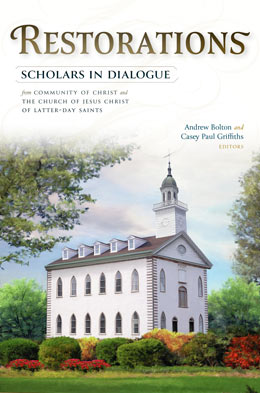
Jesus Christ
Andrew Bolton and Alonzo L. Gaskill
Andrew Bolton and Alonzo L. Gaskill, "Jesus Christ," in Restorations: Scholars in Dialogue from Community of Christ and the Church of Jesus Christ of Latter-Day Saints, ed. Andrew Bolton and Casey Paul Griffiths (Provo, UT: Religious Studies Center, Brigham Young University; Salt Lake City: Deseret Book), 15‒32.
Andrew Bolton, PhD (Wales), worked for eighteen years for Community of Christ in Independence, Missouri, and has published essays on theology, the mission of Community of Christ, and church history.
Alonzo L. Gaskill, PhD, has taught religion for more than thirty years—twenty of which have been at Brigham Young University, where he is a professor of world religions.
Jesus Christ in Community of Christ
Andrew Bolton
“[Jesus] asked them, ‘But who do you say that I am?’ Peter answered him, ‘You are the Messiah.’” (Mark 8:29)
When I was baptized at the age of twenty-three in South Wales, I knew three things. First, I wanted to make the world a better place—I wanted to commit my life to the cause of Zion. Second, I knew I needed to change for the sake of Zion. Third, I felt God calling me to be baptized and to join with others in seeking first the kingdom of God—Zion—in this world.
But who was Jesus? I didn’t have a clue. That was my next quest: to find out. Jesus asks those who follow him as disciples the same question he asked Peter and the other first disciples: “But who do you say that I am?” Now Jesus was prompting me, although I did not know it—“Who are you, Jesus? How do you fit in?” About a year later, the answer dawned on me like a revelation, helped by reading the Bible and the Book of Mormon.[1] I understood both intellectually and spiritually at the same time: “Jesus, you are God become human.” I was stunned. Uplifted. Awed. At the same time, I felt humbled and stupid. Why was I so slow to understand this? I also felt grateful to have a profound answer to my question, thankful for God’s grace and patience with this slow disciple.
God is patient, though, with all of us, as we can see with the early disciples. Peter and Andrew, Mary and Martha, followed Jesus as the first disciples, thinking Jesus was just a rabbi. Then Peter understood that Jesus was the Messiah, God’s special king. A few days later, Peter, James, and John saw Jesus in glory with Moses on one side and Elijah on the other, and Jesus was greater than either. Andrew missed out completely. Doubting Thomas was the “scientist,” needing sense evidence before he believed. When Thomas touched the resurrected Jesus for himself, he confessed, “My Lord and my God!”[2] (John 20:28). Jesus was ordinary, smelled like anyone without deodorant after a day’s work, and got tired, thirsty, and hungry. But in Jesus, God sneaks up on you and me little bit by little bit as we hang out in his stories and in the fellowship of other followers.
Jesus also asks Community of Christ together as a people, “But who do you say that I am?” This is our answer. We begin with the One “who meets us in the testimony of Israel,” who “is revealed” to us in the person and life of Jesus Christ, and who begins and “moves through all creation as the Holy Spirit.” We affirm three as one God, the Trinity, “mystery beyond understanding and love beyond imagination.” The triune God “alone is worthy of our worship.”[3] We join with other Christians over two thousand years who have also confessed this faith.
“We Proclaim Jesus Christ . . .”
The Community of Christ mission statement begins, “We proclaim Jesus Christ”![4] Why proclaim Jesus Christ? Jesus is “the Son of the living God, the Word made flesh, the Savior of the world,” and as the Council of Chalcedon concluded in 451 CE, he is fully human and fully divine.[5] In the life of Jesus, we see what God is really like. Jesus reveals a God who heals, has compassion on the hungry, and has equal regard for both women and men. When Jesus hugs and blesses children, he reveals God’s great love for eager, energetic, giggling little ones and tells us that we must become like them in trusting faith. In Jesus’s tortured body on the cross, God suffers the evil of the world and absorbs the pain, violence, and injustice infinitely to give everyone a fresh new beginning.[6] God does not take revenge; God loves his enemies and forgives all of us, including Peter and Judas, and calls us to do the same. Infinite grace floods the universe with new possibilities. And in the early light of Easter morning, we see the power of God’s love bringing new life, healing, and resurrection wholeness. In the early morning surprise of an empty tomb, justice may still take its time, but Zion is coming.
Why proclaim Jesus Christ? Jesus is the human window into God’s infinite, loving divinity. Jesus is God with skin on, the human face of God. Jesus is the perfect translation of divinity into a human life. Jesus is the Word, greater than scripture, whose kindness and love can be especially understood by children of every gender and race. The One God, Creator of the universe that Jesus reveals, is truly good, wonderful news. This is the gospel! But there is more . . .
“We . . . Promote Communities of Joy, Hope, Love, and Peace”
Community of Christ’s mission statement in full reads, “We proclaim Jesus Christ and promote communities of joy, hope, love, and peace.”[7] We believe in the salvation of individuals, societies, and the earth.[8] We proclaim Jesus Christ as “the Savior of the world.”[9] We declare God’s big salvation through Christ in our troubled times. This salvation includes ending oppressive systems, whether slavery in Egypt, the brutal Roman Empire, or racism, sexism, homophobia, or militarism; confronting ideologies like nationalism, fascism, or neoliberalism; or addressing the present climate emergency. “Through Jesus’ life and ministry, death and resurrection, God reconciles the world and breaks down the walls that divide. Christ is our peace.”[10] Seeking Zion means becoming one family, all humans becoming brothers and sisters, with Christ as our head. We think globally and work out Zion locally in our neighborhoods and villages, one street or footpath at a time.
The Spirit of Jesus
A new life is possible through the continuing presence of the Spirit of Jesus, the Holy Spirit:[11] “The Spirit moves through and sustains creation; endows the church for mission; frees the world from sin, injustice, and death; and transforms disciples. Wherever we find love, joy, peace, patience, kindness, generosity, faithfulness, gentleness, or self-control, there the Holy Spirit is working.”[12] Every Communion service, I am reminded by the prayers on bread and grape juice that in remembering Jesus, in taking his name on myself again, and in keeping his commandments, I will always have his Spirit to be with me.[13] I remember both the darkness of his Crucifixion and the hope of his Resurrection. Evil, injustice, and death do not have the last word. I also love the first account of Joseph Smith’s First Vision in 1820, written in his own hand in 1832. Young Joseph saw the crucified Lord, heard his sins were forgiven him, and for many days afterward felt a great love and joy.[14] Jesus Christ is present for all people, from youth to old age; for every gender, ethnicity, and race; and for every century. Jesus is alive and can be found today by those who seek him; he is the one in whom Zion, shalom on earth, is possible. This is our testimony of Jesus in Community of Christ.
Jesus Christ in The Church of Jesus Christ of Latter-day Saints
Alonzo L. Gaskill
The theological term Christology comes from two Greek words—Χριστός (meaning “Christ”) and λογία (meaning “words” or “discussion”). Thus, the literal meaning of the term Christology is “words or discussion about Christ.”
The Christology of the early Christian Church—particularly in the post-apostolic era—was not very united. Much of the theological discussion about Jesus was focused less on how to be like Christ, or how to apply his teachings in one’s life, and more on his nature (for example, was Jesus “half man and half God” or “fully man and fully God”?).[15] Of course, the typical Christian (the nontheologian) was heavily focused on the application of Christ’s teachings and example—as is evidenced by the thousands who were willing to die a martyr’s death.[16] However, in those early years, the application of Christ’s teachings and salvific atonement was sometimes overshadowed by the vigorous theological debates surrounding lingering Christological questions.
Just as the early Christian Church had shifts in its understanding of Jesus and his nature leading up to and even provoking events like the Council of Nicaea (AD 325), The Church of Jesus Christ of Latter-day Saints has had at least one significant shift in its Christology—and that shift took place on a “beautiful, clear day, early in the spring of eighteen hundred and twenty” (LDS Joseph Smith—History 1:14).[17] We know that when Joseph Smith entered the Sacred Grove, he held a Sabellian, or modalistic, view of the Holy Trinity, presuming the Father and Son to be a singular being.[18] However, following that sacred encounter, his understanding of the personhood of Christ evolved quite dramatically. Thus, Joseph spoke of his surprise at learning that God the Father and God the Son were wholly and completely two separate and distinct beings, though they “exactly resembled each other in features, and likeness.”[19]
The Church of Jesus Christ of Latter-day Saints certainly has a systematic theology, particularly surrounding Christological issues. However, the Encyclopedia of Mormonism is correct in noting that “the term ‘Christology’ is not frequently used by Latter-day Saints.”[20] Not only is the term not frequently employed, but questions about whether Jesus was “fully God and fully man” as opposed to “half God and half man” remain largely unasked in the church.[21] Even the Book of Mormon seems unconcerned about some early Christological issues.[22] Rather, leaders of the church, and the majority of the denomination’s members, seem much more focused on the practical side of Jesus and what he taught. Thus, our theology is less “Christological”—in the proper, academic sense of the term—and more “practical” in its discussion of “Jesus Christ, and him crucified” (1 Corinthians 2:2). Thus, the Prophet Joseph once explained, “The fundamental principles of our religion [are] the testimony of the apostles and prophets concerning Jesus Christ, ‘that he died, was buried, and rose again the third day, and ascended up into heaven;’ and all other things [pertaining to our religion] are only appendages to these.”[23] Note that Joseph’s definition is void of any focus on the more nuanced questions of Jesus’s “nature.” Rather, the Prophet’s 1838 statement seems more interested in defining Jesus’s sacred and salvific mission, not his “divine DNA,” per se.
For me, this “practical” Christology—this focus on Jesus’s love, holiness, and unique way of living and being—has made him more real. Focusing on the lived religion that Jesus taught, not only in his sermons but also in how he lived his life, has shown me how to live a peace-filled, purposeful, and holier existence. Thus, when I converted from Greek Orthodoxy, one of the things that most attracted me to the Restoration was its ability to transition me from a belief in Christ to an actual relationship with him; that relationship, for the first time in my life, included an awareness of the many ways in which I needed Jesus and the many ways in which I could rely on him. Thus, the Christology of the Church of Jesus Christ focuses little on nuanced theological arguments about his personal being and more on how followers of Jesus should personally be. Consequently, the Book of Mormon speaks of “the doctrine of Christ” (LDS 2 Nephi 31; 32; CofChrist II Nephi 13:2), which, in essence, it defines as the path to the celestial kingdom. This doctrine means living as Christ lived and incorporating into our lives the tools he has given us in order to overcome Satan, the world, and all sin and temptation.
With all of that said, there are three theological teachings in The Church of Jesus Christ of Latter-day Saints that I would like to highlight as important for those seeking to understand who Jesus is and what he should mean to and for us.
First, the church takes quite literally the scriptural declaration that Jesus Christ was “begotten of the Father” (John 1:14; see also John 3:16; Hebrews 1:5; LDS 2 Nephi 25:12; CofChrist II Nephi 11:21). He is the firstborn Son of an Eternal Father and a Heavenly Mother. He is our “Elder Brother”—as Brigham Young[24] was wont to call him—and thus “all human beings—male and female—are created in the image of God [just as Jesus was]. Each is a beloved spirit son or daughter of heavenly parents.”[25] This doctrine lays the greatest possible foundation for our belief in eternal families—all of us, including Jesus, being part of the eternal family of our heavenly parents.
Second, Jesus is our exemplar in all things (see John 13:15; 1 Peter 2:21; LDS 3 Nephi 27:27; CofChrist III Nephi 13:5).[26] Indeed, he commanded us to “follow” him—to “deny [ourselves]” and “take up [our] cross” (Matthew 16:24; see also Matthew 19:21; Mark 8:34; 10:21; Luke 9:23; 18:22; John 21:22). Jesus was the epitome of self-denial, self-sacrifice, and love, and he invites all who profess discipleship to do as he has done. In an increasingly irreligious world—a world that is seldom selfless but so often self-serving—Jesus calls those who truly believe in him to follow him through doing their best to live and love as he lived and loved.
Third, and most important of all, Jesus is our Savior and Redeemer. As the Book of Mormon so aptly testifies, “By the law no flesh is justified. . . . Wherefore, redemption cometh in and through the Holy Messiah; for he is full of grace and truth. . . . No flesh . . . can dwell in the presence of God, save it be through the merits, and mercy, and grace of the Holy Messiah” (LDS 2 Nephi 2:5, 6, 8; CofChrist II Nephi 1:69, 71, 73). The words of William Sloane Coffin echo these words of Father Lehi. Coffin wrote, “There is more mercy in God than sin in us.”[27] That is the testimony repeated over and over again in the Book of Mormon (see LDS 2 Nephi 25:20; 31:21; Mosiah 4:8; 5:8; Alma 21:9; 38:9; CofChrist II Nephi 11:39; 13:31; Mosiah 2:12; 3:10–11; Alma 13:13; 18:11–12), and it is the belief, the hope, and the witness of all who have placed their lives and salvation in the hands of Jesus.
The Church of Jesus Christ of Latter-day Saints is often perceived as unique among Christian denominations because of its temple ordinances, including its associated covenant relating to eternal families, and because of its doctrine of theosis, or divinization. Importantly, each of these intertwined ordinances and doctrines has Jesus at its center, and each highlights the need for us to strive to be Christians—not just in name but in how we think, live, interact, and love. The three doctrinal principles previously mentioned—being part of God’s eternal family, earnestly seeking to follow Jesus’s way of living, and sincerely repenting through the Atonement of Christ—are at the core of what is taught in the temple endowment, the sealing ordinances, and the doctrine of deification. Each is entirely about Christ.
Because Jesus is central to all the Church of Jesus Christ teaches and does, not surprisingly, in their January 1, 2000, proclamation to the world—“The Living Christ”—the First Presidency and Quorum of the Twelve Apostles declared sacred truths such as these: “None other [than Jesus] has had so profound an influence upon all who have lived and will yet live upon the earth.” His was “a message of peace and goodwill,” and he “entreated all to follow his example” of propagating peace and kindness. “He gave His life to atone for the sins of all mankind,” and “His life . . . is central to all human history.” In a coming day, “every knee shall bend and every tongue shall speak in worship before Him. . . . He is the light, the life, and the hope of the world. His way is the path that leads to happiness in this life and eternal life in the world to come. God be thanked for the matchless gift of His divine Son.”[28]
As a summary of Jesus’s most precious gift, I would point the reader to the words of the ancient prophet Alma, who spoke of Christ as choosing to suffer not just for our sins or our unavoidable eventual death but also for our “pains and afflictions . . . and [our] sicknesses” and our “infirmities.” Alma informs us that Jesus did this “that his bowels [might] be filled with mercy,” that he might “succor his people according to their infirmities” (LDS Alma 7:11–12; CofChrist Alma 5:20–22). Jesus felt a need—no, a desire—to know you and me so intimately that he would perfectly understand what it was like to be us, to be tempted almost beyond the ability to withstand while having our personal history, our health, our upbringing, our situation in life, and so on. Jesus truly understands our challenges because he personally experienced them and suffered for them—and this personal understanding has filled him with mercy and the ability to succor us in all things. Remarkable! Unfathomable! As the old hymn says, “What a friend we have in Jesus.”[29]
This is the Christ whom we worship and adore!
Response to Alonzo L. Gaskill
I love Alonzo’s mention of the quote by William Sloane Coffin: “There is more mercy in God than sin in us.”[30] Alonzo writes about Jesus Christ with elegance, scholarship, and sincere personal conviction. I am grateful that he has opened up new insights and perspectives on The Church of Jesus Christ of Latter-day Saints that are interesting and thoughtful. I especially appreciate his final paragraph, which sings of Jesus as a real and personal Savior who loves us more fully, deeply, and completely than we can know.
It is again important for me to say that Jesus is both as human as we are and much more. I know I will never fully understand Jesus. Jesus is more than I can conceive and greater than I can fathom or understand. “We see through a glass, darkly,” the apostle Paul wrote (1 Corinthians 13:12, KJV). For me, all language about God is provisional, metaphoric. The commandment against creating idols pushes me away from being literal about God. That is why we believe in continuing revelation; God’s Holy Spirit has more to share or to reveal. So humility in seeking to define or discuss Jesus is an important quality in a scholar disciple. That is why creeds are inadequate and why, in the end, we simply are drawn to worship in both praise and profound silence, moved too deeply to find words to express the wonder of Jesus Christ. If smartphones had been around two thousand years ago, we could have photographed Jesus, but we would not have captured at all Jesus’s divine depth. So in responding to Alonzo’s understanding of Jesus, who am I in my limited humanity to be sure I am right? If the first apostles were around Jesus for three years and still struggled to really understand him, I need to be very humble in my conclusions.
So, what are my humble reflections about Alonzo’s account?
First, we agree that in the first three hundred years after Jesus’s death, the early church was rigorous in teaching discipleship. As Alonzo states, early Christianity was a movement that suffered persecution and martyrdom. I would add that the Sermon on the Mount was central to discipleship formation at this time.[31] It took at least three years of teaching and being an apprentice Christian, including serving the poor, before a candidate was baptized.[32] Alan Kreider, an outstanding early Christian Church scholar, wrote, “It was not Christian worship that attracted outsiders; it was Christians who attracted them, and outsiders found the Christians attractive because of the Christian habitus, which catechesis and worship had formed.”[33] I think the Restoration was about recovering high-commitment discipleship and the journey of sanctification after justification through faith in Christ’s grace.[34] After Constantine, the first Christian emperor (306–37), this purpose was often lost, except for in the monastic traditions. So for the early Christians, rigorous, faithful discipleship was important. And this kind of discipleship is important for us in the Restoration. I find it beautifully significant that Jesus teaches a version of the Sermon on the Mount in all its demanding radicality to the Nephites. So if we are serious about following Jesus, we should be serious about living the Sermon on the Mount.
Second, who did Joseph really see in the First Vision? Joseph’s own first account of the 1820 First Vision says he simply saw the crucified Lord, a single personage. This account was written in Joseph’s own hand in the summer of 1832.[35] This initial theology is also evident in the Book of Mormon (LDS 2 Nephi 31:21; CofChrist II Nephi 13:31; LDS Mosiah 15:1–4; CofChrist Mosiah 8:28–32). Did Joseph continue to reflect theologically on the profound experience of the 1820 First Vision? Yes, his reflections are clear in later accounts, including the 1838 account of two personages, canonized by The Church of Jesus Christ of Latter-day Saints in the Book of Moses. So I would suggest that seeing two personages is a later reflection, not an initial understanding.
It is important to know who Jesus is as well as what it means to follow Jesus as a student disciple. For Community of Christ, Jesus is the One, infinite God of the universe, Creator of all things—become human. The human, finite Jesus is also the infinite, eternal God. Christ’s Atonement is thus infinite and personal, which is why we can agree that “there is more mercy in God than sin in us.” The infinite and personal nature of the Atonement means Zion is possible. Thus, in the mercy of God in Christ, there is hope for Alonzo, me, and you. Blessed as we are with mercy, we should also be merciful to others and love our enemies as the Savior did.
Response to Andrew Bolton
Right out of the gate, Andrew lays the foundation for the remainder of his essay by defining what it means to be a Christian. Andrew speaks of what he wanted when he converted to Community of Christ (back then the Reorganized Church of Jesus Christ of Latter Day Saints) at the ripe old age of twenty-three. He hoped to become the type of disciple of Jesus who (1) had a desire to do good, (2) had a willingness to conform his life to the image and pattern of the Savior’s life and teachings, and (3) had a sense of calling or mission wherein he knew his life had purpose and divine direction. What a beautiful summary of the true Christian life.
At times in his essay, Andrew’s language feels creedal and thus may be a bit unfamiliar to those of The Church of Jesus Christ of Latter-day Saints, in which formal creeds are not utilized. For example, he writes that Jesus was “God become human.” Then he adds, “We affirm three as one God, the Trinity, ‘mystery beyond understanding and love beyond imagination.’ The triune God ‘alone is worthy of our worship.’” While Andrew’s wording will feel foreign to those who are members of the Utah-based church, setting language aside, I think there is much in Andrew’s statement that members of The Church of Jesus Christ of Latter-day Saints would agree with. For example, the oneness of the three “persons” or “members” of the Godhead is repeatedly attested to in scripture,[36] though it is a spiritual and purposeful oneness, not a metaphysical oneness. Also, Alma testified that “there are many mysteries which are kept, that no one knoweth them save God himself” (LDS Alma 40:3; CofChrist Alma 19:31). For the most enlightened among us, God is beyond our full understanding, and his love is beyond our imagination. As to the focus of our worship, surely no Latter-day Saint Christian (of any branch of the Restoration movement) would challenge the assertion that the only beings worthy of our worship would be the members of the Godhead (or, as Andrew refers to them, the “triune God”). The Encyclopedia of Mormonism points out the following:
Latter-day Saints center their worship in, and direct their prayers to, God the Eternal Father. This, as with all things—sermons, testimonies, prayers, and sacraments or ordinances—they do in the name of Jesus Christ (2 Ne. 25:16; Jacob 4:4–5; 3 Ne. 18:19; D&C 20:29; Moses 5:8). The Saints also worship Christ the Son as they acknowledge him as the source of truth and redemption, as the light and life of the world, as the way to the Father (John 14:6; 2 Ne. 25:29; 3 Ne. 11:11).[37]
Thus, while we certainly have disagreements in how we speak of and potentially understand the Godhead or Trinity, there is more in common here than I think there is distinctiveness—all language aside.
I think the most important aspect of Andrew’s essay is his description of God’s nature and how you and I should respond to who God is at his core. Andrew speaks of God as a “compassionate . . . healer” who has concern and love for all. He describes God not as a vengeful God but instead as one who “loves His enemies and forgives all of us” through his “infinite grace.” That grace and love brings “new life, healing, and . . . wholeness,” Andrew wisely points out.
Having offered these descriptors of the character and nature of God and Christ, Andrew then makes what I feel are the most important statements in his essay and gives the most important invitations for you and me as disciples of Jesus Christ. He writes, “Jesus is . . . the human face of God,” and he is “present for all people, from youth to old age; for every gender, ethnicity, and race; and for every century.” Reflecting on these ideas, he adds, “Every Communion service, I am reminded by the prayers on bread and grape juice that in remembering Jesus, [I am] taking his name on myself again.” Of course, taking upon us the name of Jesus implies being wedded to our Bridegroom (see LDS Doctrine and Covenants 33:17; CofChrist Doctrine and Covenants 32:3e), yoked fully with him (see Matthew 11:29), and striving to be one with him while living and acting like him (see 1 Corinthians 2:16). This important point reminds me of a comment made by Elder Dieter F. Uchtdorf, a member of the Quorum of the Twelve Apostles in The Church of Jesus Christ of Latter-day Saints, paraphrasing a statement often attributed to Saint Francis of Assisi: “‘Stand as witnesses’ of the power of the gospel at all times—and, when necessary, use words.”[38] That famous statement is at the heart of Andrew’s essay. As disciples of Jesus Christ, we must live our lives as more than a verbal attestation that there is a God and Jesus is his Christ. True discipleship has, at its heart, a living, breathing, loving imitation of the words, walk, and ways of the Lord Jesus Christ. I think Andrew and I would both agree—that is the teaching and message of Community of Christ, and it is the message of The Church of Jesus Christ of Latter-day Saints as well. And, in the end, it must be the message that all our lives send to the world, if we truly do love the Lord.
Conclusion
We are denominations with a common Restoration origin but have been separate for nearly 180 years. For the first time in our histories, we are engaging in authentic dialogue, listening and seeking to understand each other. This is significant.
We agree about the nature of true discipleship—we must follow the grace-filled Jesus. We both believe that Jesus is the only true manifestation of God in the flesh. Jesus’s life is the road map for salvation. We both believe that only in and through Jesus Christ is salvation possible. While sacraments and ordinances have their place as potential avenues to God’s grace, Christ is always the source of grace. To follow Jesus also means to be committed to the equal worth of all people and “the cause of Zion”—the transformation of the world into the kingdom of God on earth. Finally, we both rejoice in William Sloane Coffin’s statement that “there is more mercy in God than sin in us.” This mercy, revealed in and through Jesus Christ, is how our personal salvation and the realization of Zion—so necessary for the redemption of the world—are possible.
As to our dissimilarities, our two traditions differ on the relative weight we each place on the importance of the Prophet Joseph Smith and Christian tradition. The Church of Jesus Christ of Latter-day Saints leans heavily on scripture (ancient and modern) and the Prophet’s revealed teachings and sacramental ordinances (and their grounding in Christ) for its understanding of the nature of Jesus and his relationship with the Father. For Community of Christ, on the other hand, the Bible, especially the New Testament, and two thousand years of Christian tradition are foundational to how Jesus’s nature and relationship to the Trinity are understood.
Notes
[1] See John 1:1–18; 14:8–11; Colossians 1:15–20; and Philippians 2:5–11. Additionally, the introduction to the Book of Mormon reads in part, “To the convincing of the Jew and Gentile that Jesus is the Christ, the Eternal God, manifesting himself unto all nations.” Echoes of the high Christology found in the Gospel of John (“Whoever has seen me, has seen the Father. . . . The Father who dwells in me does his works” [John 14:9–10, NRSV]) can also be found at least fourteen times in the Book of Mormon (e.g., CofChrist Mosiah 8:28–32; LDS Mosiah 15:1–5). Jesus is the incarnation of the God of Israel, the Creator of the universe (CofChrist III Nephi 5:11–17, 27; LDS 3 Nephi 11:10–17, 27). Incarnation is beautifully clear in many passages of the Book of Mormon.
[2] “Jesus is Lord” is the first and simplest creed of the New Testament and early church (see 1 Corinthians 12:3, NRSV). This confession of Jesus as Lord and Savior is also important for the World Council of Churches, which “is a fellowship of churches which confess the Lord Jesus Christ as God and Saviour according to the scriptures.” “What Is the World Council of Churches?,” World Council of Churches, https://
[3] “Basic Beliefs,” Community of Christ, https://
[4] Community of Christ, Sharing in Community of Christ: Exploring Identity, Mission, Message, and Beliefs, 4th ed. (Independence, MO: Herald Publishing House, 2018), 20, https://
[5] “Basic Beliefs.”
[6] The following references are teachings on infinite atonement that I find very moving: CofChrist II Nephi 6:11–19; LDS 2 Nephi 9:6–7; CofChrist II Nephi 11:26; LDS 2 Nephi 25:16; CofChrist Alma 16:207–17; LDS Alma 34:8–16.
[7] Community of Christ, Sharing in Community of Christ, 20.
[8] Community of Christ, Sharing in Community of Christ, 34–35.
[9] “Basic Beliefs.”
[10] “Basic Beliefs,” in the paragraph on Jesus Christ. See also the paragraph on salvation.
[11] For example, references to the Spirit of Jesus are found in Acts 16:6–7 and in Paul’s letters in Philippians 1:19 and Galatians 4:6. Jesus sends or gives the Holy Spirit: see Luke 24:49; John 15:26–27; and John 20:22.
[12] “Basic Beliefs.”
[13] See CofChrist Doctrine and Covenants 17:22a–23b; LDS Doctrine and Covenants 20:75–79.
[14] See Joseph Smith, “History, circa Summer 1832,” https://
[15] For example, in the years following the death of Jesus and the apostles, there were different Christological “schools,” which have been referred to as the “Heretical Left” (those who exaggerated the humanity of Jesus) and the “Heretical Right” (those who exaggerated the divinity of Christ). On the “left” were groups like the Arians (and other subordinationist schools), the Ebionites, the Logos-Anthropos school (also known as the “Word-Man” school), and the Nestorians. On the “right,” however, were Gnostics (and various branches of Gnosticism, like Docetism), Apollinarians, Monophysites, and Monothelites. Jesus’s exact nature when he walked the earth was not universally agreed on in the first centuries of the Common Era, nor is it agreed on by all Christian denominations today—including the various denominations of the Restoration.
[16] See David B. Barrett and Todd M. Johnson, “The Demographics of Christian Martyrdom, AD 33–AD 2001,” in World Christian Trends, AD 30–AD 2200: Interpreting the Annual Christian Megacensus, ed. Christopher R. Guidry and Peter F. Crossing (Pasadena, CA: William Carey Library, 2001), 228, graphic 4-1.
[17] See also Richard P. Howard, The Church through the Years, vol. 1, RLDS Beginnings, to 1860 (Independence, MO: Herald Publishing House, 1992), 94.
[18] Modalism, also called Sabellianism (after the third-century theologian Sabellius), in essence holds that the Father, Son, and Holy Spirit are the same singular divine being, who appears in different “modes” or forms to humankind. Thus, contrary to the doctrine of the Holy Trinity, wherein the Father, Son, and Holy Spirit are three distinct “persons” (or “hypostases”), modalists hold that there is only one divine “person,” but that “person” or deity chooses to reveal himself sometimes in the form of the Father, at other times in the form of the Son, and at other times in the form of the Holy Spirit.
[19] Joseph Smith, “Church History,” Times and Seasons, March 1, 1842, 707.
[20] Gary P. Gillum, “Christology,” in Encyclopedia of Mormonism, ed. Daniel H. Ludlow (New York: Macmillan, 1992), 1:272. Not only is the term Christology uncommon in the church, but for some time after Joseph Smith’s death, the term Trinity lingered before the church officially rejected that term, replacing it with the New Testament descriptor Godhead. As an example, Brigham Young would sometimes use Godhead and other times use Trinity when referencing the Latter-day Saint heavenly presidency. See The Complete Discourses of Brigham Young, 5 vols., comp. Richard S. Van Wagoner (Salt Lake City: Smith-Pettit Foundation, 2009), 1:46; 3:1377; 3:1838; 5:2818.
[21] Of our Christology, the 1992 Encyclopedia of Mormonism states the following:
The doctrine of the Church can be described in the following manner: Jesus Christ descended from his high pre-existent station as a God when he came to earth to die for mankind’s sins. . . . He was Jehovah come to earth in a physical body as the Only Begotten of the Father in the flesh. . . . While on earth he was still God, but he received from his Father “grace for grace,” as do God’s other children [Doctrine and Covenants 93:12]. The Book of Mormon and Doctrine and Covenants speak forcefully of the divine sonship of Christ and also of his humanity (Mosiah 15:2–3; Alma 6:8; 11:38; 13:16; 34:2; 3 Ne. 11:7, 28:10; D&C 93 . . .). (Gillum, “Christology,” 1:272)
[22] Indeed, that sacred text is inconsistent in its Christology, contingent on which of the ancient prophetic witnesses speak of Jesus. At times, the Book of Mormon sounds rather modalistic in its description of the Father and Son (e.g., LDS 2 Nephi 11:7; CofChrist II Nephi 8:14; LDS Mosiah 7:27; CofChrist Mosiah 5:44–45; LDS Mosiah 13:28, 34; CofChrist Mosiah 8:5, 13; LDS Mosiah 15:1–4; CofChrist Mosiah 8:28–31; LDS Mosiah 16:15; CofChrist Mosiah 8:91; LDS Mosiah 17:8; CofChrist Mosiah 9:11–12; LDS 3 Nephi 11:27; CofChrist III Nephi 5:27; LDS 3 Nephi 11:36; CofChrist III Nephi 5:38; LDS Mormon 7:7; CofChrist Mormon 3:29; LDS Mormon 9:12; CofChrist Mormon 4:71; LDS Ether 3:14; CofChrist Ether 1:77–78; LDS Ether 4:7; CofChrist Ether 2:101). At other times, it is quite clear that the Father and Son are distinct and separate personages (e.g., LDS Alma 12:33–34; CofChrist Alma 9:54–55; LDS 3 Nephi 9:15; CofChrist III Nephi 4:44; LDS 3 Nephi 11:7; CofChrist III Nephi 5:8; LDS 3 Nephi 19:29; CofChrist III Nephi 9:30; LDS Mosiah 3:8; CofChrist Mosiah 1:102; LDS 3 Nephi 20:31; CofChrist III Nephi 9:69; LDS 3 Nephi 27:28; CofChrist III Nephi 13:5–6; LDS Ether 4:12; CofChrist Ether 2:107). For at least two reasons, this inconsistency actually supports the argument that Joseph Smith is not the author of the Book of Mormon. First, Joseph’s own Christology shifted after the First Vision, and yet there are still seemingly modalistic views of the Godhead in the Book of Mormon—a text Joseph translated after his First Vision. Second, were Joseph the author of the text (as a work of nineteenth-century fiction), it is hard to imagine him consciously vacillating in his Christology as he wrote. Indeed, it would make fabricating the text much more challenging, as one would have to keep the various Christological and theological views distinct and unique, based on which “character’s” voice the novelist is seeking to convey. That said, Professor Roy Doxey suggested that the seeming contradiction in the Christology of the Book of Mormon is a result of stripping the passages cited as “evidence” of modalism from their context. See Roy W. Doxey, “Some Passages in the Book of Mormon Seem to Indicate That There Is Only One God and That He Is a Spirit Only. How Can We Explain This?,” Tambuli, May 1986.
[23] Joseph Smith, Elders’ Journal of the Church of Jesus Christ of Latter Day Saints, July 1838, 44.
[24] See Brigham Young, in Journal of Discourses (London: Latter-day Saints’ Book Depot: 1854–86), 1:91, 6:332, 7:283, 8:137, 8:339, 11:273, 12:69, 14:71, 18:77, etc.
[25] “The Family: A Proclamation to the World,” ChurchofJesusChrist.org.
[26] “The Restoration of the Fulness of the Gospel of Jesus Christ: A Bicentennial Proclamation to the World,” ChurchofJesusChrist.org.
[27] William Sloane Coffin, “Our Resurrection, Too,” in The Riverside Preachers, ed. Paul H. Sherry (New York: Pilgrim Press, 1978), 163.
[28] See “The Living Christ: The Testimony of the Apostles,” ChurchofJesusChrist.org. See also Gospel Topics, “Jesus Christ,” topics.ChurchofJesusChrist.org.
[29] Joseph Medlicott Scriven, “What a Friend We Have in Jesus,” https://
[30] Coffin, “Our Resurrection, Too,” 163.
[31] See Alan Kreider, The Patient Ferment of the Early Church: The Improbable Rise of Christianity in the Roman Empire (Grand Rapids, MI: Baker Academic, 2016), 161. See also Ronald J. Sider, ed., The Early Church on Killing: A Comprehensive Sourcebook on War, Abortion, and Capital Punishment (Grand Rapids, MI: Baker Academic, 2012), 168, 171. Sider compiled, read, and analyzed all the relevant early church documents on killing. He found that Matthew 5:38–48 is probably the most frequently cited biblical text in the writings collected. At least ten different writers in at least twenty-eight different places cite or refer to this biblical passage and note that Christians love their enemies and turn the other cheek. One can also note that the Sermon on the Mount was central to Jesus’s teaching of the Nephites.
[32] See Kreider, Patient Ferment, 177.
[33] Kreider, Patient Ferment, 135.
[34] In the “New Testament” of the Book of Mormon, Jesus teaches a version of the Sermon on the Mount, and later the disciples of Jesus live in peace for two hundred years in an expression of Zion. By seeking to live nonviolently and obey the law of consecration in communal forms of Zion, the early Saints were seeking to live bold and faithful discipleship. They embarked on the journey of sanctification, not deification.
[35] See Smith, “History, circa Summer 1832.”
[36] See, for example, John 10:30; 17:22; 1 John 5:7; “The Testimony of the Three Witnesses”; LDS Mosiah 15:1–4; 3 Nephi 11:27, 36; 20:35; 28:10; Mormon 7:7; Doctrine and Covenants 20:28; 50:43; 93:3–4; CofChrist Mosiah 8:28–31; III Nephi 5:27, 38; 9:73; 13:21; Mormon 4:29; Doctrine and Covenants 17:5h; 50:8f; 90:1b.
[37] Robert L. Millet, “Jesus Christ,” in Encyclopedia of Mormonism, ed. Daniel H. Ludlow (New York: Macmillan, 1992), 2:726; emphasis added.
[38] Dieter F. Uchtdorf, “Missionary Work: Sharing What Is in Your Heart,” Ensign, May 2019, 17.
