
 menu icon in the top, right corner of the screen.
 icon above to close this box.
 icon at the bottom of the screen below the browser—if you don't see it, swipe up to unhide it.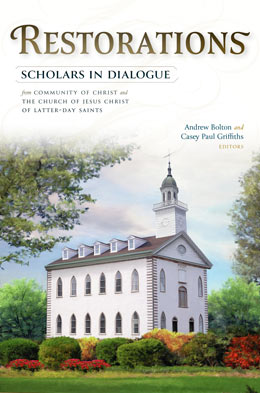
A Brief History of the Dialogue
Richard G. Moore
Richard G. Moore, "A Brief History of the Dialogue," in Restorations: Scholars in Dialogue from Community of Christ and the Church of Jesus Christ of Latter-Day Saints, ed. Andrew Bolton and Casey Paul Griffiths (Provo, UT: Religious Studies Center, Brigham Young University; Salt Lake City: Deseret Book), 1‒14.
Richard G. Moore, EdD, was employed for thirty-eight years as an instructor for the Church Educational System of The Church of Jesus Christ of Latter-day Saints, and he has authored several books and articles on theology and church history.
On a warm day in August 2016, a small group of individuals met at the campus of Graceland University in Independence, Missouri. This was the first meeting of a proposed semiannual assembly of people composed of members of Community of Christ (formerly the Reorganized Church of Jesus Christ of Latter Day Saints [RLDS Church]) and members of The Church of Jesus Christ of Latter-day Saints from Brigham Young University’s Office of Religious Outreach. Considering the many years of “bad blood” between these two organizations, it seemed an unlikely gathering.
Dialogues between religious institutions are not uncommon. A Latter-day Saint and evangelical dialogue has been taking place for nearly twenty years. A dialogue between several Latter-day Saint and Jewish scholars has also been established. Community of Christ has a long history of ecumenical efforts and cooperation, including membership in the National Council of Churches.[1] What made The Church of Jesus Christ of Latter-day Saints / Community of Christ dialogue unique was the organizations’ shared history. Both groups trace their origins to the church organized by Joseph Smith in 1830.
Joseph Smith didn’t speak of creating a new church or reforming Christianity. Rather, he spoke of a “restoration” of the ancient church established by Jesus Christ during his mortal ministry. Focused efforts at evangelization resulted in the dramatic growth of the restored church, initially known as the Church of Christ, then the Church of the Latter Day Saints, and later The Church of Jesus Christ of Latter-day Saints.[2]
The Latter-day Saints faced opposition in every part of the United States in which they tried to establish themselves.[3] Eventually, they gathered to Illinois, on the banks of the Mississippi River, where they built a city they named Nauvoo. However, during the Nauvoo era, the church once again faced bitter opposition, resulting in the murders of Joseph Smith and his brother Hyrum while they were incarcerated in Carthage, Illinois.
Following the death of Joseph Smith, division and confusion arose as to who should take the reins of leadership in Joseph’s place. This period of uncertainty is often referred to as a succession crisis.[4] Brigham Young (with the Quorum of the Twelve Apostles), Sidney Rigdon, James J. Strang, and several others each claimed to be the rightful heir to the leadership of the church. Based on these assertions, various churches emerged, each claiming (in one way or another) to be the continuation of the church restored by Joseph Smith.
Within a few years of Joseph Smith’s death, most of the Saints left the Nauvoo area, either by choice or by force. Most followed Brigham Young and the Twelve, though many joined other factions, and still others chose not to unite with any organization. Eventually, the two groups that became the largest and most thriving (of the schisms resulting from the succession crisis after the death of Joseph Smith) were The Church of Jesus Christ of Latter-day Saints and the Reorganized Church of Jesus Christ of Latter Day Saints.
Brigham Young and his group traveled west and established their church headquarters in what would become Salt Lake City, Utah. Some who did not accept Brigham Young’s leadership remained in the Midwest, still believers in the Restoration but unsure whose leadership to follow. Many former followers of Joseph Smith united with the several factions led by various individuals, such as Sidney Rigdon, James Strang, and William Smith, only to become disillusioned with these new churches, their leaders, and their doctrines. Jason W. Briggs received a revelation in which he learned that a descendant of Joseph Smith would rise up and take his rightful place as the prophet of the restored church. A loosely organized group of branches—consisting of Saints who had refused to join any of the post-Joseph-era factions and others who had followed one claimant or another but then had withdrawn from those movements—coalesced around Briggs’s prediction, awaiting the time when its promise would be fulfilled. A conference of these congregations met in the summer of 1852 to consider the revelation that had been received by Briggs. Community of Christ historian Roger D. Launius wrote of this conference: “It was united only in its opposition to other Mormon factions, in its acceptance of the Briggs document as divine revelation, in its belief that Mormonism as set forth in the Scriptures was correct, and in its affirmation that the proper successor to the prophetic office was growing to maturity in Nauvoo and would one day step forth to accept his calling.”[5]
This “New Organization” of the Church of Jesus Christ of Latter Day Saints selected presiding officers and made efforts to persuade Joseph Smith III to accept the role of leader of their church. After several years of what young Joseph considered to be humbling, preparatory experiences, he agreed to take leadership of the “New Organization.” At a church conference held in Amboy, Illinois, on April 6, 1860, Joseph Smith III was unanimously accepted as the “prophet, seer, and revelator of the church of Jesus Christ, and the successor of his father.”[6] In 1872, this organization took on the name of the Reorganized Church of Jesus Christ of Latter Day Saints.
From the time of Joseph Smith’s death, there were disagreements and hard feelings among the various factions that arose. Between the two largest organizations, The Church of Jesus Christ of Latter-day Saints and the Reorganized Church of Jesus Christ of Latter Day Saints, there was much distrust and even some animosity. Harsh things were said and put into print from each of the two churches about the other.[7] In those early days, polygamy was a significant issue between the two churches, with sharp exchanges about the origins and practice of plural marriage.
However, in more recent decades, much of the rancor that defined the early relationship between the two main Restoration churches has dissipated. There are several reasons behind this change of attitude. First, with a fourteen-year history shared by the two churches, historians from both camps have become acquainted with one another and have even worked together on some projects. These connections have facilitated the development of a comradery between historians of the two organizations, the effects of which have improved relationships. Community of Christ members also began to participate in the Mormon History Association, and Latter-day Saint scholars became involved in the John Whitmer Historical Association.[8]
Another circumstance that has led to closer relationships is, strangely enough, changes within both faith traditions that have resulted in fewer issues between the formerly hostile Restoration relatives. The Reorganized Church of Jesus Christ of Latter Day Saints aligned themselves more with the Kirtland-era church and doctrine, whereas The Church of Jesus Christ of Latter-day Saints theology was based more on the doctrine and practices of the Nauvoo era. Though early on there were certainly doctrinal differences between the two branches, such as polygamy and lineal successions of the presidency versus succession through the Quorum of the Twelve, these are not considered major issues today.[9]
A move toward more mainstream Protestantism has effected changes in doctrinal focus and resulted in a new name for the Reorganized Church of Jesus Christ of Latter Day Saints—now known as Community of Christ. While The Church of Jesus Christ of Latter-day Saints moved toward the conservative American mainstream, it has maintained many of its early distinctive beliefs, although plural marriage (or polygamy) is no longer practiced. Similarly, lineal succession is no longer perceived as a requisite for succession in Community of Christ.
In light of improved relationships between individuals within Community of Christ and The Church of Jesus Christ of Latter-day Saints, people in both groups began to consider the possibility of improving communication and understanding through an organized dialogue. Identifying all the events that created an environment for the Latter-day Saint / Community of Christ dialogue to take place is not possible; however, a few experiences can be cited as being foundational for the dialogue.
The John Whitmer Historical Association (JWHA), created primarily by members of the then Reorganized Church of Jesus Christ of Latter Day Saints, is an independent scholarly society composed of individuals of various religious faiths who share a lively interest in the history of the Restoration movement. The annual JWHA conference in 2014 was held in Lamoni, Iowa, where the main campus of Community of Christ’s Graceland University is located. Several members of The Church of Jesus Christ of Latter-day Saints attended that conference, including Scott Esplin from Brigham Young University. Esplin related the following:
After the awards ceremony on Friday night of that conference, I found myself seated at a table at the back of the room. A conversation began with Andrew and Jewell Bolton (from Community of Christ) about our respective life experiences and beliefs. I wanted to better understand the Community of Christ and to represent them properly when questions arise (as they often do) in my classes, and it quickly became clear that they had questions about our teachings as well. A lengthy, productive conversation emerged, followed by a lasting friendship. As we talked, others gathered at our table until there were several together, asking and answering questions in a spirit of genuine understanding. . . . In his kindly way, Andrew sent a nice note upon our respective return to our homes following the conference, thanking me for our time of sharing together and for answering so many questions. The friendship, and the spirit of open discussion, has remained. He has since visited my classes at BYU, we toured Temple Square and the Church History Library together, visited the open house for the Jordan River Temple, and continue to have meaningful discussions.[10]
Another influential experience took place during the annual Book of Mormon in Zion Conference in Independence, Missouri.[11] Andrew Bolton had made arrangements for a small group of individuals from Brigham Young University to meet with the president of Community of Christ, Stephen M. Veazey. At a luncheon that day, Robert L. Millet (emeritus dean of Religious Education at BYU) and Andrew Bolton (then an apostle in Community of Christ) sat together and visited. The topic of interfaith relationships came up, and Millet commented about how enjoyable the dialogue with evangelicals had been since their first meeting in 2000. Millet recalled, “Andrew asked if I thought that a Latter-day Saint/
Of this discussion, Bolton wrote, “I had been impressed by the kindly, insightful, and personable reasoning of Bob[,] who had been involved in that interchange [the Latter-day Saint / evangelical dialogue] over perhaps a decade. In addition, Bob Millet had inspiringly introduced me to the concept of ‘infinite atonement’ for which I will be forever grateful. There were already blessings of Latter-day Saint/
Over the next few weeks, Bolton and Millet communicated by email regarding what such a dialogue would look like. Principles that had guided the Latter-day Saint / evangelical dialogue were sent to Bolton, and he agreed that those principles should guide the proposed dialogue. There were some initial concerns that the dialogue might become argumentative, each side pointing out the flaws in beliefs and practices of the other, or that the dialogue was simply an attempt by Latter-day Saints to proselytize Community of Christ members. In one email response, Millet “expressed what a worthwhile experience [they] had with Evangelicals, and . . . felt [they] (Latter-day Saints and Community of Christ) could learn many things about the ‘other’ and also disabuse [themselves] of false or inaccurate perceptions about each other.” A few weeks later, Bolton contacted Millet and said he had received approval from Community of Christ’s First Presidency to move ahead with the dialogue.[14]
Not long after that, Millet was at the headquarters for The Church of Jesus Christ of Latter-day Saints in Salt Lake City, where he visited with Elder Jeffrey R. Holland of the Quorum of the Twelve Apostles. Of this conversation Millet wrote:
We chatted for a few minutes and then [Elder Holland] asked, “How’s the interfaith work going?” I spoke for a bit about our most recent experiences with our Evangelical friends. I then asked him how he perceived the Brethren would view an interfaith dialogue with Community of Christ. I specifically asked if he could foresee any problems in doing so. He was quiet for a few seconds and then said, “No, I don’t see any problems there.” He then added, “I think Brother Joseph and Hyrum would be very pleased.”[15]
The first meeting of the newly created Latter-day Saint / Community of Christ dialogue was scheduled for August 10, 2016, and a small group of people were invited to attend—based on their interest in, experience with, and understanding of the other church and their interfaith work. Community of Christ participants in the inaugural meeting included Andrew Bolton (former member of the Council of Twelve Apostles),[16] Lachlan Mackay (member of the Council of Twelve Apostles), Shandra Newcom (mission center president for the Rocky Mountain Mission Center), and Matt Frizzell (dean of the Community of Christ Seminary at Graceland University). Representing BYU’s Office of Religious Outreach were Robert Millet (former dean of Religious Education), Keith Wilson (BYU professor), and Lani and Richard Moore (authors of a book about Community of Christ). Representing Restoration branches was Richard Neill (a Seventy in the RLDS Church from 1982 to 1989 and currently a Seventy in a Restoration branch).[17] Invited to be members of the group but unable to attend the first meeting were David Howlett (member of Community of Christ and visiting professor at Smith College) and Casey Paul Griffiths (member of The Church of Jesus Christ of Latter-day Saints and BYU professor).
Ground rules for the dialogue were established during the first meeting. As noted, Bolton and Millet chose to follow some of the guidelines used for the Latter-day Saint / evangelical dialogue. A few of the most significant principles for the dialogue were the “Three Rules for Religious Understanding” created by Krister Stendahl, emeritus dean of the Harvard Divinity School and Church of Sweden Bishop of Stockholm:
- When you are trying to understand another religion, you should ask the adherents of that religion and not its enemies.
- Don’t compare your best to their worst.
- Leave room for “holy envy.”[18]
Other ideas for respectful dialogue came from Richard Mouw’s book Uncommon Decency: Christian Civility in an Uncivil World.[19] A template for the exchange was discussed and agreed on during that first meeting. Participants agreed to be respectful of one another’s perspectives and to avoid arguing or seeking to “prove” their own church’s position or point of view. Participants also agreed to uphold strict confidentiality, with no one reporting or publishing what another person in the group said without permission. In addition, participants agreed that they would avoid saying anything about another participant that they would not say to that person in kindness, face to face.
Before beginning the dialogue, participants were aware that there would be differing views and beliefs, some of them substantial. They would not be in total agreement on some very basic issues: the nature of God, the Apostasy, the nature of the Restoration, the First Vision, scripture, revelation, priesthood, gender and sexual orientation, and many other issues. Participants were all cognizant of the fact that this dialogue was not an effort to merge the two groups together but, rather, to better understand one other, dispel misconceptions, and develop friendly relationships.
By the conclusion of those first meetings, a spirit of cooperation and a feeling of optimism grew within the group so that an honest, friendly dialogue was possible and would be a positive endeavor. The group decided to meet twice each year. Two people, one from each of the faith traditions, would be selected to lead future meetings, with reading assignments suggested by each of the leaders to help prepare participants for the subject to be discussed. Topics for future dialogues were recommended, and the next gathering was scheduled for February 2017 to discuss the topic “What Is the Restoration?”
In September 2017, the group met in Nauvoo, Illinois, to exchange views on the topic “The History of Nauvoo,” not an easy subject to tackle because of the vastly different perspectives about the Nauvoo period of the organizations’ shared history. While in Nauvoo, the group toured historical sites sponsored by both churches. In March 2018, the group met in Utah for several days to discuss the topic “Ordinances and Sacraments.” The Provo get-together provided opportunities in addition to the actual dialogue, including a tour of the newly renovated but not yet rededicated Jordan River Utah Temple, a visit to the Latter-day Saint Church History Library and Museum, and attendance at a performance by the Tabernacle Choir at Temple Square.
Six months later, participants met in a conference room in the Community of Christ Temple in Independence, Missouri, and visited the Community of Christ archives, where they viewed fascinating historical items. The archives and meeting in the temple were both unique and thrilling experiences for the Latter-day Saint participants. The topic for this dialogue was “Zion.” In the fall of 2019, the group met in Fairport, New York, in conjunction with the John Whitmer Historical Association Conference. The focus for that meeting was “The Person and Work of Jesus Christ.” Some meetings have been held online, with participants from various parts of the globe, as was necessary during the COVID-19 pandemic. Topics for these meetings included “The First Vision” and “Gender.”
Additional people were added to the group after the initial dialogue. Also, depending on the topic, special guests were invited to attend specific dialogues because of their particular expertise or interest in the subject.[20] Plans are being made for future meetings of the Latter-day Saint / Community of Christ dialogue, with the intention of meeting twice annually.
Looking back at the origin and history of the Latter-day Saint / Community of Christ dialogue, it is not difficult to see that to some degree the organizations were taking a risk in starting the whole venture. There have likely been members of both The Church of Jesus Christ of Latter-day Saints and Community of Christ who, after becoming aware of the dialogue, have questioned the value of the endeavor. Some of the Latter-day Saints who have participated in the dialogue have been asked, “Have any of the Community of Christ members been converted and baptized into our church?” After they respond, “That is not really the purpose of the dialogue,” the reply has sometimes been “Then if you are not getting any baptisms, what’s the point of meeting with them?”
Some Community of Christ participants have heard from a few members of their church, “Is this a productive use of your time—should this be a priority?” The assumption of Community of Christ members who have asked these questions is that members of The Church of Jesus Christ of Latter-day Saints are extremely conservative, fixed in their views, and not serious about the equal worth of all people. In response to those who doubt the value of the dialogue, Community of Christ participants have reminded their coreligionists that Community of Christ is serious about peacemaking and reconciliation. Also, even if The Church of Jesus Christ of Latter-day Saints is considered by some to be their oldest enemy, shouldn’t the admonition of the Savior to “love your enemies” (Matthew 5:44) be followed? The dialogue is important for many reasons.
Critics might be suspicious of motives for the dialogue, citing the “missionary mindedness” of the Latter-day Saint people as the real purpose for their participation, or perhaps a Community of Christ desire to correct what they perceive as non-Christian errors found in the Latter-day Saint faith. The Latter-day Saint / Community of Christ dialogue might not be regarded as a valid ecumenical effort according to some critics’ definition of what that should look like. The dialogue might be viewed as what John-Charles Duffy refers to as “conservative pluralism” or what Matthew Bowman calls “pragmatic pluralism,” in which the groups are involved for a common cause or political ends.[21] Considering the conservative and liberal natures of the two religions and that neither group has plans to change its beliefs or unify the institutions, the dialogue appears to be simply an effort to eliminate the negative feelings of the past and strive for clearer understanding and better relationships.
Those who have been involved in the dialogue have considered it a positive effort to put away old animosities, gain a better understanding of one another, correct misconceptions,[22] and develop positive relationships and sincere friendships. To be sure, there have been some disagreements and uncomfortable moments during dialogue meetings, even what might be considered mild clashes. But there have also been enlightening and even view-changing insights during each of the meetings. All of the participants would likely readily agree with declarations from Joseph Smith’s “Articles of Faith” or “Epitome of Faith,” in which he stated, “We claim the privilege of worshipping Almighty God according to the dictates of our conscience, and allow all men the same privilege let them worship how, where, or what they may,” and “If there is any thing virtuous, lovely, or of good report or praise worthy we seek after these things.”[23]
After eight meetings of the Latter-day Saint / Community of Christ dialogue, what are the feelings of participants concerning its value? What are some of the results? Comments have included the following:
“I have a greater appreciation for the early history that we shared.”
“Sometimes I have changed my view for the better in light of more information and deeper sharing.”
“It has not been hard to like each other and for some of us to become really close friends.”
“I have invited Community of Christ friends to make presentations and participate in question/
answer sessions in the religion classes I teach at BYU. Students have expressed how much they enjoyed those classes.” “I experienced holy envy when I attended the classes at BYU and spent time with so many students who had the courage and conviction to serve lengthy LDS missions.”
“I feel that this experience has strengthened my faith in God and has helped me gain a greater feeling of love for all of God’s children.”
“What have I appreciated as a Community of Christ participant about our times and discussions together? Meeting in each other’s sacred space has been illuminating. It has been lovely to eat in each other’s homes. There has been laughter and teasing, like when Community of Christ bishop Carla Long said she was the only pregnant bishop in Utah. There have been deep and serious conversations where we have found hidden treasures in our shared tradition that bring us both joy and a sense of closeness.”
The initial plan was to meet twice each year for five years and then to review the value of the dialogue to determine whether or not to continue. From what participants are saying, it appears that they would like to see the Latter-day Saint / Community of Christ dialogue proceed for years to come.
Notes
[1] See Mark S. Diamond and Andrew C. Reed, eds., Understanding Covenants and Communities: Jews and Latter-day Saints in Dialogue (Provo, UT: Religious Studies Center, Brigham Young University, in cooperation with the Central Conference of Rabbis, 2020); Craig L. Blomberg, “Mormon-Evangelical Dialogue,” Religious Educator 13, no. 2 (2012): 27–33; Mark Scherer, The Story of a People: The Era of Worldwide Community, 1946–2013 (Independence, MO: Community of Christ Seminary Press, 2016), 390–92.
[2] The name of the church was changed in an 1838 revelation to Joseph Smith, originally published in “An Extract of Revelation,” Elders’ Journal of the Church of Latter Day Saints, August 1838, 52–53. This revelation was added to the Latter-day Saint Doctrine and Covenants in 1876. It is not included in the Community of Christ Doctrine and Covenants.
[3] They also had opposition in Canada in 1833 and in the British Isles in 1837.
[4] See Benjamin E. Park and Robin Scott Jensen, “Debating Succession, March 1846: John E. Page, Orson Hyde, and the Trajectories of Joseph Smith’s Legacy,” Journal of Mormon History 39, no. 1 (Winter 2013): 181–205.
[5] Roger D. Launius, Joseph Smith III: Pragmatic Prophet (Chicago: University of Illinois Press, 1988), 88.
[6] Conference minutes, April 6, 1860, as quoted in Richard P. Howard, The Church through the Years, vol. 1, RLDS Beginnings, to 1860 (Independence, MO: Herald Publishing House, 1992), 375.
[7] For examples, see Joseph Fielding Smith, The Origin of the “Reorganized Church” and the Question of Succession (Salt Lake City: Deseret News, 1909); and W. C. Cather, Salt Land Heresies: An Investigation of Truth and Error, or the Path of Right and Where Found (Atchison, KS: Lawless and Morgan, 1897).
[8] See Richard P. Howard, “The Mormon-RLDS Boundary, 1852–1991: Walls to Windows,” Journal of Mormon History 18, no. 1 (Spring 1992): 1–18.
[9] See William D. Russell, “The LDS Church and Community of Christ: Clearer Differences, Closer Friends,” Dialogue 36, no. 4 (Winter 2003): 177–90.
[10] Scott Esplin, personal correspondence with author, April 9, 2021.
[11] The Book of Mormon Festival was created by Patrick and Jim McKay in 2009. In 2012 Keith Wilson and Richard Moore from Brigham Young University were invited to speak at the festival. Since that time, the annual event has become known as the Book of Mormon in Zion Conference, jointly planned by the McKay brothers and several faculty members from BYU, with speakers from various Restoration churches.
[12] Robert Millet, personal correspondence with author, February 26, 2021.
[13] Andrew Bolton, personal correspondence with author, January 14, 2021.
[14] Bolton, personal correspondence, January 14, 2021.
[15] Millet, personal correspondence, February 26, 2021.
[16] Andrew Bolton, in the normal tradition of Community of Christ, retired from the Council of Twelve in June 2016.
[17] In the latter part of the twentieth century, the Reorganized Church of Jesus Christ of Latter Day Saints began moving to a more liberal Protestant view of Christianity. A substantial number of its members did not agree with the changes. Some withdrew their membership from what would become Community of Christ, while others retained their membership but pulled back their involvement. Independent Restoration branches that no longer affiliated with Community of Christ were created. Andrew Bolton felt that the views of the earlier RLDS Church should be represented. Richard Neill and later Danny Hight, members of Restoration branches, were invited to be part of the dialogue to represent RLDS beliefs.
[18] An account of Stendahl’s 1985 press conference at which he gave his three rules for religious understanding is found in Barbara Brown Taylor, Holy Envy: Finding God in the Faith of Others (San Francisco: HarperOne Publishers, 2019), 64–67. By “holy envy,” Stendahl meant that we should be willing to recognize aspects of another’s religion or faith tradition that we admire and seek to emulate. Interestingly, the press conference was in response to opposition to the Latter-day Saint temple being built in Sweden.
[19] See Richard J. Mouw, Uncommon Decency: Christian Civility in an Uncivil World, rev. and exp. ed. (Downers Grove, IL: InterVarsity Press, 2010).
[20] Up to this time, the members of the group and special guests have included the following: Community of Christ—Andrew Bolton, Jewell Bolton, David Howlett, Matt Frizzell, Lachlan Mackay, Shandra Newcom, Katherine Hill, Carla Long, John Taylor, Barbara Walden, Christie Skoorsmith, Katie Harmon-McLaughlin; Restoration branches—Richard Neill, Danny Hight; The Church of Jesus Christ of Latter-day Saints—Robert Millet, Keith Wilson, Richard Moore, Lani Moore, Barbara Morgan Gardner, Casey Griffiths, Alonzo Gaskill, Scott Esplin, Carter Charles, Steven Harper, Taunalyn Ford, Josh Sears, Maclane Heward, J. Devn Cornish (General Authority); Church of Jesus Christ of Latter Day Saints (Strangite)—Bill Shepard; Church of Jesus Christ (Bickertonite)—Daniel Stone.
[21] John-Charles Duffy has examined various views and criticisms of the Latter-day Saint / evangelical dialogue, some of which could also be applicable to the Latter-day Saint / Community of Christ dialogue. See John-Charles Duffy, “Conservative Pluralists: The Cultural Politics of Mormon-Evangelical Dialogue in the United States at the Turn of the Twenty-First Century” (PhD diss., University of North Carolina at Chapel Hill, 2011). See also Matthew Bowman, “The Evangelical Countercult Movement and Mormon Conservatism,” in Out of Obscurity: Mormonism Since 1945, ed. Patrick Q. Mason and John G. Turner (New York: Oxford University Press, 2016), 259–77.
[22] For examples of common misconceptions that Latter-day Saints often have about Community of Christ, see Richard G. Moore, “LDS Misconceptions about the Community of Christ,” Mormon Historical Studies 15, no. 1 (Spring 2014): 1–23.
[23] Joseph Smith, “Church History,” Times and Seasons, March 1, 1842, 710.
