
 menu icon in the top, right corner of the screen.
 icon above to close this box.
 icon at the bottom of the screen below the browser—if you don't see it, swipe up to unhide it.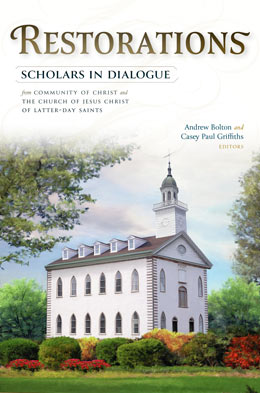
Apostasy and Restoration
Jordan T. Watkins and Gina Colvin
Gina Colvin and Jordan T. Watkins, "Apostasy and Restoration," in Restorations: Scholars in Dialogue from Community of Christ and the Church of Jesus Christ of Latter-Day Saints, ed. Andrew Bolton and Casey Paul Griffiths (Provo, UT: Religious Studies Center, Brigham Young University; Salt Lake City: Deseret Book), 153‒74.
Gina Colvin (Ngā Puhi, Ngāti Porou) is a New Zealand Māori who grew up a Latter-day Saint. She currently worships locally with the Anglican Church and internationally with Community of Christ.
Jordan T. Watkins is an assistant professor of church history and doctrine at Brigham Young University.
Apostasy and Restoration: A Community of Christ Commentary
Gina Colvin (Ngā Puhi, Ngāti Porou)
My mountain is Hikurangi.
My river is Waiapu.
My people are descendants of Porourangi.
I preface this essay with my mihi, my statement of identity. I do this because, above all else, I am the granddaughter of a long line of grandmothers whose bones have been laid down in the belly of the mother, Papatuānuku, in this land, Aotearoa (New Zealand). It is through them that I have come to be, and their presences are inextricably spiritually entwined with me. I say this because Pākehā (white) Western religious institutions, while powerful in the way that they have captivated and organized my religious attention, are seldom potent enough to steal away the self that resides in the deep inner ancestral realms that precede me and have formed me.
My Māori family has been a part of the Latter Day Saint[1] Restoration since its earliest days in Aotearoa (New Zealand). Like most Ngāti Porou who became Latter Day Saints, my family members joined the church because they felt the Anglican Church (Te Hāhi Mihinare)[2] had failed to support Māori interests. As the settler population grew, so did the demands of its political organizations associated with the Anglican Church. A slew of legal violations followed that led to the confiscation and alienation of Native land. The mainstream churches hardly protested.[3] In truth, the early Latter Day Saints didn’t object to land confiscations either, but they didn’t have as much dirt on their hands as the European churches who’d had decades of troubled history with Māori. Consequently, while the message of the Latter-day Saint missionaries was terribly unpopular with the settlers, the church’s mission to Māori quickly picked up momentum.[4]
I was raised by my settler-descended Anglican mother, who joined the Utah-based Brigham Young expression of the Latter Day Saint Restoration just five days before my birth. She came to the Latter-day Saints via my Māori father’s family. From my father, Hemi Ruwhiu, I am a third-generation Latter-day Saint.
Yet my longing and love for ecumenism and belonging in the larger body of Christ subsequently led to charges of apostasy. In 2019 I was called into a Latter-day Saint ward membership council to answer those charges. Church leaders thought I was apostate; I thought the Latter-day Saint Church was in a state of apostasy. It was an impossible scenario. Though those charges were suspended, the chill of church discipline lingered, and I consequently formally disaffiliated the following year.[5]
Yet my lingering love of the Restoration saw me becoming increasingly interested in and involved with Community of Christ. I began to see my Christian ministry playing out through this small, progessive worldwide faith full of Restoration radicals who were having conversations that resonated with me as a newly minted contextual and pastoral theologian. I was confirmed in Community of Christ in 2019 in the temple in Missouri. The seduction of a faith that made more of restoration than apostasy was irresistable.
Religiously socialized in The Church of Jesus Christ of Latter-day Saints, I believed, as I was growing up, that the apostasy and restoration narrative was straighforward. Jesus established a church. The church had fallen into a state of unfaithfulness to the teachings of Jesus. This was apostasy. Joseph Smith’s call and vocation was to restore what was lost. This was restoration. I appreciated the simplicity of it. Institutions break, are denatured, and stray from their original values. But there is yet hope.
I believed this of every institution, including my own, that there were no guarantees of faithfulness and that without a hermeneutics of institutional suspicion and the spiritual practice of ongoing revision, repentance, and reform, one’s own tradition could become corrupted. I was optimistic that given the emphasis on repentance in the Latter-day Saint tradition, the same expectations for human transformation and freedom from sin would be held at an institutional level. As Community of Christ Graceland seminary teacher and theologian Tony Chvala has pointed out, “All great rebirths and revivals in the history of the Christian church have occurred not when Christians in crisis decided to abandon their past and look elsewhere for illumination, but when they boldly but humbly re-embraced their past in the firm faith that God, who had spoken there before, would speak there again.”[6]
When I publically pointed out the failings of the Latter-day Saint Church around issues of social justice and inclusion, I was put on notice as a troublemaker and asked to rein in my objections. My calls for institutional reform were greeted with frosty indifference by church leaders, who were more concerned with my “airing of the church’s dirty laundry in public.” I had stepped over a line. In the sociology of religion, disaffiliation is given the name apostasy.[7] However, before I had disaffiliated from the Latter-day Saint Church, I was considered apostate.
As a result of my alleged apostasy, I came to see that the idea of apostasy is given much more weight in the Brighamite tradition than is the idea of restoration. But the apostasy spoken of by the Utah church is invariably personal. Apostasy is considered in light of one’s opposition to the church and its leaders.[8] Yet in Community of Christ, the idea of restoration occupies much of its unique theological terrain, while apostasy is hardly anywhere seen.
It wasn’t always so. Like the mountain Saints, the prairie Saints[9] were similarly concerned with boundary maintenance that held some of its founding ideas inviolate. The central teaching was that the Latter Day Saint Restoration was the locus of Jesus Christ’s spiritual activity and the hope of humanity’s salvation. In consquence, both the Latter-day Saint and Community of Christ faiths held a shared claim that theirs was the “one true church.”[10] Former Community of Christ president Grant McMurray reflected on growing up in Community of Christ: “I needed to deal with the fact that we understood ourselves to be the One True Church—not just vis-à-vis the Mormons, but vis-à-vis all other expressions of Christianity.”[11]
The one-true-church doctrine and apostasy, in the Latter-day Saint and Community of Christ traditions, were at one stage important identity makers that differentiated both traditions purposefully from the mainstream. However, members of Community of Christ were growing weary of claims of exclusivism. As Matthew Frizzell pointed out, the transformations (among other contextual pressures) set in motion by the baby boomers were significant: “Eventually, the ‘scripts’ that told of the church’s divine origins, the ‘fullness’ of its scriptural canon, its sole priesthood authority, and special eschatological purpose were confronted by the forces of a generation dismantling the worldview that corresponded with this version of [Community of Christ]. For a large contingency of the Baby Boom, their changing world needed a religion that would change.”[12]
Community of Christ responded to the need for change in consequence of the increasing ghettoization of its faith, which had become mired somewhat by the unsustainable literalisms of the nineteenth-century church. Community of Christ began to throw open the windows to the fresh winds of the Spirit, engaging with the question of reform cautiously but emphatically. [13]
Two major forces propelled Community of Christ out of Latter-day Saint sectarianism (including a departure from the myth of restoration and apostasy) into a new expression of the Restoration. In the first instance, Community of Christ’s international expansion meant that by the 1960s missionaries were returning from their overseas (non-U.S.) missions with questions as to the relevance of an apostasy and restoration narrative for non-Christians.[14] The apostasy and restoration narrative might have been germane in the Christian West, but it seemed a spiritually unnecessary ontological leap for the non-Christian East to form their faith around a uniquely North American theological claim of Christian difference. Additionally, Community of Christ missionary experiences in the developing world caused the church to think about the relevance of the social gospel[15] more than mythologized nineteenth-century North American claims of supernatural visions and revival charisms.
Historical criticism and the cultural turn in the arts and social sciences also played a part in the reformation of Community of Christ. Historical criticism led to the development of methodologies that examine ancient texts to discover the world behind those words. The cultural turn at the same time forced an emphasis on how meaning is culturally made, thus lurching social inquiry away from epistemological positivism.[16] In this changing intellectual environment, the professionalization of Community of Christ and its leaders brought critically trained and informed historians (as well as theologians) into church leadership. With the support of the First Presidency, church historian Richard Howard published a paper that exposed the multiple versions of Joseph Smith Jr.’s First Vision.[17] Howard’s study of the Book of Mormon manuscript demonstrated that Joseph Smith Jr. had changed his mind on wording over time, which undermined the membership’s belief in a plenary revelation through the Prophet. Similar studies of early Doctrine and Covenants sections and the “Inspired Version” of the Bible demonstrated that human elements were indeed shaping our scriptures. If Community of Christ had the fullness of the gospel, it wasn’t as pure as many had mythologized it to be.
The end of the 1960s was a pivotal time for Community of Christ. At that time, the membership of the Utah-based church had increased substantially, making it so it could afford to be exclusive from mainstream Christianity, while the Missouri-based Saints could not. Because of this, the Community of Christ became increasingly influenced by and interested in creating a shared theological dialogue with Protestants in an age of increasing ecumenism. In 1959, the Saint Paul School of Theology (a Methodist seminary) opened near the Community of Christ Auditorium in Kansas City, Missouri. Community of Christ leaders were soon in dialogue with Protestant theologians at Saint Paul. When some Community of Christ leaders began to study theology at Saint Paul, it became apparent that the broader Christian conversation entailed an intelligence, integrity, and depth that church leaders had missed while holding too tightly to ideas of Christian apostasy.[18] The early Latter Day Saint Restoration notion that every other Christian around you is in error, while church members belong to the one and only true church, did not serve Community of Christ well. It didn’t foster relationships; it forced separation, underscored practices of boundary maintenance, and created an insufferable community arrogance. Confronting the institutional sins and apostasy of Community of Christ meant that the concept of restoration took on new gravitas and meaning. Members of Community of Christ began to see themselves as culturally bound and hemmed in by mythology and historical narratives that didn’t serve their collective spiritual growth well.
This led to a significant shift in Community of Christ’s self-understanding, commissioned by the First Presidency, that spread out across the church. In 1966, the First Presidency commissioned a set of study papers for a new curriculum. These papers, which came to be known as the “Position Papers,” were intended to be internal documents but were leaked to Community of Christ membership ahead of the 1970 World Conference. These leaked documents circulated among conservative Community of Christ members and created a staunch opposition to the changes that nevertheless seemed inevitable. The Position Papers and the “New Curriculum” cemented the conservative movement within the church. Those who sided with the conservative movement would later break off and call themselves “Restorationists.”[19]
Following up on these developments, Community of Christ’s Basic Beliefs Committee produced an important book, Exploring the Faith,[20] that signaled a sea of change in Community of Christ thought that would bring the Church more in line with traditional Christianity than with traditional Restoration movements. It became apparent that the discourse of exclusivity that had historically drawn lines between the Restoration tradition and the larger Christian conversation was neither spiritually nor relationally helpful in light of Community of Christ’s new direction. Community of Christ opted to open up a dialogue with mainstream Christianity, which meant dropping some of its truth claims, including the doctrine of apostasy.[21]
Beyond the United States, Community of Christ was growing, forcing the question “How well served is the world Church by our Americacentric narratives?” An era of historical query, institutional and theological reform, and new identity formation was born. The apostasy question was quietly dropped because it was incomensurate in this new period of self-awareness and growth. Looking for and pointing fingers at others’ wrongs no longer served the spiritual interests of the church, whose leaders, in recognition of the church’s rebirth as first and foremost a faith of Christian discipleship, chose to change the name from the Reorganized Church of Jesus Christ of Latter Day Saints to Community of Christ.[22]
Why The Church of Jesus Christ of Latter-day Saints didn’t respond to the new intellectual currents of the postwar period and instead integrated its religious identity with the Christian Right when Community of Christ reformed as a progressive faith is probably a question for American politics.[23] Needless to say, the 1970s saw the polarization of the two Restoration traditions and the instantiation of the churches’ fundamentally different political orientations, particularly in North America. With the radical progressive changes, Community of Christ now saw the apostasy discourse as redundant. However, the idea of the restoration was maintained because it invoked the hope intrinsic to the movement: restoration, reconciliation, renewal, and a refreshed theological spirit.
A beloved hymn of Community of Christ is “For Everyone Born,” by fellow Kiwi Shirley Erena Murray.[24] The lyrics invite us to be creators of justice, joy, compassion, and peace. For Community of Christ, this mission is accomplished through its unique restoration theology, which enjoins all Saints to live in restorative, reconciling, and gracious relationship with one another, with the Divine, and with the Earth. While leaving behind claims of apostasy, Community of Christ has made restoration a spiritual practice rather than a matter of historical conjecture.
Thus, as someone for whom the accusation of personal apostasy has weighed heavily, being in a faith community that has made a purposeful departure from an emphasis on universal apostasy into a more generous understanding of the Restoration as paramount has been a wonderful spiritual relief.
Apostasy and Restoration in The Church of Jesus Christ of Latter-day Saints
Jordan T. Watkins
Members of The Church of Jesus Christ of Latter-day Saints believe in a robust restorationism that encompasses the Old and New Testaments and radically stretches backward into a premortal existence while also making abundant space for new sacred texts, truths, and practices. Early members came to believe that the Restoration involved a return of divine communication; a recovery of hidden scriptures and lost gifts, priesthood authority and powers, and practices; the redemption of a people; the resurrection of bodies; and eternal reunions. As this restorationism evolved, it yielded different conceptions of apostasy. Narratives of restoration and apostasy emerged through a dialectic and in relation to internal developments and outside forces.
The earliest understanding of restoration developed from Joseph Smith’s revelations. His followers believed an angel had appeared to him with instructions to uncover and translate an ancient record. The Book of Mormon indicated that “the great and abominable church” had removed “plain and precious things” from the Bible (CofChrist I Nephi 3:141, 171; LDS 1 Nephi 13:6, 29). The Book of Mormon spoke of restoring truths and a people—Israel—a favorite theme among early believers.[25] The Book of Mormon shaped the early believers’ restorationism in various ways, but most of all, their acceptance of the book’s canonical status reinforced the idea that God had called Joseph Smith as a living prophet. Smith’s other scriptural productions bolstered those understandings.
The emphasis on the return of prophetic revelation was soon tied to another claim: God restored authority to administer saving ordinances. At the organization of the Church of Christ in 1830, a question arose about whether converts from other Christian denominations needed rebaptism. The Lord answered, “It is because of your dead works that I have caused this last covenant and this church to be built up.”[26] In 1831, the Lord added that the Christian world had “strayed from [the Lord’s] ordinances & [had] broken [his] everlasting Covenant.” Thus, the Lord “spake unto [Smith]” that his “everlasting Covenant might be established” and that Smith might have “power to lay the foundation of this Church,” which the Lord described as “the only true & living Church.”[27] While understandings of priesthood restoration developed gradually, this language of life and death conveyed the idea that divine power had been lost and restored.[28]
Although early converts embraced the idea that divine authority existed in the Church of Christ, many of them understood their prior religious experiences as preparatory to their conversion. For example, some former Methodists described their earlier enjoyment of spiritual gifts as a valuable staging ground on their religious journey.[29] Furthermore, some of Smith’s revelations suggested that the religious experiences of figures such as Sidney Rigdon, a former Campbellite, had readied them for the new Restoration message, even as the revelations also explained that these converts had been called to a “greater work” with greater power.[30]
This emphasis shaped apostasy narratives that asserted the loss of revelation and authority between the post-apostolic era and Smith’s call. During the 1830s and 1840s, figures such as Rigdon, Oliver Cowdery, Parley P. Pratt, Orson Pratt, and Benjamin Winchester insisted that Protestants—including Christian primitivists who assumed Protestant corruption—could not just set aside Catholic decline and recover apostolic purity without revelation and authority. While they allowed that some historical figures, including the proto-Reformation Waldensians and the post-Reformation John Wesley, had shone as best they could in the darkness, these writers generally found little redeemable in the past, including in the Reformation.[31] In an 1840 pamphlet, Pratt registered the belief in “a general and awful apostacy from the religion of the New Testament.” He thought of apostasy in terms of the absence of “a priesthood authorized of God to administer ordinances” and a loss of “ancient gifts, and powers, and blessings.” He found restoration in the Book of Mormon, which he believed contained the same gospel “as that in the New Testament,” and in the “many revelations and prophecies” Smith had received.[32]
Smith’s revelations linked priesthood and priesthood ordinances to the biblical past.[33] During the 1830s, as his followers built a temple in Kirtland, Smith revealed washings, which he connected to the New Testament, and anointings, which he tied to the Old Testament.[34] Latter-day Saint restorationism uniquely embraced both testaments and cultivated interaction with ancient prophets.[35] Soon after the dedication of the House of the Lord in 1836, Smith and Cowdery had a series of visions in which Old Testament figures, including Elijah, appeared and restored powers that augmented the new movement’s idea of priesthood.[36]
Smith’s restorationist lens magnified even the deepest pasts. An 1841 revelation explained that the practice of baptism for the dead—introduced the summer before—had been “instituted from before the foundation of the world.”[37] As Smith envisioned a pretemporal frame for revealed teachings and practices, he continued to identify biblical antecedents and precedents for them, including the endowment, plural marriage, and radical ideas about the nature of God.[38] Smith also detected contemporary ideational resonances. In 1843, he taught that Presbyterians, Baptists, and Methodists all had some truth and that “one [of] the grand fundamental principles of Mormonism áisñ to receive thruth [truth] let it come from where it may.”[39] Smith often heard contemporary affinities as muffled echoes from ancient pasts.[40] His late efforts to restore past truths and purify present truths, which bespoke a restoration aimed at restoring relationships threatened by the vicissitudes of life, advanced an expansive restorationism.[41]
After Smith’s death, Latter-day Saint narratives became more exclusionary. The expansiveness of Smith’s restorationism encouraged some to articulate a Great Apostasy. In 1850, Orson Pratt continued to assert that “the whole Romish, Greek and Protestant ministry” are “destitute of authority from God.”[42] Dismissing the Protestant appeal to the Bible, Pratt argued that “the history of what others enjoyed is a very different thing from actual possession and enjoyment for ourselves.”[43] During the next few decades, Pratt used Smith’s First Vision to narrate a “Universal Apostasy.”[44] In the face of outside pressures of criticism, Pratt prioritized Smith’s 1838–39 account. Smith, who had produced this account in response to outside pressures, described a vision in which Christ directed him to not join any church and detailed the persecution that followed.[45] As the religious associations of the first generation of Saints waned, and as Protestants attacked the church’s polygamous practice, the First Vision became the touchstone for the claim to renewed revelation, which was the starting point for Latter-day Saint restorationism.[46]
The Great Apostasy narrative was given more definitive shape in the late nineteenth and early twentieth centuries, as Latter-day Saint writers reformulated Protestant-authored histories. In doing so, they depicted the Reformation as a precursor to the Restoration. While this mature narrative more fully embraced the old Protestant condemnation of Catholicism, it still saw deep corruption in Protestantism.[47] This narrative persisted throughout the twentieth century.
Late twentieth-century developments complicated this exclusionary view.[48] In 1978, the church’s First Presidency declared that the “great religious leaders of the world . . . received a portion of God’s light.” In registering their belief that God “will give to all peoples sufficient knowledge to help them on their way to eternal salvation”[49]—an idea contained in the Book of Mormon[50]—the First Presidency broadened the Saints’ view of God’s guidance. This message came amid the church’s global expansion, which both contributed to and followed from the 1978 announcement ending the priesthood and temple ban for members of African descent. During these years, leaders made efforts to embrace and be embraced by other Christians, as indicated by the Book of Mormon’s new subtitle, “Another Testament of Jesus Christ.”[51]
A few decades after teaching that God speaks to other people, Latter-day Saint leaders began to emphasize that God continues to carry out the Restoration. In 2014, Dieter F. Uchtdorf, then a member of the First Presidency, stated that the “Restoration is an ongoing process.”[52] This message has been reiterated by other leaders.[53] This might reflect the insight, yielded by historical research, that Smith’s restoration was a process rather than an event.[54] Scholarship has contributed to shifting views of restoration and apostasy, and those shifting views have inspired further scholarship. Latter-day Saint scholars have begun to dismantle some apostasy narratives.[55] In turn, scholars have also provided new narratives of restoration.[56]
In April 2020, President Russell M. Nelson delivered a “Restoration Proclamation.” Church leaders offered a brief narrative of Smith’s vision, wherein he “learned that . . . Christ’s New Testament Church was lost from the earth.” The proclamation does not mention apostasy, nor does it indicate how the “Church was lost.” It explains that “heavenly messengers came to instruct Joseph and re-establish the Church of Jesus Christ.” In this narrative, apostasy is a passive development, while restoration is an active process whereby embodied biblical figures restored “authority to baptize” and “the apostleship and keys of priesthood authority,” including the “authority to join families together forever.” In a statement that recalls early members’ beliefs and follows late twentieth-century trends, the proclamation describes the Book of Mormon as “a companion scripture to the Bible” that “testifies that all human beings are sons and daughters of a loving Father in Heaven.” Finally, church leaders affirm that the church “organized on April 6, 1830, is Christ’s New Testament Church restored,” and reaffirm the new emphasis that “the promised Restoration goes forward through continuing revelation.”[57]
The Church retains exclusive claims, but the most recent iteration of these claims has yielded less exclusionary understandings of apostasy and more expansive understandings of restoration, a concept that has recently come up for reexamination.[58] As the dialectics that produce these understandings proceed, the focus on revelation and authority will continue to shape Latter-day Saint views. But recent trends suggest a move toward greater flexibility, innovation, and openness surrounding the concepts of restoration and apostasy. Early and late narratives demonstrate that the Latter-day Saint commitment to an expansive restorationism does not necessitate a commitment to an expansive Great Apostasy.
Response to Jordan T. Watkins
Thank you for your essay, Jordan. It’s been a much better experience collaborating like this than I had thought it would be. Your essay underscores just how different the theologically positions of our two traditions are. Even the way in which we responded to and interpreted the question of apostasy and restoration indicates our immense dissimilarities.
For instance, you make no mention of Community of Christ in this accounting. The mountain Saints have a tendency to imagine that they are the only expression of the Restoration and predictably give little regard for any group other than themselves. On the other hand, Community of Christ has always been a bit obsessed with the other church, with an eye constantly trained (albeit a benevolent one) upon Salt Lake City.
Your approach to the topic is rigorous, positivist, objective, and straightforward. Your essay is very well researched, and your use of endnotes is impressive. My essay is discursive, autoethnographic, feminist, indigenous, and highly subjective. Our respective methodologies once more glaringly indicate our different religious orientations. Yet, here we are, seeking a dialogical interaction with some goodwill. That’s extraordinarily hopeful.
You give a thorough account of The Church of Jesus Christ of Latter-day Saints’ early beginnings. Our respective traditions share that common story of Joseph Smith’s formative revelations, and I thought it might be worth saying so. We have only fourteen years in common before Brigham went west, but this shared history is significant in that the opening account of Restoration history hasn’t shaped just the mountain Saints but the prairie Saints as well. However, our respective evolving intepretations and trajectories related to apostasy and restoration eventually go in markedly different directions, and I’m left to wonder why.
You seem to be saying that Latter-day Saint understandings of restoration and apostasy are fixed and wholly dependent upon each other. This idea implies an obvious calculation that in order to fix something, it needs to be broken. An emphasis on legitimate authority is also clear, which suggests that the Latter-day Saints are determined that only they have the divine right to restore. I can see how the ideas of apostasy, restoration, and authority are conflated. Of course, I’m familiar with the rhetoric, but our conversations left me wondering, what is it about the Utah Church that leans so heavily upon the question of authority? How has restoration become so dependent upon authority? Why does any one particular religious tradition bear the exclusive responsibility of restoration? Why can’t the goal of restoration be shared across different churches, peoples, and cultures? Unless the point that you are making is that the reinstantiation of the Old Testament temple theology and its exclusive priesthood holders that serve in those rituals in the service of an exclusive, set-apart people is the Restoration—in which case, I would argue that the Latter-day Saints have held tenaciously to their identity as latter-day restorationists through the twinned ideas of apostasy and restoration. In consequence, I’m starting to think that Community of Christ is not a restorationist faith at all, except in the loosest possible interpretation. Members of Community of Christ are reformers. To restore is to painstakingly make something as it once was or even better. To reform is to break apart, unravel, and rebuild again, hopefully without the faulty parts.
You rightly point out that the Latter Day Saint movement offered spiritual freedom to Christian converts, which is certaintly a part of our shared history. The push away from dogmatic constraint was a lure for many. You argue that there was a convert quest for legitimate religious authority, and I do take issue with that somewhat. I think the story of “legitimate authority” was written later and imposed upon a people who were largely after some fresh winds of the spirit away from a climate of dogmatic constraint in their own churches, whether Protestant or Catholic. My sense is that these early adherents were also captured by the idea of hope-filled immigration to the United States (in the case of the European converts) or social mobility and the promise of new possibilities in an age of terrible economic depression. I would argue that the legitimate authority discourse came after the fact to support the “one true church” doctrine of the Latter-day Saints.
I take issue somewhat with your seemingly innocent use of the idea of everlasting covenant and priesthood. In its earliest iterations, both were synonymous with the practice of plural marriage. The temple and the rituals of freemasonry were also triangulated into this development, particularly in Nauvoo. I can’t see how any of these doctrines and early practices are innocent of the stain of polygamy.
Thank you for this dialogue. It has caused me to consider the possibility that the idea of restoration in the Latter-day Saint Church is based upon a theology that understands restoration as the return of religious practices that are drawn from a Jewish/
Response to Gina Colvin
Gina, the essays you and I have written highlight distinctive and perhaps even contrasting approaches to the concepts of apostasy and restoration. The essays necessarily convey our subjective perspectives and do not reflect the spectrum of views and beliefs held by the communities that they represent, though some core differences do emerge in these accounts.
You provide an insightful, personal narrative of restoration by way of two apostasies. These apostasies include your own, at least according to some members of the Latter-day Saint Church, as well as your view of an apostasy of the Latter-day Saint Church itself. In your telling, you moved away from a church that “was in a state of apostasy” and toward “the larger body of Christ” that same church told you was apostate. In your narrative, apostasy functions not as a distant historical event that preceded a modern restoration but as a contemporary reality that shaped your own restorative move from one faith community to another.
Your faith transition powerfully informs your understanding of Latter-day Saint views of apostasy and restoration. Much of Latter-day Saint restorationism assumes and asserts a close relationship between past and present, and the Restoration present has often given shape to varied and evolving views of apostasy. In a similar yet distinct way, your past and present appear to have shaped your understanding of Latter-day Saint ideas about apostasy and restoration, which you tend to flatten and freeze. You present the Latter-day Saint views of apostasy and restoration as “a straightforward narrative” characterized by “simplicity.” Consequently, in your passing statements on these views, you suggest that apostasy outweighs restoration. However, while the Latter-day Saint Church has embraced a robust view of apostasy from beginning to end, the concept of restoration has consistently given shape to the idea of apostasy. Your essay reveals little about how the concepts of apostasy and restoration have functioned in Latter-day Saint thought and instead conveys your experience and your narrative about that experience.
You trace the history of Community of Christ belief in apostasy and restoration, but more than that, you articulate how, in the process of giving up one faith tradition for another, you have embraced a new kind of restorationism. You describe your coreligionists as “restoration radicals” who “made more of restoration than apostasy.” If you oversimplify the Latter-day Saint view, it’s because you are more concerned with explaining the “irresistible” allure of a different restoration tradition. That allure resulted, in part, due to changes within the Reorganized Church that occurred during the second half of the twentieth century, which changes brought “the church more in line with traditional Christianity than with traditional Restoration movements.” In this process, which perhaps has been echoed in your own conversion, the organization distinguished itself from the Latter-day Saint Church in ways that may have obscured its own past—including its own apostasy narratives—in favor of a new restoration present.
Your essay conveys your journey from apostasy to restoration, and in doing so it sheds light on theological developments within your faith tradition. You write of a belief in restoration as “reconciliation, renewal, and a refreshed theological spirit.” And yet, despite this explanation, I remain somewhat unclear on what restoration means in this tradition that has set aside apostasy. You point to the salubrious move “to open up a dialogue with mainstream Christianity,” but restoration seems unnecessary to this development. I’m left with this question: Does the Community of Christ adhere to restoration as an essential belief?
Even as I question the relevance of “restoration” for the Community of Christ, I still wonder about points of overlap with the Latter-day Saint Church on this issue. Toward the end of your essay, you characterize a “unique restoration theology, which enjoins all Saints to live in restorative, reconciling, and gracious relationship with one another, with the Divine, and with the Earth.” This characterization departs from the insistence on a restoration of past truths, practices, and powers in favor of a focus on relationships. This trimmed-down view of restoration can be seen as a clear departure from the earlier restorationisms resulting from Smith’s ministry, but it does bear affinities with some of the teachings and practices that Smith introduced in Nauvoo, which Latter-day Saints continue to embrace. I am interested in the further articulation of the Community of Christ belief in restoration, or the negation of that belief, which might further highlight the differences between the two traditions, or, on the other hand, might point toward unsuspecting points of correspondence.
Conclusion
This exercise of intrareligious exchange has highlighted crucial distinctions in Latter-day Saint and Community of Christ conceptions of apostasy and restoration. The original breach between the mountain Saints and the prairie Saints has had lasting implications for the way in which our respective traditions have evolved. While both communities have maintained the original language of apostasy and restoration, we couldn’t be more different in our interpretations of these concepts. In the Latter-day Saint tradition, these concepts have continuously evolved together in a kind of dialectic. While continuing to develop this binary, the Latter-day Saint Church has maintained an emphasis on authority even while moving away from an all-encompassing apostasy and toward a belief that God has inspired and continues to guide other prophets and peoples. In the Community of Christ tradition, apostasy has given way to a new kind of restoration, one that eschews a discourse of exclusivity in favor of a community that opens itself to other Christian conversations and communities. While our narratives about these developments underscore the different ways in which each faith tradition has responded to historical forces, the historical trajectories of both traditions have created the conditions to make this conversation possible. In other words, the very fact that we have been able to engage in this exchange from distinct perspectives and with contrasting methodologies, and that we have then been able to embrace the different narratives that resulted, indicates that the time is ripe for ongoing intrareligious dialogue. Developing a consciousness of the contextual factors that caused the differentiation could serve as a fresh starting place from which to host our future ecumenical conversations.
Notes
[1] Different forms of the term Latter Day Saint have been used by both Community of Christ and The Church of Jesus Christ of Latter-day Saints. In this chapter, the term Latter Day Saint with a capital D is used to denote the early movement before the split between the two churches. The hyphenated term Latter-day Saints with a lowercase d is used as shorthand for The Church of Jesus Christ of Latter-day Saints.
[2] Hirini Kaa, Te Hahi Mihinare: The Māori Anglican Church (Wellington, NZ: Bridget Williams Books), 2020.
[3] Keith Newman, Beyond Betrayal: Trouble in the Promised Land: Restoring the Mission to Māori (Auckland, NZ: Penguin, 2013).
[4] Marjorie Newton, Tiki and Temple: The Mormon Mission in New Zealand, 1854–1958 (Salt Lake City: Greg Kofford Books, 2012).
[5] Peggy Fletcher Stack, “ʻMormonism at Its Best’—Bishop Clears New Zealander Who Faced Possible Excommunication,” Salt Lake Tribune, December 20, 2018.
[6] Anthony Chvala-Smith, “Theological Analysis of Stewardship 2000” (unpublished manuscript, April 1997). This paper was written in response to the Latter-day Saint Presiding Bishopric’s stewardship resource Stand in Holy Places (1997). Today, Tony would be very cautious about any form of restoring any pure past (email to author, August 25, 2021).
[7] David G. Bromley, Falling from the Faith: Causes and Consequences of Religious Apostasy (Ann Arbor, MI: University Microfilms International, 1999).
[8] Lester Bush, “Excommunication and Church Courts: A Note from the ‘General Handbook of Instructions,’” Dialogue 14, no. 2 (1981): 74–98.
[9] Colloquial terms refering to the Utah-based Latter-day Saint Church and the Missouri-based RLDS/
[10] William D. Russell, “Courage: A Liberal Journal Foreshadows RLDS Doctrinal Shifts,” John Whitmer Historical Association Journal 28 (2008): 137–56.
[11] Greg Prince, “Walking into the Heart of the Questions: An Interview with Grant McMurray,” Dialogue (December 8, 2011), https://
[12] Matthew Frizzell, “A Baby Boomer Transformation: The Current Generation of Leadership and the Remaking of the Reorganized Church,” in Theologies Across the Generations, ed. Ruth Ann Wood and Suzanne Trewhitt McLaughlin (Independence, MO: Graceland Press and Herald Publishing House, 2005), 56.
[13] William D. Russell, “Beyond Literalism,” Dialogue 19, no. 1 (Spring 1986): 57–68.
[14] Frizzell, “Baby Boomer Transformation.”
[15] Walter Rauschenbusch, A Theology for the Social Gospel (London: Forgotten Books, 2017).
[16] See Fredric Jameson, The Cultural Turn: Selected Writings on the Postmodern, 1983–1998 (London: Verso, 1998).
[17] Richard P. Howard, “An Analysis of Six Contemporary Accounts Touching Joseph Smith’s First Vision,” Restoration Studies 1 (1980): 95–117.
[18] W. B. “Pat” Spillman, “Taking the Road More Travelled,” John Whitmer Historical Association Journal 24 (2004): 135–48.
[19] William J. Knapp, “Professionalizing Religious Education in the Church: The ‘New
Curriculum Controversy,’” John Whitmer Historical Association Journal 2 (1982): 47–59.
[20] Exploring the Faith: A Series of Studies in the Faith of the Church Prepared by a Committee on Basic Beliefs (Independence, MO: Herald Publishing House, 1970).
[21] Keith Wilson, and Mitch McClellan, “Remaking the Reorganization: The Transformative Years of 1958 to 1970 in the RLDS Church,” John Whitmer Historical Association Journal 32, no. 2 (Fall/
[22] William D. Russell, “The Last Smith Presidents and the Transformation of the RLDS Church,” Journal of Mormon History 34, no. 3 (2008): 46–84.
[23] Neil J. Young, We Gather Together: The Religious Right and the Problem of Interfaith Politics (Oxford: Oxford University Press, 2015).
[24] Shirley Erena Murray, “For Everyone Born,” in Community of Christ Sings (Independence, MO: Herald Publishing House, 2013), 285–86.
[25] See, for example, CofChrist I Nephi 4:32–34; LDS 1 Nephi 15:20; “Revelation, circa 7 March 1831 [Doctrine and Covenants 45],” The Joseph Smith Papers, https://
[26] “Revelation, 16 April 1830 [Doctrine and Covenants 22],” p. 4, The Joseph Smith Papers, https://
[27] “Revelation, 1 November 1831-B [Doctrine and Covenants 1],” p. 126, The Joseph Smith Papers, https://
[28] On priesthood restoration as a process, see, for example, Michael Hubbard MacKay, Prophetic Authority: Democratic Hierarchy and the Mormon Priesthood (Urbana, IL: University of Illinois Press, 2020).
[29] See Christopher C. Jones and Stephen J. Fleming, “‘Except Among That Portion of Mankind’: Early Mormon Conceptions of Apostasy,” in Standing Apart: Mormon Historical Consciousness and the Concept of Apostasy, ed. Miranda Wilcox and John D. Young (New York: Oxford University Press, 2014), 66–71.
[30] “Revelation, 7 December 1830 [Doctrine and Covenants 35],” p. 46, The Joseph Smith Papers, https://
[31] See Jones and Fleming, “‘Except Among That Portion of Mankind,’” 57–66.
[32] Orson Pratt, An Interesting Account of Several Remarkable Visions, in The Pamphlets of Orson Pratt, comp. David Hammer (Salt Lake City: Eborn, 2017), 28–29.
[33] See “Revelation, 22–23 September 1832 [Doctrine and Covenants 84],” The Joseph Smith Papers, https://
[34] See “Journal, November 12, 1835,” p. 30–35, The Joseph Smith Papers,
https://
[35] On the use of the Old Testament, see Jan Shipps, Mormonism: The Story of a New Religious Tradition (Urbana, IL: University of Illinois Press, 1987), 67–85.
[36] “Visions, 3 April 1836 [Doctrine and Covenants 110],” The Joseph Smith Papers, p. 192–93, https://
[37] “Revelation, 19 January 1841 [Doctrine and Covenants 124],” p. 5, The Joseph Smith Papers, https://
[38] See “Discourse, 1 May 1842, as Reported by Willard Richards,” The Joseph Smith Papers, https://
[39] “History, 1838–1856, volume E-1 [9 July 1843],” p. 1666, The Joseph Smith Papers, https://
[40] For example, while acknowledging the links between masonry and the endowment, Smith appears to have viewed masonry as a corrupted form of a purer ancient practice. See Heber C. Kimball to Parley P. Pratt, June 17, 1842, Parley P. Pratt Correspondence, 1842–1855, Church History Library, Salt Lake City.
[41] See Samuel Morris Brown, In Heaven as It Is on Earth: Joseph Smith and the Early Mormon Conquest of Death (New York: Oxford University Press, 2012).
[42] See Orson Pratt, Divine Authenticity of the Book of Mormon, in Hammer, Pamphlets of Orson Pratt, 285–86.
[43] Pratt, Divine Authenticity, 381.
[44] Orson Pratt, “Universal Apostasy, or the Seventeen Centuries of Darkness,” in A Series of Tracts on Mormon Doctrine, in Pamphlets, 571–89.
[45] “History, circa June 1939–circa 1841 [Draft 2],” The Joseph Smith Papers, https://
[46] See Steven C. Harper, First Vision: Memory and Mormon Origins (New York: Oxford University Press, 2019), 71–102.
[47] See Eric R. Dursteler, “Historical Periodization in the LDS Great Apostasy Narrative,” in Standing Apart: Mormon Historical Consciousness and the Concept of Apostasy, ed. Miranda Wilcox and John D. Young (New York: Oxford University Press, 2014), 55–76. See also Matthew Bowman, “James Talmage, B. H. Roberts, and Confessional History in a Secular Age,” in Standing Apart, 77–92; and Miranda Wilcox, “Sacralizing the Secular in Latter-day Saint Salvation Histories (1890–1930),” Journal of Mormon History 46, no. 3 (July 2020): 23–59.
[48] Even Bruce R. McConkie’s language softened. See John G. Turner, The Mormon Jesus: A Biography (Cambridge: Belknap Press of Harvard University Press, 2016), 286–87.
[49] Spencer W. Kimball, N. Eldon Tanner, and Marion G. Romney, “Statement of the First Presidency regarding God’s Love for All Mankind,” February 15, 1978.
[50] See CofChrist II Nephi 12:64–72; LDS 2 Nephi 29:10–13.
[51] See Boyd K. Packer, “Scriptures,” Ensign, November 1982, 51–53.
[52] Dieter F. Uchtdorf, “Are You Sleeping through the Restoration?” Ensign, May 2014, 59.
[53] See Gary E. Stevenson, “The Ongoing Restoration,” BYU Speeches, August 20, 2019; LeGrand R. Curtis Jr., “The Ongoing Restoration,” Ensign, April 2020, 20–25; and Russell M. Nelson, “Hear Him,” Ensign, May 2020, 88.
[54] See, for example, Jonathan Stapley, The Power of Godliness: Mormon Liturgy and Cosmology (New York: Oxford University Press, 2018); and Michael Hubbard MacKay, “Event or Process? How ‘the Chamber of Old Father Whitmer’ Helps Us Understand Priesthood Restoration,” BYU Studies 60, no. 1 (2021): 73–101.
[55] See Miranda Wilcox and John D. Young, Standing Apart: Mormon Historical Consciousness and the Concept of Apostasy (New York: Oxford University Press, 2014).
[56] See, for example, Terryl L. Givens, Wrestling the Angel: The Foundations of Mormon Thought: Cosmos, God, Humanity (New York: Oxford University Press, 2015), 23–41; and Nicholas J. Frederick and Joseph M. Spencer, “Remnant or Replacement? Outlining a Possible Apostasy Narrative,” BYU Studies 60, no. 1 (2021): 105–27.
[57] “The Restoration of the Fulness of the Gospel of Jesus Christ: A Bicentennial Proclamation to the World,” ChurchofJesusChrist.org.
[58] See Patrick Q. Mason, Restoration: God’s Call to the 21st-Century World (Meridian, ID: Faith Matters Publishing, 2020), esp. 11–54.
