
 menu icon in the top, right corner of the screen.
 icon above to close this box.
 icon at the bottom of the screen below the browser—if you don't see it, swipe up to unhide it.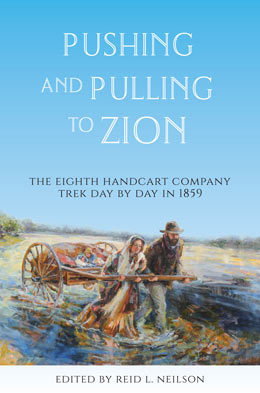
Editor's Preface
"Editor's Preface," in Pushing and Pulling to Zion: The Eighth Handcart Company Trek Day by Day in 1859, ed. Reid L. Neilson (Provo, UT: Religious Studies Center, Brigham Young University; Salt Lake City: Deseret Book), ix-1.
Some must push and some must pull
As we go marching up the hill,
As merrily on the way we go
Until we reach the valley, oh.
—John D. T. McAllister, “The Hand Cart Song,” chorus
On the evening of December 18, 1899, William and Rachel Atkin gathered their children and grandchildren to celebrate their forty-fifth wedding anniversary in St. George, Utah. Following a meal in the dining room, the growing Atkin family moved to the parlor and resumed their conversations. Luella Atkin then asked her grandparents, “Is not this the happiest day of your lives?” After reflecting for a moment, William responded: “Well, this is certainly a happy day, to be so comfortably situated in this beautiful, quiet home, blest with so many loving friends and with such pleasant surroundings; but to give a direct answer to your question I must say, No, and I shall have to go back forty years, to May 1859, to tell you the real happiest day of our lives.” He then described to his posterity how “after seven years of diligent labor, with prayer to our Heavenly Father to open the way for us to gather to Zion, we found ourselves at Florence [Nebraska Territory] on the banks of the Missouri River with our two children, (both under two years of age,) preparing to cross the plains” as impoverished members of the Eighth Handcart Company.[1]
Several years before this family gathering, William Atkin had written and published the story of their conversion to The Church of Jesus Christ of Latter-day Saints in England and their subsequent gathering to Utah. Over a period of ten months beginning in February 1896, Atkin’s two-part autobiographical sketch, “A Youth’s Experience” and “Handcart Experience,” appeared almost weekly in the Union, a pioneer newspaper edited by Joseph W. Carpenter in southwestern Utah.[2] His faith-promoting reminiscence began: “Although some of this narrative may not be interesting to all your readers, yet I trust it may be of sufficient interest to the youth of Zion as to strengthen their faith in the gospel.”[3] Later on, closing the narrative, he said:
The writer of this little Handcart Experience has written it with a desire to show to the youth of this people that their fathers and mothers were willing to pull a handcart or labor in any reasonable way to get to the land that God had designated for a gathering place for his people . . . in order that they might train up their children in the ways of the Lord, where they could hear a prophet’s voice and mingle with the saints of God and share with them in both sorrow and joy, and be one with them in all things in righteousness.[4]
William Atkin (1835–1900) and Rachel Thompson (1835–1903) are my paternal great-great-grandparents through their son Joseph Thompson Atkin (1863–1938) and his second wife Susie Jane Fawcett (1875–1962). While writing a biography detailing their story in 1999, published as From the Green Hills of England to the Red Hills of Dixie,[5] I drew heavily upon William’s reminiscent account of their handcart trek, grateful that he had put his memories to paper before passing away in May 1900.
Leading the Washington DC North Mission during COVID-19
Two decades after writing the Atkins’ life stories, my wife, Shelly, and I were called to preside over the Washington DC North Mission, headquartered in Potomac, Maryland. We began our three-year missionary service at the annual mission leadership seminar at the Missionary Training Center in Provo, Utah, in late June 2019, and then moved our family to the Chesapeake Bay State. That September, local Church members Brent and Meg Pratt invited us and our five children—Johnny (then 15), Kate (13), Ally (9), Whitney (6), and James (3)—over for dinner at their lovely home in Potomac, which was located just off the winding country road between our mission home and mission office. I had been good friends with the Pratts’ daughter, Christy, during our undergraduate days at Brigham Young University, where we had made the connection that we were distant cousins through different children of William and Rachel Atkin; she was my third cousin once removed, making her father Brent my third cousin.
Before sitting down to eat that evening with the Pratts, Brent showed me and my family a painting that he had commissioned from the talented Latter-day Saint artist Julie Rogers. The painting, entitled Crossing the Green River, featured William and Rachel Atkin pulling their handcart, complete with two infants and all their worldly belongings, alone across the fast-moving Green River in Wyoming in August 1859 (see image on first page). “I’ve always been especially drawn to paint the stories of the pioneers,” Rogers related to her fellow Saints on an earlier version of her website. “Remembering what the pioneers endured and how they endured their trials with faith, patience, courage, and perseverance can help each of us as we go through our struggles today.”[6] Clearly, the Pratt family had internalized lessons of fortitude and perseverance as they passed by Rogers’s painting each day hanging on the wall of their family room.
That night I, too, was taken by Rogers’s artistic depiction of the Atkins’ handcart travail, which to them was the most miraculous moment of their entire overland journey. This is how William Atkin narrated that moment from August 1859 in his reminiscent account: “We again labored in pulling our cart, and when we came to Green River, we found the [handcart] train had crossed and gone; and we were alone on its banks. We looked at the river, and I said to my wife we cannot cross this river alone. She said, ‘no but the Lord will help us over.’” Our shared great-great-grandfather continued with emotion:
At these words my heart seemed to leap for joy, and I said, “yes, he surely will,” and we arranged our children and other things in the cart, and then knelt down on the ground, in all humbleness, and in the sincerity of our souls we told our heavenly father that we were doing all in our power to keep his commandments to gather to the land of Zion and now we had come to this river, and we could not cross it alone, and we knew that all power was in his hand, and we relied on him to assist us over. We started into the stream, and as we did so we could see the deep water just ahead of us, and the next step we expected to step into the deep water, but when we took that step, the deep water was still ahead, and thus it was all the way across, and to our surprise we had not wet the axletree of our cart and were truly thankful to our heavenly father that we landed on the other bank in safety.[7]
Although twenty years had passed since I had written the Atkins’ histories, standing in front of that painting rekindled in me a desire to know more about the day of their miraculous crossing of the Green River. Yet I had a mission to lead; I was no longer officed in the Church History Library in Salt Lake City, Utah, with its extensive manuscript and book collections. So I pushed my historical curiosity to the back of my mind, put my head down, and worked.
About nine months into our mission, however, the COVID-19 pandemic began wreaking havoc on life around the world. Little did we know then, just weeks into the global pandemic, how it would change our lives and missionary service. Starting on March 16, 2020, our missionaries transitioned to life in isolation within their apartments, an isolation that lasted until June 2021, fifteen months later. Throughout this time, our elders and sisters were no longer authorized to go tracting door to door or street contacting, shifting instead to online proselyting initiatives. During April 2020 general conference, Elder Jeffrey R. Holland of the Quorum of the Twelve summarized our predicament well when he said: “Even as we speak, we are waging an ‘all hands on deck’ war with COVID-19, a solemn reminder that a virus 1,000 times smaller than a grain of sand can bring entire populations and global economies to their knees.”[8] What we had initially imagined would be a multiweek contagion spread into a global pandemic, unprecedented in several generations. Zoom video conferences quickly replaced in-person meetings, lessons, and interviews across missions worldwide, including ours. We could no longer meet or eat together. Protective face masks became the norm when we were out in public settings. Spring turned into summer with no signs of the pandemic lifting. In fact, things continued to deteriorate across the United States and the world. Our lives had gone almost entirely virtual due to COVID-19.
In late June 2020, Church leaders gathered again with newly called mission presidents and their companions, this time virtually, for two days of online broadcasts in the annual mission leadership seminar. To new mission leaders, President Dallin H. Oaks described what awaited them in their mission fields (and what we were then experiencing in Maryland and Washington DC): “You will preside over a group of missionaries whose variety is unique in our history. Because of the extraordinary releases and transfers required to minimize infections caused by the COVID-19 virus, you will have many missionaries transferred from other missions. Some of these will be experienced leaders. Others will be new missionaries—some endowed and some not yet endowed, some with patriarchal blessings and others without.” He continued:
Some of you will preside for a time over more missionaries than is optimal. Those of you in missions in the United States and Canada will have some missionaries reassigned from international missions who hope their time in your mission will be temporary until they can be returned to the mission to which they were originally assigned.” Oaks resumed: “Looking at these unusual circumstances from the point of view of the missionaries, we must anticipate that some of them are feeling like they have been jerked around in the location, timing, and other circumstances of their service. Some are coming to you with their fourth assignment: home to the missionary training center (MTC), the MTC to their original assignments, return to home, and now assigned to your mission.[9]
After laying out the problem, President Oaks then outlined a solution and recommended a mindset to help mission leaders navigate the increasingly difficult road ahead. “Our Savior’s willing sacrifice is the example that guides us forward along the covenant path. As members and missionaries, we follow that example by sacrifices suitable to our own circumstances. During the two centuries since the First Vision, the sacrifices involved in major disruptions, shifting locations, and changing assignments of Latter-day Saints have been a constant, not an exception.” Oaks then rehearsed many different episodes from Church history when missionary work took place during less-than-ideal circumstances, including the early missions of the Quorum of the Twelve to open Great Britain; the mission of his own great-grandfather, Abinadi Olsen, who helped establish the Church in Samoa; the mission of an elders quorum president who left behind his wife and children while he did missionary work during the Korean War years; and the missions of converts to the gospel who have been abandoned by their loved ones. Oaks reminded his listeners of the “costly and stressful overland moves from New York State to Ohio, from Ohio to Missouri, from Missouri to Illinois, from Illinois to Iowa, and from there the thousand-mile pioneer trek to the valley of the Great Salt Lake.” He concluded his review of Latter-day Saint history with an important caution for those of us in the mission field during COVID-19: “Surely the disruption of our lives and missionary work is usually less serious than what our predecessors experienced. Remind your missionaries of this. Encourage them to ponder the fact that their disruptions and inconveniences in the current pandemic are not unique in the work of the Lord or in the services of their ancestors or fellow members.”[10]
Of the dozen or so inspiring addresses given by General Authorities and General Officers of the Church during the 2020 mission leadership seminar, President Oaks’s remarks touched my heart in a special way, likely because I am both a mission president and a professional historian. His use of our sacred history to illustrate his points was motivating to me and prompted me to share his published sermon with our entire mission, to “remind all of us of things we need to remember when we experience extraordinary changes in missionary assignments, schedules, and locations.”[11] We would follow his counsel over the next many months as our Washington DC North Mission shrank from about 165 young elders and sisters and 45 senior missionaries in March 2020 to a low point of 120 young elders and sisters and 6 senior missionaries in April 2020, and then expanded to a high point of 250 young elders and sisters and 4 senior missionaries in October 2020. Biweekly missionary transfers during that entire summer and fall left us exhausted by wintertime.
In December 2020, as the pandemic raged around the world, an interviewer from the Church News asked Elder Holland, “What is your message for people who are weary right now?” Elder Holland replied by likewise invoking our sacred past. “Well, I think we have to carry on. I think when these times come, and thank heavens, they don’t come very often, we haven’t had very many pandemics. But I think of pioneers, our Latter-day Saint ancestors who must have been weary pulling those handcarts and trudging across the continent on foot, and with handmade wagons and carts. They were weary too. And so when you’re weary, I suppose that’s a time to reinvigorate, renew your strength, and that strength comes from heaven.”[12] President Oaks’s prophetic admonition and Elder Holland’s historic reminder prompted me to ponder once again William and Rachel Atkin’s overland journey in 1859, especially their harrowing handcart crossing of the Green River showcased in Julie Rogers’s painting.
As mission leaders, we likewise needed to carry on and have our strength renewed from heaven. To relax and reenergize, some of my friends play golf and tennis, while others solve crossword or sudoku puzzles. But I really don’t do any of those typical pastimes to unwind at the end of a long day or week. I am, however, invigorated by studying family and Church history. My leisure activities have usually involved reading and writing, especially at times when travel is not an option, as was the case in the mission field. As a mission president I had little discretionary time to recharge my personal batteries. Nevertheless, during the coronavirus pandemic I started working on this history project late at night or on my Saturday preparation days. I determined to create a documentary history of the day-by-day trek of the Eighth Handcart Company as they pushed and pulled to Zion in the summer of 1859. From the examples of my great-great-grandparents and their rickety wooden handcart, I found inspiration to keep moving forward as a mission leader myself during COVID-19. When I got discouraged or down, I would think of William and Rachel and then square up my shoulders, lead another meeting, conduct an additional interview, read one more president’s letter, or respond to a further phone call from our wonderful elders and sisters.
I worked diligently in my spare moments to complete this book manuscript. One day I had the inspiration to invite our missionaries to experience the Eighth Handcart Company’s trek in a very meaningful way. Beginning on April 7, 2021—exactly 162 years since the William Tapscott weighed anchor from the docks in Liverpool carrying hundreds of future handcart pioneers to America—I shared the company’s daily “sail, rail, and trail” experiences with our junior and senior elders and sisters. In the words of President Oaks, I wanted to “teach them to remember the heritage of faith of those who have gone before.”[13] I wanted our missionaries to be able to answer the question “How did our predecessors endure the kinds of disruptions and persecutions they faced?” with Oaks’s words: “They had faith in God and trust in His promises and in His eternal plan, just as we do.”[14] I thought the trials and tribulations overcome by our spiritual forebearers might better contextualize the missionaries’ current COVID-19 restrictions and challenges. Many of our missionaries have shared with me how meaningful it was to compare their daily experiences in 2021 with the trail diaries of these handcart pioneers in 1859. They were both humbled and inspired, just as I had hoped.
Book Contributions and Structure
Chroniclers of America’s Westward migration have spilled much ink on the Latter-day Saint overland exodus to Utah, especially concerning those roughly 67,000 pioneers who traveled conventionally by wagon train. Historian Lyndia Carter notes that “a relatively small number of Saints journeyed to Zion by handcart compared to the vast majority, who came by wagon. Of the 70,000 immigrants to Utah from 1847 to 1869, only 3,000 (4.3%) traveled by handcart. The Church organized handcart companies during only 4 of those 22 years. . . . Though the number of handcart pioneers was small, the handcart experience has come to symbolize the faith, determination, and sacrifice of all the pioneers.”[15] While historians have published dozens of books on the Mormon Trail experience, only two books tell the saga of the handcart pioneers from beginning to end.[16]
Ten handcart companies traveled west to Utah (and one traveled east from Utah)[17] between 1856 and 1860. Of these ten, the two companies led by James G. Willie and Edward Martin in 1856, which ended in tragedy and rescue, have received the overwhelming attention by publishers.[18] “For Latter-day Saints, the handcart story, particularly the account of the Willie and Martin companies, has darkened the collective memory of the westering saga. But that episode is also remembered for the unparalleled gallantry exhibited by so many, immigrants and rescuers alike,” writes Latter-day Saint scholar Howard A. Christy. “Of particular note is the superb performance of the women; their courage and mettle contributed enormously to the eventual survival of both companies. It was at once the most ill-advised and tragic, the most heroic, and arguably the proudest single event in the Mormon pioneer experience.”[19] Ironically, Latter-day Saint observers and other historians of the American West know little about the other eight handcart companies (which arrived largely safe in Zion) because they did not end in disaster.
This documentary history seeks to highlight the daily experience of the Eighth Handcart Company captained by George Rowley in the summer of 1859. The primary sources featured herein make several important contributions to our understanding of the handcart experience, the Mormon Trail, the Great Platte River Road, and the European gathering to Zion. These pioneer record keepers:
- Depict the challenges and opportunities that came with managing all three segments of the “sail, rail, and trail” immigration experience, from Europe to Utah.
- Tell a compelling shared story through their multiple authorial voices and writing styles, which helps provide readers with a multifaceted perspective of “lived religion” on the Mormon Trail as the authors demonstrated their faith by pushing and pulling handcarts to Zion.
- Describe the variety of social encounters between Latter-day Saints and different tribes of Native Americans; gold rush miners heading to the Pike’s Peak region; California- and Nevada-bound overlanders; mountain men and trading post proprietors; and their fellow wagon train religionists.
- Illustrate what the Great Platte River Road looked like in 1859, its busiest year of immigrant travel, including the proliferation of Indian settlements, villages, post offices, forts, trading posts, and military installations along the entire route from the Missouri River to the valley of the Great Salt Lake.
- Portray the advances (and continued limitations) in Latter-day Saint immigration planning and execution by 1859, including immigration agent assistance, improved handcarts, ferry crossings, and established trail routes.
- Communicate to modern readers that most handcart pioneers suffered from the heat of the midsummer sun, not the cold of the early winter snows. Although few died in the summer of 1859, they all suffered mightily from hunger and anticipated starvation before they were rescued by promised resupply wagons from Utah.
This volume’s title, Pushing and Pulling to Zion, is derived from “The Hand Cart Song,” written by pioneer John D. T. McAllister. In December 1855, he wrote a letter to Apostle Franklin D. Richards describing the spiritual enthusiasm of the Irish Saints in Belfast, where he was then laboring as a missionary: “The work is in a good, thriving condition. The Priesthood and members feel alive in ‘Mormonism,’ and, from the oldest to the youngest, all feel Zionward, and are, at the present time, rejoicing in the anticipation of pulling or pushing a hand-cart to their home in the west.”[20] After completing his mission to Ireland in 1856, McAllister sailed to the United States, where he helped outfit the original handcart companies that summer before traveling with Richards and a dozen other returning missionaries by wagon to Salt Lake City.[21] His original chorus to “The Hand Cart Song,” which serves as the epigraph to this preface, reads as follows:
Some must push and some must pull
As we go marching up the hill,
As merrily on the way we go
Until we reach the valley, oh.[22]
Handcart historians Leroy R. Hafen and Ann W. Hafen suggest that McAllister’s “song cannot be ranked as great poetry, but it expresses the spirit of the people. It became a source of encouragement to them and was often sung by the immigrants.”[23] Accordingly, I further determined to feature each of the song’s half-dozen verses as the epigraphs at the beginning of each of this volume’s six chapters.
I initially conceived of this book project as a documentary history of the Eighth Handcart Company’s overland journey to Utah, my attempt to contextualize my great-great-grandparents’ overland trek experience. But in his classic critique of the traditional Mormon Trail story, “Sail and Rail Pioneers before 1869,” scholar Stanley B. Kimball reminds historians (including me) that the gathering to Zion required travel by ships and trains for nearly all Latter-day Saint immigrants, including William and Rachel Atkin. “Some cultural myopia in Zion blurs our views regarding our sail/
However, Kimball’s admonition and my own research forced me to push back my narrative sixty-four days earlier to April 7, 1859, when at least 229 identified members (89 percent) of the Atkins’ impending handcart company boarded the William Tapscott and set sail from Liverpool, England, bound for New York City, New York. For that reason, I tell their “sail” story in chapter 1, which is so integral to understanding their group dynamics and pre-rail/
Lastly, I have provided supplementary materials about the Utah arrival and membership of the Eighth Handcart Company, as well as the conversion and handcart trek of my great-great grandparents. Appendix 1, “Newspaper Accounts of the Arrival of the Eighth Handcart Company,” features five contemporaneous news articles from the Deseret News, Valley Tan, and Mountaineer, which were all Salt Lake City papers. It also features two editorials from the Daily Alta California, published in San Francisco, discussing the handcart pioneers’ arrival in the Salt Lake Valley. A final newspaper account describes a belated public hearing over the contested leadership conduct of handcart company captain George Rowley in November 1859. Moreover, appendix 2, “Eighth Handcart Company Roster,” draws upon several earlier published rolls of its membership, but with added research and information. Appendixes 3 and 4 detail William and Rachel Atkin’s reminiscent conversion narratives and their “sail/
Pioneer Record Keepers in the Eighth Handcart Company
My great-great-grandfather William Atkin became somewhat of an exception among overland pioneers when he wrote and published his “Handcart Experience” narrative in a southern Utah newspaper at the end of the nineteenth century. William E. Hill, who has written popular histories of the Mormon Trail, California Trail, Oregon Trail, Santa Fe Trail, and the Pony Express, made the following observation about the record-keeping practices of American pioneers: “In most respects Mormon emigrants were similar to non-Mormon emigrants. Most did not record their journey, and most of those who did seem to have written brief accounts. There appears to be no reason to explain the existence of detailed non-Mormon, or Gentile, diaries except for the individual desires of some emigrants.”[26] Thankfully, although most individual pioneers generally did not keep records, the Latter-day Saint administrative structure encouraged formal record keeping with its pioneer wagon and handcart trains. “Mormon companies, because of their more formal organization often specifically assigned one or more persons the responsibility for recording the progress and daily events of the journey,” Hill continues. “They may have been assigned to act either as the official clerk of the camp or as the clerk or diarist for one of the leaders of the company.”[27]
For the main body of this documentary history, I insisted on detailed trail diaries penned by Eighth Handcart Company pioneers for the main body of text, not their later reminiscent accounts. Merrill J. Mattes, the preeminent scholar of America’s overland trails, reminds those who read his classic bibliography, Platte River Road Narratives, that it is important to “provide firm definitions” when describing the narrative accounts historians use to tell the story of the overland migration: “A diary is a narrative that was composed, normally on a daily basis, while the traveler was en route,” while “a journal is a detailed progressive account, usually not on a straight daily basis, written soon after the journey, and sometimes based on an actual diary or field notes, as well as recollections or combinations thereof. Many journals are obviously composed with an audience, such as descendants, in mind; others, showing rhetorical polish, suggest intent to publish, whether or not this intent was fulfilled.” Despite how others might employ these terms, Mattes does not use the label of diary or journal for “offerings that are clearly only latter-day recall, reminiscence, recollections, or autobiography.” He continues: “A recollection is a narrative conjured up after the journey, usually at several years or decades (in some cases over half a century) removed. As a class it is, of course, inferior to a diary or journal in accuracy and historical value, but all recollections included have some degree of value, and some of them are surprisingly accurate and readable.”[28]
Written and published in 1896, William Atkin’s “Handcart Experience” is clearly a recollection, not a contemporaneous diary or journal of his young family’s 1859 overland adventure thirty-seven years earlier, which is why I added it as an appendix. But who did write and leave a trail diary that I could use to document their shared daily trek experience? As a Latter-day Saint historian, I knew that the most comprehensive collection of personal accounts of life on the Mormon Trail has been sponsored for decades by the Church History Department of The Church of Jesus Christ of Latter-day Saints in Salt Lake City, Utah. My friend and trail expert Mel Bashore had originally helped create the award-winning “Mormon Pioneer Overland Travel Database,” now part of the Church History Biographical Database. A quick online search of the Eighth Handcart Company’s sources revealed that several of its male leaders left detailed diary accounts of their daily overland journey. Sadly missing, however, are any concurrent diaries from any of the women in the Atkins’ handcart company.
Eighth Handcart Company secretary Thomas McIntyre, as well as three of the seven captains of ten—Henry Hobbs, Hans Olsen Magleby, and Mathias Brock Nilsson—along with Robert F. Neslen, who was their company president aboard the William Tapscott, all carefully documented their oceanic and/
Table 1. Pioneer Diarists and their Sail, Rail, and Trail Narratives in 1859
| Pioneer Diarist | Chapter 1 Sail | Chapter 2 Sail/ | Chapter 3 Trail | Chapter 4 Trail | Chapter 5 Trail | Chapter 6 Trail |
| Neslen | ||||||
| Hobbs | ||||||
| Magleby | ||||||
| Nilsson | ||||||
| McIntyre |
Who were these handcart pioneer diarists? All five record keepers were relatively young men, averaging twenty-five years of age. As a group, they averaged about five years of Church experience as Latter-day Saints since their own conversion baptisms. All five were European emigrants: two were born in England, one in Scotland, one in Denmark, and one in Sweden. Only one, Robert F. Neslen, had previously crossed the Atlantic and gone overland to Utah by wagon. Three of the men were newlyweds in spring 1859 (Neslen married a month before departure, Hobbs married just days before departure, and Magleby married on board the William Tapscott), and the other two, bachelors McIntyre and Nilsson, would marry fellow handcart pioneers after reaching the Salt Lake Valley. Finally, all five served in leadership roles while traveling overland in 1859: Neslen as a company captain; Hobbs, Magley, and Nilsson as captains of ten; and McIntyre as company secretary. It is helpful to know the basic details of these men’s lives before reading their daily diary entries.
Robert Francis Neslen (1832–1912). Born in Lowestoft, England on December 10, 1832. Baptized into the Church in November 1851, at age eighteen. Served as a proselyting missionary in England. Immigrated to America at the age of twenty in summer 1853 on board the Golconda. Went overland to Utah as a member of the Claudius V. Spencer Wagon Company in 1853. Called on a mission to Europe in 1855, serving until 1859. Married Eleanor Stevens Trewella on March 10, 1859, at the age of twenty-six. The following month they immigrated to America on board the William Tapscott, with him serving as the company captain of 725 Latter-day Saint immigrants. He then was appointed captain of the eponymous Robert F. Neslen Wagon Company in 1859. In 1870 and again in 1890 he served proselyting missions in Europe., He passed away on June 3, 1912 at the age of seventy-nine in Salt Lake City and was buried there.
Henry Hobbs (1836–1917). Born in Cheltenham, England on September 24, 1836. Was baptized a member of the Church on May 26, 1851, at the age of fourteen. Served a proselyting mission for the Church in Great Britain. Married Jane Bellman in Liverpool, England, on April 4, 1859, at the age of twenty-two, just days before they both began their immigration to America on board the William Tapscott and as members of the Eighth Handcart Company in summer 1859. He served as the second captain of ten in the company. He and Jane had one child together. At the age of eighty-one he died in Salt Lake City on November 10, 1917, and was buried in Kaysville, Utah.
Hans Olsen Magleby (1835–1903). Born in Dragor, Denmark on April 14, 1835. Apprenticed as a carpenter before serving in the Danish Navy. Joined the Church on October 24, 1855 at the age of twenty. Served a proselyting mission for the Church in 1856 at age twenty-one in Scandinavia, where he was imprisoned several times. Immigrated to America at the age of twenty-three aboard the William Tapscott and then as a member of the Eighth Handcart Company, serving as the fifth captain of ten. Married Gjertrude Marie Christiansen Roe while crossing the Atlantic Ocean to New York Harbor. They had four children together. Served a mission to Scandinavia in 1881, at the age of forty-five. Died on August 16, 1903, in Monroe, Utah, where he was buried.
Mathias Brock Nilsson (1829–1926). Born in Vestra Vemmenhogs, Sweden, on March 8, 1829. Joined the Church on July 1, 1856, at the age of twenty-seven. Immigrated to the United States on board the William Tapscott and then as a member of the Eighth Handcart Company in summer 1859, at the age of thirty. Served as the seventh captain of ten. Married fellow handcart pioneer Caroline Chappell Woodward at Salt Lake City on August 24, 1861. Served a proselyting mission for the Church in Europe in 1872. Served for a decade as a city councilman in Tooele, Utah, and later as its mayor. Died at the age of ninety-seven on May 8, 1926 in Salt Lake City and was buried in Tooele, Utah.
Thomas McIntyre (1832–1914). Born in Edinburgh, Scotland, on June 30, 1832. Baptized into the Church in fall 1854 at the age of twenty-two. Labored as a printer in Scotland before immigrating to America as a twenty-six-year-old single man on board the William Tapscott and then as the secretary of the Eighth Handcart Company in summer 1859. Married fellow handcart pioneer Emma Allen Cook at Salt Lake City on May 19, 1860, and they had thirteen children together. Passed away on February 9, 1914 at the age of eighty-one in Salt Lake City, where he was buried. Remembered for composing the music for the hymn “How Great the Wisdom and the Love.”
Editorial Method
The contemporaneous daily diaries of Robert F. Neslen, Henry Hobbs, Hans Olsen Magleby, Thomas McIntyre, and Mathias Brock Nilsson provide historians and handcart descendants with an unprecedented window into the daily lives of the Eighth Handcart Company pioneers, beginning with their transatlantic travels from the docks of Liverpool, England. For ease of reading, I have bolded and standardized the date headings chronologically for each day of the journey and added the day of the week. Moreover, I have provided the day number of the trek on the Mormon Trail beginning on June 9, 1859, when they departed from Florence, Nebraska Territory, for Salt Lake City, Utah Territory.
Following an “expanded transcription” style of documentary editing, I chose to judiciously standardize the records’ grammar, capitalization, orthography, paragraphing, punctuation, and usage as long as these changes do not alter original meaning.[30] In most cases I have done this silently to avoid intrusive editorial annotations or the use of sic, which could distract readers. I have occasionally bracketed clarifications to the text where further questions or confusion might arise. I have made these corrections according to the seventeenth edition of The Chicago Manual of Style, the fifth edition of the Latter-day Saint Church Style Guide for Editors and Writers, and the eleventh edition of Merriam-Webster’s Collegiate Dictionary. My main goal is to provide readers with a reliable and accessible text true to the personal records of these pioneers and record keepers.
I have also chosen to clarify the names of some people referenced in the five men’s diaries by correcting misspelled names to ease confusion, adding bracketed insertions of full names when a partial name is mentioned each day, but only in the first instance that day. Whenever possible I have attempted to identify all the men and women referenced in the diaries. I have benefited greatly from the online resources of FamilySearch International, the world’s largest genealogy organization, which is sponsored by the Church’s Family History Department. As of July 2022, the department’s flagship website, FamilySearch.org, had 11.47 billion searchable names in historical records, 4.86 billion published digital images, and 1.42 billion people in its Family Tree.[31] Rather than recreate biographical entries for all Latter-day Saint pioneers mentioned in these records, I have instead listed each pioneer’s unique Family Search personal identification number consisting of letters and numbers—specifically four characters, a hyphen, and three additional characters. For example, the identification number KWJ8-QXB corresponds to William Atkin’s biographical entry.[32]
With so many searchable online databases, it is making less and less sense to produce lengthy biographical registers. For many of the more notable pioneers mentioned in these diaries, I have listed references to Andrew Jenson’s four-volume Latter-day Saint Biographical Encyclopedia, which is available in PDF format at FamilySearch.org.[33] Furthermore, all known handcart pioneers from 1859 are listed in the “Eighth Handcart Company Roster,” appendix 2 herein.
I annotated themes that readers may be unfamiliar with or topics that might require more explanation beyond the pioneer diaries. An abbreviated citation format was used, and complete source information can be found in the bibliography. Cross-references to information elsewhere in the volume are placed in the footnotes, and I deferred to the chapter number rather than the chapter title. Unless otherwise noted, all footnotes on geographical locations are cited from the third edition of Merriam-Webster’s Geographical Dictionary. Likewise, all clarified terms are cited from the eleventh edition of Merriam-Webster’s Collegiate Dictionary or the third edition of the Oxford English Dictionary. “Church,” when used to reference The Church of Jesus Christ of Latter-day Saints, and “Saints,” when used to indicate its members, are left capitalized in the text of the diaries and throughout the rest of the volume. I have followed the fifth edition of the Church’s official style guide, which clarifies that “‘Mormon’ is correctly used in proper names such as the Book of Mormon or when used as an adjective in such historical expressions as ‘Mormon Trail.’”[34]
Acknowledgments
When my wife and I received the assignment to preside over the Washington DC North Mission, I was working as Assistant Church Historian and Recorder and as Managing Director of the Church History Department in Salt Lake City. My office was then on the fourth floor of the downtown Church History Library, which houses “375,000 books, pamphlets, magazines, and newspapers; 150,000 collections of original, unpublished records (journals, diaries, correspondence, minutes, etc.); 4.6 million patriarchal blessings for Church members; 15,000 photograph collections; and 70,000 audiovisual items,”[35] making it the most comprehensive and rich collection of historical materials by or about the Church anywhere in the world. No other repository comes even close to its breadth or depth of coverage of the Latter-day Saint experience. For a decade I had the remarkable privilege to request these records to my office when researching and writing. During this same time, I had amassed an extensive personal library of books, which required me to pack up many dozens of moving boxes and place them in storage while I was away from my work office and home library in the mission field.
Moving with our family to suburban Maryland, I brought a few dozen books with me to grace the shelves of our new home because, like Thomas Jefferson and my like-minded historians, “I cannot live without books.”[36] But I no longer had physical access to the records of the Restoration that are housed in the religious and university archives of Utah. Working on a history project across the nation from the confines of my mission home office was an eye-opening and mind-stretching experience for me. Complicating matters were the COVID-19 closures of all university libraries in the mid-Atlantic region. High-speed internet access became my lifeline to the scholarly collections of the world. Late at night I regularly accessed the online historical archives of Brigham Young University, the University of Utah, and the Utah State Historical Society, as well as Utah Digital Newspapers, Google Books, Google Scholar, JSTOR, Internet Archive, and Deseret Bookshelf. Incredibly, I never left my mission home office in Maryland while researching and writing this documentary history, a feat I could not have imagined years earlier.
Instead of driving the eleven miles from my home in Bountiful, Utah, to the Church History Library and its physical collections, I now logged into the online Church History Catalog to research and access its digital archives, which are extensive and easy to navigate. Of particular use to me was the award-winning Church History Biographical Database, which “began more than 30 years ago as staff at the Church History Library began to explore ways to help researchers better understand the experience of the Latter-day Saints as they crossed the plains to the Great Basin between the years 1847 and 1868. The database now contains information on more than 61,000 pioneers and 384 wagon and handcart companies.”[37] I was able to mine the database for transcribed diaries, journals, recollections, newspaper articles, and biographical records of the members of the Eighth Handcart Company. Simply stated, this documentary history was made possible by the longtime employees and volunteers who painstakingly populated the database over decades. I am grateful for their dedication and diligence in recovering these nearly forgotten voices from our Latter-day Saint story.
Serving a mission together with our five children—Johnny, Kate, Ally, Whitney, and James—has been an incredible experience, even during the COVID-19 pandemic. At the beginning of our mission assignment, I read the following counsel in the Mission President’s Handbook: “Your calling as a mission president is one of the most demanding callings you will have in the Church. But even more demanding and more important is your eternal calling as a husband and father. You must continue to devote your time, your energy, and your attention to your family. No success in the mission is adequate compensation for failure in your family.”[38] President Gordon B. Hinckley similarly taught worldwide priesthood leaders: “It is imperative that you not neglect your families. Nothing you have is more precious. Your wives and your children are deserving of the attention of their husbands and fathers. When all is said and done, it is this family relationship which we will take with us into the life beyond.” The prophet then paraphrased the Savior’s words to his disciples (see Mark 8:36): “What shall it profit a man though he serve the Church faithfully and lose his own family?”[39] I was determined not to misplace my loved ones during my time as a mission president.
Inspired by President Hinckley’s counsel, I printed his words and posted them to my office wall downstairs and bathroom mirror upstairs to remind me each day of my proper priorities. Still, I quickly learned that leading a mission was an all-consuming experience. There was no way I could do everything that I wanted to do or that missionaries and members asked of me in the daily barrage of phone calls, text messages, emails, and president’s letters. But I did my best to keep up with the demands. My wife and I were encouraged to schedule our preparation day when our children were not in school, so we turned every Saturday into a family day. I am pleased to note that we ended the mission a more loving and united family than we began. Family members, including Shelly, Johnny, and Kate, also helped me complete my transcription verification of the diaries showcased in this volume.
This volume could not have happened without the skilled editorial eye of my longtime friend and colleague R. Mark Melville, who has helped me prepare several historical publications. Not only did he help improve my prose and annotation, but he was able to decipher and transcribe the handwriting of Englishman Henry Hobbs, who in my opinion was the finest diarist of the Eighth Handcart Company. Mark has become a skilled writer and historian in his own right, and I continue to watch his career progress with great pleasure.
I commenced and completed this documentary history while serving as a mission president. I am grateful for the support of my outstanding mission presidency counselors, President Thomas M. Isaacson, President Robert D. Nelson, and President Donald K. Irvine, all of whom became my dear friends during our service together. My tenure in Maryland and the nation’s capital was blessed by the wonderful members of our Washington DC North Coordinating Council, including Elder Kevin E. Calderwood (Area Seventy), President Clayton F. Foulger (Washington DC Temple), President Darren E. Arnold (Seneca Maryland Stake), President Eric S. Baxter (Silver Spring Maryland Stake), President Derrick L. Boyd (Suitland Maryland Stake), President Alvin B. Jackson (Washington DC North YSA Stake), President F. Wayne Janzen (Washington DC YSA Stake), President Kenneth V. Niumatalolo (Annapolis Maryland Stake), President D. Nathan Sheets (Washington DC Stake), and Brother Scott M. Wheatley. Many thanks are also due to the North America Northeast Area’s General Authority leadership team, including Elder Quentin L. Cook, Elder D. Todd Christofferson, Elder Robert C. Gay, and Elder Paul V. Johnson, as well as Area Presidency members Elder W. Mark Bassett, Elder Randall K. Bennett, Elder Sean Douglas, Elder Allen D. Haynie, Elder Kelly R. Johnson, Elder Peter M. Johnson, and Brother Stephen K. Greenhalgh. Moreover, the members of the Kentlands Ward of the Washington DC Stake, where we attended weekly Sabbath services in person or online for three years, were so welcoming and friendly to our family. We will forever be grateful for these faithful Latter-day Saints, especially Bishop Sterling A. Crowder and Bishop Glenn E. Dickey and their counselors, Chase J. Carlson, Greg S. Carver, Robert J. Hellewell, and Brian P. Zarchin.
Finally, I dedicate this documentary history to the elders and sisters of the Washington DC North Mission, 2019–2022, especially those stalwarts who served during the disruptive COVID-19 pandemic. These valiant men and women, both the junior and senior missionaries, inspired me each day with their optimism and diligence during one of the most difficult times in our nation’s history. “We are continuing to learn how to improve missionary work now and for the future,” said Elder Dieter F. Uchtdorf as the Church was compelled to transition to online proselyting in a matter of weeks during COVID-19. “The Lord has promised to ‘hasten His work’ for the blessing of all of God’s children. I feel that we are right in the middle of this process while living through this challenging time. Our precious missionaries are the pioneers of our day, blazing a trail of sharing the gospel message in new ways fitting to our circumstances, so that the Church of Jesus Christ will continue to roll forth until it fills the whole earth.”[40]
Our faithful elders and sisters were among those proselyting pioneers who kept pushing and pulling our mission to Zion during these tumultuous times. As a Neilson family, we will be forever grateful for their consecrated efforts and Christlike examples. Together, we became a “Jershon”[41] mission family through our shared pioneering journey.
President Reid L. Neilson
Washington DC North Mission
Potomac, Maryland
Spring 2022
Notes
[1] Luella M. Atkin, “The Happiest Day of His Life,” Juvenile Instructor 36, no. 3 (February 1, 1901): 75–76.
[2] Rhondo [William Atkin], “A Youth’s Experience,” Union, February 8–May 7, 1896, Parts 1–13; and William Atkin, “Handcart Experience,” Union, May 14–November 21, 1896, Parts 1–25; see Appendixes 3 and 4 herein.
[3] Rhondo [William Atkin], “A Youth’s Experience,” Union, February 8, 1896, 3.
[4] William Atkin, “Handcart Experience,” Union, November 21, 1896, 1.
[5] Neilson, From the Green Hills of England.
[6] “Pioneers,” Julie Rogers Art, accessed February 26, 2021. An archived version of the site containing this quote may be found at the following URL: https://
[7] William Atkin, “Handcart Experience,” Union, October 10, 1896, 3.
[8] Holland, “Perfect Brightness of Hope,” 82.
[9] Oaks, “Counsel for Mission Leaders.”
[10] Oaks, “Counsel for Mission Leaders.”
[11] Oaks, “Counsel for Mission Leaders.”
[12] Quoted in Sarah Jane Weaver, “Episode 7: Elder Jeffrey R. Holland joins Sarah Jane Weaver to talk about the pandemic, his testimony,” podcast, Church News, December 1, 2020, https://
[13] Oaks, “Counsel for Mission Leaders.”
[14] Oaks, “Counsel for Mission Leaders.”
[15] Lyndia Carter, “Handcarts,” in Encyclopedia of Latter-day Saint History, 463.
[16] See Hafen and Hafen, Handcarts to Zion; and Moulton, Mormon Handcart Migration.
[17] See Griggs, “Handcarts Going East.”
[18] Book-length treatments of this heartbreaking episode and aftermath include Arrington and Cornwall, Rescue of the 1856 Handcart Companies; Swinton and Groberg, Sweetwater Rescue; Madsen, Second Rescue; Olsen, The Price We Paid; Lyman, Willie Handcart Company; Roberts, Devil’s Gate; and Olsen and Allphin, Follow Me to Zion.
[19] Howard A. Christy, “Handcart Companies,” in Encyclopedia of Mormonism, 2:573.
[20] John D. T. McAllister to Franklin D. Richards, December 31, 1855, published as “Home Correspondence,” Millennial Star 18, no. 3 (January 19, 1856): 47; italics in original.
[21] Hinton, “John D. T. McAllister,” 110–11.
[22] Hafen and Hafen, Handcarts to Zion, 272–73.
[23] Hafen and Hafen, Handcarts to Zion, 64–66. They note in associated footnote 16: “Authorship has been claimed for various persons, which results largely from the fact that several handcart songs were composed and sung. . . . There was some variation in the wording of this most famous one, which has as its chorus ‘Some must push and some must pull,’ etc.”
[24] Kimball, “Sail and Rail Pioneers,” 7.
[25] Kimball, “Sail and Rail Pioneers,” 7.
[26] Hill, Mormon Trail, 57.
[27] Hill, Mormon Trail, 57.
[28] Mattes, Platte River Road Narratives, 9.
[29] The diary of John Young Smith is also extant, but a comparative reading reveals that it is a copy and expansion of the diary of Thomas McIntyre featured herein.
[30] For more on this “expanded transcription” approach, see Stevens and Burg, Editing Historical Documents, 76–77. See also Kline and Perdue, Guide to Documentary Editing, 167–73.
[31] “Company Facts,” FamilySearch.org, updated October 2022, https://
[32] “What are ID numbers used for in Family Tree?,” Family Search, updated July 19, 2022, https://
[33] Latter-day Saint Biographical Encyclopedia, https://
[34] “Style Guide—The Name of the Church,” Church Newsroom, https://
[35] “About the Church History Library,” Church History Library, The Church of Jesus Christ of Latter-day Saints, https://
[36] Jefferson to John Adams, June 10, 1815, in Looney, Papers of Thomas Jefferson, 8:523.
[37] “About the Pioneer Database,” Church History Library, The Church of Jesus Christ of Latter-day Saints, https://
[38] Mission President’s Handbook, 7.
[39] Hinckley, “Privilege to Serve,” 22.
[40] Quoted in Sarah Jane Weaver, “‘Our Precious Missionaries Are the Pioneers of Our Day,’” Church News, April 19, 2020, 6; emphasis mine.
[41] In late spring 2020, as we anticipated receiving hundreds of reassigned missionaries from other missions during COVID-19, I was inspired by an article by religious educator Scott Royal Bagley, who wrote, “After the people of Ammon are given the land of Jershon, they are soon joined by religious refugees from among the Zoramites (Alma 35:6–9), fugitives from among the Lamanites (Alma 47:29), and Lamanite wartime prisoners (Alma 62:17, 27–29). The people of Ammon accept all of these people as their own.” As a mission leadership council, we did our best to create a similar “Jershon” culture in the Washington DC North Mission for our incoming missionary refugees over the next year. See Bagley, “A Jershon Classroom,” 75–87.
