
 menu icon in the top, right corner of the screen.
 icon above to close this box.
 icon at the bottom of the screen below the browser—if you don't see it, swipe up to unhide it.
When Does Easter Morning Come?
Marie K. Hafen
Marie K. Hafen, "When Does Easter Morning Come?," in The Power of Christ's Deliverance, ed. Jan J. Martin and Alonzo L. Gaskill (Provo, UT: Religious Studies Center, Brigham Young University; Salt Lake City: Deseret Book), 11‒28.
Marie K. Hafen is a coauthor with her husband, Bruce C. Hafen, of several books, including The Contrite Spirit and, most recently, Faith Is Not Blind.
I wish we could sit together and talk in person about our experiences with life and living the gospel. But, as I write, I can feel we’re together in spirit, and I’m glad we can connect through these words. My hope in sharing these thoughts with you is to rekindle our hope.[1]
We are living through some pressurized, demanding, sometimes even dark days. Perhaps we could even say we feel entombed by our circumstances. As we look to the Easter story, we might find ourselves asking, when will the stone be rolled away for me, for us? When will deliverance come, and how? When will my Easter morning come?
Perhaps we each could be asked the same questions that were asked of Mary Magdalene on that first Easter morning so long ago: “Woman, why weepest thou? Whom seekest thou?” (John 20:15). Remembering what happened that morning for Mary—in the doorway of that tomb—can lift our eyes, revive our hearts, lighten our feet, and bring us back to life.
It was an early morning just after Passover in Jerusalem. Mary, perhaps unable to sleep, had come before dawn to the borrowed tomb where Christ had been laid three dark days before. Finding the stone rolled away and the tomb empty, she ran to find Peter and John who ran back to the tomb to take in what she had just told them (see John 20:1–2). “For as yet, they knew not the scripture, that he must rise again from the dead” (John 20:9). Having seen the empty tomb for themselves, Peter and John returned to “their own home” believing, but no doubt also bewildered (John 20:10).
Mary remained, weeping.
I can imagine that she was exhausted but trying to wrap her mind around what she was not seeing. Where was his body? Where had “they” taken him? Looking into the tomb, she was greeted, this time by two angels. Their question of her was compassionate: “Woman, why weepest thou?” (John 20:13). But it didn’t seem to console her.
She turned away from them, perhaps simply from being overcome with grief, only to hear the same question asked again—this time from someone standing outside the tomb, someone she mistook to be the gardener.
“Woman,” he asked, “why weepest thou? Whom seekest thou?”
“Sir,” she replied, without lifting her eyes and perhaps while barely able to breathe, “tell me where thou hast laid him, and I will bear him away.”
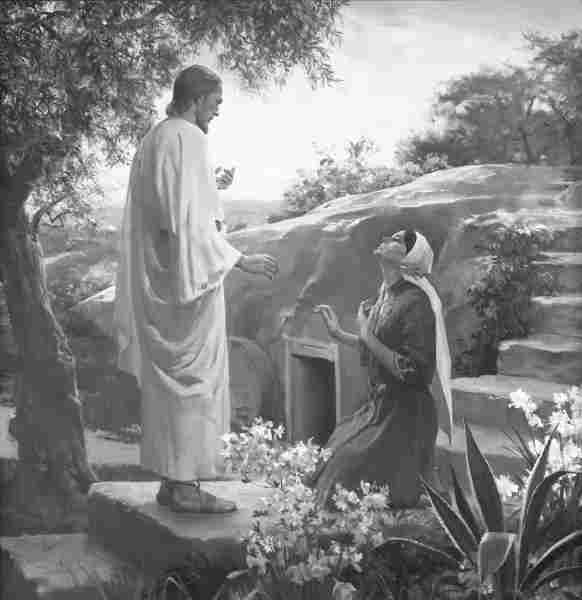 The Resurrection, by Harry Anderson. Courtesy of Intellectual Reserve, Inc.
“Mary.” (John 20:15–16).
She heard her name. She heard his voice speak her name. Could it be he?
Of this moment, I wonder if there are any words in any language that can adequately describe what Mary felt. This is the moment that God’s children had been watching for since Father Adam and Mother Eve first learned that a Savior would be sent to redeem us from the Fall and restore our access to God (Moses 5:6–9). This is the moment upon which all our hopes rest—when the victory over the grave was claimed and the possibility of our becoming one with God was affirmed. And yet, in all its universal and infinite significance, this moment was simple and intimate for Mary alone.
“Rabboni,” she exclaimed (John 20:16).
The records say nothing of it, but can there be any wonder that she would have reached for him, that he would have reached for her? Whatever was unspoken between them privately, John recorded what Jesus did say: “Hold me not” (JST John 20:17), meaning, perhaps, don’t try to keep me here, “for I am not yet ascended to my Father.” But I have something I need you to do: “go to my brethren, and say unto them, I ascend unto my Father, and your Father; and to my God, and your God” (John 20:17).
He was saying to her, go and deliver the news to my brethren and, in essence, through them, to all the world that the plan of redemption is complete, the way for deliverance is prepared. To all generations he was proclaiming—by revealing himself to one—that the victory over death had been won.
Mary heard him, recognized and turned to him, then went and did what he asked her to do (see John 20:14–18).
In a broad sense, Mary’s moment at the tomb—with her Master and our Master—marks the middle of what we have come to call the Easter story. The scope of this story includes each of us and stretches from our first mortal parents in the Garden of Eden through to our personal moments of return to our Heavenly Parents. How does this story go for each of us? for me, for you? Do we hear him, recognize and turn to him, and do what he asks?
Mary knelt, on each of our behalf, as it were, in the doorway of the tomb that could not hold the remains of God the Father’s ultimate offering—his Lamb, his Son—placed on the altar of sacrifice for our sakes. Adam and Eve also knelt for our sakes in the doorway of time at the first altar of sacrifice. At the beginning of the Easter story, they didn’t yet understand what it meant to sacrifice the “firstlings of their flocks” (Moses 5:5).
“An unblemished lamb in similitude of the Lamb? What does it mean?” they would have asked (see Moses 5:5–7).
Whatever they didn’t yet understand—or remember, for the veil had been drawn—the Father had promised, before they left Eden, that a Savior would be provided for them and for us. A Redeemer from their Fall. A Deliverer from our bondage. A Repairer of the breach between us and God (see Moses 5:9).
But for this story to be complete, in order to make our return, we have to hear, turn, and do. We can learn much of how this is done by looking closely at how Adam and Eve did it. Their story is our story. It is the story of receiving Christ’s Atonement.
[Insert image. The Angel with Adam and Eve, by Walter Rane. © by Intellectual Reserve, Inc.]
Learning from Adam and Eve
Few artists have captured the depth of meaning in the Adam and Eve story quite as beautifully as Walter Rane. In his 2013 painting, The Angel with Adam and Eve, Rane focuses on the crucial moment when our first parents are introduced by an angel to how they—and their children—can return to the presence of God. As they kneel at their altar, they begin the story of salvation, of redemption, of deliverance. It is the beginning of the Easter story.
 The Angel With Adam and Eve, by Walter Rane. Courtesy of Intellectual Reserve, Inc.
“Why,” the angel asks, “dost thou offer sacrifices unto the Lord?”
“I know not,” Adam replies, “save the Lord commanded me” (Moses 5:6).
The angel explains, “This thing is a similitude [or a likeness] of the sacrifice of the Only Begotten of the Father. . . . Wherefore, . . . thou shalt repent and call upon God in the name of the Son forevermore” (Moses 5:7–8). In other words, the heavenly messenger is teaching us, through Adam and Eve, to turn from our ways and follow the Son, even taking upon ourselves his name, in living the ways of God.
Rane’s painting gives the angel a compassionate face. He, the angel, wants Adam and Eve to understand what he is teaching and to have a desire to do what they will need to do to ascend into the presence of God. He wants them to make the climb, to get themselves out of the mud of the world (in the lower right corner of the painting) and up into the light of heaven (in the upper left corner). The angel’s radiance and posture draw the viewer’s eye along a path that crosses directly over the sacrificial offering lying on the altar.
Adam and Eve aren’t fearful. Rather, Rane shows them leaning forward, wanting to understand. Eve’s hand on Adam’s shoulder seems to be saying, “We’re going to do this together.”
In the Book of Moses, the Holy Ghost enters this scene and witnesses to Adam of the great plan of redemption (see Moses 5:9), a teaching that fills Eve with illuminating insight. She and Adam have long since outgrown the innocence of Eden. By the time they are at this altar with the angel they’ve had children and grandchildren (Moses 5:2–3) and, no doubt, many hard experiences. Yet Eve “heard all these things and was glad, saying: Were it not for our transgression we never should have had seed, and never should have known good and evil, and the joy of our redemption.” She’s saying, “If we hadn’t chosen to taste the bitter, we wouldn’t—we couldn’t—prize the good” (Moses 5:11). Lehi echoes these truths: no experience, no children, no misery, no sin—and therefore, no joy (see 2 Nephi 2:23–25).
Eve concludes, without the anguish “we” wouldn’t know “the joy of our redemption, and the eternal life which God giveth unto all the obedient” (Moses 5:11). I love how she doesn’t say “unto all the perfect,” but “unto all the obedient”—those who are striving, sincerely trying.
The Book of Moses uniquely teaches that Christ and his atoning mission are central to the Adam and Eve family story from its earliest days through its last, and that mortal afflictions are designed not to punish but to teach us—by experience—to hear, turn, and do—how to become like God.
Hearing, Turning, and Doing in Our Day
So how does what happened with Adam and Eve at the beginning of the Easter story help us as we live out our stories in these compressed, last days? How does what happened with Mary Magdalene at the empty tomb help us through our grief and bewilderment to still hear him, turn to him, and keep doing for him?
Tracy Hafen
Tracy Hafen has some insights on this question; she shared this in a sacrament meeting talk recently:
I can’t comprehend all that God has in store for us. But I’ve had a taste of what it might be like.
We have a daughter who had severe cerebral palsy. Her name is Chaya. One evening, a week before her sixteenth birthday, while Tom was out of town with a new job, Chaya passed away unexpectedly, without any signs or warning. The experience of her passing was actually beautiful, and I gathered with the kids in a circle around her and said a prayer of thanksgiving before the mortuary came to take her body.
But after the kids were in bed, I felt a hole and a sadness that overwhelmed me. I threw myself on her bed to bury myself in her pillow and smell her face. I ached inside, wanting to hold her again. I thought about how the kids had been jumping on the trampoline after school that afternoon. I had felt too tired and busy to lift her from her wheelchair onto the trampoline, so I had just wheeled her over to watch the kids jump. I was filled with regret. But mostly it was a hole. Throughout the night, I cried, drifted off to sleep, woke to the gaping hole, over and over, wanting it all to not be true.
The next morning, a couple from our ward who had lost a nine-year-old child in a bike accident many years earlier knocked on the door. I threw myself into Sister Hendrickson’s arms, sobbing, “How long will I feel like this? When will this hole go away?” For the rest of that day and into the next, I felt that hole. No matter what I did, it was there. And the regrets of everything I hadn’t done with her that I felt I should have done surfaced over and over.
As I was reflecting on all the things I could have done better as a mom to Chaya, a voice came into my head: “I am not up here thinking about what you could have done better.” With that thought, my mind immediately turned to our Heavenly Father’s plan for us. I knew that plan. I had faith in that plan. In one moment—in that moment—the hole I had felt was filled with peace and even with joy.
A blanket of complete contentment settled over me. Though I had known the Spirit could bring comfort, I was astonished by this power. It was a palpable peace that I could not shake. It was as tenacious and ever-present as the hole had been the day before. This was the payment only my Heavenly Father could give, and I remember thinking at the time, “How can you do this? How can you make me feel like this?”
I said to Heavenly Father in my prayers that night that I would do anything, give up anything, sacrifice anything to have this feeling forever. If there was a being who could make me feel this way, I would do anything to be with that being forever.
Remarkably, this feeling remained with me to almost this same degree for several months. I remember thinking that God couldn’t let this feeling stay forever, because I couldn’t be tried or tempted when I was feeling like this. I couldn’t get angry, I couldn’t get impatient, I couldn’t get discouraged. It was like heaven lived in my heart for a while, and I will never forget it.
Those feelings of continual peace and joy gradually left me for the everyday ups and downs, but I have never had a moment of sadness about Chaya or felt that hole again. My sorrow was turned to eternal joy and an appreciation for the Atonement of Jesus Christ, that will allow us to be with our Father in Heaven, Chaya, and everyone we love for the eternities.[2]
Tracy heard forgiveness in Chaya’s voice that brought with it a sweet reminder of Heavenly Father’s eternal promises to us. Tracy turned from her regrets and allowed her faith in Christ’s Atonement to fill the hole of sorrow she had been feeling with palpable peace. And that peace changes how she goes about the doing of her days.
Ann Meyers Romriell
My ministering sister, Ann Meyers Romriell, has this same kind of faith. Like Tracy’s, it has been forged in life’s fiery furnace. She has lost two dear husbands in untimely deaths, and now she faces her own from ALS. She recently wrote, “Yes, I am shocked and more than a little afraid for what will be ahead. Having said that. . . . I am feeling comfort and peace despite the inevitable. . . . I know that through the Atonement of Jesus Christ all will be made whole and that our mortal pains and suffering will one day be a distant memory.”[3]
CaMary Wynne
Another dear friend, CaMary Wynne, also stricken with ALS, recently wrote this from a hospital bed set up for her in her bedroom, “My hands no longer work, and I’m typing with one (crooked) finger. Today I face death years before I thought possible. And I’m not afraid. . . . The Atonement is our foundation. It is our ticket home. Jesus Christ paid the way for each of us. But we have to do our part. We need not fear if we are living his commandments. I trust in him, and because of his Atonement my stupid mistakes are gone. And so long as I’m careful, the Lord will welcome me home.”
CaMary is filled with this serenity and peace because she lived her life hearing him and doing for him. Over the years, every morning she has prayed, “What is most important for me to do today?” And, she says, “I have always received an answer.”[4]
She and her husband, Lee, have helped many young people come to know what the Spirit of the Lord feels like by bringing them into their home, into their barn, or into their horse arena and teaching them how to build stable lives filled with the joy and peace of knowing and trusting God.
CaMary’s body is declining rapidly, but her mind is active and eager. Now her challenge is to allow others to do for her what she would rather be doing for them.
CaMary and Lee inspire me to sift my thoughts and lift my faith when the pressure of life has me feeling beaten down and discouraged, when I am tempted to pull back, retreat, or shrink away from the demands of these intense days. Examples such as theirs, Ann’s, Tracy’s, Mother Eve’s, and Mary Magdalene’s help me keep turning to him, listening for his reassurance, and doing for him.
Doing is powerful. Listen to what happened with a high-powered international executive from when he was a university student until now because he chose to do what was asked of him.
Jeff Franks
Jeff Franks, a graduate of Princeton, Harvard, and Oxford, has lived and worked all over the world in international economics and finance. He has served in the smallest of branches to the largest of wards. In an interview for a podcast recently, Jeff shared with me his experience in a tiny, limping branch from when he was a student at Oxford. He had increasingly felt like giving up on the Church—it just wasn’t worth his time. Besides that he had some nagging unanswered questions about Church doctrine and history.
One Sunday he woke up saying to himself, “I’m going today, but I’m not going after this. . . . I’m not getting anything out of it. I don’t fit in. They don’t understand me.”
That Sunday, wouldn’t you know, the branch president “called me aside and asked me to be Primary teacher for a difficult set of ten-year-old boys. ‘None of the women can control them,’ he said. ‘Could you do it? Could you try?’ I was pretty hesitant, but I finally said, ‘OK. I’ll give it a try.’
“During the next year I came to fall in love with those little boys. I took them ice skating and to other activities. I had a chart. If they behaved they got a point. And if they had enough points, they got a treat.” All of that “gave me a reason to go every Sunday. . . . I think I had some small impact on those boys, but they had a major impact on me.”
He gradually discovered that “if you’re not going [to Church] to get something, but you’re going to give something, [that] changes your whole mentality about why we are there.” So Church was no longer about his Church questions or “do I fit in” with the branch. Those kids and that calling changed not only Jeff’s brilliant mind but also transformed his slightly hardening heart.
After that, “when tough intellectual questions would come up, I’d play a little game with myself: If I got to heaven and found out that my answer [to a particular question] was wrong, would it make any difference to me?” He decided it wouldn’t, so long as he believed in and lived what he called “the core of the gospel,” which “is in the first few temple recommend questions: Do you believe in God, Jesus Christ, and the Holy Ghost? Do you believe in Christ and his Atonement? Do you believe that the gospel has been restored? If you do, you’re now asking about faith, repentance, baptism.
And now, “When I get to feeling pride sneaking in or a little ego, I think of my favorite Primary song, ‘I’m trying to be like Jesus, I’m following in his ways. . . . Be gentle and loving . . . ” Jeff quoted the entire verse and chorus from memory.
“I have a very strong feeling about my relationship with Jesus Christ. . . . And what I’ve learned over the years is, that’s enough.
“I, too, can [now] attest that we receive the power of Christ’s atonement as we ‘try to love as He did in all that we do and say.’”[5]
As we listen for Christ’s voice, how we do what he asks us to do is as important as the doing. Elder Maxwell taught that when we sacrifice the animal in us, when we place our broken hearts and contrite spirits on the altar, our doing shapes our becoming.
He put it this way: “If we are serious about our discipleship, Jesus will eventually request each of us to do those very things which are most difficult for us to do.[6]
No matter what we are asked to do, will we be . . .
- Meek and humble instead of self-concerned, dismissive, proud, seeking ascendency?
- Patient instead of hectic, hurried, or pushy?
- Full of love instead of demanding, dominating, manipulative, condescending, or harsh?
- Gentle instead of coarse, brusque, and vindictive?
- Easily entreated instead of unapproachable, inaccessible, and nonlistening?
- Long-suffering instead of impatient, disinterested, curt, and easily offended?
- Submissive to God instead of resistant to the Spirit and life’s lessons?
- Temperate (self-restrained) instead of egotistic, eager for attention and recognition, or too talkative?
- Merciful instead of judgmental and unforgiving?
- Gracious instead of tactless, easily irritated, disingenuous?
- Holy instead of worldly?
Such a list can make living the gospel feel out of reach. There are times when we all feel like shrinking, like pulling away from what we have been asked to do. In such dark days, we must remember that a Savior has been provided, that the angels will attend, and that we have each other.[7]
In the words of the Apostle Paul, we can cling to our faith “that the sufferings of this present time are not worthy to be compared with the glory which shall be revealed in us” (Romans 8:18).
In the words of our friend Thom Harrison, “These are difficult times. Times when our present pain is multiplied and enlarged. Times when we cannot in any way fight the enemy alone. Times where our combined faith in Christ holds us together moment by moment. Too great is the pain to ever endure it alone. Alone it will crush us. Alone we are destroyed by its accumulated strength. Yet together, . . . as a whole, with revelation, faith experience, testimony and the power of the Most High God, we gain power minute by minute. Not enough to destroy [evil] as yet, but enough to keep us strong, afloat, not conquered, not on our own, not defeated—strong enough to endure this time until we rise slowly towards the ultimate victory. Hold on, little flock. Our Shepherd is sure. Our Shepherd awaits us.”[8]
 An Angel Comforting Jesus, by Carl Bloch. Courtesy of Intellectual Reserve, Inc.
Even Christ wondered if he had the strength to withstand the pressure that came with doing what he was asked of the Father to do (see Matthew 26:39, Luke 22:42). Even he had to stretch to his depths to avoid shrinking from his pain—from our pain (see Doctrine and Covenants 19:18). Even he leaned on the angels for support (see Luke 22:42). But he did not shrink! He finished the work he was given to do—work only he could do (see Doctrine and Covenants 19:18–19). And because of him, the promise of deliverance from our tombs is sure!
What does it mean for us to “not shrink?” Staying open to learning from our experiences and staying supple to the Spirit, even when the supplications seem unheard for a time—perhaps a lifetime—is what it means to “not shrink.” It is to stay trusting in his eventual deliverance of us even while our bitter cups seem bottomless and the chill of our winter seems endless. It is to be assured, no matter how dark the days and nights, that Easter morning is coming—for all of us!
Notes
[1] I am especially indebted to Martha Johnson for joining me in writing and editing this article.
[2] Tom Hafen, email message to Marie Hafen, March 15, 2021.
[3] Ann Meyers, email message to Bruce Hafen, December 11, 2020.
[4] Personal conversations between CaMary Wynne and Marie Hafen, March to June 2021.
[5] “Jeff: How a Harvard Graduate Found His Testimony in a Primary Classroom,” Faith Is Not Blind (podcast), December 6, 2019.
[6] Neal A. Maxwell in Bruce C. Hafen, A Disciple’s Life: The Biography of Neal A. Maxwell (Salt Lake City: Deseret Book 2002), back cover jacket.
[7] Neal A. Maxwell, “In Him All Things Hold Together” (Brigham Young University devotional address, March 31, 1991), speeches.byu.edu.
[8] Thom Harrison, Facebook post, March 17, 2021.
