
 menu icon in the top, right corner of the screen.
 icon above to close this box.
 icon at the bottom of the screen below the browser—if you don't see it, swipe up to unhide it.
Cause for Celebration
Virginia Hinckley Pearce Cowley
Virginia Hinckley Pearce Cowley, "Cause for Celebration," in The Power of Christ's Deliverance, ed. Jan J. Martin and Alonzo L. Gaskill (Provo, UT: Religious Studies Center, Brigham Young University; Salt Lake City: Deseret Book), 29‒44.
Virginia Hinckley Pearce Cowley is an author who served as first counselor in the Young Women General Presidency and on the Primary General Board.
I have no clear premonitions that my death is imminent. But I do know that at the age of seventy-seven I am walking through a veritable minefield. It seems that on either side of me at expected and unexpected moments, there is an explosion. Someone, a friend and contemporary, nearby, who felt mostly fine yesterday, has just received a diagnosis of inoperable cancer today. Or another simply does not wake up in the morning, having suffered a fatal heart attack or massive stroke. Or the multiple sclerosis or Parkinson’s disease that has mostly been held at bay starts moving more rapidly and visibly toward its inevitable conclusion. I read the obituaries with one eye on the birth dates and the other looking for names I recognize.
But the ache I feel for those whose mortal life has come to an end and for we who love them is accompanied by a feeling of deep love and gratitude. Amid the ache of loss, there is additionally a feeling of elation. Here is someone who fought the good fight, finished the course, and kept the faith (see 2 Timothy 4:7). I want to jump in the air and high five each of them with a great big “You did it!”
At this Easter season, I wish to acknowledge my gratitude to the Lord by enumerating a few of the many things life has taught me—the truths that have piloted me through the storms and sunshine of life and that seem to shine more brightly every day—lighting the way to an unknown but gladly anticipated future. They are my reasons for celebration!
I celebrate the truth, the certainty, that the life he has given you and me is precious. My life is precious. Your life is precious. None of us know how long it will last, but we got to come! We got a body! No one else will have the same circumstances, the same innate characteristics and talents, the same stumbling blocks, the same opportunities. We are each wonderfully different. We are his work and his glory, and he wants us back (see Moses 1:39)! To that end, we are each given “one wild and precious life,”[1] and then we are given the power to choose what we will do with it. Life plus agency.
I love watching the two-year-old who has discovered the word “No!” He or she invokes its endlessly and loudly, reminding us how deeply is planted that desire to direct our own lives—to decide what and when. And then we get to learn from the consequences of our decisions. Honestly, that is cause for celebration. So now we are here—on this mortal stage, making decisions, responding to our weaknesses and our strengths and all the difficulties that are inherent in our mortal experience. Some afflictions we may have been born with, others we experience at the hands of others, and others come because of our own mistakes. But I stand here today to declare that God is a God of wonderful surprises. I celebrate the fact that he can take our afflictions and consecrate them to the welfare of our souls (see 2 Nephi 32:9).
Turning water to wine is certainly a miracle (see John 2:1–11), but in my life he has worked far greater miracles. With the Book of Mormon prophet Jacob, I know the greatness of God. He has consecrated—and I believe will continue to consecrate—my afflictions for my gain (see 2 Nephi 2:2–3). He has taken my troubles and turned them into wonder. He has taken the tragedies, large and small, and given me wisdom and compassion in return. Out of heartbreak, friends old and new have risen up to love me. Out of disappointment, new opportunities have presented themselves: “beauty for ashes, the oil of joy for mourning, the garment of praise for the spirit of heaviness” (see Isaiah 61:3).
The worldwide pandemic is certainly unique. When in the course of human history have so many on the planet experienced a common plague at the same point in time? But each of us experienced this affliction in a different way. What have been some of the wonderful surprises God has given you? How has he consecrated this particular affliction to the welfare of your soul? Has he sent beauty for ashes? The oil of joy for mourning? The garment of praise for the spirit of heaviness? If you don’t see those compensatory blessings now, keep trusting and living righteously and I promise you miracles.[2] God has promised you miracles. Watch for them. Count them.
Now, a death and dying story—because I guess that’s what you get from a woman with almost eight decades under her belt. Several years ago, I stood with a friend at the bedside of a man who knew that the end was near. He had suffered for more than a year with a terminal disease—no treatment and inevitable death. My friend held his hand and asked him, “What have you learned from all this?” It took him only a moment to make a short reply: “It’s about relationships. Relationships are all that really matter.” I was actually a little surprised at such a simple reply, but over the ensuing years I have continued to think about it. It makes sense to me to look at the whole of mortal life in terms of relationships.
Perhaps an axis is the way to picture it—a vertical line intersected by a horizontal line—a kind of plus sign. We could put my relationship with myself at the bottom, my relationship with the Father and the Son at the top, and on one end of the horizontal axis my relationship with family—on both sides of the veil. Then my relationship with community—my church community and all the humans in all spheres of my life—the human race—at the other end of the horizontal line. Let’s talk about these four kinds of relationships one by one, understanding all the while that they are not discrete entities but are interwoven in organic ways.
Relationship with Self
First, my relationship with myself. Can I celebrate myself? How solid is my sense of intrinsic worth and identity? Do I really see myself as a child of God? One who carries his spiritual DNA and is loved and valued by him? This is critical knowledge, because I am the filter through which all my other relationships flow. I cannot hope to love, support, and celebrate others if I feel like a sham—an unworthy charlatan.
We get information about our worthiness from so many sources: our family of origin, others in our environment, life experiences. And building a healthy sense of self is not done in a day. It takes long and consistent effort. It takes picking ourselves up from the wounds inflicted by a world that has altogether too much meanness and criticism. It takes experiences that build within us a reservoir of strength and confidence. Experiences that teach us—that actually write upon our souls—that we have skills that enable us to engage with the world, making it a better place. Every time we solve a problem or learn how to do something, we gain confidence in ourselves and build that positive sense of identity.
Relationship with the Divine
But that’s not enough. Our identity only becomes firm in the context of a real and constantly growing relationship with God the Father and his Son Jesus Christ. When we take our own given name and accept the gift of his name, we begin to glimpse the wonder of ourselves. The only 100 percent reliable source for this knowledge comes from our Father in Heaven. The kind of identity that really counts doesn’t come from degrees or paychecks or numbers of clicks on our Facebook page. The way to have a relationship with the Savior—like anyone else—is to have more experiences with him.[3] That is frankly one of the best parts about having lived a lot of years—it is having had so many experiences with the Lord that I have all but lost my fear of the future.
 Man of Joy, by Anthony Sweat. Courtesy of Anthony Sweat.
After the death of my husband, I remarried. Both of us were in our seventies at the time. We have been amazed at how joyful and easy our union has been. We believe that is somewhat because we both know who we are. Deep down. Because of our decades of experiences with the Savior in the past, we are deeply secure in our individual identity. Furthermore, we are sure that he will see us through—no matter what. As we strive to honor our covenants, he is bound to honor his promises to us.[4] President George Q. Cannon said,
No matter how serious the trial, how deep the distress, how great the affliction, [God] will never desert us. He never has, and He never will. He cannot do it. It is not His character [to do so]. He is an unchangeable being; the same yesterday, the same today, and He will be the same throughout the eternal ages to come. We have found that God. We have made Him our friend, by obeying His Gospel; and He will stand by us. We may pass through the fiery furnace; we may pass through deep waters; but we shall not be consumed nor overwhelmed. We shall emerge from all these trials and difficulties the better and purer for them, if we only trust in our God and keep His commandments.[5]
Do you hear echoes of God’s wonderful surprises? That he can turn every affliction to our gain? You and I can pray, asking God about ourselves.[6] Who am I? Do you really know and love me? We can then see that God communicates his unconditional and powerful love to us through the Holy Ghost, always available to you and me. We keep his commandments—because we love him, not so that he will love us!
Through priesthood authority we have been given the gift of the Holy Ghost. Paul tells us that the Spirit is like earnest money. Earnest money is a down payment that makes an agreement binding. So the presence of the Spirit in our lives is a down payment from God saying that he intends to have us live with him forever. And so our relationship with ourselves is most fully developed as we nourish our relationship with God!
Relationships with Family
You can see how our axis begins to be circles overlaid on one another—my relationship with myself, my relationship with God, and now on to our other relationships. My life has taught me that our relationships with one another—family as well as the briefest encounter with a stranger—are the lifeblood of our mortality. They are cause for celebration. They give us a reason to get up in the morning. They fill us with purpose and with love.
Let’s begin with family relationships. Wow! This is where there is so much joy—and so much heartache and pain. Our family relationships are complicated by our huge sense of responsibility—our hopes, dreams, and aspirations for our children in particular. But where else could we really learn about repentance, forgiveness, long-suffering, patience, diligence, faith, and tenacity? It’s such an important laboratory precisely because we can never give up and we can always repent and do better. Elder Christofferson gives practical counsel:
In reality, the best way to help those we love—the best way to love them—is to continue to put the Savior first. If we cast ourselves adrift from the Lord out of sympathy for loved ones who are suffering or distressed, then we lose the means by which we might have helped them. If however, we remain firmly rooted in faith in Christ, we are in a position both to receive and to offer divine help. If (or I should say when) the moment comes that a beloved family ember wants desperately to turn to the only true and lasting source of help, he or she will know whom to trust as a guide and a companion. In the meantime, with the gift of the Holy Spirit to guide, we can perform a steady ministry to lessen the pain of poor choices and bind up the wounds insofar as we are permitted. Otherwise, we serve neither those we love nor ourselves.[7]
But with the waiting and wanting there is still so much joy, so much day-to-day meaning through the companionship of others.
I love the reflective poetry in Ecclesiastes. In chapter 4 of Ecclesiastes, the writer describes our need for human connection: “Two are better than one; because they have a good reward for their labour. For if they fall, the one will lift up his fellow: but woe to him that is alone when he falleth; for he hath not another to help him up. Again, if two lie together, then they have heat: but how can one be warm alone?” (Ecclesiastes 4:9–11). That is a haunting question: “How can one be warm alone?”
Relationships with Fellow Travelers through Life
And yet in our world there are so many of our fellow travelers who are alone. “One study showed about 200,000 elderly people in the U.K. had not had a conversation with a friend or a relative in over a month. . . . Loneliness can kill. It’s proven to be worse for health than smoking 15 cigarettes a day.”[8] London is reportedly the loneliest city in the world.[9] In response to this very real health threat, the United Kingdom has formed the post of Minister of Loneliness. It is currently held by the Baroness Diana Barran. Germany and Japan also have high-level ministries tasked with ameliorating this epidemic. The data goes on and on. Japan is known to have cases of the elderly being found dead and alone in their homes sometimes months after the fact. Almost fifty million people in Europe don’t meet friends or relatives at all throughout the year. They live in total isolation.[10] The poet’s haunting question: How can one be warm alone?
Certainly, the coronavirus pandemic sharpened our awareness of loneliness. We knew that there were individuals in our families and neighborhoods who were isolated—day after day alone. We may have been one of those, but even if that wasn’t our lot, we certainly found ourselves on our knees asking for ways to help those who were alone. More than half of adults in the Church today are widowed, divorced, or not yet married.[11] This does not mean they are isolated and lonely, but many struggle for a sense of belonging—a need for relationships.
And so, we recognize that on this axis or these overlaid circles, joy increases when our relationship with ourselves—our true identity—is understood through the power of our relationship with God. And when we love him and his Son, our love for our fellow men, including our family members, increases automatically. “A man filled with the love of God, is not content with blessing his family alone. [B]ut ranges through the world, anxious to bless the whole of the human family.”[12]
Relationships with family members, with friends and neighbors, and with the perfect stranger allow us to grow and change. This life with all its people becomes a laboratory for becoming like him as we engage with others. Our bumping against people allows us to be damaged. And conversely, we will damage others. Our relationships sometimes create such discomfort that we are driven to our knees. Why else would we beg to forgive and be forgiven—to absorb pain and hurt and choose not to pass it on—to love as Christ loved—to become like him. Think about that. Could we really become like the Savior in the absence of our relationships with others? I think not. His central characteristic is love, and love requires the Other.
A Church of Belonging
Standing on a lifetime of belonging, I celebrate my membership in The Church of Jesus Christ of Latter-day Saints. It affords me a covenant relationship with God—tying him, the sure keeper of promises, to me—with a clear path to follow, a keep-my-covenants path. My membership cradles me in a community, a community of believers who become part of my covenant responsibility and who are also bound by covenant to help and bless me. It’s a laboratory where I can practice being a better human being: making mistakes, being forgiven and given the opportunity to try again. Yes, by covenant, it gives me the power (his power) to be better. It gives me an ever-growing number of individuals to learn from and to bless—an abundance of relationships! I love being a member of his Church!
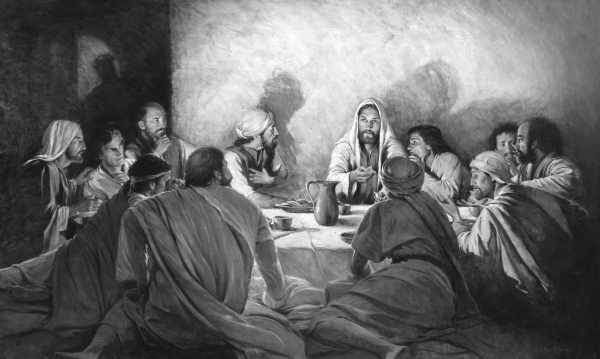 In Remembrance of Me, by Walter Rane. Courtesy of Intellectual Reserve, Inc.
At one time several of the beloved members of my ward were suffering. As a ward, we fasted, prayed, and wept with them. Our bishop reverently suggested that when we suffer with our brothers and sisters, in a very small way we are participating in the Atonement, where the Savior suffered for each of us. Since then, I have felt a sense of awe about my pleas and sorrow for individuals in my ward family.
And then there are the relationships beyond our families and wards. An abundance of our brothers and sisters on this planet to learn from and to love—whether it be the mechanic who fixes my car or the friend from second grade who suddenly appears at a reception or funeral or class reunion.
And so I celebrate relationships! All of them—with myself, with God, with my family, with my church family, and with every human who crosses my path! Certainly, one of the unheralded wonders of growing old is that every week—every single week—we bump into people we have known and loved on this planet. It may be in person or through a telephone call or a note, but it makes old age surprisingly delightful. Trust me, you’re gonna love it!
The Power of Nature
Now, another reason to celebrate. I celebrate the life-affirming powers to be found in nature, recognizing that they are daily tangible evidence of God’s love. Early-morning running or walking; hiking in the mountains; nurturing tomatoes in our backyard; heart-stopping sunsets; the technicolor wonder of flowers, butterflies, birds, water in every form—rolling waves, gushing streams, peaceful rivers, and the stillness of a deep clear lake.
You can tell
what’s worth
a celebration
because
your heart will
POUND
and
you’ll feel
like you’re standing
on top of a mountain
and you’ll
catch your breath
like you were
breathing
some new kind of air.[13]
Age pushes one to think about the prophets of old who recorded their last words to their posterity and people. I stand with them. At this Easter season in the winter of my life, I wish to declare my gratitude for mortal life—for agency; for the multitude of relationships I have been woven into; for the opportunity to seek after and experience his ever-constant love. I declare, first, last, and always, that I love the Savior. He is my King, my Redeemer. He is my greatest cause for celebration! With Nephi, “my heart groaneth because of my sins; nevertheless, I know in whom I have trusted. . . . O Lord, I have trusted in thee, and I will trust in thee forever (2 Nephi 4:19, 34).
That’s all he asks—to trust him to bring us and those we love home to the Father again. To trust him to deliver on his promises. To trust his timing. To trust his perfect goodness. To trust his redeeming and constant love for me and for each of you.
Notes
[1] Mary Oliver, “The Summer Day,” https://
[2] Neil L. Andersen, “A Compensatory Spiritual Power for the Righteous” (Brigham Young University devotional address, August 18, 2015), speeches.byu.edu.
[3] Neal A. Maxwell said, “Since experiential learning is etched deeply into our souls it is not easily forgotten.” Neal A. Maxwell, Not My Will, But Thine (Salt Lake City: Bookcraft, 1988), 98.
[4] Jeffrey R. Holland taught, “Just because God is God, just because Christ is Christ, they cannot do other than care for us and bless us and help us if we will but come unto them, approaching their throne of grace in meekness and holiness of heart. They can’t help but bless us. They have to. It is their nature.” Jeffrey R. Holland, “Come unto Me” (Brigham Young University devotional address, March 2, 1997), speeches.byu.edu
[5] George Q. Cannon, “Remarks,” Deseret Evening News, March 7, 1891, 4; quoted by Jeffrey R. Holland, “Come unto Me,” Ensign, April 1998.
[6] M. Russell Ballard, “Children of Heavenly Father” (Brigham Young University devotional address, March 3, 2020), speeches.byu.edu
[7] D. Todd Christofferson, “Finding Your Life,” Ensign, March 2016.
[8] Jason Daley, “The U.K. Now Has a ‘Minister for Loneliness.’ Here’s Why It Matters,” Smithsonian Magazine, January 19, 2018.
[9] “6 Loneliest Cities in the US,” 9Kilo.
[10] “Loneliness: What Does It Do to Us?,” Medisana Health Magazine, December 22, 2020.
[11] M. Russell Ballard, “Hope in Christ,” Liahona, May 2021, 55.
[12] Joseph Smith, “Letterbook 2,” p. 191, The Joseph Smith Papers.
[13] Baylor Byrd, I’m in Charge of Celebrations (New York: Aladdin, 1995), 4.
