
 menu icon in the top, right corner of the screen.
 icon above to close this box.
 icon at the bottom of the screen below the browser—if you don't see it, swipe up to unhide it.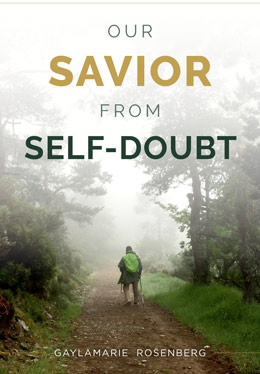
Focus on His Patience
Gaylamarie Rosenberg, "Focus on His Patience," in Our Savior From Self-Doubt (Provo, UT: Religious Studies Center, Brigham Young University; Salt Lake City: Deseret Book), 1‒16.
Feelings of self-doubt come when we are impatient with ourselves. The Savior is patient with us and encourages us to focus on patient progress instead of immediate perfection. We can focus on who we are already instead of who we are not—yet. Instead of striving to have perfect abilities, we can focus on our perfectibility (“perfect-ability”) with Christ.
Ten days after my husband and I were married, we left for Spain to direct a study abroad group in Madrid. I was excited to learn from him, since he was a professor of Spanish literature. We were both older when we met, and we felt fortunate to finally find each other. After meeting, we had a very short courtship and engagement before we married, so when we hurried off to Spain, we had not known each other for very long. I had just completed graduate work in family sciences and was determined to practice the skills and theories I had studied on my new husband. I had high expectations for our marriage. Since I was trained in marriage-relationship skills, I was confident our marriage would be perfect from day one!
After several weeks of running here and there with him, I felt a little neglected because his mind seemed to be preoccupied with his work. I looked at him one day and said, “Sometimes I feel like you love Spain more than me.” With a smile, he responded, “Well, I’ve known Spain longer.” He thought it was funny. After all, it was a silly question—of course he loved me more than he loved Spain. I was his bride, sealed to him for eternity! But I wasn’t laughing. He saw the serious look on my face and said something like “Can we just enjoy where and who we are and not expect our marriage to be perfect—yet?” He was inviting me to be happy with our marriage so far and not to be discouraged with what we hadn’t yet created. After all, we had been married for only one month! Could we just take one day at a time and enjoy our marriage for what it was at that stage? I was expecting to learn a lot about Spain from my husband, but that day I learned about patience, perfection, and the Creation process from him.
The Creation Process
God is a patient creator. Elder Richard L. Evans taught, “There seems to be little evidence that the Creator of the universe was ever in a hurry. Everywhere, on this bounteous and beautiful earth, and to the farthest reaches of the firmament, there is evidence of patient purpose and planning and working and waiting.”[1] In Genesis 1 we read the account of the creation of the earth. Verse 10 ends the third day of creation with the phrase “And God saw that it was good.” We learn the same thing about each subsequent day: each day was good. God was pleased with the state and progress of each day, content with what had been created thus far. He wasn’t concerned that on day two He had not yet created beautiful flowers and trees. God was perfectly fine with not having animals on day four. My husband reminded me, “At the end of day five, God did not say, ‘After all this work and all this time, all I have to show for my effort is fish.’”[2] Instead, after each day of creation, our biblical account says that God was pleased with the progress of that day and the progress toward day seven.
 God is pleased with each day of the creation of the earth, which helps us visualize His satisfaction with our daily efforts in the creation of a Christlike nature. Courtesy of Pixabay.
I believe our Heavenly Father views our process of becoming perfect the same way He viewed the process of the Creation: each individual day or stage is good—even the stages of imperfection. I believe He would say to us, “You are good! Look at your progress this day. Look how I have blessed you already.” We can feel satisfaction in the progress we make each day, imperfect and messy as it may feel, and prepare ourselves for the next day. We should not think that God is disappointed with us until we reach restful day seven. We can recognize how God has helped us already. For each day is good—and necessary—in His eyes. (For previous thoughts shared on the Creation and the process of becoming, see notes 2 and 3.)[3]
My husband’s request that I “not expect our marriage to be perfect—yet” was an invitation to be patient. He invited me to see the goodness and growth in the present moment. Like the Creation process, I could see each day as good and necessary. I could be happy with my marriage and enjoy each day my husband and I had to grow together instead of expecting it to be perfect and complete already. My husband’s comment gave me peace that he didn’t expect me to be perfect in everything and reminded me to do the same for him. I realized that I could find hope and happiness—even with all our imperfections and inexperience—not only in our marriage but in our individual journeys.
You may find yourself, like me, frequently needing a reminder that God is patient with you and will never forsake you. Elder Marvin J. Ashton taught, “We do not have to worry about the patience of God, because he is the personification of patience, no matter where we have been, what we have done, or what we, to this moment, have allowed ourselves to think of ourselves.”[4] What have we allowed? We may find ourselves thinking, “I’m not good enough.” “I don’t have what it takes.” “I’m not perfect and never will be.” We want drive-through progress: fast, easy, and inexpensive! But our pathway to perfection requires dining in: although expensive and time intensive, patience gives us time to plan, time to wait, and time to enjoy each other’s company. Patience helps us see that the outcome is worth the wait.
Recognizing God’s patience helps us overcome self-doubt by changing our focus to how He has helped us already and how He will continue to help us. God knows that for us to reach day seven—a state of perfection—we will have to be patient with ourselves and others.
Impatience Gets in the Way
Impatience gets in the way of progress. When we’re impatient, we focus on who we are not instead of who God has helped us to become already. We expect immediate perfection. And then we miss the daily goodness and growth in front of us. We don’t notice the husband who took the garbage out, because we wish he was reading to the kids. We don’t acknowledge the daughter who just said thank you, because we want her to pick up her dirty clothes. We overlook the neighbor who raked our leaves, because we want him to cut down his tree that’s scattering the leaves. We fail to appreciate a sibling’s gesture to wish us a happy birthday, because she is ten days late.
In other words, we see what others lack instead of what they can offer. We don’t cherish the moment, because it’s not good enough—we want it to be better now! Impatience prevents us from seeing what we have done, because we are fixated on the undone. Impatience threatens our faith in God’s eternal plan. Elder Neal A. Maxwell taught, “Patience is tied very closely to faith in our Heavenly Father. Actually, when we are unduly impatient we are suggesting that we know what is best—better than does God.” He further explained that impatience is like constantly pulling up the daisies to see how the roots are doing or opening the oven door every five minutes to see if the cake is done baking. “Without patience we will learn less in life. We will see less; we will feel less; we will hear less. Ironically, ‘rush’ and ‘more’ usually mean ‘less.’”[5]
When we try to rush our growth, we hinder our growth. We miss the opportunity to be tutored by God, and we create unrealistic expectations for ourselves—expectations not imposed on us by God.
Perfectionism versus Perfectibility
Elder Gerrit W. Gong taught that “our campfire of faith can encourage us to remember perfection is in Christ, not in ourselves or in the perfectionism of the world.”[6] What is perfectionism? Psychologist Brené Brown describes perfectionism as “a self-destructive and addictive belief system that fuels this primary thought: If I look perfect, live perfectly, and do everything perfectly, I can avoid or minimize the painful feelings of shame, judgment, and blame.” She further says that “perfectionism is not self-improvement. [It] is, at its core, about trying to earn approval and acceptance. . . . We’re too afraid to put anything out in the world that could be imperfect. . . . [It is] deep fear of failing, making mistakes, and disappointing others.”[7]
We see pressure to be perfect and fear of making mistakes demonstrated on The Great British Baking Show. Contestants square off to see who will become the “star baker.” This amateur baking contest consists of technical and showstopper challenges that require contestants to make biscuits, cakes, cookies, and breads. The judges often introduce a technical challenge by saying, “The texture must be perfect, the flavors must harmonize beautifully, and each item must look exactly alike. We expect nothing less than perfection!” The stress on the contestants’ faces is captivating. Relief finally comes when “Time’s up!” is called, with some contestants collapsing on the floor as if steam from an Instant Pot pressure cooker had been released. Tears of disappointment flow when something is overbaked, flavors don’t harmonize, or texture is doughy. We are glued to the screen, mouths watering to taste just one of those butter pecan tea biscuits laced with maple frosting. We are stunned that something so delicious looking is deemed a failure. Does it really have to be perfect to be a success? This baking show is just a form of entertainment, but what about real life? Do we needlessly pour on pressure with a similar standard of perfection?
Perfectionism feeds on self-doubt and frequently arises while viewing social media. We think, “Kalie has the perfect life traveling to other countries, so I need to travel to have the perfect life.” Or “Milly is perfectly dressed in fashionable clothes, so I need to be fashionable too.” Or “I’m just a brownie baker, a soup maker, and a perfect mom faker!” We may say, “Oh, I’m not a perfectionist,” but call out to our family, “Everyone, come quick and clean the house! The bishop is coming, and we don’t want to look like we live in a mess!” Are we focused on what others think of us, wanting to appear perfect to them? Elder Jeffrey R. Holland taught, “My brothers and sisters, except for Jesus, there have been no flawless performances on this earthly journey we are pursuing, so while in mortality let’s strive for steady improvement without obsessing over what behavioral scientists call ‘toxic perfectionism.’ . . . Every one of us aspires to a more Christlike life than we often succeed in living. If we admit that honestly and are trying to improve, we are not hypocrites; we are human.”[8]
When we give in to perfectionism, we try to do the “perfecting” work that is not our role or even within our power. It is God’s work. As someone once said to me, “I’ve learned to let God be God, to let Him do His work with me.” It is God’s work and glory “to bring to pass the immortality and eternal life of man” (Moses 1:39). It is Christ’s work to enable us to be “at-one” with Him and our Father. Our Savior makes our journey back to Them achievable.
It is comforting that “God sent not his Son into the world to condemn the world; but that the world through him might be saved” (John 3:17). The Savior came to save us from our weaknesses, not to make us feel worse about them. Yet it is common to think and act as if God is condemning us, as if He is disappointed that we are not already perfect. However, God did not intend for us to have perfect abilities in this life but to embrace our perfectibility: the ability to eventually become perfect as He is.
President Russell M. Nelson helps us understand the verse “Be ye therefore perfect, even as your Father which is in heaven is perfect” (Matthew 5:48). He explains that the word perfect comes from the Greek word teleios, “which means ‘complete.’ Teleios is an adjective derived from the noun telos. . . . The infinitive form of the verb is teleiono, which means ‘to reach a distant end, to be fully developed, . . . or to finish.’”[9] No one is complete and fully developed yet; we are only in the early stages of our eternal pilgrimage.
“It is a serious thing to live in a society of possible gods and goddesses. . . . There are no ordinary people,” said C. S. Lewis.[10] God has granted us the ability to become like Him. That is our long-term goal, but what about our short-term goal of dealing with our current state of imperfection? We all feel the gap between where we are and where we need to go, much like pilgrims on the first days of their journey on the Camino de Santiago, wondering if they will ever reach their destination miles away. We learn from Elder Maxwell, “There is no way the Church can honestly describe where we must yet go and what we must yet do without creating a sense of immense distance. . . . The scriptural advice, ‘Do not run faster or labor more than you have strength’ (Doctrine and Covenants 10:4) suggests paced progress, much as God used seven creative periods in preparing man and this earth. There is a difference, therefore, between being ‘anxiously engaged’ and being over-anxious and thus underengaged.”[11]
We need to remember that complacency is just as disruptive to God’s plan as perfectionism. Can we be anxiously engaged in progression and at the same time be careful not to be overanxious about our quest for perfection? We must take one day at a time, throughout this life and beyond. How can we increase our focus on patience?
Focus on Patience: Progress instead of Perfection
In a TED Talk, Stanford University psychologist and author Carol Dweck spoke of a high school in Chicago where the students were required to complete eighty-four units to graduate. If students did not pass a unit, they did not receive a failing grade. Rather, their report card read “Not Yet.” “Not Yet” implied that the students were still learning and still working to complete all that was required. Dweck said, “If you get a failing grade, you think, I’m nothing, I’m nowhere. But if you get the grade ‘Not Yet,’ you understand that you’re on a learning curve. It gives you a path into the future.”[12] The students and their teachers discovered that “Not Yet” grades helped students maintain motivation to keep working instead of giving up. They did not feel like failures but instead were at ease that there was still work to be done. A “Not Yet” mindset helped students accept tasks that were difficult; it created kids who were hardy, resilient, and persistent.
We can change our fixed mindset to what Dweck calls a growth mindset: one that is open to new growth and progress. Can we let it be OK that we are not finished and that there is still work to be done?
We are all in the state of “not yet”—we’re not perfect yet, but we will be eventually. Right now we can focus on the progress we’ve made thus far and on our next steps forward. We can change our focus to who we are already (because of God’s help) and be grateful instead of focusing on who we are not . . . yet. I accept that I have a “Not Yet” grade in every area of my life. There’s a lot of work to be done. The tasks are endless, and I have miles to travel before I can sleep. But Christ gives me hope. His loving patience motivates me to keep trying. It motivates me to be patient with myself and others. And it motivates me to pour out my heart in gratitude for His loving companionship as we walk together.
Being patient helps us cherish others regardless of their imperfections. With patience, we let go of expectations that others have to be better in order for us to enjoy their company. With patience, we love more, we forgive more, we serve more, and we see the goodness in each other more. We simply find more joy in our relationships when our daily mortal walk is filled with patience.
I found joy one day when my daughter made me breakfast in bed for Mother’s Day: burnt toast, cooked-to-death eggs, juice spilling out of the cup—the works! She presented me with a handwritten note that said, “I love you, Mom,” and my heart melted. Another day she wrote a letter to me that said, “You are my best friend forever—my BFFFFFFFFFFFFFF,” several extra Fs emphasizing the “forever” part. So I didn’t have the heart to get mad at her for making a mess in the kitchen. I was just happy to be her mom. Focusing on who our children are instead of who they are not enables us to treasure who they are today. It is a beautiful gift we give to one another—to feel cherished.
Someone once told me, “It’s amazing how good others look when you look for the good. And it’s amazing how bad others look when you look for the bad.” So, what are we looking for? Let us look for the good today. Let us see the stepping stones of progress made this day.
We can be patient by taking one day at a time, trusting God’s promises of our perfectibility, and looking for patient progress instead of immediate perfection.
Joy in the Process
Like the Creation process, we don’t have to reach the final stage of our perfection before we experience God’s love and feel God rejoice in who we have become thus far. We trust that the Lord would say to us what Alma said to his son Shiblon: “I say unto you, my son [or daughter], that I have had great joy in thee already, because of thy faithfulness and thy diligence, and thy patience” (Alma 38:3). Alma didn’t find joy in his son at that moment for who he would become but for who he was already. Likewise, God finds joy in us now. I know God loves us too, no matter what our weaknesses and imperfections may be. Do we have a long way to go until we become like Him? Absolutely. He knows that, and so do we! But we can find joy by cherishing this day and knowing that God rejoices in our progress this day as well.
As parents we find joy in our children when they are small, still learning to walk and talk. We are not disappointed that they can’t quote Shakespeare by their first birthday. We have no expectation that they will walk on their first attempt. None of us would dream of getting mad at or being disappointed with a one-year-old for falling down. Nor would we expect an infant to run around the block. We know better. Instead, we gather around them and cheer them on: “You can do it! Keep trying! You’re almost there!” It is a joint effort. It is a partnership in growth and development. And we find joy in their every effort to become.
We also believe in a God who cheers us on. He not only loves us but finds joy in us with each day’s diligent efforts. We can enjoy who we are today, knowing that the best is yet to come. Elder Dieter F. Uchtdorf said, “The lessons we learn from patience will cultivate our character, lift our lives, and heighten our happiness.”[13]
Walking with Patience
A typical day on the Camino de Santiago began early in the morning. We packed our suitcases to be dropped off to a carrier service and packed a day pack with snacks, water, extra socks, and rain ponchos. We ate breakfast, stretched our legs and feet, grabbed our walking poles, and headed for the trail. The twelve to fifteen miles we walked each day took about five or six hours, which meant that we would arrive in the next town in the afternoon. I loved walking through all the villages, taking in the beautiful scenery, and meeting new people, but some days my feet got tired. Very tired. The arches in my feet would feel like fire. My husband would wait for me. He waited while I took extra stops at the snack shops to rest my feet. He waited while he rubbed my feet. He waited while I took an extra-long lunch. He waited while we sat on rocks along the trail. His patient words kept the journey enjoyable: “No problem, we will take as long as you need. There’s no hurry. We can sit down and enjoy the scenery and meet more pilgrims.” On those days we spent another four or five hours getting to our destination. But it was fun. Thanks to my husband’s patience, we could enjoy our day’s walk. There was no irritation for not arriving sooner. In fact, we met more people and learned more about their personal quests to draw closer to God. Being patient on our journey made it better, not worse.
 When my husband and I walked the Camino path, having patience made our journey enjoyable. Courtesy of author.
Patience requires “waiting” on one another. Elder Robert D. Hales taught, “Waiting upon the Lord gives us a priceless opportunity to discover that there are many who wait upon us. Our children wait upon us to show patience, love, and understanding toward them. Our parents wait upon us to show gratitude and compassion. Our brothers and sisters wait upon us to be tolerant, merciful, and forgiving. Our spouses wait upon us to love them as the Savior has loved each one of us.”[14] Can we let it be OK that we need to wait on one another? Waiting on one another makes our lives better, not worse. And it takes a lot of “waiting” to become our best selves.
My husband gave me a gift that summer we got married, when he was loving Spain . . . and me: an invitation to enjoy the creation of our marriage relationship. On the inside of our wedding rings, we had the Latin phrase Incipit vita nova engraved, meaning “A new life begins.” We began a new life together, one of building a relationship—one day at a time. I love him for being patient and “waiting” with me. He often quotes Robert Browning:
Grow old along with me!
The best is yet to be,
The last of life, for which the first was made:
Our times are in His hand
Who saith “A whole I planned,
Youth shows but half; trust God: see all, nor be afraid!”[15]
Being patient has helped us enjoy the marriage we have, a relationship we cherish as it is today. Now, after thirty years of marriage, we look at each other and wonder if we have reached “day two” yet (like the seven-day Creation process of the earth).
We honor Christ as we walk with Him by focusing on His patience and accepting His invitation to be patient too. He doesn’t expect us to run at top speed. He just asks us to keep on the path with Him, walking a steady, consistent pace forward. Elder Joseph B. Wirthlin reminds us, “Oh, it is wonderful to know that our Heavenly Father loves us—even with all our flaws! His love is such that even should we give up on ourselves, He never will. We see ourselves in terms of yesterday and today. Our Heavenly Father sees us in terms of forever. Although we might settle for less, Heavenly Father won’t, for He sees us as the glorious beings we are capable of becoming.”[16]
The next time we have feelings of self-doubt and consider giving up on ourselves, or the next time we consider giving up on someone we love, please remember that God will never give up on us. And He will never give up on the people we love.
Loving patience is powerful in cultivating relationships and personal growth and in overcoming self-doubt. It helps us find joy in the present moment. Patience helps us recognize how God has helped us progress, and it gives us hope that He will continue to do so. We are reminded in Doctrine and Covenants 67:13, “Ye are not able to abide the presence of God now, . . . wherefore, continue in patience until ye are perfected.”
On our personal journeys, we can imagine the Savior’s invitation “Come, join me! Come warm your hands by the fire of my patience! See how I have blessed you already! Walk with me, and the glory of your potential will be made known to you—one day at a time.”
♦ ♦ ♦
Invitation: Focus on being patient with yourself and others in the process of becoming perfected. Let go of expectations that we or those we associate with have to be perfect in order to enjoy each other’s company.
Think-in-ink journal challenge: Write down five ways God already has helped you become who you are at this point in your life.
Notes
[1] Richard L. Evans, in Conference Report, October 1952, 95; quoted in Joseph B. Wirthlin, “Patience, a Key to Happiness,” Ensign, May 1987, 33.
[2] My husband also presents this idea in John R. Rosenberg, “The Syntax of Creation,” Humanities at BYU, Fall 2013, 3.
[3] For past talks given on the Creation process and personal progression, see Gaylamarie Rosenberg, “Allowing the Savior to Help Us with Our Imperfections” (address, Brigham Young University Women’s Conference, Provo, UT, May 1, 2015), time codes 11:00–17:33, https://
[4] Marvin J. Ashton, “Patience Is a Great Power” (Brigham Young University devotional, February 13, 1973), 5, speeches.byu.edu.
[5] Neal A. Maxwell, “Patience” (Brigham Young University devotional, November 27, 1979), 1, 3, speeches.byu.edu.
[6] Gerrit W. Gong, “Our Campfire of Faith,” Ensign, November 2018, 42.
[7] Brené Brown, The Gifts of Imperfection: Let Go of Who You Think You’re Supposed to Be and Embrace Who You Are (Center City, MN: Hazelden, 2010), 56–57; italics in original.
[8] Jeffrey R. Holland, “Be Ye Therefore Perfect—Eventually,” Ensign, November 2017, 42.
[9] Russell M. Nelson, “Perfection Pending,” Ensign, November 1995, 86.
[10] C. S. Lewis, The Weight of Glory (New York: HarperOne, 2001), 45–46.
[11] Neal A. Maxwell, “Notwithstanding My Weakness,” Ensign, November 1976, 12–13.
[12] Carol Dweck, “The Power of Believing That You Can Improve,” Ted Talk, November 2014, 10:11, https://
[13] Dieter F. Uchtdorf, “Continue in Patience,” Ensign, May 2010, 59. For simplicity, the title “Elder” will be used throughout this work to refer to Dieter F. Uchtdorf regardless of his position at the time he made each statement quoted herein.
[14] Robert D. Hales, “Waiting upon the Lord: Thy Will Be Done,” Ensign, November 2011, 73.
[15] Robert Browning, “Rabbi Ben Ezra,” in Dramatis Personae (London: Chapman and Hall, 1864), p. 77.
[16] Joseph B. Wirthlin, “The Great Commandment,” Ensign, November 2007, 29–30.
