
 menu icon in the top, right corner of the screen.
 icon above to close this box.
 icon at the bottom of the screen below the browser—if you don't see it, swipe up to unhide it.
Focus on His Forgiveness
Gaylamarie Rosenberg, "Focus on His Forgiveness," in Our Savior From Self-Doubt (Provo, UT: Religious Studies Center, Brigham Young University; Salt Lake City: Deseret Book), 107‒28.
Feelings of self-doubt come when we feel we are not worth or worthy of God’s help. Because of the Savior’s atoning sacrifice, we can be forgiven for our sins and wrongdoing. We can focus on our ability to repent—to change—and accept His love and forgiveness.
One Christmas my husband gave our family a pottery-mending kit that replicated the Japanese art technique called kintsugi. Kintsugi begins with flawed, imperfect, broken pieces of pottery. An experienced kintsugi artist applies a natural resin to the broken seams that makes them stronger than the bonds of the original material. Then the artist covers the crooked lines and cracks with gold, silver, or platinum powder, resulting in a beautiful work of art. Ceramics repaired with the kintsugi technique are highly valued for their unique beauty.
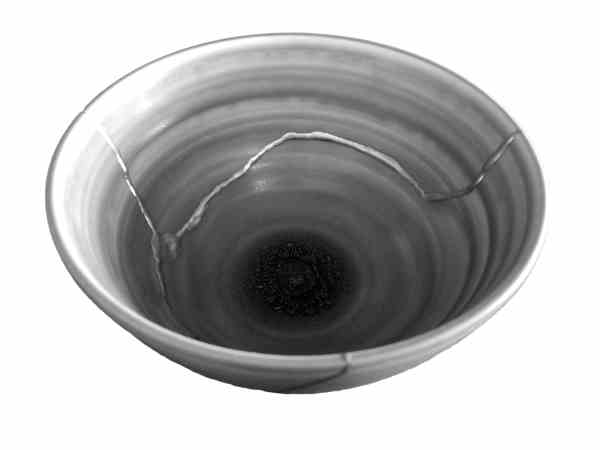 Kintsugi bowls can symbolize flaws and weaknesses that can become beautiful in the refining process. Photo by author.
In addition to the mending kit and a set of dishes, my husband gave us a beautiful kintsugi bowl to help us visualize a finished masterpiece. We began our project. We dropped a few pieces from the set of dishes and watched them break into pieces. Each of us picked a broken dish and carefully applied the resin to the crooked and cracked edges, sanded the seams, and sprinkled on the powdered gold. Even though our dishes weren’t as beautiful as those made by skilled kintsugi artists, they were still a reminder of how something that is broken can be transformed by a master into something beautiful and valued.
As a family we discussed several lessons we could apply from that activity. Creating our kintsugi artwork reminded us that we are all imperfect, like a shattered dish, and we must decide if we will receive help from our Savior and Redeemer. We all have flaws. No one is exempt. Some may feel broken because of sin. Others may feel broken because of weaknesses or the behavior of others. Civil rights activist Bryan Stevenson wrote, “We are all broken by something. We have all hurt someone and have been hurt. We all share the condition of brokenness even if our brokenness is not equivalent. . . . Our brokenness is also the source of our common humanity, the basis for our shared search for comfort, meaning, and healing. Our shared vulnerability and imperfection nurtures and sustains our capacity for compassion.”[1] We become more compassionate as we see that we all need a little mending. In our culture we have a mindset that we should be flawless, as if a life without imperfections is a sign of true beauty and strength. But none of us is without imperfections. We all could use some gold sprinkled on our weak seams. As with kintsugi, mending “brokenness” produces priceless pieces of soul work.
In a devotional for BYU Education Week, Elder Jeffrey R. Holland taught why religion is essential for mending and healing: “Our English word religion comes from the Latin word religare, meaning ‘to tie’ or, more literally, ‘to re-tie.’ In that root syllable of ligare you can hear the echo of a word such as ligature, which is what a doctor uses to sew us up if we have a wound. . . . Religion is that which unites what was separated or holds together that which might be torn apart—an obvious need for us, individually and collectively, given the trials and tribulations we all experience here in mortality.”[2]
In our religion, we praise a Savior who ties and reties us to Him. We praise Him as our Master Surgeon who binds our wounds, our brokenness, our imperfections, and anything that separates us from Him and one another. Christ came to help us become “at-one” with Him, not to be left “al-one.” We are not broken pieces of pottery left with no hope of mending.
In a world today that has more people leaving religion behind, people are forgoing the healing power of the Son of God. To believe that religion can heal souls is the very key to one’s progression in mortality. To be religious means that we seek divine assistance to heal and mend what is broken or imperfect. Do we trust in our Savior’s refining influence? Do we know we are worth healing?
“You Are Worth It!”
Self-doubt often comes when we feel we are not worth or worthy of God’s help. We feel we are too broken, too flawed—that we have just made too many mistakes for the Savior to love us, help us, or forgive us. Satan fills our minds with guilt, shame, and the fear that God has given up on us, that He no longer loves us or cares about us. Satan would have us believe that our worth is insufficient for God’s grace. Nothing could be further from the truth!
Are we too harsh on ourselves because we are not perfect yet? Do we think our worth is determined by how good we are right now? My nephew shared with me some of the thoughts he had when he was battling perfectionism:
- “I am either going to do [this task] perfectly, or I’m not going to do it at all—there is no use trying.”
- “If I don’t live my life perfectly, then I will not have the Spirit with me.”
- “If I don’t [do it] perfectly, then I’m not worth anything, and others will think I’m a failure, and I’ll tell myself that I’m a failure.”[3]
Our weaknesses do not define our worth; God has already defined it. An article of faith about our divine worth might read, “We believe we are children of heavenly parents, made in their image and with the potential to become like them because they love us.” We have reason to believe that we are worth loving! I imagine our Heavenly Father saying, “Because of who you really are, my child, you are worth helping, worth inspiring, worth forgiving, and worth loving. You belong to me—making the glory and grandeur of your worth divine!” If we are ever tempted to say, “I’m not worth anything,” could we remember how God sees us? “Remember the worth of souls is great in the sight of God” (Doctrine and Covenants 18:10). My nephew sees himself differently now: as someone with great worth in God’s eyes. That knowledge has motivated him to give his best effort and enjoy the journey through life more—even with imperfections.
While serving as Primary General President, Joy D. Jones taught that there is a difference between worth and worthiness: “They are not the same. Spiritual worth means to value ourselves the way Heavenly Father values us, not as the world values us. Our worth was determined before we ever came to this earth. . . . On the other hand, worthiness is achieved through obedience. If we sin, we are less worthy, but we are never worth less! We continue to repent and strive to be like Jesus with our worth intact. . . . No matter what, we always have worth in the eyes of our Heavenly Father.”[4]
Not too long ago, one of my students doubted his worth because of his sins. “I don’t think I am worthy of God’s love,” he shared. “I’ve made too many mistakes and committed too many sins. I find it hard to believe that the Savior could take someone as broken as me and see someone worth helping.” My heart went out to him. The most important lesson we learn from the Savior about His atoning sacrifice is that He loves us! He made it possible to overcome physical and spiritual death because we are worth it. With all He has done for us, He seems to say, “I did it all for you, because you are worth it to me! I paid the price for your sins so you can be worthy of returning back to my presence—worthy of eternal glory.” The Savior believes in us! He knows what we can become with Him. “For it is I that taketh upon me the sins of the world; for it is I that hath created them; and it is I that granteth unto him that believeth unto the end a place . . . eternally at my right hand” (Mosiah 26:23–24).
President Jones continued, “If the love we feel for the Savior and what He did for us is greater than the energy we give to weaknesses, self-doubts, or bad habits, then He will help us overcome the things which cause suffering in our lives. He saves us from ourselves.”[5] Because the Savior suffered for us, He rescues us from our suffering. We honor Him as we doubt our worth less and do more to be worthy.
Our Savior’s Willingness to Forgive
In the Gospel of John we read the story of a woman taken in adultery. The scribes and Pharisees judged and condemned both her and her sin. Then Jesus came, stooped to the ground, and wrote in the sand as He upbraided her accusers: “He that is without sin among you, let him first cast a stone at her. . . . And they which heard it, being convicted by their own conscience, went out one by one.” Jesus then approached the woman and said, “Woman, where are those thine accusers? hath no man condemned thee? She said, No man, Lord. And Jesus said unto her, Neither do I condemn thee: go, and sin no more” (John 8:3–11).
We learn two important lessons from the Savior’s response. First, Jesus did not condemn the woman; He confirmed her divine worth, and He forgave her. Second, Jesus did not condone her sin. The woman needed to “sin no more”; she needed to repent. That is, she needed to grow. Repentance is growth under God’s direction.
We can be at peace knowing that Christ came to save us from sin—not to condemn us as though we were ready for Final Judgment. We are not ready yet. Much growth is still needed. “For God sent not his Son into the world to condemn the world; but that the world through him might be saved. He that believeth on him is not condemned” (John 3:17–18). Christ came to save us from wrongdoing—we just need to believe Him!
Christ pleads our cause before the Father, even as He did for those who had put Him on the cross: “Father, forgive them [the soldiers]; for they know not what they do” (Luke 23:34). Christ was able to see beyond their horrific behavior, perceive their limited understanding, and know what possibilities of change were still theirs—even then, on the cross. Christ’s response is a witness to all of us that He is willing to forgive. It’s hard to fathom the depth of His compassion. If Jesus Christ is willing to forgive those who nailed Him to the cross, is He not also willing to forgive me and you for our sins? I believe He is willing. I stand in awe of His mercy. I love Him and will forever be grateful for what He has done for each one of us.
Sin takes a toll on our self-esteem. When we sin, we judge ourselves to be unworthy of the Perfect Judge’s help. We hear people say, “I don’t doubt that God can help me; I just doubt that I can stop my poor behavior, so I’m not worthy of God’s help”; “I’m beyond help because of all the bad things I’ve done”; or “I have turned my back on God and assume He has turned His back on me.” Author Brad Wilcox identifies these feelings as signs that we misunderstand the depth of the Atonement:
We understand that God and Jesus were willing to forgive the first time, but we wonder how many more times they will be willing to watch us bumble along before they finally roll their eyes and declare, “Enough already!” We struggle so much to forgive ourselves that we wrongly assume God must be having the same struggle. . . .
Christ Himself answers, “As often as my people repent will I forgive them their trespasses against me” (Mosiah 26:30; see also Moroni 6:8). Would Christ command us to “continue to minister” to the afflicted (3 Nephi 18:32) if He were not willing to continually minister to us in our afflictions?[6]
I love Brother Wilcox’s statement that Christ will continue to minister to us—even when we have acted poorly, even when we have sinned. Why will He continue to minister to us? Because that is His work and His glory. He can see the end from the beginning and knows what we are capable of becoming.
Sometimes we confuse sin and weakness. Psychologist Wendy Ulrich explains that sin is willful rebellion against God, whereas weakness refers to human limitations and vulnerabilities. When we sin, repentance is needed to align our hearts and behavior with the will of God. But weaknesses are not sins. They are not rebellion against God; repentance is not needed. What is needed is humility.[7]
Some people feel guilty about having weaknesses, as if having weaknesses is a sin: “I feel so guilty for not being a better mother.” “I’m ashamed that I’m not smarter.” “I feel bad that I’m a terrible communicator.” Did these people defy the will of God? If not, they have not committed sin. They may have weaknesses they need help with, but they have not rebelled against God—an important distinction.
Our Savior can forgive our sins and help us overcome our weaknesses. While there is always room for improvement, so many of us are doing better than we think we are. Can we stop feeling guilty for weaknesses that are not sins? Can we strive to have a humble heart and seek the Lord’s help in overcoming both?
Humility requires submissiveness to the will of our Savior, which opens our hearts to personal refinement. In 1987 I participated in a BYU study abroad trip to Israel as a college student. One of the highlights of the trip was our visit to a potter’s shop. We watched the potter work the clay on his potter’s wheel. It was fascinating to watch him as he molded a pot, repeatedly adding more water and more clay. As he saw imperfections in his piece, he smoothed out the rough edges or started over with the mass of clay to make it bigger and better than before. The goal was to keep refining the piece until it was finished and complete. As a group we read Jeremiah 18:6: “Cannot I do with you as this potter? saith the Lord. Behold, as the clay is in the potter’s hand, so are ye in mine hand.”
That experience in Israel made a lasting impression on me. I pondered, “In what ways am I like clay in His hands? What does the Lord do with me if He is my potter?” Elder Neal A. Maxwell taught, “If faithful, we end up acknowledging that we are in the Lord’s hands and should surrender to the Lord on His terms—not ours. . . . It is only by yielding to God that we can begin to realize His will for us. And if we truly trust God, why not yield to His loving omniscience? After all, He knows us and our possibilities much better than do we.”[8] I learned that if I trust God, He can make more of me than I can. I needed to be spiritually submissive—submitting my will to God’s will—which requires a humble heart.
Jesus Christ has promised to help us whenever we turn our hearts to Him and seek to receive His refining influence. Just as a kintsugi artist takes a broken pot and mends and beautifies fractured seams to create a work of art, Jesus Christ takes our sins, imperfections, and inadequacies and refines our character, improving us beyond our original state. We become more beautiful than we can imagine. The most essential part of this refining process is the Savior’s forgiveness.
When we experience doubt about our worth or worthiness, can we remember the Savior’s belief in our worth and His willingness to forgive our sins? Doctrine and Covenants 61:2 reminds us, “For I, the Lord, forgive sins, and am merciful unto those who confess their sins with humble hearts.” The Savior asks us to be obedient so that we may be worthy of His blessings. President Ezra Taft Benson taught, “When obedience ceases to be an irritant and becomes our quest, in that moment God will endow us with power.”[9] If our quest is to see how good we may become, we seek to be obedient. We seek to repent of our sins, knowing that the Savior is willing to forgive.
Repentance
For many of us, the word repentance is connected with feelings of guilt and shame and implies that we should feel bad about ourselves. Or perhaps we think repentance is necessary only for those who have committed big sins. But recently President Russell M. Nelson taught us:
Does everyone need to repent? The answer is yes.
Too many people consider repentance as punishment—something to be avoided except in the most serious circumstances. But this feeling of being penalized is engendered by Satan. He tries to block us from looking to Jesus Christ, who stands with open arms, hoping and willing to heal, forgive, cleanse, strengthen, purify, and sanctify us.
The word for repentance in the Greek New Testament is metanoeo. The prefix meta- means “change.” . . .
Thus, when Jesus asks you and me to “repent,” He is inviting us to change. . . .
When we choose to repent, we choose to change! We allow the Savior to transform us into the best version of ourselves. . . . We choose to become more like Jesus Christ![10]
I have caught myself ignoring this concept of repentance, thinking it really didn’t apply to me; I didn’t have big sins, so I didn’t need to think about repentance. But our prophet’s invitation to choose change has been a powerful reminder that we are choosing to let our Savior “transform us into the best version of ourselves.” And that is powerful motivation to choose repentance. One friend said that she applies a “growth mindset” (as explained in chapter 4) to repentance: “I see repentance as an opportunity for me to become better. It’s how I can learn and grow and be a better me.”
Our relationship with God changes when we realize that continually growing is what we were designed to do. This is the process by which we become more godlike, one day at a time. Repentance shouldn’t be something we avoid but something we embrace. One sister shared her change of attitude about repentance:
Formerly I had pictured God as a stern, finger-shaking personage who was impossible to please. I had been taught that he loved me, but since I didn’t feel lovable I had built a barrier between us that made his love for me seem academic and meaningless. I was so overwhelmed by my distorted view of gospel “demands” and by my own lack of perfection that I could find little joy, comfort, or strength in the gospel—that which should have been my greatest resource.
. . . [Then I realized that] God was my Friend. He had a smile on his face and had abundant approval and encouragement for me. I realized that he truly wanted me to experience the joy of learning and growing. . . .
. . . Now I think of repentance as growth, and forsaking sin means avoiding things that limit growth. I now find myself free of the terrible burden of guilt, inadequacy, and fear of not “making it” that used to haunt me. Instead of feeling overwhelmed by my weaknesses, I feel a genuine desire to grow.[11]
Willingness to change produces growth. And growth and progress create joy. “For, behold, the Lord your Redeemer . . . suffered the pain of all men, that all men might repent and come unto him. . . . And how great is his joy in the soul that repenteth!” (Doctrine and Covenants 18:11–13). My favorite story about someone who had the courage to change and found joy in repenting is that of Alma the Younger. Alma was a rebel; he turned his back on God, committed many sins, and sought to destroy the Church of God. After an angel appeared to him, he had a mighty change of heart and became a great witness of Jesus Christ:
And it came to pass that as I was thus racked with torment, while I was harrowed up by the memory of my many sins, behold I remembered also to have heard my father prophesy unto the people concerning the coming of one Jesus Christ, a Son of God, to atone for the sins of the world. . . .
And oh, what joy, and what marvelous light I did behold; yea, my soul was filled with joy as exceeding as was my pain!
Yea, I say unto you, my son, that there could be nothing so exquisite and so bitter as were my pains. Yea, and again I say unto you, my son, that on the other hand, there can be nothing so exquisite and sweet as was my joy. (Alma 36:17, 20–21)
We may have people close to us that are in need of an Alma-like experience. We desire that they may know of the joy made possible through our Savior. Turning away from God and relying on our own strength can be painful. But the amazing peace and joy Christ provides is ours if we choose to change. President Dallin H. Oaks taught, “The gospel of Jesus Christ challenges us to change. . . . The purpose of the gospel is to transform common creatures into celestial citizens, and that requires change.”[12] When we think about our divine potential, it seems obvious that everyone needs to change—a lot—to get from where we are to where we need to be eventually. So why are we so afraid of change? Where can we start?
We can start by thinking about what God would have us change today. One of my friends suggested that we ask ourselves, “What is one thing I am not doing in my life that I should be doing?” or “What is one thing that I am doing right now that I should not be doing?” Remember, the adversary likes to overwhelm us with a long list of what we could be doing better, but the Holy Spirit does not work with us that way; He gives us one or two promptings at a time in a loving and motivating manner.
Change is achievable one step at a time. We can listen to the Spirit for guidance on the most important thing we can change right now. We can also ask the Lord in prayer, “What lack I yet?” Elder Larry R. Lawrence invited us to “humbly ask the Lord the following question: ‘What is keeping me from progressing?’ In other words: ‘What lack I yet?’ [After asking,] wait quietly for a response.” He shared some examples of people who asked this question and what the Spirit whispered to them:
A humble young man who couldn’t seem to find the right young woman went to the Lord for help: “What is keeping me from being the right man?” he asked. This answer came into his mind and heart: “Clean up your language.” . . .
A single sister bravely asked the question: “What do I need to change?” and the Spirit whispered to her, “Don’t interrupt people when they are talking.” . . .
. . . [A girl in college] fell to her knees and cried out, “What can I do to improve my life?” The Holy Ghost whispered, “Get up and clean your room.” . . .
. . . “It is our duty to be better today than we were yesterday, and better tomorrow than we are today” [Joseph Fielding Smith, Doctrines of Salvation, comp. Bruce R. McConkie, 3 vols. (1954–56), 2:18].[13]
Change can be big or small. We can change big bad habits, little bad habits, a sin, or a weakness. The process of change can begin with a simple prayer: “Please help me change _____.” “Please forgive me for _____.” I believe the Lord hears every plea for help to become a better person.
Our willingness to repent welcomes a better version of ourselves. We have an opportunity to repent every Sunday when we partake of the sacrament. Elder D. Todd Christofferson taught, “The bread and water represent the flesh and blood of Him who is the Bread of Life and the Living Water, poignantly reminding us of the price He paid to redeem us. . . . Figuratively eating His flesh and drinking His blood has a further meaning, and that is to internalize the qualities and character of Christ [His holiness], putting off the natural man and becoming Saints ‘through the Atonement of Christ the Lord’ [Mosiah 3:19].”[14] When we partake of the sacrament, we partake of the divine nature of Christ—of godliness. We become a little more godlike with each partaking. I have a friend who said, “Since I have an invitation each week to partake of godliness, I don’t want one week to pass without me partaking of divinity to get me through the next week.” Her statement has reminded me personally of the power of this sacred ordinance. Christ’s gift to us on a weekly basis is to partake of His power, His love, and His strength as we symbolically internalize His atoning sacrifice for us.
The beauty of the Atonement is that Christ already paid the price for us to progress. Now it’s up to us to accept His help. He is our Savior and our Friend: He paid the price for us to be forgiven from sin, and His encouragement is constant. In the hymn “Reverently and Meekly Now,” we sing:
In the solemn faith of prayer
Cast upon me all thy care,
And my Spirit’s grace shall be
Like a fountain unto thee.
At the throne I intercede;
For thee ever do I plead.
I have loved thee as thy friend,
With a love that cannot end.
Be obedient, I implore,
Prayerful, watchful evermore,
And be constant unto me,
That thy Savior I may be.[15]
When we choose to repent, we invite the Savior to go to work on us. Our willingness to change calls down the redeeming power of the Savior that molds and refines us into something more beautiful, like an artist’s masterpiece.
Our Forgiveness—Emulating the Atonement
During one class period at BYU, I shared a quote from President Boyd K. Packer with my students: “The Lord provides ways to pay our debts to him. In one sense, we ourselves may participate in an atonement. When we are willing to restore to others that which we have not taken, or heal wounds that we did not inflict, or pay a debt that we did not incur, we are emulating His part in the Atonement.”[16] I then asked my students, “How can we emulate the Atonement?” One student said, “I can wash dishes that I did not dirty and clean up messes that I did not make.” Another said, “I can forgive someone who made no apology.” And another, “When my roommate drives me crazy, I can be patient anyway.”
My husband, John, taught at a BYU Women’s Conference, “While we do not have the power to blot out our spouse’s sins or offenses, we can heal each other when we imitate the merciful dimension of the Savior’s memory—His kind forgetfulness.”[17] We don’t have the redemptive power unique to the Savior, but we can imitate His loving-kindness and His forgiveness. When someone acts poorly, we can love that person anyway, be patient anyway, serve him or her anyway, and be a good example anyway. Can we look beyond poor behavior and focus on the person’s potential? Can we not be easily offended and instead look for the need behind an irritating behavior? Let us try to fill in the gaps where someone is weak, comfort those that stand in need of comfort, and mourn with those that mourn (see Mosiah 18:9). We help others and ourselves when we extend the Savior’s loving-kindness and forgiveness.
The Savior offers hope in His forgiveness and wants us to experience the peace that accompanies it. He also requires that we forgive others and seek to be instruments in His hands: “For if ye forgive men their trespasses, your heavenly Father will also forgive you” (Matthew 6:14).
Elder Timothy J. Dyches retold how Corrie ten Boom, a Holocaust survivor, was able to receive and then extend the Savior’s love and forgiveness:
Corrie ten Boom, a devout Dutch Christian woman, found . . . healing despite having been interned in concentration camps during World War II. She suffered greatly. . . .
After the war she often spoke publicly of her experiences and of healing and forgiveness. On one occasion a former Nazi guard who had been part of Corrie’s own grievous confinement in Ravensbrück, Germany, approached her, rejoicing at her message of Christ’s forgiveness and love.
“‘How grateful I am for your message, Fraulein,’ he said. ‘To think that, as you say, He has washed my sins away!’
“His hand was thrust out to shake mine,” Corrie recalled. “And I, who had preached so often . . . the need to forgive, kept my hand at my side.
“Even as the angry, vengeful thoughts boiled through me, I saw the sin of them. . . . Lord Jesus, I prayed, forgive me and help me to forgive him.
“I tried to smile, [and] I struggled to raise my hand. I could not. I felt nothing, not the slightest spark of warmth or charity. And so again I breathed a silent prayer. Jesus, I cannot forgive him. Give me Your forgiveness.
“As I took his hand the most incredible thing happened. From my shoulder along my arm and through my hand a current seemed to pass from me to him, while into my heart sprang a love for this stranger that almost overwhelmed me.
“And so I discovered that it is not on our forgiveness any more than on our goodness that the world’s healing hinges, but on His. When He tells us to love our enemies, He gives, along with the command, the love itself.”[18]
Corrie ten Boom learned a life-changing lesson: the Nazi guard was also worthy of the Savior’s love and forgiveness—even after all the horrible things he had done. His deeds were unworthy, but his soul was worth redeeming. She was able to feel the Savior’s love work through her because she was willing to forgive. (There are additional principles that must be addressed with the complexity of circumstances regarding abuse. Only basic principles are addressed here.)
Peter asked Jesus, “How oft shall my brother sin against me, and I forgive him? till seven times? Jesus saith unto him, I say not unto thee, Until seven times: but, Until seventy times seven” (Matthew 18:21–22). God asks that we always forgive, and He promises that something beautiful will happen to our hearts when we do: we will feel the Savior’s goodness and grace and want to share it with others.
Forgiveness is essential for overcoming self-doubt. President James E. Faust taught:
If we can find forgiveness in our hearts for those who have caused us hurt and injury, we will rise to a higher level of self-esteem and well-being. Some recent studies show that people who are taught to forgive become “less angry, more hopeful, less depressed, less anxious and less stressed,” which leads to greater physical well-being [Fred Luskin, in Carrie A. Moore, “Learning to Forgive,” Deseret Morning News, Oct. 7, 2006, p. E1]. Another of these studies concludes “that forgiveness . . . is a liberating gift [that] people can give to themselves” [Jay Evensen, “Forgiveness Is Powerful but Complex,” Deseret Morning News, Feb. 4, 2007, p. G1].[19]
Forgiveness is a gift from God, a gift we can generously give to others—and to ourselves. Sometimes we forget that we need to forgive ourselves too. In a BYU devotional, Steven M. Sandberg, assistant to the president of BYU, taught:
You are worth being and feeling forgiven; and . . . our Savior wants to help you forgive yourself. . . .
When you find that your inner critical voice is louder than your compassionate voice [toward yourself], imagine what you might say to a close friend in a similar situation. You would sit with them in empathy. You would offer words of hope. You would point out their strengths and remind them that they are loved. I know Christ would do this for you if He sat beside you.
Can you become that friend to yourself? When Christ asks us to act with compassion unto “the least of these,” that includes you and how you treat yourself [Matthew 25:40].[20]
Again, sometimes you are the person you most need to forgive!
As we participate in the repentance process, we are reminded that God believes in us more than we believe in ourselves. He loves us more than we love ourselves, because we belong to Him; we are His family, and He knows what we can become.
Putting Our Trust in the Hands of God
A few years ago, our family went to the Accademia Gallery Museum in Florence, Italy, where we saw many of Michelangelo’s masterpieces. I’ll never forget seeing the statue of David for the first time and wondering how someone could create something so perfect. We saw many impressive pieces of marble that portrayed the majesty of the human body. The ones I found most intriguing were the statues that were only partially carved; they looked as if the figures were trying to break out of the stone. You could see only part of a finished masterpiece, a beautiful person emerging from the rugged and unfinished edges. When Michelangelo was asked how he created a magnificent statue of an angel, he reportedly replied, “I saw the angel in the marble and carved until I set him free.”[21]
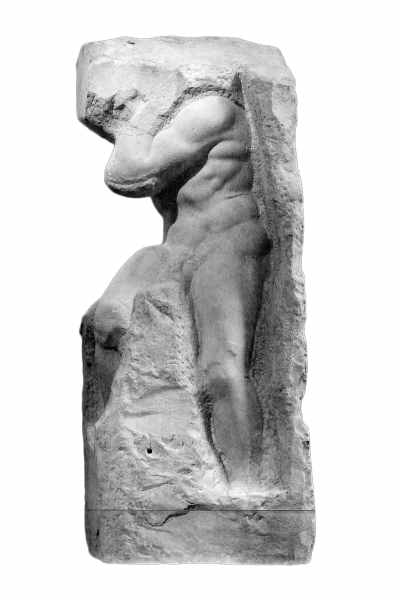 Michelangelo (1475–1564), Atlas Slave. One of Michelangelo’s Prisoners statues that are still in the process of becoming perfected—just like us. Courtesy of Jörg Bittner Unna. Wikipedia.org.
Perhaps one of the reasons Michelangelo left these pieces unfinished—non finito—was to illustrate, like kintsugi artists, the beauty of imperfection. His figures, like each of us, struggle to free themselves from whatever binds them. Scholars claim that Michelangelo deliberately left these statues (called the Prisoners) incomplete to represent the “struggle of man to free the spirit from matter.”[22] The problem many feel is that we are prisoners stuck in a state of weakness that prevents us from seeing our potential as masterpieces. We want to be free of the sins and weaknesses that constrain us.
We are like art, continually being refined by the hand of our Creator. He is our Master Sculptor, the Master of peace, creating a masterpiece in each one of us. With our limited vision, we may see only the rugged, jagged, unfinished edges that need refining. If we could see as God sees, we would perceive our non finito (“unfinished”) magnificence simply because we are made in His image. We are His children with the potential to become like Him. He carves, molds, and refines us until we are perfected as He is—if we accept His help. We pray, “O Lord, thou art our father; we are the clay, and thou our potter; and we all are the work of thy hand” (Isaiah 64:8).
God knows us and our possibilities better than we do. Can we put our lives in His hands and accept His refining influence? Can we believe we are worth helping? Our Savior seeks to bless us. Can we seek to be worthy of His blessings?
 The yellow arrow signs along the Camino point the way, which is like our need to receive directions to the right path in life. Photo by Allen Kreutzkamp.
On the Camino de Santiago, pilgrims frequently see yellow arrow signs that mark the path. These yellow arrows are painted on barns, buildings, poles, trees, rocks—you name it. The yellow arrows ensure that pilgrims won’t get lost. When sin causes us to get off the path as we walk our journey through life, repentance puts us back on the “Camino”—like yellow arrows pointing the way to becoming a better version of ourselves. Elder Dale G. Renlund taught that the Swedish word for repentance, omvänd, means “to turn around.”[23] In the words of C. S. Lewis, repenting is “being put back on the right road.”[24] The very process of repentance is about turning our hearts back to God. As we repent, God not only forgives us but confirms our worthiness to receive His blessings.
If we get off the path, Christ points the way back: “I am the way, the truth, and the life: no man cometh unto the Father, but by me” (John 14:6; italics added). I imagine Him reminding us, “I made the pathway back home possible for you. Repent and come unto me. Accept my refining influence because you are a child of God with divine potential—that makes you worth helping!”
♦ ♦ ♦
Invitation: Focus on the Savior’s desire and willingness to forgive you. Focus on how you can change, repent, and partake of the Savior’s refining influence.
Think-in-ink journal challenge: Write down why you are thankful for the Savior’s willingness to forgive. Identify and write down one thing you can change and work on right now (that is, one thing you are doing that you need to stop doing or one thing you are not doing that you should be doing).
Notes
[1] Bryan Stevenson, Just Mercy: A Story of Justice and Redemption (New York: Spiegel and Grau, 2015), 289.
[2] Jeffrey R. Holland, “Religion: Bound by Loving Ties” (Brigham Young University Education Week address, August 16, 2016), 1, speeches.byu.edu.
[3] Devin Vogelsberg, email message to author, May 28, 2020.
[4] Joy D. Jones, “Value beyond Measure,” Ensign, November 2017, 14.
[5] Jones, “Value beyond Measure,” 15.
[6] Brad Wilcox, The Continuous Atonement (Salt Lake City: Deseret Book, 2009), 14–15.
[7] See Wendy Ulrich, Weakness Is Not Sin: The Liberating Distinction That Awakens Our Strengths (Salt Lake City: Deseret Book, 2009), 21–37.
[8] Neal A. Maxwell, “Willing to Submit,” Ensign, May 1985, 72; italics added.
[9] Quoted by Donald L. Staheli, “Obedience—Life’s Great Challenge,” Ensign, May 1998, 82.
[10] Russell M. Nelson, “We Can Do Better and Be Better,” Ensign, May 2019, 67.
[11] Louise Brown, “Learning to Love Myself,” Ensign, March 1982, 30.
[12] Dallin H. Oaks, “Repentance and Change,” Ensign, November 2003, 37.
[13] Larry R. Lawrence, “What Lack I Yet?,” Ensign, November 2015, 33–35.
[14] D. Todd Christofferson, “The Living Bread Which Came Down from Heaven,” Ensign, November 2017, 37; italics added.
[15] “Reverently and Meekly Now,” Hymns, no. 185; italics added.
[16] Boyd K. Packer, “The Brilliant Morning of Forgiveness,” Ensign, November 1995, 20.
[17] John R. Rosenberg, “‘Old Variaunce’ or ‘Newe Attonement’: Marriage and the Imitation of Christ,” in A Light Shall Break Forth: Talks from the 2005 BYU Women’s Conference (Salt Lake City: Deseret Book, 2005), 192–93.
[18] Timothy J. Dyches, “Wilt Thou Be Made Whole?,” Ensign, November 2013, 38–39.
[19] James E. Faust, “The Healing Power of Forgiveness,” Ensign, May 2007, 68.
[20] Steven M. Sandberg, “The Light of Forgiving” (Brigham Young University devotional, March 10, 2020), 5, speeches.byu.edu.
[21] Quoted in David S. Baxter, “Overcoming Feelings of Inadequacy,” Ensign, August 2007, 14.
[22] “Michelangelo’s Prisoners or Slaves,” Accademia.org, http://
[23] Dale G. Renlund, “Repentance: A Joyful Choice,” Ensign, November 2016, 122.
[24] C. S. Lewis, The Great Divorce (1946), 6; quoted in Renlund, “Repentance: A Joyful Choice,” 122.
