
 menu icon in the top, right corner of the screen.
 icon above to close this box.
 icon at the bottom of the screen below the browser—if you don't see it, swipe up to unhide it.
Robbie Taggart, "The Paschal Way: Walking in Newness of Life," in Life in Christ: A Celebration, ed. Phillip Abbott, Daniel Becerra, Mark D. Ellison, and Joshua M. Sears (Provo, UT: Religious Studies Center, Brigham Young University; Salt Lake City: Deseret Book, 2026), 17–34.
Robbie Taggart is an associate teaching professor of ancient scripture at Brigham Young University.
 Bartolomé Esteban Murillo, La conversión de San Pablo (The Conversion of St. Paul). Courtesy of Museo del Prado via Wikimedia Commons.
After his life-transfiguring experience on the road to Damascus, Paul’s view of discipleship became fundamentally participatory. He perceived that his life was now “in Christ”—a phrase he uses over eighty times in his epistles to indicate the generous, generative quality of life shared by Jesus and his followers.[1] Paul sensed that he and all believers were invited into a new way of seeing existence and of inhabiting the world. His life became part of the life and work of Jesus. In Romans 6, Paul provides an image that links this theology of participation with the message of Easter—of death and resurrection. He asks, “Know ye not, that so many of us as were baptized into Jesus Christ were baptized into his death?” (v. 3). Note that Paul imagines baptism as an entrance “into Jesus Christ,” an immersion into the way of being of the Son of God. Baptism initiates us into a Christian life, but this baptism also represents a death of sorts: “Therefore we are buried with him by baptism into death” (v. 4). In discipleship, every Christian descends with Jesus through the anguish of death and the loss of all things. This is the paschal way—the Easter way, a way that does not deny death or suffering but willingly passes through and forgives it, relinquishing the need to control everything or hold on to everything. But in a paschal life, death does not have the final word. Paul ultimately asserts that “like as Christ was raised up from the dead by the glory of the Father, even so we also should walk in newness of life” (v. 4). This death with all its very real attendant miseries becomes merely the gateway into a dazzling new existence in Christ. What might it mean to “walk in newness of life,” the glory of the Father pulsating through us as participants in the radiant life of Christ? What does the paschal life look like? Let me offer an illustration by way of analogy.
Eighteen years ago, when my second child—a son who is now a sometimes-surly, always-holy, beautiful teenager trying to find his way in a world that seems sideways—was a tiny infant with eternity in his eyes, my mother-in-law was diagnosed with Parkinson’s disease. This degenerative illness would slowly whittle away the lithe movements and verbal agility of this remarkable woman whose unexpected friendship came to me as a bonus blessing for marrying her stunning and generous daughter. When we learned the news, I held my wife, and we wept together. We grieved the anticipated losses—the bike rides our two small children and their forthcoming siblings would never take with their grandmother, the ways we imagined they would be strangers to the real her of her, the verve and vitality of her soul. I was young and scared, but I tried to appear brave for my wife. The next morning, I met a friend at the temple and wept because I was not brave; I was baffled and fearful. This felt like a death.
When we first sat down with my wife’s family to discuss this new element of our shared life, my mother-in-law told us there were days she sorrowed, curled up with the pain, and mourned. There was genuine lament. But she told us also that she trusted that the experience would teach her wisdom and grace, would help her become more fully the person she longed deep down to be. She spoke of “awakening to the unexpected beauty of [her] brokenness.”[2] She began to learn the art of dancing through the darkness.
The intervening years held miracles and grace, priesthood blessings and answered prayers. But her mobility diminished gradually, and her tremors increased over time. She began walking with a cane, which she affectionately called “Shugah.” She dubbed her two trembling legs “Loma” and “Prieta” in honor of the 1989 earthquake she lived through in the San Francisco Bay area. She poured herself out in service to her family, shining the spotlight of her affectionate attention on each member of her posterity in turn. To be in her presence is to feel yourself seen and loved. She wished she could do more as she took to resting more frequently and joining on fewer hikes during family camping trips to national parks. After a mission to sub-Saharan Africa, which invigorated her spiritually but wearied her physically, her mobility and functionality began to seriously suffer.
Then last year, she underwent two major surgeries to implant electrodes in her brain in a procedure known as deep brain stimulation. For these surgeries, she was conscious and curious as they cut open her skull and maneuvered around in the tissue of her brain. They implanted a neurostimulator in her chest that would communicate with these electrodes. The family organized a fasting chain, with family members and friends fasting every day for the weeks leading up to and between her surgeries, pleading to the God of love to consecrate these medical efforts to the joy and well-being of this woman we love.
Then, in June of last year, she had an appointment to turn on the transmitter. Her doctors told her that it sometimes takes up to a year to calibrate the device, and there might be glitches and setbacks along the way. They encouraged her to prepare for a journey of recovery that would hopefully in time restore some mobility and help slow the progress of her Parkinson’s symptoms.
She arrived at the hospital with her head shorn from the surgeries, in a wheelchair pushed by her only son. Once in the hospital, she took her faltering steps toward check-in, a sort of shuffling toward hope, struggling to make her foot obey her will to move forward, her left arm held inertly at her side. As she sat, preparing for the technicians to activate her transmitter, her legs bounced and trembled like fish out of water, wildly outside the realm of her control. When they turned on the device remotely and without her knowledge, she felt an immediate difference, a settling and a surge of clarity. “Whoa!” she exclaimed, feeling a new quality of life inside her muscles and mind. She walked out of the hospital grinning, without her cane, navigating the stairs with the confidence and nonchalance of the young. Then in the parking lot she began to test the limits of her newly restored body. She marched and swung her arms. She laughed and began to dance down the sidewalk, buoyed by an inner force, rejoicing in the healing she had been gifted. It truly felt like a New Testament–quality miracle.
Shortly after these events, she wrote the following in a family email:
I have no words for the wonder and gratitude and sheer delight of these days. Almost daily I see bits and pieces of my old self returning, fluttering in from above, or striding firmly through the front door of my self. Some grab me by the shoulders and spin me around, laughing. Others sit shyly beside me, wondering if I remember them and if there’s still place for them in my me. A few step into stride next to me, linking an arm through my elbow and leaning in to chat and catch up. They have a lot to say, and I’m thrilled to listen to them again. I really can’t describe it adequately.
Now every day she tries to live inside this newness of life.
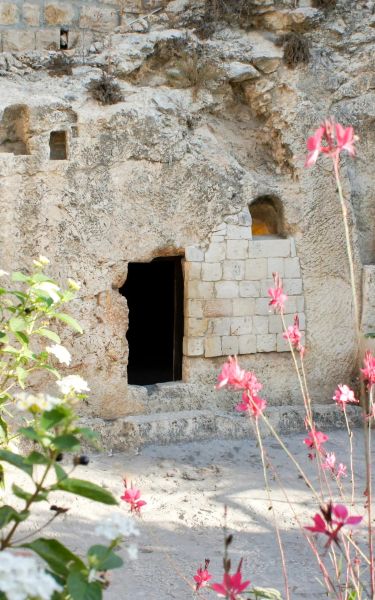 Entrance to the Garden Tomb. Courtesy of Intellectual Reserve, Inc.
This is the image I want to offer you of what it might look like to walk in newness of life. This new life in Christ manifests an inner aliveness. It reflects a fundamental rewiring of the brain and a revitalizing of the heart. Where we shuffled, we dance. Where we limped, we leap. Light pours from us. Despite the irrevocability of death and loss, ecstatic celebration becomes inevitable. This is an Easter life, a life that encompasses sorrow and joy, death and life, suffering and rejoicing. A paschal life participates in the full life of Jesus Christ, including the wounds, the isolation, and the darkness. But peace, healing, and power clothe the follower of Christ. In his letter to the Galatians, Paul teaches, “For as many of you as have been baptized into Christ have put on Christ” (3:27). When we arise from that grave in Christ, with Christ, covered by Christ, we have entered a new quality of life. We see the world differently. The very air has changed. The melodies of wind and laughter possess a hymnic quality. There is simultaneously a delicious quietude—the very silence sings. And now we walk this ragged world as in a melee of miracles.
What are the qualities of a new life in Christ? Joy, certainly. And hope, love, confidence, compassion. Jesus promised, “I am come that [you] might have life, and that [you] might have it more abundantly” (John 10:10). Abundance is that which overflows. This is life and light so full inside us, it cannot help but spill out and illuminate and quench the thirst of others. I want to explore a few salient elements of the abundant life that Christ modeled during the last days of his earthly ministry—both before and after his resurrection—to offer a sense of the existence in which disciples are to participate. Since Paul offers such a robust theology of participation in the Christ life, I will use some of his language to accentuate certain concepts. For the follower of Jesus, life in Christ begins before resurrection. It is a life of fullness, interconnectedness, presence, forgiveness, wisdom, and gladness.
Fullness
In Colossians 1, Paul writes that “God would make known [to the saints] . . . the riches of the glory of this mystery . . . ; which is Christ in you, the hope of glory” (v. 27). Christ in you. The hope of glory—in you, now. Paul wants his audience to recognize that they can live as if God breathes through their lungs, as if light flows through their veins. They can walk through this world as luminous souls, as holy ones. He urges the Colossians into this fuller way of navigating the world: “That ye might walk worthy of the Lord unto all pleasing, being fruitful in every good work, and increasing in the knowledge of God; strengthened with all might, according to his glorious power, unto all patience and longsuffering with joyfulness; giving thanks unto the Father which hath made us meet to be partakers of the inheritance of the saints in light: who hath delivered us from the power of darkness, and hath translated us into the kingdom of his dear Son” (vv. 10–13). Joyfulness, patience, gratitude, and glorious power attend the follower of Jesus.
Paul promises that as we walk in Christ, “rooted and built up in him,” we will abound in thanksgiving (Colossians 2:6–7). We will perceive the miraculous nature of the world in which we live. Just as Christ on the evening of his arrest and betrayal found opportunity to give thanks to God before breaking bread (Luke 22:19), the disciple of Jesus senses the fullness and giftedness of life, the holiness of the everyday. And just as Jesus urged his followers to see his continued presence in the quotidian emblems of bread and wine during the Last Supper, those who walk in newness of life perceive the sacramental nature of our ordinary existence. This way of seeing fills us with wonder and gratitude. Paul testifies, “In every thing ye are enriched by him” (1 Corinthains 1:5), and asserts, “Now ye are full, now ye are rich” (4:8). We may dance today with gladness and gratitude for the richness of the grace we have received. Now we are full. Now we are rich. Perhaps we will look with more care at the mountains or clouds or into the eyes of one we love today and repeat these words: Now I am full. Now I am rich.
Interconnectedness and Presence
The paschal life is a life with others—a life of communion, of shared meals and rituals, of love and mutuality. As he approached the inevitable suffering of Gethsemane and the cross, Christ chose to spend his final hours with those he loved. John records, “Now before the feast of the passover, when Jesus knew that his hour was come that he should depart out of this world unto the Father, having loved his own which were in the world, he loved them unto the end” (13:1). What a wonderful phrase! Having loved his own which were in the world, he loved them unto the end. During his singular, holy, mortal life, Jesus entered into authentic relationships with particular humans with their inimitable personalities and idiosyncrasies and gifts and challenges. And he loved each of these individuals in this world unto the end of his time with them. This kind of love is part of life in Christ. As Jesus and my mother-in-law have modeled, we can be present within our relationships and attentive to the radiance of the people right in front of us.
May I share a brief reflection from my personal life which hints at the simplicity, dailiness, and possibility of this relational aspect of abundant life in Christ? Often as I tuck my youngest daughters in bed at night, I read to them from emails I sent to our extended family when they were younger. These messages recount the antics and witticisms of their childhoods and offer my sense of gratitude and wonder at being their father. My purpose is to share with my daughters the love I have always felt for them, to let them know that I have tried to be attentive to their unique gifts and special brand of hilarity and light. The other night I read to my youngest child an entry from when she was three years old. This was a stage of her life I loved deeply. She had wild, unruly, curly hair that was rarely tamed. Her blue eyes glistened with intelligence and wit. The words that tumbled from her mouth were often uncanny or hilarious.
The entry reads in part,
Tessa in the bathtub said, “When I dunked under, I felt a throat in my mouth, so I can’t wash my body.” . . . Today she wanted to wear a t-shirt to church with the word “SPAM” printed in big yellow letters. I told her, “Trust me, this is not a Sunday shirt.” She said, “No, trust me dad.” . . . When she finally took it off, it had a spot of something on it. It looked like dried food. She said she thought it was from an egg stand. A couple minutes later she came into the room and said, “It was really from a egg stand. I tasted it, and it was from a egg stand. Egg stands are really gross.” . . . When I was holding her the other day, she said, “You have the wonder sink of all the babies.” “The wonder sink?” I asked. She nodded, “Of all the babies.”
As we read these marvelous three-year-old utterances, my now-older daughter chuckled as she snuggled closer into me in her bed, and I felt again grateful that this is my one mortal life, that I am the witness to her light, that I indeed have “the wonder sink of all the babies.” Life in Christ is present to the gift of those with whom we share existence.
That final night, Christ gathered with his friends to eat and remember. When he dressed himself in the humble trappings of a servant and washed their feet, he asserted the value of every person around the table. None were excluded from his generous ministrations. Each received the tender touch of the God who walked among them. Each found themselves the center of his attention and care. On the cross, he saw beyond his own grief to the needs of his mother, and he honored her humanity by arranging for her well-being and provision. What might it look like for us to live with such tender attentiveness to the people that surround us? How might we walk in such newness of life in our families, in our neighborhoods, with our colleagues, and in our wards?
After his resurrection, Jesus continued to model connectedness and affection. When he spoke Mary’s name at the tomb, he manifested again the personal nature of his ministry. He knew her intimately, cared about her sorrow, and visited her in her grief. May the name of every person we love be as sacred in our mouths as hers was in his that day. From Luke’s story about Jesus’s walk with two disheartened disciples along the road to Emmaus, we learn that we have a God who longs to accompany us in our anguish, who listens to us, and who gently teaches us. When Jesus provided breakfast on the shore for his weary and disappointed disciples who had spent the night in fruitless fishing, he showed that resurrection life is more about generosity than about power. And could there be an element of intimate playfulness in these personal postmortal appearances—the wry humor of disguise? The divine is always hidden in plain sight. These mundane encounters show that the paschal life happens in common upper rooms, in gardens, along roads and shorelines, with the people we love. Life in Christ is life attentive to the miraculous nature of the mortals in our midst.
Forgiveness
Despite its radiance, every life has its share of disappointments and shattered hopes. My mother-in-law forgave the losses that Parkinson’s disease brought with it and determined to learn from rather than resent her pain. The paschal life will require forgiveness. This world can break your heart. People fail us, and God often seems distant. Sometimes we cannot dance, despite our yearning for joy. The violent seem to possess all power, and greed and malice rule the nations. As Jesus hung from the cross, uttering the unforgettable words, “Father, forgive them; for they know not what they do” (Luke 23:34), he manifested the radical forgiveness that defines new life in Christ. This man lived a stunningly beautiful life, doing harm to none, and seeking to heal and elevate all. And yet the world rejected him, betrayed him, and killed him. He responded with forgiveness and mercy, inviting followers to do the same.
Forgiveness can be costly. Years ago, I received a distraught phone call from a friend asking me to come to his home. When I arrived, he was anguished and angry. He fell sobbing into my arms and told me that he had just learned that a young man had violently abused and mistreated his daughter. He told me he wanted to hurt the young man, that he honestly wished the boy dead. He asked me for a blessing. He was hungry to hear the voice of God through his grief and rage. I felt wildly inadequate to the task of providing any real comfort or healing. I prayed that God would put words in my mouth. When I laid my hands on my friend’s head, I first felt and expressed an overwhelming outpouring of divine love for this friend, a sense that this man was known and loved and held. The next thing I sensed was a clear message: You must forgive. I hesitated, not daring to say these words. I did not want to minimize his or his daughter’s suffering. I did not want to excuse the abuse or perpetuate injustice. But I sensed God’s will in the invitation to forgiveness. When I finally forced the words from my mouth, my friend’s head dropped into his hands, his body racking with sobs. After the blessing, he asked me, “How?” This is a fair question. Forgiveness is not to condone or overlook the suffering caused by abuse. But it is to recognize that the only path to peace is an end to retaliation, hatred, and violence. Only life in Christ could provide such power.
How can we forgive this brutal world? How can we forgive ourselves and those who hurt us? Elder Jeffrey R. Holland asserts that although the Savior enjoins disciples to “forgive all” (Doctrine and Covenants 64:10), it is “important for some of you living in real anguish to note what He did not say.” He continues,
He did not say, “You are not allowed to feel true pain or real sorrow from the shattering experiences you have had at the hand of another.” Nor did He say, “In order to forgive fully, you have to reenter a toxic relationship or return to an abusive, destructive circumstance.” But notwithstanding even the most terrible offenses that might come to us, we can rise above our pain only when we put our feet onto the path of true healing. That path is the forgiving one walked by Jesus of Nazareth.[3]
Life in Christ empowers disciples to overcome anger, hatred, and a sense of injustice. Retribution retreats when we recognize we were made for mercy, and we are recipients of a mercy we have not merited.
Thank God that Christ has forgiven us. Paul writes, “And you, being dead in your sins . . . hath he quickened together with him, having forgiven you all trespasses” (Colossians 2:13). We could not come forth into the radiance of new life without the merciful grace of Jesus. And life will not be transfigured until it is forgiven. One definition of the verb forgive is “to give up resentment.”[4] We may need to forgive mortality for being what it is—imperfect, disappointing, full of sorrow. Resurrection can be seen as the forgiveness even of death—to live again as if nothing were taken. New life in Christ can be new every day. Despite the darkness and death of yesterday, we can forgive existence and live with fresh hope and vitality today. May we breathe deeply in this broken and holy world and sense that we live in Christ.
Wisdom and Gladness
As my mother-in-law manifested, the joy of paschal life does not wait for the miracle to arrive before blossoming. Gladness does not arise only despite suffering, but it can grow more vigorous through and sometimes because of sorrow. Without death there is no resurrection. Life on the other side of suffering possesses a deeper, wiser joy than the mere pleasures of comfort. As poet Christian Wiman writes, “Even joy is, in a way, sorrow’s flower: lovely, necessary, sustaining, but blooming in loneliness, rooted in grief.”[5] Jesus showed us that there is death and there is deliverance. There is the wandering and there is the promised land. In the desert and in the tomb, we learn the lessons that allow us to bless this world with our compassion. Paul taught Christian disciples, “For all things are yours; whether . . . the world, or life, or death, or things present, or things to come; all are yours; and ye are Christ’s; and Christ is God’s” (1 Corinthians 3:21–23). After quoting these words as a promise to the inheritors of celestial glory, section 76 of the Doctrine and Covenants adds, “And they shall overcome all things” (v. 60). All things belong to the disciple, even death. And all things will be overcome, even death. This is the message of Easter: death is the doorway to life, darkness is the birthplace of light, and sorrow is the midwife of joy.
We have used Paul as the theologian of the paschal life. But of course, the language of life in Christ does not originate with Paul but with Jesus. During his final night with his disciples, the Savior taught these mournful mortals, “Ye shall know that I am in the Father, and ye in me, and I in you” (John 14:20; emphasis added). Later that evening, he urges them, “Abide in me, and I in you” (John 15:4), promising, “My joy might remain in you, . . . that your joy might be full” (v. 11). When Christ visits the Americas after his foray into death, he can affirm that his joy is now full (3 Nephi 17:20). Such a fullness of joy does not come until we say yes to life, yes to suffering, yes to the power of God inside and through us. Our suffering allows us to be participants in the work of healing a world in desperate need of healing.
Through the grace of Christ, through the message of Easter, we can walk in newness of life, today. We can be transformed into luminous humans, moving in new ways as my mother-in-law did after her surgery. We can replicate the rhythms of the gentle, generous life Jesus lived. We can dance despite the darkness. We can rejoice in newness of life. We can see the suffering of the world as the teacher of holiness and compassion, as the catalyst for the kind of eternity we desire to embody today. So let us kneel down in humble awe before the miracle of existence, and then let us rise up singing a new song, allowing God’s love to pour into us and through us, because Christ has given us new life, today. Hallelujah! In the name of Jesus Christ, amen.
Notes
[1] James D. G. Dunn, The Theology of Paul the Apostle (Eerdmans, 1998), 396.
[2] Jerie Sandholtz Jacobs, “Shall We Dance?,” Segullah, January 31, 2011, https://
[3] Jeffrey R. Holland, “The Ministry of Reconciliation,” October 2018 general conference, www.churchofjesuschrist.org.
[4] Merriam-Webster, under “forgive.” It is this definition that Latter-day Saint scholar Adam S. Miller seems to reference when he writes, “Expecting a frozen perfection, we’ll see only a live parade of imperfections. We’ll be frustrated. We’ll be disappointed. We’ll despise this unfinished world and our unfinished selves. . . . Disciples, on the contrary, practice forgiveness as a bearing. They practice forgiveness as a sober and attentive existential mood, as a posture, as a manner of life, as a way of moving through this world” (Mormon: A Brief Theological Introduction [Neal A. Maxwell Institute, Brigham Young University, 2020], 63).
[5] Christian Wiman, My Bright Abyss: Meditation of a Modern Believer (Farrar, Straus, and Giroux, 2013), 20.
