
 menu icon in the top, right corner of the screen.
 icon above to close this box.
 icon at the bottom of the screen below the browser—if you don't see it, swipe up to unhide it.
A Sample of Pure Language
Stephen O. Smoot and Brian C. Passantino, ed., "A Sample of Pure Language," Joseph Smith's Uncanonized Revelations (Provo, UT: Religious Studies Center, Brigham Young University; Salt Lake City: Deseret Book), 47–51.
Circa March 4–20, 1832
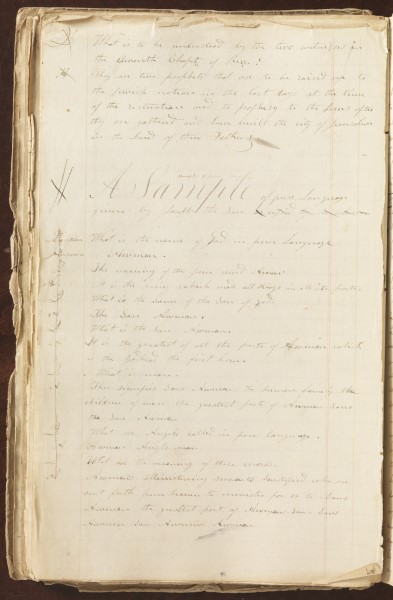 A “sample of pure language” given through Joseph Smith and recorded sometime between March 4–20, 1832. The text is presented in a short series of questions and answers. Joseph Smith Papers Project, © by Intellectual Reserve, Inc. Used by permission. All rights reserved. www.josephsmithpapers.org.
In June 1830, just months after publishing the Book of Mormon, Joseph Smith began a bold new prophetic enterprise: what he called a “new translation” of the Bible.[1] The result of this project—which was completed in July 1833 but never published in the Prophet’s lifetime—includes what is today called the Book of Moses in the Pearl of Great Price. One of the important expansions on the story of Adam and Eve contained in the Book of Moses is the detail that by “the spirit of inspiration” Adam kept “a book of remembrance” in a “pure and undefiled” language (Moses 6:5–6). This same language, the Book of Moses further clarifies, was used by the seer Enoch in his ministry (verse 46) and reveals something important about God’s nature: “In the language of Adam, Man of Holiness is [God’s] name, and the name of his Only Begotten is the Son of Man, even Jesus Christ, a righteous Judge, who shall come in the meridian of time” (verse 57).
The Prophet and other early Latter-day Saints made earnest efforts to recover this “pure language” of Adam,[2] and historians now recognize more clearly how these early Saints viewed the interpretation of tongues and the translation of ancient languages to be a manifestation of heavenly gifts returning to the earth with the restoration of the gospel.[3] By revelation Joseph Smith was called to be a “translator” (compare Doctrine and Covenants 21:1; 107:92; 124:125), a role that evidently included efforts to restore some awareness of Adam’s “pure language” that had been lost through generations of compounding linguistic confusion and chaos.
Smatterings of this Adamic speech are preserved throughout Joseph Smith’s canonized and uncanonized revelations. The word Ahman, for instance, explained by the Prophet to be God’s name in the pure language,[4] appears throughout the Doctrine and Covenants (Doctrine and Covenants 78:15, 20; 95:17; 107:53; 116; 117:8, 11) and in Joseph’s uncanonized revelation on the name of the Council of Fifty.[5] Some of the code names that appeared in the first printed edition of the Doctrine and Covenants may also derive from the pure language,[6] as too might some words in the Book of Abraham.[7] An important “sample” of this pure language was recorded in March 1832, where “Awmen” is identified as the “name of God in pure language” and interpreted to connote “the being which made all things in all its parts,” suggesting a certain polyvalence to the name which can also mean “man of holiness” per the Book of Moses. Although this tantalizing specimen of pure language leaves much unexplained, it nevertheless provides an important if not also limited glimpse into not only the pure language spoken by Adam but also what that language imparts about humanity’s relationship to deity and other heavenly powers.
❋ ❋ ❋
A sample of pure language, given by Joseph the Seer as copied by Brother John Johnson.
Q. What is the name of God in pure language?
A. Awmen.
Q. What is the meaning of the pure word Awmen?
A. It is the being which made all things in all its parts.
Q. What is the name of the Son of God?
A. The Son Awmen.
Q. What is the Son Awmen?
A. It is the greatest of all the parts of Awmen, which is the Godhead—the Firstborn.
Q. What is man?
A. This signifies Sons Awmen, the human family, the children of men, the greatest parts of Awmen Sons, the Son Awmen.
Q. What are angels called in pure language?
A. Awmen Angls-men.
Q. What is the meaning of these words?
A. Awmen’s ministering servants—sanctified—who are sent forth from heaven to minister for or to Sons Awmen, the greatest part of Awmen Son.
Notes
[1] For a recent overview of the history and significance of what is today called the Joseph Smith Translation of the Bible, see Kent P. Jackson, Understanding Joseph Smith's Translation of the Bible (Provo, UT: Religious Studies Center, Brigham Young University; Salt Lake City: Deseret Book, 2022).
[2] For recent analysis of Joseph Smith’s efforts to recover the “pure language,” see David Golding, “‘Eternal Wisdom Engraven upon the Heavens’: Joseph Smith’s Pure Language Project,” in Producing Ancient Scripture: Joseph Smith’s Translation Projects in the Development of Mormon Christianity, ed. Michael Hubbard MacKay, Mark Ashurst-McGee, and Brian M. Hauglid (Salt Lake City: University of Utah Press, 2020), 331–62; Samuel Morris Brown, Joseph Smith’s Translation: The Words and Worlds of Early Mormonism (New York: Oxford University Press, 2020), 19–49.
[3] See generally Christopher James Blythe, “‘By the Gift and Power of God’: Translation among the Gifts of the Spirit,” in Producing Ancient Scripture, 27–53. The phenomenon of glossolalia, or speaking in unknown, heavenly tongues, is well-documented in the early days of the Restoration. On the evolving nature of the gift of tongues in Latter-day Saint thought and practice, see generally Lee Copeland, “Speaking in Tongues in the Restoration Churches,” Dialogue: A Journal of Mormon Thought 24, no. 1 (1991): 13–35; Dan Vogel and Scott C. Dunn, “‘The Tongue of Angels’: Glossolalia among Mormonism’s Founders,” Journal of Mormon History 19, no. 2 (Fall 1993): 1–34; J. Spencer Fluhman, “The Joseph Smith Revelations and the Crisis of Early American Spirituality,” in The Doctrine and Covenants: Revelations in Context, ed. Andrew H. Hedges, J. Spencer Fluhman, and Alonzo L. Gaskill (Provo, UT: Religious Studies Center, Brigham Young University; Salt Lake City: Deseret Book, 2008), 66–89; Matthew R. Davies, “The Tongues of the Saints: The Azusa Street Revival and the Changing Definition of Tongues,” in Joseph F. Smith: Reflections on the Man and His Times, ed. Craig K. Manscill et al. (Provo, UT: Religious Studies Center, Brigham Young University; Salt Lake City: Deseret Book, 2013), 470–85.
[4] JSP, D8:65, “The Great God has a Name By wich he will be Called Which is Ahman”; JSP, CFM:81, “The chairman explained the meaning of the word ‘Ahman’ which signifies the first man or first God, and ‘Ahman Christ’ signifies the first mans son.”
[5] JSP, CFM:48, “This is the name by which you shall be called, The Kingdom of God and his Laws, with the keys and power thereof, and judgement in the hands of his servants. Ahman Christ.”
[6] David J. Whittaker, “Substituted Names in the Published Revelations of Joseph Smith,” BYU Studies 23, no. 1 (1983): 103–12; Golding, “‘Eternal Wisdom Engraven upon the Heavens,’” 352–54; JSP, R2:708–11.
[7] The words Shinehah and Olea in Abraham 3:13 might be connected to the pure language, as suggested by Matthew J. Grey, “Approaching Egyptian Papyri through Biblical Language: Joseph Smith’s Use of Hebrew in His Translation of the Book of Abraham,” in Producing Ancient Scripture, 429n159. Alternatively, there exists a plausible Egyptian etymology for Shinehah. See John Gee, “Fantasy and Reality in the Translation of the Book of Abraham,” Interpreter: A Journal of Latter-day Saint Faith and Scholarship 42 (2021): 156–58; Stephen O. Smoot, “Framing the Book of Abraham: Presumptions and Paradigms,” Interpreter: A Journal of Latter-day Saint Faith and Scholarship 47 (2021): 300–301; Stephen O. Smoot, John Gee, Kerry Muhlestein, and John S. Thompson, “Shinehah, the Sun,” BYU Studies Quarterly 61, no. 4 (2022): 138–41.
