
 menu icon in the top, right corner of the screen.
 icon above to close this box.
 icon at the bottom of the screen below the browser—if you don't see it, swipe up to unhide it.
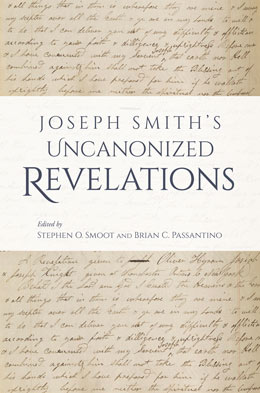
A Revelation on the Removal of the First Presidency to Zion
Stephen O. Smoot and Brian C. Passantino, ed., "A Revelation on the Removal of the First Presidency to Zion," Joseph Smith's Uncanonized Revelations (Provo, UT: Religious Studies Center, Brigham Young University; Salt Lake City: Deseret Book), 105–6.
January 12, 1838
By January 1838, circumstances in Kirtland had gone from bad to worse for Joseph Smith. “A new year dawned upon the church in Kirtland in all the bitterness of the spirit of apostate mobocracy,” the Prophet’s history records, “which continued to rage and grow hotter and hotter.”[1] In the late summer of 1837, the Kirtand Safety Society—a financial institution begun in the fall of 1836 to help buoy the local economy in Kirtland—had all but ceased operations, resulting in substantial financial loss for many (including Joseph) and leaving others feeling disillusioned with the leadership of the Church.[2] Besides a serious economic downturn for the Saints in Ohio, the failure of the Kirtland Safety Society also resulted in the outcry of dissenters who claimed Joseph was a fallen prophet. A wave of excommunications and threats of mob violence escalated tensions.[3]
In response to the growing crisis, the Prophet received a revelation wherein the Lord instructed him and “the presidency” of the Church to remove themselves to Far West, Missouri, “as soon as it is practicable.” This was not, as Joseph’s enemies wrongly assumed, an attempt to flee justice or dodge responsibility. The Prophet, after all, left agents in Kirtland to settle his outstanding financial obligations in his absence.[4] It was, rather, a sober warning about real threats against Joseph and other Church leaders. “The lawsuits were building up,” notes historian Richard Bushman, “and apostates were feared to be plotting more desperate measures.”[5] The revelation itself speaks of Joseph’s labors being finished in Kirtland “for a season,” suggesting an intention to eventually return once things had cooled down.
But until then, Joseph was warned that there was no safety for him and his family in Kirtland. Accordingly, at 10 o’clock in the evening on the same day that this revelation was received, Joseph and Sidney Rigdon left Kirtland on “horseback to escape mob violence which was about to burst upon us.” A few days later their families met with them, and together they “pursued [their] journey with [their] families in covered wagons toward the city of Far West in Missouri.” The “weather was extremely cold” and the Prophet’s wife Emma was six months pregnant.[6]
❋ ❋ ❋
Thus saith the Lord—let the presidency of my church take their families as soon as it is practicable, and a door is open for them, and move on to the west as fast as the way is made plain before their faces; and let their hearts be comforted, for I will be with them. Verily, I say unto you, the time has come that your labors are finished in this place for a season. Therefore, arise, and get yourselves on to a land which I shall show unto you, even a land flowing with milk and honey. You are clean from the blood of this people, and woe unto those who have become your enemies who have professed my name, saith the Lord—for their judgment lingereth not, and their damnation slumbereth not. Let all your faithful friends arise with their families also and get out of this place, and gather themselves together unto Zion, and be at peace among yourselves, O ye inhabitants of Zion, or there shall be no safety for you.
Notes
[1] Joseph Smith, History, 1838–1856, volume B-1 [1 September 1834–2 November 1838], 780, www.josephsmithpapers.org.
[2] On the history of the Kirtland Safety Society, including its failure and the legal and financial aftermath, consult Scott H. Partridge, “The Failure of the Kirtland Safety Society,” BYU Studies 12, no. 4 (Summer 1972): 437–54; Jeffrey N. Walker, “Looking Legally at the Kirtland Safety Society,” in Sustaining the Law: Joseph Smith’s Legal Encounters, ed. Gordon A. Madsen, Jeffrey N. Walker, and John W. Welch (Provo, UT: BYU Studies, 2014), 179–226; Walker, “The Kirtland Safety Society and the Fraud of Grandison Newell: A Legal Examination,” BYU Studies Quarterly 54, no. 3 (2015): 33–148.
[3] JSP, D5:500–501.
[4] “Even after Joseph Smith left Ohio, work to settle his financial affairs there was not neglected. Oliver Granger, who had assumed responsibility for many of Joseph Smith’s Kirtland financial assets, continued to work on settling his financial affairs and paying remaining debts in the area until Granger’s death in 1841, when Reuben McBride assumed these financial responsibilities.” “The Kirtland Safety Society,” Church History Topics, www.churchofjesuschrist.org. See also JSP, D6:62–63, 252–54.
[5] Richard Lyman Bushman, Joseph Smith: Rough Stone Rolling (New York: Alfred A. Knopf, 2005), 340.
[6] Joseph Smith, History, 1838–1856, volume B-1 [1 September 1834–2 November 1838], 780; Bushman, Joseph Smith, 342.
