
 menu icon in the top, right corner of the screen.
 icon above to close this box.
 icon at the bottom of the screen below the browser—if you don't see it, swipe up to unhide it.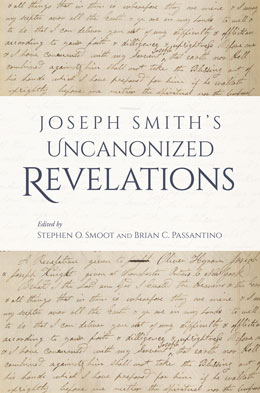
Introduction
Stephen O. Smoot and Brian C. Passantino, ed., "Introduction," Joseph Smith's Uncanonized Revelations (Provo, UT: Religious Studies Center, Brigham Young University; Salt Lake City: Deseret Book), 1–32.
Introduction: Joseph Smith, His Revelations, and the Latter-day Saint Canon
 Revelation Given to Joseph Smith at the Organization of the Church, by Judith A. Mehr. © by Intellectual Reserve, Inc.
Among the accomplishments the Prophet Joseph Smith was eulogized for shortly after his martyrdom were his roles as the translator and publisher of the Book of Mormon and as a revelator who had “brought forth the revelations and commandments” in the Doctrine and Covenants.[1] It is appropriate that the Prophet be remembered in this manner. A revelation given on April 6, 1830, the date of the formal organization of the Church of Christ—later designated by revelation The Church of Jesus Christ of Latter-day Saints (Doctrine and Covenants 115:4)[2]—avows that “there shall a Record be kept among” the Saints and that in it Joseph would be esteemed a seer, translator, prophet, and an apostle of Jesus Christ—one who, “being inspired of the Holy Ghost,” was to be remembered as the one God called to lay the foundation of the restored Church.[3] In the inspired preface to the Doctrine and Covenants, the Lord declared, “Wherefore I the Lord, knowing the calamity which should come upon the inhabitants of the earth, called upon my servant Joseph Smith jr. and spake unto him from heaven, and gave him commandments; and also gave commandments to others, that they should proclaim these things unto the world.”[4] Addressing the Prophet directly in another revelation, the Lord stated succinctly that “this generation shall have my word through you.”[5] These divine pronouncements given in the opening years of the dispensation of the fulness of times remain in force today nearly two centuries later (see Doctrine and Covenants 21:1; 1:17; 5:10).
For the spiritual and ecclesiastical affairs of the Latter-day Saints, the revelations formally canonized in the Doctrine and Covenants (most during the Prophet’s lifetime, but a handful canonized after his death) are of inestimable value and importance. Something that might come as a surprise to many members of the Church, however, is the fact that Joseph Smith recorded dozens of revelations that, for a variety of reasons, went unpublished or uncanonized (or both) during his lifetime. Although perhaps not as well known as their canonized counterparts, these texts are no less important in helping Latter-day Saints appreciate Joseph Smith as a modern revelator and prophet. Besides this, they are valuable to scholars and historians seeking to understand Joseph Smith as an American religious leader. These uncanonized revelations are the subject of this volume, which builds on the groundwork laid by the Joseph Smith Papers Project (JSPP)—an undertaking to “gather together all extant Joseph Smith documents and to publish complete and accurate transcripts of those documents with both textual and contextual annotation.”[6]
This is not the first time Joseph Smith’s uncanonized revelations have been gathered or discussed in Latter-day Saint historical literature. To mention just a few examples of past work, Roy W. Doxey, in his 1965 series The Latter-day Prophets and the Doctrine and Covenants, noted how “all of the revelations received by the Prophet Joseph Smith are not included in the Doctrine and Covenants” and pointed to “other revelations by the Prophet” in the six-volume History of the Church prepared by B. H. Roberts, which for most of the twentieth century was the go-to resource for Latter-day Saints interested in learning about Joseph Smith’s life and the early history of the Church.[7] Elder (and later President) Joseph Fielding Smith recognized something similar, remarking in one 1958 publication how “the Doctrine and Covenants does not contain all the revelations given to the Prophet Joseph Smith,” and emphasizing that it is instead a “‘selection’ of revelations which contain doctrines and commandments covering every phase of salvation.” He went on to say that “the Lord has given revelation to each of the presidents of the Church, but it is unnecessary that every word revealed should be added to that volume.”[8] Speaking more generally, Elder Bruce R. McConkie acknowledged in 1976 how it is “obvious” that there are “other revelations [of Joseph Smith] which might appropriately be given . . . additional dignity and formal stamp of approval” by inclusion in the Latter-day Saint scriptural canon.[9]
Fred C. Collier compiled a book of “unpublished revelations” in 1979 that included material from the Prophet,[10] while Lyndon W. Cook catalogued thirty-four uncanonized revelations in his The Revelations of the Prophet Joseph Smith, published in 1981 (and republished in 1985).[11] More recently, H. Michael Marquardt included several uncanonized Joseph Smith revelations in a 1999 volume.[12] Why, then, might a new volume such as this one be necessary? For starters, these past works are now out of print and so are not readily available to average Latter-day Saints. More than that, advances in scholarship since these works first appeared have in some ways rendered them outdated. While these past publications made important contributions, we now simply know more about Joseph Smith’s uncanonized revelations (particularly their historical context) thanks to advances in scholarship since especially the inauguration of the Joseph Smith Papers Project in 2008. What’s more, while still useful in some ways, Collier’s volume in particular suffers from a number of shortcomings, such as the fact that much of the Joseph Smith material in his compilation is technically neither “unpublished” nor in some cases even, strictly speaking, “revelation.”[13] For these and other reasons, we, the compilers of this volume, felt the time was right to produce a new collection of Joseph Smith’s uncanonized revelations.
Besides offering an update to past work on Joseph Smith’s uncanonized revelations, this present volume aims to contribute to Latter-day Saint historical literature in other ways. For example, while the texts featured in this volume are of course accessible in The Joseph Smith Papers, both online and in print, average readers will probably find it difficult or bothersome to sift through all twenty-seven volumes of the papers to locate these items. This book aims to remove that barrier to help facilitate access to these fascinating revelations. We also hope to enhance the Saints’ study of this material by distilling the latest scholarship on this subject in an approachable yet rigorous manner. We hope that, as with other academic by-products derived from the work of the Joseph Smith Papers Project, this volume will both “increase public knowledge” of Joseph Smith’s uncanonized revelations and “spur future scholarship.”[14] In short, this book aims to assemble these texts and make them accessible for Latter-day Saints who are looking to confirm and strengthen their testimonies in Joseph Smith as God’s prophet. Scholars looking for a reference or guide to this corpus of Joseph Smith documents may also find this volume useful.
At the outset, we should demystify some things for the reader before he or she proceeds any further. There may perhaps understandably be some initial unease when someone first learns that Joseph Smith received revelations that have gone uncanonized. Since most of this material is probably unknown to the average Saint, there may also be some wariness in encountering these new revelations. What do they contain, and are they dramatically different from what is in the Doctrine and Covenants? If it at all helps allay the reader’s apprehension and appropriately calibrates expectations, we can assure upfront that there is nothing in these texts that fundamentally overturns any teachings of the Church or revolutionizes our understanding of who Joseph Smith was. There are no revelations in this volume that pinpoint the location of Kolob or that give the precise date of the Second Coming or that identify the specific hiding place of the Ark of the Covenant. Nor are there any revelations in this compilation that suggest Joseph Smith had some deep, undisclosed secrets. This isn’t to say that these revelations are unimportant, only that the reader may rest assured that they do not significantly change our understanding of either Church history or doctrine. Instead, they provide fuller context to some of Joseph Smith’s teachings and inform our understanding of some specific incidents in the early history of the Restoration. They contain inspired and inspiring principles that are in harmony with the restored gospel as taught in the scriptures, to be sure, and also raise some doctrinal questions that are worth readers’ considered attention.
A Brief History of the Publication of Joseph Smith’s Revelations
Before proceeding any further, it would perhaps be useful to say a few words on the history of the publication of Joseph Smith’s revelations to provide some historical context to the reader.[15] Since its earliest days, members of the restored Church of Jesus Christ understood Joseph Smith’s revelatory pronouncements to be on equal footing with the Bible—or, in short, to be canonical. The English word canon derives from the Greek kanon, meaning a measuring rod and thereby a standard. In Christian usage it has “a wide application,” including the “rule of faith,” the “decrees of councils,” and, perhaps most importantly, “lists of authoritative books of the Bible.”[16] F. F. Bruce, the influential Protestant New Testament scholar, defined canon simply as “the list of books contained in scripture . . . recognized as worthy to be included in the sacred writings of a worshipping community.”[17] For Latter-day Saints, the word is used primarily “to denote the authoritative collection of the sacred books” used in The Church of Jesus Christ of Latter-day Saints.[18] These books are commonly called the “standard works” by members of the Church today and currently include the Bible, the Book of Mormon, the Doctrine and Covenants, and the Pearl of Great Price. Writing in 1976, Elder McConkie described these “standard works” as, appropriately, “the standards, the measuring rods, by which doctrine and procedure [in the Church] are determined.”[19] A unique aspect of the Latter-day Saint understanding of the canon of scripture is the affirmation of an open canon, meaning a canon that is open to receive additional authoritative texts for inclusion in the future. (The Latter-day Saint concept of the canon and the significance Joseph Smith’s unpublished revelations hold for such will be addressed in depth below.)
For Joseph Smith to have elevated his revelatory pronouncements as being canonically authoritative on par with the Bible was in his nineteenth-century Christian environment “something virtually unheard of among” contemporary coreligionists, who widely assumed and affirmed a canon closed to any further scriptural books or revealed pronouncements.[20] “To American observers” of the restored gospel in the nineteenth century, notes historian David F. Holland, the Latter-day Saint “commitment to ongoing revelations was precisely what made the movement so menacing” and theologically aberrant. “In the Latter-day Saint view, the Bible demonstrated that God would offer timely revelations in particular moments of need—something which they felt only an open canon of revelation could facilitate. They believed that in closing the Bible, traditional Christians had violated its fundamental premise.”[21]
On the day the Church was formally organized, Joseph received a revelation wherein God commanded the Church to “give heed unto all his [Joseph’s] words and commandments which he shall give unto you as he receiveth them. . . . For his word ye shall receive, as if from mine own mouth, in all patience and faith” (Doctrine and Covenants 21:4–5). Since this first injunction and for many of the reasons mentioned above, the Latter-day Saints have sought to preserve and publish the Prophet’s revelations. These efforts began in June 1832 when some of Joseph’s revelations first appeared in print in the Church’s periodical The Evening and the Morning Star.[22] Coinciding with this publication was the work of what was called the Literary Firm headed by William W. Phelps, Oliver Cowdery, and John Whitmer. This committee was tasked with reviewing the revelations—mostly from an important manuscript book that preserved the texts called Revelation Book 1—and preparing them for publication under the title Book of Commandments. Unfortunately, the press producing both the Star and the Book of Commandments was destroyed by a mob on July 20, 1833, halting the work of publication.[23] This setback, however, did not stop efforts to print the Prophet’s revelations. In 1835 the Church was finally able to produce a compilation of his prophetic utterances and teachings under the title Doctrine and Covenants of the Church of the Latter Day Saints. After the book was presented to the general body of the Church, it was accepted as part of the canon and thereby became binding scripture for the Latter-day Saints.[24] The 1835 edition of the Doctrine and Covenants contained 103 sections. Two of the sections (101 and 102) were not considered revelations but were articulations of the Church’s position on matters concerning marriage and government. It also contained what the preface called “a series of Lectures . . . embracing the important doctrine of salvation” that would later be known among Church members as the Lectures on Faith.[25] In 1844, just after the martyrdom of Joseph and Hyrum Smith, the Church published the second edition of the Doctrine and Covenants. This edition added seven new revelations from the Prophet, as well as a section eulogizing Joseph and Hyrum (now section 135), bringing the total number of sections in the 1844 second edition of the Doctrine and Covenants to 111.[26] Interestingly, two revelations added in 1844 (sections 101 and 102 in the 1844 edition)[27] could have been inserted in the 1835 first edition of the Doctrine and Covenants but for reasons unknown were not.
The next major adjustment to the canon of the Church came in 1876 with a new edition of the Doctrine and Covenants.[28] From 1874 to 1876, apostle Orson Pratt, acting as the Church historian, worked under the direction of President Brigham Young to create a new edition of the Doctrine and Covenants. When the volume was published, twenty-six sections were added, and one section deleted (the article on marriage).[29] These sections included portions of Joseph Smith’s Liberty Jail letter (sections 121–23), a revelation on celestial and plural marriage (section 132), and sections containing teachings of the Prophet as recorded in the journal of William Clayton (sections 129–31). Two of Joseph Smith’s revelations that were in the Pearl of Great Price were moved to this edition as well (sections 77 and 87). It also contained a revelation to Brigham Young (section 136), making it the first edition of the Doctrine and Covenants to contain a revelation from a prophet other than Joseph Smith and bringing the total number of sections in the 1876 edition to 136 (updated in 1879).
Two years after the publication of this edition of the Doctrine and Covenants, Elder Pratt began work on an American printing of the Pearl of Great Price,[30] which was originally published for use among British Latter-day Saints in 1851.[31] Elder Franklin D. Richards, the president of the British mission and a newly called apostle, compiled the book by gathering various revelations and other writings from Joseph Smith that were then available in print. It originally included selections from Joseph Smith’s translation of the Bible, the Book of Abraham, “A Key to the Revelations of St. John” (now section 77), a revelation received by Joseph Smith on December 25, 1832 (now section 87), excerpts of Joseph Smith’s 1838 history (now Joseph Smith—History), extracts from Doctrine and Covenants 20, 27, and 107 (as currently numbered in the 2013 edition), the thirteen articles of faith as extracted from Joseph Smith’s 1842 Wentworth Letter, and a poem titled “Truth” that is now known as the Latter-day Saint hymn “Oh Say, What Is Truth?”[32] Elder Pratt’s revised second edition of the Pearl of Great Price, completed in 1878, and his updated edition of the Doctrine and Covenants were presented to the Church in the October 1880 general conference and by sustaining vote were received and accepted as “revelations from God” in the Church’s canon.[33]
Only slight changes were made to the standard works between the editions done by Orson Pratt in the 1870s and the next major edition published in 1921. In 1902 James E. Talmage, who was not yet an apostle but who was acting under the direction of the First Presidency,[34] standardized the text of the Pearl of Great Price by providing a new chapter and versification system and removing the revelations of Joseph Smith that also appeared in the Doctrine and Covenants.[35] That edition was accepted and sustained as a standard work in the October 1902 general conference.[36] Beginning in 1908, the Doctrine and Covenants began to include concordances and excerpts from the 1890 Manifesto by President Wilford Woodruff ending the practice of plural marriage.[37] For the 1921 edition of the Doctrine and Covenants, a committee of apostles was assembled with Elders George F. Richards as chair, Anthony W. Ivins, Joseph Fielding Smith, James E. Talmage, and Melvin J. Ballard. Among the noteworthy items discussed by that committee was what to do with several known uncanonized revelations of Joseph Smith and his prophetic successors. Elder Richards recorded in his journal that the committee recommended an astounding twenty additional revelations be added to the Doctrine and Covenants at that time.[38] These included Joseph Smith’s vision of the celestial kingdom (which would eventually become section 137) and various revelations received by John Taylor and Wilford Woodruff.[39] Ultimately, no additional sections were added at that time. The Lectures on Faith, however, were removed from the Doctrine and Covenants, and the Manifesto ending plural marriage was added as an “Official Declaration.”[40]
About a decade after the 1921 edition of the Doctrine and Covenants appeared in print, Elder Talmage, then a senior apostle, undertook the creation of an abridged and simplified version of this edition. As Elder Talmage recorded in his journal on June 28, 1930, the purpose of this abridgment “containing extracts from the Doctrine and Covenants” was to “make the strictly doctrinal parts of the Doctrine and Covenants of easy access, and to reduce its bulk.” This was done, in turn, to make the doctrinal contents of the Doctrine and Covenants “suitable for distribution by missionaries and for general use by investigators.”[41] Elder Talmage worked on this project through the summer of 1930, and in the middle of September he presented his draft to the First Presidency, who authorized it for publication.[42] Two months later the book appeared under the title Latter-day Revelation: Selections from the Book of Doctrine and Covenants.[43] According to the published foreword, the selections in the book were revelations Elder Talmage deemed were of “general and enduring value” to Saints who were living in the twentieth century far removed from the historical setting of the Doctrine and Covenants.[44] The First Presidency and the Twelve concurred with the selections, even though Elder Talmage retained ultimate responsibility for the book’s contents.[45]
On November 24, 1930, the Deseret News ran an advertisement for the new book, emphasizing that it was in no way meant to replace the canonical Doctrine and Covenants but was instead intended to be “a convenient summary of many of the most important and impressive revelations” of Joseph Smith for those investigating the Church and for Latter-day Saints to use in their personal and classroom study.[46] The book went on to be translated into languages including Danish, Norwegian, and Spanish,[47] and “in some countries this would be the only version of the Doctrine and Covenants that would be available for several years.”[48] Although well intended, the book was, according to one account, ultimately withdrawn from publication by President Heber J. Grant to avoid further conflict with Mormon Fundamentalists who objected to Elder Talmage’s omission of section 132 from his compilation.[49]
The most recent major adjustment to the canon to include content from the Prophet’s revelatory record came in 1976. On March 25, 1976, while in assembly in the Salt Lake Temple, the First Presidency and the Twelve unanimously approved the addition of two items to the Pearl of Great Price.[50] One week later on April 3, a sustaining vote in the Church’s general conference ratified the inclusion of this material in the canon. What is now section 137 of the Doctrine and Covenants was then canonized as “Joseph Smith—Vision of the Celestial Kingdom” in the Pearl of Great Price.[51] It was moved to the Doctrine and Covenants three years later in June 1979 by action of the First Presidency and the Quorum of the Twelve and published in the 1981 (current) edition of the scriptures as section 137.[52] In the lead-up to that adjustment, a committee of apostles including Thomas S. Monson, Boyd K. Packer, Marvin J. Ashton, and Bruce R. McConkie proposed several more additions to the Pearl of Great Price, including more content from Joseph Smith’s translation of the Bible (from Genesis, Psalms, Luke, and John) and two new articles of faith, restoring the Lectures on Faith, adding the Wentworth Letter, and inserting the Prophet’s vision of the celestial kingdom and Joseph F. Smith’s vision of the spirit world.[53] The Church ultimately decided to add only the latter two suggestions.
From this review of the history of the publication and canonization of Joseph Smith’s revelations, we learn that the canon, or the standard works of the Church, is an organic, evolving corpus of authoritative writings, and neither unalterably fixed nor static. For a church that emphasizes an ongoing restoration of Christ’s gospel and the continual outpouring of God’s revelations upon his children (Articles of Faith 1:9),[54] this is only to be expected. We also learn from this that Church leaders historically have been well aware that Joseph Smith’s revelatory outpouring exceeded what has been or is contained in the canon.
Joseph Smith’s Uncanonized Revelations: An Overview
Perhaps the most impressive feature of Joseph Smith’s uncanonized revelations is just how many there are. There are possibly more in existence than are identified in this volume. By our count, following the criteria for Joseph Smith documents outlined by the Joseph Smith Papers Project (more on this below), we identify forty-two revelations or portions of revelations the Prophet produced that went uncanonized in his lifetime and that remain uncanonized today. Despite our best efforts in identifying the uncanonized revelations, we acknowledge the possibility that there are more than have been identified in this volume. Compared to the number of revelations canonized during Joseph Smith’s lifetime in the two editions of the Doctrine and Covenants prepared under his supervision (one in 1835 and another in 1844),[55] this is not an insignificant number and serves as a witness to his prophetic proficiency. But, on the other hand, readers would do well to remember, as one historian put it, that “while not all the revelations Joseph Smith dictated were canonized, it is a mistake to think his canonized revelations represent only the tip of the revelatory iceberg. There is no vast collection of unpublished, uncanonized revelations in the Church archives.”[56]
As with his revelations canonized in the Doctrine and Covenants, the Prophet’s uncanonized revelations are a diverse selection of texts that were received at various times and settings, were directed to various individuals, and cover various subjects. Some revelations are addressed directly to Joseph from God, some are given through Joseph to another individual, and others still are given through Joseph to a group of individuals, including priesthood quorums or presidencies. These uncanonized revelations touch on a variety of issues ranging from the publication of the Book of Mormon, the signs of the Second Coming, Church administration, admonitions to individual Saints in their respective duties and callings, divine rebukes and calls to repentance, instructions on how to implement the law of consecration, the nature of the “pure language” spoken by Adam and Eve, and plural marriage.
Both men and women are addressed in Joseph Smith’s uncanonized revelations, although as with the revelations in the Doctrine and Covenants, men are predominantly the ones to whom these revelations are directed.[57] The reason for this disparity is most likely because when they are not concerned with more abstract theological concepts or prophecies, the Prophet’s uncanonized revelations focus heavily on the organization and duties of the Church’s all-male priesthood, the Church’s administration run by that all-male priesthood, and the work of the all-male missionary force of the earliest years of the Church’s history. This is not to say that women didn’t play important roles in the early days of the Restoration,[58] but rather to acknowledge the fact of this disparity and try to contextualize it. Of the three women who are the subjects or recipients of some of these uncanonized revelations—Mary Bailey Smith, Marinda Nancy Johnson, and Sarah Ann Whitney—two of them (Marinda and Sarah Ann) would become plural wives of Joseph Smith,[59] and the revelations addressed to them either implicitly or overtly pertain to the unfolding of the practice of plural marriage in the early Church.
Besides the many revelations to specific individuals given in the first-person voice of God that resemble those contained in the Doctrine and Covenants, some texts in this collection are prophecies, revelatory expositions, and visions. For example, Latter-day Saints are familiar with Joseph Smith’s vision of the celestial kingdom now canonized as section 137 of the Doctrine and Covenants. The canonical form of the text familiar to members of the Church, however, omits details from a longer, uncanonized portion of the record of that vision. Likewise, Latter-day Saints are aware of Joseph Smith’s prophecy given on Christmas Day in 1832 that foretold an impending civil war that would rip asunder the United States over the issue of slavery (section 87). Most, however, are probably not aware that Joseph pronounced another prophecy in November 1837 in the pages of the Elders’ Journal, the Church’s official periodical at the time, that was never canonized but which, like the Civil War prophecy, foretold that a terrible war was at hand and for the Saints to prepare accordingly. Finally, in Moses 6:5–6 in the Pearl of Great Price readers learn that Adam and Eve had a “pure and undefiled” language that they taught their children. In March 1832 the Prophet provided a revelatory “sample” of this language as part of a larger quest to restore the “pure language” of heaven.[60]
As mentioned, two of the revelations in this collection pertain directly or indirectly to Joseph Smith’s practice of plural marriage. One of these revelations was given to Marinda Nancy Johnson, and the other to Newel K. Whitney and his daughter Sarah Ann. Both Marinda and Sarah Ann were sealed to the Prophet as plural wives in Nauvoo, and the two revelations in this volume pertaining to these women provide insight into how Joseph gradually introduced the practice of plural marriage among a small group of Saints in the early 1840s.[61] Of the two, the revelation to Newel and Sarah Ann is especially of note since it contains an important contemporary description of how plural marriage sealings were performed in Nauvoo or at least how one such sealing was performed. Of course, section 132 of the Doctrine and Covenants, a revelation received by Joseph Smith on July 12, 1843,[62] is a foundational text on the doctrine of celestial or eternal marriage in the Church of Jesus Christ today and the principle of plural marriage as practiced by Latter-day Saints in the nineteenth century.[63] The revelation to Newel and Sarah Ann featured here complements section 132 by providing some additional information on the gradual restoration of sealing in the Church.
 Joseph Smith’s February 27, 1832, revelation to Lincoln Haskins in Revelation Book 2, p. 10. This revelation was crossed out with a large X most likely sometime before the publication of Joseph Smith’s revelations in the 1835 first edition of the Doctrine and Covenants. Joseph Smith Papers Project, © by Intellectual Reserve, Inc. Used by permission. All rights reserved. www.josephsmithpapers.org
But the question remains: why weren’t the revelations featured in this volume ever canonized? For most of these texts we have no definitive answer because we have no historical evidence that can give us any insight into the decision to leave them uncanonized. That being said, we do have a limited sense as to why some of these revelations went uncanonized, even if we yet lack a full understanding. “Most are short and deal with administrative matters, such as how to obtain paper to publish the Book of Commandments or how particular individuals should complete their missionary labors” and so were probably left uncanonized for this reason.[64] The two revelations received in the Council of Fifty went uncanonized because Joseph Smith expressly instructed that the minutes of that council be kept secret;[65] and, furthermore, “once [the minutes] were in the possession of the First Presidency, they were seldom used or read by Church leaders, and there was no pressing reason to make them [publicly] available,” much less canonize them.[66]
The revelation to Sarah Ann Whitney was preserved among her descendants and certainly was never intended for publication because its subject matter, plural marriage, was taught privately at first as it was introduced in Nauvoo.
The so-called Canadian copyright revelation was reportedly left out of the published Doctrine and Covenants at Joseph’s direction when he was confronted by David Whitmer over the supposed failure of the revelation.[67]
And, as already discussed, Joseph Smith’s January 21, 1836, vision of the celestial kingdom (now section 137) was never canonized in his lifetime, either in full or in part, so the decision of which portion of that vision to canonized wasn’t made by the Prophet in the first place.
In other cases, we only have tantalizing clues. Joseph Smith’s revelation to Lincoln Haskins was, for reasons that remain elusive, intentionally kept uncanonized, as it was physically crossed out of the manuscript revelation book probably shortly before the compilation of the Doctrine and Covenants.[68]
Similarly, the Prophet’s revelation concerning Ezra Thayer and a farm was also crossed out with a notation saying this text was “not to be printed” without further elaboration.[69] For these and other reasons we must for now make do with the fact that we cannot fully answer this question, and in most cases must simply guess why a given revelation ultimately went uncanonized.
Whatever the case, the uncanonized status of these revelations in no way detracts from their authenticity or inspired nature. Responding to an inquirer in 1891, President George Q. Cannon, then First Counselor in the First Presidency, was emphatic that the Prophet’s revelations “were authentic and divinely inspired, whether any man or body of men received them or not. Their reception or non-reception of them would not affect in the least their divine authenticity.”[70] This is true for both Joseph’s canonized and uncanonized revelations. The difference between the two is not that one set is authentic and the other inauthentic; rather, as President Cannon clarified, it is that the former have been formally submitted and accepted as binding by the general membership of the Church “after God had revealed them,” whereas the latter are not canonically binding on the Latter-day Saints as a whole.[71] The uncanonized portion of Joseph Smith’s 1836 vision, to use just one example, is no less authentic than the canonized portion.
The Latter-day Saint Concept of “Canon” and the Implications of Joseph Smith’s Uncanonized Revelations
There is no codified procedure for canonizing scripture in The Church of Jesus Christ of Latter-day Saints.[72] The Church’s manual on scripture study for teachers points to the canonization of sections 137 and 138 of the Doctrine and Covenants in 1976 as illustrative of the process of canonization without giving a formal procedure.[73] That process included the reading of a resolution presented by President N. Eldon Tanner informing the membership of the Church that the First Presidency and Quorum of the Twelve Apostles had met together and approved the addition of two revelations to the scriptural canon. Once the resolution was read, the members of the Church voted on the resolution, and it was officially added to the standard works. A similar process has been carried out for each official emendation to the standard works.[74]
The infrequency of adjustments to the standard works in nearly two hundred years of Church history has led some scholars to argue that the changing of the Latter-day Saint canon is less consequential than the fact that it can change in the first place. David Holland has described additions or deletions to the scriptural canon as the thickening of brushstrokes already on the canvas of faith.[75] The fact that noncanonical teachings such as Joseph Smith’s King Follett sermon or the proclamation on the family have received quasi-authoritative status in the Church without finding a place (so far) within the pages of the standard works complicates the necessity of canonization. “Published canonization has an impact, the Standard Works play a distinctive role in the matrix of Mormon revelation,” Holland notes, “but the effect is not absolute, exclusive, or unalterable.”[76] This is further complicated by the fact that the standard works could theoretically compete with further revelation received by living prophets and apostles.[77] This tension is most dramatically captured in a recollection given by President Wilford Woodruff in 1897:
I will refer to a certain meeting I attended in the town of Kirtland in my early days. At that meeting some remarks were made . . . with regard to the living oracles and with regard to the written word of God. . . . [A] leading man in the Church got up and talked upon the subject, and said: “You have got the word of God before you here in the Bible, Book of Mormon, and Doctrine and Covenants; you have the written word of God, and you who give revelations should give revelations according to those books, as what is written in those books is the word of God. We should confine ourselves to them.” When he concluded, Brother Joseph turned to Brother Brigham Young and said, “Brother Brigham I want you to take the stand and tell us your views with regard to the written oracles and the written word of God.” Brother Brigham took the stand, and he took the Bible, and laid it down; he took the Book of Mormon, and laid it down; and he took the Book of Doctrine and Covenants, and laid it down before him, and he said: “There is the written word of God to us, concerning the work of God from the beginning of the world, almost, to our day.” “And now,” said he, “when compared with the living oracles those books are nothing to me; those books do not convey the word of God direct to us now, as do the words of a Prophet or a man bearing the Holy Priesthood in our day and generation. I would rather have the living oracles than all the writing in the books.” That was the course he pursued. When he was through, Brother Joseph said to the congregation: “Brother Brigham has told you the word of the Lord, and he has told you the truth.”[78]
The Church continues to teach that the words and teachings of the living prophets and apostles are essential in our day and that we should give them precedence over former prophetic teachings.[79] Even with this emphasis, the canonized scriptures of the Church are an indispensable repository of “all that God has revealed” (Articles of Faith 1:9). As Elder D. Todd Christofferson has put it, Restoration scriptures contain “the core doctrine of the Church of Jesus Christ reestablished upon the earth.”[80] Along with the teachings of living prophets and apostles, the standard works are the authoritative sources of Church doctrine and policy.
How, then, should one approach a revelation that is not canonical, such as those encountered in this volume? A canonized revelation given to the Prophet instructs that “whatsoever they [those sent forth to preach the gospel] shall speak when moved upon by the Holy Ghost shall be scripture, shall be the will of the Lord, shall be the mind of the Lord, shall be the word of the Lord, shall be the voice of the Lord, and the power of God unto salvation” (Doctrine and Covenants 68:4). With this understanding in mind, one may approach an uncanonized revelation as the word of the Lord given through his prophet for a particular circumstance or touching on a specific subject, including those of Joseph Smith. These revelations, however, have neither been deemed universally authoritative by Church leaders nor accepted as such by its members according to their common consent as an ecclesiastic body and community (Doctrine and Covenants 26:2; 28:13; 104:21), and should, consequently, not be used “to govern [the] Church” (Doctrine and Covenants 42:59). As one illustrative example of this point, in 1933 the First Presidency issued a formal statement on a contested revelation pronounced by President John Taylor in 1886 that pertained to the practice of plural marriage. Because this “revelation was never presented to and adopted by the Church or by any council of the Church,” the First Presidency reasoned, it “could have no . . . binding effect and force upon Church members.”[81] Uncanonized revelations certainly can enlighten, inspire, provide guidance, and prompt further revelation. They also provide a glimpse into the divine will and bear witness to the reality of ongoing revelation as the voice of the Lord being heard in the latter days. However, they should not and cannot be used to supersede or combat authorized canonical texts or the living prophetic leaders of the Church.
Notwithstanding their place outside of the canon, these revelations in this volume portray a God who is engaged in our lives and who cares about even the seemingly minute details of our daily existence. When Elder Orson Pratt was asked about the timing and printing of a certain revelation from Joseph Smith, he responded that “the Lord had His own time . . . to accomplish His purposes, and He suffered the revelations to be printed just when He saw proper.”[82] We, the compilers of this volume, likewise acknowledge the hand of the Lord in preserving these revelations and the countless individuals who have contributed to their preservation. Whether or not any of these revelations someday become canonical is something that the Lord will reveal to his appointed servants if and when the time is right. Whatever the case, these revelations stand as a testament to the ongoing restoration of the Church and gospel of Jesus Christ.
Methodological Notes
Readers may rightly wonder how exactly we arrived at the revelations featured in this volume. Asked a different way, what methodology did we use in determining what constitutes an uncanonized revelation from Joseph Smith?
First, the most obvious criterion we used was whether the material in question had ever once been a part of the Latter-day Saint canon—meaning was the material ever part of the Doctrine and Covenants or other books that constitute the Church’s standard works. We decided to exclude from consideration for this volume material that was perhaps once part of the canon but subsequently removed, such as the Lectures on Faith, which were part of the Doctrine and Covenants from 1835 until their removal in 1921.[83]
Second, we limited ourselves to documents that are certainly from Joseph Smith. For this we followed the JSPP in its cataloguing of sources that can be safely assigned to the Prophet, as we feel the JSPP has the soundest methodology for determining what are authentic Joseph Smith documents. As our readers will see in our appendix, there are some revelations that have been attributed to Joseph Smith but are questionable and so are best approached cautiously. We have listed a few examples of this type of revelation because they purport to preserve a direct text from Joseph Smith and illustrate the practice of others attributing revelation to the Prophet—an interesting phenomenon that deserves more sustained study elsewhere. There are also individuals who paraphrased revelations Joseph Smith reportedly uttered but do not preserve a verbatim record of that revelation.[84] Finally, there is some material that was once part of the canon but not a Joseph Smith document, such as John Jacques’s poem “Truth” that was part of the canonical text of the Pearl of Great Price from 1880 until its excision in 1902.[85] These we have omitted from this volume.
Third, we have restricted ourselves to prophetic or revelatory declarations by Joseph Smith. In some instances, this is rather clear, such as when the text is presented in the first-person voice of God. In other cases, a note by one of Joseph’s clerks prefacing the text identifies it as a revelation. This means we have not included letters, meeting minutes, sermon audits, journal entries, published works, or similar types of documents as uncanonized Joseph Smith revelations except insofar as they may have embedded in them revelatory pronouncements. For example, several of the uncanonized revelations we include in this volume were preserved in one of Joseph Smith’s journals or histories, often couched in longer passages that describe the events surrounding the reception of the revelation. In other instances the Prophet received a revelation while in a council meeting that was preserved in that council’s minutes. For the purposes of this volume, we have excised the revelatory portions from the surrounding text. We have also included visions, prophecies, and other content from Joseph Smith that was clearly indicated either by the Prophet or his clerks as having derived from revelation or were in some manner a direct presentation of divine speech. Despite our best efforts, we acknowledge that more revelations may exist that have not been identified.
Fourth, we have excluded larger scriptural projects undertaken by the Prophet, such as his “new translation” of the Bible (see Doctrine and Covenants 37:1; 45:60–61; 73:3–4; 93:53)[86] designated today as the Joseph Smith Translation (JST).[87] This we have done mainly out of practical concerns as it would be unfeasible to republish this material given the scope and intention of this project.[88] We also feel the Prophet’s inspired revision or translation of the Bible seems to fall under a different sort of category than his standalone revelations (both canonized and uncanonized) that were pronounced at various times and under various circumstances and often tailored to meet the needs of the individuals being addressed. This is not to diminish the significance of the JST but merely to say that inclusion of the uncanonized portions of that text did not appear to warrant inclusion in this volume for these and other considerations.
Notes on Transcriptions and Other Technical Matters
For the benefit of the reader, we will conclude here with a brief description of our transcriptions and related technical matters.
First, for the base text of the revelations in this volume that appear in the Joseph Smith Papers Project, we have, with the kind permission of Matthew C. Grow, managing director of the Church History Department of The Church of Jesus Christ of Latter-day Saints, used the transcriptions of the JSPP. That base text we have modified to standardize spelling, punctuation, and grammar to make these texts more comprehensible for our intended readers. This standardization process included the deletion of things such as “&c.” or other immaterial notations in the original texts.
Second, although we use the transcriptions of the JSPP for our base text, we have not reproduced the technical annotations that accompany these transcriptions. We refer readers to the appropriate volumes of the JSPP for the textual annotations to the transcriptions of these documents. (See “Location of Uncanonized Revelations in The Joseph Smith Papers” at the end of this volume.)
Third, we have given names, dates, and short introductions to each revelation to provide historical and other contextual information for the reader. As we have felt it potentially beneficial to our readers, we have discussed some of the textual or manuscript features of these revelations in our introductions. As appropriate, we have also drawn out some doctrinal commentary and pastoral application from these revelations, although this volume is not primarily intended to give theological or pastoral exposition to these texts. For the dating of these revelations, we have followed the dates given by the JSPP. Unless otherwise indicated, original sources quoted in the historical introductions have also been standardized.
Fourth, we have standardized the names of the individuals who are featured or named in the revelations, including giving the full name at the first usage in the text. In doing this we have followed the spelling of names as given by the JSPP. We have distinguished Joseph Smith Jr. from his father, Joseph Sr., in revelations given before the latter’s death on September 14, 1840. We also sometimes supply names in our modified transcriptions, especially the names of women who otherwise go unmentioned but are clearly referred to in the text. As a matter of personal preference, and in keeping with a well-established custom in Latter-day Saint historical writing, we refer to historical figures by both their last and first name or by their ecclesiastic titles in the case of General Authorities (such as apostles and presidents of the Church).
Fifth, we have demarcated superscriptions or other editorial prefaces in the original text of the revelations with italics. These superscriptions are most likely not part of the original revelation but were supplied by Joseph Smith’s clerks as they copied and preserved the revelations. We felt it was useful to keep the superscriptions because they often provide valuable historical details or insight into how the Prophet and his associates understood these texts.
Throughout this volume we cite both the online and print edition of volumes in the JSPP. For the sake of convenience, we have abbreviated our citations of the print volumes as follows: CFM = Council of Fifty Minutes; D = Documents; H = Histories; J = Journals; MSR = Manuscript Revelation Book; R = Revelations and Translations. The number that appears next to the abbreviation is the volume number in that series, and the numbers after the colon are page numbers. Thus, for example, JSP, R2:235 would correspond to Revelations and Translations, volume 2, Published Revelations, page 235. Or JSP, J3:13 would correspond to Journals, volume 3, May 1843–June 1844, page 13, and so forth. Also for the convenience of the reader, we have included a citation guide at the back of the book correlating our abbreviation system with the formal citations of the print volumes of the JSPP.[89] All other cited material follows conventional citation formatting.
Notes
[1] “Section CXI,” in The Doctrine and Covenants of the Church of Jesus Christ of Latter Day Saints; Carefully Selected from the Revelations of God. By Joseph Smith, President of Said Church (Nauvoo, IL: John Taylor, 1844), 444, https://
[2] See K. Shane Goodwin, “The History of the Name of the Savior’s Church: A Collaborative and Revelatory Process,” BYU Studies Quarterly 58, no. 3 (2019): 5–41.
[3] JSP, MRB:22; JSP, R2:177; spelling original; compare JSP, D7:527 (D&C 124:125).
[4] JSP, R2:386; JSP, D2:106; spelling original.
[5] JSP, R2:159.
[6] “About the Project,” https://
[7] Roy W. Doxey, comp., The Latter-day Prophets and the Doctrine and Covenants, 4 vols. (Salt Lake City: Deseret Book, 1965), 4:xi.
[8] Joseph Fielding Smith, Answers to Gospel Questions, 5 vols. (Salt Lake City: Bookcraft, 1958), 2:202.
[9] Bruce R. McConkie, “A New Commandment: Save Thyself and Thy Kindred!” Ensign, August 1976, 7–8.
[10] Fred C. Collier, Unpublished Revelations of the Prophets and Presidents of The Church of Jesus Christ of Latter-day Saints vol. 1 (Salt Lake City: Collier’s, 1979).
[11] Lyndon W. Cook, The Revelations of the Prophet Joseph Smith: A Historical and Biographical Commentary of the Doctrine and Covenants (Provo, UT: Seventy’s Mission Bookstore, 1981; Salt Lake City: Deseret Book, 1985), 361–64.
[12] H. Michael Marquardt, The Joseph Smith Revelations: Text & Commentary (Salt Lake City: Signature Books, 1999).
[13] For instance, Collier, Unpublished Revelations, 1–54, reproduces the “Lectures on Faith,” which have been continually in print since 1835 in various canonical and non-canonical forms. Likewise, Collier, Unpublished Revelations, 61, 73–74, 85, 97–100, reproduces material that is not strictly speaking a Joseph Smith revelation. Collier’s scope is also more broadly focused, as he includes material from Joseph Smith’s successors in the presidency of the Church and other contemporaries.
[14] Introduction to The Council of Fifty: What the Records Reveal about Mormon History, ed. Matthew J. Grow and R. Eric Smith (Salt Lake City: Deseret Book; Provo, UT: Religious Studies Center, Brigham Young University, 2017), xv.
[15] For an accessible overview of the history of the publication of Joseph Smith’s revelations that touches on many (but not all) of the same points discussed herein, see Richard E. Turley Jr. and William W. Slaughter, How We Got the Doctrine and Covenants (Salt Lake City: Deseret Book, 2012).
[16] Anders Winroth, “Canon,” in The Cambridge Dictionary of Christianity, ed. Daniel Patte (Cambridge: Cambridge University Press, 2010), 168.
[17] F. F. Bruce, The Canon of Scripture (Downer Grove, IL: InterVarsity Press, 1988), 17.
[18] See “Canon,” in Bible Dictionary, The Holy Bible (Salt Lake City: The Church of Jesus Christ of Latter-day Saints, 2013), 612.
[19] McConkie, “A New Commandment,” 7.
[20] Grant Hardy, “Textual Criticism and the Book of Mormon,” in Foundational Texts of Mormonism: Examining Major Early Sources, ed. Mark Ashurst-McGee, Robin Scott Jensen, and Sharalyn D. Howcroft (New York: Oxford University Press, 2018), 37; Richard Lyman Bushman, Joseph Smith: Rough Stone Rolling (New York: Alfred A. Knopf, 2005), 105.
[21] David F. Holland, Sacred Borders: Continuing Revelation and Canonical Restraint in Early America (New York: Oxford University Press, 2011), 150–52.
[22] JSP, R2:195–97. For an overview of the publication and canonization of Joseph Smith’s revelations, see Ryan Combs and Brian Passantino, “Ask Us: Top Five Reference Questions about Doctrine and Covenants Publishing,” Church Historical Blog, February 26, 2021, https://
[23] JSP, R2:4–11.
[24] JSP, D4:382–96.
[25] JSP, R2:313; spelling original. For more information on the Lectures on Faith, see Richard S. Van Wagoner et al., “Lectures on Faith in the Latter Day Saint Tradition,” in Open Canon: Scriptures of the Latter Day Saint Tradition, ed. Christine Elyse Blythe, Christopher Hames Blythe, and Jay Burton (Salt Lake City: University of Utah Press, 2022), 132–45.
[26] JSP, R2: 637–42.
[27] In the current Doctrine and Covenants these are sections 103 and 105.
[28] For more information on the adjustments in 1876 edition, see Brian C. Passantino, “Orson Pratt and the Expansion of the Doctrine and Covenants” (master’s thesis, Utah State University, 2020).
[29] The numbers of the sections that were added, in the most current edition (2013) are 2, 13, 77, 85, 87, 108–11, 113–18, 120–23, 125, 126, 129–32, and 136. For contemporary reasoning for why the article on marriage was deleted, see Joseph F. Smith, “Plural Marriage,” July 7, 1878, in Journal of Discourses, 26 vols. (London: Latter-day Saints’ Book Depot, 1880), 20:29.
[30] Robert J. Woodford, “The Historical Development of the Doctrine and Covenants” (PhD diss., Brigham Young University, 1974), 87.
[31] The Pearl of Great Price: Being A Choice Selection from the Revelations, Translations, and Narrations of Joseph Smith (Liverpool: F. D. Richards, 1851).
[32] The Pearl of Great Price, vii–viii; Kenneth W. Baldridge, “Pearl of Great Price,” in Encyclopedia of Mormonism, ed. Daniel H. Ludlow, 5 vols. (New York: Macmillan, 1992), 3:1027; Terryl Givens with Brian M. Hauglid, The Pearl of Greatest Price: Mormonism’s Most Controversial Scripture (New York: Oxford University Press, 2019), 1–26.
[33] “Fifth Day,” Deseret Evening News, October 11, 1880, 2.
[34] The thirty-eight-year-old Talmage was assigned the task of “preparing a revised edition” of the Pearl of Great Price on February 2, 1900, after an interview with the First Presidency. “I was appointed today to prepare the same,” he recorded in his journal, “the text to be divided into paragraphs or verses, with references. I undertake this as I have attempted other labors in connection with Church work, in a missionary spirit without hope or expectation of reward.” James E. Talmage, journal, February 2, 1900, MSS 229, L. Tom Perry Special Collections, Harold B. Lee Library, Brigham Young University, Provo, UT.
[35] The Pearl of Great Price: A Selection from the Revelations, Translations, and Narrations of Joseph Smith (Salt Lake City: Deseret News, 1902).
[36] Seventy-Third Semi-Annual Conference of the Church of Jesus Christ of Latter-day Saints (Salt Lake City: Deseret News, 1902), 83.
[37] “Official Declaration,” in Proceedings at the Semi-Annual General Conference of The Church of Jesus Christ of Latter-day Saints. Monday Forenoon, October 6, 1890 (Salt Lake City: n.p., 1890), 2–3.
[38] George F. Richards, journal, July 29, 1921, quoted in Woodford, “Historical Development,” 95.
[39] See LeGrand Curtis Jr., “An Evening in the Museum with Elder LeGrand R. Curtis Jr.” YouTube, June 17, 2021, 21:53–23:41, https://
[40] In the introduction to the 1921 edition, the following explanation pertaining to the removal of the “Lectures on Faith” was included: “Certain lessons, entitled ‘Lectures on Faith,’ which were bound in with the Doctrine and Covenants in some former issues, are not included in this edition. Those lessons were prepared for use in the School of Elders, conducted in Kirtland, Ohio, during the winter of 1834–1835; but they were never presented to nor accepted by the Church as being otherwise than theological lectures or lessons.” “Explanatory Introduction,” in The Doctrine and Covenants of The Church of Jesus Christ of Latter-day Saints (Salt Lake City: The Church of Jesus Christ of Latter-day Saints, 1921), v.
[41] James E. Talmage, journal, June 28, 1930, Perry Special Collections. In that same entry, Elder Talmage reasoned that an abridgement of the Doctrine and Covenants was expedient since “many of the revelations received by the prophet Joseph related to personal directions in temporal activities incident to the early years of the Church, the immediate importance of which was localized as to time and place.”
[42] James E. Talmage, journal, September 13, 1930, Perry Special Collections.
[43] Latter-day Revelation: Selections from the Book of Doctrine and Covenants of the Church of Jesus Christ of Latter-day Saints (Salt Lake City: The Church of Jesus Christ of Latter-day Saints, 1930).
[44] “Foreword,” in Latter-day Revelation, iv. The selections made by Elder Talmage included all or portions of sections 1, 2, 4, 7, 13, 18, 19, 20, 22, 27, 29, 38, 42, 43, 45, 46, 50, 56, 58, 59, 63, 64, 65, 68, 76, 84, 87, 88, 89, 93, 98, 101, 107, 110, 119, 121, 124, 130, 131, 133, and 134.
[45] James E. Talmage, journal, November 22, 1930, Perry Special Collections.
[46] “Timely Doctrinal Treatise,” Deseret News, Monday, November 24, 1930, 4; compare James E. Talmage, “Latter-day Revelation,” Improvement Era 34, no. 7 (May 1931): 427.
[47] Ny aabenbaring: uddrag af Lærdommens og Pagtens Bog (København, Denmark: Jesu Kristi Kirke af Sidste Dages Hellige, 1934); Ny apenbaring utdrag fra Paktens Bog (Oslo: Universal-Trykkeriet, 1934); Revelacion de Los Ultimos Dias: selecciones del Libro de Doctrinas y Convenios de La Iglesia de Jesucristo de los Santos de los Últimos Días (Los Angeles, CA: La Misión Mexicana de la Iglesia de Jesucristo de los Santos de los Últimos Días, 1933).
[48] James P. Harris, foreword, in James E. Talmage, The Articles of Faith: A Series of Lectures on the Principal Doctrines of the Church of Jesus Christ of Latter-day Saints (Salt Lake City: Signature Books, 2003), xxx.
[49] Harris, foreword, xxx; see also Richard O. Cowan, “The Living Canon,” in Hearken, O Ye People: Discourses on the Doctrine and Covenants (Salt Lake City: Randall Book, 1984), 26.
[50] McConkie, “A New Commandment,” 7.
[51] One Hundred Forty-Sixth Annual Conference of The Church of Jesus Christ of Latter-day Saints (Salt Lake City: The Church of Jesus Christ of Latter-day Saints, 1976), 1, 29; Ensign, May 1976, 19.
[52] See “Additions to D&C Approved,” Church News, June 2, 1979, 3; Official Report of the One Hundred Fifty-Second Semiannual General Conference of The Church of Jesus Christ of Latter-day Saints (Salt Lake City: The Church of Jesus Christ of Latter-day Saints, 1983), 75–76.
[53] Thomas S. Monson et al., “Proposed Additions to the Pearl of Great Price,” internal memorandum, January 25, 1974; “New Version of the Pearl of Great Price,” internal memorandum, The First Presidency and the Council of the Twelve (ca. 1976). An unpublished draft of this proposed edition of the Pearl of Great Price dated to 1976 was prepared and evidently distributed among the Quorum of the Twelve for members’ consideration (per instructions given in the accompanying memorandum). For more information on the contents of this proposed revision to the Pearl of Great Price, see Stephen O. Smoot “Appendix III: Elder Bruce R. McConkie’s Proposed Additions to the Pearl of Great Price,” in The Pearl of Great Price: A Study Edition for Latter-day Saints (Springville, UT: Book of Mormon Central, 2022), 162–67.
[54] Compare Dieter F. Uchtdorf, “Are You Sleeping through the Restoration?” Ensign, May 2014, 58–62.
[55] See “Corresponding Section Numbers in Editions of the Doctrine and Covenants,” The Joseph Smith Papers, https://
[56] Grant Underwood, “A Flood of Revelations,” in Joseph Smith, the Prophet and Seer, ed. Richard Neitzel Holzapfel and Kent P. Jackson (Provo, UT: Religious Studies Center, Brigham Young University; Salt Lake City: Deseret Book, 2010), 77.
[57] Only two women are named in the Doctrine and Covenants: Emma Hale Smith (Doctrine and Covenants 25) and Vienna Jacques (Doctrine and Covenants 90:28).
[58] On the important contributions of women to the early Restoration, see generally Jennifer Reeder and Janiece Johnson, The Witness of Women: Firsthand Experiences and Testimonies from the Restoration (Salt Lake City: Deseret Book, 2016); Richard E. Turley Jr. and Brittany Chapman Nash, eds., Women of Faith in the Latter Days, vol. 1, 1775–1820 (Salt Lake City: Deseret Book, 2011); Women of Faith in the Latter Days, vol. 2, 1821–1845 (Salt Lake City: Deseret Book, 2014); Amy Easton-Flake and Rachel Cope, “A Multiplicity of Witnesses: Women and the Translation Process,” in The Coming Forth of the Book of Mormon: A Marvelous Work and a Wonder, ed. Dennis L. Largey, Andrew H. Hedges, John Hilton III, and Kerry Hull (Provo, UT: Religious Studies Center; Salt Lake City: Deseret Book, 2015), 133–53.
[59] See Todd Compton, In Sacred Loneliness: The Plural Wives of Joseph Smith (Salt Lake City: Signature Books, 1997), 228–53, 342–63; In Sacred Loneliness: The Documents (Salt Lake City: Signature Books, 2022), 241–47, 704–6.
[60] See David Golding, “‘Eternal Wisdom Engraven upon the Heavens’: Joseph Smith’s Pure Language Project,” in Producing Ancient Scripture: Joseph Smith’s Translation Projects in the Development of Mormon Christianity, ed. Michael Hubbard MacKay, Mark Ashurst-McGee, and Brian M. Hauglid (Salt Lake City: University of Utah Press, 2020), 331–62; Samuel Morris Brown, Joseph Smith’s Translation: The Words and Worlds of Early Mormonism (New York: Oxford University Press, 2020), 19–49.
[61] For the best comprehensive treatment of Joseph Smith and the origins of plural marriage to date, consult Brian C. Hales, Joseph Smith’s Polygamy: History and Theology, 3 vols. (Salt Lake City: Kofford Books, 2013). For a more accessible overview, consult “Plural Marriage in Kirtland and Nauvoo,” Gospel Topics, https://
[62] JSP, D12:457–78.
[63] See further Jed Woodworth, “Mercy Thompson and the Revelation on Marriage: D&C 132,” in Revelations in Context: The Stories Behind the Sections of the Doctrine and Covenants, ed. Matthew McBride and James Goldberg (Salt Lake City: The Church of Jesus Christ of Latter-day Saints, 2016), 281–93. For a recent historical and theological exposition on Doctrine and Covenants 132, see William Victor Smith, Textual Studies of the Doctrine and Covenants: The Plural Marriage Revelation (Salt Lake City: Greg Kofford Books, 2018). For reviews of Smith that offer some critique of his theological framing of Doctrine and Covenants 132, see Brian C. Hales, “The Case of the Missing Commentary,” Interpreter: A Journal of Latter-day Saint Faith and Scholarship 29 (2018): 197–218; Craig L. Foster, “Much More than a Plural Marriage Revelation,” Interpreter: A Journal of Latter-day Saint Faith and Scholarship 29 (2018): 219–26.
[64] Underwood, “A Flood of Revelations,” 99n1.
[65] JSP, CFM:11.
[66] Introduction, in The Council of Fifty, ix.
[67] In an 1886 anti-Mormon publication, a certain “Mr. Traughber” left an account of an incident he claimed to get from David Whitmer and William McLellin. According to Traughber, when pressed by David in a council meeting in 1831, Joseph reluctantly admitted that the copyright revelation was not true, and so it would not be printed in the forthcoming book of Joseph’s revelations. While it is likely that this account preserves a kernel of truth, such as the claim that Joseph and other Church leaders debated which revelations should be printed by the Church, it is questionable that the Prophet would so flatly admit one of his revelations was false. This, combined with the fact that Traughber’s account is late, hostile, and thirdhand, means it should be treated skeptically. See W. Wyl, Joseph Smith, the Prophet; His Family and His Friends (Salt Lake City: Tribune Printing and Publishing Company, 1886), 310–11.
[68] JSP, D2:192–93.
[69] See “Revelation, 15 May 1831,” https://
[70] “Topics of the Times,” Juvenile Instructor 26, no. 1 (January 1, 1891): 14.
[71] “Topics of the Times,” 14.
[72] Van Wagoner et al., “Lectures on Faith in the Latter Day Saint Tradition,” 136.
[73] Scripture Study: The Power of the Word—Teacher Manual (Salt Lake City: The Church of Jesus Christ of Latter-day Saints, 2001), 2. For more on this process, see Alexander B. Morrison, “The Latter-day Saint Concept of Canon,” in Historicity and the Latter-day Saint Scriptures, ed. Paul Y. Hoskisson (Provo, UT: Religious Studies Center, Brigham Young University, 2001), 1–16.
[74] The major changes to the standard works occurred in 1830, 1835, 1844, 1876, 1880, 1921, 1976, and 1981.
[75] David Holland, “Revelation and the Open Canon in Mormonism,” in The Oxford Handbook of Mormonism, ed. Terryl L. Givens and Philip L. Barlow (New York: Oxford University Press, 2015), 149–64.
[76] Holland, “Revelation and the Open Canon in Mormonism,” 161.
[77] On the various forms of authority within the Church, see David Holland, “The Triangle and the Sovereign: Logics, Histories, and an Open Canon,” in The Expanded Canon: Perspectives on Mormonism and Sacred Texts, ed. Blair G. Van Dyke, Brian D. Birch, and Boyd J. Petersen (Salt Lake City: Greg Kofford Books, 2018), 3–7, who posits that the three forms of authority in the Church are the standard works, the words of the living prophets and apostles, and a personal witness of the truth from the Spirit.
[78] Sixty-Eighth Semi-Annual Conference of The Church of Jesus Christ of Latter-day Saints (Salt Lake City: Deseret News, 1897), 22–23.
[79] For recent examples, see Russell M. Nelson, “Sustaining the Prophets,” Ensign, November 2014, 74–77; Jeffrey R. Holland, “Choose the Lord and His Prophet,” Liahona, June 2022, 4–9; Allen D. Haynie, “A Living Prophet for the Latter Days,” Liahona, May 2023, 25–28, esp. 28n17.
[80] D. Todd Christofferson, “The Doctrine of Christ,” Ensign, May 2012, 86.
[81] See “An Official Statement from the First Presidency of the Church of Jesus Christ of Latter-day Saints,” Deseret News, June 17, 1933, 4 (Church News section). A similar sentiment was expressed privately by Church leaders at the same time as this public announcement. See, for instance, Anthony W. Ivins, letter, February 10, 1934, Supplement to the New and Everlasting Covenant of Marriage, ed. Joseph W. Musser and J. L. Broadbent (Salt Lake City: Truth, n.d), 13, 15; Melvin J. Ballard, letter to Eslie D. Jenson, December 31, 1934, in Marriage: Ballard–Jenson Correspondence (Salt Lake City: Truth, nd), 23–28. For different perspectives on this contested revelation from President Taylor, see variously Samuel W. Taylor, The Kingdom or Nothing: The Life of John Taylor, Militant Mormon (New York: Macmillan, 1976), 368–70; J. Max Anderson, The Polygamy Story: Fiction and Fact (Salt Lake City: Publishers Press, 1979), 63–76; D. Michael Quinn, “LDS Church Authority and New Plural Marriages, 1890–1904,” Dialogue: A Journal of Mormon Thought 18, no. 1 (1985): 28–29; Elden J. Watson, “President John Taylor's 1886 Revelation,” Different Thoughts 3 (March 1989): 1–44; Holzapfel and Jones, “‘John the Revelator,’” 295–96; Brian C. Hales, “John Taylor’s 1886 Revelation,” in The Persistence of Polygamy: Fundamentalist Mormon Polygamy from 1890 to the Present, ed. Newell G. Bringhurst and Craig L. Foster (Independence, MO: John Whitmer Books, 2015), 58–111; see also “The Manifesto and the End of Plural Marriage,” note 14, https://
-marriage, which observes, “The [John Taylor] revelation had been superseded by the Manifesto, which was given by revelation to President Wilford Woodruff and was accepted by the Church at general conference.”
[82] Orson Pratt, “Celestial Marriage” (October 7, 1869), in Journal of Discourses, 13:194.
[83] See Leland H. Gentry, “What of the Lectures on Faith?” BYU Studies 19, no. 1 (Fall 1978): 5–19; Richard S. Van Wagoner, Steven C. Walker, and Allen D. Roberts, “The ‘Lectures on Faith’: A Case Study in Decanonization,” Dialogue: A Journal of Mormon Thought 20, no. 3 (Fall 1987): 71–77.
[84] For example, Heber C. Kimball recorded on June 4, 1837, how “the word of the Lord” came to him “through Joseph the Prophet that I should go to England to open the door of proclamation to that nation” (spelling standardized). See Heber C. Kimball, journal, 1837 June, 1838 February, 1840 February–March, 1846 May, 1847 February, [3], MS 627, CHL. Sometime in August–September 1842 (probably August 27), Wilford Woodruff recorded that “the word of the Lord” came through Joseph Smith to various Church leaders instructing them to preach in the northeastern United States. See Wilford Woodruff, journal, August 10, 1842–September 19, 1842, Wilford Woodruff Papers, [166–67], www.wilfordwoodruffpapers.org; compare Marquardt, The Joseph Smith Revelations, 376–78. As one final example, William Clayton recorded in his journal how on September 15, 1843, Joseph told him that he “had a new item of law revealed to him” concerning plural marriage. According to Clayton’s paraphrase, “He said the Lord had revealed to him that a man could only take 2 [sisters] of a family except by express revelation.” See George D. Smith, ed., An Intimate Chronicle: The Journals of William Clayton (Salt Lake City: Signature Books, 1995), 120. Since these are secondhand paraphrases of revelations Joseph received on these occasions, they do not make an appearance in this volume.
[85] Compare The Pearl of Great Price: Being A Choice Selection From the Revelations, Translations and Narrations of Joseph Smith (Salt Lake City: Latter-day Saints’ Printing and Publishing Establishment, 1878), 71; The Pearl of Great Price: A Selection From the Revelations, Translations and Narrations of Joseph Smith (Salt Lake City: Deseret News, 1902). This poem is in the current Latter-day Saint hymnal as hymn no. 272—“Oh Say, What Is Truth?”
[86] JSP, D3:154, 167.
[87] For an early treatment on the JST, see Robert J. Matthews, “A Plainer Translation”: Joseph Smith’s Translation of the Bible—a History and Commentary (Provo, UT: Brigham Young University Press, 1975); for more recent scholarship, see Kent P. Jackson, Understanding Joseph Smith’s Translation of the Bible (Provo, UT: Religious Studies Center, Brigham Young University; Salt Lake City: Deseret Book, 2022); Kent P. Jackson, ed., Joseph Smith’s Translation of the Bible: The Joseph Smith Translation and the King James Translation in Parallel Columns (Provo, UT: Religious Studies Center, Brigham Young University; Salt Lake City: Deseret Book, 2022).
[88] See Scott H. Faulring, Kent P. Jackson, and Robert J. Matthews, eds., Joseph Smith’s New Translation of the Bible: Original Manuscripts (Provo, UT: Religious Studies Center, Brigham Young University; Salt Lake City: Deseret Book, 2004); Kent P. Jackson, ed., The Book of Moses and the Joseph Smith Translation Manuscripts (Provo, UT: Religious Studies Center, Brigham Young University; Salt Lake City: Deseret Book, 2005); Thomas A. Wayment, ed., The Complete Joseph Smith Translation of the Old Testament (Salt Lake City: Deseret Book, 2009); Thomas A. Wayment, ed., The Complete Joseph Smith Translation of the New Testament (Salt Lake City: Deseret Book, 2005); Jackson, Joseph Smith’s Translation of the Bible.
[89] See https://
