
 menu icon in the top, right corner of the screen.
 icon above to close this box.
 icon at the bottom of the screen below the browser—if you don't see it, swipe up to unhide it.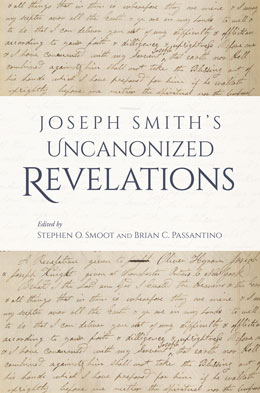
A Commandment to Secure the Copyright of the Scriptures
Stephen O. Smoot and Brian C. Passantino, ed., "A Commandment to Secure the Copyright of the Scriptures," Joseph Smith's Uncanonized Revelations (Provo, UT: Religious Studies Center, Brigham Young University; Salt Lake City: Deseret Book), 59–61.
April 23, 1834
On April 23, 1834, Joseph Smith received a lengthy revelation on the United Firm that is now canonized as section 104 of the Doctrine and Covenants.[1] The United Firm was an organization started by revelation in the spring of 1832 with the intention to manage the temporal affairs of the Church. (See the introduction to “A Revelation on the United Firm” herein.) The revelation now canonized as section 104 gave both general principles (“counsel”) and particular instructions (“commandment[s]”) on how the Saints were to run the United Firm “for the benefit of my church, and for the salvation of men” (verse 1).
Among the instructions the Lord gave in section 104 was a commandment for the Firm to “print my words,” specifically “the fulness of my scriptures” and “the revelations which I have given unto you, and which I shall, hereafter, from time to time give unto you” (verse 58). The Prophet had completed the work of translating or revising the Bible the previous year,[2] and had voiced his intention to publish the text.[3] There was also still a pressing need to publish and make accessible a convenient collection of Joseph’s revelations, since only a few copies of the Book of Commandments barely made it off the press in Missouri before the Church’s printing establishment in Independence was ransacked by a mob. One of the duties of the United Firm, per section 104, was to assist in the publication of these important texts.
For reasons unknown, the printed version of this revelation omitted a commandment from the Lord to secure a new copyright for the Book of Mormon, Joseph’s “new translation” of the Bible (now called the Joseph Smith Translation), and the revelations he and the Saints were to compile in what would eventually become the Doctrine and Covenants. The omitted text featured here, which appears in each of the extant early manuscript copies of this revelation,[4] occurs between verses 10 and 11 in the 1835 edition Doctrine and Covenants,[5] or verses 59 and 60 of the current edition.
This was not the first time Joseph had received divine instruction on obtaining a copyright for the new scriptures he was producing, as seen in another uncanonized revelation featured in this volume (see “A Revelation to Secure the Copyright of the Book of Mormon” herein). The command in the omitted portion of the April 23, 1834, revelation that Joseph needed to secure a new copyright so that “others may not take the blessings away from you” makes sense in light of the troubles Joseph previously encountered with Abner Cole, who in the winter of 1829–30 violated Joseph’s copyright of the Book of Mormon secured on June 11, 1829,[6] and pilfered extracts of the book while it was at press.[7]
We may only guess why this portion of the revelation went unpublished and subsequently uncanonized. It may have to do with the fact that no copyright was ever secured for Joseph’s Bible translation (which went unpublished in his lifetime). Whatever the case, this short uncanonized portion of the revelation that became section 104 of the Doctrine and Covenants nevertheless provides a brief glimpse into one of the duties of the United Firm and demonstrates the Lord’s attentive response to the unfolding complexities and roadblocks that confront the Saints as they attempt to carry out his will.
❋ ❋ ❋
Therefore, a commandment I give unto you, that ye shall take the Books of Mormon, and also the copyright, and also the copyright which shall be secured of the articles and covenants, in which covenants all my commandments which it is my will should be printed shall be printed (as it shall be made known unto you), and also the copyright of the new translation of the scriptures. And this I say that others may not take the blessings away from you which I have conferred upon you.
Notes
[1] See JSP, D4:19–31.
[2] The work of reviewing the translation of the New Testament was completed on February 2, 1833. The Old Testament revision was completed on July 2, 1833. See Minute Book 1, 8, February 2, 1833; Old Testament Revision 2, 119, www.josephsmithpapers.org; see also JSP, D3:167.
[3]JSP, D3:167, 206, 233, 237.
[4] See JSP, MRB:369, 627; JSP, D4:29.
[5]JSP, R2:243.
[6]JSP, D1:76–81.
[7] On Joseph’s encounter with Abner Cole, see Andrew H. Hedges, “The Refractory Abner Cole,” in Revelation, Reason, and Faith: Essays in Honor of Truman G. Madsen, ed. Donald W. Parry, Daniel C. Peterson, and Stephen D. Ricks (Provo, UT: Foundation for Ancient Research and Mormon Studies, 2002), 447–75; Robin Scott Jensen, “Abner Cole and The Reflector: Another Clue to the Timing of the 1830 Book of Mormon Printing,” Journal of Book of Mormon Studies 24 (2015): 238–47; Michael Hubbard MacKay and Gerrit J. Dirkmaat, From Darkness unto Light: Joseph Smith’s Translation and Publication of the Book of Mormon (Provo, UT: Religious Studies Center, Brigham Young University; Salt Lake City: Deseret Book, 2015), 206–12; Lucy Mack Smith, History, 1845, 165–68, www.josephsmithpapers.org, provided the memorable retelling of Joseph confronting Cole in E. B. Grandin’s Palmyra print shop over his pirating of the Book of Mormon text.
