
 menu icon in the top, right corner of the screen.
 icon above to close this box.
 icon at the bottom of the screen below the browser—if you don't see it, swipe up to unhide it.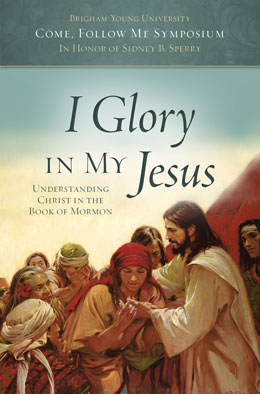
"That They May Bear Testimony of Him"
Jesus Christ's Communication to and about Prophets in the Book of Mormon
Stephanie Dibb Sorensen
Stephanie Dibb Sorensen, "'That They May Bear Testimony of Him': Jesus Christ's Communication to and about Prophets in the Book of Mormon," in I Glory in My Jesus: Understanding Christ in the Book of Mormon, ed. John Hilton III, Nicholas J. Frederick, Mark D. Ogletree, and Krystal V. L. Pierce (Provo, UT: Religious Studies Center, Brigham Young University; Salt Lake City: Deseret Book), 107–24.
Stephanie Dibb Sorensen is an adjunct instructor in the Department of Church History and Doctrine at Brigham Young University.
The Book of Mormon begins with the account of a prophetic vision in which Lehi sees the coming Messiah, and a thousand years later it ends with Moroni’s testimony of the Christ (see 1 Nephi 1:6–15; Moroni 10:18–32). Although Jesus Christ is physically present for less than one percent of the timespan of the Book of Mormon, he is the central figure throughout the book. President Russell M. Nelson taught, “Few things build faith more than does regular immersion in the Book of Mormon. No other book testifies of Jesus Christ with such power and clarity. Its prophets, as inspired by the Lord, saw our day, and selected the doctrine and truths that would help us most.”[1] How can a book written by mortals living in times and places so far removed from the geographic homeland and the mortal ministry of Jesus Christ give so much insight about the Son of God? The Book of Mormon was written by prophets, individuals called by God and tutored spiritually by the Savior himself to communicate his teachings and his guidance. These prophets revealed his will for the people in the Book of Mormon lands and time, but also for the future audience that would receive their record after a period of Restoration. Moroni proclaimed, “Behold, I speak unto you as if ye were present, and yet ye are not. But behold, Jesus Christ hath shown you unto me, and I know your doing” (Mormon 8:35).
In the Doctrine and Covenants, Jesus testified of prophets’ authority to teach his words: “What I the Lord have spoken, I have spoken, and I excuse not myself; . . . whether by mine own voice or by the voice of my servants, it is the same” (Doctrine and Covenants 1:38). This Restoration-era declaration continues a revelatory pattern found in ancient scripture. The Savior’s divine communication with his prophets and servants in the Book of Mormon can educate modern Book of Mormon readers about the role and importance of living prophets.[2]
The Book of Mormon stands as a testament of Jesus Christ as the Son of God and the Savior of the world. It also stands as a testament of his revelation to prophets. A careful study of the Book of Mormon establishes the extent to which Jesus Christ values and uses prophets, identifying the ongoing pattern by which he communicates with them to direct his church and teach his gospel. [3] I will first discuss instances in which Jesus Christ personally appeared to Book of Mormon prophets, followed by additional occasions where he spoke directly to his prophets but did not appear. Finally, I examine what Jesus Christ taught about prophets as he revealed himself to peoples and individuals in the Book of Mormon.
In His Own Person
Although relatively uncommon in the Book of Mormon, Jesus Christ communicated at times with prophets in person. The culminating event in the chronicle of the Nephite civilization is his appearance in the Americas following his death and resurrection in Jerusalem. The glorious account found in 3 Nephi proclaims, “Behold, they saw a Man descending out of heaven; and he was clothed in a white robe; and he came down and stood in the midst of them; and the eyes of the whole multitude were turned upon him. . . . And it came to pass that he stretched forth his hand and spake unto the people, saying: Behold, I am Jesus Christ, whom the prophets testified shall come into the world” (3 Nephi 11:8–10).
The Savior referenced the prophets, discussed more fully in a later section, and identified himself as Jesus Christ, of whom they prophesied. Shortly thereafter, Jesus ministered to the people “one by one” (3 Nephi 11:15) and specifically invited the prophet Nephi to come to him (see 3 Nephi 11:18). Jesus said to Nephi, “I give unto you power that ye shall baptize this people when I am again ascended into heaven” (3 Nephi 11:21). Thus, one of Christ’s very first acts after his appearance was to clearly confer his authority upon Nephi.
Nephi was not the only individual to receive this authority. Jesus “called others, and said unto them likewise; and he gave unto them power to baptize” (3 Nephi 11:22). By giving primacy and special designation to Nephi and others, Jesus Christ showed the significance of those whom he had called to lead. Over many days, he taught, blessed, and ministered to individuals and multitudes. He also specifically called and focused on twelve disciples. Commenting on this event, Moroni wrote that Christ called each disciple by name and said, “Ye shall call on the Father in my name, in mighty prayer; and after ye have done this ye shall have power that to him upon whom ye shall lay your hands, ye shall give the Holy Ghost; and in my name shall ye give it, for thus do mine apostles” (Moroni 2:2). Jesus Christ’s communication with his chosen servants included instruction in doctrine and a bestowal of authority to act in his name and perform saving ordinances for his people.
For example, he asked the disciples to bring bread and wine, and then indicated, “There shall be one ordained among you, and to him will I give power that he shall break bread and bless it and give it unto the people of my church” (3 Nephi 18:5). He then taught them about the symbolism of the sacrament and the commandment to partake of it. He instructed them about its relationship to the covenant of baptism and outlined the promised blessings of protection (3 Nephi 18:6–13). Before addressing the multitude, Jesus specifically counseled his disciples to watch and pray always to avoid temptation and to pray throughout the church as he had shown them (3 Nephi 18:15–16).
He then directed the disciples in matters of administration, to authoritatively preside over participation in the ordinance of the sacrament and to exercise judgment concerning the worthiness of individuals who partake of it (3 Nephi 18:26–29). Regarding those who may be unworthy, he encouraged his disciples to not cast them out but to pray for them, warn them, and invite them to repent and to participate in the ordinances of baptism and sacrament (3 Nephi 18:30–33). The next day Jesus renewed his exhortation to pray, and he prayed with the disciples and for them (3 Nephi 19:15–21). He also miraculously provided the sacrament again, commanded the disciples to administer it to the multitude, and testified of its power to fill their souls (3 Nephi 20:1–8). The Savior’s assignment to direct the work of ordinances is a prophetic pattern that has been restored in our day as well. Elder Robert E. Wells taught, “To prepare the way for the Second Coming, the Restoration took place—through Joseph Smith—of every necessary doctrine and sacred ordinance given by God to the prophets of past dispensations.”[4]
Later, while the disciples journeyed and preached as Jesus had taught them, he appeared among them and addressed several topics. He told them the church should be in his name and be built upon him and his gospel. He reminded them to always follow his example in all things in the church and to help others repent and be baptized and endure to the end. He testified of his own atoning mission and their responsibility to teach and write about it and declared that they would be judges among the people (3 Nephi 27:3–27). When he asked them about the desires of their hearts, they dared not confess their hopes to either tarry with him in his work or quickly return to him in heaven. “And he said unto them: Behold, I know your thoughts” (3 Nephi 28:6), and he reported each of their desires with a promise that they would be granted. The account relates, “When Jesus had spoken these words, he touched every one of them with his finger save it were the three who were to tarry, and then he departed. And behold, the heavens were opened, and they were caught up into heaven, and saw and heard unspeakable things” (3 Nephi 28:12–13).
Jesus Christ’s interactions with his chosen disciples demonstrates the principle of revelation in a council setting. After his ascension into heaven, the disciples ministered to the people and prepared them for his return the next day, teaching the words they had been specifically instructed by Jesus (3 Nephi 19:8). They gathered by the water’s edge and continued to pray, and angels came and ministered to them until “Jesus came and stood in the midst and ministered unto them” (3 Nephi 19:15). Because of the great faith they exercised together, Jesus taught them miraculous things and said, “There are none [among the Jews] that have seen so great things as ye have seen; neither have they heard so great things as ye have heard” (3 Nephi 19:36). On the previously mentioned occasion where they were journeying together and united in prayer, “Jesus came and stood in the midst of them” (3 Nephi 27:2).
In both instances, as they counseled and prayed together, he answered their questions and instructed them in the ways of church governance, organization, ordinances, and his doctrine. For example, regarding the importance of consensus and unity of doctrine, he said, “I give you these commandments because of the disputations which have been among you. And blessed are ye if ye have no disputations among you” (3 Nephi 18:34). These accounts document a revelatory pattern still seen in communication to prophets and apostles today. According to Elder John H. Smith, “We not only believe that the Lord did in ancient days reveal Himself to man, but we accept the doctrine of revelation as necessary for the guidance of the Church today; that the same Lord who so signally blessed and sustained His people anciently can bestow similar blessings in our day.”[5]
While the primary accounts of Jesus Christ’s in-person visitations take place in 3 Nephi, there are other occasions of his appearance in the Book of Mormon. For example, Nephi recorded, “And now I, Nephi, write more of the words of Isaiah, for my soul delighteth in his words . . . , for he verily saw my Redeemer, even as I have seen him. And my brother, Jacob, also has seen him as I have seen him” (2 Nephi 11:2–3). Their combined witness serves to establish early in the Book of Mormon the reality and divinity of Jesus Christ as the promised Redeemer.
The book of Ether recounts how a group of individuals left the Tower of Babel and journeyed to the promised land. In preparation for such a journey, the brother of Jared sought guidance for completing their barges. The Lord answered his request to light the provided stones, and the brother of Jared remarkably saw the Lord’s finger touch the stones. He expressed his astonishment to know the Lord had a body, and in response Jesus said, “Because of thy faith thou hast seen that I shall take upon me flesh and blood; and never has man come before me with such exceeding faith as thou hast; for were it not so ye could not have seen my finger. Sawest thou more than this?” The brother of Jared asked the Lord to reveal himself. “And when he had said these words, behold, the Lord showed himself unto him, and said: Because thou knowest these things ye are redeemed from the fall; therefore ye are brought back into my presence; therefore I show myself unto you. . . . Behold, I am Jesus Christ” (see Ether 3:9–14). In Moroni’s summary, he reaffirmed the brother of Jared’s experience: “Wherefore, having this perfect knowledge of God, he could not be kept from within the veil; therefore he saw Jesus; and he did minister unto him” (Ether 3:20).
In later commentary, as Moroni finished his record of the Jaredite people, he shared that he too had been visited by the Lord. “And now I, Moroni, bid farewell unto the Gentiles, yea, and also unto my brethren whom I love, until we shall meet before the judgment-seat of Christ. . . . And then shall ye know that I have seen Jesus, and that he hath talked with me face to face, and that he told me in plain humility, even as a man telleth another in mine own language, concerning these things” (Ether 12:38–39). Moroni’s father, Mormon, had also been taught personally by the Lord. Mormon stated, “And I, being fifteen years of age and being somewhat of a sober mind, therefore I was visited of the Lord, and tasted and knew of the goodness of Jesus” (Mormon 1:15).
These foregoing accounts describe occasions where individuals witnessed the personal appearance of Jesus Christ. In addition, other prophets and servants in the Book of Mormon saw and were taught by the personage of Christ in visions. For example, Lehi, Nephi, and Jacob saw scenes of the future Messiah’s life and ministry as shown to them in vision (see 1 Nephi 1:8; 10:17; and 2 Nephi 2:2–4). Alma the Younger alluded to having seen the Lord in the vision he experienced upon the angel’s visit:“For because of the word which he has imparted unto me, behold, many . . . have seen eye to eye as I have seen” (Alma 36:26). After being taught by Ammon, King Lamoni also experienced such a vision and declared his joy, saying, “For as sure as thou livest, behold, I have seen my Redeemer” (Alma 19:13).
In both ancient and modern times, those servants with a special knowledge of the Lord are called to boldly share their witness of Jesus Christ. Book of Mormon readers can come to know of the reality and divinity of Jesus Christ through the testimony of these witnesses. Elder Adney Y. Komatsu taught, “Throughout the thousand years of Book of Mormon history, many prophets bore solemn witness of the divinity of Jesus Christ as the Son of God. . . . These prophets spoke from pure knowledge, knowledge that came by personal visitations of the Savior to them, by the testimony of angels who spoke with them, by visions, and by the power of the Holy Ghost. They knew whereof they spoke and could not be shaken from their testimonies.”[6]
By His Own Voice
All the previous examples of Jesus Christ’s communication to his servants were both seen and heard, but not all revelation came visually. In fact, there are far more examples of communication that came through the voice of the Lord. Book of Mormon examples abound where prophets heard the voice of the Lord as instruction, warning, counsel, command, or reassurance. The Lord told Lehi to remove his family from Jerusalem and travel to the wilderness (1 Nephi 2:2) and then return for the brass plates (1 Nephi 3:2–3) and Ishmael’s family (1 Nephi 7:1–2). The voice of the Lord commanded Nephi to keep records (1 Nephi 9:3), to build a ship (1 Nephi 17:8), to shock his brothers (1 Nephi 17:53), and to take his followers and flee from their brethren (2 Nephi 5:5). It also comforted him when his brothers threatened and hurt him (1 Nephi 2:19). Jacob taught his people in the temple and on other occasions words he had been commanded by the Lord (Jacob 1:17; 2:9). When contending with Sherem, he mentioned multiple times that he had been taught by the voice of the Lord (Jacob 7:5).
Enos wrestled in mighty prayer to receive remission of his sins, and he heard the voice of the Lord granting him forgiveness and then promising to visit his brethren the Nephites.[7] Abinadi experienced this divine confirmation as he fulfilled the commandment to speak the words of the Lord to the wicked King Noah and his priests: “Thus hath he commanded me, saying, Go forth, and say unto this people, thus saith the Lord—Wo be unto this people, for I have seen their abominations, and their wickedness” (Mosiah 11:20). Because he would not deny the words the Lord had commanded him to teach, Abinadi died as a martyr, but the priest Alma believed his words, repented, and became a servant of the Lord. Later, when Alma was discouraged by wickedness in the church, he too heard the Lord’s voice: “Blessed art thou, Alma, and blessed are they who were baptized in the waters of Mormon. Thou art blessed because of thy exceeding faith in the words alone of my servant Abinadi” (Mosiah 26:15). This declaration reaffirms the Lord’s consideration that the words taught by his prophets represent his own voice and will.
Shortly thereafter Alma the Younger and the sons of Mosiah experienced their miraculous change of heart because of an angelic visit and a vision of the Redeemer. When King Mosiah asked the Lord if he should send his newly converted sons to teach the Lamanites, the Lord spoke and said, “Let them go up, for many shall believe on their words” (Mosiah 28:7). On that mission Ammon heard the voice of the Lord on many occasions, directing him where to travel or avoid, and warning him that his brethren were in prison (Alma 20:2). He became a leader among the Anti-Nephi-Lehies, and the Lord’s voice revealed the evil designs of the Amalekites and commanded them to relocate to a safer land (Alma 27:12).
Alma the Younger later traveled to Ammonihah, where the Lord’s voice came to him, giving him the exact words to invite Amulek to join his ministry of preaching repentance. These two men then taught together for at least the next eight years. When the Lamanites came against the Nephites in war, Captain Moroni led the Nephite army but sought Alma’s guidance. The voice of the Lord told Alma his desired strategy, and when the armies obeyed, “they were prepared against the time of the coming of the Lamanites” (Alma 43:26).
Despite being cast out, Samuel the Lamanite went back to teach the wicked Nephites because “the voice of the Lord came unto him, that he should return again, and prophesy unto the people whatsoever things should come into his heart” (Helaman 13:3). He stood atop a wall and cried out, calling them to repentance and testifying that his words were “the words of the Lord which he doth put into my heart” (Helaman 13:5), and he “did prophesy a great many more things” (Helaman 14:1).
A remarkable occurrence of the Lord speaking to prophets is when he announced his own birth. Nephi, the son of Helaman, was distraught because the believers were all facing execution for refusing to abandon their faith in Christ. “And it came to pass that he cried mightily unto the Lord all that day; and behold, the voice of the Lord came unto him, saying: Lift up your head and be of good cheer; for behold, the time is at hand, and on this night shall the sign be given, and on the morrow come I into the world” (3 Nephi 1:12–13). The Son of God announced to Nephi that his long-awaited mortal ministry would begin.[8] Thirty-three years later, in the days leading up to Jesus’s appearance among the Nephites, his voice from heaven chastised the unrepentant and prepared the people to meet the resurrected Lord (3 Nephi 9:1; 10:3).
The book of Ether reports many accounts of prophets hearing the voice of the Lord. Before the brother of Jared saw him in his spirit body, he first heard the voice of the Lord as he stood in a cloud and talked with him for three hours (Ether 2:4–5, 14). There are also multiple unnamed prophets throughout the book of Ether who brought messages of repentance and warning from the Lord (see Ether 7:23; 9:28; 11:1, 12, 20). The prophet Ether heard the voice of the Lord on two recorded occasions as well. First, “the word of the Lord came to Ether, that he should go and prophesy unto Coriantumr” (Ether 13:20), and after Coriantumr’s final battle the Lord’s voice said, “Go forth,” that Ether might see what had been done (Ether 15:33).
Moroni recorded in the book of Ether that the Lord’s voice told him what to write, what to include and exclude, and what to seal up for his purposes (Ether 4: 65–8). He complained to the Lord that people might mock his writing, and by his account, “when I had said this, the Lord spake unto me, saying: Fools mock, but they shall mourn” (Ether 12:26), and the Savior taught him how he would use weaknesses to accomplish his work and bring men unto him. Furthermore, the Lord spoke reassuring words to dissuade Moroni from worrying about judgment from the Gentiles (Ether 12:37).
Finally, when Mormon began to witness the downfall of his people, the Lord’s voice came to him, first telling him to cry repentance that they might be spared, and later to declare, “Vengeance is mine, and I will repay . . . because this people repented not” (Mormon 3:15). In all these circumstances throughout the Book of Mormon, the Lord spoke to his servants, either to comfort or strengthen them in their calling or to deliver a message that his people needed to hear.[9] Book of Mormon readers can learn through these examples that prophets become authorized intermediaries for the voice of the Lord. Elder Francisco J. Viñas taught, “The voice of the Lord may be received by listening to the Lord’s servants.”[10] President Russell M. Nelson affirmed, “We hear Him as we heed the words of prophets, seers, and revelators. Ordained Apostles of Jesus Christ always testify of Him. They point the way as we make our way through the heart-wrenching maze of our mortal experiences.”[11]
Jesus Christ Taught about Prophets
The many different accounts shared here demonstrate the consistent pattern of Jesus Christ’s communication to his chosen servants throughout the Book of Mormon. In addition to these interactions with them, he also spoke on several occasions about his prophets, directing his people toward those whom he had called. In Nephi’s vision of the tree of life, he was shown that prophets would be called to prepare the way for the Messiah (1 Nephi 11:27). The Lord’s voice to Alma praised him for accepting his prophet, saying, “Thou art blessed because of thy exceeding faith in the words alone of my servant Abinadi” (Mosiah 26:15). When Samuel the Lamanite spoke the words the Lord had put into his heart, he included this rebuke:
Wo unto this people, because of this time which has arrived, that ye do cast out the prophets, and do mock them, and cast stones at them, and do slay them, and do all manner of iniquity unto them, even as they did of old time. . . .
Behold ye are worse than they; for as the Lord liveth, if a prophet come among you and declareth unto you the word of the Lord, which testifieth of your sins and iniquities, ye are angry with him, and cast him out and seek all manner of ways to destroy him; . . .
Your destruction is made sure; and then shall ye weep and howl in that day, saith the Lord of Hosts. And then shall ye lament, and say:
O that I had repented, and had not killed the prophets, and stoned them, and cast them out. (Helaman 13:24, 26, 32–33)
This prophecy was powerfully fulfilled a few decades later when Jesus Christ made his appearance among the Nephites.[12] In the days preceding his arrival, the lands of the Nephites were in disastrous upheaval, being buried in earthquakes or swallowed up into the sea. During this dark time, a voice from heaven mourned their wickedness, and the most often repeated accusation against them was their collective rejection of prophets.
And behold, that great city Moronihah have I covered with earth, and the inhabitants thereof, to hide their iniquities and their abominations from before my face, that the blood of the prophets and the saints shall not come any more unto me against them. . . .
Yea, and the city of Onihah and the inhabitants thereof, and the city of Mocum and the inhabitants thereof, and the city of Jerusalem and the inhabitants thereof; and waters have I caused to come up in the stead thereof, to hide their wickedness and abominations from before my face, that the blood of the prophets and the saints shall not come up any more unto me against them. (3 Nephi 9:5, 7; emphasis added)
The Lord continued to name city after city whose destruction happened “because of their wickedness in casting out the prophets, and stoning those whom I did send to declare unto them concerning their wickedness and their abominations” (3 Nephi 9:10). These words from Jesus Christ identify the great importance of prophets to him and his great displeasure when they are rejected.
The darkness and upheaval came to an end; God the Father’s voice introduced his Son; and then the resurrected Jesus Christ descended from heaven to appear among the Nephite people. “And it came to pass that he stretched forth his hand and spake unto the people, saying: Behold, I am Jesus Christ, whom the prophets testified shall come into the world” (3 Nephi 11:9–10). In the very same sentence where he named and presented himself for the first time, he identified himself as the one foretold by prophets. The Savior’s first words to the Nephites vindicated the words of the prophets. He acknowledged their teachings and their prophecies as the means of letting people know who he really was.
On this momentous occasion, Jesus Christ proclaimed the invaluable role that prophets played in preparing the world for his coming. We read, “And it came to pass that the multitude went forth, and thrust their hands into his side, and did feel the prints of the nails in his hands and in his feet; and this they did do, going forth one by one until they had all gone forth, and did see with their eyes and did feel with their hands, and did know of a surety and did bear record, that it was he, of whom it was written by the prophets, that should come” (3 Nephi 11:15; emphasis added). Their testimony of Jesus Christ was ratified by what they had been taught by prophets.
Shortly after introducing himself, the Savior gave an extended sermon in 3 Nephi 12–16. He prefaced these words by specifically pointing to the twelve disciples he had just called and said, “Blessed are ye if ye shall give heed unto the words of these twelve whom I have chosen from among you to minister unto you, and to be your servants; and unto them I have given power that they may baptize you with water; and after that ye are baptized with water, behold, I will baptize you with fire and with the Holy Ghost” (3 Nephi 12:1).
Later, as he prayed with and for his disciples, he said, “Father, I thank thee that thou hast given the Holy Ghost unto these whom I have chosen; and it is because of their belief in me that I have chosen them out of the world. Father, I pray thee that thou wilt give the Holy Ghost unto all them that shall believe in their words” (3 Nephi 19:20). His prayer requested that those who believed his disciples’ words would have the Holy Ghost. He also linked faith in his servants to faith in him. He said, “Father, I pray unto thee for them, and also for all those who shall believe on their words, that they may believe in me, that I may be in them as thou, Father, art in me, that we may be one” (3 Nephi 19:23). Then, when he commanded the disciples to write the words he had taught them and keep a record of the people, he declared, “Out of the books which have been written, and which shall be written, shall this people be judged . . . ; therefore out of the books which shall be written shall the world be judged. And know ye that ye shall be judges of this people, according to the judgment which I shall give unto you” (3 Nephi 27:25–27). The Lord used these occasions to affirm the power and authority of those whom he had called, and he promised blessings to those who would hearken to their words.
During his sojourn among the Nephites, the Savior reiterated his continued endorsement of prophets: “Think not that I am come to destroy the law or the prophets. I am not come to destroy but to fulfil” (3 Nephi 12:17). He often answered their questions and taught them by reminding them, “Search the prophets, for many there be that testify of these things” (3 Nephi 23:5).[13] When he discovered that some of Samuel the Lamanite’s teachings had not yet been recorded, he commanded them to write his words (3 Nephi 23:9–13). The way that Jesus Christ spoke about his prophets testified of them, demonstrating the importance of their missions and their special connection to his mission. His declarations and directions among the Nephites echoed the principle, “Surely the Lord God will do nothing, but he revealeth his secret unto his servants the prophets” (Amos 3:7).
Conclusion
In the Book of Mormon, Jesus Christ revealed to his prophets that he would continue to call prophets to prepare the way for him. Nephi saw John the Baptist in vision, laying the foundation for the coming of the Messiah. He and his father also understood that a future prophet would be prepared to bring the gospel to their descendants. RoseAnn Benson explained, “In the patriarchal blessing that Lehi gave his son Joseph, we learn that God foreordained Joseph Smith to be a seer long before Joseph was born. . . . He promised that in the latter days, [Joseph of Egypt’s posterity] would learn of covenants with God by a ‘choice seer’ whom the Lord would ‘raise up’ (see 2 Nephi 3:5–7). Joseph of Egypt knew that this latter-day seer and the seer’s father would have his same name, ‘Joseph’ (see 2 Nephi 3:15).”[14]
Perhaps the most notable mention of future prophets was Jesus Christ’s own account of Joseph Smith’s coming role, given in his visit among the Nephites:
For in that day, for my sake shall the Father work a work, which shall be a great and a marvelous work among them; and there shall be among them those who will not believe it, although a man shall declare it unto them. . . .
Therefore it shall come to pass that whosoever will not believe in my words, who am Jesus Christ, which the Father shall cause him to bring forth unto the Gentiles, and shall give unto him power that he shall bring them forth unto the Gentiles, (it shall be done even as Moses said) they shall be cut off from among my people who are of the covenant. (3 Nephi 21:9, 11)
Of this account, Scott Esplin summarized, “Christ, speaking to the Nephites during his visit, further prophesied of Joseph Smith and his mission of restoration and clarification.”[15] Many other gospel scholars have concluded that Joseph Smith and the coming forth of the Book of Mormon are the subject of and fulfillment of the Savior’s prophecy here.[16]
Throughout the Book of Mormon, Jesus Christ highlighted the importance of prophets: those who had prophesied of his coming, those whom he called and organized during his time among the Nephites, and those who would subsequently testify of him and restore his truths. Regarding restored prophetic authority, President Spencer W. Kimball testified, “I say, in the deepest of humility, but also by the power and force of a burning testimony in my soul, that from the prophet of the Restoration to the prophet of our own year, the communication line is unbroken, the authority is continuous, a light, brilliant and penetrating, continues to shine. The sound of the voice of the Lord is a continuous melody and a thunderous appeal.”[17]
The Church of Jesus Christ of Latter-day Saints is led today by prophets and apostles who are called by God to act with authority and teach in his name. They, like ancient prophets, teach that which is revealed to them by Jesus Christ, who leads his church. President Henry B. Eyring testified, “First, Jesus Christ is the head of the Church in all the earth. Second, He leads His Church today by speaking to men called as prophets, and He does it through revelation. Third, He gave revelation to His prophets long ago, still does, and will continue to do so. Fourth, He gives confirming revelation to those who serve under the leadership of His prophets. From those fundamentals, we recognize that the Lord’s leadership of His Church requires great and steady faith from all who serve Him on earth.”[18] Speaking of divine revelation today, President Russell M. Nelson stated emphatically, “The living Lord leads His living Church! The Lord reveals His will for the Church to His prophet.”[19]
The Book of Mormon repeatedly bears witness that Jesus Christ spoke to prophets to direct his work, and the Restoration bears witness that he still does. The Nephite and Lamanite civilizations rejected the prophets and faced total destruction. Perhaps one of the most important principles the Book of Mormon teaches us about Jesus Christ is his power to save us, even by sending prophets to protect us. Just as he did in Book of Mormon times, the Lord communicates with living prophets today, and through their ministry he continues to carry out his eternal work and the salvation of mankind.
Notes
[1] Russell M. Nelson, “Embrace the Future with Faith,” Ensign, November 2020, 75.
[2] For the purposes of this paper, I will use the terms prophets, apostles, disciples, and servants to represent those in scripture who are generally understood to have appointed roles as witnesses of Christ. Speaking of the Book of Mormon, Elder Parley P. Pratt stated, “[We] profess that it is inspired, and was written by Prophets, and men that enjoyed the ministering of angels, more or less of them, and had communion with the heavens, and the spirit of prophecy.” “Mormonism,” in Journal of Discourses (London: Latter-day Saints’ Book Depot, 1854–86), 1:43 (July 10, 1853). In addition to its authors, this paper also considers what Shon Hopkin identified as “those figures who could be called ‘minor prophets’ in the Book of Mormon, whose important teachings only span pages instead of full books but whose recorded sermons have a powerful impact on the rest of the book and on its modern-day readership.” “Introduction,” in Abinadi: He Came Among Them in Disguise, ed. Shon D. Hopkin (Provo, UT: Religious Studies Center; Salt Lake City: Deseret Book, 2018), v–xiv. I acknowledge that the modern church structure is not completely analogous to the Nephite structure of spiritual leadership or its designated titles. Regardless of these semantic distinctions, I believe that there are applicable principles that we can learn from the Savior’s interactions with and words about Book of Mormon prophets.
[3] Jesus Christ uses a variety of means to communicate with prophets. Elder D. Todd Christofferson taught, “In the Church today, just as anciently, establishing the doctrine of Christ or correcting doctrinal deviations is a matter of divine revelation to those the Lord endows with apostolic authority.” He then outlined the established methods by which that revelation is received: “How does the Savior reveal His will and doctrine to prophets, seers, and revelators? He may act by messenger or in His own person. He may speak by His own voice or by the voice of the Holy Spirit—a communication of Spirit to spirit that may be expressed in words or in feelings that convey understanding beyond words. He may direct Himself to His servants individually or acting in council.” This chapter will focus on the specific communications of Jesus Christ in the Book of Mormon, either given in person or spoken, where the speaker is identified as Jesus Christ or “the Lord.” Accounts of the additional revelatory methods suggested by Elder Christofferson are also found in the Book of Mormon, but they are beyond the scope of this paper. See D. Todd Christofferson, “The Doctrine of Christ,” Ensign,May 2012, 86.
[4] Robert E. Wells, “Our Message to the World,” Ensign, November 1995, 65.
[5] John H. Smith, “Value of Liberty, etc.,” in Journal of Discourses, 26:29 (July 27, 1885).
[6] Adney Y. Komatsu, “Looking to the Savior,” Ensign, May 1987, 78.
[7] Of this account, Elder James E. Faust explained, “So how can we recognize inspiration when it comes? Enos stated, ‘While I was thus struggling in the spirit, behold, the voice of the Lord came into my mind’ (Enos 1:10). The voice of the spirit of revelation is not necessarily audible, but it gives us divine confirmation through our thoughts and feelings.” “Did You Get the Right Message?,” Ensign, May 2004, 61.
[8] See also 3 Nephi 7:15–17 for a summary of Nephi’s communications with the Lord.
[9] This chapter has attempted to list and briefly summarize all the occasions where Jesus Christ spoke directly to his servants in the Book of Mormon. Future research could analyze dialogic revelation, comparing the Savior’s style of communication to prophets across different books of scripture, similar to Terryl L. Givens’ work in By the Hand of Mormon: The American Scripture that Launched a New World Religion (Oxford: Oxford University Press, 2003). See also Terryl L. Givens, “The Book of Mormon and Dialogic Revelation,” Journal of Book of Mormon Studies 10: No. 2 (2001): 16–27, 69–70.
[10] Francisco J. Viñas, “Listening to the Voice of the Lord,” Ensign, November 1996, 78.
[11] Russell M. Nelson, “Hear Him,” Ensign, May 2020, 88.
[12] Like Samuel the Lamanite, Nephi had also prophesied of the destruction that would come to those who rejected the prophets. Fulfillment of that prophecy can be found in 3 Nephi 9, in the details of the calamitous events preceding the Savior’s appearance to the Nephites. See Nephi’s prophecy and doctrinal discourse on following prophets in 2 Nephi 26:1–10.
[13] In this case, “prophets” refers to their recorded words in scripture.
[14] RoseAnn Benson, “Joseph Smith and the Messiah: Prophetically Linked,” Religious Educator 3, no. 3 (2002): 65–81.
[15] Scott C. Esplin, “‘Millions Shall Know Brother Joseph Again’: Joseph Smith’s Place among the Prophets,” in Joseph Smith and the Doctrinal Restoration (Provo, UT: Brigham Young University, Religious Studies Center, 2005), 172–86.
[16] See also RoseAnn Benson and Shon D. Hopkin, “Finding Doctrine and Meaning in Book of Mormon Isaiah,” Religious Educator 15, no. 1 (2014): 95–122; Robert L. Millet, “Joseph Smith and the Rise of a World Religion,” in Global Mormonism in the 21st Century, ed. Reid L. Neilson (Provo, UT: Religious Studies Center, Brigham Young University, 2008), 3–29; and RoseAnn Benson and Joseph Fielding McConkie, “A Prophet . . . like unto Thee,” Religious Educator 12, no. 3 (2011): 109–27.
[17] Spencer W. Kimball, “Revelation: The Word of the Lord to His Prophets,” Ensign, May 1977, 78; see also Teachings of Presidents of the Church: Spencer W. Kimball (Salt Lake City: The Church of Jesus Christ of Latter-day Saints, 2006), 241.
[18] Henry B. Eyring, “The Lord Leads His Church,” Ensign, November 2017, 81.
[19] Russell M. Nelson, “Sustaining the Prophets,” Ensign, November 2014, 74.
