
 menu icon in the top, right corner of the screen.
 icon above to close this box.
 icon at the bottom of the screen below the browser—if you don't see it, swipe up to unhide it.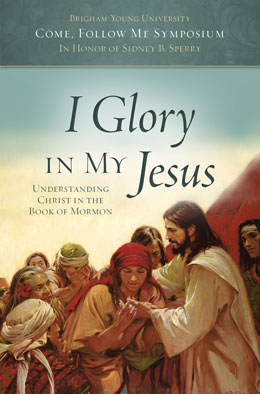
Introduction
At the beginning of the Book of Mormon, Nephi tells us the main reason he is writing: “The fulness of mine intent is that I may persuade men to come unto the God of Abraham, and the God of Isaac, and the God of Jacob, and be saved” (1 Nephi 6:4).[1] As Nephi passes the plates to Jacob, this emphasis continues. Jacob records, “[Nephi] gave me, Jacob, a commandment that I should write upon these plates a few of the things which I considered to be most precious. . . . We labored diligently among our people, that we might persuade them to come unto Christ” (Jacob 1:2, 7).
The small plates were passed from one author to another, finally coming into the possession of Amaleki, who finished the small plates by writing, “I would that ye should come unto Christ, who is the Holy One of Israel, . . . and offer your whole souls as an offering unto him” (Omni 1:26). Throughout the remainder of the Book of Mormon, there is a consistent focus on Jesus Christ. Consider just a few examples:
- King Benjamin taught, “There shall be no other name given nor any other way nor means whereby salvation can come unto the children of men, only in and through the name of Christ, the Lord Omnipotent” (Mosiah 3:17).
- Abinadi declared, “Christ . . . is the light and the life of the world; yea, a light that is endless, that can never be darkened; yea, and also a life which is endless, that there can be no more death” (Mosiah 16:8–9).
- Alma the Younger testified, “I know that Jesus Christ shall come, yea, the Son, the Only Begotten of the Father, full of grace, and mercy, and truth. And behold, it is he that cometh to take away the sins of the world, yea, the sins of every [person] who steadfastly believeth on his name” (Alma 5:48).
The pinnacle of the Book of Mormon occurred in 3 Nephi when Jesus Christ personally ministered to the Nephites and Lamanites. He directly told them, “Arise and come forth unto me, that ye may thrust your hands into my side, and also that ye may feel the prints of the nails in my hands and in my feet, that ye may know that I am the God of Israel” (3 Nephi 11:14).
The final writers of the Book of Mormon end where Nephi began. Mormon says, “I write unto you, . . . that ye may believe the gospel of Jesus Christ. . . . And I would that I could persuade all ye ends of the earth to repent and prepare to stand before the judgment-seat of Christ” (Mormon 3:20–22), and Moroni concludes his record with one final plea to “come unto Christ” (Moroni 10:32).
Clearly the central purpose of those writing on the plates was to invite and persuade each of us to come unto Jesus Christ. He is the central individual in the Book of Mormon. In 1978 Susan Ward Easton published a landmark article, numerically demonstrating this fact by showing that Christ was mentioned by name or title 3,925 times in the Book of Mormon, which averages out to be once every 1.7 verses.[2]
This valuable study highlights the centrality of Christ in the Book of Mormon; however, it significantly undercounts the frequency with which Christ is mentioned by excluding pronouns that refer to him. Consider how the following verse emphasizes the Savior through pronouns: “Begin to believe in the Son of God, that he will come to redeem his people, and that he shall suffer and die to atone for their sins; and that he shall rise again from the dead, which shall bring to pass the resurrection, that all men shall stand before him, to be judged at the last and judgment day, according to their works” (Alma 33:22). In Dr. Easton’s original study, this verse would have counted as one reference to Christ from the title “Son of God.” However, the Savior is mentioned five additional times. This verse emphasizes that Jesus Christ is not only the Son of God but is also the one to redeem us through his everlasting atonement and resurrection.
Ultimately the number of references to Jesus Christ is not the most important detail to learn from the Book of Mormon; however, each reference to Christ can teach us about his divine nature and mission. When all mentions of Christ, including titles and pronouns are included, his name appears 7,452 times in the Book of Mormon—an average of more than one reference per verse.[3]
The Book of Mormon has much to teach us about Jesus Christ; indeed, as President Ezra Taft Benson taught, it “is the keystone in our witness of Jesus Christ.”[4] In this volume, you will find fifteen carefully crafted essays that examine the life, teachings and nature of Jesus Christ as described in the Book of Mormon. We hope that this exploration of our Savior in the Book of Mormon will help you both “glory in” and “seek” Jesus Christ (2 Nephi 33:6; Ether 12:41).
Finally, we are grateful for the good work of the Religious Studies Center team: Jared W. Ludlow, Devan Jensen, Brent Nordgren, Carmen Cole, and Adi Marshall.
John Hilton III
Nicholas J. Frederick
Mark D. Ogletree
Krystal V. L. Pierce
Brent R. Nordgren
Beverly Yellowhorse
Symposium Committee
Notes
Since 1973 the BYU Sidney B. Sperry Symposium has become one of the premier venues for Latter-day Saint religious studies. The symposium originated to encourage faith-based religious scholarship on Latter-day Saint topics. Beginning in January 2024, the Sperry Symposium will be renamed the Come, Follow Me Symposium in Honor of Sidney B. Sperry. The dates changed from October to January to connect the symposium more closely to the Come, Follow Me schedule.
[1] All emphasis in this introduction is added.
[2] Susan Ward Easton, “Names of Christ in the Book of Mormon,” Ensign, July 1978, 60–61.
[3] Some verses contain multiple references to Christ, while others have none. On average there is one reference to Christ for every .88 verses in the Book of Mormon. The counting of these references was done by John Hilton III and Madison Sinclair.
[4] Ezra Taft Benson, “The Book of Mormon—Keystone of Our Religion,” Ensign, November 1986, 5.
