
 menu icon in the top, right corner of the screen.
 icon above to close this box.
 icon at the bottom of the screen below the browser—if you don't see it, swipe up to unhide it.
Wednesday
A Loving Act Framed by Dark Episodes of Conspiracy
Eric D. Huntsman and Trevan G. Hatch, "Wednesday: A Loving Act Framed by Dark Episodes of Conspiracy," in Greater Love Hath No Man: A Latter-Day Saint Guide to Celebrating the Easter Season (Provo, UT: Religious Studies Center, Brigham Young University; Salt Lake City: Deseret Book), 89‒102.
Verily I say unto you, Wheresoever this gospel shall be preached throughout the whole world, this also that she hath done shall be spoken of for a memorial of her. (Mark 14:9)
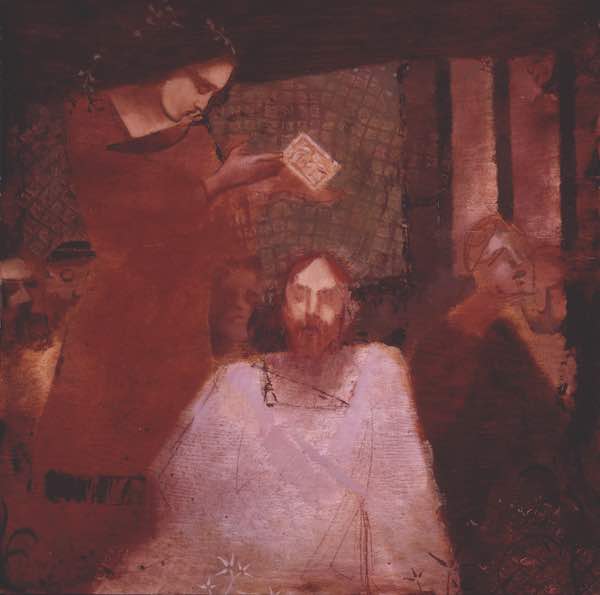 J. Kirk Richards, Alabaster Box. Used by permission.
Although some Gospel harmonies do not list any events for the Wednesday of Jesus’s last week, traditional observance has associated three short but significant passages with this day. First, in all three Synoptic Gospels, the Jerusalem authorities gather and resolve to work actively to arrest Jesus and put him to death (Mark 14:1–2; parallels Matt 26:1–5; Luke 22:1–2). Next, Mark and Matthew shift the scene to Bethany, where an unnamed woman lovingly anoints Jesus’s head, which Jesus declares, as he did with the anointing of Jesus’s feet by Mary of Bethany (Mark 14:3–9; parallel Matt 26:6–13; cf. John 12:1‒8), was in anticipation of his burial. Finally, the accounts of Mark, Matthew, and Luke all recount Judas’s decision to betray Jesus, accepting money in return for helping them find and arrest his Master (Mark 14:10–11; parallels Matt 26:14–16; Luke 22:3–6). The first and third darker, ominous events have led to this day sometimes being called “Spy Wednesday.” Together they create another intercalation, or sandwich structure, that frames the anointing scene, contrasting with it and emphasizing it as they cast its beauty in high relief.[1]
The brief events marked on this day signal an important shift in the passion narratives. The previous fierce opposition of the Jerusalem authorities becomes murderous as concrete plans are laid to destroy Jesus. Similarly, Jesus’s own actions change in their focus. With the anointing evoking images of kingship (1 Sam 16:13; 2 Sam 2:4; 5:3; 1 Kgs 1:33‒34, 39), it serves as a fitting climax to the kingly portion of Jesus’s last week that focused upon his triumphal entry, his authoritative actions and teaching in the temple, and his prophetic discourse about his Second Coming. Yet Israelite anointing was also associated with priests (Exod 40:13; Lev 6:20), and after this day Jesus assumed a more priestly role as he instituted the sacrament of the Lord’s Supper, interceded for us and began the process of atonement in Gethsemane, and, finally, offered himself as a sacrifice upon the cross. Wednesday thus serves as an important pivot point in Holy Week as it moves into its priestly phase.[2]
For modern believers, the events of Wednesday call us to introspection and action. Will we be found firmly on the side of Jesus, maintaining our loyalty even as the world and its values rise in opposition to him? Will our testimonies of Jesus Christ be focused firmly on his sacrifice, and will they motivate us to serve and care for others as if they were the Lord himself? Indeed, the loving act of the unnamed woman provides a powerful example of devotion and service. While she was a real woman who was devoted to Jesus, by leaving her anonymous, Mark and Matthew also allow her to serve as a type for all believers—women and men—today. Drawing upon her example, President Linda K. Burton, who served as the sixteenth General President of the Relief Society from 2012 to 2017, wrote, “May we seek inspiration, act on impressions we receive, and reach out in unity to help those in need as we are able and inspired to do so. Perhaps then it might be said of us, as the Savior said of a loving sister who ministered to Him: ‘She hath wrought a good work. . . . She hath done what she could.’ I call that extraordinary!”[3] Yet more significant than her service was her testimony: she understood not only who Jesus was, the anointed king and priest, but also that he had come to die, and through his death and resurrection we all can be saved in the kingdom of God.
Text: Mark 14:1‒11
The story of the unnamed woman who anointed Jesus’s head in Bethany (Mark 14:3–9; parallel Matt 26:6–13) is framed by the plot of the Jerusalem authorities to put Jesus to death (Mark 14:1–2; parallels Matt 26:1–5; Luke 22:1–2) and the decision of Judas Iscariot to hand Jesus over to them (Mark 14:10–11; parallels Matt 26:14–16; Luke 22:3–6).
Mark
| 14 |
1After two days was the feast of the passover, and of unleavened bread: and the chief priests and the scribes sought how they might take him by craft, and put him to death. 2But they said, Not on the feast day, lest there be an uproar of the people.
3And being in Bethany in the house of Simon the leper, as he sat at meat, there came a woman having an alabaster box of ointment of spikenard very precious; and she brake the box, and poured it on his head. 4And there were some that had indignation within themselves, and said, “Why was this waste of the ointment made? 5For it might have been sold for more than three hundred pence, and have been given to the poor. And they murmured against her.” 6And Jesus said, “Let her alone; why trouble ye her? she hath wrought a good work on me. 7For ye have the poor with you always, and whensoever ye will ye may do them good: but me ye have not always. 8She hath done what she could: she is come aforehand to anoint my body to the burying. 9Verily I say unto you, Wheresoever this gospel shall be preached throughout the whole world, this also that she hath done shall be spoken of for a memorial of her.”
10And Judas Iscariot, one of the twelve, went unto the chief priests, to betray him unto them. 11And when they heard it, they were glad, and promised to give him money. And he sought how he might conveniently betray him.
The Timing and Significance of the Events of Wednesday
Background
The relative time markers in Mark (see again Appendix B) clearly locate these episodes three days after the triumphal entry, at least in that Gospel’s narrative—that is, they occurred on Wednesday according to both the traditional and our working chronologies of Holy Week. Nevertheless, the statement at Mark 14:1 that Passover was “two days away” (Greek, meta dyo hēmeras; KJV, “after two days” but better rendered “in two days’ time”) has led to some disagreement about the timing. For instance, some Gospel harmonies familiar to Latter-day Saints have taken this phrase exclusively, which places the conspiracy and the anointing on Tuesday and leaves Wednesday empty of recorded events.[4] However, if it is taken inclusively, Passover would have been on Friday, which by Jewish reckoning began at sunset Thursday.[5] Interestingly, if Mark was in this instance following the Roman manner of marking time as he does elsewhere, Mark’s statement might actually bring his chronology into harmony with John’s, placing the beginning of Passover the evening after Jesus’s crucifixion.[6]
 Nicolas Poussin, The Sacrament of Panance or The Supper at House of Simon. Wikimedia Commons.
One other possible challenge arises from the similarities between the anointing of Jesus by the unnamed woman (Mark 14:3–9; parallel Matt 26:6–13), his anointing by Mary of Bethany (John 12:1‒8) that we have already discussed, and another anointing recounted by Luke much earlier in the Galilean ministry (Luke 7:36‒50). The stories share enough similarities that some New Testament scholars suggest that they are different versions of the same original story. Of the four anointing stories, Luke’s account is significantly different. Variously called “the woman who was a sinner,” or, better, “the woman who loved much,”[7] the woman featured by Luke enters a dinner party in the house of Simon the Pharisee and anoints Jesus’s feet in gratitude for the mercy Jesus is able to extend to her. [1/
Still, John’s naming Mary of Bethany, having her anoint Jesus’s feet rather than his head, and placing the story before the triumphal entry makes it possible that there were, in fact, two different anointings. If the scene in Mark and Matthew is in fact a different event from the one in John, there were other female disciples who could have performed this act of devotion on this occasion, and keeping her anonymous is significant. Regardless of what happened historically,[12] the placement of the unnamed woman in Mark and Matthew anointing Jesus’s head mid-week gives it a significant narrative function: Julie Smith calls the episode “the hinge between the accounts of his life and his death,” being the last part of the narrative of Jesus’s life and the first part of what, on the next day, will be part of the Passion proper and hence, the story of his death.[13]
The Plot against Jesus
Interpretation and Application
 James Tissot, The Conspiracy of the Jews. Artokoloro/
In John, the raising of Lazarus, particularly its leading to many of “the Jews” to believe in Jesus, was presented as the proximate event that led the Jerusalem leadership under Caiaphas to begin its plot against Jesus, especially since the reception of Jesus in the triumphal entry seemed to indicate a possibly revolutionary movement (John 11:47‒53; 12:17‒19). In the Synoptics, Jesus’s cleansing of the temple seems to have been the deciding factor in arraying the leadership against Jesus. Historically the chief priests, the leading legal experts, and the elders of the people comprised the Sanhedrin, which under the Roman occupation was charged with maintaining day-to-day order in the city, which the temple incident undercut. Whatever their ostensible interest might have been in maintaining order and avoiding Roman intervention, Jesus’s fierce rebuke of them following their failed attempts to catch Jesus in his words aroused further enmity. However, with the city filling with pilgrims, who approved of Jesus’s condemnation of their leaders, the political situation was tense, leading the council to seek to take Jesus secretly and “not during the festival so that there will not be a commotion among the people” (Mark 14:2, authors’ translation). [1/
The Anointing of Jesus in Mark and Matthew
Interpretation and Application
Rather than taking place in the shared home of Martha, Lazarus, and Mary, the anointing in Mark and Matthew takes place in the home of one “Simon the leper” at an occasion the New Testament scholar A. J. Levine calls “the First Supper,” because in many ways it anticipates the themes and significance of the Last Supper on Thursday.[15] Because currently suffering from the disease would have made him ritually unclean and kept him from hosting such a dinner, Simon had presumably been cured, perhaps even having been healed previously by Jesus himself.[16] Nevertheless, such ritual purity concerns had not concerned Jesus before, and having rejected the temple in Jerusalem, formerly a place of holiness, Jesus’s presence in Simon’s house makes it a new sacred space.[17] The woman’s costly gift, the value of which approximately equaled a year’s wages for a laborer, resonates with the simple gift of the poor widow; while one was great and the other seemingly small, they both represented faithfulness from women across the social and economic spectrum.[18]
As with the anointing of Jesus by Mary of Bethany described by John, Jesus explicitly connects this anointing with his coming burial, suggesting that the woman understands that rather than having come to Jerusalem as its earthly king, Jesus has come to die, an understanding that contrasts markedly with that of Peter and the other disciples.[19] After the first passion prediction, Peter, who had a testimony of who Jesus was as the Christ and Son of God, still did not understand what he had come to do. Particularly in the Gospel of Mark, prior to Easter, the male disciples are, as often as not, characterized by their failures—failures to understand Jesus and failures to act appropriately. His female followers, on the other hand, seem to understand better his purpose and will be faithful to the end.[20] As noted, by not naming her, the Marcan and Matthean stories more easily allow the woman to serve as a type of the ideal believer.[21] In other words, she represents women of Christ, the kind that President Julie B. Beck, fifteenth General President of the Relief Society from 2007 to 2012, calls “women who know and love the Lord and bear testimony of Him.”[22]
Although explicitly connected to Jesus’s death, the anointing implicitly represented power, authority, and favor being poured upon the recipient. In the Hebrew Bible, not only kings but also priests and, on occasion, even prophets were anointed to their position, so the woman’s act can be seen as combining both a royal anointing and a royal burial, with the woman taking the place of priest.[23] The temple-like setting suggested by the “inverted holiness” of the house of Simon the leper could, in fact, give emphasis to the priestly aspect of this anointing for the recipient as well.[24] In her careful study of this episode, Julie Smith has written, “When we call Jesus the Christ, the Messiah, or the Anointed One, we should, as this story teaches us, keep in mind that that is not a simple designation but rather a many-layered declaration of Jesus’s salvific death, his royal status, and his priestly power because it is only through the combination of those elements that he was able to atone for sins.”[25] This anointing was so significant that Jesus declares, “wherever the good news is proclaimed throughout the whole world, this also which she has done will be recounted in her memory” (Mark 14:9, authors’ translation; parallel Matt 26:13). Still, while Jesus clearly wanted her devotion to be commemorated, too frequently this incident is neglected in commemorations of Holy Week. Recalling it not only honors her but also focuses us on her testimony of Jesus’s coming saving death, one that we should share.
Judas Agrees to “Betray” Jesus
Interpretation and Application
In Mark’s and Matthew’s accounts of the anointing, the disciples are aroused to indignation because of the unnamed woman’s seeming waste of precious ointment (Mark 14:4‒5; parallel Matt 26:8‒9). In John’s early version of the story, one disciple was bothered by this act—Judas Iscariot, whom that evangelist characterizes particularly negatively, impugning his integrity in managing the finances of Jesus’s group (John 12:4‒6). The Judas material in the Gospels, however, is riddled with ambiguity and contradiction, leading readers to ask themselves who the historical Judas really was and what his motivations were.[26] The standard narrative is that one of Jesus’s apostles succumbed to the temptation of greed and then betrayed him. After delivering Jesus to the authorities, he was overcome with guilt. He attempted to return the blood money, but it was too late. He then hanged himself. A tragic story indeed, but historians are skeptical that the story can so easily be patched together with such ease.
These details about Judas are not all found together in one Gospel, and this narrative ignores some details while assuming others. Many holes remain, and the Gospels do not agree on the most significant points. Mark, whom we have accepted as the earliest of the Gospels to have been written, first introduces Judas when he appears last in a list of the Twelve whom Jesus called and appointed early in the Galilean Ministry, describing him as “Judas Iscariot, even the one who handed him over” (Mark 3:19, authors’ translation). Judas was the common Greek form of the Old Testament name Judah in this period,” leading Smith to suggest that just as the patriarch Judah had sold his brother Joseph (Gen 37:26‒27), so Judas “sold” Jesus, yet both Joseph and Jesus went on to save their people.[27] Iscariot is usually taken to mean that he was from the town of Kerioth (Hebrew, ʾîš qəriottôt; literally “man from Qerioth”) in the southern region of Judea, which would have made Judas the only one of the Twelve who was not from Galilee. Other suggestions for the meaning of Iscariot include the possibility that he had earlier been a zealot or freedom fighter (Latin, sicarius) or that he was from the beginning a false disciple (Hebrew, šqr, meaning “to lie”).[28] While this introduction of Judas clearly foreshadows that Judas would eventually deliver Jesus to the Jewish authorities, it is significant that not only Mark but all the Gospels consistently use a term that means “hand over” (Greek, paradidōmi) rather than the technical term meaning “betray” (prodidōmi).[29] While context certainly seems to suggest that Judas’s act was a betrayal of Jesus’s friendship and trust,[30] it is not necessarily the loaded expression that many English translations suggest.
 Giotto, Payment of Judas, also known as Judas Agrees to Betray Jesus. Art Heritage/
While the Gospels are consistent in using this less explosive term for Judas’s act of delivering Jesus, they do not agree on his motives. Mark, for instance, only notes that the Jewish leaders offered Judas money, not that he accepted the money or handed Jesus over for money,[31] while Luke and John instead suggest that he was driven by Satanic influence (Luke 22:3; John 6:70‒71; 13:2, 27).[32] The Gospels also do not agree on the details of his actions, nor do they agree on his ultimate fate. Why would he deliver Jesus for a measly profit, only to regret his actions within hours? Some modern scholars and at least one ancient source have wondered whether Jesus himself directed Judas to act as he did,[33] but why would Jesus ask Judas to deliver him knowing that such actions would lead to Judas’s suicide and a subsequent legacy of dishonor and disgrace? It seems that the one known as the Great Physician would have done everything in his power to save Judas from this fate. Could Judas, in fact, have firmly believed that Jesus was the promised Messiah but expected him to deliver Israel soon from its Roman oppressors, thinking that if he “forced Jesus’s hand” it would result in his revealing his true power?[34] Given these valid questions, as readers we should avoid demonizing Judas in our interpretations of him in any Holy Week observance. While the issues surrounding the figure of Judas cannot be fully resolved, the Gospel authors, particularly Matthew, had scriptural precedents for how they presented Judas in their accounts.
Only in Matthew does Judas accept the chief priests’ offer of thirty pieces of silver in exchange for Jesus (Matt 26:15), with the “thirty pieces of silver” alluding to both Jeremiah 19:11 and Zechariah 11:12–13. Matthew specifically references “Jeremiah” in this fulfillment of prophecy (Matt 27:9), reminding readers that Jeremiah prophesied, “And they took the thirty pieces of silver, the price of the one on whom a price had been set, on whom some of the people of Israel had set a price, and they gave them for the potter’s field, as the Lord commanded me” (Matt 27:9–10 NRSV). In reality, however, Matthew’s quotation is a combination of passages from Jeremiah and Zechariah, with some ancient manuscripts of Matthew 27 containing the name “Zechariah” instead of “Jeremiah.”[35] After Judas delivers Jesus, he returns the money to the temple treasury, but the chief priests reject it (Matt 27:3–10). The word treasury in Zechariah 11:13 appears in some ancient manuscripts as potter,[36] and when the priests reject Judas’s silver for the temple treasury, they use the money to buy the potter’s field for burying foreigners (Matt 27:7–10). Also described as “the field of blood” (27:8), the traditional site for the potter’s field is in the Hinnom Valley, running southwest to south of the city. Here Jeremiah had smashed a clay jug, or pot, as a symbol of Israel’s coming destruction (Jer 19:1‒13). In short, by using condemnatory material of Israel from both Jeremiah and Zechariah in relation to Judas, Matthew emphasizes for his original, mostly Jewish audience the condemnation awaiting the literary character of Judas, blurring the depiction and possible motivations of the actual historical figure, which were just as likely to have been a result of disappointed, conventional messianic expectations. (For a more detailed discussion of Judas and his possible motivations, see Appendix C: “His Friend Judas: Why Didn’t He Betray His Messiah?,” by Trevan Hatch.)
Nevertheless, regardless of the motivations of the historical Judas, the agreement he reached with the Jerusalem authorities that night set the trajectory for the final showdown between the authorities and Jesus the next day that would lead to his condemnation and death. Significantly, however, the use of the term “hand over” simply makes Judas’s “betrayal” the first in a series of actions—actions, which we noted earlier in our discussion of the passion predictions, that had Jesus delivered first to the Jewish authorities (Mark 14:10‒11, 21; Matt 27:3‒4), then by the Jewish leaders to the Roman governor Pilate (Mark 15:1, 10; John 18:30;19:6), and finally by Pilate to the Roman soldiers to crucify him (Mark 15:15). In fact, the Septuagint uses the same term for “hand over” in its rendition of the prophecy that “the Lord hath laid on him the iniquity of us all” (Isa 53:6; emphasis added), and Paul declares that God himself “spared not his own Son, but delivered [Greek, paredōken] him up for us all” (Rom 8:32).[37] Each of these deliverances were necessary steps for Jesus to deliver us and part of God’s plan whereby he “so loved the world, that he gave his only begotten Son, that whosoever believeth in him should not perish, but have everlasting life” (John 3:16).
Celebrating “Spy Wednesday” in the Christian Tradition
Holy Wednesday is also called “Spy Wednesday” because some Christians remember that Judas began conspiring with chief priests on this day.[38] The earliest recorded observance of the Wednesday of Holy Week dates to the fourth century, the same era in which early Christians started developing and observing Holy Monday and Holy Tuesday. The fourth-century pilgrim Egeria recorded that Christians met at the Church of the Holy Sepulchre to read, sing, and pray—just as they had done the previous two days. In addition to reading the same passages of the previous two evenings (Matt 24:1–26:2), the Wednesday reading included the subsequent verses about Judas meeting with chief priests (Matt 26:3–16). Egeria wrote, “When that passage has been read, there is such a groaning and moaning from all the people that there is no one who could not be moved to tears at that time.”[39]
In more recent centuries, Roman Catholics have participated in the “Tenebrae” service on the evening of Holy Wednesday. Tenebrae means “darkness” in Latin. The service is powerful, as a fifteen-light candelabra is the only source of light in the church to begin the service. Candles are extinguished one at a time throughout the service until practitioners are sitting in complete darkness. All present then leave the service in silence. The entire experience is meant to evoke sadness and mourning. In Eastern Orthodox Christianity, the Wednesday commemoration highlights the woman who anointed Jesus as the primary theme, conflating Luke’s account of Jesus’s anointing (Luke 7:36‒50) with the account found in Mark and Matthew, with the actions of Judas as a secondary theme.[40] Several other Christian groups also observe some version of the Tenebrae service, including Lutherans, Anglicans, Methodists, Presbyterians, and some Baptists.
Suggestions for Latter-day Saints
Latter-day Saint families can mark the conspiracy of the Jerusalem authorities and Judas’s decision to betray Jesus by discussing how important it is to remain faithful to the Savior despite any opposition from the world. If they would like to borrow something from traditional Tenebrae services, they could light two or more candles at the beginning of their family devotional and blow them out during the course of their meeting; for instance, one when reading about the conspiracy of the leaders (Mark 14:1‒2) and then another when Judas meets them and accepts money to betray Jesus (14:10‒11). In contrast, if they have decided to use an Easter wreath as part of their Holy Week celebration, they could light the purple kingly candle as they begin and then light the red priestly candle after the woman anoints Jesus (Mark 14:3‒9), preparing him for the final phase of Passion Week.
Indeed, the anointing provides the most meaningful focus for a family service. As Elder Mark E. Petersen (1900‒1984), a member of the Quorum of the Twelve Apostles from 1944 to 1984), wrote of this incident, “A woman anointed his head with costly ointment, a thing so significant in His eyes that He said that her act of adoration would be made known wherever the gospel is preached.”[41] Her faith, her loving devotion, and, above all, her understanding of both who Jesus was and what he had come to do can provide families with a powerful opportunity to talk about testimonies and, in particular, the role of women of Christ in sharing their faith. Following the approbation of Lois and Eunice, two women who were instrumental in the spiritual formation of Timothy (see 2 Tim 1:5), family members could take turns paying tribute to important women in their lives—mothers, grandmothers, sisters, teachers, and friends—who helped plant and nurture the seeds of faith in them. [42]
Art depicting these events includes Tissot’s The Conspiracy of the Jews and The Meal in the House of the Pharisee, and Giotto’s Payment of Judas, also known as Judas Agrees to Betray Jesus. A hymn that reflects the love of Jesus is “O Love That Glorifies the Son” (Hymns, no. 295), by Lorin F. Wheelwright (1909‒87), which includes the lovely lines, “O love that binds our family / O love that brings my heart to thee / Pure love that lasts eternally— / Come, fill my soul today.” Ironically, this hymn’s references to love “that turns the bitter sweet” and changes “foe to friend” stands in ironic contrast to Judas, who turned away from his friend that night.[43]
Marking the Wednesday of Holy Week
Taking time, either in personal study or with our families, to mark the events of Wednesday can be an important and effective way to finish our preparation for commemorating the vitally important events that occurred at the Last Supper, in Gethsemane, on the cross, and at the empty tomb. It can allow us to take inventory of our own testimonies and our resolution to be faithful to the Lord in the face of any opposition or challenge. It also affords us an opportunity to highlight and celebrate the role of women of faith—both Jesus’s original female followers and women of Christ today. President Nelson pled, “We need women who are devoted to shepherding God’s children along the covenant path toward exaltation; women who know how to receive personal revelation, who understand the power and peace of the temple endowment; women who know how to call upon the powers of heaven to protect and strengthen children and families; women who teach fearlessly.”[44] §
For Further Reading
Borg and Crossan. The Last Week, 85–108.
Hatch. A Stranger in Jerusalem, 134‒53.
Holzapfel. A Lively Hope, 29‒31, 85‒89.
Huntsman. God So Loved the World, 39–48.
Levine. Entering the Passion, 91–108.
Smith. The Gospel according to Mark, 701–26.
———. “‘She Hath Wrought a Good Work’: The Anointing of Jesus in Mark’s Gospel.” Studies in the Bible and Antiquity 5 (2013): 31–46.
Notes
[1] France, Gospel of Mark, 547‒48; Borg and Crossan, Last Week, 86‒87.
[2] Huntsman, God So Loved the World, 44, 133‒35.
[3] Linda K. Burton, “I Was a Stranger,” Ensign, May 2016, 15.
[4] In the Latter-day Saint community, this trend seems to have begun with J. Reuben Clark, Our Lord of the Gospels (Salt Lake City: Deseret Book, 1954), 395, who, following some late nineteenth-century biblical scholarship, wrote, “Apparently [Wednesday] is spent with his disciples and it is believed at Bethany.” The Church’s 1979 edition of the Bible Dictionary included a Harmony of the Gospels that was largely the work of Robert C. Patch (1921–2008), a longtime religious educator (1949–54, 1959–86) and chair of the Department of Ancient Scripture (1972–75) who served on the Bible Aids Committee that produced the Church’s original Bible Dictionary. See Fred E. Woods, “The Latter-day Saint Edition of the King James Bible,” in The King James Bible and the Restoration, ed. Kent P. Jackson (Salt Lake City: Deseret Book, 2011), 262–64, 266, 267, and especially 268; see also Joshua M. Sears and Luke T. J. Huntsman-Petersen, “The Latter-day Saint Bible Dictionary (1979, 2013),” forthcoming. While Patch drew upon both the 1893 Cambridge Companion to the Bible and its 1903 successor A Concise Bible Dictionary, much of the scheme was, in fact, his own. His version placed the supper at Bethany and the conspiracy against Jesus on “the second day before Passover,” but the revision of the harmony in the 2013 version of the Bible Dictionary reverted to Clark’s position, noting that “events of this day are unknown.” See the discussion in Appendix B.
[5] France, Gospel of Mark, 548; Huntsman, God So Loved the World, 39‒40, 131.
[6] Witherington, Gospel of Mark, 364.
[7] Barbara Reid, Choosing the Better Part? Women in the Gospel of Luke (Wilmington, DE: Michael Glazier, 1996), 107–23.
[8] France, Gospel of Mark, 550‒51; Witherington, Gospel of Mark, 365‒66.
[9] See, for instance, Grenville J. Kent, “Mary Magdalene, Mary of Bethany and the Sinful Woman of Luke
7: The Same Person?,” Journal of Asia Adventist Seminary, 13.1 (2010): 21–28.
[10] Tertullian (ca. AD 155–ca. 220) linked the woman in Luke 7:36–50 with the anointing woman of Mark 14:3–9 (see De pudicitia 11.1 PL2 col 1001B). Ephrem the Syrian (ca. AD 306–373) likewise connected the Lucan and Marcan women in Hymns on Virginity 26.4 and then connected the Marcan anointer with Mary of Bethany in Homily on Our Lord, 46 (see France, Gospel of Mark, 550). In the Middle Ages, Pope Gregory the Great (ca. AD 540–604) infamously connected Luke’s “sinful” woman with Mary Magdalene, Mary of Bethany, and, by implication, even the woman taken in adultery in John 8:1–11 (Sermon 33.1 = S. Grégoire Le Grand, Homiliae in evangelia, II, xxxiii, PL76, col.1239C).
[11] See Carla Ricci, Mary Magdalene and Many Others: Women Who Followed Jesus (Minneapolis: Fortress Press, 1994), 30–40; Ann Graham Brock, Mary Magdalene, the First Apostle: The Struggle for Authority, Harvard Theological Studies 51 (Cambridge, MA: Harvard University Press, 2003), 168–69n118; Mary Ann Beavis, “Who Is Mary Magdalene?,” Christian Reflection: A Series in Faith and Ethics. Women in the Bible, ed. Robert B. Kruschwitz (Waco, TX: Baylor University Press, 2013), 24. Most recently Elizabeth Schrader, “Was Martha of Bethany Added to the Fourth Gospel in the Second Century?,” Harvard Theological Review 110, no. 3 (2017): 360–92, has suggested that some manuscript variants seem to indicate that the figure of Martha of Bethany might originally have been Mary of Magdala.
[12] While scholarship remains divided on how many anointings there were historically, in regard to the events of the Passion Week, it remains possible that a second woman might have followed the example of the first, in this case, the unnamed woman in Mark and Matthew imitating the earlier act of Mary of Bethany, in which case two distinct anointings have tended to become conflated in the tradition. See Craig L. Blomberg, The Historical Reliability of John’s Gospel: Issues & Commentary (Downers Grove, IL: IVP Academic, 2011), 176; Keener, Gospel of John, 860–61.
[13] Julie M. Smith, “‘She Hath Wrought a Good Work’: The Anointing of Jesus in Mark’s Gospel,” Studies in the Bible and Antiquity 5 (2013): 35.
[14] Witherington, Gospel of Mark, 365.
[15] Levine, Entering the Passion, 92‒95.
[16] France, Gospel of Mark, 551.
[17] J. Duncan M. Derrett, “No Stone upon Another: Leprosy and the Temple,” JSNT 30 (1987): 3–20.
[18] Witherington, Gospel of Mark, 367n19.
[19] Borg and Crossan, Last Week, 103‒5.
[20] France, Gospel of Mark, 27‒29; Witherington, Gospel of Mark, 54‒55; Levine, Entering the Passion, 96‒99; Smith, Gospel according to Mark, 10‒14.
[21] Smith, “She Hath Wrought a Good Work,” 39.
[22] Julie B. Beck, “Mothers Who Know,” Ensign, November 2007, 78.
[23] Witherington, Gospel of Mark, 368; Levine, Entering the Passion, 95; Craig A. Evans and N. T. Wright, Jesus, the Final Days: What Really Happened, ed. Troy A. Miller (Louisville, KY: Westminster John Knox Press, 2009), 8‒9.
[24] Smith, “She Hath Wrought a Good Work,” 34.
[25] Smith, “She Hath Wrought a Good Work,” 35.
[26] Borg and Crossan, Last Week, 87‒91; Evans and Wright, Jesus, the Final Days, 8‒9.
[27] Smith, Gospel according to Mark, 230. See also Hatch, Stranger in Jerusalem, 149‒50.
[28] Brown, Driver, Briggs, “šqr,” BDB, 1055. See France, Gospel of Mark, 163.
[29] Compare Wiard Popkes, “paradidōmi,” EDNT 3.18‒20, with Bauer, “prodidōmi, def. 2,” BDAG, 867. Only Luke 6:16 uses a noun, prodotēs meaning “betrayer,” that derives from the technical term prodidōmi for “betray.”
[30] France, Gospel of Mark, 556, notes but dismisses the attempt of William Klassen, Judas: Betrayer or Friend of Jesus, to suggest that Judas was trying to serve as an “honest broker” in setting up a meeting between Jesus and the Jerusalem authorities.
[31] Witherington, Gospel of Mark, 369; Borg and Crossan, Last Week, 105.
[32] Borg and Crossan, Last Week, 106; Levine, Entering the Passion, 117; Hatch, Stranger in Jerusalem, 147.
[33] Gospel of Judas 56–58. See Hatch, Stranger in Jerusalem, 145.
[34] See the full range of possibilities listed and summarized by Brown, Death of the Messiah, 1401‒4.
[35] Metzger, Textual Commentary, 55; Roger L. Omanson, Textual Guide to the Greek New Testament: An Adaptation of Bruce M. Metzger's Textual Commentary for the Needs of Translators (Stuttgart: German Bible Society, 2006), 49.
[36] For more detailed treatments of the arrest narratives and their connections to Hebrew Bible prophets, see Ulrich Luz et al., Matthew 21–28, Hermeneia (Philadelphia: Fortress Press, 2005), 466–77.
[37] Brown, Death of the Messiah, 210‒12; Levine, Entering the Passion, 115‒16.
[38] Gulevich, “Spy Wednesday,” Encyclopedia of Easter, Carnival, and Lent, 574‒75.
[39] Itinerarium Egeriae 34 = McGowan and Bradshaw, Pilgrimage of Egeria, 171.
[40] Saunders, Celebrating a Holy Catholic Easter: A Guide to the Customs and Devotions of Lent and the Season of Christ’s Resurrection (Charlotte, NC: TAN Books, 2020), 72–74; One can find many Holy Wednesday services on YouTube. Search “Tenebrae Service” and the results will yield several services ranging from thirty to ninety minutes.
[41] Mark E. Petersen, “Even As I Am,” Ensign, May 1982, 99.
[42] Huntsman, “The Woman and Her Testimony,” God So Loved the World, 45.
[43] Huntsman, “discussion of ‘O Love That Glorifies the Son,” God So Loved the World, 40.
[44] Russell M. Nelson, “Plea to My Sisters,” Ensign, November 2015, 96.
