
 menu icon in the top, right corner of the screen.
 icon above to close this box.
 icon at the bottom of the screen below the browser—if you don't see it, swipe up to unhide it.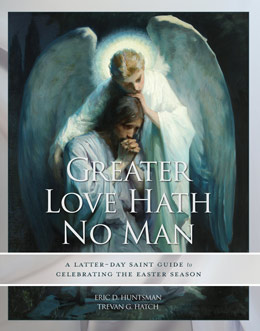
Preface
According to the Gospel of John, after the Last Supper and before Gethsemane, Jesus delivered a series of intimate discourses to his closest friends. In one of them he poignantly declared, “Greater love hath no man than this, that a man lay down his life for his friends” (John 15:13). This declaration puts the atoning suffering, death, and resurrection of Jesus Christ in a movingly personal light: Jesus did not only submit to an unfathomable ordeal and die for the world and all humanity in a general sense, although that is certainly true. In Greek, as in many languages, at the root of the word for “friend” is the verb “to love.” He died for you and for us because he loved us, and as we accept that sacrifice, we are no longer just his servants but are also his friends (see Doctrine and Covenants 84:77; John 15:15).
As disciples who love the Master, it behooves each of us to treasure what he has done for us, and one powerful way of doing this is to immerse ourselves in the Gospel accounts of Jesus’s final days and hours, seeking not only to know more about his atoning sacrifice and glorious resurrection but to come to actually know him better as we walk with him on his final journey in the lines of the New Testament Gospels. We can, and should, do this at any time of the year, but this scriptural journey has particular power when we walk it at that season of the year—Easter and the week preceding it—when we join with most of the Christian world in commemorating those pivotal events. Still, the Latter-day Saint community has few fixed ways of celebrating this holiday week. Rather, it is left to us as individuals and families to make the week a vital part of our personal study and family traditions.
In 2011 Eric Huntsman published God So Loved the World: The Final Days of the Savior’s Life with Deseret Book as a Latter-day Saint introduction to the scriptural, artistic, and musical resources available for individuals and families in their preparation for Easter. In 2019 Trevan Hatch published A Stranger in Jerusalem: Seeing Jesus as a Jew, a careful study of the historical and cultural context of the historical Jesus and his ministry, with Wipf & Stock. In this book we have joined together to produce an updated, more in-depth treatment of Holy Week to help Latter-day Saints use the texts and traditions surrounding the last days of Jesus’s life as accessible resources for celebrating the focus of the “good news” of the New Testament Gospels—the salvific suffering, death, and resurrection of our Lord Jesus Christ.
After introductory materials, Greater Love Hath No Man follows the same user-friendly format of the earlier God So Loved the World, organizing the chapters according to the traditional days of Holy Week with expanded discussion and additional materials. Foremost among these new materials will be a reader’s edition of the most important scriptural accounts for each day so that individuals and families can have them readily at hand for both individual study and group reading, perhaps in the context of daily family devotionals. After discussing these passages, each chapter will then summarize how these scriptural events have been celebrated through the centuries in different Christian traditions before sharing suggestions on how Latter-day Saints can both study the texts and commemorate the events in their own families. We have also included suggestions for further reading at the end of each chapter as well as some detailed discussions in the appendices, providing interested readers with a deeper dive into the material surrounding Jesus’s final week.
In 1 John 4:19 we read, “We love him, because he first loved us.” It is our testimony that as we come to better understand and appreciate the great love of the Father and the Son for us, particularly as manifested in the atoning sacrifice and resurrection of Jesus Christ, we will come to love them ever more profoundly. That love will strengthen and deepen our faith, enabling us to lay hold of eternal life, which is the greatest of the gifts of God.
—Eric D. Huntsman and Trevan G. Hatch
