
 menu icon in the top, right corner of the screen.
 icon above to close this box.
 icon at the bottom of the screen below the browser—if you don't see it, swipe up to unhide it.
Trinidad Hernández Javier
1882-1976
F. Lamond Tullis, "Trinidad Hernández Javier: 1882-1976," in Grass Roots in Mexico: Stories of Pioneering Latter-Day Saints (Provo, UT: Religious Studies Center, Brigham Young University; Salt Lake City: Deseret Book), 151‒68.
In the early 1930s on two and one-half acres (roughly the size of two US football fields) that Trinidad Hernández had donated,[*] a fledgling group of the first members of The Church of Jesus Christ of Latter-day Saints in Santiago Tezontlale[1] built an impressive stone church. By 2012 it had housed six generations of worshippers. Walking the grounds after a thirty-seven-year absence, I noticed that a new, modern chapel complex within a stone’s throw from the old building had been constructed. Clearly, however, in 2012 it was not the new edifice that hundreds of visitors were coming to see. It was the old stone meeting house in its restored functional beauty that continued to command wonderment. It housed a curated ward history collection that by March 1912 had attracted more than four hundred people, some traveling from as far away as the United States.

 Top: Another view of the restored old stone church. Many of the original trees that Trinidad and his children planted were removed to make room for the new chapel complex that sits to the left. The grounds have always been carefully tended. Bottom: The restored old church in Santiago Tezontlale, Hildalgo, Mexico, in March 2012. Branch members built the edifice from volcanic rock and hand-pressed bricks in the early 1930s.Photos courtesy of Eileen Roundy-Tullis.
The first members in Santiago Tezontlale designed and financed the construction of their stone church from Trinidad Hernández’s relatively abundant economic transfers from his employment with the Mexican Light and Power Company, fundraisers that members frequently sponsored, and their donated labor. They built the edifice from lava rock, which they hewed from a quarry two-thirds of a mile away, and pressed bricks. Draft animals pulling carts hauled the rock to the building site. There the men, including some not yet baptized into the Latter-day Saint faith and a few who never would be,[2] hand-chiseled the quarried stones into appropriate shapes and laid them up with an uncommon, even startling zeal.[3] The women and their daughters, some of an exceedingly tender age, prepared victuals to keep their husbands and fathers working intermittently year after year. Trinidad’s enthusiasm was an inspiration then and remains so for his descendants at the present day.
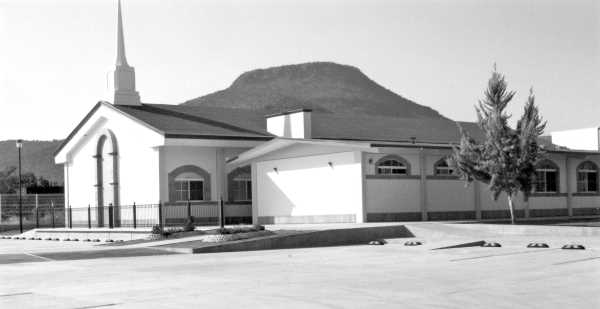 New chapel complex next to the old stone church, Santiago Tezontlale, 2012. Photo courtesy of Eileen Roundy-Tullis.
When the members finished constructing their meetinghouse, they built a basketball court on the premises and surrounded the whole site (108,900 sq. ft.) with an eight-foot fence. The old fence has now been replaced with a modern metal upgrade. The entry gate is currently usually locked, but in 1975 when I first visited Santiago to interview the then ninety-four-year-old Trinidad, one could freely pass through to admire the grounds. Even in 1975 some of the many trees and ornamental shrubs were thirty to forty years old, and at least thirty new trees had been planted within the previous decade. In 2012 the grounds continued to be well maintained around both the old stone church and the new modern chapel complex. That was how Trinidad had wanted it, and he worked diligently for more than a half century to keep it that way.
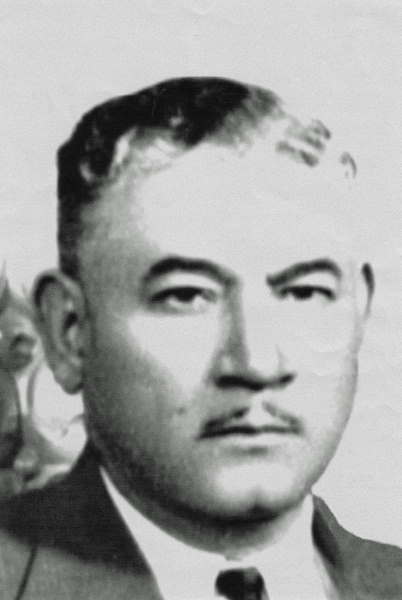
 Trinidad Hernández Javier, ca. 1917. Photo courtesy of Araceli Salinas Cerón.
Thirty-five-year-old Trinidad Hernández was baptized in 1917 as the first member of the Church in Santiago Tezontlale.[4] By then eight of his thirteen children had already been born. From his example that influenced the lives of not only his own children but other key families in Santiago, by 2012 the Church had become the beneficiary of more than a thousand members, many of whom lived, or had lived, in what can only be described as a Santiago diaspora. Every resident Latter-day Saint family had members living in Mexico City, Pachuca, Tula, San Marcos, or elsewhere in Mexico. Some, such as the Hernández family, had numerous relatives in the United States who continued to live the Latter-day Saint traditions that the first members in Santiago Tezontlale had bequeathed them in their homeland.[5]
 Librado Hernández Parra with his wife, Paula Morales, and sons at their home in California, 1976. Librado and his brother Trinidad Jr. eventually made their homes in the United States as part of the Hernández diaspora. Photo courtesy of Araceli Salinas Cerón.
Of Trinidad’s thirteen children, two sons (Librado and Trinidad Jr.) migrated to the United States in the 1930s and formed their families there. In 2020 their own descendants reached to great-great-grandchildren. Strikingly, one great-grandson, Benjamin Wise, born in the United States, sporting the greenish-blue eyes that his great-grandfather Trinidad was noted for, had joined the US Foreign Service and, in 2012, was stationed at the US Embassy in Mexico City. He attended the English-speaking Latter-day Saint ward in Tecamachalco along with his attorney wife, a Bolivian also eminently bilingual, along with their several young children who felt comfortable speaking English or Spanish as the situation required.
In 2020 many of Trinidad’s numerous descendants were not only local and regional leaders in the Church but also entrepreneurs, teachers, parents, professionals, and mid-level managers. Aside from the US Embassy official, at least one great-grandson attended Brigham Young University.
Like hundreds of other Latter-day Saint children elsewhere, many Hernández descendants left Santiago for the cities in search of better economic opportunities. Most of them planted their religious traditions in new climes. Even so, enough remained in 2012 in the small village of Santiago Tezontlale[6] to have two functioning wards and enough social, economic, and educational capital to launch one of the most impressive ward history fairs I have seen anywhere.
Trinidad the Man
How did one man who became a key to the Church’s expansion in Santiago Tezontlale become a Mexican Latter-day Saint pioneer? Trinidad, born June 7, 1882,[7] in the semiarid Valley of the Mesquite in Tula, Hidalgo, began his life in an unremarkable way. His rural family was attached to the land, indeed, and had loved it for generations. Trinidad naturally acquired a deep affection for the agricultural soil of his place. By the end of his life he had amassed more than two hundred acres of the land, nearly a third of a square mile,[8] a remarkable achievement.
Trinidad’s parents were likely illiterate, particularly his mother, which was the norm for the time, a condition that also included Trinidad. At the time of his baptism in 1917, Trinidad was still illiterate, a matter he eventually addressed after joining the Church.[9] His wife, Vidala Parra Zarate,[10] remained illiterate to the end of her days but nevertheless successfully served as a Relief Society president for many years and sponsored numerous projects to raise building funds for the stone church.[11]
Literacy aside, Trinidad’s birth family not only knew how to work but also loved their daily labors. His parents provided a relatively respectable home and adequate larder for their brood of children. When Trinidad’s own offspring began to arrive, he and his wife replicated what they had seen their forebears do—build a home and provision it. Having many children was the norm in those days. Trinidad and Vidala began their family of thirteen offspring with Jacinta in 1902 and ended with Justina in 1926.[12]
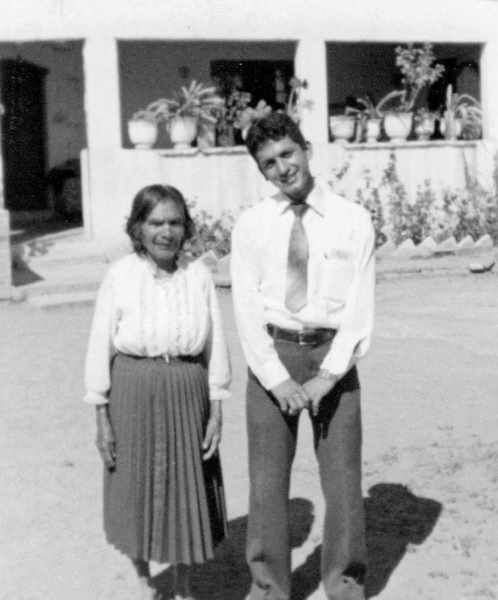 Jacinta Hernández Parra (1902-1993), Trinidad and Vidala's oldest daughter, with missionary Alfredo Nonir C. in the courtyard of the Hernández home in Santiago Tezontlale, ca. 1982. Jacinta spent her entire life in service to her family and the Church. Although unable to read or write, she provided strong guidance and humanitarian assistance to branch sisters and their Relief Society president. Photo courtesy of Araceli Salinas Cerón.
Traditional rural stability began to change for Trinidad in 1903 after electricity came to central Mexico. The Mexican Light and Power Company, incorporated in Canada in 1898 by non-Mexicans as a for-profit enterprise to generate and distribute electricity in Mexico, successfully obtained a concession from the Porfirio Díaz regime to begin work in and around Mexico City.[13] Díaz was, if anything, renowned for his love of foreigners to carry out Mexico’s industrialization. By 1906 the company, under the name of MEXLIGHT, was in a position to ask for and receive concessions from Mexican local and federal governments to extend its services beyond the Federal District into the states of Mexico, Puebla, Hidalgo, and Michoacán.[14] In the state of Hidalgo, the company set up offices in Pachuca, about thirty miles from Santiago Tezontlale. The company advertised for workers to build transmission lines.
Twenty-two-year-old Trinidad heard about the prospects of a wage job, applied for one around 1906, and was hired. He did not know anything about electricity, but he knew how to work with his hands and his heart. His third child, Gabriel, had just arrived, and Trinidad apparently felt a need to enhance his family’s cash flow. He stayed with the company until his retirement around 1943,[15] living through the Mexican civil war and a turbulent time of radical unionization as Mexico’s workers challenged foreign industrialists for a say in the policies of the companies they worked for.
All the while, and even though Trinidad had a home in Pachuca for his wage work and took advantage of the government-sponsored schools there to educate his children, a matter he pushed them hard on, he continued to maintain his home and lands in Santiago Tezontlale, where he engaged local agriculturalists to work them. He spent his vacations and many weekends enjoying the product of his hopes and labors there.[16]
Approximately ten years after obtaining employment with the electric company, Trinidad was supervising a work crew on a transmission line from Juando, in the state of Mexico, to Santiago Tezontlale, a distance of seventy miles. Being illiterate and supervising a power transmission construction job may seem incongruous, and indeed it is. However, illiteracy among manual workers of Trinidad’s generation was common, and a company sometimes had little choice but to place workers at tasks where they demonstrated exceptional skills without demanding they also be literate. One was Trinidad. He soon found a friend in an unusual countryman, a young Bernabé Parra, who had just recently become literate himself.[17]
Trinidad Becomes a Latter-day Saint
Bernabé showed up to work one day in 1916 or 1917, apparently on Trinidad’s work crew or at least in his work camp. Trinidad was curious. Bernabé carried the same last paternal surname as Trinidad’s wife, Vidala Parra Zarate.
 Bernabé Parra Gutiérrez, gifted orator and influential Church leader in central Mexico. Photo courtesy of Araceli Salinas Cerón.
For political and economic reasons, Bernabé had earlier fled San Marcos, Hidalgo, twenty-five miles from Santiago Tezontlale. At the same time, he had resigned his ecclesiastical job there as president of the San Marcos branch of the Church.
Bernabé was illiterate into his twenties. However, the relatively wealthy Rafael Monroy family in San Marcos had taken a liking to him, employed him as a ranch hand, and soon placed him in a supervisory role.[18] He eventually married Monroy’s sister Jovita.[19] Later he would become a district Church official.[20] However, in the meantime, imponderables of history put Bernabé and Trinidad in proximity to each other and they struck up a conversation. In due course Trinidad told Bernabé of an episode that still troubled him. It dealt with a bible that Trinidad could not read.
Before Trinidad became acquainted with Bernabé, and while Trinidad was working on transmission lines elsewhere, an elderly man had approached him wanting to sell him a Bible in order to buy food for his grandchildren. The elderly man was loud and insistent. Most of the other employees in Trinidad’s work crew had turned their backs on the old man, but Trinidad was intrigued. Would this be the first book he had ever held in his hand? Would buying it be a prestigious act? Would the old man be able to purchase enough food for his grandchildren if Trinidad bought the book? What else would the hawker have to sell in order to provision his family? Whatever Trinidad was thinking, he paid the man his asking price and then tucked the bible away among his camp belongings. Happily, the old man had spent some time telling the illiterate Trinidad what the book was about. Trinidad liked what he heard.
Bernabé’s immediate response after hearing Trinidad’s story was to say that the book he had obtained contained the word of God, which made it important to own, and that he should learn to read it. However, Bernabé added that he had another book that complemented the Bible. The title was the Book of Mormon, he said, and this book also contained God’s word. Bernabé explained its contents, which motivated one after-work discussion after another.
At some point Bernabé told Trinidad about the church that had the book. There was a regional conference being held soon (probably in Pachuca), Bernabé said, where Trinidad could find out more about this matter. Would he be interested in accompanying Bernabé to attend it?
By this time, Trinidad had a home in Pachuca, which he apparently invited Bernabé to visit. There Bernabé learned that a member of Trinidad’s family was seriously ill with little chance of survival. Bernabé asked Trinidad’s permission to give his loved one an anointing and blessing following ancient traditions and powers that he said had been restored to the earth less than a century before and that he himself possessed. Trinidad accepted. Surprisingly to the Hernández family, their loved one recovered,[21] a great relief given that they had already lost their son José back in 1912.[22] Following this experience Trinidad’s interest in the Church, as well as that of his whole family, skyrocketed. Trinidad’s baptism occurred sometime thereafter, in December of 1917 in San Marcos, which by then Bernabé felt empowered to revisit since strong members of the Church lived there.[23] It had taken Trinidad years of study and reflection to make this momentous decision about his Church affiliation. Once made, he never wavered, and he brought his family and friends along with him.
Trinidad’s wife and children of baptismal age eventually followed his example—Vidala in 1921 and at least the four oldest children at about that time. A Church membership photo taken around this time shows well-dressed Hernández family members, including Vidala and her daughter Jacinta, posed at attention.[24] Jacinta, the oldest Hernández child, sported a bandolero over her dress, which might seem odd given that bandoleros were functional attire for revolutionary insurgents during the Mexican civil war, which had just subsided a few years earlier. But now Mexico was finally at peace.
Did Trinidad ever become literate? Yes. His grandson Florencio, a Church patriarch in Pachuca in 2012, stated that Trinidad learned everything about reading as he worked in the Church and learned to study the scriptures, beginning with the Bible he had first purchased and following with the Book of Mormon he later acquired.[25] Apparently all this transpired in Trinidad’s thirties. For more than fifty years thereafter, he read his bible and the Book of Mormon to his children and even a few of his great-grandchildren.

 Top: Justina Hernández Parra (about age 11) and Librado Hernández Parra (about age 15), two younger children of Trinidad and Vidala, ca. 1937. Bottom: Two of Trinidad and Vidala's numerous great-grandchildren: Araceli Salinas Cerón (decended from their daughter Rafaela) and Saúl Hernández (decended from their son Agustín), by the old stone church, Santiago Tezontlale, Hildalgo, Mexico, 2012. Photo courtesy of Eileen Roundy-Tullis.
Trinidad tasked his children to preach and to invite their friends, acquaintances, and neighbors to religious discussions. Some of these people also joined the Church and made significant sacrifices to firmly implant their lives in and around their old stone church. One of Trinidad’s great-grandchildren still speaks of the Tomás Bravo, Marcial Paredes, and Félix Garfias families.[26]
The Maturing of the Church in Santiago Tezontlale
As Trinidad shuttled between his workstation in Pachuca and the land of his love in Santiago Tezontlale, Church membership grew in both places but soon outstripped the capacity of member homes in Santiago for Sunday services. For a while the members traveled to the nearby village of Guerrero, several miles away, to meet with the Latter-day Saint congregation there that had secured a relatively large rented meeting space.[27] Santiago Latter-day Saints eventually tired of this and began to wonder about building their own locale. At this point Trinidad donated his land and gathered Santiago’s Latter-day Saint families around him, which by the early 1930s numbered four or five extended ones, and “loved them into the dedication required to build their own church” where men “wore their hands into blood carrying and working the heavy stones.”[28]
Church administrative procedures in Mexico were finding their way and not without very unusual manifestations as in, for example, the change in the branch presidency in Santiago on March 12, 1933. District president Isaías Juárez and his counselor Bernabé Parra had arrived to make the change.[29] After the requisite singing of a hymn and offering of a prayer, Bernabé spoke of the need to make the change and noted that the new branch president, whoever he was, needed to be both “very intelligent and very dedicated” as were “those of old.” Indeed, he charged the whole congregation of fifty-five members and seventeen investigators to hone their intelligence and develop their knowledge and dedication.
Bernabé then invited the congregation to propose who their next branch president should be. José Regino nominated Marcial Paredes, who in turn nominated Félix Garfias, after which the matter was put to a vote by raised hands. Paredes received nine votes, Garfias thirty-one. Counselors were also elected. Those nominated included Trinidad’s son Agustín Hernández, Crispín Paredes, and Marcial Paredes. Agustín Hernández received twenty-three votes, Crispín Paredes six votes, and Marcial Paredes eight votes. With the voting completed, district president Juárez ordained Félix Garfias and Agustín Hernández elders in the Melchizedek Priesthood and established them as the new branch presidency. He also ordained Marcial Paredes and José Regino as teachers in the Aaronic Priesthood. Oddly, the new branch president then conferred the Aaronic Priesthood on José Regino. Juárez called Trinidad Hernández Jr. to be the branch secretary.[30]
Establishing new leadership by nomination and election appeared to be the norm in the Protestant congregations from which some early Latter-day Saint leaders in Mexico emerged. Clearly it was a temporary practice among the Latter-day Saints, soon replaced by the practice of being “called of God”[31] to leadership positions.
With the reorganization completed, Isaías Juárez invited Félix Garfias, Agustín Hernández, Marcial Paredes, and José Regino to bear their testimonies about the restored gospel of Jesus Christ. He also asked Timoteo Flores, visiting from the San Pedro Martyr Branch, to testify about the gospel. Bernabé then gave one of his impressive speeches, admonishing the congregation to offer the new branch president, Félix Garfias, respect and help. The meeting lasted two and one-half hours.[32]
Aside from learning to read the scriptures, handling administrative changes in unusual ways, and caring for their families and for one another, many of the members appeared to be intent on finding what they considered to be the will of the Lord in other parts of their lives. For Trinidad, this meant teaching his children to have fastidious care of their stone church and the grounds on which it stood, which mission president Rey L. Pratt had called “a credit to the faith of the people.”[33] It also meant organizing missionary activities during difficult times that prevented foreign missionaries from working in Mexico (e.g., during the civil war and the Cristero Rebellion). As a district leader in the Church, he traveled, preached, and encouraged, quite losing himself in the service of others. He taught three generations of Santiago Latter-day Saints the importance of such service. “Serving the Lord,” he reminded everyone, “means blessing the lives of others.”[34] For Trinidad, this also meant looking after widows and others in difficult economic circumstances.[35]
In his thirties, Trinidad acquired the ability to read and write, a skill he successfully imprinted on all his children except his oldest daughter, Jacinta, who nevertheless found important ways to serve, including a successful stint as Relief Society president. When a public elementary school finally arrived in Santiago Tezontlale, Trinidad made sure that children from economically challenged member families had school uniforms and money for school fees so they could attend.[36] In his own way, the once-illiterate Trinidad became an evangelist for education among his people. His influence was widely felt.
Long before a temple was available in their land (1983 in Mexico City), Mexican Latter-day Saints in all walks of life longed for an opportunity to participate in the sacred ceremonies undertaken therein as part of what they considered an element of their eternal progress. Some put together the wherewithal to do it and the stamina to handle a weeks-long bus journey to Mesa, Arizona, and back. Some members of the Trinidad Hernández family were able to make this journey in the early 1950s. The trip seemed to set a pattern that saw many of Trinidad and Vidala’s descendants subsequently participating in temple worship in Mexico’s thirteen operating temples as of 2020. A new temple for Puebla was announced in October 2018 and will likely be brought online in 2021 or 2022.[37]
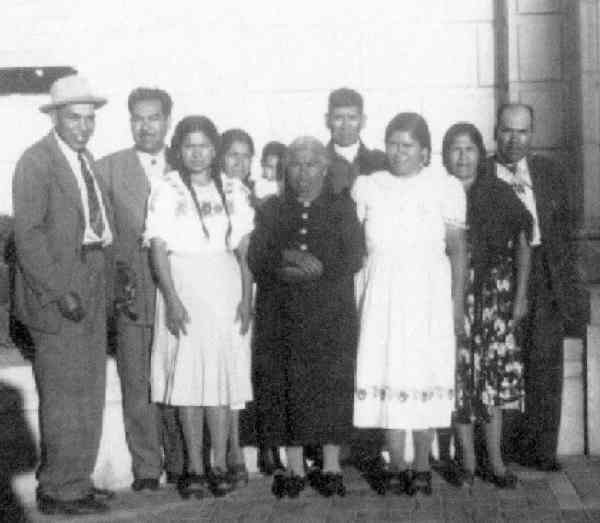 Trinidad Hernández family excursion to Mesa Arizona Temple, ca. early 1950s. From the left: Trinidad Jr., Gabriel, Justina, Eva with infant Moroni Aguiler Hernández, Vidala, Trinidad, Rafaela, María, and Agustín. Photo courtesy of Araceli Salinas Cerón.
In the 1970s the Relief Society in Santiago Tezontlale was particularly active among Church members in matters of health and hygiene, sponsoring the equivalent of miniseminars on infant and child care, food preservation, and transmitting knowledge about bacteria and disease. In some of the meetings, scores of people (mostly women) showed up. A few years thereafter, public health indicators among Church members improved greatly. Service missionaries were helping numerous branches in the state of Hidalgo during this decade.[38] In 1975 I found fifteen Santiago Tezontlale Relief Society women surrounding a boiling pot of water as they learned to sterilize infants’ clothes to help deal with severe cases of diaper rash.
However spectacular the expansion of the gospel among Santiago Tezontlale residents, and however unusual some Church administrative practices were by present-day standards, common travails remained for the members. People died. A few defected from the Church. Some marriages were dissolved in acrimony, including the marriage of one of Trinidad’s daughters. Illnesses frequently plagued the people from time to time. A few wilted in the face of life’s inevitable pressures and disappointments. But not Trinidad Hernández Javier. Weakened, bedridden, frail, and hollow-eyed, his final words to me those many years ago in 1975, a few weeks before his death at age ninety-four, were “All that we are, all that we have become, all that we can ever expect to be, we owe to the gospel of Jesus Christ and to our membership in his church.”
Notes
[*] The information for this vignette derives from LaMond Tullis, “Los Primeros—Mexico’s Pioneer Saints,” Ensign, July 1997; LaMond Tullis, Mormons in Mexico: The Dynamics of Faith and Culture (Logan: Utah State University Press, 1985), 176–77; Trinidad Hernández, interview by LaMond Tullis, Santiago Tezontlale, May 1975; and Araceli Salinas Cerón, interviews by LaMond Tullis, February 4 and March 17, 2012. Araceli Salinas Cerón is the great-granddaughter of Trinidad Hernández and creator and sponsor of an impressive ward history fair to celebrate the seventy-sixth anniversary of the founding of the Church in Santiago. I scanned thirty-seven of Salinas Ceron’s collected documents and photos and interviewed with her for a combination of two and one-half hours. A great-grandson of Trinidad, Saul Hernández, facilitated the 2012 visits and helped collect some of the information reported in this vignette. Eileen Roundy-Tullis has provided photographs of the Church compound in Santiago Tezontlale as it appeared in 2012, and she helped gather the information for this vignette during on-site visits in February and March 2012. This information was supplemented with an interview with Florencio Hernández Viguéraz, a grandson of Trinidad, in Pachuca, Hidalgo, on January 23, 2012. He had the family’s genealogy sheets, vivid memories of his grandfather, and other helpful information.
[1] In the late nineteenth century, this village was known simply as “Tezontlale.” Birth, marriage, and death records note the locale absent the currently attached name of “Santiago.” I do not know when the transition to “Santiago Tezontlale” occurred.
[2] Information from Document ST-3, Santiago Tezontlale ward history fair and Araceli Salinas Cerón interviews.
[3] Member-constructed church buildings were one way that meetinghouses could be acquired in the 1930s. Notable member-initiated construction accomplishments include the church edifices in San Gabriel Ometoxtla built in 1930 with adobe blocks and a metal roof, and the more durable Santiago Tezontlale church, finished around 1933 or 1934, made of stone. An elegant plastered and large building in San Pedro Mártir, completed in 1938, was the first Church-financed chapel in central Mexico. A larger and more urban church building, also financed by the Church, was constructed at Ermita in Mexico City in 1941. Document ST-3 and Araceli Salinas Cerón interviews.
[4] Trinidad Hernández Javier, native of Santiago Tezontlale, was baptized on December 10, 1917, in San Marcos, Hidalgo, some forty-six kilometers away. The Church had an earlier beginning in San Marcos, and one of its members, Bernabé Parra Gutiérrez, was instrumental in Trinidad’s conversion. Hernández family genealogy sheets; Araceli Salinas Cerón and Florencio Hernández Viguéraz interviews.
[5] These are gross but not unreasonable estimates: In 2010 Santiago Tezontlale had 4,226 inhabitants (see https://
[6] In 1900 Tezontlale had a population of 1,068, in 1975 a population of 2,400, and in 2005 a population of 3,894. See https://
[7] There is a year’s discrepancy in some of the records. A family group worksheet prepared by Trinidad’s son Agustín lists the referenced date. Another record at the Santiago ward history fair put the date at 1883, still on June 7.
[8] At the end of his life, Trinidad still owned more than two hundred acres in and around Santiago, some of which he may have acquired by inheritance, but most of which he purchased later on. He was careful to obtain land in several microclimates so as to bargain against weather vagaries, thereby helping to ensure that some crops would survive each year.
[9] Florencio Hernández Viguéraz interview.
[10] Vidala Parra Zarate was born on August 12, 1885, in “Tezontlale.” She and Trinidad were married on December 10, 1901. Vidala died on October 20, 1959, in Tezontlale. Apparently Trinidad never remarried.
[11] Document ST-9, Santiago ward history fair; Araceli Salinas Cerón interview.
[12] Family genealogy sheets provided by Florencio Hernández Viguéraz, January 23, 2014.
[13] See “Luz y Fuerza del Centro,” https://
[14] By the time the company was nationalized and liquidated in 2009, it had grown to cover eighty municipalities in the state of Mexico, two in Morelos, two in Puebla, and five in Hidalgo. See “Luz y Fuerza del Centro.”
[15] Florencio Hernández Viguéraz interview.
[16] Florencio Hernández Viguéraz interview. Florencio, who spent time working his grandfather’s lands in the heat of the day and with a moon at night, said that the men, including his grandfather whenever he was there, worked the fields.
[17] See LaMond Tullis, Martyrs in Mexico: A Mormon Story of Revolution and Redemption (Provo, UT: Religious Studies Center, Brigham Young University; Salt Lake City: Deseret Book, 2018), 91–93.
[18] See Tullis, Martyrs in Mexico, 32.
[19] See Tullis, Martyrs in Mexico, 98.
[20] See Tullis, Martyrs in Mexico, 113–20.
[21] Araceli Salinas Cerón interview.
[22] Hernández family genealogical group sheet, courtesy of Florencio Hernández Viguéraz.
[23] Hernández family genealogical group sheet; Florencio Hernández Viguéraz and Araceli Salinas Cerón interviews.
[24] Document ST-22, Santiago Tezontlale ward history fair.
[25] Florencio Hernández Viguéraz interview.
[26] Document ST-4, Santiago Tezontlale ward history fair. This information is also consistent with what Trinidad’s daughters Rafaela and Jacinta told me when I interviewed them in 1975. Document ST-4 states that Rafaela and Jacinta told the same story many times because they had heard it many times from their father’s lips.
[27] Document ST-3, Santiago Tezontlale ward history fair; Araceli Salinas Cerón interview.
[28] Document ST-3, Santiago Tezontlale ward history fair.
[29] The recorder of this event, Trinidad Hernández Jr., branch secretary, wrote of Bernabé Parra as being the “President of the Mission in the State of Hidalgo” and of Isaías Juárez as being the “President of the Mexican Mission.” Document ST-29, Santiago Tezontlale ward history fair, “Acta de Reorganization,” written by Trinidad Hernández Parra, son of Trinidad, as branch secretary. In reality Isaías Juárez was the district president and Bernabé Parra was his counselor. Rey L. Pratt was the mission president.
[30] Document ST-29, Santiago Tezontlale ward history fair.
[31] Articles of Faith 1:5.
[32] Document ST-29, Santiago Tezontlale ward history fair.
[33] Tullis, “Los Primeros.”
[34] Jorge Hernández, grandson of Trinidad Hernández, interview by LaMond Tullis, Provo, UT, August 1978.
[35] See Tullis, “Los Primeros.”
[36] See Tullis, “Los Primeros.”
[37] See “List of temples of The Church of Jesus Christ of Latter-day Saints by geographic region,” https://
[38] See Tullis, Martyrs in Mexico, 147–48.
