
 menu icon in the top, right corner of the screen.
 icon above to close this box.
 icon at the bottom of the screen below the browser—if you don't see it, swipe up to unhide it.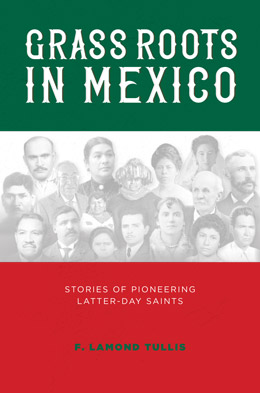
Rafael Monroy and Vincente Morales
1878-1915 / 1887-1915
F. Lamond Tullis, "Rafael Monroy and Vincente Morales: 1878-1915 / 1887-1915," in Grass Roots in Mexico: Stories of Pioneering Latter-Day Saints (Provo, UT: Religious Studies Center, Brigham Young University; Salt Lake City: Deseret Book), 121‒30.
Among many members of The Church of Jesus Christ of Latter-day Saints in Mexico, Rafael Monroy and Vicente Morales are incarnations of ultimate sacrifice. The martyrs represent a decisive conviction, commitment, and fidelity to their faith. After more than a hundred years, people still visit their graves in Tula in the state of Hidalgo, especially during Mexico’s “Day of the Dead” on November 2. Like Joseph and Hyrum Smith, these men paid the ultimate price for their faith. One of several reasons Monroy and Morales were executed during Mexico’s civil war of 1910–17 was their allegiance to what antagonizers called “the alien religion of the Mormons.”
The execution itself was perhaps not atypical of how numerous people, including several Latter-day Saints, died during Mexico’s civil war. More than a million people lost their lives from the hostilities or from the privation, dislocation, abuse, and starvation that accompanied them. Torture, taunting, disregard of exculpatory evidence, and a final fusillade were visited upon many unfortunate souls.
“What bravery!” reportedly remarked one of the executioners. “They died with their boots on.”[1] He was reflecting almost respectfully on the surreal way that Monroy and Morales had stood to receive the gunfire that pierced their bodies on the evening of July 17, 1915, following several episodes of their being hung to unconsciousness (and then revived) from an enormous tree near the village square in San Marcos, Hidalgo. The terror of facing an execution squad notwithstanding, no cowering, no begging, and no hysterics marred their decision not to repudiate their faith.
The commander of a rebel Zapatista militia that had temporarily gained control over the area reportedly offered them their lives if they would repudiate their faith. The men responded by reaffirming their religious convictions, emphasizing that the only arms they possessed were not the clandestine military weapons they were accused of hiding in the Monroy family store but rather their sacred texts—the Bible and the Book of Mormon—that Monroy carried with him nearly all the time.[2] Monroy was president of the San Marcos Branch of the Church. Morales, Monroy’s employee, was his first counselor.
Whether the slaughterers would have spared the men had they renounced their faith is now moot. These pioneer Mexican Latter-day Saints who, moments before their executions, knelt and likely prayed for their killers sealed their fidelity when the executioners’ guns spit out the lead that silenced their young lives.
If in the Zapatista mind a constellation of factors condemned Monroy to a firing squad (his religious persuasion being one among them), the matter appeared to be less complicated for the Zapatista general regarding Morales, who was from the Mexican underclass the Zapatistas were fighting to free. As a Latter-day Saint, Morales was pairing with aliens, and he was a confidant of the rural middle-class Monroy, who would not confess his alleged crimes no matter the torture. Even worse, Morales would not betray Monroy by doing the confessing himself. That was enough. In those days, examination of evidence was not a hallmark of the Zapatistas’ minds except insofar as it affected their own sense of oppression and maltreatment at the hands of Mexico’s privileged classes. Spiteful vengeance (venganza rencorosa), not to mention indiscriminate vengeance, is a powerful motivator of malevolence. In the Mexican Revolution or civil war, spiteful and indiscriminate vengeance amply fueled grief and despair as pandemonium enveloped the land like smoke from a thousand wildfires.
People who elect martyrdom over renunciation live life beyond the moment. They look forward a hundred or even a thousand years as they view their place as being neither just here and now nor theirs alone but one tied to cohorts, followers, and descendants through generations. For some within the Latter-day Saint community, this hearkens to the principles set forth in the sixth lecture on faith delivered at the School of the Prophets at Kirtland, Ohio.[3] This lecture teaches that no sacrifice is too much or oblation too demanding if one lives by faith. However, it does produce a question: How would the martyrs’ lives affect their descendants even to the end of time? This matter was probably front and center with Monroy and Morales and perhaps so even with Monroy. Morales’s wife was pregnant with his unborn child, which would be his only genetic link to the future. The men had time to ponder a lot of thoughts as their impending demise loomed, however unarticulated they may have been in their minds, as they knelt in prayer moments before their execution. Mexican Latter-day Saints do not seek martyrdom. However, as historical accounts show us, at least two chose it on their own terms over whatever alternative may have been available.
Rafael Monroy
Before moving to San Marcos, Hidalgo, in December 1906, Rafael’s immediate family had become relatively well-off elsewhere in that state. Various members worked as hacienda administrators, teachers, and governmental employees. For generations, the Monroy family had striven to become literate and upwardly mobile, to rise from servitude to independence. One of the reasons they moved to San Marcos was to gain access to better educational opportunities for their children.
 Portrait of Rafael Monroy by the studio Napoleón Fotografía in Mexico City, ca. 1911. The venue, attire, and quality of the portrait suggest that the Monroy family was relatively well-off economically.
While living in San Marcos, Rafael developed a romantic relationship with Guadalupe Hernández Ávalos, whom he apparently had known for some time through his extended family. Guadalupe lived in San Agustín Tlaxiaca, Hidalgo (forty-five miles northeast of San Marcos), and there, in 1909 or 1910, she and Rafael Monroy were married.[4] In due course they produced a daughter, María Concepción, who married late in life and did not have children. Rafael had two children by a previous relationship with Maclovia Flores. His daughter Amalia, from that union, joined The Church of Jesus Christ of Latter-day Saints, and his son Luís, also from that union, was sympathetic to the Church. These two became the conduit for Rafael’s subsequent descendants.
When, María Concepción was two years old, Rafael began to pay attention to the Church’s missionary discussions. He took particular interest not only in the Book of Mormon as a compelling document but also in the Restoration’s teachings about God’s relationship with his earthly children and his requirement that they repent of their sins and be baptized.
Except for Rafael’s wife Guadalupe, who was not happy about all this and had done her best to thwart the missionaries’ efforts,[5] the whole Monroy family was mesmerized at what they understood to be Joseph Smith’s hand in the restoration of the gospel of Jesus Christ and, in particular, his work in translating the Book of Mormon. Accordingly, and not unexpectedly, in 1913 Rafael and his two sisters (Guadalupe and Jovita) were baptized, and soon their mother, Jesusita, joined them. Surprisingly, and despite her early foot-dragging, Rafael’s wife was also baptized a month and a half later.[6] W. Ernest Young had discharged his missionary duties well.[7]
 The Monroy family in San Marcos, Hildalgo, ca. 1913 (from the left): Rafael holding his daughter, María Concepción; his wife, Guadalupe Hernández; his sister Natalia Monroy Mera; his mother, Jesusita; and his sisters Jovita Monroy Mera and María Guadalupe Monroy Mera. Photo courtesy of Church History Library, Salt Lake City, Utah.
The Monroy family’s relatively good social and economic status in the community notwithstanding, Rafael, his sisters, and their mother soon felt the scimitar of persecution for, in the eyes of their neighbors, having abandoned the teachings of the community’s ancestors by joining an alien church centered in the United States.[8] Associating with foreigners was particularly anathema to the xenophobic Zapatista revolutionaries from the state of Morelos whose militia would later occupy the village during the civil war.
Persecution aside, the Monroy home became the meeting place for what would become a gradually increasing number of Latter-day Saints in San Marcos. Elsewhere an amplified story of these intrepid souls has been told.[9]
Monroy’s descendants, now in the seventh generation, live not only in all parts of Mexico but also in the United States. An overwhelming majority of them are distinguished for their service to family, community, and the Church. Morales’s descendants are in their eighth generation, and many have likewise distinguished themselves down through the years.
In December 2006 a posterity gathering took place in Provo, Utah, among Monroy’s descendants and those of W. Ernest Young, the missionary instrumental in Rafael’s conversion to the faith. James E. Faust of the Church’s First Presidency sent a congratulatory letter (Faust had used the execution story in one of his general conference talks). A grand gathering of souls congregated not only to celebrate their forebears but also to reflect in gratitude about the circumstances that had brought them to that moment. One of Rafael’s great-grandsons, José Luis Montoya Monroy, read the names of the families descended from Rafael and commented that more than two hundred of Monroy’s posterity were then working in the Church in one or more capacities. Many on the list were either then serving or had served missions.
Probably the most visible is Hugo Montoya Monroy, one of Rafael’s great-grandsons (through his mother) and also a great-grandson (through his father) of another of the founding families in San Marcos, where the Church took root and the executions took place. On April 4, 2015, at age fifty-five, Hugo Montoya Monroy was sustained as a member of the First Quorum of the Seventy. He had been serving in the Fourth Quorum of the Seventy in the Mexico Area. In 2018 he became the first counselor to President Enrique R. Falabella in the South America Northwest Area Presidency.[10]
As Rafael Monroy knelt in prayer moments before his execution—not to petition the Lord to save his life but rather to ask for blessings for his loved ones, and also most likely for his posterity, even until the end of time—it would appear that his prayer has been richly answered.
Vicente Morales
Vicente Morales was born among the indigenous Otomí in the municipality of Alfajayucan, in the state of Hidalgo.[11] He was living in Cuautla in the state of Morelos when he became acquainted with the Latter-day Saints, whose church he joined in 1907 at age twenty. From age seventeen, he had been in a common-law relationship with María Petra Gutiérrez, four years his junior, with whom by 1907 he had begotten and buried two daughters. After Vicente and María legalized their union through marriage to facilitate Vicente’s baptism (which must have comforted María, given that she had joined the Church in Toluca at age ten), the couple had one more daughter (1909) who, like the others, died before her first birthday. In less than two years thereafter, María herself died (1911) from unrecorded causes but perhaps related to another pregnancy.
With the family of his first love wiped out, and stressed by grief and despair, Vicente nevertheless cemented himself in the Church by accepting a call as a part-time local missionary when regular missionaries fled Mexico in August 1913 due to war hostilities.[12] Given his difficulty in speaking the Spanish language (his native tongue being Otomí), his acceptance of a mission assignment to Spanish speakers was of itself remarkable.[13] His missionary efforts eventually took him to San Marcos, Hidalgo, where he made several visits. Specifically, from January to March 1914 he and his traveling companions met with the Monroy family on at least three separate occasions to give them postbaptism gospel teachings.
Aside from visiting the Monroys, there was perhaps an additional compelling reason for Vicente to be attracted to San Marcos as a local missionary. Her name was Eulalia Mera, the seventeen-year-old niece of Rafael Monroy’s mother, Jesusita, and therefore Rafael’s cousin, who was living in the Monroy compound. Her appearance was very appealing to Vicente. Indeed, Eulalia was beautiful, had come of age, and was a member of the Church. Although Vicente had lost three children and his wife, and although he was more than a decade older than Eulalia, he nevertheless wondered if the young woman might be interested in him. He was stable, had none of the regular male vices of the day, was a strong member of the Church who was faithful to its teachings, and was considered by some to be quite handsome. They were both of Otomí heritage. So, he wondered.
Around 1912, then-fifteen-year-old Eulalia had moved to San Marcos from the municipal seat of Tula, Hidalgo. Jesusita took her niece in as if she were one of her own, a deed Jesusita had done before and would continue to do for others on numerous occasions. Eulalia was not long in her new home before she accepted the Latter-day Saint faith and was baptized (1913). By mid-1914, she had taken a liking to Morales, and within a year that liking matured. With mission president Rey L. Pratt’s written permission (necessary, it was said, because Vicente had a missionary calling) delivered from the United States, where he had taken refuge from the civil war, Vicente and seventeen-year-old Eulalia were married in San Marcos in early January 1915, just six and a half months before Vicente’s execution.[14] In March, when the fratricide of the civil war subsided for a few weeks, they had their marriage registered with civil authority in Tula—at least that part of civil authority that still functioned in Hidalgo.
When the Zapatista bullets pierced Vicente’s body on July 17, 1915, his daughter Raquel was still in utero. Eulalia was five months pregnant when she heard the Zapatista fusillade that killed her husband and her cousin Rafael.
Vicente Morales’s genes and his legacy to the Church survived in his daughter Raquel, who lived most of her forty-nine years in San Marcos. Raquel served a two-year mission (1937–39) in Monterrey and then spent an additional six months in service to Church members in Ozumba at a difficult time when the branch there was undergoing great stress from the dissident Margarito Bautista’s separatist group.[15] In Ozumba, Raquel further fortified her commitments to the Church.
Joined in union with Antonio Roberto Saunders barely a month before his own baptism, Raquel had three children with him: two boys and one girl. Through the girl, Ruth Josefina Saunders Morales, not only did Vicente’s genes pass to a seventh generation as of 2013, but so did his fidelity in the Church. With Ruth’s marriage to Benito Villalobos Vásquez—from another of the great families from San Marcos—genes, culture, and religious conviction combined to create scores of faithfully committed descendants. These, with others of Vicente Morales’s posterity, had produced by 2012 twenty-four missionaries, two Area Seventies, one mission president, one stake president, four Relief Society presidents, ten Young Women and Primary presidents at stake and ward levels, and numerous others invested in the religious, humanitarian, and educational foundations of their faith.[16] In figurative response to the townspeople’s mocking comments as Vicente’s widow accompanied her husband’s body to the Tula cemetery in 1915 (“See, this is what you get for being a Mormon”), someone could now say on Vicente’s and Eulalia’s behalf, “See, this is what we have given you.”
As Vicente faced his executioners with his convictions unbowed and his testimony resolute, one wonders if his hopes for his family’s future might have embodied the following aphorism derived from 3 John 1:4: “My greatest blessings are to see my children walk uprightly before the Lord.”[17] If so, he is not disappointed.
Notes
The vignettes presented here draw on F. LaMond Tullis, Martyrs in Mexico: A Mormon Story of Revolution and Redemption (Provo, UT: Religious Studies Center, Brigham Young University; Salt Lake City: Deseret Book, 2018), 1–84, 155–63.
[1] The Spanish rendition as recorded by Rafael’s sister Guadalupe is “¡Qué valor de hombre! ¡Han muerto con sus calzones en su lugar!” Guadalupe Monroy Mera, “Como llegó el evangelio restaurado al pueblo de San Marcos, Tula de Allende, estado de Hidalgo,” 1944, transcribed typescript by Minerva Monroy, 1999, 3, MS 23361, Church History Library. Parts of this account are also available at https://
[2] An excellent analysis of the events leading up to the executions is Mark L. Grover, “Execution in Mexico: The Deaths of Rafael Monroy and Vicente Morales,” BYU Studies 35, no. 3 (1995–96): 7–28. See also LaMond Tullis, Mormons in Mexico: The Dynamics of Faith and Culture (Logan: Utah State University Press, 1987), 100–103, 109–10; and Tullis Martyrs in Mexico, 51–72.
[3] Lectures on Faith: Delivered to the School of the Prophets in Kirtland, Ohio, 1834–35 (Salt Lake City: Deseret Book, 1985).
[4] When Rafael Monroy and Guadalupe Hernández joined in marriage on January 8, 1909 (Hugo Montoya Monroy’s date), or January 6, 1910 (María Guadalupe Monroy Mera’s date from her diary), Maclovia Flores, Rafael’s earlier love, appeared to give up on any thought of reconciliation with Rafael. She subsequently began a relationship with Santos Ortiz that produced two girls, Juliana and Alfonsa. We do not know if Rafael maintained any communication with Maclovia and the children he had with her. However, several fragments in the history of the family indicate that from time to time Rafael mentioned his children with Maclovia. Hugo Montoya to LaMond Tullis, February 27, 2014.
[5] See Grover, “Execution in Mexico,” 11.
[6] See The Diary of W. Ernest Young (Provo, UT: Brigham Young University Press, 1973), 107.
[7] On June 11, 1913, W. Ernest Young performed the baptisms while mission president Rey L. Pratt was a witness. Diary of W. Ernest Young, 658–60. See also the narrative by Guadalupe Monroy Mera, one of those baptized, in “Como llegó el evangelio,” 4–5.
[8] See Monroy Mera, “Como llegó el evangelio,” 3–45.
[9] See Tullis, Martyrs in Mexico.
[10] See https://
[11] Ruth Josefina Saunders Morales de Villalobos (daughter of Raquel Morales Mera and granddaughter of Vicente Morales) to LaMond Tullis, February 11, 2014.
[12] The call probably came from Agustín Haro, president of the San Pedro Mártir Branch, which, along with the Ixtacalco Branch, undertook supervision of San Marcos when the full-time missionaries and President Rey L. Pratt fled Mexico. Monroy Mera, “Como llegó el evangelio,” 7–48. Haro, whose own work in the Church has become legendary, was Casimiro González’s brother-in-law. Saunders Morales to Tullis, February 11, 2014.
[13] Saunders Morales to Tullis, February 11, 2014. Additionally, accomplished writer Guadalupe Monroy put it this way: Morales “was quite poor and spoke Spanish incorrectly or with a bad pronunciation because his mother tongue was Otomí. He was from Alfajayucan from the state of Hidalgo. Luck had extracted him from there and he had accepted the gospel.” Monroy Mera, “Como llegó el evangelio,” 7. Translation from the Spanish by LaMond Tullis.
[14] Vicente Morales and Eulalia Mera were married on January 4, 1915. Monroy Mera, “Como llegó el evangelio,” 13; and Familia Montoya Monroy, “Martirio en México,” Linaje Monroy en el Estado de Hidalgo, México, January 17, 2014, 3, https://
[15] For extensive coverage on Margarito Bautista and his association with the dissident Third Convention, see LaMond Tullis, “A Shepherd to Mexico’s Saints: Arwell L. Pierce and the Third Convention,” BYU Studies 37, no. 1 (1997–98): 127–57. The best insight into Bautista’s ideological persuasions and the driving force behind his dissidence, first from the mainline Church and thereafter from the Third Convention, is found in Elisa Eastwood Pulido, The Spiritual Evolution of Margarito Bautista: Mexican Mormon Evangelizer, Polygamist Dissident, and Utopian Founder, 1878–1961 (Oxford University Press, 2020). Another fine piece is Stuart Parker, “Queso y gusanos: The Cosmos of Indigenous Mormon Intellectual Margarito Bautista,” in Just South of Zion: The Mormons in Mexico and Its Borderlands, ed. Jason H. Dormady and Jared M. Tamez (Albuquerque: University of New Mexico Press, 2015), 111–25.
[16] LaMond Tullis to Elder Daniel L. Johnson, November 4, 2012.
[17] The scripture reads, “I have no greater joy than to hear that my children walk in truth.”
