
 menu icon in the top, right corner of the screen.
 icon above to close this box.
 icon at the bottom of the screen below the browser—if you don't see it, swipe up to unhide it.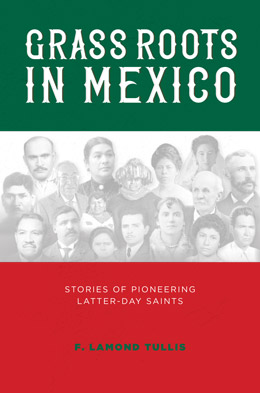
Preface
F. LaMond Tullis
This volume’s first two chapters consist of synopses of events important to the history of The Church of Jesus Christ of Latter-day Saints in Mexico. They establish a contextual background for the pioneer vignettes that follow. The vignettes are mostly about pioneer Mexican Latter-day Saints, focusing mainly on the circumstances of their lives as newly converted members of the Church, the nature of their conversions, and what happened to them and their families afterward. I have also included two vignettes of Anglo-Europeans who were among the many striking foreigners who promoted the Latter-day Saint faith in Mexico. In their case, they were key to making the expansion of the Church there possible.
During my travels in Mexico in 1975 and 2011–13, I came upon or searched out people who had papers, diaries, journals, photographs, collections, and vivid memories of their forebears that compelled my attention to their ancestral past. Also, there were several still-alive pioneers who had supporting documents about their own lives. I listened, gathered, and wrote.
Additionally, from my archival research over the years and through interviews with informed people in the United States, both ethnic Anglo and ethnic Mexican, other remarkable people came to my attention, and I have also written about them.
The vignettes presented here vary greatly in length depending on the availability of information. I do not claim that they embody the whole Latter-day Saint experience in Mexico, but they certainly are representative of much of it.
I have selected nineteen vignettes for their illustrative importance regarding the subject matter of this volume. At this writing (2021), two of the subjects are still alive—Luis Alfonso López Hidalgo and Agustín Gutiérrez Ruiz.
The vignettes include people from vastly different socioeconomic backgrounds and ethnic and linguistic persuasions. In that sense, they represent something of the historical diversity of the Church of Jesus Christ in Mexico.
Thousands of Mexican Latter-day Saint pioneers have stories that need to be told. Writers and researchers of Mexican and Anglo-European descent are engaged in identifying these stories and sharing them on the Internet. Others are publishing their research in conventional print form. Additionally, the Church History Department’s prodigious oral history program in Mexico has been underway since at least 1973 but has accelerated its work since 2012. Hundreds of oral histories have been deposited in the Church’s archives in Mexico as well as in Salt Lake City. I hope that many more people will write about Mexico’s Latter-day Saint pioneers.
Who is a pioneer Mexican Latter-day Saint? Anyone who is a first convert to the faith in a family is a pioneer. Thus the vignettes cover people born as early as 1814 (Desideria Quintanar de Yáñez) and as late as 1963 (Agustín Gutiérrez Ruiz).
Some readers will no doubt point out serious omissions in the array of vignettes presented herein. I agree, yet I have done what I could with the resources available to me. I urge others to take up this important task. It is not without its challenges: I was frequently disappointed after spending as much as a week chasing down promising prospects and interviewing them, only to find that all their family history documents had been gathered up by others and taken away from the families who thought they owned them.
Many narratives have been written about pioneers in the Church’s historical heartland—for example, about Joseph Smith and other founders of the faith; about the Saints’ travails and persecutions; about their schisms in Kirtland and Nauvoo; and about the trek west to settle land belonging to Mexico that became the United States’ extralegal “State of Deseret” (1849–1850) following the Treaty of Guadalupe Hidalgo with Mexico. After that treaty closed the Mexican–American War in 1848, the US government designated it as the Territory of Utah (1850–1896). In this territory many of the stories relate the early members’ struggles with Native Americans who were being displaced from the land but considered themselves to be its rightful occupants. Interestingly, thousands of Native Americans also became pioneer Latter-day Saints following their own baptisms into the faith.
Most of the available biographical narratives about Latter-day Saint pioneers detail how Anglo-European members uprooted sagebrush, laid out irrigation canals, and “made the desert blossom as the rose” as they prospered economically amid continual conflict with the US federal government. All this and more have become grist for countless stories of people’s struggles to grow in their faith and defend the product of their labors.
The prominence of Anglo-Europeans and Anglo-Americans in these written pioneer narratives is therefore high, while the number of pioneer Native American and ethnic Mexican Latter-day Saints featuring in written records is low. To be sure, many stories of the latter exist, but with a few notable exceptions[1] the anecdotes reside mostly in the realm of oral history and unassembled documents and photographs, sometimes closely held within families or discoverable only through personal interviews with descendants. The principal purpose of this book is to bring to the fore individual stories of pioneer members of the Church in Mexico so that interested readers can sample from the grass roots how the faith has evolved there. In an international church, every nation deserves its own narratives to supplement those from the Church’s heartland. In this book I have expanded those contributions from Mexico. The Spanish versions of some of these narratives were originally posted in 2012 and 2013 on the Church’s website in Mexico (formerly lds.org.mx).
As typical in most male-dominated societies, whether traditional or modern, it is easier to write about men than about women because of traditional gender emphases on male activities and the relatively wider availability of records about them. Nevertheless, I have been able to develop seven vignettes about female Mexican Latter-day Saints. Hopefully, other writers will be able to find sufficient materials to write about many more.
A few reviewers have wondered why I have mentioned education and literacy so much in these vignettes, even wondering if I have a prejudice against illiterate people. Wholly to the contrary, I mention these topics frequently because they were at the forefront of interest and effort among many early adult members of the Church in Mexico who had experienced little or no opportunity for a formal education and whose pathway to literacy arose out of their intense desire to be able to read the Book of Mormon. Indeed, many early pioneer Mexican members who had already entered the ranks of the literate also spent enormous efforts to help those who had not been able to read the Church’s sacred texts. Readers of the vignettes will marvel at the prodigious struggles expended to this end. I focus on education and literacy among those early members because they gave them so much emphasis. It is part of their heritage, part of who they are.
Any historical volume lugs an author’s ideological overlay, explicit or implied. Mine compels me to marvel at people who change the trajectory of their lives at whatever age and strike out in a new faith. The innovative path for many Latter-day Saint pioneers in Mexico included not only a spiritual conversion, sometimes under exceedingly difficult circumstances, but also an enlarged enthusiasm for the persistent cultural and social markers they saw attached to it. They sifted out some of these from the Anglo-European missionaries they met. They also reached into the bedrock of their own ancestral past to find markers unique to themselves. These social and cultural threads have combined with a new faith to make Mexican Latter-day Saints especially vibrant and distinct Church members. I have tried to capture this transition in the vignettes.
Religious convictions and religious antagonisms are among the most persuasive factors in determining how people deal with their realities, particularly during difficult times. I have tried to see people in the context of their times and observe how they viewed life as they faced it, and I have tried to analyze the consequences of their existence for the larger fabric of the Church in Mexico.
I began gathering materials for this volume in 1975, the year my thirteen-year-old son Michael and I spent the summer towing a modest travel trailer from village to town to city in Mexico and Guatemala. From the then largely Anglo-European Colonia Juárez in Mexico’s northern state of Chihuahua to Guatemala City, south of Mexico’s profoundly indigenous state of Chiapas, we interviewed scores of members of the Church of Jesus Christ who in those days referred to themselves as “Mormons.”
Locals also used the “Mormon” moniker when referring to Latter-day Saints, but sometimes derisively. Whatever their opinions, most villagers and townspeople knew where the Mormon “house of prayer” (casa de oración) was in their respective localities. From there I found people knowledgeable about the history of the Church in their areas. In some instances, I had specific people to seek out, their names having appeared in the Church’s archives in Salt Lake City that I had reviewed. My son and I spent twelve weeks in this delightful and memorable endeavor.
The travel trailer was requisite gear. Except in the larger towns and cities, there were no hotel—let alone motel or boardinghouse—conveniences along the way of my interviews, and local people we met generally did not have accommodations for peripatetic travelers, although they most certainly would have shared what they had were we to have asked. The villages and small towns we visited were consistent with the historical development of the Church in central Mexico and Guatemala, where, beginning in 1876 in Mexico and 1954 in Guatemala, the faith generally took root among the less economically well-off people.
As part of the Church’s sesquicentennial history project initiated in 1974,[2] I was commissioned to carry out a large research project in Mexico and Central and South America. I began my effort in Mexico in 1975, but in 1976 I expanded my interviewing and research to include contacts in Brazil, Uruguay, Argentina, Chile, Bolivia, and Peru (where during 1966–67 I had completed field research for a book I was writing).[3]
The sesquicentennial history project eventually fell on hard times and was canceled, but in the end I pulled together my research on Mexico for a volume published in 1987 by Utah State University Press (Mormons in Mexico: The Dynamics of Faith and Culture). I also wrote a number of articles about the Church in Latin America that appeared in BYU Studies Quarterly, Dialogue: A Journal of Mormon Thought, Southern California Historical Quarterly, and Journal of Mormon History.
My wife Marta Morrill, who died in 2007, was heavily engaged in these projects and lent her enthusiasm and linguistic expertise to facilitate their completion. I later married Eileen Heurkens Roundy. During 2011–13, we served a Church history mission in Mexico. One of our tasks was to write an updated history of the Church in Mexico for Mexican members. Off and on over the years, selected narratives from this effort were posted at https://
Scores of people have aided this work over the nearly half century of its accumulation. There are too many to name except insofar as I reference them in the historical narratives and pioneer vignettes contained herein. I am grateful to all who have provided information about their own lives and those of their forebears. I also appreciate the help of those who have shared their observations or critiqued my work. As always, I am grateful to Eileen Roundy-Tullis for her support.
Notes
[1] See, e.g., F. LaMond Tullis, Martyrs in Mexico: A Mormon Story of Revolution and Redemption (Provo, UT: Religious Studies Center, Brigham Young University; Salt Lake City: Deseret Book, 2018).
[2] A general overview of the sesquicentennial history project, along with a description of its ultimate demise, may be found in Gregory A. Prince, Leonard Arrington and the Writing of Mormon History (Salt Lake City: University of Utah Press and Tanner Trust Fund, 2016), 168–73; 331–38. I describe my involvement in this project in “Writing about the International Church: A Personal Odyssey in Mexico,” Journal of Mormon History 42, no. 4 (October 2016): 1–30.
[3] LaMond Tullis, Lord and Peasant in Peru: A Paradigm of Political and Social Change (Cambridge, MA: Harvard University Press, 1970.
