
 menu icon in the top, right corner of the screen.
 icon above to close this box.
 icon at the bottom of the screen below the browser—if you don't see it, swipe up to unhide it.
Narciso Sandoval Jiménez
1898–1976
F. Lamond Tullis, "Narciso Sandoval Jiménez: 1898–1976," in Grass Roots in Mexico: Stories of Pioneering Latter-Day Saints (Provo, UT: Religious Studies Center, Brigham Young University; Salt Lake City: Deseret Book), 179‒86.
Narciso Sandoval Jiménez was one of the most energetic missionary members of the Church of Jesus Christ whether he was doing so for the mainline Church or its dissident offshoot, the Third Convention. He serially pushed the agendas of both.
In an oral history interview conducted just two years before his death, Narciso Sandoval stated that he first met foreign missionaries from the Church in 1910.[1] They were preaching in Puebla just before Mexico’s civil war (1910–17) began. Protestant missionaries had been in the area since at least the last quarter of the nineteenth century,[2] and Narciso had met some of them too. In fact, he liked the Methodists and their message.
Narciso’s conversion to the Church was not swift. He still had not been baptized when the missionaries fled in 1913 owing to war hostilities. They did not return until 1921, at which time Narciso’s father, Juan Francisco Sandoval, who had been affiliated with the Methodist Church, joined the Latter-day Saints and brought several members of his family into the Church with him. However, for Narciso, affiliating with the Latter-day Saints was not easy. He had comfortable social relationships with the Methodists. Yet his father and the missionaries had persuaded him that the Church of Jesus Christ passed the greater test of veracity, in particular because of what Narciso called its supplementary sacred text, the Book of Mormon. For two intensive years Narciso studied, prayed, thought, and considered, and then finally asked for baptism, which occurred on August 15, 1923. At the time, Narciso was twenty-five years old. The record does not reveal his parents’ reaction. However, apparently they were profoundly happy that their hardheaded yet resolute son had finally, from their perspective, “seen the light.”
Narciso energetically engaged his new faith. When in 1925 district president Isaías Juárez organized a new branch in San Gabriel Ometoxtla, Puebla (while mission president Rey L. Pratt was in Argentina overseeing the initiation of missionary work), he set Narciso apart as its president. Narciso was in this position when the government later forced all foreign missionaries out of the country because of the Cristero Rebellion (1926–29). Narciso had been a member for three years and a branch president for one when the missionaries left in 1926, which was the third time they had been obliged to abandon the Latter-day Saints in central Mexico (1884–1901, 1913–1917, and 1926–1934).[3]
 Seated, from left: Mission president Rey L. Pratt and district president Isaías Juárez. Standing, from left: David Juárez, Benito Panueya, Tomás Sandoval, unidentified man in hat, and Narciso Sandoval, ca. 1927. Photo courtesy of Church History Library, Salt Lake City, Utah.
Rather than sit back and let the vineyard wither without missionary support, Narciso invited all the Puebla members and interested friends to his home for religious study classes, thereby doing missionary outreach without the missionaries. By July 1927, less than a year after its inception, the branch had grown enough to require a larger meeting place.
With their missionary zeal and Narciso’s enthusiasm, the Puebla members designed a meetinghouse they could build and mostly pay for themselves. Most members contributed financially and shared in both sweat and enthusiasm at the construction site. They erected walls and partitions with adobe blocks made by time-proven native techniques.
They had no funds for a roof, so the native district leaders in Mexico City (President Isaías Júarez, Abel Páez, and Bernabé Parra) stepped in and gave financial support—apparently with authorization and funding from mission president Rey L. Pratt, who had been trying to orchestrate membership retention and branch recovery from afar. The Puebla members soon had a roof for their walls and a hall in which to sing their hymns and preach their sermons.

 Top: Adobe edifice for the church services that members in San Gabriel Ometoxla constructed, ca. 1930. The door was installed later. Photo courtesy of Church History Library, Salt Lake City, Utah. Bottom: Scale model of the finished model that branch members in San Gabriel Ometoxla built. The cutout shows the handmade adobe bricks seen in the above photo. The model resides in the Church's archives in Mexico City. Its creator is not identified. Photo courtesy of LaMond Tullis.
Under the direction of district president Isaías Juárez, Narciso labored for nearly nine years to expand membership in his own town and carry the Latter-day Saint message to nearby communities. Through his missionary work he helped to establish branches in many of them. He also wrote letters to Elder Antoine R. Ivins—the mission president who succeeded Rey Pratt —regarding doctrinal questions when little literature other than the Book of Mormon was available in Spanish. He was thirsty for additional authoritative information about his new faith and the way he should carry out his leadership tasks.[4]
Narciso Sandoval’s branch of the Church in San Gabriel and several other congregations in the state of Puebla flourished. Nevertheless, most of the new branches were aching for literature, and they needed the tutelage of the missionaries. Little wonder then that some of the early members in the Puebla branches were confused from time to time about Church procedures and policies, particularly when, because of political turmoil in the land, they were left alone so much, and so often.
Beginning in 1934, when North American missionaries slowly began to trickle back into Mexico to reintegrate themselves in the branches the government had forced them to abandon because of the Cristero War, they found what they considered to be ineptly kept membership records, inadequately prepared statistical forms, and related difficulties. In their formalistic zeal, some of the missionaries failed to note that the local Latter-day Saints had held religious meetings, attended to spiritual needs, baptized new converts, ordained others to the priesthood, and maintained an organization in spite of political disruption and lack of communication and direction from the authorities in Salt Lake City.
The Church had survived and, in the hands of its Mexican leaders, had grown. The members had launched and sustained missionary efforts and constructed meetinghouses. Narciso had been in the thick of it, encouraging, pushing, facilitating, organizing, and planning, not just in San Gabriel where he was branch president but also in the whole contiguous area and beyond.
Narciso was deeply hurt in 1934 when he was shunted aside while “foreigners” (the returning missionaries) again took charge of the Church in Puebla. He and others who were similarly offended took up an affiliation with the Third Convention, a nationalistic dissident group of Latter-day Saints that eventually comprised about one-third of the Church’s Mexican members.[5] Third Conventionists, as they were called, were in fact passionately mainline Latter-day Saint on everything except who their leaders should be.
This divisive issue reached a wise and happy conclusion in 1946 when Church president George Albert Smith journeyed to Mexico to preside over the Church’s long-sought reunification in Mexico that mission president Arwell L. Pierce, his assistant Harold Brown, and others had orchestrated.[6] It was a joyful day as both conflict and suspicion gave way to a larger vision of the Latter-day Saint gospel of Jesus Christ in every member’s life.
 Narciso Sandocal played key roles in both the mainline Church of Jesus Christ of Latter-day Saints and an offshoot, the Third Convention. Photo ca. 1940 from LaMond Tullis archive.
Following President Smith’s visit, Narciso continued as a key figure among the Latter-day Saints, this time being instrumental in bringing back nearly all the Puebla members who had left the mainline Church over disputes about the ethnic bloodline of their mission president and other leaders. Moreover, he carried on with his missionary efforts. In the words of oral history interviewer Gordon Irving, Narciso “continued his tireless efforts to further the work to which he was committed by serving [yet another] two-year proselyting mission in northern Mexico, 1947–49, and a short-term mission in Yucatán in 1952.”[7]
In one of his humble statements, Narciso Sandoval said: “I was baptized and became a Mormon, and since then I have had a great love for the gospel, and I began to preach it in several villages, in Atexcal, Xalitzintla, San Buenaventura, Puebla, Atlixco, Santa Ana Sanmimelulco, San Lorenzo Almecatla. I preached in all these, a lot. Some people were converted.”[8]
Indeed, many people were converted. To this day scores of their descendants look upon Narciso Sandoval as one from whom their families garnered bedrock spiritual guidance. His influence was felt not only in his homeland of Puebla but also, after his marriage and his ordination as an elder, in Oaxaca and Veracruz, where he preached for a time—and still later in northern Mexico and Yucatán, where in his senior years he served those full-time missions.
Narciso Sandoval found his peace in the embrace of the Latter-day Saint gospel doing service to others. Throughout some of Mexico’s most turbulent years, he remained one of the strongest and most effective early advocates of the Church of Jesus Christ in the country. At age seventy-six, he wistfully reviewed his experiences in an interview with Gordon Irving. Casting his view into the future and seeing his life and genes reflected in generations to follow, he was pleased. So are many of his descendants, who continue their affiliation with The Church of Jesus Christ of Latter-day Saints in the magnificent land that first heralded the Latter-day Saint missionaries in central Mexico in 1876.
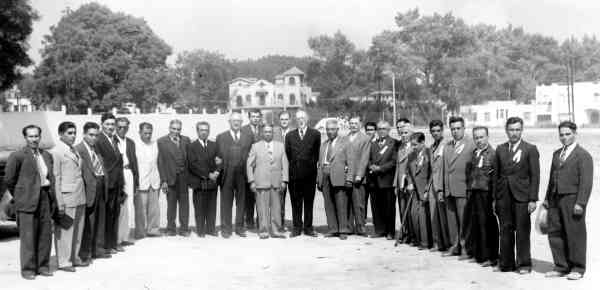 In April 1946, after the reunification conference in the Ermita chapel (background), Third Convention and mainline Church leaders gathered around President George Albert Smith for this photograph. To the right of President Smith is Abel Páez, and to his right are mission president Arwell L. Pierce, Apolonio Arzate, Felilpe Barragán, Narciso Sandoval, Daniel Mejía, Sabino Lozano, José García, José Villanueva, and Enrique Gonzales. To the left of President Smith are Isaías Juárez, Joseph Anderson, Guadalupe Zárraga, Tiburcio Guerrero, Othón Espinoza, Santiago Péerz, David Juárez, José Castelán, Juan Rama, and Matías Paredes. In the back row, left to right, are Oscar Bluth, Harold Brown, Manuel de los Ríos, and Andrés Hinojosa. Photo courtesy of Church History Library, Salt Lake City, Utah.
Notes
[1] See Francisco N. Sandoval Jiménez interview: San Gabriel Ometoxtla, Puebla, Mexico, 1974, transcript, Church History Library.
[2] See Wayne Andersen, “Missionary Spotlight—The Protestant Church in Mexico,” Evangelical Times, June 2003, https://
[3] For a historical synopsis, refer to chapter 1 of this volume.
[4] Whereas Rey L. Pratt was an absentee mission president because of the civil war and the Cristero Rebellion, Antoine R. Ivins was an absentee mission president by choice, preferring to lead from the United States even though he was a Spanish speaker who had lived in Mexico as a student, probably at the behest of his father, Anthony W. Ivins. That Sandoval was writing to Ivins demonstrated several points: Narciso was literate, he was thoughtfully engaged in learning about his new faith, and he thought himself to be an equal to district president Isaías Juárez in doctrinal matters, which, in his mind, therefore required that he check in with higher authority from time to time when he had questions.
[5] See LaMond Tullis, Mormons in Mexico: The Dynamics of Faith and Culture (Logan: Utah State University Press, 1987), 137–68.
[6] See chapter 2 of this volume, as well as LaMond Tullis, “A Shepherd to Mexico’s Saints: Arwell L. Pierce and the Third Convention,” BYU Studies Quarterly 37, no. 1 (1997–98): 127–57; and Tullis, “A Diplomat’s Diplomat: Arwell L. Pierce and the Church in Mexico,” in Pioneers in Every Land: Inspirational Stories of International Pioneers Past and Present, ed. Bruce A. Van Orden, D. Brent Smith, and Everett Smith Jr. (Salt Lake City: Bookcraft, 1997), 113–24.
[7] Sandoval Jiménez interview; quotation from Gordon Irving’s preface to the interview.
[8] Sandoval Jiménez interview; quotation translated by LaMond Tullis.
