
 menu icon in the top, right corner of the screen.
 icon above to close this box.
 icon at the bottom of the screen below the browser—if you don't see it, swipe up to unhide it.
Juana Páez
ca. 1883-ca. 1933
F. Lamond Tullis, "Juana Páez: ca. 1883-ca. 1933," in Grass Roots in Mexico: Stories of Pioneering Latter-Day Saints (Provo, UT: Religious Studies Center, Brigham Young University; Salt Lake City: Deseret Book), 147‒50.
The Páez family has a long history of membership and service in The Church of Jesus Christ of Latter-day Saints in Mexico, even though one member, Abel, championed the dissident Third Convention movement in the 1930s and 1940s. Later reconciled with the Church, he thereafter returned to his historic pattern of allegiance to its authorities and dedicated service to its membership.
Of Juana Páez there is little in the record about her. She may have been a toddler when the Páez family settled near Colonia Juárez in the early days of that settlement in the northern state of Chihuahua. She also may have been living as an eighteen-year-old in Amecameca, near Mexico City, with other members of a Páez family when Ammon Tenney returned to Mexico in 1901.[1] However, during Apostle Abraham O. Woodruff’s furtive visit to Mexico in 1904, Juana surfaced as an epitome of compassion as she risked her own life in service to the apostle’s dying wife.[2]
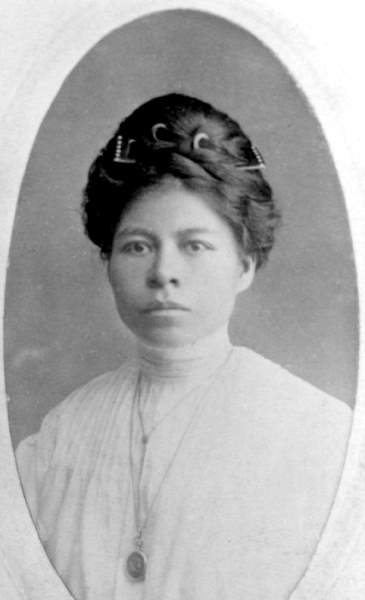 In 1904, Juana Páez (shown here in 1910) gave nursing care to Helen Woodruff, wife of Apostle Abraham O. Woodruff, when the couple contracted smallpox during their visit to Latter-day-Saints in and around Mexico City. The Woodruffs died from the disease. Photo courtesy of Church History Library, Salt Lake City, Utah. LaMond Tullis archive.
Disease and infirmity have accompanied the human condition everywhere, and Latter-day Saints have not been immune, although many reportedly have been made well through the ordinances of the holy priesthood. In the Church’s early days in Nauvoo, malaria, cholera, and measles were prevalent.[3] Brave and valiant women stepped up to ease the suffering there. Juana Páez and other Latter-day Saint women did likewise in Mexico.
In the late 1800s and through the turn of the century in Mexico, yellow fever, typhoid fever, and smallpox took the lives of not only thousands of Mexican citizens, including some Latter-day Saints, but also missionaries such as Feramorz L. Young, Sylvester O. Collett, and Elmer Hooks. In 1904 smallpox also killed Apostle Abraham O. Woodruff and his wife Helen, who were touring the Mexican Mission. Their six-month-old daughter Rhoda and her three older siblings traveling with their parents were left orphans, later taken in by family members in Utah and raised to maturity.
Smallpox vaccination was first employed in Massachusetts Bay Colony as early as 1721. By the late 1800s it was practiced throughout the United States with probably less than a 0.5 percent mortality rate, which was a large advantage over the 20–30 percent death rate from variola major, the severe form of smallpox. Around 1900, vaccinations for immunity against that disease were widely available in Salt Lake City. Apostle Woodruff decided against it and, unprotected against the disease, left for Mexico with his wife and four children, not realizing the danger he and his family were facing.
When Helen May Winters Woodruff contracted the dreaded pox in Mexico, thirty-one-year-old Abraham O. Woodruff frantically sought help from resident British medical personnel. They quarantined his wife, took their baby (most likely placing the six-month-old in the arms of an available wet nurse), and advised him that the case was grim. Apostle Woodruff hired an English nurse to watch after his beloved wife of seven and one-half years. With tender care and loving attention, Woodruff himself stayed close to Helen, desperately trying to relieve her fever and the wracking pain from the pox pustules that covered every part of her body.
The English nurse soon withdrew from the case. Into the breach stepped Juana Páez, who gave Helen the competent and caring attention her English nurse could not or would not provide, willingly risking her own life for a dying sister in the faith. Helen soon passed away, and Apostle Woodruff died of the same illness two weeks later (June 20, 1904) in El Paso, Texas, en route to Salt Lake City.
Juana was not new to these tragedies. A year earlier she and other Relief Society sisters had taken care of many others. For example, when Lino Zárate died in 1903, he left a wife and seven children. All but his wife and one small daughter were bedridden with the typhoid fever that had taken his life. The Relief Societies of his own branch and nearby branches nursed the family back to health and aided them materially and spiritually. Juana Páez had much practical experience as she nursed the ill around her.
Juana Páez and others tendered compassionate service even under conditions that could have imperiled their own lives. Such service is an abiding gospel principle for all Latter-day Saints. In the October 2011 general conference of the Church, President Dieter F. Uchtdorf counseled: “We must not turn aside our hearts or our heads from becoming more self-reliant, caring better for the needy, and rendering compassionate service.” Juana Páez is a notable example of a woman of courage who embraced a service beyond her own inner circle, one who cared for the stranger despite grave personal risk.
Notes
I am grateful to Sharman Gill and Eileen Roundy-Tullis for critiquing earlier drafts of this vignette.
[1] See LaMond Tullis, Mormons in Mexico: The Dynamics of Faith and Culture (Logan: Utah State University Press, 1987), 80.
[2] Basic background information on Apostle Abraham O. Woodruff is found in Lawrence R. Flake, Prophets and Apostles of the Last Dispensation (Provo, UT: Religious Studies Center, Brigham Young University, 2001), 423–25.
[3] Evan L. Ivie and Douglas C. Heiner, “Deaths in Early Nauvoo, Illinois, 1839–46, and in Winter Quarters, Nebraska, 1846–48,” Religious Educator 10, no. 3 (2009): 163–74; and Steven C. Dinger, “‘The Doctors in This Region Don’t Know Much’: Medicine and Obstetrics in Mormon Nauvoo,” Journal of Mormon History 42, no. 4 (October 2016), 51–68.
