
 menu icon in the top, right corner of the screen.
 icon above to close this box.
 icon at the bottom of the screen below the browser—if you don't see it, swipe up to unhide it.
Consuelo Gómez González
1896–1965
F. Lamond Tullis, "Consuelo Gómez González: 1896–1965," in Grass Roots in Mexico: Stories of Pioneering Latter-Day Saints (Provo, UT: Religious Studies Center, Brigham Young University; Salt Lake City: Deseret Book), 187‒94.
Although she neither married nor had children of her own, Consuelo Gómez González spent her adult life nurturing the children of hundreds of others in their educational pursuits as well as successfully raising three abandoned children—two nephews, one niece—as if they were her own. She was a highly literate and accomplished schoolteacher who nevertheless thought of herself in spirit as a campesina, a woman of the soil. In her mature years, she confided, “I have placed my grain of sand with the end of bettering the lives of the campesinos of which I am one.”[1]
Consuelo appears to have been heavily influenced by the great Latter-day Saint Isaías Juárez, whose radicalizing work on behalf of Mexico’s rural workers is legendary (see the vignette on Juárez herein). During the 1920s and early 1930s, Juárez, who was The Church of Jesus Christ of Latter-day Saints’ district president in central Mexico at the time, frequently visited the Pachuca de Soto Branch in the state of Hidalgo where in 1925 Consuelo, at age twenty-nine, became a member. The first Latter-day Saint missionaries there, Elders Milton G. Fisher and Iris B. Morgan, later joined by Elder Alma L. Pond, had been working the area less than two years. Consuelo was not the first member in Pachuca, but she and three of her siblings were certainly early Latter-day Saint pioneers there.[2]
Consuelo would most likely have lived out her campesino sentimentalities in reality as much as in sentiment had it not been for the Methodists. They first showed up institutionally in central Mexico in 1871 as the Methodist Episcopal Church South, followed in 1873 by the Methodist Episcopal Church.[3] They were soon established in Pachuca, bolstered in no small way by hundreds of English-speaking miners from Cornwall, England (the Cornish), who had come to work the rich silver and gold mines around nearby Real del Monte.[4] The Cornish brought with them not only their sports, their culinary preferences, and their surnames (which last to this day in Pachuca and Real del Monte) but also their religion: Methodism.[5] Many miners stayed on, married local woman, and mingled their genes, their customs, and their religion with the Mexican ambiance. Around 755 miners are buried in the Panteón Inglés, or English Cemetery in the area. Cornish/
The Methodists and the Latter-day Saints who followed them to Mexico and subsequently hived off a large number of Methodist adherents had at least one thing in common: they thought of the human soul in its corporal home as deserving of enlightenment, progress, and betterment. Both religious persuasions prized education as a vehicle to those ends. Methodist founder John Wesley taught that every child of whatever gender and economic station in life had a right to an education. Not surprisingly, the Methodists were not long in constructing, staffing, and sustaining private schools wherever there were enough members to merit them, particularly in areas where public schools were either nonexistent or wholly inadequate for Methodist children.[7]
One of those places was Pachuca. By 1901 the Methodists had an elementary school up and running. By 1903 they had enough going on to hold their Mexico Annual Conference in Pachuca (January 15–19, 1903).[8] Soon they established a middle school (secundaria) too. For a time in Pachuca, the Methodists offered classes in English and Spanish in their schools.
Consuelo’s parents had converted to Methodism around 1900. Whatever the nature of their religious experience, they were enthused with the Methodists’ teaching on the value of education and, in particular, with founder John Wesley’s idea that it was crucial for salvation. Marginally literate themselves, they clearly had in mind the benefits of a formal education for their children. They had a meat-processing business in town that gave them an economic wherewithal beyond that of many others in the area to pay for their children’s education. Around 1902 they enrolled Consuelo in the first grade in the Methodists’ new school in Pachuca.
Consuelo excelled in elementary school, both in enthusiasm and learning. Her teachers recommended that she move on to the Methodists’ middle school. Around 1908 she did. By this time her siblings were all enrolled in the Methodists’ schools. Clearly there was much enthusiasm in the Gómez home for the Methodists’ educational endeavors.
At the middle school, Consuelo became a voracious reader and began to write the poetry for which she later became distinguished. She gained considerable self-confidence. The multitude of “foreigners” in the area who spoke French and English publicly did not intimidate her (for background on French, see the vignette on Desideria Quintanar de Yáñez herein). She learned basic communication in both languages.
Around 1912 the school’s faculty and administrators began to encourage the sixteen-year-old Consuelo to think about taking up residence in Puebla, some eighty-five miles to the south, where the Methodists had a normal, or teacher-training, school. They affirmed that Consuelo had every prospect of becoming an excellent teacher. Whether she realized it or not, the Methodists were clearly interested in bringing her back to Pachuca as a new faculty member as soon as she received her teaching diploma. They had a scholarship for her, which would fund her further studies at their boarding school in Puebla. This was fortunate because within a year Consuelo’s father died, which left the family economically deprived.
In 1919, at age twenty-three, Consuelo received her diploma from the Methodist’s normal school in Puebla[9] and was immediately hired as a teacher in Pachuca. This happy arrangement lasted until 1925, when the Methodists fired Consuelo for having become a “Mormon.”
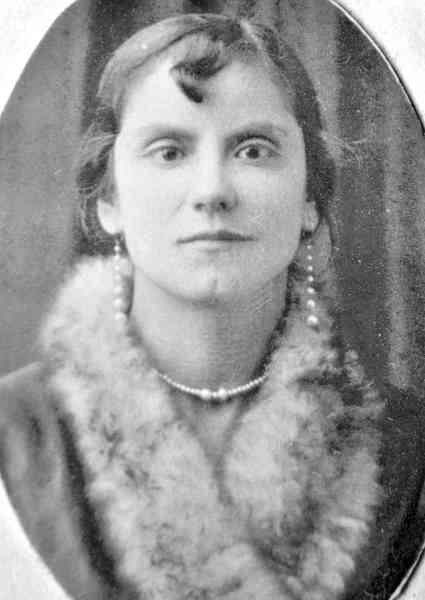 Consuelo Gómez González at about twenty-nine years of age. Pachuca, Hidalgo, Mexico, ca. 1925. Photo courtesy of the Museum of Mexican Mormon History, Provo, Utah.
That trauma aside, Consuelo’s sojourn with the Methodists—in her family, in church, in school, in associations, and as a teacher—was much to her liking. Later in life, she affirmed, “I was born in a Methodist home and had a good schooling and many good moral and religious teachings. I thought of the Methodists as being members of the one and only true religion.” All that notwithstanding, “I became a Mormon,” she disclosed, and for the remaining forty years of her life she remained so.[10] It no doubt helped her anguish that three of her four siblings were baptized with her.
Readers of the previous vignettes on Trinidad Hernández and Vidala Parra will see how the Hernándezes no doubt influenced Consuelo to consider becoming a Latter-day Saint. Their ancestral home was in Santiago Tezontlale, about thirty miles to the west, but they also had a home in Pachuca, where after 1917 they were talking up the Latter-day Saint cause. (Trinidad Hernández’s influence was so great in Pachuca that years later, in 1938, the Pachuca Branch of the Church had to cancel its January 9 sacrament meeting because nearly everyone had gone to Santiago Tezontlale, Trinidad’s hometown, to attend religious services there.[11] This may well have been for the inauguration of the new stone church in Santiago.) In those early days the enigmatic Latter-day Saint stalwart Bernabé Parra from San Marcos, Hidalgo, about fifty miles to the west, frequently visited the area, coming, as Consuelo said, to “cheer up and encourage the Saints.”[12] His speeches were mesmerizing. The legendary mission president Rey L. Pratt also visited for a district conference of the Church as early as 1924.[13] Latter-day Saints in Mexico had already awarded him hero status (see the vignettes on Rafael Monroy and Jesusita Mera herein).
For the next twenty years or so following Consuelo’s baptism in 1925, the record is scant on what happened to her, whether she found employment elsewhere as a teacher after the Methodists fired her, whether she helped out with her family’s butcher shop, or whether she did something else. Regardless, we know that she kept very active as a teacher in the Pachuca Branch of the Church of Jesus Christ. For example, a photograph shows a twenty-nine-year-old Consuelo joined with at least fourteen children of both genders ranging from about five years of age to fifteen who presumably were her Sunday School students.[14] If so, she must have been a very creative soul to have bridged that age group in a single class. Then during 1926–29, when foreign missionaries were prohibited entry into Mexico because of the Cristero Rebellion, Consuelo also taught the priesthood classes because so many of the male branch members at the time were illiterate.[15]
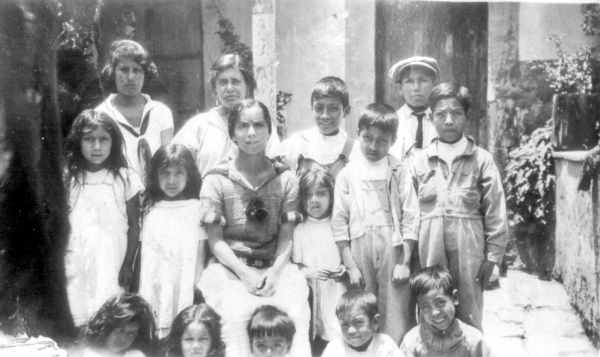 Consuelo Gómez González as a Sunday School teacher in Pachuca, Hidalgo, Mexico. Photo courtesy of the Museum of Mexican Mormon History, Provo, Utah.
We do know that during the decade following Consuelo termination at the Methodist school, Bernabé Parra, second counselor in the district presidency, visited the Pachuca Branch of the Church frequently and would have become acquainted with her, would have learned of her experience as a schoolteacher, and would have seen her functioning as a Sunday School teacher and perhaps even as a priesthood class teacher. He would have been impressed.
Around 1946, Parra invited the fifty-year-old Consuelo to join his private school effort in San Marcos, Hidalgo. She soon became the principal (directora) of Los Héroes de Chapúltepec, where she served until her death in 1965 at age sixty-nine. In 1950 she attended the cornerstone-laying celebration for the school’s new building. Also in attendance were the state’s school inspector; school officials Bernabé Parra, Benito Villalobos, and Guadalupe Pérez; and building committee members Baldomero Artiaga, Nicolás Gutiérrez, and Daniel Montoya Jr. They all signed a commemorative document.[16]
As teacher and principal for nearly two decades in San Marcos, Consuelo Gómez was thrilled with the product of her educational efforts. “My heart is filled with happiness,” she said, “when I see our children of the epoch of my early teaching now becoming pillars in the Church, when I see many who were then investigating that are still in the gospel path.”[17]
At the time, many single women in the Church often found a dearth of suitable marriage partners. Some did not want to settle for anything less than marriage within the Church, preferably with someone of their same educational level. Consuelo Gómez and Guadalupe Monroy from San Marcos are two examples. Rather than embark on a hopeless domestic journey, they opted to remain single and, in this status, nevertheless rendered widespread service to Church members. Guadalupe Monroy lamented not having her own biological children. Perhaps Consuelo did also. Nevertheless, both rose above their despair in a land that, at the time, highly prized women having many babies, and not necessarily within a formal marriage.
Notes
Aside from the specific references cited below, I am indebted to Fernando Gómez and his wife Enriqueta for information gained from interviews with them as well as for access to Consuelo Gómez’s papers that the Gómezes collected and have now housed at their Museum of Mexican Mormon History in Provo, Utah. The numerous original-source holdings, dating from 1948 to 1965, in connection with the Héroes de Chapultepec School in San Marcos, Hidalgo, are invaluable. I interviewed Fernando and Enriqueta on May 22, 2019, at their museum. I had a follow-up interview with Fernando at the museum on October 16, 2019. Earlier, I had done on-site research in Pachuca, Hidalgo, on January 21–23, 2012.
[1] The source document (single page) is unidentified by author, title, or date. The first four paragraphs are a biographical statement of Consuelo Gómez written sometime in her mature years. The folder containing the page is entitled “Pachuca Sunday School, Consuelo Gómez,” housed at the Museum of Mexican Mormon History, Provo, Utah.
[2] Consuelo’s siblings who were baptized with her on April 4, 1925, were Esperanza, Raymundo, and Margarita. “Pachuca Sunday School, Consuelo Gómez.”
[3] These two versions of Methodism united in 1930 and became known as the Methodist Church in Mexico, an autonomous church. World Council of Churches, “Methodist Church of Mexico,” https://
[4] “The silver mines surrounding Real del Monte were the source of more than half the silver produced during the 300 years that Spain ruled Mexico (1521–1821).” “The History of Real del Monte, Mexico’s Little Slice of Cornwall,” The Conversation, https://
[5] Aside from their brand of Methodism, the Cornish brought with them football, wrestling, and baking pasties, which the locals now call pastes. In 2009 the Cornish Mexican Cultural Society launched a three-day annual “International ‘Paste’ Festival.” See “Cornish Mexican Cultural Society,” https://
[6] See “History of Real del Monte.”
[7] See United Methodist Church, “What was the first school started by Methodists?,” https://
[8] See Methodist Episcopal Church, “Minutes of the Nineteenth Session of the Mexico Annual Conference of the Methodist Episcopal Church,” January 15–19, 1903, Pachuca Hidalgo, https://
[9] See Asociación de Ex-alumnas Pro Patria del Instituto Normal Metodista e Instituto Normal Mexico de Puebla de Zaragoza, ed., Bodas de Diamante del I. N. M. de Puebla, Pue. 1881–1956 (México D.F.: Editorial Jakez, 1957). This is a diamond anniversary (seventy-fifth) of the Methodist normal school in Puebla. Consuelo Gómez has a poem (p. 43) entitled “Recordando” with the notation that she graduated in 1919.
[10] “Pachuca Sunday School, Consuelo Gómez.”
[11] See Consuelo Gómez González, “Historia de la rama de Pachuca Hidalgo,” no date but on or after 1938 based on internal evidence. Museum of Mexican Mormon History, Provo, Utah.
[12] Gómez González, “Historia de la rama de Pachuca Hidalgo.”
[13] See Gómez González, “Historia de la rama de Pachuca Hidalgo.”
[14] The photograph is entitled “Escuela Dominical de Pachuca, 1925, Maestra Consuelo Gómez.” It is found in the “Pachuca Sunday School, Consuelo Gómez” folder.
[15] Fernando Gómez interview, October 16, 2019.
[16] See “Acta Solemne Comemorativa,” February 13, 1950. Museum of Mexican Mormon History, Provo, Utah.
[17] “Pachuca Sunday School, Consuelo Gómez.”
