
 menu icon in the top, right corner of the screen.
 icon above to close this box.
 icon at the bottom of the screen below the browser—if you don't see it, swipe up to unhide it.
Bertha Hidalgo Rojas
1933–2008
F. Lamond Tullis, "Bertha Hidalgo Rojas: 1933–2008," in Grass Roots in Mexico: Stories of Pioneering Latter-Day Saints (Provo, UT: Religious Studies Center, Brigham Young University; Salt Lake City: Deseret Book), 235‒56.
Her crying, which alternated between a wail and a whimper, had continued unabated for hours. Grief, heartbreak, loss, despair of the desperate, desolation of the lonely or the fear of it—all simultaneously penetrated the essence of her soul. [unnumbered note] The dreams she had nurtured, the hopes she had cherished, the expectations she had felt almost within her grasp lay tattered before her, all there in the weeping countenances of her five remaining sons whom she had worked to salvage from the clutches of the Mormons. She had already lost Luis Alfonso and Gustavo, her first and third sons, to the Church from the United States. “What will become of me?” she plaintively pleaded. “Now I am all alone.”
It was no use supplicating her deceased husband, Alfonso López Sierra (1922–71), for help, although she had prayerfully tried it on many occasions. After nine years as a widow, she was still fighting with God for having taken him and leaving her with seven fatherless sons. It was bad enough that María Concepción, her third child and only daughter, had died at nine months of diarrheal dehydration. Now Bertha was losing them all. She wanted to die.
In despair and frustration, Bertha’s sons bid their mother good night and went upstairs to bed in the ample home in Atlixco, Puebla, she had inherited from her well-to-do parents and in which her children had spent nearly a decade of their lives. They had pleaded, reasoned, poured out their hearts to their mother. To no avail.
The next morning, August 10, 1980, the boys arose early to ready themselves for their baptisms. They had made fun of Alfonso and Gustavo when these two had joined The Church of Jesus Christ of Latter-day Saints five and four and a half years earlier, and had even worked hard to undermine their brothers’ new convictions. Now, they—Rubén (21), Paulo (17), Roberto (15), Benjamín (12), Arturo (11)—had also succumbed to the Mormons’ powerful and terrifying concoctions. Bertha was undone.
As the sons descended the stairs, they saw that their mother was still on the couch weeping. “Please, Momma, come to our baptism. We love you. We will never desert you.” She turned away. The boys cried again and then left for their appointment at the baptismal font.
 Bertha Hidalgo Rojas with her seven sons in her parents' home in Atlixco, Pueblo, on August 9, 1974, where she moved following the death of her husband Alfonso in 1971. A portrait of Bertha's father is on the wall. From left to right: Rubén, Paulo, Benjamín, Gustavo, Roberto, Arturo, Bertha, and Luis Alfonso. Photo courtesy of Joseph Michiels via David Richardson.
The oldest brother, Alfonso, baptized in 1975, had served a mission and been married in the temple. Accompanied by his wife Linda Olson, he had journeyed from their home in the United States intent on baptizing his siblings. He also pleaded with his mother. No use.
As the brothers were dressing following their baptism, Elder Stucky tapped on the door and said to Rubén, who had responded to the knock, “They are looking for you.” (Les buscan.) Rubén, already dressed, stepped out to respond to the request. Amazingly, there stood his mother! He ran to embrace her, as did the rest of her astonished sons as soon as they saw her. “Momma, you have come!” (¡Mamá, has venido!)
Bertha had an important announcement to make: “Yes, and if you are not coming with me, I am going with you. I have come to be baptized!” (¡Sí, y si ustedes no vienen conmigo, yo voy con ustedes. ¡Vengo a bautizarme!)
The confirmation services were delayed while Elder Stucky interviewed Bertha, following which Alfonso, with his heart hardly able to contain all his happiness, entered the baptismal font a second time, now to baptize his mother. His five brothers stood in tearful witness to this staggering event that was both unforeseen and unexpected. Afterward they entered the chapel, where in accordance with Latter-day Saint custom Alfonso confirmed them members of the Church and bestowed upon them the gift of the Holy Ghost.
There were tears that day, as much from the many members who witnessed the baptisms as from those who had just been baptized and confirmed. Gustavo, baptized four and a half years earlier, had been on his mission in Monterrey only fourteen days when his brothers and mother were baptized. The patriarch who blessed him before his departure had already seen and promised him this moment. Soon Gustavo’s mission president, Roy H. King, informed him of the happy event. The young missionary looked for a nearby chair, sat down, and joined the chorus by weeping what, for him, was a hymn of happiness.
Bertha’s Prayer and a Startling Answer
After the five López Hidalgo sons had left their disconsolate and despairing mother that Sunday morning, Bertha, ever crying, decided for the first time in a long while to pray to God, hoping he might listen and answer so she could know what to do. She was still smarting with resentment because, from her perspective, God had taken her husband when she most needed him. However misguided her bitterness, it had corroded a part of her normally buoyant personality. Over the years, not even her sons knew the extent of her dolorous, weeping, sleepless nights. Having prayed, she got in her car and drove aimlessly around Atlixco. She thought of going to Atlixco’s small, isolated Catholic Church (El Cristo) on a former hacienda where she and her sons had worshipped almost every Sunday. She decided that would be too painful with many memories to fight through. However, she needed to envelop her distraught condition in religious space. She, her husband, and her sons (some having served as altar boys and acolytes because their father encouraged them to be priests) had been “very Catholic,” as had all their extended families and the generations of forebears who had given them life. She settled on the nearby Church of San Agustín.[1] Perhaps there she could calm her tortured soul.
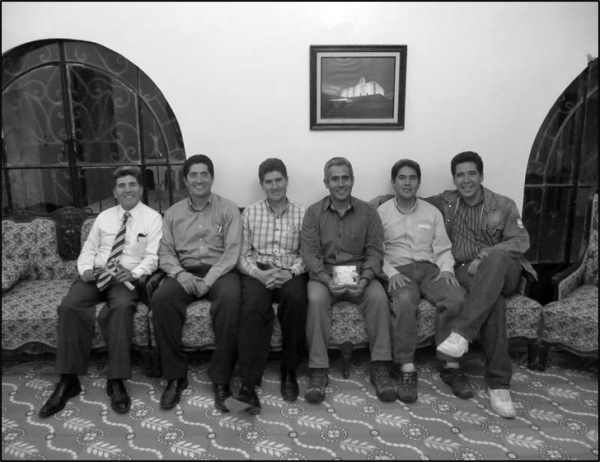 Six of Bertha Hidalgo's seven sons in April 2012: Rubén, Paulo, Bejamín, Gustavo, Roberto, Arturo (oldest son Luis Alfonso not present). The picture on the wall of this room is in the Hildago compound where the children grew up is of the Mexico City Temple, taken in October 1982 by Juan Serafín Camacho Reyes. Photo courtesy of David Richardson.
As Bertha knelt and exhaled a prayer of desperation, she was indeed comforted by being in her accustomed religious surroundings. Nevertheless, what happened there as she was kneeling stunned her and forever altered her life. As she wiped the ever-running tears from her face, she said she heard a voice exclaim to her: “Go, be with your sons! Be baptized!” (¡Ve con tus hijos y bautízate!). Aghast, she arose from her knees and sat down. After a few minutes to recover from the jolt, she gathered up her wits and speedily drove to the Latter-day Saint chapel to be with her six sons there and ask for baptism.
Bertha’s lengthy resistance to her sons’ baptisms had energized their efforts to teach her about the Church and their newly formed convictions. They urgently wanted her to understand their pressing desire to enter the waters of baptism in order to participate in an ordinance that they believed the restoration of the priesthood had made not only sacred and hallowed but efficacious. The more vigorous her opposition, the more her resistance required her to learn. Quite contrary to her parents’ assumption about her mental prowess, she was a quick study, which also enhanced her sons’ learning as they talked and bantered.
On occasion Bertha even became curious. With her son Rubén she had journeyed to Salt Lake City around 1978 for a general conference of the Church. In the Tabernacle she had heard President Spencer W. Kimball’s talk that referenced keeping the Sabbath holy.[2] With Rubén not yet a member of the Church and Bertha alternately fighting God over the death of her husband and either disputing the Church’s teachings or wondering what would happen if she put them to a test, at Rubén’s perhaps defensive suggestion she decided to close her pharmacy on Sundays. She was discomfited to find that her business increased.
Now Bertha just needed to switch from disdaining the Church to embracing it, Rubén opined. She did that precipitously on August 10, 1980, in the Church of San Agustín. A miracle, her sons said. She thought so too.
For the López Hidalgo children and their mother, the transition from Catholic to Latter-day Saint levied social and family tolls. As news of Bertha’s and her children’s betrayal spread among family and friends, these souls distanced themselves, some severing all bonds. Former friends found other acquaintances, and some worked to isolate and punish the López Hidalgo children. Frustrated and unable to comprehend Bertha’s actions, her brothers accused her of joining the Latter-day Saints simply to satisfy her rebellious and wayward sons. Before their switch to the Church of Jesus Christ, Bertha had frequently hosted family dinners on Sunday evenings in the ample surroundings of her parents’ home that she then occupied following their deaths. Now her extended family kept its distance. The large home grew increasingly silent.
Bertha had made her decision. She stood sad but stalwart and surefooted in the whirlwind of social rubble and debris cascading upon her. Her older children distanced themselves from the detritus and went on with their lives in their new faith. Benjamín (twelve) and Arturo (eleven) hunkered down and protected their flanks because, as Benjamín affirmed, “when God has answered your prayer and touched your soul, criticism and mockery from those who once professed to be our friends had no effect. We gave it no importance.”
Even so, the persecution and mockery were less for the five sons than for Alfonso and Gustavo when they made their transitions to the Church five and four and a half years earlier. At the time, relatives in particular did not just distance themselves, but some drilled in with a furious intensity. On one occasion Alfonso’s uncles were particularly rough with him. As had been his custom throughout his life when in a stressful or imponderable circumstance, he consulted the Lord through prayer. His father, who always wanted him to be a priest, had taught him to do that, a practice reinforced for Alfonso in his five years within the community of the Latter-day Saints. On this occasion, Alfonso asked the Lord to help his uncles understand what he affirmed was “the truth of the Church.” Reminiscing about this day, Alfonso said, “And once again the Lord obliged.”
Luis Alfonso and His Bishop
A distressed employee at the Hidalgo Pharmacy where Alfonso also worked had spoken of an eight-year-old family member bedridden for days as if possessed by an evil spirit of biblical magnitude. The extended family, including medical personnel summoned to attend her, had done all they could for the little girl. Family and friends had gathered in a vigil to await her death.
Recently baptized eighteen-year-old Alfonso thought this might be an opportunity for people to see what he considered the real priesthood in action to restore the child’s health, heal her soul, and, if necessary, cast out evil spirits possessing her. He implored Bishop Roque to give the child a priesthood blessing. Roque was no doubt taken aback. This was not an ordinary request for a priesthood blessing.
Together Alfonso and his bishop consulted the Lord in the only way they knew. Following their prayer, Bishop Roque warmed to the request and they traveled to the child’s home. Upon their entrance, people parted to make way. A Catholic priest immediately left the premises.
The Hidalgo Pharmacy employee led Alfonso and the bishop to the child’s room. Bishop Roque put his hands on her head, blessed her to be healed, and commanded whatever evil spirits present to leave her. With astonishingly abiding confidence he then proclaimed, “My child, you can stand up now. You are well.” (Mi hijita, ya puedes ponerte de pie. Ya estás bien.) The girl arose, clasped the bishop’s hand, and with Alfonso leading the way, left the bedroom and walked among the startled people standing vigil outside.
A few days later Alfonso noticed a radical reduction in antagonism toward him. It still wafted among the knolls and swales of Atlixco but now seemed more tentative and uncertain. His extended family backed off and gave him some peaceful space.
Prayer, conviction, determination, study and participation in Church activities—these steadied the family’s nerves and encouraged the López Hidalgo family members’ stability in their newly adopted faith.
Seven sons became seven missionaries who then became seven high priests and thereafter seven bishops. Much later, and in a new marriage with Patriarch Carlos Enriques, Bertha herself served a full-time mission in the visitors’ center near the Mexico City Temple and, later, as a temple worker one week each month.
The hopes of a deceased father and husband were finally realized. He had his priests. And his wife of fifteen years, the mother of his children, was protected and secure in her place.
A Family Searching for an Honorable Life
We look for what underpinned Bertha and her seven sons. After first resisting the Church, they then embraced it with uncommon enthusiasm and stood stalwart against withering family and social criticism. Although many who accept an alternative religion find that in time their ardor cools and convictions wander, especially in the face of persistent persecution, others steel their nerves and not only hang on but double down in their new faith. This happened to Bertha and her sons, explained in part by the moral and ethical foundations of their lives that found great resonance in the Church’s teachings. These, in turn, derived in a curious way from Bertha’s birth home and the culture of the foster family that welcomed her husband Alfonso when a teenager in the wake of his abandoning his own dysfunctional birth home.
Aside from being steeped in traditional Catholicism, Bertha’s parents were sensitive to ideas about religiosity, personal rectitude, and individual morality that figured strongly in how they raised their daughter and greatly influenced how she later chose to live her life as a young adult, wife, and mother.
Bertha’s father, José Luís Macedonio del Corazón de Jesús Hidalgo León (people called him Dr. Luís R. Hidalgo), was a medical doctor and, among other talents, a painter, sculptor, and politician; her mother, Blanca Eugenia Rojas Manilla, was a pharmaceutical chemist. Together they built a business around made-on-the-spot medicaments that gained wide notoriety in Atlixco and beyond for being effective. They conducted their business affairs in such a way that the name Hidalgo became synonymous not only with good herbal-based medicine but with honesty and integrity. Their business, which eventually developed into a conventional pharmacy (Farmacia Hidalgo) was hugely successful, a tradition that Bertha perpetuated during the fifteen years she managed it as a widow.
Aside from being a noted medical doctor, businessman, sensitive artist, and sculptor, as a politician the boys’ maternal grandfather stood well outside the pack. He was the first constitutionally elected president of the municipality of Atlixco (1951), which was marked by new, even brilliant, progress in the material and social conditions of the people.[3] He was also the first one to fly steadfastly in the face of endemic corruption in the local governmental and political machinery.
With the family’s reputation on solid footing, Bertha’s mother stepped up to compensate for her husband’s affective austerity. “Blanquita,” as she was affectionately called, suffused her home with emotional warmth and emotive love. Aside from her well-appreciated work with medicaments in the family pharmacy, Blanca donated time to the Mexican Red Cross and other charitable organizations, setting an example for her daughter in doing service to others. Long after her death in 1973, she remained remembered in the community as an exceptionally caring, loving woman.
On the other hand, Alfonso López Sierra, Bertha’s husband and the father of all her sons, came from a morally and spiritually dysfunctional if not bankrupt home, which he fled at age twelve to live in a foster home. Nevertheless, from his own subsequent Bible studies that his new family encouraged and from the example they set, Alfonso developed ideas about a good and moral life that in many ways closely parallel Latter-day Saint teachings.

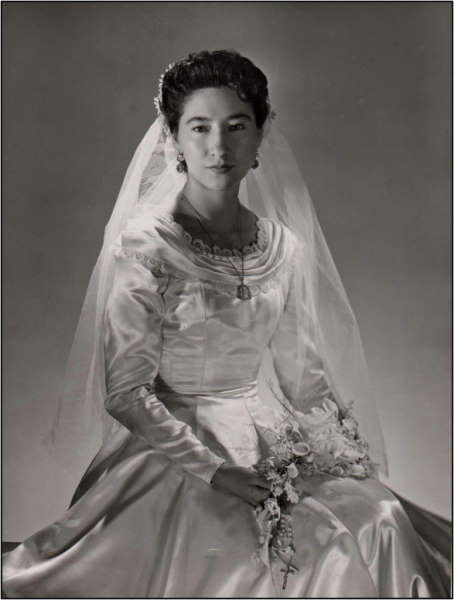 Top: Bertha, about age seventeen, at a recital in Atlixco, ca. 1950. Bottom: At age twenty-two in a wedding dress. Photos courtesy of Paulo López Hidalgo.
Even after Alfonso had been dead forty years, his sons continued to affirm in 2012 that he was the greater spiritual influence in their young lives. The oldest children (Alfonso, Rubén, and Gustavo) absorbed their father’s informal and formal teachings and in due course imprinted them onto their younger siblings (Paulo, Roberto, Benjamín, and Arturo).
Alfonso, Rubén, and Gustavo remember that in the 1960s their father held regular family gatherings in which they read the Bible together. He had a good command of his Catholic scriptures, more so than some of the priests his children consulted later when they were looking to build a case against the Latter-day Saint missionaries in Atlixco.
With traditional Socratic teaching, Alfonso quizzed his children about what they read and about its meaning in their lives (for example, from the story of Joseph in Egypt emerged an indelible understanding of chastity and personal morality). He taught them that the Lord did not want them to drink or smoke or in other ways debase their spirits or impair their minds. When the cousins came to visit, they, too, were pressed into learning. Coming from an aspiring middle class of people, all these children went to school.
Alfonso interviewed his children on a regular basis. The oldest ones remember his emphasis on what he called the “law of chastity” and on their becoming sufficiently worthy to become a priest (sacerdote), a hope he had for each of his sons as they emerged from their mother’s womb. “This one is going to be my priest” (Éste va a ser el sacerdote), he would say to each one.
In his interviews and daily interactions with his sons, Alfonso taught his children about getting ready for life, including marriage and fatherhood. The goodness of his own marriage was widely acknowledged. Some of his work colleagues visited him with their wives or fiancées for marriage counseling. He practiced what he preached. In front of his children, he honored his wife by telling his sons that their mother was a saint (Tu mamá es una santa).
Even though their father was a major in the Mexican Army (his training was in veterinary science; he watched over the health of the cavalry’s horses and other livestock), the family never sported much money while their father was alive, certainly not enough to purchase a car. Nevertheless, as family members recalled, “we were very rich in our father’s and mother’s love for us.”
Where did this gospel-centered culture come from? Certainly not from Alfonso’s birth home, which was characterized by domestic fights, verbal and physical assaults, and other insults among the parents and their many children, and this in a family with an educated father and mother who also owned a successful pharmacy. This culture came from Alfonso’s foster home, his own studies and decisions about life, and the reinforcing support that his wife Bertha gave him. Alfonso’s children are distressed not to know the names of the people who took their father in after he had fled his parents’ abuse. In 2012 they wanted to thank them.
Bertha’s ethical and principled background, which encouraged her to pass on to her children her family’s moral teachings in addition to its Catholicism, and Alfonso’s background, which motivated him to reject his birth family’s moral and ethical foundation in favor of constructing his own gospel-centered worldview, contributed to the eventual conversion of Bertha and all her children to become Latter-day Saints and to their decisions to stand steadfastly in their defense. Had a persuasive opening been presented to the children’s father before his death, it is conceivable that Alfonso also would have been attracted to the gospel that the Latter-day Saints preached.
Bertha and Alfonso
When Bertha and Alfonso married in 1956, she at twenty-two, he at thirty-three, at first blush the union seemed improbable. Bertha came from a well-appointed home with a positive community-wide reputation. She had been protected, perhaps even coddled, during her growing-up years. She was the beautiful, sought-after maiden that many men fancied. On the other hand, Alfonso was much older, had no worthwhile pedigree outside his own accomplishments, and certainly was not in line ever to be wealthy.
Would not Bertha’s parents object to her taking him as her husband? On the contrary, they were delighted! Alfonso had a career as a veterinarian with a 1953 degree from the National University of Mexico (UNAM—Universidad Nacional Autónoma de México). Being a major in the Mexican army, he received much accorded status and prestige. He was principled, ethical, and moral, characteristics that Bertha’s parents prized. They thought their daughter was lucky, especially because they considered her to be less well-endowed intellectually than her four brothers (an assessment she amply proved to be erroneous while a widow). Still, with a good marriage, they judged that Bertha would be well cared for and they would not need to set her up with a small store to guarantee her livelihood. In her adolescence, this is something the parents talked about. They could tell that Alfonso would be a stable and faithful partner. He was not a womanizer.
There was one real, objective problem, a medical one that Alfonso had suspected since age twenty-nine but did not inform his wife about until after their children began to arrive. “This heart is going to give you a lot of pain,” he eventually said to her (Este corazón te va a dar mucha lata). His mitral valve was failing.
As Alfonso’s time drew near in 1971 for his imminent passing, he instructed Bertha to take their children to her family home in Atlixco to raise them. He knew that Bertha’s mother would protect her (her father had died seven years earlier) and care for her and the children aged fourteen, thirteen, ten, eight, six, four, and two. He was desperate not to die. Nevertheless, knowing that he would do so imminently pressed his preparations for the safety and security of his wife and children in his absence. He appeared to have an unarticulated idea that he would see them again and that they would all still be a family.
Bertha as a Widow in Atlixco
In Atlixco in 1971, Bertha threw herself into learning to manage the family pharmacy and in shepherding her sons. Raquelita, the live-in nanny (nana) Bertha’s mother Blanquita had employed, picked up many of the routine domestic tasks. After all, Arturo was barely out of diapers and Benjamín had not yet started school. Blanquita happily helped for two years, but then passed on (March 20, 1973), leaving Bertha with another round of profound sadness. Through it all, Bertha nevertheless found time to enroll in English classes in a nearby night school. She wanted her children to learn English and thought that she herself should set the example.
Bertha became aware that a university in the United States was sponsoring nutritional, economic, and agricultural development projects in nearby villages (part of Brigham Young University’s Project Mexico). Sometime in early 1973 she was introduced to its resident director, Kirt Olson, and through that acquaintance her son Alfonso became interested in the program’s agricultural projects as well as involved with the Olson family. Later, Bertha offered to house a couple of the ninety-five BYU students for the month they would be working on the projects (May 17–June 18, 1973). However, she had a proviso. It was that her student guests speak only English to her children and her. She wanted them to have an intensive exposure. David Richardson and Bruce Brittain, returned missionaries from Peru and apparently Mexico, were selected to be housed with the Hidalgo family.[4]
It was a happy time for the guests, who were pleased to speak English on myriad topics. Bertha and her sons Rubén and Alfonso were particularly interested in BYU. Informally, the guests also talked about their culture, which, of course, was eminently imbedded in the Latter-day Saint faith as practiced in the United States. Obviously, the topics touched on religion because Bertha said on numerous occasions that her family was “very Catholic” (muy católica).[5]
For Bertha, life’s undulating seasons unfolded for nine years: work at and manage the pharmacy; raise her sons; struggle with her losses and bouts of despair over the deaths of her daughter, husband, and mother; deal with the frustration over her children’s growing affiliation with the Church; do whatever she could to take her mind off her problems. A spiritual detonation disrupted this lengthy routine. It happened there, in the Church of San Agustín, on August 10, 1980, when she heard a voice speak to her: ¡Ve con tus hijos y bautízate!
Bertha Remarries—Three Times
Bertha continued to grow in the Church for six years while shepherding her four youngest sons until, like their older brothers, they became productively occupied in their schools, universities, missionary service, or ultimately in their own homes. She served many years as the ward organist and studied prodigiously for the sacrament meeting talks she was assigned. After spending five more years as a widow (for a total of fifteen), at age fifty-two a lonely Bertha met Enrique Arce Murillo from Mexico City, a widower and a member of the Church. She wrote in her diary that she could happily be married to him.[6]
Bertha’s decision-making was fast, decisive, and resolute. It was that way when she married Alfonso, when she decided to be baptized, and now in her two-day relationship with Enrique Arce. Three months later they were married (1986).
A year after the marriage, Bertha and all her sons, and Enrique and his daughter Claudia, gathered in the Hidalgo home in Atlixco. They sang “Oh My Father,” which Bertha accompanied on her piano that frequently resounded to the classical music she enjoyed playing, had a family prayer, and then traveled to the Mexico City Temple for a sealing that would rival in emotions those of the 1980 baptisms. Around the altar, with Enrique as proxy for Bertha’s husband Alfonso, and Claudia for her daughter María Concepción, the López Hidalgo family, according to their Latter-day Saint faith, was sealed for eternity. They were swept over with joy. The sons are certain their father and sister heartily approved. Arturo was sixteen, Benjamín eighteen, Roberto twenty, Paulo twenty-two, Gustavo twenty-four, Rubén twenty-seven, and Alfonso twenty-nine.
Although Enrique’s transition to a stepfather was not a smooth one, after an eighteen-month marriage nothing mattered except burying him and straightening out the family’s financial and legal matters. In 1987 Bertha’s second husband died instantly in a car wreck in Mexico City (and she was badly injured), caused by a traffic policeman’s insistent hand-waving that put a truck into the driver’s side of Bertha’s car.
Once again a disconsolate Bertha was thrown to the winds of despair and depression. She deeply loved Enrique. With him she felt protected and safe. Now, widowed again, her worst fears had become her reality. So much sadness to think about as she lay many weeks in her hospital bed in Mexico City.
Gustavo and his wife Nuria traveled from their home in Cuernavaca to visit his hospitalized mother (as did other family members) as soon as he received word of the dreadful accident. His mother was slightly sedated when he entered her room but still coherent. As was his custom, he began to banter with her a trifle to cheer her up: “Momma, would you like to be married again?” Her discombobulating answer: “Yes, just as soon as I get out of this hospital!”
Gustavo was understandably taken aback, and perhaps his mother too, at what might be considered an intemperate exchange. Nevertheless, never one to discount his mother’s words, Gustavo took her statement seriously and began to work on it.
When Gustavo returned to his home in Cuernavaca, he called his widowed stake patriarch, Carlos Enríquez Almazán, and inquired: “Wouldn’t you like to be my father?” Doing a shocked double take, the patriarch responded, “What do you mean?”
“Well,” Gustavo replied, “my mother is widowed, you are a widower. Wouldn’t you like to become acquainted with my mother?” The patriarch began to think about it.
Bertha was released from the hospital to return to her home in Atlixco to recuperate and to try to reclaim her life. Benjamín left on his mission, and Arturo returned to his university studies. Bertha was almost alone again, but not quite. The children’s nana, Raquelita, stayed with her.
At some point Carlos Enríquez’s thinking began to consume him, which prompted him to ask Gustavo to introduce him to his mother. In due course Gustavo arranged for the introductions. Three months later Carlos and Bertha were married. It was 1987.
 Bertha and Carlos. Photo courtesy of Paulo López Hidalgo.
The patriarch was not a good-looking man, the children affirmed, had an uncomely hair style, wore horned-rim glasses half-way down his nose, suited up in ill-fitting clothes, and drove a clunker car. None of this mattered to Bertha. The patriarch was a good man who could care for, protect, and appreciate her and walk with her in the Savior’s love. She said, “What I need is a man who will take me to God. I don’t care about the rest.”
Gradually, even surreptitiously, Bertha transformed her new husband’s outer shell to match his inner worth. She got him new glasses, changed his hair style, and purchased him a new wardrobe and a new car. Bertha’s decisiveness was in action again, which helped the patriarch in his relationship not only with his stepchildren but also with his own children. They marveled at how much he had changed since his marriage to Bertha.
It was the culture of the time. The patriarch did not have a refined temperament and had, by his own children’s estimate and despite his high positions in the Church, been hard on them. However, Bertha’s children soon grew to love the man, in particular after Rubén had strong “teaching words” with him one day about how to treat their mother. The grandchildren eventually related to the patriarch as the best grandfather in the world, lovingly referring to him as el patriarca. During a visit a year or so into the marriage, his own children expressed their astonishment to Bertha: “What have you done? Never since we became his children have we known him to be this way! How wonderful!”
Bertha, ever ingenious, hatched a plan to bring all her children to live by her along Oriente 31, the street where her house, once the home of her parents, had stood in Atlixco for many decades. She wanted to share her happiness with them and to rejoice in the company of her grandchildren. Bertha made a hefty down payment on seven apartments nearby and then called her sons to inform them what she had done: “I have paid your deposit of 5,000 pesos; you pay the rest. I will expect you next week!” They came. Her children lived in the apartments for several years and later sold them and built on lots their mother gave them along the street next to her home. Thus Oriente 31 also came to be known as “López Lane” (calle de los López).
 Bertha and Carlos celebrating Pioneer Day (July 24) while teaching home economics in a family preparation fair in the Atlixco stake, ca. 1990. Photo courtesy of Paulo López Hidalgo.
With the patriarch—that is what everyone soon called him—and her children nearby, Bertha spent fifteen years and one month in happiness. Together she and the patriarch served a full-time mission in the visitors’ center next to the Mexico City Temple and later a one-week-a-month mission in the temple itself where Carlos was a sealer and Bertha a temple worker. Carlos Enríquez continued to give patriarchal blessings, which Bertha, the excellent stenographer and typist that she was, took in shorthand and neatly transcribed for submittal to the archives in Salt Lake City and to give to the recipients. Bertha, Carlos, and their children did genealogy work together, tracing Bertha’s parentage back eight generations and that of her first husband Alfonso back seven generations. They did much temple work for their families, and they were involved in ward activities and in Church callings. It was mostly a wonderful time.
Seemingly inevitably for Bertha, everything would soon change. The year 2002 was dreadful. The patriarch died and Bertha was widowed again. Staggeringly sad once again, she pondered the deaths of her first two husbands, not being sure she could again bear the shroud of loneliness with the loss of her third. Thankfully, it was a little easier this time. She had grandchildren who also loved their grandfather (abuelito) and in whom she could take cheer but not have to experience the responsibility of raising.
Bertha faced life’s undulating seasons for five more years of widowhood, but this time she had many family members, joyful occasions to celebrate, remembrances to cherish, and stories to tell. Every week something good happened.
Sensing her loneliness, Bertha’s daughters-in-law began to invite her to accompany them wherever they were going. That helped, as did her sons’ proximity and her grandchildren’s coming for overnight visits (Abner, Sarai, Rebeca, and Nury), even sleeping in her bed. So many things to talk about. So much to tell them.
 Bertha (fourth from left) with her seven daughters-in-law, about 1988. From left to right: Felisa López Muñoz, wife of Arturo; María Luisa Palacios Martínez del Campo, wife of Roberto; Heidi Villalobos Arteaga, wife of Benjamín; Bertha; Nuria Villalobos Saunders, wife of Gustavo; Josefina Melo Navarro, wife of Paulo; Sara Leticia Hernández, wife of Rubén; and Guadalupe González, wife of Luis Alfonso. Photograph courtesy of the López Hidalgo Family.
Bertha resumed her work at the pharmacy, but not nearly as intensively as before. She watched her children and grandchildren come and go and sometimes stop in for a visit. Whenever there was movement along Oriente 31, she came to a window to look out and, if she saw her family, bask in the generational beauty of what she witnessed.
One day as Bertha was working in the pharmacy, an older, partly bald, gray-haired man entered. He and Bertha chatted a while and he then left. Later Bertha said to her son Paulo, the pharmacy’s manager, “Did you see that man? He is Juan Carranza Zepeda. We knew each other when we were children.”
Juan had migrated to the United States and spent years there, never learning much English but securing a pension from his restaurant work that enabled him to live the winter of his life in his Mexican homeland. He was mostly illiterate, having never gone to more than a grade or two of school.
After the meeting in the pharmacy, Juan approached Bertha’s son Paulo seeking permission to take his mother on a date. This was a time not only of a certain civility but one in which cultured, educated, and responsible sons fastidiously guarded the welfare and safety of their mothers. It is unlikely that Bertha would have independently gone out with anyone without first checking with Paulo, with whom she worked most closely.
Paulo said yes but had misgivings. Juan was not a member of the Latter-day Saint faith. Paulo knew how lonely his mother was and feared, should the relationship mature, that the vast gulf separating a believer and nonbeliever in spiritual matters would ultimately spell unhappiness if not doom in domestic and intimate matters.
The relationship not only warmed, it matured, and Bertha repeated her often-voiced phrase: “I do not want to be alone.” Bertha went to her bishop—her son Benjamín—to ask his advice. Benjamín, a young, newly ordained bishop, “regrettably,” he said later, responded that he thought it would be all right. Juan then went around to each of Bertha’s sons seeking permission to marry their mother. They consented, but all had the same misgivings that Paulo had voiced.
The sons’ overriding issue was their mother’s happiness. She was unhappy living alone and had been dreadfully sad during her cumulative twenty years of widowhood. Since renewing her acquaintance with Juan, a spark had returned to her countenance as the prospects of a new relationship developed. Her sons decided to offer her the freedom she had finally ceded to them during the struggles over their baptisms: “All right, Momma, do what you think is best.”
Bertha’s daughter-in-law Nuria was not so detached: “Bertita, you have been committed to the gospel for a long time. Now is no time to make a decision like this. You will lose all your opportunities to go to the temple with your companion.” Bertha’s response: “But it’s that I am now all alone, and I don’t want to be.” Nuria gave assurances that her love for Bertha would remain constant regardless of her decision.
Bertha’s 2006 union at age seventy-three with Juan Carranza was her fourth marriage. As anticipated, there were many adjustments in this marriage, ultimately a discouraging one for Bertha. After a year, Paulo suggested she get a divorce. The ever decisive, loyal, and dedicated Bertha said, “No. I will see it through.”
Juan had his limitations, and he never did join the Church as Bertha and some of her sons had hoped. For one thing, he was frightened to attend any class where someone might ask him to read. The embarrassment of not being able to do so would demolish him. For another, Juan was not an intrinsically spiritual man, so different from Bertha’s other husbands, Alfonso López, Enrique Arce, and Carlos Enríquez.
His limitations notwithstanding, Juan stood by Bertha during her bout with cancer. Through the surgery and ensuing chemotherapies, during the nausea and fatigue, and even when all appeared hopeless, he attended to her needs. When she subsequently became acutely distressed, he was helping to dress her to go to the hospital when she died in the arms of her son Rubén. It was October 3, 2008. The couple had been married a little more than two years.
Just minutes before her death, Bertha had been fixing herself up as if for an important date—putting on makeup, combing her hair, making sure her clothes were as she wanted them. Her death was tranquil, as if she knew death more as friend than foe. She seemed both content and eager to see those awaiting her across the veil that separates this world from the next, a matter in which she firmly believed.
Bertha’s Funeral
At Bertha’s funeral held in the Hidalgo compound where her home stood, more than a thousand people attended, including political and social dignitaries from the community. Because so many nonmembers were present, her sons turned the services for their mother into a missionary outreach. Despite their sadness, they put forth the Latter-day Saint plan of salvation and the ultimate hope and expectation that Jesus Christ gives to those who learn and abide by his gospel and enter the covenants that chart a course toward eternal life. For many people, perhaps for all who attended the funeral, it was a day of thought and contemplation. For most Latter-day Saints there, it was a day to meditate on the Church’s teachings about the resurrection and life eternal.
The funeral exhibited a vast social change for the Atlixco Latter-day Saints from prior years when persecution and acrimony rained upon the López Hidalgo children and their mother for having joined the Church. All this change, and in just one generation!
Bertha, like a multitude of other Latter-day Saint mothers, saw in her children a future imprint of her hopes. She unleashed a full stop on them when they abandoned Catholicism. When she decided to join their cause in a new religion after her dramatic experience in the cathedral of San Agustín, she was equally resolute. Seven sons. Seven missionaries. Seven high priests. Seven bishops. Members of high councils, counselors in stake presidencies, district presidents, temple workers, a mission president, and holders of many other Church offices. Daughters-in-law as presidents of Primaries, Relief Societies, and Young Women programs. Teachers. Bertha herself serving two missions. Grandchildren on missions and preparing themselves for a future of service in the Church. Great-grandchildren preparing to follow them. It is a fitting legacy to Bertha Hidalgo Rojas and Alfonso López Sierra and their seven sons, who each in her and his own way listened to a call that, they affirmed, was to enjoy a higher order of living. In death the boys’ father left an influence strong enough to guide his sons through life. In life their mother’s influence also influenced the generations.
On López lane in Atlixco, the genes that once framed the biological essence of Bertha Hidalgo Rojas and Alfonso López Sierra have now combined with others to produce a crowd of humanity four generations deep. A hundred years? A thousand years? Untold numbers may have occasion to reflect on a little mother and her seven sons in a big house on Oriente 31 in Atlixco, state of Puebla, Mexico, whose spiritual essence responded to their Lord’s summons.
No family is immune to the vicissitudes of life, which sometimes take people down for a season. Nevertheless, a clarion call for faithful unity seemed to be ever present in the numerous López Hidalgo households even when fractures appeared, most of which seemed to be resolved in the course of time.
In the Hidalgo compound, in a quiet, intimate family gathering in 1987, Bertha played her piano, her family sang a hymn, and someone offered a prayer. Then they left for Mexico City to gather at the temple, in a sealing room, to link the bonds of life to the eternities. Their Lord had made himself manifest, and they had listened. Theirs is a song of sought-for happiness that they believe will last beyond the end of time.
Notes
Sources for this vignette: On December 3, 2011, my wife, Eileen Roundy-Tullis, and I spent two days in Atlixco with five of the seven sons of Bertha Hidalgo Rojas (Rubén, Paulo, Gustavo, Benjamín, and Arturo). Paulo afforded us accommodations in his lovely home at 31 Oriente Street, no. 404, Colonia Francisco I, Madero. Earlier Paulo had shared with me by mail a draft biographical typescript that he and his brothers had made about their mother. The family added additional documents and photographs during my on-site visit. I took notes from dinner conversations and recorded approximately eight hours of group and individual interviews, all of which became the principal sources for this writing. Later I shared with Rubén a draft of a paper I had written about Bertha and her husband Alfonso. After consulting with his brothers, Rubén made some corrections and supplied additional information. I also wrote individual biographical vignettes of six of the seven brothers (Roberto excepted). This vignette draws from those sources, a longer version of which was posted (in Spanish) at lds.org.mx (sud.org.mx) in its portal on the history of the Church in Mexico.
The English version of this vignette profits from commentary by Eileen Roundy-Tullis, Sharman Gill, and Rubén López Hidalgo, as well as from supplemental information that David Richardson, one of the BYU students who lodged for several weeks in the López Hidalgo home in the 1980s, sent me via letter on May 22, 2012.
[1] The cathedral of San Agustín, one of the most imposing in the area and noted for its baroque stucco work, was built between 1589 and 1698. Sixteen generations of Atlixco Catholics had attended Mass in this striking edifice by the time Bertha knelt in anguished prayer there on account of her children.
[2] President Spencer W. Kimball mentioned observance of the Sabbath in his October 1978 conference address (“Hold Fast to the Iron Rod”). The subject of Sabbath observance had been on his mind since at least late 1977 when he prepared the First Presidency’s message for the January 1978 issue of the Ensign (“The Sabbath—A Delight”). As Bertha was reading Church literature at the time, it is probable that she read Kimball’s translated message in the Mexican edition of the Liahona and then found it reinforced in his October 1978 conference address. In any event, Kimball’s words, as reported in the January 1978 special issue of the Ensign, completely dedicated to the subject of the Sabbath, are indeed moving. See Spencer W. Kimball, “The Sabbath—A Delight,” Ensign, January 1978.
[3] Bertha’s father’s name is listed as “Luis R. Hidalgo,” who held the municipal presidency as the first president (1951–54). Wikipedia, “Atlixco,” Cronología de Presidentes Municipales, https://
[4] David Richardson to LaMond Tullis, May 22, 2012.
[5] Richardson to Tullis, May 22, 2012.
[6] From Bertha’s diary under date of March 23, 1985. Translated by LaMond Tullis.
