
 menu icon in the top, right corner of the screen.
 icon above to close this box.
 icon at the bottom of the screen below the browser—if you don't see it, swipe up to unhide it.
Agustín Gutiérrez Ruiz
1963–
F. Lamond Tullis, "Agustín Gutiérrez Ruiz: 1963–," in Grass Roots in Mexico: Stories of Pioneering Latter-Day Saints (Provo, UT: Religious Studies Center, Brigham Young University; Salt Lake City: Deseret Book), 263‒92.
Agustín Gutiérrez Ruiz is a Mayan from the mountains near San Cristóbal de las Casas. In 2020, among the Maya in Mexico’s southern state of Chiapas, bilingual competency in the Tzotzil-Mayan and Spanish languages ranged from nonexistent to superb, from the monolingual campesino’s wife and her children in the countryside to a superbly bilingual Chenalhó-Tzotzil Latter-day Saint university professor living in San Cristóbal de las Casas.[1] This is Agustín.
Agustín was a farmhand (campesino) who was not literate in Spanish until his twenties. Even so, he learned the language well enough to translate selections of the Book of Mormon into Tzotzil and to translate and record the Latter-day Saint temple ceremonies into Tzotzil. Also impressive was his rise to become an esteemed professor at the Universidad Autónoma de Chiapas (UNACH), the state’s most respected institution of higher education, at its campuses in San Cristóbal de las Casas and Tuxtla Gutiérrez. Such accomplishments are simply astonishing for anyone from such inauspicious beginnings.

 Top: A Tzotzil-Mayan translation of Selections from the Book of Mormon was published in 1992. Bottom: The 1992 Tzotzil translation of 1 Nephi using a now generally accepted Tzotzil phonetic alphabet.
Agustín’s notoriety as a linguist became widespread. When Pope Francis made his celebrated visit to Chiapas in 2016,[2] he requested that only the region’s best translators work with him. In short order, he settled on a single person to translate his Argentinian Spanish into the Tzotzil of the Maya. That was Agustín Gutiérrez Ruiz[3]—never mind that he was a two-term Latter-day Saint bishop and a counselor in the Church’s mission presidency in Tuxtla Gutiérrez.
Given their many dialects, how could Tzotzil-speaking Maya and Tzeltal-speaking Maya possibly become converts to the Latter-day Saint faith? While spiritual influences on religious conversions have been markedly pronounced among them, some Maya were led to the Church partly because of wrenching environmental changes that made them available for alternative value commitments at a time when unusual personalities idiosyncratic to time, place, and circumstance either showed up or burst upon them.
One of those changes was the Catholics’ Word of God and Liberation Theology movements that broke open traditional floodgates to new ideas beginning in the 1960s. Another derived from sweeping reductions in infant and child mortality rates that increased population density on available arable land and forced out-migration to cities and towns, especially during the late 1970s and 1980s, a condition exacerbated by the spillover of the brutal Guatemalan civil war (1960–96) and a cyclical draught. Another was the Mexican state’s establishment of elementary schools in mountain locales in the last quarter of the twentieth century, usually in municipal capitals, which contributed to liberating minds and hearts and undermining traditional authority to the point of thwarting its ability to control the Maya’s religious expressions.[4]
The ensuing dislocations changed the social and religious landscape—newly awakened indigenous Word-of-God Catholics (however syncretic their religious beliefs were) emerged in force; Protestants and Evangelicals increased from virtually nothing in 1960 to 5 percent of the population in 1970 and, by 2000, to 21 percent in Chiapas;[5] and Latter-day Saints with their eventual thousand converts arose, beginning in the village of Chojolhó in the municipality of Chenalhó. The new adherents joined faiths that promised spiritual and temporal verities for people who were eager for all kinds of embracing changes in their lives. The Latter-day Saints, in particular, emerged with striking religious convictions.
Agustín’s story as a Latter-day Saint actually begins with his maternal cousin, Fernando Ruiz. A native son of the village of Chojolhó, a day’s walking distance from San Cristóbal de las Casas, Fernando came from a large, extended family, some members of which even resided in the municipal capital (Chenalhó) a few miles down the rutted roadway in the direction of San Cristóbal de las Casas.
As a young teenager, Fernando moved to San Cristóbal, where he became acquainted with a Latter-day Saint family who gave him temporary sustenance and steered him to paid work from time to time.
Fernando was an ambitious lad. At around age fourteen, and no doubt egged on by his education-loving Latter-day Saint friends, he enrolled in the first grade of a government-funded elementary school in San Cristóbal de las Casas.[6] Never mind that some of his classmates were just six years old and others ranged up to around twenty. Never mind that Fernando could hardly speak Spanish. In those days a wide variation in ages and abilities was common in the elementary schools. The least prepared were nearly always the oldest and came primarily from the indigenous population in the mountains.
Fernando worked hard to complete six years of elementary schooling, sandwiched between his itinerant employment in and near San Cristóbal de las Casas. He was around twenty years old. He became conversant in basic Spanish infused with a Tzotzil patois and acquired a fledgling ability to read and even write a little. Around 1976 he converted to the Latter-day Saint faith and was baptized, becoming perhaps the first indigenous Tzotzil-speaking Maya Latter-day Saint.
For Fernando, joining with the Latter-day Saints was a magical moment. It helped him decide on his future employment. He reasoned he could be an itinerant laborer, trekking back and forth from Chenalhó to San Cristóbal for paid seasonal work and pursue his family’s subsistence agricultural life. He might even become a merchant with his newly acquired Spanish-language skills. On the other hand, he could take advantage of an invitation to matriculate in one of Mexico’s teacher-training schools for a year or so in the school’s rural teacher (maestro rural) training track.[7] He decided to become a teacher.
The rural teacher program was Mexico’s grand experiment in trying to pull millions of indigenous people into the mainstream of the country’s economic and political if not social life. Mexican president Lázaro Cárdenas had pushed the idea in the 1930s and, along with several other revolutionary policies of his presidency, subsequent federal administrations had continued with it off and on.[8] By the 1980s the effort was on again and had developed a head of steam.
Rural teachers were selected from among those whose native language and cultural skills would enable them to integrate with their respective language communities and help the children and youth there acquire a modicum of competency in Spanish (using their native languages as a bridge). They were expected to engage in a community’s progress, including finding labor for building a school and helping out with the ejido (communal) system of agriculture.[9]
Of course, the teachers were expected to teach, but a uniform curriculum and supporting materials were not forthcoming until perhaps the late 1970s.[10] That is when the Latter-day Saint Fernando Ruiz was placed on a meager government payroll, sent to Chojolhó (his home village), and there took up his new career as the village’s first schoolteacher. Even before he got a classroom built, he taught his students in a vacant mud and wattle hut with a thatched roof that had been used as a residence. One of his students was his cousin, Agustín Gutiérrez Ruiz.
Fernando Ruiz wore two hats, so to speak. He was the village schoolteacher but also the only Latter-day Saint in the region. During the daytime he taught school. In the evenings he talked to people about his new religion.
Fernando’s maternal extended family, especially his younger cousins, seemed most interested in the Latter-day Saint message: Agustín, Agustín’s older brother Pablo, Federico Ruiz, and his brother José were the first initiates. All except Agustín were among the village boys who had been to San Cristóbal de las Casas as itinerant workers.[11] Now back in their home village of Chojolhó for a time and under the tutelage of Fernando Ruiz, around 1984 they began to hold religious meetings in Fernando’s mother’s thatched-roof house as well as in a few other homes.[12] Fernando talked about his experiences in San Cristóbal and about his conversion to the Latter-day Saint faith.
 Pablo Gutiérrez Ruiz at his new cinderblock home in Chojolhó. In the Church, he served seventen years as Chojolhó's first branch president. He was released in 2005. Photo courtesy of Eileen Roundy-Tullis.
The young Agustín Gutiérrez attended a few of the meetings with his cousins in Chojolhó but soon returned to his job of working a landowner’s cornfields near the town of Chenalhó, about six miles away. Nevertheless, some aspect of the Latter-day Saint faith, or the discussions about it, quickened an enduring interest in this twenty-two-year-old Tzotzil-speaking Maya. Accordingly, after returning to his work in the fields, on ensuing Sundays he walked the footpath to San Cristobal de las Casas (ca. twelve miles, shorter than the vehicular road by at least a third) to attend church services where his schoolteacher cousin had told him the Latter-day Saints met for their religious meetings. Never mind that they were held in Spanish. Agustín was obsessed with learning Spanish fluently.
In due course Agustín met up with his cousins who had recently returned to San Cristóbal to again find paid work. On one of Agustín’s Sunday treks, his brother and cousins were impressed enough to join him for church services, a practice they returned to on many occasions. Indeed, in time all four young men regularly attended Latter-day Saint Sunday services together where they progressively learned about the Church as their Spanish improved. Townspeople attending the services seemed welcoming of these young Tzotzil-speaking men from the Chiapas mountains whose Spanish was halting at best, a language they understood better than they spoke it.
Through his weekly Sunday walking visits to San Cristóbal and his personal study during the week while not hoeing corn, Agustín learned more than enough Spanish to get him around and enough association with the Latter-day Saints to be persuaded. On December 1, 1985, he was baptized.[13] A little over a year later, his brother Pablo was also baptized (February 1987),[14] as were his Ruiz cousins Federico and José around the same time, all in San Cristóbal de las Casas.
In the meantime, schoolteacher Fernando Ruiz continued his religious meetings in Chojolhó. The evidence suggests that all this was very low key and that the village elders did not know he was holding meetings about the Latter-day Saint faith or, if they did, attributed no more importance to it than, say, preparing to celebrate the image of a local saint or upcoming Day of the Dead festivities. In any event, there had been a lot of religious talk of late in the village, cascading from the efforts of cadres of Word of God Catholics buttressed by Liberation Theology to expand horizons and make opportunities in the name of Jesus Christ.[15] Just more talk.
On one of their periodic visits to Chojolhó, the young men who had been baptized in San Cristóbal celebrated their new identities as Latter-day Saints with their schoolteacher cousin. They also talked with extended family members who had been attending Fernando’s gatherings regarding their new faith commitments. They spoke with anyone else who expressed interest. Then something egregious happened that focused the village elders’ thinking and catalyzed their response.
Chojolhó’s Elders React
Whatever had dampened a potential ideological wildfire earlier in Chojolhó did not now stand in its way. When news of the young men’s baptisms as Latter-day Saints gained notoriety in the village, the elders (regidores) called a community meeting at which ninety-four men showed up to determine how to deal with the “Mormon cancer” that had appeared in their midst and to judge the accused.[16] They summoned the four young men as well as their cousin schoolteacher to the village square to be questioned. It did not take the village authorities long to render a verdict:
“There is only one church, the Catholic one.”[17]
“You cannot have another so-called religion here.”[18]
“Either you are one of us or you are one of them. If you want to go with them, you must leave us.”[19]
“If you recant we will spare you any retribution.”[20]
“What say you?”[21]
The young men knew that banishment would mean loss of all their communal rights, including access to common properties for grazing their animals, loss of the use of their personal properties and homes, and abandonment of their families. All but Agustín were married and had offspring. Their monolingual wives and children would not be able to accompany them into exile. It meant they could never again set foot in their ancestral homeland. It meant becoming a pariah, an object of scorn more than pity, to be cast on the wayside of life as punishment for an egregious sin. It meant their families would suffer because they too would be shunned.
The village authorities were operating under customary indigenous law that offered them wide discretion regarding sanctions and punishments, including banishment. Authorities’ decisions could be appealed to the courts governed by Mexican civil law, but this required lawyers and therefore much money. Defendants sometimes languished a long time in jail in the municipal capitals such as Chenalhó for lack of money to appeal a verdict—even a highly unjust one—rendered under customary law.
The father of Pablo and Agustín was one of the village functionaries at the time but, being a timid man, did not stand up to the maximum village authorities. Indifferent to the Church in 2012, he nevertheless was tranquilo (calm) in the mid-1980s when his sons had opted to become Latter-day Saints. He and his wife were not necessarily on the same page regarding their sons, but they appeared not to be in substantial conflict about it. The father probably felt intense pressure to abandon his wayward children or perhaps even to disown them in favor of the collectivity known as los regidores, the “Aldermen.”[22] However, he did not, which says something about the solidarity of extended families in the Sierra Madre de Chiapas.[23] (In 2012, Church membership in Chojolhó consisted mostly of six extended families,[24] the principal ones being Ruiz, Guzmán, Gutiérrez, Solís, and Pérez).
Back in the village square:
“So, what say you?”
“We cannot deny what we know to be true!”
On a Friday afternoon in 1987, the five Latter-day Saint men were marched six miles to the municipal jail in Chenalhó, where they languished overnight before curious people came by to gawk, some suggesting that death would be a fitting response for the heinous crime they had committed of straying from the religious ways of the fathers.[25] Apparently, there was some conniving with the guards, but the men survived because Agustín “was a good talker,” even an inspired one.[26] Pablo Gutiérrez’s response was “If they kill me, they kill me. I am ready to die. If I live, I am going to serve the Church.”[27]
The case was noteworthy enough that the president of the Chenalhó municipality came by the following morning, Saturday, with an entourage and offered the men a drink of alcohol and an opportunity to recant. They declined both, upon which the president said, “They are not sons of God. They are spawns of Satan.” (No son hijos de Dios. Son engendros de Satanás.) The municipal authorities quickly pronounced articles of banishment and ordered the men “never to return.”[28] Upon being released from jail after an overnight stay, they acquiesced to traditional authority and began walking their twelve miles into exile in San Cristóbal de las Casas.
The kinsmen slept under the stars Saturday night and then on Sunday went to church with the Latter-day Saint congregation they had been associating with before the fracas in Chojolhó and Chenalhó. They spoke with the branch president in San Cristóbal, who announced in sacrament meeting that “members have arrived from Chojolhó, banished, and cannot return to their homes. Can someone help them?”[29] Several people raised their hands.
“I have land. I have work. I’ll take them.”[30]
“Yes, and they can lodge at my house,” said another.[31]
The last responder, María Elena Gómez Sánchez de Lowe, crossed ethnic boundaries. She was a Tzeltal-speaking native from Oxchuc on the other side of the mountain who, as a teenager, had fled her abusive father (who nevertheless later in life also converted to the Church of Christ) and found refuge in San Cristóbal de las Casas, where she was baptized.[32]
About a third of María Elena’s Tzeltal dialect and the Chenalhó Tzotzil dialect of the other Latter-day Saints was more or less mutually understandable. With all the migrations, dislocations, and relocations going on in the sierra at the time, mobilized people just figured out how to communicate with words if they worked whether in fledgling Spanish or in their native tongues, facilitated as needed by body motions, facial expressions, and an extended hand.
María Elena had recently married Ronald William Lowe, son of Gareth Lowe of Brigham Young University’s New World Archaeological Foundation. Ronald had been in Chiapas several years working with his father at archaeological sites. The young couple happily offered refuge to the exiled men from Chojolhó.[33] For three months María and Ronald provided sleeping quarters, food, advice, and a circle of contacts for the refugees.
The banished Latter-day Saints worked in San Cristóbal for about a year,[34] covering their expenses and somehow getting money to their families to help sustain them from crashing under the strain of their difficult circumstances during the men’s exile.[35] Back in Chojolhó, the wives and children and even the parents who had not disowned the banished men were subjected to the rumormongering routinely heaped upon the wayward as they were shunned and denied their basic rights as bats’ik’op people, or the “true people” of Tzotzil-speaking lineage.[36]
In the meantime, helpful souls in San Cristóbal de las Casas arranged appropriate legal representation for the men and apparently shouldered some of the costs. The lawyer, who was acquainted with both the Chenalhó Tzotzil dialect and the region wherein it was spoken, petitioned an itinerant judge to accept the case for trial according to Mexican (not native customary) law. After a period of months, the judge took the case and set a date for trial. The accusing village authorities from Chojolhó could testify why the men were of sufficient danger to public safety that good sense required they be banished forever. By the same token, the alleged offenders could, in fact, defend themselves.
The defendants and their attorney showed up for the trial as scheduled. However, for undisclosed reasons, Chojolhó’s accusing authorities did not. Given that Mexico conducts its courts in Spanish, was it a language issue? Was it simply pride? Even in 2012, some if not all of the village authorities of 1985 could not speak Spanish very well.[37] Tzotzil-Spanish translation services could have been made available, but that would have cost money the authorities either did not have or required village resources they were unwilling to allocate. Faced with the task of hiring a qualified attorney from a world alien to their understanding, or even finding one who would accept their case, did the village authorities simply have second thoughts about their banishment verdict? Or had passions cooled and, although resentments remained, the ardor to prosecute the wayward had waned? For whatever reason, the accusers did not appear in court.[38]
The judge trumped native customary law and invalidated the banishment edict. The exiled men could return to their homes if they desired without fear of further eviction. The Ruiz brothers and Pablo Gutiérrez rejoined their wives and children and stepped foot once again in their homes and on their small plots of ground.[39] It must have been a joyful homecoming.
For the Church members now back in Chojolhó, the judge had ruled that the men could return to their homes “with prejudice,” that is, that the village authorities thereafter would be legally powerless to evict them for being Latter-day Saints. This verdict carried sharp teeth: Chojolhó’s traditional authorities may not have known much about Mexican law and its correctional or punitive systems, but they certainly recognized that contravening the judge’s decision could land them in the very jail they had ordered for the Latter-day Saint men.
What the judge could not do was reverse the locals’ decision to shun or ostracize the Latter-day Saint men and their families. It was only “after four or five years” that Agustín’s brother and cousins were able to become reintegrated in the village in the sense that people would speak to them. Even so, for many years they could not participate in village affairs, not only in matters of governance but also in village celebrations.[40]
In the meantime, the men turned their attention to the affairs of their new religion. Because being a Latter-day Saint was not a crime other than in public sentiment, the ostracized men and their loved ones worked to cement the Latter-day Saint faith among their extended families. The schoolteacher Fernando Ruiz donated a plot of ground, located down a ravine at the end of a footpath a half mile or so from the village square, on which to build a chapel. In December of 1990, the members built a small house of worship (casa de oración) there in the traditional wattle, mud, and thatch-roof tradition—their own house of worship. However bucolic it may have appeared to others, it allowed them to move their meetings from individual homes and open-air settings to enclosing walls with a roof of their own.[41] (In 2001 this building was razed and replaced by a lovely chapel and an adjacent building with six classrooms.)
Agustín Gutiérrez Ruiz chose not to return to his native Chojolhó, a decision that was extremely consequential for the advancement of the Latter-day Saint faith among the Tzotzil Maya. His monolingual and illiterate mother who respected, loved, and followed him into the Church was there, as was his almost monolingual and mostly illiterate father for whom, for a number of years, the lad had been a big disappointment. But Agustín did not yet have a wife or children, a home of his own or land to cultivate. He would continue his itinerant work as a field hand in Chenalhó and on Sundays walk twenty-four miles round trip to attend church among the Latter-day Saints in San Cristóbal de las Casas. And he would continue to learn all the Spanish he could.
The Church Takes Note
In 1988 the Chiapas Mission of The Church of Jesus Christ of Latter-day Saints formally organized a branch in Chojolhó[42] with Pablo Gutiérrez, who was ordained an elder in September of that year,[43] seven months after his baptism, as its first president,[44] his limited, even broken Spanish notwithstanding. He served for seventeen years, finally being released in 2005. The mission president arranged for a “casita especial” (a special little house) in which the growing body of Chojolhó Latter-day Saints, including the centenarian grandmother of Miguel Ángel Ruiz, who was murdered in 2006 while serving as branch president, could worship.[45]
 Horacio Tenorio (center) and (on his left side) Dr. José Ismael Ruiz Guadiana with missionaries at the new Latter-day Saint chapel in Chojolhó, 2005. Missonaries working in the region learn Tzotzil-Mayan and do most of their teaching in that language. Photo courtesy of Dr. José Ismael Ruiz Guadiana.
Later, the mission began a cooperative effort (the Church providing the materials and contracting for skilled labor, the branch supplying the general labor) that in 2001[46] produced on Fernando Ruiz’s donated plot of ground, at the end of the footpath that traversed land belonging to someone else, a reinforced cinderblock chapel with white-plastered walls and a metal roof. The men carried in every cinderblock, every bag of cement and lime, every tool, every sheet of roofing, every piece of timber, all the furniture, and everything else required on their backs using the traditional mecapal system (in which a load is carried by tying it to ropes attached to a broad leather strap placed on the forehead; the person leans over and balances the cargo on the backs with lift coming partly from the head).[47] For good measure, using this technology they portaged in enough material to also build six detached classrooms and western-style restrooms.
The Church continued to grow. When the Chojolhó district was formed in 2005, it consisted of branches in Chojolhó, Pom, Porvenir/
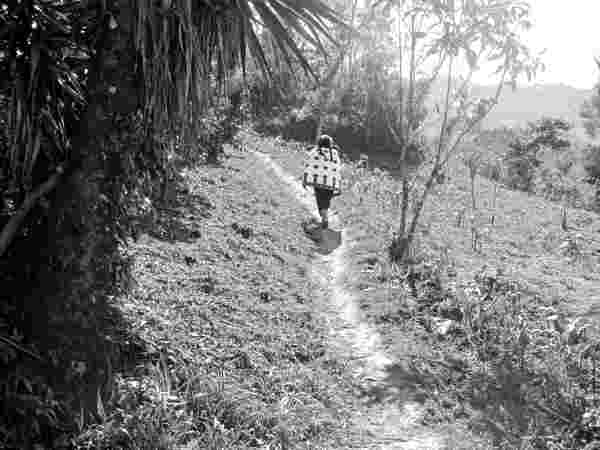 Footpath to the Latter-day Saint chapel in Chojolhó from the new paved road servicing the village, 2012. Four years later this dirt pathway was replaced with a hard-surface walkway. Photo courtesy of Eileen Roundy-Tullis.
Besides attending services in Chojolhó, Tepeyac, Pom, and Porvenir/
Access to the Church’s four lovely locales for worship has improved for some members but remains a burden for others. In 2016 the eighth-mile footpath that connects the chapel in Chojolhó with the village road was itself laid in concrete. Until then the walkway was a well-trod dirt trail. Members of the Tepeyac Branch walk up to three hours on a long road that still becomes impassable to vehicular traffic during the rainy season. Even when the road is dry, transit requires a high-clearance four-wheel-drive vehicle. To reach the Pom chapel, visitors must park on the highway and walk a mile to the chapel. The dirt path crosses two streams and transits a cornfield. During the rainy season, passage is difficult and sometimes impossible. Members in the neighborhood are connected to the chapel via numerous winding dirt paths. The Porvenir chapel is at the end of a paved highway in the village of Pantelhó. However, for idiosyncratic political reasons, most members live in Porvenir, about four miles away. Members walk in groups because of muggers that sometimes ply the road.[52]
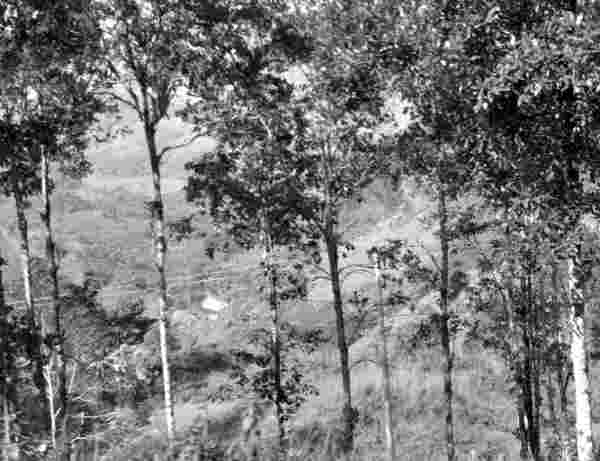 Pom chapel from point of nearest vehicular access, 2012. Notice the recently installed power line that now transits the area. Photograph courtesy of Hugo Montoya Monroy.
A host of questions lay ahead with respect to missionary work among the Maya in Chiapas. Which languages and dialects? Chenalhó-Tzotzil, Zinacantán-Tzotzil, Chamula-Tzotzil, and some dialect of Tzeltal. Any suitable curriculum materials around? What could be improvised? Access to sacred texts? That would come later. Literacy?[53] There was little of it among women and children; in 2012 a few men could read and write in Tzotzil, some in Spanish, and a few could do well in both Tzotzil and Spanish.[54] The men wore huarache sandals so they could work their fields., while many of the women and virtually all the children strode barefoot (at least in December during my visit). In recent years developmental strides have been made in literacy. Yet linguistically, culturally, and educationally, the work of strengthening and expanding Church membership among the Maya in Chiapas would entail significant challenges.
The Book of Mormon: Agustín’s Driving Force and Opportunity
We have seen how Agustín Gutiérrez was a Tzotzil-speaking farmhand (campesino) when he joined the Church of Jesus Christ, marginally literate in his mother tongue but functionally deprived in Spanish.
A driving force in Agustín’s life, as in the lives of numerous other Mexican Latter-day Saints who have engaged their long treks to literacy and religious authenticity, has been the Book of Mormon. The book has played a singular role not only in motivating Mexicans to join with the Latter-day Saints but also in enticing them educationally and economically as they wrestle with the spiritual implications of their new faith. Agustín Gutiérrez Ruiz, who as a young man in his early twenties was banished from his village of Chojolhó, imprisoned in Chenalhó, and exiled to San Cristóbal de las Casas for having become a Latter-day Saint, is a celebrated example.
His story continues to unfold this way:[55]
After about a year’s banishment, Agustín and his exiled brother Pablo and cousins Federico and José secured the right to return to their homes in Chojolhó. All but Agustín did so; as mentioned earlier, he elected to return to his field work in the municipal capital of Chenalhó.[56] He had employment and friends and a place to stay. By walking to San Cristóbal on Sundays to attend church, he could continue to improve his Spanish skills and learn about his new faith, which gave him great pleasure. Despite the satisfying routine, it was clouded by a gnawing preoccupation: “Why doesn’t the Church give us our sacred texts in our own tongue, the language of our mothers and our fathers, the one that imprints the sentiments of our hearts on our souls?”
At a level of public visibility, the Latter-day Saints had done nothing to translate their sacred texts into any of the local Mayan languages (although they had published selections from the Book of Mormon in Mayan languages other than those spoken in Mexico).[57] On the other hand, as already mentioned in relationship to Liberation Theology, Bishop Ruiz of the local Catholic diocese had sponsored translations of the New Testament and was performing Mass and facilitating the spread of the seven Catholic sacraments[58] in at least four of the six Tzotzil dialects. Evangelical groups had invested great effort in penetrating the obscurity of several Mayan languages, creating dictionaries and syntactical and grammatical aids and then using these to translate all the New Testament into numerous Mayan languages and dialects.
Agustín could read the New Testament in his Chenalhó dialect, but what about the Book of Mormon? What about his friends and relatives who were monolingual and could not understand Spanish but who could read some things in the new phonetics of Tzotzil? What of those who could read Spanish but felt their mother tongue speak to them in more comprehensible and emotive ways? Absent a written text that the literate could read and the illiterate could have read to them, many new members would miss the augmentation in spiritual integrity that tends to accompany greater understanding in their new faith. Then there was a crunching question: What about the relationship of a sacred text not only to doctrinal purity but to a conviction of its veracity? In what language?
Some monolingual authorities residing thousands of miles away have responded: “Let them learn Spanish [or English or Tagalog or whatever, depending on the locale]. “The Savior,” the indigenous people responded, “spoke to our ancestors in the language they learned from their mothers. The language of our mothers guides our souls. Why do you not teach us in the language of our souls?” The monolingual members felt they could not learn or feel enough simply by listening to the missionaries in their broken Tzotzil or by hearing sacrament meeting talks and attending Sunday School lessons in their native tongue. They wanted literature, especially their sacred texts, in their own language. They wanted the literate among them to read the texts out loud in a public forum.
Though semiliterate in Spanish, Agustín set himself on a life’s course, an ambitious one by any standard: he, alone if necessary, would translate the Book of Mormon into Tzotzil. Through Agustín Gutiérrez (and professional and academic linguists in Utah), the lack of Church literature for Tzotzil speakers would change. Agustín would be instrumental in doing it.
While Agustín was living and working as a campesino in Chenalhó and attending church at the branch in San Cristóbal de las Casas, he saw an announcement of a custodial position in the newly constructed Latter-day Saint chapel and classroom facility in San Cristóbal. The Church had implemented a program of paid custodial care for its new religious properties. Agustín’s branch president nominated him for the position, for which the lad made a formal application. Two other nominees were also put forward. From among these three, one would be selected.
At the appointed day, the Church’s physical facilities supervisor for Chiapas traveled to San Cristóbal to conduct the interviews. Agustín was the only one to show up. He got the job.
With relatively stable employment in hand, Agustín left his work as a field hand in Chenalhó and moved to San Cristóbal de las Casas, beginning his first day of janitorial employment on February 16, 1986.[59]
Agustín considered his janitorial job a godsend and a confirmation that he was to translate the Book of Mormon into Tzotzil. For two years he worked at his job by day and studied Spanish by night, including its grammatical and syntactical structures, often doing so at the church (which had electricity and therefore lights; his lodging was candlelit only). He would get himself prepared to do the translation that burned in his soul.
Unbeknownst to Agustín, at the same time he was honing his skills in Spanish, linguists in Salt Lake City and Provo, Utah, were working on the Tzotzil language (as well as several others of Mayan origin, principally in Guatemala). In 1986 the Church decided to translate the Book of Mormon, or at least selections from it, into several South American, North American, and Mesoamerican-linked Amerindian languages, including Tzotzil.[60] How the linguists and Agustín got together was serendipitous, even fated, as some observers believe.
Agustín did not know that word of his unique skills in Tzotzil and Spanish had filtered all the way to Salt Lake City. In 1988 representatives from the Church flew into Tuxtla Gutiérrez, the state capital, rented a van, and took the requisite hour to cross a mountain range and descend into the valley that snugly embraces San Cristóbal de las Casas.
Having secured the cooperation of mission and district officials, the visiting linguists asked Agustín to join a group of bilingual Tzotzil-Spanish speakers to read aloud a page written in Tzotzil they had brought with them. Following this they asked Agustín to remain for a more intensive language assessment. Initially the visitors asked him to translate four nonscriptural selections from Gospel Principles. The linguists then gave him New Testaments in five of the Tzotzil dialects that Protestants and Evangelicals had prepared and asked him to study the linguistic variations and recommend how they might be harmonized. And so the day proceeded. The ensuing charge was as simple as the task was complex. Suddenly one of the evaluators remarked, “Agustín, you have a gift. God has prepared you to translate the Book of Mormon! You are going to translate it from the Spanish so that all Tzotzil readers will be able to understand it, no matter their dialect!”[61] In 1989, at age twenty-six and with only a primary education, Agustín began his translation.
It is problematic that anyone could accomplish such a feat, particularly since one of the Tzotzil dialects (San Bartolo) is tonal, like Mandarin, Navajo, and Bantu.[62] Nevertheless, it was a worthy goal, and Agustín and his friends gave it their every effort as they traipsed from mountaintop to mountaintop, to hollow, dell, and valley, checking their translated text against the words of diverse Tzotzil speakers whose language variants had drifted around over the centuries as illiterate, displaced, isolated peoples huddled and laid claim to sidehills of the majestic Sierra Madre de Chiapas.
Agustín translated the Book of Mormon from Spanish into Tzotzil allowing for as much cross-dialect comprehension as he could muster. But what of the originating Spanish text itself, the one translated from some version of English, itself a worked, reworked, and edited-for-clarity version of Joseph Smith’s original translation? In 1988 the latest Spanish edition of the Book of Mormon had not yet been published. Never mind, the linguists had one working copy in unbound sheets, which they gave to Agustín with the injunction that he not share or divulge it.[63]
In the off-hours from his work as custodian of the new San Cristóbal Latter-day Saint church complex, Agustín labored at his lodging during whatever daylight hours were available and at night in the church. Someone gave him an old typewriter that would produce all the Tzotzil phonetic characters. The typewriter was a contraption he had never used but soon learned to manipulate as he translated. Fernando Ruíz and his wife, along with Agustín’s brother Pablo, reviewed the translation as it came forth. Together they struggled with the various dialects. Even so, as Agustín affirmed, “with Tzotzil, you don’t translate words, you translate messages.”[64] The excitement of producing a text so important to so many people amply mitigated the tiresome toil of their remarkable efforts.
Bridging several Tzotzil dialects would appear to be even more daunting than trying to produce an English text equally comprehensible to nineteenth-century Americans in their various regions as well as to Welsh, Scottish, English, and Northern Ireland English speakers in the United Kingdom, not to mention the Cockney dialect of central London or the English now spoken in South Asia and English-speaking Africa. It required a tremendous linguistic skill and, Agustín affirmed, a lot of prayer.
As he finished a section, Agustín sent it through the postal service to his contacts in Salt Lake City to be checked and edited. They marked the text with suggested changes, queries, and comments. The texts traveled back and forth until everyone was happy that the translation was as it should be, which occurred in 1992[65] when the Church published 195 pages in Tzotzil comprising “everything,” Agustín stated, “except the wars.” It has been a missionary and teaching staple for the Church of Jesus Christ in the mountains of Chiapas ever since.
Ten years following the publication of Selections of the Book of Mormon in Tzotzil, in 2002 the Church made initiatives to translate the temple ordinances into Tzotzil as well. Somehow the multidialect issue was resolved in a quiet room in the Tuxtla Gutiérrez Temple (dedicated in 2000), where Agustín secluded himself for three weeks for the translation. Thereafter he and his wife Regina and three other couples traveled to the Salt Lake City Temple to record the audiotapes.
A Dramatic Educational Push
Nearly simultaneously with the publication of Selections of the Book of Mormon in Tzotzil in 1992, the Church changed its janitorial policy from paid to volunteer help. Agustín was terminated from his employment. He had his wife Regina and young daughter Sandra Elizabet and son Israel Daniel to support. He sold tacos for four years while also pursuing every educational opportunity he could lay hands on. Because of the notoriety of the published translation of the Book of Mormon by a person with only a sixth-grade education, local governmental officials soon opened opportunities and provided providential guidance and some financial assistance.
Flowing from his translation work and motivated by the Church’s injunction that its members work to improve their lives and progress educationally at whatever age, at thirty-three (1996) Agustín entered middle school (secundaria) and received his graduation certificate three years later. He rested a year or two from his formal studies and then entered high school (preparatoria), attending classes in the afternoons after his work. He graduated in 2005 at age forty-two with a host of seventeen- and eighteen-year-old fellow students. Following admonitions from his stake president, in 2008 he entered the University of Chiapas in San Cristóbal. In 2011, at age forty-eight, after an arduous, even epic effort, one fraught with frightful financial angsts, he graduated with a law degree. For years his stake president had kept up a drumbeat of encouragement coupled with whatever support he could marshal.

 Above: Agustín Gutiérrez Ruiz with his mother and wife, Regina, Latter-day Saint chapel grounds in Chojolhó, December 2012. Agustín is in his attire as a university professor and second counselor in the Church's mission presidency in Chiapas. His mother is dressed in the customary "best dress" for women in the village. Regina attired herself in the traditional dress for her visit to Chojolhó "to make my mother happy." Below: Agustín Gutiérrez Ruiz with his father dressed in traditional Tzotzil attire at a village celebration in Chojolhó, December 2012. Men no longer customarily dress in traditional attire except on special occasions. Decades back, Agustín's father was a village elder or authority. On this celebratory day, the community honored him along with all the other past village leaders still living. Photos courtesy of Eileen Roundy-Tullis.
While Agustín was advancing himself educationally, he was also struggling to provide for his family economically and also rendering ecclesiastical service, serving ten years on two separate occasions as bishop (one of them over a Tzotzil-speaking ward in San Cristóbal), twice as a bishop’s counselor, two times on the stake high council, and, in 2013, as the first counselor in the Church’s Tuxtla Gutiérrez Mission under President Juan G. Cárdenas Tamayo (who as a young man served a mission among Tzotzil speakers). In 2016 he continued to serve as first counselor in the mission headed by Cárdenas’s successor, Arley Hulet George.
In 2016 Agustín was a professor (catedrático) of language and culture at the University of Chiapas (Universidad Autónoma de Chiapas) and gave classes at its satellite campus in San Cristóbal as well as at the main campus in Tuxtla Gutiérrez. His surviving children also showed their affinity for education. Three earned university degrees, and at the time of my interviews in 2012, another was enrolled in courses toward a degree in communications. Agustín’s sons served missions, and his daughter Sandra was married with children and held a university degree in language and culture. All were actively engaged in Church activities.
The life journey of Agustín Gutiérrez Ruiz on which his monolingual, nonliterate mother and his almost monolingual and mostly illiterate father launched him, and on which his wife Regina and his children profoundly supported him, deserves to be remembered with wonder, marvel, even astonishment. Endowed with immense intelligence and language gifts and, in the minds of many, raised to do a transformational work, he has ascended his many challenges with the dedication, sensibility, and spiritual clear-sightedness that mark stellar people from every walk of life, every culture, and every land.
Notes
The material in this vignette derives in part from my study “Tzotzil-Speaking Mormon Maya in Chiapas, Mexico,” Journal of Mormon History 43, no. 2 (2017): 189–216 (this article garnered the Mormon History Association’s “Best International Article Award” for 2017), and from my unpublished monograph “Mormonism among Tzotzil-speaking Maya in Chiapas, Mexico,” December 10, 2015, incorporating on-site field research done in 2012–13. All of the information came from a weeklong visit to Chiapas during December 2012. Agustín was my initial guide into the mountains around San Cristóbal de las Casas. He introduced me to Church members and local political dignitaries and functioned as my interpreter for interviews with monolingual informants. He was an invaluable source of information. My wife, Eileen Roundy-Tullis, helped gather information on-site .
[1] See LaMond Tullis, “Selecciones del Libro de Mormón en Tzotzil: Agustín Gutiérrez Ruiz y los santos en el distrito de Chojolhó, Chiapas,” Liahona, February 2014.
[2] See Jim Yardley and Paulina Villegas, “At Mass, Pope Francis Embraces ‘Misunderstood’ of Mexico,” New York Times, February 15, 2016, https://
[3] Email from Armando Ceballos to LaMond Tullis, Mexico City, March 1, 2016.
[4] On Liberation Theology, see Gustavo Gutiérrez, Teología de la liberación: perspectivas (Lima, Peru: Centro de Estudios y Publicaciones [CEP], 1971). The first English edition is A Theology of Liberation: History, Politics, and Salvation, trans. and ed. Caridad Inda and John Eagleson (Maryknoll, NY: Orbis Books, 1973). On cyclical droughts in Mesoamerica, see D. W. Stahle et al., “Major Mesoamerican Droughts of the Past Millennium,” Geophysical Research Letters 38 (2011). On the Guatemalan civil war, see Richard Newbold Adams, Crucifixion by Power: Essays on Guatemalan National Social Structure, 1944–1966 (Austin: University of Texas Press, 1970); Victoria Sanford, “Violence and Genocide in Guatemala,” Yale University Genocide Studies, 2015, http://
[5] See “Chiapas,” https://
[6] Abraham Guzmán Pérez and his wife Anita Gutiérrez Ruiz de Guzmán, interview by LaMond Tullis, December 17, 2012, Chojolhó, Chiapas, Mexico; and email from Gary Utt to LaMond Tullis, December 12, 2012.
[7] The revolutionary flavor of the rural teacher concept that carried over from its origins in 1932 to the early1990s is seen in “Escuelas para pobres. Las normales Rurales en México,” ¡El Comienzo! Llamado revolucionario al proletariado de la ciudad y el campo, http://
[8] See Rockwell, “Rural Schooling in Mexico.”
[9] See María Teresa Vázquez Castillo, Urbanization, Formation of Regions, and Globalization in Ejidos (New York: Routledge, 2004); and Laura Randall, ed., Reforming Mexico’s Agrarian Reform (Armonk, NY: M. E. Sharpe, 1996).
[10] See “Mexico y sus maestros rurales,” teleSUR En Profundidad, http://
[11] The eventual migration pattern for many village youths faced with population pressures in the mountains and unacceptable economic opportunities at home, even by traditional standards, as interpreted by their newly acquired changes in life aspirations, has been simply to take up residence in larger towns and cities, like San Cristóbal de las Casas. They return to their villages en masse for celebration days and delight in showing off their new assets, which in 2012 in Chojolhó included fairly new stake-rack pickup trucks. Eventually the mountain villages begin to lose many of their youth and their age demographics change. In the case of Chojolhó, a recent report showed its population decline since 2005 to around 2017 to be 37 percent. See Pueblos America, “Chojolhó, https://
[12] See Pueblos America, “Chojolhó.”
[13] Pablo Gutiérrez Ruiz, interview by LaMond Tullis, December 17, 2012, Chojolhó, Chiapas, Mexico.
[14] Pablo Gutiérrez Ruiz interview.
[15] See Christine Eber, The Journey of a Tzotzil-Maya Woman of Chiapas, Mexico: Pass Well over the Earth (Austin: University of Texas Press, 2011), chaps. 1–3.
[16] See Eber, Journey of a Tzotzil-Maya Woman of Chiapas.
[17] Abraham Guzmán Pérez and Anita Gutiérrez Ruiz de Guzmán interview.
[18] Abraham Guzmán Pérez and Anita Gutiérrez Ruiz de Guzmán interview.
[19] Pablo Gutiérrez Ruiz interview.
[20] Pablo Gutiérrez Ruiz interview.
[21] Agustín Gutiérrez Ruiz, interview by LaMond Tullis, December 17, 2012, Chojolhó, Chiapas, Mexico.
[22] By 2012 there had been an obvious rapprochement. At the inaugural celebration of the new road to Chojolhó, the boys’ father marched with a couple dozen former and present regidores, all adorned in traditional Tzotzil dress, to the accompaniment of a small brass band. Each came over to me and my wife to shake hands and offer greetings. Agustín, now a celebrated son of the village, had personally introduced us to his father and to some of the dignitaries.
[23] Pablo Gutiérrez Ruiz interview.
[24] When I asked Abraham Guzmán Pérez how many members of the Church lived in Chojolhó, he consulted with his wife and then said, “Six families.” Abraham Guzmán Pérez and Anita Gutiérrez Ruiz de Guzmán interview.
[25] Agustín Gutiérrez Ruiz interview.
[26] Email from Gary Utt to LaMond Tullis, September 17, 2013.
[27] Pablo Gutiérrez Ruiz interview.
[28] Pablo Gutiérrez Ruiz interview.
[29] Pablo Gutiérrez Ruiz interview.
[30] Pablo Gutiérrez Ruiz interview.
[31] María Elena Gómez Sánchez de Lowe, interview by LaMond Tullis, June 12, 2015, West Valley City, Utah. Gary Utt facilitated this interview.
[32] “Conoce a María Lowe,” De Mujer a Mujer, January 2010, 5–7 (regional magazine published in West Valley City, Utah); and email from Gary Utt to LaMond Tullis, June 8–9, 2015.
[33] Gómez Sánchez de Lowe interview.
[34] Pablo Gutiérrez Ruiz interview.
[35] Agustín Gutiérrez Ruiz interview.
[36] Robert M. Laughlin, “The Tzotzil,” in Handbook of Middle American Indians, vol. 7, Ethnology, ed. Evon Z. Vogt (Austin: University of Texas Press, 1969).
[37] For example, Agustín’s father, a village authority at the time and one still publicly acknowledged during celebratory times, could not, in December of 2012, communicate in Spanish with me. Other past village authorities (but not present ones) could not communicate in Spanish either and also required a translator. Interestingly, each paid dignified respect to me and my wife as researchers. It was clear that by 2012 the rift between Agustín and his father over the Latter-day Saint faith had been healed. Agustín’s mother, his sister Anita, and his brother Pablo, as noted in the text, had been baptized, but his father “never developed an interest.” LaMond Tullis, conversations with village authorities in Chojolhó, Chiapas, Mexico, December 16–19, 2012.
[38] Agustín Gutiérrez Ruiz interview.
[39] Agustín Gutiérrez Ruiz interview.
[40] Agustín Gutiérrez Ruiz interview.
[41] Juan Gabriel Cárdenas Tamayo, interview by LaMond Tullis, December 15, 2012, Tuxtla Gutiérrez, Chiapas, Mexico.
[42] See “A Gift of Water,” Church News, November 9, 2001, https://
[43] Pablo Gutiérrez Ruiz interview.
[44] “Gift of Water.”
[45] Clifford L. Whetten, “Called to Serve on the Other Side of the Veil: The Legacy of a Young Mayan (Tzotzil) Branch President and His Family,” typescript ca. 2007, 2, in my possession; and Abraham Guzmán Pérez and Anita Gutiérrez Ruiz de Guzmán interview. Miguel Ángel Ruiz, a cousin of Pablo and Agustín Gutiérrez Ruiz, was on his way to visit family in San Cristóbal de las Casas when he was murdered. It is not known if the lethal assault related to Ruiz’s church membership and his relatively high profile status of being the branch president in Chojolhó. Many who came to the funeral were not members of the Church. The services, held in Chenalhó, were conducted in the local dialect of the Tzotzil language. The Church’s First Presidency sent a letter of condolences to be translated and read at the services. These events would suggest that by 2006 the animosity in Chenalhó toward the Church had subsided considerably due, in part, to a change in the town’s political leadership.
[46] The first chapel was dedicated in June of 2001. See “Gift of Water.”
[47] Hugo Montoya Monroy, “Distrito Chojolhó (17061772),” letter and diagrams sent to the Mexico Area Presidency, October 2012, 1.
[48] Moisés Ulloa Solís and his wife Rosby, interview by Armando Ceballos and Dina De Hoyos, Tuxtla Gutiérrez, Chiapas, October 13, 2013.
[49] The Pom Branch was established on January 16, 2005; Porvenir on January 23, 2005; Tepeyac in 2005. Later, the San Cristóbal Stake apparently absorbed these branches, but in 2011 they were again attached to the Tuxtla Gutiérrez Mission. Around 2017 the stake itself was downgraded to a mission district.
[50] Email from Gary Utt to LaMond Tullis, December 7, 2015.
[51] Cárdenas Tamayo interview.
[52] Personal observations supplemented by two e-mails from Gary Utt, December 7, 2015.
[53] In about 2017 the average number of years of schooling for men in Chojolhó was 4.88, for women 3.93. Eleven percent of men were illiterate, as were 30 percent of women. See Pueblos America, “Chojolhó.”
[54] By 1985 there was a government-sponsored school in Chojolhó. According to Manuel Solís Ruiz, the Chojolhó branch president in 2012, the majority of the teaching during 1985–91 when he was doing his six years of elementary schooling was in Spanish but with little comprehension among the students. They learned to read and write a little in Spanish but not speak it. In Solís’s case, he could read and pronounce Spanish words but did not understand what they meant. To him it was all “gobbledygook.” Some of the teaching was done in Tzotzil, particularly if oriented toward vocational education (“how to cultivate the land, plant corn and beans”), and there Solís learned to read in his mother tongue. He wanted to go to secondary school in Chenalhó, the municipal capital, but had no money. His father could not support him because of the family’s extreme poverty. Solís was twelve when he finished elementary education and was ready to enter the agricultural workforce, “scared and ill-prepared to face life.” Solís really learned Spanish on his Church mission in Mexico City and environs. Reading the Book of Mormon in Spanish was his greatest aid, he said. When asked in 2012 whether he preferred the Book of Mormon in Spanish or Tzotzil, he said, “Better in Spanish,” for it is by studying the book that he gained an impeccable foothold in the Spanish language. Manuel Solís Ruiz, interview by LaMond Tullis, December 18, 2012, Chojolhó, Chiapas, Mexico.
[55] Most of the material contained in this section is derived from the following: Agustín Gutiérrez Ruiz interview; Pablo Gutiérrez Ruiz interview; Abraham Guzmán Pérez and Gutiérrez Ruiz de Guzmán interview; email from Gary Utt to LaMond Tullis, December 12, 2012; and Ulloa Solís oral history. A portion of this story, written by me, was published in the Mexican centerfold pages of the Liahona magazine in February 2014.
[56] Agustín Gutiérrez Ruiz interview.
[57] The flurry of Book of Mormon translations into indigenous languages in the late 1970s and early 1980s was driven by Robert W. Blair and his colleagues (Kristine Campbell, Lyle Campbell, John S. Robertson, and others), linguists at Brigham Young University. Illustrative is their work in Guatemala on the Kaqchikel (Cakchiquel) language spoken by around 500,000 indigenous people in the Guatemala highlands. See “A History of Cakchiquel (Kaqchikel) Translation in the LDS Church,” http://
[58] Baptism, Confirmation, First Communion, Reconciliation or Penance, Marriage, Holy Orders, Healing.
[59] Agustín Gutiérrez Ruiz interview, 4.
[60] In 1980 selections from the Book of Mormon were published in Ecuadorian Quechua as Mormon Killkashkamanta, with a later 2011 complete edition as Mormónpaj Quilcasca. In 1982 selections were published in Guaraní as Mormon Kuatiañe’ẽ (for Paraguay, Argentina, and Brazil), with a complete translation published in 2009. Only selections have been published for other indigenous languages: in 1978 in Kaqchikel (Guatemala) as Ri Vuj Richin Ri Mormon; in 1979 in Peruvian Quechua as Mormon Q’el Qaqmanta Aqllaska; in 1979 in Quiché (Guatemala) as Jutak Cha’om Wuj Re Ri Wuj Re Ri Mormon; in 1980 in Navajo as Naaltsoos Mormon Wolyéhigii; in 1981 in Kuna (Panama, Colombia) as Mormón Kaiya Purba; in 1981 in Bolivian Quechua as Mormompa Libronmanta; in 1983 in Mam (Guatemala) as Pix Aj U’j Te Mormon; in 1983 in Maya (Mexico, Belize, Guatemala) as U Libroil Mormon; and in 1992 in Tzotzil (Chiapas, Mexico) as Vun Yu’un Mormon. A table summary may be found in Kai A. Andersen, “In His Own Language,” Liahona, June 1997. A more robust discussion is in “List of Book of Mormon Translations,” https://
[61] Agustín Gutiérrez Ruiz interview.
[62] See “Tone (Linguistics),” https://
[63] Most undoubtedly this unbound collection consisted of copies of the galley sheets or perhaps the page proofs for the Spanish edition that the Church eventually published in 1992. For an insightful scholarly discussion, see Juan Miguel Zarandona (Universidad de Valladolid), “The different editions of The Book of Mormon in Spanish, or the possibility of censored retranslation in search of quality, accuracy and balance,” Hikma: estudios de traducción 10 (2011): 195–216.
[64] For example, “Tzotzil has words for ‘sea’ and ‘road’ but not for ‘ship,’ so one has to work around it.” Agustín Gutiérrez Ruiz interview. The complexity is further illustrated by the following: “The teacher” in Tzotzil, according to the SIL, is translated as li jchanubtasvaneje, literally “one who habitually causes (someone) to learn something.” Summer Institute of Linguistics in Mexico, “Mayan Family,” https://
[65] Various sources list the publication date of the Tzotzil edition as 1994. The copy in my possession lists the copyright date as 1992, which ordinarily corresponds with the publication date.
