
 menu icon in the top, right corner of the screen.
 icon above to close this box.
 icon at the bottom of the screen below the browser—if you don't see it, swipe up to unhide it.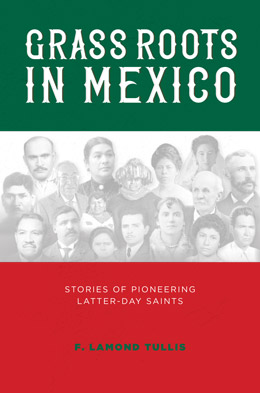
Afterword
F. Lamond Tullis, "Afterword," in Grass Roots in Mexico: Stories of Pioneering Latter-Day Saints (Provo, UT: Religious Studies Center, Brigham Young University; Salt Lake City: Deseret Book), 293‒98.
Quite by accident I began to research and write about The Church of Jesus Christ of Latter-day Saints and its members in Latin America. However, following my first professorial appointment in 1969, my normal academic pursuits as a professor of political science held sway for several years. Along the way, I became interested in such topics as politics and social change in revolutionary environments. Oddly, this interest morphed into my going back to take another look at the expansion of the Church into Latin America, a region then in general political and social upheaval and one in which probable outcomes for some Latter-day Saints there in the 1960s and several decades thereafter appeared to be problematic.[1]
The more I studied the subjects of my academic discipline, the more I came to understand the destabilizing role religion can play in a society, either as a means of social control at times when people long for change and the powerful seek to thwart it, or as an expression, even a revolutionary one at times, of hope for a new life. I wondered how Latter-day Saint converts in Latin America would handle this and, also, what mainline Church authorities would do with the imponderables of taking a faith with specific cultural manifestations across languages, nationalities, cultures, and varied geographies. So, in my spare time I delved into this line of wonderment.
The Church’s enduring core, when stripped of its diverse members’ cultural expressions, ingrained ideologies, rationalizations driven by tradition, custom, politics, and economics, all of which are sometimes nurtured in less than thought-affirming understanding, is quite simple: It is the knowledge and practice of the Church’s theology and people’s beliefs regarding the Lord Jesus Christ and the ordinances and principles associated with that theology and beliefs that transcend time and space and presumably are as applicable to, say, the inhabitants of Zarahemla as to people now and are as germane in any time as time itself. The key elements of the core “include belief in God the Father, his Son Jesus Christ and the Holy Spirit; belief in prophets and continuing revelation; belief that through Christ’s atonement all [humankind] may be saved by obedience to the laws and ordinances of Christ’s Gospel; belief in the importance of repentance and baptism by immersion for the forgiveness of sins; and belief in the right of all people to worship God as they please.”[2] The core is buttressed by sacred texts, which, in the contemporary period, include the Bible and the Book of Mormon. Considerable deference is also paid to addresses given in the Church’s general conferences.
Taking this core across boundaries of time, space, nationality, language, ethnic identity, and idiosyncratic history has been a trial in the nineteenth and twentieth centuries and is a constant challenge in the twenty-first. Readers of this volume will marvel at the identity adaptations that have arisen in Mexico as members have clothed the core in new cultural apparels. They have embraced a part of the Anglo-European Latter-day Saints’ cultural and social preferences and have rejected much in favor of their own.
Among varied peoples the core does not stand alone. The institutional struggle, if that is what it is, is to maintain uncompromised fundamentals in the face of circumstances that can cause them to become shrouded by diverse yet compatible cultures, societies, languages, political and economic systems, and heartfelt national or subnational traditions and customs.
This volume is about people of goodwill in Mexico and the United States who have struggled with this dilemma and for the most part have come to an understanding that appears satisfactory not only to sundry Latter-day Saints in Mexico but also to many in the Church’s United States heartland. In 2017, as part of his epic worldwide ministry, Church president Russell M. Nelson visited members in Mexico and appeared pleased with what he found.[3] As for the heartland, it is rare today to see Anglo-American cultural imperatives masquerading as the gospel of Jesus Christ. It has not always been this way.
In the undulating vicissitudes of the Latter-day Saint message in Mexico that among its successes included periods of abandonment, dissidence, failing interest, and a falling away, one nevertheless sees good people striving to find the will of their Lord for them and, once having found it, dedicating enormous personal and collective efforts to bring it to fruition. Since the late 1800s, active membership has grown in number and in strength. In 2020 hundreds of thousands of members gathered in some two thousand congregations in Mexico and had better access to the faith’s holiest rites in thirteen operating temples there and in any other temples elsewhere where they may have been traveling. The Church’s audio presentations of its temple rights are made possible in a multitude of languages depending on the need.
The oft-cited low participation rate of around 19 percent does not seem to discourage the Mexican Saints.[4] Many people believe that the record of the Church and its members is impressive for just 144 years of the faith’s existence in Mexico, the acknowledged falling away of many, especially among those baptized in the 1970s and early 1980s, notwithstanding.
Following the reunification of the Church of Jesus Christ in Mexico in 1946 following a decade of schismatic activity, members moved through the 1950s and approached the 2020s with additional accomplishments despite encountering numerous speed bumps along the way. Surely a record of note has been the thousands of Mexican members who have relentlessly pursued a better education, whether informal or formal, whether self-taught or school taught, whether as children or as adults. Along with this personal motivation, the Church has expended much treasure and developed considerable administrative scaffolding to help all its members become literate and acquire an education. The thirst for self-improvement via education and learning is a cultural hallmark among Latter-day Saints in Mexico.
A notable benchmark in the Church’s history in Mexico centers on June 29, 1993. On that date the Mexican government formally accepted the Church as a legal religious entity. This allowed the Church to own property and function without the extraordinary legal and political encumbrances that had plagued its first 118 years there.[5] The programmatic consequences for Latter-day Saints in Mexico have been incalculable, granting the Church ownership of its holy edifices and removing the proscription of foreigners serving as clerics, to name a few benefits. The relatively free movement of people and resources and the security of assets have made it possible for the Church to expand its programs as it seeks to bless its members spiritually and attend to some of their social and temporal needs.
In the coming decades, other writers will continue to expand our awareness and understanding of recent Latter-day Saint history in Mexico. For instance, we need to know more about the era of temple building and temple attending, as well as how large numbers of Latter-day Saint families have so integrated themselves into Mexico’s national society and economy as to demonstrate an astonishing multigeneration social mobility. Additional studies focusing on lay leadership training as an integral part of the Church’s rapid institutional development are needed too. The Church’s welfare program in a land where needs have been great has undergone significant transformations in the past two decades. How is it working now? Hardly anything has been written about this. Dissident offshoots of the faith continue to thrive in Mexico. What effect are they having on the mainline Church? What has happened to the Anglo-European colonies in Chihuahua and Sonora, and to what degree do they continue to provide material and human resources to help sustain and expand the Church throughout Mexico if not all Latin America as they have done historically?
What are the prospects for Latter-day Saint Maya becoming fully integrated spiritually, economically, and socially among the Saints in Mexico? What role might the Church take? A follow-up study is certainly merited. Mexico has a host of official languages whose protection is memorialized in the country’s constitution of 1917. Around 20 percent of Mexico’s population identify themselves with an indigenous group, and around seven million of them are speakers of one or another of the country’s multitude of indigenous languages. Nahuatl has more than 1.7 million speakers; Maya in its many variants is spoken by nearly a million. Mixtec has a half million speakers.
Interestingly, while Spanish is the dominant language in Mexico, it is not currently defined legislatively as the country’s official language.[6] Should there ever be a resurgence of interest in Lamanite issues (see the appendix) among Latter-day Saints, new linguists may seek to do for others what an earlier generation did for the Tzotzil Maya—that is, begin a new round of translations of the faith’s sacred text, the Book of Mormon. Would that be a good idea?
How do Mexican members in all their varieties adapt themselves to the core substance of the Church? Looking down through the centuries, is there a limit to such adaptation, after which Church members in their respective homelands become less recognizable as universal Latter-day Saints and more noticeable as adherents of separate national if not nationalistic religions? There will be struggles.
The vignettes presented in this volume scratch the veil of biographical familiarity to bring into relief some of the whys that Mexicans have been attracted to the Church of Jesus Christ and what has happened to them and, in some instances, to their descendants into the sixth generation.
There are tens of thousands of Mexican Latter-day Saint pioneer vignettes yet to be prepared. Will someone write them?
Notes
[1] See LaMond Tullis, “Politics and Society: Anglo-American Mormons in a Revolutionary Land,” BYU Studies 13, no. 2 (Winter 1973): 126–34; and Tullis, “Mormons and Revolution in Latin America,” BYU Studies 16, no. 2 (Winter 1976): 235–49.
[2] Quoted from “What Are the Core Tenets of the Mormon Religion?,” https://
[3] See Jason Swensen, “President Nelson Lauded in Mexico for Church’s Commitment to Family,” March 9, 2017, https://
[4] Observers frequently tend to see what they want to see or find what they believe confirms their predilections of what they expect to encounter. It is an age-old issue among historians, social scientists, philosophers, lawyers, and pundits. Thus, observations about the Church in Mexico range from the critical and pessimistic to the optimistic and upbeat. My half-century examination of the evolution of the faith in Mexico leaves me coming down on the fairly optimistic side of this divide. I arrived at that position even after considering at least more than a handful of serious problems the Church has faced and is likely yet to face in Mexico. A helpful review of the methodological and philosophical struggles over approaches to explaining historical events and finding meaning in history appears in the Stanford Encyclopedia of Philosophy under the title “Philosophy of History,” first published February 18, 2007, and substantively revised September 28, 2012, http://
[5] Statistical information from https://
[6] “How Many Languages Are Spoken in Mexico?,” https://
