
 menu icon in the top, right corner of the screen.
 icon above to close this box.
 icon at the bottom of the screen below the browser—if you don't see it, swipe up to unhide it.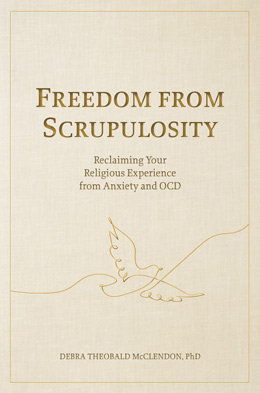
Self-Help Treatment
Building a Solid Emotional Foundation
Debra Theobald McClendon, "Self-Help Treatment: Building a Solid Emotional Foundation," in Freedom From Scrupulosity: Reclaiming Your Religious Experience from Anxiety and OCD (Provo, UT: Religious Studies Center, Brigham Young University; Salt Lake City: Deseret Book), 181–94.
This chapter is the first of several chapters teaching you how you might work through some your own treatment in a self-help format. In religious terms, building a spiritual foundation often involves activities such as prayer, scripture study, and church or temple attendance. In physical terms, building a solid foundation for your body emphasizes the importance of exercise, diet, and sleep. Here I will teach you some basic skills to build a solid emotional foundation. I will cover mindfulness, self-soothing, meditation, more intense emotional regulation skills called TIP skills, and positive-sentiment activities.
Mindfulness
Remember that anxiety is caused, in part, by anxiety sensitivity. Focusing too much on the sensations of anxiety creates more anxiety. The more you’re trying to avoid your own anxiety, the more you’re actually creating it. So an important part of your emotional self-care is mindfulness. The first thing to be mindful of is your own anxiety level. What is going on for you? You need to label the anxiety. Label the OCD. Label the scrupulously.[1] Say it out loud. Labeling becomes a method for implicit emotion regulation,[2] diminishing the responsiveness of the amygdala and other limbic regions of the brain to negative emotional images.[3] “By calling out our fear-based doubts, we reinforce the fact that they neither comprise nor define us. They are simply thoughts, meaningless except for the meaning that we assign them.”[4] It is commonly said that you can reduce anxiety up to 50 percent by simply noticing and calling it out. My clients have experienced that great benefit.
Mindfulness, on a broader level, is intentionally paying attention in the present moment without judging it or clinging to it. It connects us to the present moment. An author wrote, “Mindfulness doesn’t erase confusion as much as it notices it and dissolves, or at least reduces, the fear about it. As fear lessens, misperceptions begin to correct themselves.”[5] It is a skill that can be developed by practice, but it is “more of an experiential practice than a thinking activity, subjective to and fraught with emotions.”[6] Mindfulness practice includes such exercises as meditation, contemplative prayer, and mindful movement such as yoga, martial arts, and spiritual dancing. Hiking, horseback riding, and walking can also constitute mindful movement.[7] When you practice mindfulness, you are not trying to suppress intrusive thoughts or obsessions; instead, you take notice of them, accept that they can be there, and then stay focused on living your life in the way you choose (rather than changing course to obey whatever anxiety may be demanding). ACT therapy (discussed below) has some wonderful mindfulness metaphors you can look up and explore.
One author explored ways that you can be mindful when attending a church meeting or a temple worship service.[8] How are you sitting in the room and experiencing that place? Find something concrete to focus on, such as listening intently to the speaker, focusing on the music, noticing the textures or colors in the room, or paying attention to your feet and how they feel as they touch the floor. If you are having difficulty identifying the influence of the Spirit because of your scrupulosity, the author also encourages you to identify and hold moments when you have felt the Spirit in the past—then you can work to re-create those moments in the present when possible, such as through scripture study, singing hymns, or listening to others share their testimonies of belief.
Self-Soothing
Our modern-day culture at large generally promotes the use of unhealthy activities to soothe negative emotions. Some examples include consuming alcohol or drugs, binge eating, viewing pornography or participating in other types of sexual acting out, binge spending of massive amounts of money, or even engaging in self-mutilation. These maladaptive coping strategies tend to be shallow and unfulfilling because they are only temporarily soothing. They often end up out of control because one is always seeking more yet never satisfied. You may say that you can never get enough of something you don’t need.
Our culture also tends to promote a lack of personal resilience and responsibility. Instead of looking for the world or others to soothe you, such as always relying on a partner to give you a back rub when you are upset or needing to talk to a parent to come down from an anxiety spike, focus here on self-care and the idea of building up your ability to self-soothe.
Instead of following the unhealthy trends of the culture around you, be proactive in selecting self-soothing strategies that are healthy and adaptive—behaviors and mindsets that will help you rather than hinder you. Adaptive strategies will slow down the body’s stress response and feel calming. These are generally not hard activities to do; the hardest part of self-soothing is remembering to do it. You will need to disengage an autopilot approach to your life and choose health on purpose. If you’re really struggling, you can ask, “What can I do to help myself?” Or you can say, “Okay, I need to calm down. Before I can do anything else, I’ve got to calm down.” I often recommend that people put physical notes where they can see them or put alarms on their electronic devices to remind them to be mindful of self-soothing when needed.
To identify some self-soothing activities, researchers have taken the approach of aligning soothing with the five senses:[9] sight/
Okay, let’s walk you through the five senses and have you create your own self-soothing list.
Let’s look at items from the self-soothing list of one married man in his late twenties.[10] His choices are preceded by question prompts that may help guide your own thinking. In some instances I offer further comment and explanation. Let’s begin with the sight/
What could you listen to that would be comforting or soothing for you? This client enjoyed listening to happy, upbeat songs and nature sounds, and also talking to his wife or friend. Clients often put listening to some type of religious content on their soothing list (music, devotionals, talks/
What could you smell that would help you calm down in an anxious moment? This client enjoyed cinnamon, peppermint, and going outside after it rains. Write down what you could smell that might help you.
As you think about the sense of taste, do you need to steer clear of self-soothing with food? Food tends to be a trigger issue for people who engage in emotional eating or other types of disordered eating behaviors. If that’s not the case for you and you can use food occasionally to settle you, then enjoy. But if it tends to turn into bingeing or emotional eating for you, I would recommend staying away from using food for soothing. Additionally, you can consider using things that provide you with taste but are not food, such as herbal teas, gum, mint, mouthwash, and so forth. This client chose not to soothe with taste. Is there anything you could taste that would help calm you? Write it down.
What could you touch or sense with your body that would comfort you? This can include things you can touch as well as other experiences relative to your bodily sensations, such as exercise, a hot tub or sauna, or deep breathing. A lesser-known soothing option that uses your body is tapping, or psychological acupressure. This is called emotion freedom technique,[12] and it focuses on tapping the body at meridian points. This client enjoyed a hot shower, holding his wife’s hand, and deep breathing.
I recommend that everybody try deep breathing. Deep breathing hacks the vagus nerve, a connection between your brain and your gastrointestinal system, and slows down your heart rate, creating a relaxation response through your whole body.
There are many different breathing patterns that people use to practice their deep breathing. One group of researchers reported a ratio of breathing they found to be effective in minimizing stress and improving decision-making. Inhale for four seconds slowly through the nose, and then with very tight, controlled lips exhale out through the mouth in a very controlled, fine stream for eight seconds.[13] Doing this for even two or three cycles creates a nice, calming effect. However, the researchers found that if you breathe the four-to-eight ratio for two minutes, it engages the vagus nerve, increases your heart rate variability, improves decision-making, and decreases your subjective experience of stress. So you can choose to breathe a few times in a brief exercise and get some great benefit, or slow down and breathe for a full two minutes if you have greater needs.
Now, write down what touch/
Okay, so now you should have a nice rough draft to help you begin to explore some soothing options for you. Allow this to be a working rough draft, deleting items on the list when they don’t prove helpful and adding new items when you think of them. This list now gives you a tangible hard copy so when you’re in a moment of high anxiety upset, you can look at it and have all your ideas right there for you.
Meditation
Meditation is a wonderful practice that you may want to consider participating in daily as a staple on your self-soothing list. It is a tool to steady and calm you. “You can see things more clearly and act from inner balance rather than being tossed about by the agitations of our mind.”[14]
A basic approach to meditation is to focus on your breath, giving “full attention to the feeling of breath”[15] as it goes in and out without your manipulating or controlling it in any way (this is not the same as the deep breathing described above). Once you notice your attention has wandered a bit, just take note of it and let that thought go, bringing your attention back to your breath. What a great opportunity to practice mental flexibility for one who struggles with OCD with its rigidity, intrusive thoughts getting stuck, and obsessions looping, looping, looping, again and again and again! This is the practice of letting thoughts go.
You can meditate in many ways, such as lying down, sitting in a chair, or doing yoga.[16] Here is how one person was taught to meditate:
The practice was a revelation. I learned that meditation was about recognizing your thoughts and letting them pass by. It wasn’t about controlling what you thought or making your mind do anything. One of the recommended strategies for formal meditation was an exercise in which I was instructed to light a candle and just . . . watch it. I was to notice everything about the flame of the candle, how it sits on the wick, how it melts the wax, and not think about anything else. This felt weird and exotic. The purpose of the activity was to get me out of my mind and into the real world. If some other thought came to my mind while I was supposed to be focused on the flame it was OK; I was just to let those thoughts fall in and out of my mind.
This was wonderful and bizarre. It was an activity I was allowed to fail. In fact, the only way I could really do it wrong was if I got mad at myself for not doing it right. And it ran counter to everything I knew and everything I had taught my brain to do for years. To let a thought go? What about a sexual thought or a doubtful thought? Were those allowed to just . . . leave? It felt radical and strange and wonderful and liberating. I did not have to chase my thoughts away—I did not have to hit them away—I could allow them to just pass through town. It felt heretical, and yet completely pure.[17]
Meditation has been shown to be an effective intervention in the treatment of anxiety disorders.[18] A meditation expert explained the benefits of meditation:
By doing so you are training your mind to be less reactive and more stable. You are making each moment count. You are taking each moment as it comes, not valuing any one above any other. In this way you are cultivating your natural ability to concentrate your mind. By repeatedly bringing your attention back to the breath each time it wanders off, concentration builds and deepens, much as muscles develop by repetitively lifting weights. Working regularly with (not struggling against) the resistance of your own mind builds inner strength. At the same time, you are also developing patience and practicing being non-judgmental. You are not giving yourself a hard time because your mind left the breath. You simply and matter-of-factly return it to the breath, gently but firmly.[19]
TIP Skills
TIP skills are crisis regulation skills.[20] These are targeted specifically for building distress tolerance when negative emotion has gotten out of control, beyond your window of tolerance such as when you are overwhelmed, overloaded, having a panic attack, sobbing hysterically, and the like. If mindfulness, self-soothing, and meditation aren’t enough for the intensity of the emotion you are experiencing, that is the time to remember to employ your more dramatic TIP skills.
The T stands for tip the temperature[21] of your face with cold water. This will help you to calm down fast by decreasing your heart rate rapidly. You can literally dunk your face in a bowl of cold icy water and hold it underwater for thirty seconds. If this method isn’t amenable to you, you can try using a cold ice pack or a ziplocked bag of ice cubes and put that over your eyes or face. Within about fifteen to thirty seconds, the cold will trigger a dive response that helps calm you down: your heart rate will slow down, blood flow to nonessential organs will be reduced, and blood flow will be redirected to the brain and heart.
The I stands for intense exercise.[22] To quickly alter your emotional state, engage in intense exercise even if it is only for a short time. Think about activities such as breaking out into a sprint and running until your legs can’t go any further, going to the gym to lift weights and working to break your personal record, doing jumping jacks or other high-impact exercises until you just can’t do it anymore, and so on. The intense exercise helps you to calm down fast.
The P stands for two activities that go together: paced breathing and paired muscle relaxation.[23] Pace your breathing to slow it down. Here you can use deep breathing with the four-to-eight ratio (or any ratio you prefer). Then pair your paced breathing with muscle relaxation. Tighten up a muscle on the in-breath, and then consciously relax the muscle on the out-breath. A nice way to do this is to go methodically through your whole body. Maybe start with your feet and tighten up your toes, and then you let them go. Then work your way up through the rest of the body. With each breath you can tighten your muscles as you breathe in, and then as you breathe out, you can let the muscles relax.
These TIP skills are ways to connect to your body very quickly. These skills are strategies to cope with the anxiety that are adaptive. Once the anxiety settles a bit, you’ll be able to think more clearly about what you need to do next to move forward in a healthy manner.
Positive-Sentiment Activities
It’s nice to not only be able to calm down your bad feelings but also to know how to create more positivity for yourself. I have clients create a list of positive-sentiment activities, things that they enjoy doing, and I’ll have you do the same here. This is an excellent strategy to enhance your self-care.
What do you like to do? Do something, or several somethings, from this list every day for a happier, more balanced life. If your whole life is about doing the dishes, going to work, going to school, paying the bills, changing the diapers, doing the laundry, paying the taxes, or meeting deadlines, you may not have a particularly happy or satisfying life. We all need to be doing things that give our life joy and flavor, things that bring us a sense of purpose, value, or happiness in our lives.
As you think about constructing your own positive-sentiment list, consider hobbies, sports, arts and crafts, time with family and friends, and the like. Here I share the positive-sentiment activities from the client that shared his self-soothing activities. He organized his list according to how much time he might have. Less than a minute: deep breaths, listen to music. Five minutes: look at old photos. Ten minutes: talk with a friend or colleague. Thirty minutes: go for walk/
ACT Therapy Principles
Acceptance and commitment therapy (ACT therapy, said as one word—act—rather than A-C-T) is a “third wave” cognitive behavioral therapy that continues to gain traction in the treatment of OCD.[24] It is an empirically based approach that uses the types of purposeful engagement and activities I have described in this chapter, such as acceptance and mindfulness, in concert with commitment and a willingness to change behavior to improve one’s psychological flexibility. Psychological flexibility is the ability to “distance oneself from problematic thoughts and accept uncomfortable emotion in the service of engaging in personally valued actions.”[25] In therapy for OCD, people are taught to accept the presence of intrusive thoughts and obsessions while committing to changing their response to them. Instead of engaging in compulsions, the ideal solution is to do nothing about them. As fodder being produced by an OCD glitch in the brain, they are not relevant and so therefore hold no meaning and require no response.
The acceptance of uncertainty is an important ACT therapy principle—to realize that uncertainty is “the rule of life. This is not just for you because you have OCD, this is true for everyone.”[26] As you accept uncertainty, it means you also accept the possibility that your greatest feared outcomes might occur—that you might be responsible for getting someone sick, that you might sin, that your motives may not have been completely pure in that business deal, and the like. You don’t want these feared outcomes, but accepting their possibility means you can prepare and cope if they occur, rather than imploding if they do.
ACT therapy also emphasizes moving towards one’s values and goals in life, rather than getting pulled offtrack by chasing obsessions. You want to be able to make the decisions in your life; you don’t want to give anxiety the power to demand what you will or will not do. So, for scrupulosity, instead of focusing on avoiding the potential for sin, choose to focus more on engaging with your values in a positive way. It’s easier and more productive to work on doing something positive than not doing something. Many people unwittingly make goals to not do something (such as “Don’t listen to my obsessions”). In ACT therapy that is called a dead man’s goal.[27] A dead man’s goal is any goal that a dead man can do better than you! A dead man can be better at avoiding something or not doing something—because he’s dead. He can definitely be better at not listening to obsessions, because he can’t listen to anything. A dead man’s goal only specifies what you are trying to avoid, rather than identifying what you will do to work toward a chosen path; from ACT’s perspective, it is not a useful therapy goal. You will want to set goals to do something positive toward making personal progress and pursuing your values. So instead of avoiding positive action, you may want to say to yourself, “Stay on track when an intrusive thought hits. Keep going. Continue to be engaged in the present moment.”
Notes
[1] Schwartz, J. M., & Beyette, B. (1996). Brain lock: Free yourself from obsessive-compulsive behavior. HarperPerennial, 5–38.
[2] Torre, J. B., & Lieberman, M. D. (2018). Putting feelings into words: Affect labeling as implicit emotion regulation. Emotion Review, 10(2), 116–124. https://
[3] Lieberman, M. D., Eisenberger, N. I., Crockett, M. J., et al. (2007). Putting feelings into words: affect labeling disrupts amygdala activity in response to affective stimuli. Psychological Science, 18(5), 421–428. https://
[4] Bell, J. (2009). When in doubt, make belief: An OCD-inspired approach to living with uncertainty. New World Library, 73.
[5] Boorstein, S. (2007). Happiness is an inside job: Practicing for a joyful life. Ballantine Books, 106.
[6] Shapiro, L. J. (2020). Obsessive compulsive disorder: Elements, history, treatments, and research. Praeger, 204.
[7] Linehan, M. M. (2015). DBT skills training handouts and worksheets (2nd ed.). Guilford Press, 46.
[8] Tolk, M. (2017, August 12). 4 tips for those who experience anxiety in the temple and at church. LDS Living. https://
[9] Linehan, 2015. DBT skills training handouts and worksheets, 334.
[10] Client work, used with permission.
[11] Linehan, 2015. DBT skills training handouts and worksheets, 334.
[12] Anthony, K. (2018, September 18). EFT tapping. Healthline. https://
[13] De Couck, M., Caers, R., Musch, L., et al. (2019). How breathing can help you make better decisions: Two studies on the effects of breathing patterns on heart rate variability and decision-making in business cases. International Journal of Psychophysiology, 139, 1–9. https://
[14] Kabat-Zinn, J. (2005). Full catastrophe living: Using the wisdom of your body and mind to face stress, pain, and illness. Delta Trade Paperbacks, 53.
[15] Kabat-Zinn, 2005. Full catastrophe living, 64.
[16] Shannahoff-Khalsa, D., Ray, L., Levine, S., et al. (1999). Randomized controlled trial of yogic meditation techniques for patients with obsessive-compulsive disorder. CNS Spectrums, 4(12), 34–47. https://
[17] Kerby, Taylor. (2021). Scrupulous: My obsessive compulsion for God. Common Consent Press, 120. Used with permission.
[18] Miller, J. J., Fletcher, K., & Kabat-Zinn, J. (1995). Three-year follow-up and clinical implications of a mindfulness meditation-based stress reduction intervention in the treatment of anxiety disorders. General Hospital Psychiatry, 17(3), 192–200. https://
[19] Kabat-Zinn, 2005. Full catastrophe living, 65.
[20] Linehan, 2015. DBT skills training handouts and worksheets, 329.
[21] Linehan, 2015. DBT skills training handouts and worksheets, 329–330, 376.
[22] Linehan, 2015. DBT skills training handouts and worksheets, 329.
[23] Linehan, 2015. DBT skills training handouts and worksheets, 329, 331, and 377.
[24] Twohig, M. P., Hayes, S. C., & Masuda, A. (2006). Increasing willingness to experience obsessions: Acceptance and commitment therapy as a treatment for obsessive-compulsive disorder. Behavior Therapy, 37(1), 3–13. https://
[25] Shapiro, 2020. Obsessive compulsive disorder, 204.
[26] Grayson, J. (2014). Freedom from obsessive compulsive disorder: A personalized recovery program for living with uncertainty. Penguin Group, 124.
[27] Luoma, J. B., Hayes, S. C., & Walser, R. D. (2007). Learning ACT: An acceptance and commitment therapy skills-training manual for therapists. New Harbinger Publications, 161.
