
 menu icon in the top, right corner of the screen.
 icon above to close this box.
 icon at the bottom of the screen below the browser—if you don't see it, swipe up to unhide it.
Scrupulosity
A Deeper Understanding
Debra Theobald McClendon, "Scrupulosity: A Deeper Understanding," in Freedom From Scrupulosity: Reclaiming Your Religious Experience from Anxiety and OCD (Provo, UT: Religious Studies Center, Brigham Young University; Salt Lake City: Deseret Book), 49–66.
Part 2
Exploring Scrupulosity
In part 2, chapters 4 through 8, I explore scrupulosity in depth, focusing on research published by clinicians and academics. Here is an outline of the content so you can anticipate what you’ll encounter.
In chapter 4, “Scrupulosity: A Deeper Understanding,” I discuss many elements of how scrupulosity plays out in the lives of those that suffer with it. What does it look like? In addition to exploring these types of scrupulous dynamics, I cover some history of scrupulosity and look at some well-known historical figures believed to have suffered from this disorder. I also examine modern clinical views of scrupulosity. Lastly, I address the process of anxiety within scrupulosity.
In chapter 5, “Contributing Factors to the Development of Scrupulosity,” I cover factors that contribute to the development of scrupulosity OCD. I begin with presentations of age and gender, biological models, and cognitive processes (including anxiety sensitivity, information processing, and cognitive domains of OCD). I conclude the chapter with a brief discussion of the affective process (emotional component) and the social component of scrupulosity.
In chapter 6, “Behavioral Features in the Development and Maintenance of Scrupulosity,” I explore behavioral contributions to scrupulosity, particularly those we call safety behaviors or safety-seeking behaviors that interfere in the cycle of anxiety, including compulsions, avoidance, reassurance seeking, and suicidality.
In chapter 7, “Religion and Scrupulosity,” I answer the question, “Does religion cause scrupulosity?” I also address how symptoms of scrupulosity are different for those of various religious faiths. In addition, I define a faulty belief called thought-action fusion and discuss how thought-action fusion interacts with religious belief. I also treat the role of confession and discuss some doctrinal clarifications.
In chapter 8, “Scrupulosity versus Healthy Religious Faith,” I begin by exploring why scrupulosity is not a desirable way to live one’s religion. After contrasting religious faith with scrupulosity, I discuss the broader religious principles of the nature of God, views of grace and salvation, and the concept of faith and how these can become corrupted by anxiety’s influence. I then discuss the specific principles of perfectionism, guilt, confession, and repentance. Lastly, I share some thoughts about what a person with scrupulosity can do when attending church is a painful experience.
Chapter 4
Scrupulosity: A Deeper Understanding
I feel like my problems with scrupulosity have developed slowly and gradually. I can identify the start of my scrupulosity towards the end of my mission. I began to become extreme with worry over disobeying promptings of the Spirit. At the same time, I started to become fixated on perfectionism in the form of making my calling and election made sure and the fear of falling and not being exalted. The duration of eternity and not being exalted terrifies me. Quotes from the Prophet Joseph Smith about the disappointment for Saints at the final judgment or [other church leaders] add to this fear.
I think I began to think that I was responsible for perfecting myself, and I began to get extreme with setting unrealistic goals and expectations for my future out of fear of not “making it.” I began to think that if I failed in small matters, then I would have missed my future potential. . . .
I remember reading [a book] and coming across a part that made me feel with great worry that I was not clean from something I had done in my youth and that I needed to talk to my bishop. So, after some heart-wrenching, painful anxiety involving whether I should talk to my bishop or not, I came home from work and told my wife I needed to see the bishop now! She told me that I shouldn’t see him now, that I was probably overthinking this and that if I needed to, I should set up an appointment. I checked in with the executive secretary only to discover that my bishop was out of town for the week. After I heard that he was out of town for that long, I felt frustrated and fell into a sudden panic attack. I felt like I could not be exalted unless I told my bishop everything perfectly. As I was feeling this, I started frantically praying in the kitchen for what I should do when I heard in my mind, “It’s not the Spirit, it’s your anxiety.”[1]
Definitions of Scrupulosity
Scrupulosity is derived from the Latin word scrupulum, meaning “small stone.” Think about having a sharp pebble stuck in the bottom of your shoe. Scrupulosity is like a small stone that keeps annoying and agitating regardless of how diligently you follow your religious or moral beliefs.
Later definitions of scrupulosity shifted. It’s a term that originated in apothecaries’ weights—the tiniest of weights (one twenty-fourth of an ounce) that affected only the most sensitive of scales.[2] The term entered religious vocabulary to describe people with overconcern and hesitation concerning all areas and appetitive behavior and people who were commonly “assailed by naughty and blasphemous thoughts.”[3] In the Renaissance, a moral connotation took hold: “a scruple was a minute concern that needlessly upset a delicate conscience.”[4] “A cardinal feature of scrupulosity is persistent uncertainty leading to anxiety and fear about whether or not one has committed religious or moral sin.”[5]
History of Scrupulosity
One of the first people to publicly talk about scrupulosity was Bishop John Moore of Norwich in 1691. In his first public address on the topic, he referred to the disorder as religious melancholy. He described the effect of it on people by indicating there was
a flatness in their minds . . . which makes them fear, that what they do, is so defective and unfit to be presented unto God, that he will not accept it. . . . [They experience] naughty, and sometimes Blasphemous Thoughts . . . [which] start in their Minds, while they are exercised in the Worship of God . . . [despite] all their endeavors to stifle and suppress them. . . . The more they struggle with them, the more they encrease [sic] . . . They are mostly good People . . . for bad men . . . rarely know anything of these kind of Thoughts.[6]
To illustrate, Samuel Johnson (1709), was a devout Anglican who viewed his distress as a dangerous combination of “imagination” and tormenting, obsessive guilt. He was observed
reviewing every year of his life, and severely censuring himself, for not keeping resolutions, which morbid melancholy, and other bodily infirmities, rendered impracticable. We see him for every little defect imposing on himself voluntary penance, going through the day with only one cup of tea without milk, and to the last, amidst paroxysms and remissions of illness, forming plans of study and resolutions to amend his life. Many of his scruples may be called weaknesses; but they are the weaknesses of a good, a pious, and most excellent man.[7]
Scrupulosity has plagued good people over the centuries, most of them seeking help from clergy. Evidence is seen as early as about AD 600. John Climacus (579–649), an abbot serving in St. Catherine’s Monastery in Sinai, wrote, “If you have blasphemous thoughts, do not think that you are to blame. God knows what is in our hearts and He knows ideas of this kind come not from us. Those unclean and unspeakable thoughts come at us when we are praying, but, if we continue to pray to the end, they will retreat, for they do not struggle against those who resist them.”[8]
Margery Kempe (1373–1438) wrote the first English-language autobiography, dictating her spiritual journey to a local priest since she was illiterate. She was tormented with sexual obsessions and scrupulous fears. She sought to atone for these perceived sins by compulsive self-denial and self-punishment. “Our Lord withdrew from her all good thoughts . . . so now she had as many hours of foul thoughts and foul memories of lechery and all uncleanness. . . . When she should see the Sacrament, make her prayers, or do any other good deed, every such cursedness was put into her mind.”[9]
Some prominent Christian figures that experts believe most likely suffered from scrupulosity[10] include Martin Luther (1483–1546), a German theologian and religious reformer who was the catalyst of the sixteenth-century Protestant Reformation after revolting from the Catholic Church in 1517;[11] Catholic soldier-turned-priest Ignatius of Loyola (1491–1556), Luther’s adversary and founder of the Catholic order known as the Jesuits and leader of the Counter-Reformation; Jane de Chantal (1572–1641), a well-known Catholic saint in the sixteenth century who founded the Order of the Visitation; John Bunyan (1628–1688), seventeenth-century Puritan, famous for writing The Pilgrim’s Progress; Alphonsus Maria Liguori (1696–1787), an eighteenth-century Italian Catholic saint known for his work in the field of moral theology, was a lawyer who experienced emotional crisis after losing his first case after eight years of legal practice;[12] and St. Thérèse Martin of Lisieux, France (1873–1897), a nineteenth-century nun adoringly called the “Little Flower.”
Martin Luther described his mental agonies as “so great and so much like hell that no tongue could adequately express them, no pen could describe them, and one who has not himself experienced them could not believe them.”[13] Luther used the German word anfechtungen, meaning “terrible psychological assaults,” to describe his torment.[14] Ignatius of Loyola described his repetitive and disturbing obsessions in these terms: “I have the thought that I have sinned, while on the other hand, there is the thought that I have not sinned. In all this I feel disturbed.”[15]
Clinical Descriptions of Scrupulosity
Authors have written that those suffering with scrupulosity “live in a relentless, tortured state of vigilance, always alert to the possibility of committing some immoral or blasphemous act and being punished harshly for it.”[16] Hannah Allen (1683) was a seventeenth-century Englishwoman who wrote an autobiographical record of her struggle with blasphemous thoughts: “The enemy of my soul . . . cast in horrible blasphemous thoughts and injections into my mind, insomuch that I was seldom free day or night, unless when deep sleep was upon me. . . . I was persuaded I had sinned the unpardonable sin. . . . I would often in my thoughts wish I might change conditions with the vilest persons I could think of, concluding there was hope from them though not for me.”[17]
One author called it “continuous mental torture.”[18] A client said of her journey, “The agony of my scrupulosity began to be too heavy. I started to wonder what the difference was between my life and spirit prison. Both were Hell in my eyes. My earthy life was my personal version of Hell.” This type of pain, fear of eternal torment and damnation, turns people inward. They may come across as self-focused and excessively sober.
In his journals from August of 1848, Danish philosopher Søren Kierkegaard (1813–1855) sought to understand what causes obsessive thoughts. He described scrupulosity as follows:
It is quite a particular form of spiritual tribulation when a man sins against his will, in the full sense of the word, haunted by the dread of sin; for example, when sinful thoughts come to him which he would more than willingly escape and does everything to avoid. . . . [In those cases] a man can truthfully say, I know that I did not occasion those evil thoughts, I know that I do everything I can to fight against them; consequently it is always against his will. . . .
The thoughts pursue him. Full of dread, he flies from them in every possible way . . . It is of no avail, the dread only increases. And so in this case the usual advice, to try to forget and to avoid them, does not help; for that is exactly what he does and it only brings dread nearer.[19]
One author described scrupulosity as an “unhealthy and morbid kind of meticulousness which hampers a person’s religious adjustment. . . . Scrupulosity means fear and insecurity which tend to make an individual see evil where there is no evil, serious sin where there is no serious sin, and obligation where there is no obligation. Thus scrupulosity is not seen due to a lack of knowledge but to emotional factors. There is evidence of a disturbance of judgment in that the scrupulous person considers something as important which in reality is trifling and negligible.”[20] Other authors have described it as “phobia concerning sin,”[21] “the doubting disease” in which a “person judges personal behavior as immoral that one’s faith community would see as blameless,”[22] and an “overly strict and rigid code of religious, moral, or ethical conduct that “demands precision beyond what is appropriate.”[23] In a study examining how Catholic priests understood the characteristics and origins of scrupulosity, the core concept identified by the priests was “a rigid and fearful view of self, God, and world.”[24]
A common presentation of scrupulosity in ultraorthodox Judaism is repeated housecleaning before Passover, when followers are to make sure there is no bread in their home. Researchers identified a passage in the second-century Mishna that addresses the extreme nature of scrupulosity:
“[When cleaning the bread out of one’s house on Passover eve] one should not fear that a weasel may have dragged [a breadcrumb] from one house [not yet cleaned] to another house [already cleaned], or from one place to another place. For in that case why not from one courtyard to another, or from one city to another—and there would be no end to the matter!” (Mishna Pesachim 1:2). . . . [This demonstrates] an awareness that some may take the need to be “breadfree” to extremes as “something may happen,” and the author of the Mishna sees no virtue in this extreme.[25]
You can see the disorder is largely one of degree. Being a religious zealot or devout in some way is not seen as mental illness, but it is going over or beyond what is typical even for very dedicated disciples. An ultraorthodox rabbi taught, “And where it says: Do not be too righteous, the simple meaning is that righteousness of this kind can lead to madness, God forbid.”[26] St. Ignatius of Loyola described scrupulosity as “an inclination in devout people to go too far in the right direction, to be too cautious, too safe, too sure about pleasing God and too anxious to be certain that they have not sinned.”[27]
Here is one way to illustrate scrupulosity: “Compulsive behavior goes beyond the requirements of religious law. . . . If rules of fasting call for no food or drink, scruples become obsessions about not swallowing saliva (as if this were physically possible).”[28] In a study of Catholic children, breathing was believed to be a problem: “breathing is a sin, and breathing is stealing the air that doesn’t belong to them.”[29]
One researcher summarized that “a cardinal feature of scrupulosity is persistent uncertainty leading to anxiety and fear about whether or not one has committed religious or moral sin.”[30] In scrupulosity, intolerance of uncertainty represents three types of beliefs: (1) beliefs that being certain is necessary or required, (2) beliefs that unpredictable change is threatening to one’s ability to cope, and (3) beliefs about the inability to adequately function when ambiguity is present.[31]
These fears may largely stem from a core issue seen in scrupulosity: those struggling with scrupulosity “think of themselves not only as needing moral improvement but also as morally bad people.”[32] Yet a book on moral theology used for training Catholic priests many years ago taught that the “basic factor in a scrupulous conscience is not so much error as fear.”[33]
Hoping to avoid triggering their anxiety, people struggling with scrupulosity may “pathologically exaggerate the seriousness of misconduct or misclassify ordinary and acceptable behavior altogether.”[34] Their lives begins to shut down because they start avoiding everything that has any relationship to the topics that trigger their anxiety. My clients describe it as being “held hostage,” “paralyzed,” or in the “depths of hell.” Their thoughts “get backed up,” “get stuck,” or are “sticky.”
Scrupulosity is unique to each individual. One person might turn to religious symbols as a way of relieving anxiety, whereas another might avoid such symbols because they trigger anxiety.[35]
One client depicted how she experiences her scrupulosity OCD in a drawing. See figure 4.1.
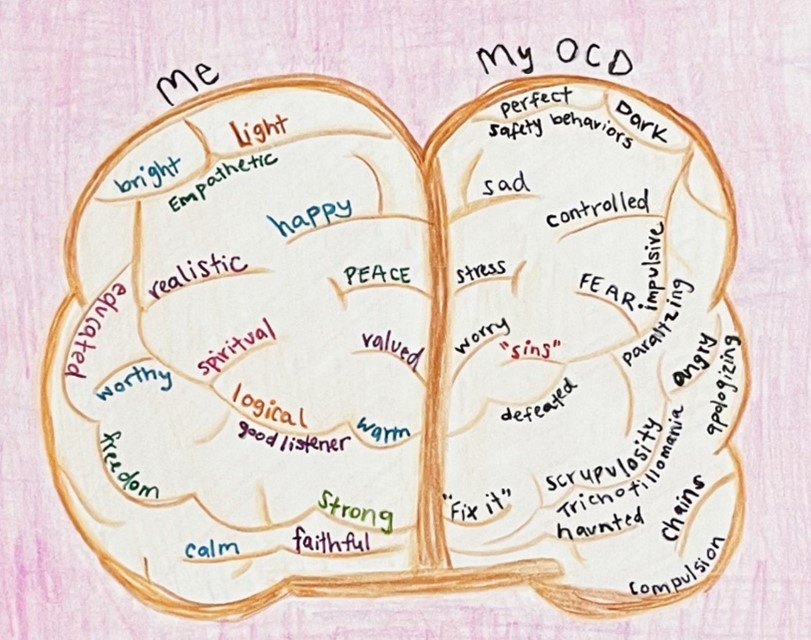 Figure 4.1. Client’s drawing of how she experiences OCD
The presence of religious symptoms does not represent a more severe type of OCD, meaning time spent dealing with symptoms or the amount of interference in daily life isn’t more severe than that for other types of OCD. Yet these phenomena might represent a particularly more distressing presentation of OCD.[36] In a study of Muslim women in Saudi Arabia, religious symptoms were reported to be more distressing than other symptoms because they disrupted their relationship with God, which was more difficult for the women to tolerate.[37] I believe it to be a more distressing presentation of OCD because every thought, every issue, every trigger that incites anxiety (no matter how small it might look to somebody on the outside) feels like a legitimate threat to lose absolutely everything the person loves and values—including eternal salvation. The person may fear that eternal welfare hangs dangerously in the balance, that all can be lost for eternity in just a fraction of a moment if he or she tips the scales of justice ever so slightly to one side. One client, a woman in her late sixties, described this struggle as the “feeling of being on a tightrope. . . . If you think or do the wrong thing you’ll fall off.”
Scrupulosity and associated clinical issues
Scrupulosity is most strongly associated with obsessional symptoms, rather than compulsive symptoms. Religious obsessions are commonly seen together with unacceptable violent thoughts, sexual obsessions, and blasphemous obsessional thoughts.[38] Some may also present with mental contamination, “a sense of internal dirtiness that originates in the absence of physical contact with a stimulus.”[39] One client described a variation on this theme: “When I am touching something and have an ‘inappropriate’ thought, I feel that I can no longer touch that object. The fear is that if I do, I will be condoning and choosing to accept the ‘bad’ thought.”
These various types of obsessions may or may not present with overt compulsive behaviors as neutralizing rituals.[40] In addition, OCD can be a “shape-shifter”[41] that changes form. For example, it is not uncommon for significant life events such as a move, entering a graduate program, or having children to trigger different OCD concerns. Current anxiety triggers may fade away and largely be forgotten, while new and different triggers flare in all of OCD’s fury.
Additionally, it is quite common to suffer with a mixed presentation of obsessional thoughts and acts. Many of my clients have scrupulosity and other types of OCD. In addition to their scrupulosity, my clients have also had unwanted intrusive thoughts and obsessive-compulsive fears around germs and contamination, harm and self-harm, relationships, order, somatic issues (i.e., bodily sensations), sexual orientation, and pedophilia. Along this line, one person noted the following: “Because I felt that the most important thing for me as a missionary was to be pure, and to have the Spirit, I believe OCD attacked me where I felt I would be most impure—so I dealt with a variety of sexual OCD themes (homosexuality OCD, pedophilia OCD, religiosity, including sexual thoughts about religious figures). I also had harm OCD, where I was afraid I would hurt my companions or others. The more I fought against it, through trying to convince myself that I was ok, or through fasting or prayer, the stronger it seemed to become.”[42]
Scrupulosity is also associated with increased anxiety and depression symptoms.[43] In one study, 48 percent of the study participants with scrupulosity qualified for a diagnosis of at least one co-occurring anxiety disorder (panic disorder, agoraphobia, specific phobia, social phobia, post-traumatic stress disorder, generalized anxiety disorder, or an anxiety disorder not otherwise specified).[44] In addition, this study found those with scrupulosity reporting symptoms of depression. Scrupulosity has also been found to overlap with obsessive-compulsive personality disorder. The presence of the personality disorder tends to predict poorer treatment outcomes.[45]
Scrupulosity can also be an expensive disorder—and this comes on top of the inordinate amount of time and energy that obsessions, ruminations, and compulsions demand. For example, people may throw newly purchased merchandise (e.g., clothing) in the garbage, purchase items they do not want simply because their children touched them while in the store, or offer substantially more money than the other party sought in business deals, just to make sure they appeased their toxic anxiety. One person ripped an entire roof off his home after he had just finished installing it. He remarked:
In preparation for selling it, I needed to reroof the house. I decided to do it on my own. After finishing it, I started worrying about whether I had installed the tar paper thick enough to protect from ice damming because the roof had a low pitch on it. Most people would have just moved on and identified that in the seller’s disclosure when they sold the house, but I couldn’t shake the anxiety this brought to me—I wanted an assurance or guarantee that there would be no ice dams occurring in the future for the new owners, but I couldn’t guarantee that. So, as crazy as this sounds, I just went ahead and tore off the new roof I had just put on and then hired a roofing company for $7,000 to come in and do it “properly.” I even had anxiety about their work and compulsively micromanaged them on the job. Once all of it was done, I still had anxiety for months.[46]
Scrupulosity and common obsessions
Obsessions in scrupulosity may include any thought or mental image that the person experiences as evidence of religious, moral, or ethical failure, including: [47]
- Repetitive thoughts about having committed a sin or moral transgression by mistake or without realizing it
- Intrusive sacrilegious or blasphemous thoughts and images (e.g., “God doesn’t exist”; unwanted mental images such as Satan, hell, or 666; or sexual thoughts about God, Jesus, or a religious figure)
- Excessive fear of having offended God
- Thoughts that one is not faithful, moral, or pious enough; hasn’t shown proper devotion or respect to God
- Fears that one did not perform a religious ritual properly
- Persistent fears of going to hell and eternal damnation or punishment from God
- Excessive focus on religious, moral, or ethical perfection
- Excessive fear of having acted counter to one’s personal morals, values, or ethics
Examples of scrupulous obsessions[48] include:
- “If I could just remember every sin!”
- “If I have a bad thought, I am guilty of sin.”
- “My prayers don’t count if I don’t say them the right way.”
- “If I feel anxiety about my confession, I must have done it wrong and need to redo it.”
- “Having a bad thought is just like doing it. I am just as guilty.”
- “If I don’t fix or undo the bad thought, something bad will happen.”
- “Since I had an evil thought, I am evil.”
- “If I didn’t say something perfectly, I lied and am guilty of sin and have to repent.”
Examples of secular, moral scrupulosity or moralosity obsessions[49] include:
- “If someone is gossiping, and I don’t stop them, it is as if I said it.”
- “If I don’t check my income taxes again thoroughly, they will find a mistake and I will go to jail.”
- “If I touch something shopping when my finger has a hangnail or dry skin, I am ruining merchandise and need to buy it.”
- “If I discipline myself in all areas, I will avoid becoming a bad person.”
- “Doing rituals will cancel out bad thoughts that may be harming others.”[50]
Authors have commented that it is common for those with scrupulosity “to convince themselves that the presence of persistent unwanted thoughts is evidence that they could or even are likely to suddenly lose all self-control and commit horrific, harmful acts. Despite the incredible degree of discomfort, fear, and frustration these thoughts bring about, no evidence of OCD patients ‘snapping’ exists.”[51]
Scrupulosity and common compulsions
As discussed previously, compulsions can be defined as any intentional thought or behavior done to neutralize or reduce the person’s sense of guilt, pain, and anxiety. Compulsions can be categorized into four types: (1) overt behavioral compulsions, (2) mental compulsions, (3) avoidance behaviors, and (4) reassurance-seeking behaviors.
Examples of scrupulous compulsions may include:[52]
- Repeated and ritualized confessing (to religious authorities, police or child protective services, or friends and family)—some may even “overconfess,” in which they confess things they are not sure they did, or things they know they did not do, “just in case.”
- Reassurance seeking about behaviors and thoughts related to religion, morals, ethics, or values (e.g., “Is this okay?”).
- Excessive, ritualized praying and reading of scriptures or other religious texts, including the repeated begging of forgiveness from God.
- Excessively quoting specific verses from the Bible or other religious texts (either out loud or silently).
- Ruminating on past acts or thoughts, trying to reason through an obsession logically to seek certainty that they have not committed a sin or acted in a manner they believe is immoral, unethical, or counter to religious teaching.
- Questioning motives, wondering if their motives were 100 percent pure.
- Ritualized “undoing” behaviors to counteract perceived sins and transgressions.
- Excessive acts of self-sacrifice (i.e., giving away large amounts of money or possessions).
- Avoidance of situations in which they fear religious anxiety will be triggered (i.e., church, temple, mosque, synagogue, prayers, movies with devil themes, dating).
- Avoidance of content that they associate with immorality or sin (i.e., certain clothes, certain numbers).
- Making deals with God to avoid eternal damnation (or merely to reduce current anxiety and discomfort).
Those suffering with scrupulosity enact compulsions seeking to relieve anxiety. However, researchers have explained that compulsions actually “maintain anxiety and the cycle of symptoms by preventing the sufferers from learning that their distress would subside without the rituals. Moreover, compulsions and avoidance behaviors prevent people from recognizing they can tolerate the distress associated with obsessive thoughts and uncertainty. Additionally, attempting to rid oneself of unwanted thoughts backfires by increasing the frequency of such thoughts. Given that religious certainty can never be obtained, those with scrupulosity become entangled in a cycle of doubt, anxiety, attempts to neutralize distress, and uncertainty.”[53]
The Process of Anxiety in Scrupulosity
One author described the process by which a scruple may be formed in each instance. Key elements in the process include an ambiguous situation, a self-accusation, an effort to prove something didn’t happen (which is futile), anxiety, guilt, compulsive confession, interference in daily living tasks, and mental exhaustion.[54]
On a broader level, while anxiety is generally known to be future-oriented, scrupulosity often keeps people imprisoned by the past. They may be tormented by past life events, details, mistakes, sins, and so on. They may also be tormented by doubts about whether their intentions were pure, even if they didn’t do anything wrong. You may ask, “If anxiety is generally future-oriented, why am I so stuck in the past?” This can be a tricky point! In scrupulosity you may be anxious and ruminating about how the past, which cannot be verified, changed, or erased (though it can be forgiven), will affect your unverifiable future (self, family, relationship with God, or eternal salvation).[55] The exquisite uncertainty that these “nonlogical doubts”[56] create is highly anxiety provoking and distressing for the scrupulous person. One person explained: “The best way I can describe scrupulosity would be a thought would enter my mind that would trigger a stress reaction that begins the process of worrying if that thought is true. My mind almost starts working at hyperspeed coming up with thoughts that would support the triggering thought being true, even though it is not. Stress and anxiety typically make scrupulosity worse, so I begin entering a downward spiral where I feel like I can’t get out.”
With scrupulosity, personal worship gets hijacked by anxiety, which means that prayer, scripture study, or church and temple attendance no longer create peace or feelings of connection with the Spirit. Instead, religious practices are often done out of a fear of punishment. And then when they are done, they often create feelings of condemnation. The lose-lose scenario is just such a painful situation for the sufferer. The religious focus often gets so narrow and trivial that the person’s religious practice gets extreme. Indeed, in this situation people often “fixate on one or a few religious values or rituals when their fixation makes them neglect other people and projects, including other moral or religious practices that may be even more important.”[57] Behaviors such as praying and confessing become repetitive, persistent, and unwanted compulsions that create a high level of personal distress. It’s not uncommon for these people to repent repeatedly every day in an effort to gain some peace from the out-of-control nature of their anxiety. Thus beleaguered, their “world has become limited and unsustainable.”[58]
One client shared her perspective: “Scrupulosity took what I loved most in life (my faith, my children, my identity as a mother, the hope of being able to live in the Celestial Kingdom with my family) and it ripped those things away from me. It was like everything good in my life was tied to a stone, and that that stone was just heavy enough to sink those dreams down to the dark waters of a lake. The awful thing was, I felt like I was the one that dropped the stone. I just couldn’t be righteous enough to hold on to everything I held most dear.” Another expressed a similar sentiment: “I felt hopeless, alone, abandoned, terrified, and damned. But worst of all, I felt that I deserved it.”
Notes
[1] Client story, used with permission.
[2] Greenberg, D., Witztum, E., & Pisante, J. (1987). Scrupulosity: Religious attitudes and clinical presentations. British Journal of Medical Psychology, 60(1), 29. https://
[3] Greenberg, D., & Huppert, J. D. (2010). Scrupulosity: A unique subtype of obsessive-compulsive disorder. Current Psychiatry Reports, 12, 282–289. https://
[4] Osborn, I. (2008). Can Christianity cure obsessive-compulsive disorder: A psychiatrist explores the role of faith in treatment. Brazos Press, 35.
[5] Abramowitz, J. S., Huppert, J. D., Cohen, A. B., et al. (2002). Religious obsessions and compulsions in a non-clinical sample: The Penn Inventory of Scrupulosity (PIOS). Behaviour Research and Therapy, 40(7), 835. https://
[6] Mora, G. (1969). The scrupulosity syndrome. International Journal of Clinical Psychology, 5(4), 163.
[7] Murphy, A. (1792). An essay on the life and genius of Samuel Johnson. Printed for T. Longman and others, 136.
[8] Climacus, J. (2012 [1605]). Ladder of divine ascent (4th ed.). Holy Transfiguration Monastery.
[9] Kempe, M., & Butler-Bowdon, W. (1936). The book of Margery Kembpe, 1436. J. Cape.
[10] Osborn, I. (2008). Can Christianity cure obsessive-compulsive disorder?,7–17.
[11] Judd, D. K. (2016). Clinical and pastoral implications of the ministry of Martin Luther and the Protestant reformation. Open Theology, 2, 324–333. https://
[12] Shapiro, L. J. (2015). Understanding OCD: Skills to control the conscience and outsmart obsessive compulsive disorder. Praeger, 50.
[13] Luther, M. (1976). Luther’s works (J. Pelikan & H. T. Lehmann, Eds.). Concordia and Fortress, 31, 129.
[14] Osborn, 2008. Can Christianity cure obsessive-compulsive disorder?, 53.
[15] Ignatius of Loyola. (1951). The spiritual exercises of Saint Ignatius (L. J. Puhl, Ed. & Trans.). Loyola University Press, 154.
[16] Hyman, B. M., & Pedrick, C. (2010). The OCD workbook: Your guide to breaking free from obsessive-compulsive disorder (3rd ed.). New Harbinger Publications, 179.
[17] Allen, H. (1683). A narrative of God’s gracious dealings with that choice Christian Mrs. Hannah Allen (afterwards married to Mr. Hatt) reciting the great advantages the devil made of her deep melancholy, and the triumphant victories, rich and sovereign graces, God gave her over all his stratagems and devices. John Wallis.
[18] O’Flaherty, V. M. (1973). Therapy for scrupulosity. In R. M. Jurievich (Ed.), Direct psychotherapy: Twenty-eight American originals (pp. 221–243). Miami University Press, 236.
[19] Kierkegaard, S. (1938). The journals of Søren Kierkegaard (A. Dru, Ed. & Trans.). Oxford University Press, 265–67. As cited in https://
[20] Weisner, W. M., & Riffel, P. A. (1960). Scrupulosity: Religion and obsessive-compulsive behavior in children. American Journal of Psychiatry, 117(4), 314.
[21] Carroll, M. G. (Ed.). (1964). The treatment of scruples. Divine Word Publications. As cited in Ciarrocchi, J. W. (1995). The doubting disease: Help for scrupulosity and religious compulsions. Paulist Press, 5.
[22] Ciarrocchi, 1995. The doubting disease, 5.
[23] Summers, J. S., & Sinnott-Armstrong, W. (2019). Clean hands? Philosophical lessons from scrupulosity. Oxford University Press, 122.
[24] Hepworth, M., Simonds, L. M., & Marsh, R. (2010). Catholic priests’ conceptualisation of scrupulosity: A grounded theory analysis. Mental Health, Religion & Culture, 13(1), 6. https://
[25] Greenberg, D., Shefler, G. (2008). Ultra-orthodox rabbinic responses to religious obsessive-compulsive disorder. Israel Journal of Psychiatry and Related Sciences,45(3),184; emphasis added.
[26] Greenberg & Shefler, 2008. Ultra-orthodox rabbinic responses, 186; emphasis added.
[27] O’Flaherty, 1973. Therapy for scrupulosity, 222.
[28] Ciarrocchi, 1995. Doubting disease, 51.
[29] Weisner, W. M., & Riffel, P. A. (1960). Scrupulosity: Religion and obsessive-compulsive behavior in children, 117, 315.
[30] Abramowitz et al., 2002. “Religious obsessions and compulsions in a non-clinical sample, 40, 835.
[31] Obsessive Compulsive Cognitions Working Group. (1997). Cognitive assessment of obsessive-compulsive disorder. Behaviour Research and Therapy, 35, 678.
[32] Summers & Sinnott-Armstrong, 2019. Clean Hands?, 82.
[33] Jone, H., & Adelman, U. (1959). Moral theology. Newman Press, 38; emphasis added.
[34] Miller & Hedges, 2008. Scrupulosity disorder: An overview, 1044.
[35] Abramowitz, J. S., & Hellberg, S. N. (2020). Scrupulosity. In E. A. Storch, D. McKay, & J. S. Abramowitz (Eds.), Advanced casebook of obsessive-compulsive and related disorders: Conceptualizations and treatment, 72. Academic Press/
[36] Nelson, E. A., Abramowitz, J. S., Whiteside, S. P., & Deacon, B. J. (2006). Scrupulosity in patients with obsessive-compulsive disorder: Relationship to clinical and cognitive phenomena. Anxiety Disorders, 20(8), 1071–1086. https://
[37] Al-Solaim, L., & Loewenthal, K. M. (2011). Religion and obsessive-compulsive disorder (OCD) among young Muslim women in Saudi Arabia. Mental Health, Religion & Culture, 14(2), 180. https://
[38] Abramowitz & Hellberg, 2020. Scrupulosity, 74.
[39] Fergus, T. A. (2014). Mental contamination and scrupulosity: Evidence of unique associations among Catholics and Protestants. Journal of Obsessive-Compulsive and Related Disorders, 3(3), 236; emphasis in original. https://
[40] Buchholz, J. L., Abramowitz, J. S., Reimann, B. C., etal. (2019). Scrupulosity, religious affiliation and symptom presentation in obsessive compulsive disorder. Behavioural and Cognitive Psychotherapy, 47(4), 478–492. Nelson, E. A., Abramowitz, J. S., Whiteside, S. P., & Deacon, B. J. (2006). Scrupulosity in patients with obsessive–compulsive disorder, 1071–1086.
[41] Ferguson, K. (2017). The OCD Mormon: Finding healing and hope in the midst of anxiety. Cedar Fort, 49–50.
[42] Story, used with permission.
[43] Greenberg, D., & Huppert, J. D. (2010). Scrupulosity: A unique subtype of obsessive-compulsive disorder, 286.
[44] Siev, J., Rasmussen, J., Sullivan, A. D. W., & Wilhelm, S. (2021). Clinical features of scrupulosity: Associated symptoms and comorbidity. Journal of Clinical Psychology 77(1), 182. https://
[45] Siev et al., 2021. Clinical features of scrupulosity, 173–188.
[46] Story, used with permission.
[47] OCD Center of Los Angeles. (2013, April 23). Scrupulosity: Where OCD meets religion, faith, and belief. https://
[48] Shapiro, 2015. Understanding OCD, 60–61.
[49] Shapiro, 2015. Understanding OCD, 88–89.
[50] Shapiro, 2015. Understanding OCD, 88–89.
[51] Hyman & Pedrick, 2010. OCD workbook, 163.
[52] OCD Center of Los Angeles, 2013. Scrupulosity.
[53] Abramowitz & Hellberg, 2020. Scrupulosity, 75–76.
[54] O’Flaherty, 1973. Therapy for scrupulosity, 224–225.
[55] Miller, C. H., & Hedges, D. W. (2008). Scrupulosity disorder: An overview, 1046. Obsessive Compulsive Cognitions Working Group. (1997). Cognitive assessment of obsessive-compulsive disorder, 678.
[56] Inozu,M.,Kahya,Yorulmaz,O.(2020).Neuroticismandreligiosity:Theroleofobsessivebeliefs,thought-controlstrategiesandguiltinscrupulosityandobsessive–compulsivesymptomsamongMuslimundergraduates.JournalofReligionandHealth,59(3),1145.
[57] Summers & Sinnott-Armstrong, 2019. Clean Hands?, 79.
[58] Shapiro, L. J. (2020). Obsessive compulsive disorder: Elements, history, treatments, and research. Praeger, 42.
