
 menu icon in the top, right corner of the screen.
 icon above to close this box.
 icon at the bottom of the screen below the browser—if you don't see it, swipe up to unhide it.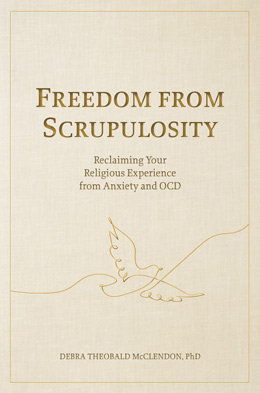
Religion and Scrupulosity
Debra Theobald McClendon, "Religion and Scrupulosity," in Freedom From Scrupulosity: Reclaiming Your Religious Experience from Anxiety and OCD (Provo, UT: Religious Studies Center, Brigham Young University; Salt Lake City: Deseret Book), 95–112.
Does Religion Cause Scrupulosity?
Some believe that their religion is to blame for their scrupulosity. They may feel bitterness toward or even hate their church because of their difficulties. Some choose to abandon their belief system because they believe their religious devotion is the source of their pain, they are exhausted from the emotional turbulence, or they simply “feel they should.”[1] Maybe this is how you feel. Please know that the social science research on scrupulosity just does not support the assumption that your religion caused your scrupulosity. One researcher explained that this “view fails to distinguish between religion causing the disorder from religion as its background.”[2] Another commented that we are “seeing the presentation of obsessive-compulsive disorder in a religious context.”[3]
This is not to claim that your religious tradition does not have flaws. Indeed, religious groups coalesce around doctrine, ritual, and social organization.[4] Religious culture (the social piece) has a way of taking on its own less-than-ideal or even toxic dynamics at times, and we should always seek to improve these cultural problems. However, these cultural imperfections notwithstanding, no research studies have found that a religious upbringing causes OCD.
What the research does show is that if a person develops OCD and happens to also be religious, the religiosity may be expressed in that person’s OCD.[5] Conservative Christians, for example, are more inclined toward scrupulosity than individuals who do not consider themselves religious.[6] In an examination of religiously committed Jews in Jerusalem, Israel, one author said, “It is suggested that religious patients have religious compulsions just as religious psychotics have religious delusions, in that their religious commitment is merely incorporated into the presenting problem rather than being a causal factor.”[7] In other words, scrupulosity “custom fits its message of doubt to the specific beliefs and practices of the sufferer.”[8]
Is there more scrupulosity in a specific religion?
Scrupulosity is found in all the world’s major religions. Studies do not provide strong evidence to suggest that certain religions have higher rates of scrupulosity than others. For example, one study examining those with OCD presenting for treatment at residential, partial hospital, and intensive outpatient programs (these people would have a more severe level of OCD) compared different religious traditions and found no differences across religious affiliation with respect to total OCD symptom severity, or the severity of any particular OCD symptoms.[9] However, the researchers may have found differences in the degree of scrupulosity. People who identified as Catholic and Protestant reported the highest levels of scrupulosity (but not statistically different from each other) compared to people who identified as Jewish or having no religion. This suggests that it may be possible there is less scrupulosity in the Jewish faith than in the Christian faith; however, these findings should be interpreted with caution because it may also be the case that the measure used to assess scrupulosity, the Pennsylvania Inventory of Scrupulosity-Revised (PIOS-R: nice play on the word pious), may not be as sensitive to Jewish populations as it is to other faith groups.[10]
Another study examining Christians, Muslims, and Jews living in Italy found that Muslims had more severe obsessive-compulsive symptoms compared to the Christians and Jews.[11] Yet this study, too, should be interpreted with caution since the researchers used a nonclinical community sample (meaning those that were not diagnosed with OCD).
Is scrupulosity caused by being too religious?
Research has generally shown that one’s intensity of scrupulous distress was not significantly related to the patient’s strength of religious devotion.[12] However, study findings are mixed.
A study examining fundamental Protestant Christians found that, contrary to the researchers’ hypothesis, religious fundamentalism (a strict, literal interpretation of religious dogma) was not significantly related to scrupulosity; in other words, level of fundamentalism was independent of scrupulosity severity.[13] Also to the contrary, a doctoral dissertation survey conducted by a person who was not a member of The Church of Jesus Christ of Latter-day Saints found that “more religious Mormons [a previously used common nickname for members of this church that is no longer preferred] were more likely to report lower levels of obsessions and compulsions, and, correspondingly, less religious Mormons were more likely to report higher levels of these traits.”[14] These finding show that people who are highly committed to their religious faith do not necessarily have a higher, more intense level of scrupulosity than their less-committed peers. So being devout or even perhaps “overly religious” may not necessarily put you at a greater vulnerability for developing scrupulosity. Another study of a nonclinical sample found that level of religiosity was not significantly associated with obsessive-compulsive symptoms or severity of cognitions.[15]
However, one study examining Canadian Christians and Turkish Muslims found that, regardless of nationality or religion, level of religiosity correlated with higher levels of OCD and scrupulosity.[16]
Are Symptoms of Scrupulosity Different for Different Religions?
Religious identity does not cause OCD and does not influence the overall severity of OCD, but it may inform the type of obsessional concerns that develop.[17] Therefore, the typical manifestation of scrupulosity differs by religion due to differences in religious traditions, values, and doctrines.
Indeed, scrupulosity is present among followers of all the world’s religions. Normal religious practice for each religion generally includes the following:[18]
- The use of water for ritual purification (such as baptism or ritual washings)
- Dietary laws (such as the Word of Wisdom for The Church of Jesus Christ of Latter-day Saints, vegetarianism and kosher laws for Seventh-day Adventism, vegetarianism for Hinduism, prohibition of swine or pork for Islam, and kosher laws in Judaism)
- Fasting
- Rituals for rites and celebrations, including prayer
- Principles of confession, forgiveness, and atonement
- Emphasis on precision of religious rituals
Each of these normal religious practices can become corrupted by anxiety’s influence on the practitioner. For example, each religious tradition listed above emphasizes the importance of prayer along with having the “right” mindset for prayer, yet such practices can be especially difficult for people suffering with scrupulosity.[19]
A brief look at some religious traditions (Christianity, Islam, Hinduism, and Judaism) follows, including commentary on potential difficulties for treating scrupulosity among their adherents. If your religious tradition is not represented, remember that the content seen in these religious beliefs is not what is most important in our discussion here, but the process of a toxic anxiety that is striking at what you value most. “Regardless of your faith, treatment will always consist of ‘doing the opposite’ of the obsession while resisting compulsive urges to respond to it with mental or physical rituals.”[20]
Christianity
In Christianity, faith is defined by a belief in Jesus Christ. Christianity emphasizes public worship, intentions, and striving for excellence. Adherents perform relatively few religious rituals compared to, say, Jews and Muslims. In devout Christians, especially evangelical (Protestant or Pentecostal), common obsessional themes for those struggling with scrupulosity are displeasing God, going to hell, and engaging in devil worship.[21] Catholics tend to demonstrate a mix of these more behaviorally oriented fears such as those mimicking other forms of OCD (e.g., concerns about dropping the Eucharist during communion or needing to say the Hail Mary just right), and also specific belief-based fears (such as going to hell or worshipping Satan).[22]
Additionally, Catholics, Protestant Christians, and members of The Church of Jesus Christ of Latter-day Saints have a strong moral obligation to follow New Testament teachings (and teachings from other holy texts) about maintaining purity of heart and mind. For many people with scrupulosity, these standards are painful as they seek with genuine intent to follow them as proscribed but find reaching the ideal is not possible. For example, in the Bible, Jesus states, “But I say unto you, That whosoever looketh on a woman to lust after her hath committed adultery with her already in his heart.”[23] The message may get interpreted that one must never have an intrusive sexual thought about anyone other than his or her spouse, which is all but impossible. [24]
Common obsessional themes for Latter-day Saints beset by scrupulosity are displeasing God or doubting God, confession, immoral thoughts, law of chastity, perfect honesty, and loss of exaltation. The Book of Mormon additionally states, “Our words will condemn us, yea, all our works will condemn us; . . . and our thoughts will also condemn us.”[25] Those with scrupulosity are tirelessly fighting to control both their actions and thoughts. One OCD treatment center indicated, “Indeed, our experience with treating Mormon clients has shown that thought suppression can be a significant impediment to progress. Helping a Mormon with scrupulosity learn to allow and accept the inevitable presence of unwanted thoughts can thus be quite a challenge.”[26]
Islam
Since Islam is a more ritualistic religion, obsessional themes for devout Muslims are often similar to those seen in ultraorthodox Judaism: issues of purity, dietary laws, concerns about accuracy of prayers, and other religious behaviors. Believers strive for salvation by following these rules and rituals.[27] Islamic teachings include a devil character, Shaytan. As seen in other religious traditions, Shaytan is a “whisperer” of doubting and sinful thoughts. Muslims with scrupulosity may attempt to suppress these unwanted thoughts. Some principles of treatment, such as exposure therapy, may feel like an assault on a Muslim’s faith if the therapist is believed to be encouraging the spirit of Shaytan to dwell in his or her thoughts.[28]
Hinduism
OCD may affect how Hindus see themselves performing puja such as personal worship in the home or elaborate temple rituals. They may obsess over the pronunciation of slokas (chanted verses and praises of the Divine) as well as their interpretation. They may be concerned with honoring the “correct” deity or following their dharma (eternal and inherent nature of reality) appropriately. They may worry about whether they have performed washing and purification rituals properly.[29] Another stressor may be preparing rangoli (a multicolored floor decoration representing wealth, joy, prosperity, and thanksgiving to deities) perfectly before festivals. [30]
Hindus may fall prey to compulsive self-shaming or self-criticism. Some believe that if they have sorrow about their weaknesses, then they might receive good karma (destiny or fate, following the law of cause and effect). When they engage in consistent self-shaming, it may also remind them to be hypervigilant about preventing negative behaviors that may impact their progress in dharma. They may feel like they must do everything perfectly to reach moksha (a transcendent state of enlightenment, a release from the cycle of rebirth impelled by the law of karma). For those with scrupulosity, these cultural tendencies may become destructive compulsions.
Judaism
Obsessional themes for ultraorthodox Jews with scrupulosity tend to more closely follow the forms of general OCD themes, such as contamination/
Judaism’s books of law contain 613 commandments. Any of these commandments can become an anxiety trigger for a person struggling with scrupulosity. A common obsession is concern about past violations of Jewish law (real or imagined). In addition, Judaism is full of ritual and has an intellectual tradition as well as a spiritual tradition. Many Jewish people consider discussing doctrinal interpretation and posing doctrinal questions to be part of the process of true devotion. So, in scrupulosity treatment, working through ideas such as accepting uncertainty may seem an insult to the faith.[33] Further, Judaism requires followers to reconcile issues around Jewish law and interpretation of law. This can be difficult for those suffering with scrupulosity, with its intolerance of ambiguity or uncertainty.[34]
Other differences between faiths
One study utilizing nonclinical undergraduate students found that Muslims in Turkey endorsed beliefs about the importance of controlling thoughts at a higher rate than did Christians in Canada.[35] However, the authors suggested their findings should be viewed as preliminary and the nonclinical, nonspecialized nature of this study would also suggest a need for caution in interpretation.
A later, more specific study found the opposite and suggested some nuanced differences between highly devout Christians and Muslims (also in Canada and Turkey, respectively), including those in specialized religious training schools to become pastors or imams (Islamic religious leaders).[36] Obsessive thoughts were more highly correlated with scrupulosity in the Christian group than in the Muslim group. This is consistent with doctrinal differences—Christianity emphasizes the importance of thoughts and intentions, while Islam is mainly focused on behaviors like following rules and performing religious rituals. Also, the Muslims scored higher on a fear-of-God scale than did the Christians. This is consistent with Muslim doctrine emphasizing fear of God, while Christianity more heavily focuses on the love of God. There was no difference between the two groups on a fear-of-sin scale.
Moral Thought-Action Fusion and Religion
Thought-action fusion (TAF) is a faulty belief seen broadly in OCD in which a person has “difficulty understanding the limitations of [his or] her thoughts.”[37] There are two categories: likelihood thought-action fusion and moral thought-action fusion. In likelihood thought-action fusion, the person believes that the mere occurrence of an unwanted thought is assumed to increase the likelihood that the feared outcome or negative event will occur. In moral thought-action fusion, the person believes that bad thoughts are equivalent (or close) to bad deeds, failing to distinguish the difference. Even if the thoughts are obsessions, which are unwanted and uncontrollable, the person sees them as equally (or almost) as bad as being immoral—in intentions, attempts, or actions.[38]
In one study, highly religious Protestants were found to hold stronger beliefs about the significance of their thoughts, especially the importance and control of thoughts, than Catholic or nonreligious people. Catholics and Protestants, while not differing significantly from each other, endorsed higher levels of moral thought-action fusion than Jews, independent of their OCD symptoms. Yet moral thought-action fusion predicted OCD symptoms only in the Jewish population. This finding suggests that thought-action fusion may only be a marker of pathology when such beliefs are not culturally normative. So although there may be thought-action fusion types of doctrines present in one’s theology, they seem to be predictive of OCD pathology only when it is not normal in the culture to have those types of beliefs. Researchers indicated that “when [beliefs of moral thought-action fusion] are consistent with religious doctrine, they are not indicative of psychopathology. For example, whereas Christianity emphasizes the importance of thoughts and intentions, Judaism is primarily focused on behavioral observance. . . . Hence, moral TAF [thought-action fusion] may be a marker of healthy religious beliefs in Christians but a sign of, or a risk factor for, obsessiveness in Jews.”[39]
When assessing scrupulosity, the PIOS-R assessment tool was believed to capture two main factors: fear of God and fear of sin. [40] Fear of God tended to be the more prominent symptom for Muslims, although it has been suggested that the assessment tool is not sensitive enough to adequately capture scrupulosity in some Jewish and Muslim populations.[41] Fear of sin tended to be more highly associated with scrupulosity in general. Fear of sin has been seen most strongly in Protestant Christians: Lutherans, Baptists, Methodists, Presbyterians, Pentecostals, Assemblies of God missionary churches, Reformed churches, evangelical churches, and so on. Also, with fear of sin, but to a lesser degree, you have the Catholics, the ultraorthodox Jewish groups, and nonreligious groups.
Confession
Confession is a prominent part of many religious traditions. The Bible teaches, “He that covereth his sins shall not prosper: but whoso confesseth and forsaketh them shall have mercy.”[42] To confess is to make an acknowledgment of sinfulness. The process can involve communal confessions (such as in Judaism) or informal confessions such as a private confession to God in a personal prayer, a confession to a person harmed in some way, or confession to a family or group. Some traditions also include a formal confession of sin to an ecclesiastical leader. For many struggling with scrupulosity, confession is a particularly anxiety-laden issue that can often become quite compulsive.
According to many religious doctrines, when parishioners are guilty of sin, repentance is required. Confession is often one part of this repentance process. The purpose of confession, as taught by The Church of Jesus Christ of Latter-day Saints, is to encourage parishioners “to unburden themselves so they can fully seek the Lord’s help in changing and healing.”[43] In Hinduism there are no official clergy, and confession is done directly to God. Also, in Islam there is no concept of formal, ecclesiastical confession to a religious leader; individuals limit their confessions to direct confession to God in their prayers and deeds. Sins are identified in the Qur’an, and there are verses in the Qur’an that teach of atonement.[44] In Judaism, confessions are done communally in church worship services, such as in saying, “We have sinned.” Yom Kippur is the Day of Atonement in which Jews reflect on their past year and recognize when they have missed the mark or made moral sins. The usual practices during this holiday include fasting, going to the temple and praying, and apologizing to those they have wronged.
Many Christian churches utilize formal confession to a religious authority in some way. For example, the Catholic Church considers confession a sacrament instituted by the Lord. For Catholics, the priest is believed to stand in place of the Lord and his church. For members of The Church of Jesus Christ of Latter-day Saints, their bishop is believed to hold this role. However, some Christian churches do not utilize this formal confession process. Pentecostals confess their sins directly to God and not to a church leader.
Legitimate confession of sin can be healing and soul-lifting to a believer. The Bible teaches, “If we confess our sins, he is faithful and just to forgive us our sins, and to cleanse us from all unrighteousness.”[45] Yet some people engage in frequent confession driven by toxic anxiety. This can be a difficult circumstance for clergy. For example, some with scrupulosity are prone to “shop around” for ecclesiastical leaders. One Catholic priest commented about a scrupulosity-driven parishioner, “If one priest doesn’t seem to take her seriously she’ll go to another priest and another.”[46] These people may feel obsessively anxious about whether the confession was done the right way. So, wanting to rid themselves of ambiguity and uncertainty, they may choose to go visit with the next person up the chain in religious authority.
Another aspect of confession that is quite susceptible to the compulsivity of scrupulosity is personal prayer and direct confession to God. Although the dysfunction of the compulsions may be less visible to others than is formal confession to a confessor, the problem tends to be more frequent for those with scrupulosity since they have unlimited access to God through personal prayer.
Doctrinal Clarifications
Doctrinal misconception can contribute to some of the difficulty of scrupulosity, driving up anxiety. Two common doctrines I have found helpful to clarify at the outset of therapy (for my clients, members of The Church of Jesus Christ of Latter-day Saints) are the nature of sin and the principle of confession (when confession to a clergy member is needed). I will discuss these in turn with reference to both Latter-day Saint and Catholic perspectives. Is there doctrinal clarification that would be helpful for you from your own religious tradition?
Sin
What is sin? The Latter-day Saint Bible Dictionary defines sin thus: “To commit sin is to willfully disobey God’s commandments or to fail to act righteously despite a knowledge of the truth.”[47] Sin is intentional, an active rebellion against the commandments of God—knowingly and actively choosing to behave in a manner contrary to God’s will.
Catholic doctrine makes the same distinction, clarifying for its parishioners the difference between venial sins (imperfections or weaknesses surrounding less important matters) and mortal sins. “Venial sins, which do not separate us from the grace of God, and into which we frequently fall . . . may be omitted [from confession] without sin.”[48] It is also not a mortal sin if there was no intention of committing sin.
For those suffering with scrupulosity, anxiety blurs this concept of willful disobedience. They forget that sin is intentional and fear they can be guilty of inadvertently, or unintentionally, sinning—having an immoral intrusive thought pop into their heads, making a mistake, accidentally doing something they later find out was wrong, deliberating imperfectly, and so on. These are natural consequences of mortal living but are not generally considered sinful.
For example, some with scrupulosity fear that touching or washing their genitals when showering or bathing makes them guilty of sin (or at a bare minimum reveals a deep, unconscious desire to commit sin). The fact is these people are showering to take care of their hygiene needs, with no intention of committing sin—yet they may torture themselves for fear of having done so (e.g., “Was that one too many swipes with the soap?”).
Confession to clergy
I have also found that the doctrine of confession frequently needs to be discussed and properly understood. Parameters for what constitutes necessary confession to an ecclesiastical leader may not always be well communicated or may simply be misunderstood since high levels of anxiety in scrupulosity can skew one’s perception of doctrine.
Catholics make confession of venial sins (lesser sins, typically occurring in daily living due to mortal imperfections rather than resulting from purposeful rebellion or disobedience) directly to God, but more significant mortal sins must be confessed to the priest. Three requirements must be met at the same time for sin to be considered mortal:
- The sin must include grave matter (e.g., skipping Mass without an appropriate reason, stealing, abortion, etc.).
- One must have full knowledge there is grave matter present. One cannot sin accidentally.
- One must actively choose to sin in light of the knowledge that there is grave matter. One must choose to use agency to freely commit the sin.[49]
My Latter-day Saint clients often express a need “to go talk to the bishop” if they have an immoral thought or are uncertain about their intentions in a given situation, or if they worry that they may have omitted a detail in a previous confession. While describing his difficulties with scrupulosity in an initial therapy appointment, one client, a single eighteen-year-old male, commented, “I’ve repented to a bishop for holding a girl’s hand. That was scary.” Within this faith tradition, formal confession to an ecclesiastical leader is required only for certain issues.[50] The Latter-day Saint Bible Dictionary clarifies this: “Confession to a church official (in most cases the bishop) is necessary whenever one’s transgression is of a nature for which the Church might impose loss of membership or other disciplinary action. The bishop cannot and does not forgive sin, but he may judge the matter and waive the penalty that the Church might otherwise impose against the person. The repentant sinner must still make confession and obtain forgiveness of the Lord.”[51] In other words, in the repentance process most confession not only can but should be done privately between the individual and God (and the person harmed, if relevant).
If one has worked with a church leader to resolve a legitimate sin issue and that leader has indicated that requirements for repentance have been satisfied, then the repentance process was done properly. People with scrupulosity often become obsessed with intense fear when they think their repentance or confession was not adequate in some way. There is no need to return to the same leader or any other ecclesiastical leaders for additional confessions on the same issue. Elder Gerrit W. Gong taught, “Once we repent and priesthood leaders declare us worthy, we need not continue to confess and confess these past sins. To be worthy does not mean to be perfect. Heavenly Father’s plan of happiness invites us to be humbly at peace on our life’s journey to someday become perfected in Christ, not constantly worried, frustrated, or unhappy in our imperfections today.”[52] In addition, The Church of Jesus Christ of Latter-day Saints does not impose ecclesiastical discipline on anyone for their thoughts.
In the spirit of offering doctrinal clarification, I have compiled expansive lists of what I call anti-scrupulosity scriptures and anti-scrupulosity quotes by leaders from The Church of Jesus Christ of Latter-day Saints. The scriptural references include many Bible references. I offer these to you in appendix 2 and appendix 3, respectively. Enjoy these for their interest and spend time reviewing and rereviewing doctrines that you feel have become skewed for you. However, please be aware that doctrinal misconception does not lie at the core of the disorder. According to one researcher, “Mere intellectual insight, however, is not enough to generate change.”[53] So, while enjoying these resources, please look forward to learning more about the gold-standard treatments to be discussed in the chapters to come.
Notes
[1] Shapiro, L. J. (2015). Understanding OCD: Skills to control the conscience and outsmart obsessive compulsive disorder. Praeger, 69.
[2] Ciarrocchi, J. W. (1995). The doubting disease: Help for scrupulosity and religious compulsions. Paulist Press, 8.
[3] Greenberg, D., & Witztum, E. (1991). Problems in the treatment of religious patients. American journal of psychotherapy, 45(4), 562. https://
[4] Greenberg & Witztum, 1991. Problems in the treatment of religious patients, 563.
[5] Greenberg, D., & Huppert, J. D. (2010). Scrupulosity: A unique subtype of obsessive-compulsive disorder. Current Psychiatry Reports, 12, 282–289.
[6] Inozu, M., Clark, D. A., & Karanci, A. N. (2012). Scrupulosity in Islam: a comparison of highly religious Turkish and Canadian samples. Behavior Therapy, 43(1), 191. https://
[7] Greenberg, D. (1984). Are religious compulsions religious or compulsive? A phenomenological study. American Journal of Psychotherapy, 38(4), 530.
[8] OCD Center of Los Angeles. (2013, April 23). Scrupulosity: Where OCD meets religion, faith, and belief. https://
[9] Buchholz, J. L., Abramowitz, J. S., Reimann, B. C., et al. (2019). Scrupulosity, religious affiliation and symptom presentation in obsessive compulsive disorder. Behavioural and Cognitive Psychotherapy, 47(4), 478–492.
[10] Huppert, J. D. & Siev, J. (2010). Treating scrupulosity in religious individuals using cognitive-behavioral therapy. Cognitive and Behavioral Practice, 17, 384.
[11] Dèttore, D., Berardi, D., & Pozza, A. (2017). Religious affiliation and obsessive cognitions and symptoms: A comparison between Jews, Christians, and Muslims in non-clinical groups in Italy. Psychology of Religion and Spirituality, 9(4), 348–357. https://
[12] Nelson, E. A., Abramowitz, J. S., Whiteside, S. P., & Deacon, B. J. (2006). Scrupulosity in patients with obsessive-compulsive disorder: Relationship to clinical and cognitive phenomena. Anxiety Disorders, 20(8), 1071–1086. https://
[13] Witzig, T. F., Jr., & Pollard, C. A. (2013). Obsessional beliefs, religious beliefs, and scrupulosity among fundamental Protestant Christians. Journal of Obsessive-Compulsive and Related Disorders, 2(3), 331–337.
[14] Medeiros, M. (2015). Intrusive worries, related behaviors, and religious beliefs among Mormons [Doctoral dissertation, Palo Alto University], 42.
[15] Dèttore, D., Berardi, D., & Pozza, A. (2017). Religious affiliation and obsessive cognitions and symptoms, 348–357.
[16] Altin, M. (2009). A cross-cultural investigation of obsessive compulsive disorder symptomatology: The role of religiosity and religious affiliation [Doctoral dissertation, Middle East Technical University].
[17] Siev, J., Chambless, D. L., & Huppert, J. D. (2010). Moral thought-action fusion and OCD symptoms: The moderating role of religious affiliation. Journal of Anxiety Disorders, 24, 309–312. Purdon, C., & Clark, D. A. (2005). Overcoming obsessive thoughts: How to gain control of your OCD. New Harbinger Publications, 94; emphasis added.
[18] Shapiro, 2015. Understanding OCD, 62–69.
[19] Shapiro, 2015. Understanding OCD, 75.
[20] Shapiro, 2015. Understanding OCD, 61–62.
[21] Huppert & Siev, 2010. Treating scrupulosity in religious individuals, 383.
[22] Huppert & Siev, 2010. Treating scrupulosity in religious individuals, 383.
[23] Matthew 5:28.
[24] Based on OCD Center of Los Angeles, 2013. Scrupulosity.
[25] Alma 12:14.
[26] OCD Center of Los Angeles, 2013. Scrupulosity.
[27] Yorulmaz, O., Gençöz, T., & Woody, S. (2009). OCD cognitions and symptoms in different religious contexts. Journal of Anxiety Disorders, 23(3), 401–406. https://
[28] OCD Center of Los Angeles. (2013, April 23). Scrupulosity.
[29] Shapiro, 2015. Understanding OCD, 62–63.
[30] O’Dunne, K. Religious scrupulosity in hinduism. International OCD Foundation. https://
[31] Huppert & Siev, 2010. Treating scrupulosity in religious individuals, 383. Greenberg, D., & Shefler, G. (2008). Ultra-orthodox rabbinic responses to religious obsessive-compulsive disorder. The Israel Journal of Psychiatry and Related Sciences, 45(3), 184.
[32] Greenberg, D., Witztum, E., & Pisante, J. (1987). Scrupulosity: Religious attitudes and clinical presentations. British Journal of Medical Psychology, 60(1), 29–37.
[33] OCD Center of Los Angeles, 2013. Scrupulosity.
[34] Hershfield, J. (2020, January 7). Treatment for OCD scrupulosity needs to respect the faith. Anxiety.org. https://
[35] Yorulmaz, Gençöz, & Woody, 2009. OCD cognitions and symptoms in different religious contexts, 404.
[36] Inozu, Clark, & Karanci, 2012. Scrupulosity in Islam, 191.
[37] Summers, J. S., & Sinnott-Armstrong, W. (2014). Scrupulous agents. Philosophical Psychology, 28(7), 6. https://
[38] Summers & Sinnott-Armstrong, 2014. Scrupulous agents, 6.
[39] Siev et al., 2010. Moral thought-action fusion and OCD symptoms, 311.
[40] Shapiro, L. J., Krompinger, J. W., Gironda, C. M, Elias, J. A. (2013). Development of a scrupulosity severity scale using the Pennsylvania Inventory of Scrupulosity-Revised. Journal of Obsessive-Compulsive and Related Disorders, 2(4),420–424. https://
[41] Greenberg, D., & Huppert, J. D. (2010). Scrupulosity: A unique subtype of obsessive-compulsive disorder, 285. Huppert & Siev, 2010. Treating scrupulosity in religious individuals, 384.
[42] Proverbs 28:13.
[43] The Church of Jesus Christ of Latter-day Saints. (2022). Repentance and Church membership councils. In Serving in The Church of Jesus Christ of Latter-day Saints. https://
[44] Shapiro, 2015. Understanding OCD, 67.
[45] 1 John 1:9.
[46] Hepworth, M., Simonds, L. M., & Marsh, R. (2010). Catholic priests’ conceptualisation of scrupulosity: A grounded theory analysis. Mental Health, Religion & Culture, 13(1), 8. https://
[47] The Church of Jesus Christ of Latter-day Saints. (n.d.). Sin. In Bible dictionary. https://
[48] Beattie, T. (2011). Scruples and sainthood: Accepting and overcoming scruples with the help of the saints. Loreto Publications, 104.
[49] Beattie, 2011, Scruples and sainthood, 105; emphasis added.
[50] See discussion in McClendon, D. T. (September 2019). Understanding scrupulosity (religious OCD). https://
[51] The Church of Jesus Christ of Latter-day Saints. (n.d.). Confession. In Bible dictionary. https://
[52] Gong, G. W. (2016, May). Always remember him. Ensign, 109. https://
[53] Ciarrocchi, 1995. Doubting disease, 55.
