
 menu icon in the top, right corner of the screen.
 icon above to close this box.
 icon at the bottom of the screen below the browser—if you don't see it, swipe up to unhide it.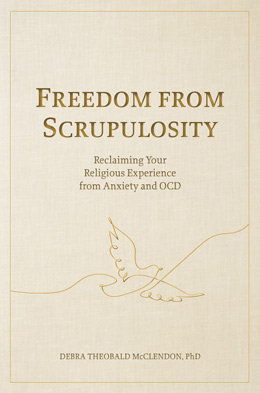
Introduction
Debra Theobald McClendon, "Introduction," in Freedom From Scrupulosity: Reclaiming Your Religious Experience from Anxiety and OCD (Provo, UT: Religious Studies Center, Brigham Young University; Salt Lake City: Deseret Book), xi-1.
A Devastating Disorder
Near the end of my missionary service for The Church of Jesus Christ of Latter-day Saints, I started having anxiety episodes over being in tune with the Spirit and potentially disobeying spiritual promptings. I began to think that I was responsible for perfecting myself and would set extreme and unrealistic expectations. Eternity seemed to hang on everyday decisions.
I feared I was offending God. I became fixated on the idea that God knew my thoughts, and so I started to try and control my thoughts through self-talk and outward compulsive behavior. Sometimes I would exhale in frustration while simultaneously throwing my hands into the air when a “bad” thought would cross my mind. Other times I would give myself a pep talk to think better. This type of behavior became routine and over the next couple of years escalated in frequency and intensity.
I started outlawing different types of personal enjoyment for reasons I described as consecration. I would often feel guilty using leisure time to play a board game or watch a television show for fear that God would be disappointed with these decisions. I thought all my spare time had to be filled with reading church literature and progressing spiritually. I would pray compulsively on how I should use my time and thought my heightened anxiety over that last athletic event or show I had watched was a sign that God was displeased with my previous choice. I began to dread praying and worried that I would have to give up another pleasurable activity. My prayers, which had previously been filled with peace and joy, had now been replaced with angst and worry.
I also started experiencing anxiety regarding my worthiness even though I had been told previously by a church leader that I was clean and worthy. Religious content about repentance would trigger my anxiety, and I found myself needing repeated reassurance that I was in good spiritual standing. I would ruminate about my past, hoping I had confessed my sins properly. I would also feel an urge to confess mistakes.
The anxiety also affected my personal life. When I started dating, I was anxious over making sure I found the “one.” Then when I got engaged, I prayed over and over about whether I had made the right choice, even after I had received a confirming feeling of peace.
I had periods of ups and downs, but this type of compulsive behavior continued to increase until my anxiety eventually climaxed. Anxiety over my thoughts was so bad that I legitimately thought I had lost my mind. I fell into a depression from the constant worry over my thoughts. The combination of prolonged, exquisite suffering mixed with no visible end in sight became unbearable. Hopelessness, deep sadness, and panic—along with a mixture of anger towards God—consumed me, and I wondered how I could keep going on.
The anxiety had cornered me into a pseudo-righteousness that was void of the mercy, grace, forgiveness, and hope of the gospel of Jesus Christ. My compulsive behavior made me appear spiritually sensitive and holy to others, but in truth my behavior was mostly motivated out of fear and anxiety. It was torment. But I am grateful I didn’t give up, because one day I learned about a disorder called scrupulosity and was miraculously guided towards therapy.[1]
A leader from The Church of Jesus Christ of Latter-day Saints, Elder Neal A. Maxwell, observed, “There is a difference . . . between being ‘anxiously engaged’ and being over-anxious.”[2] The tormented person in the above account was indeed overanxious!
Do you see some of yourself in that story? Are you obsessively worried about your worthiness before God? Is your ability to feel peace disrupted by anxiety and worry about doing things right or about having done some things wrong? Is your life held hostage by anxiety over religious or moral issues? Do worship activities such as scripture study or attendance at church meetings create emotional torment because you are hyperfocused on content that triggers your anxiety but you don’t know how to let it go? Do you excessively pray or perform religious rituals to try to assuage uncomfortable feelings? Do you more than frequently seek reassurance from others? Do you feel like you suffer the pains of a damned soul no matter how much you repent? Or do you feel you are handling your life pretty well except you can’t get over that “one thing” you did? These feelings often create spiritual torment in the lives of otherwise dedicated, conscientious people.
Most people are surprised to learn that rather than being legitimate spiritual promptings, these anxious thoughts and processes are facets of a particular form of obsessive-compulsive disorder (OCD) called scrupulosity. “Scrupulosity is a psychological disorder primarily characterized by pathological guilt or obsession associated with moral or religious issues that is often accompanied by compulsive moral or religious observance and is highly distressing and maladaptive.”[3]
Yes, the craziness that is happening to you is a real thing—it has a name and a treatment! And you are not the only one. One client reflected on the beginning of her mental health journey: “I just felt crazy and I didn’t want to explain my thoughts [to anyone].” Yet in therapy she did describe her intrusive thoughts: “Fat, crazy thoughts that are so disturbing. They’re terrible, absolutely terrible.” Another client said: “I didn’t even know what was happening to me. I knew I was anxious, and I knew I confessed a lot to my wife to try and relieve the anxiety I felt, but I had no idea what was going on with me even though I could barely function.”[4] Maybe, like these people, you feel crazy and don’t know what is going on with you. Maybe you just can’t understand why the things you are trying to do to help yourself aren’t helping. Maybe you are scared to even know.
To understand scrupulosity, you must first understand OCD because scrupulosity is a form of OCD—meaning scrupulosity is OCD. OCD is a disorder in a class of mental disorders called obsessive-compulsive and related disorders, which builds on a class of disorders called anxiety disorders. In these disorders, anxiety lies at the core of the distress and impairment.
In OCD, people suffer from obsessions, which are intrusive, irrational, unwanted thoughts that become highly distressing and cause an intense level of anxiety as people try to neutralize the distress of the thoughts. These thoughts may come out of nowhere and then get stuck looping in their mind again and again and again . . . and again and again and again . . . and again and again and again . . . and again and again and again . . . for hours, days, weeks, and sometimes years. It is a maddening process. They can’t stop thinking the thought or stop worrying about what the thought means; they can’t let it go. They may further engage in compulsions, which are mental or physical acts that are done to try to neutralize the obsessions or to protect themselves from experiencing the anxiety caused by the obsessions.
There are a variety of forms of obsessive-compulsive disorder with content focused on different concerns. Scrupulosity focuses on religious and moral obsessions. Because scrupulosity is attached to religious and moral content, identifying it presents some unique challenges when compared to other forms of OCD, such as germ/
Scrupulosity is a devastating disorder. Sufferers often experience deep fear and even terror when facing what they believe will be the loss of all they believe in, their family, and salvation for eternity because of what they perceive to be their own failings. Although the content of the obsessions in scrupulosity is religious or moral in nature, it is not a religious, spiritual, or moral problem at its core. Scrupulosity is not caused by one’s religious denomination or one’s personal worthiness, but rather is an anxiety problem driven by poorly regulated, very high, toxic anxiety. It is an affliction.
The people who struggle with scrupulosity are amazing, valiant individuals with a dedicated love of God and a strong desire to live good lives in accordance with his will. They know the doctrines of their religious faith and generally could give a sermon on any topic if they were asked to do so. Yet they are tormented with paralyzing fear. Their problems do not stem from a moral failing or a lack of faith. The core of scrupulosity lies in the destructive process of toxic anxiety.
For example, one author illustrated his pathological anxiety process and toxic guilt that intersected with religious content. Although this story is dramatic, sadly, it is not unusual to the dedicated religious believers suffering with scrupulosity.
Occasionally, the guilt would strike while I was at the store. I would be in Walmart walking along, maybe looking at the toys, and I would step on a wrong tile. More accurately, I would step on the wrong section of tile. The place where a tile touched another diagonally shouldn’t be stepped on.
It shouldn’t.
I don’t remember when this started. But somewhere I had discovered that two tiles diagonal from one another sort of resemble breasts if looked at together.
Of course they didn’t really.
Of course it was crazy.
But breasts were sexual.
Sexual was bad.
It was sinful.
Other people didn’t do this.
I have a special relationship with God.
He expects more of me.
I stepped on it because I wanted them.
I wanted sex.
I was sexual.
I was sinful.
I WAS SINFUL.
I needed to kneel.
Kneel down now.
KNEEL.
KNEEL.
KNEEL!
Better safe than sorry.
I’d pretend to look at a bottom shelf. Maybe tie my shoe.
I can remember this happening in so many stores, all of the sudden feeling that throbbing pang of guilt.
For me, that guilt was God. . . .
God is how you feel him.
I would have told anyone who asked that God was a loving and caring Father in Heaven with a near mysterious love for all his children. But when the guilt struck, as suddenly as lightning and as forcibly as thunder, my intellectual convictions of who I supposed God to be all went silent. Sometimes it was unprovoked. Other times it came because I stepped on the wrong section of the store’s linoleum tile and had thus offended God. One way or another, I needed to pray for forgiveness.[5]
As seen in this story, when this person was calm, he had a beautiful testimony of the benevolent nature of God. Yet when this maladaptive anxiety process kicked in, putting him in a frenzy of anxiety that kicked him out of his window of tolerance, everything he knew about God went offline. The good news is that scrupulosity, as with other forms of OCD, can be successfully treated with evidence-based treatment practices. That’s what this book is about!
When people I see in treatment begin to heal and improve, the word freedom seems to be the word most commonly chosen to express the qualitative change beginning to occur in their lives. Freedom to not think about their fears. Freedom to not think about their OCD 24/
Details about This Book
This book is a comprehensive examination of religious scrupulosity, with a focus on treatment. In part 1, I describe basics of anxiety, OCD, and scrupulosity and how each is related and interconnected. Part 2 explores scrupulosity on a deeper level, including what researchers have learned about scrupulosity through their studies as reported in the academic literature. In part 3, I discuss treatment considerations and present a gold-standard, evidence-based approach to self-help treatment. The interventions described can serve as a stand-alone self-help treatment for scrupulosity or as an adjunct to working with a competent mental health professional. The final chapter in this section explores issues related to treatment outcome and shares many client stories.
Scrupulosity can be seen in all religious traditions. This book is written to anyone interested in learning about scrupulosity regardless of religious affiliation. Indeed, the research presented examines all types of people from many faith traditions. However, because I am a licensed psychologist practicing in Utah, my psychotherapy practice is filled exclusively with members of The Church of Jesus Christ of Latter-day Saints. Therefore, many of the discussions and client stories will include Christian content and will specifically reference content of The Church of Jesus Christ of Latter-day Saints, such as quotes from its leaders (they will be introduced with a title such as Elder, President, apostle, or prophet), scriptures from holy texts such as the Bible and Book of Mormon, or references to lifestyle circumstances, such as missionary service or temple attendance. I will also include compilations of anti-scrupulosity scriptures (including scriptures from the Bible and holy texts of The Church of Jesus Christ of Latter-day Saints) and quotes from its leaders in the appendix. For those unfamiliar with The Church of Jesus Christ of Latter-day Saints, I have included in appendix 1 a glossary to explain any specialized language.
Religious scrupulosity can also be found in those who may not hold a religious belief. Although they may not believe in a god or accept religious principles such as an afterlife, they may still suffer with obsessions and compulsions that are religious in nature. In addition, scrupulosity may manifest with moral content that is not religious in nature. This is called secular moral scrupulosity. Although this book focuses on religious scrupulosity due to the nature of my religious clientele, the discussions and examples also include moral, secular issues (such as being honest or being a law-abiding citizen) and will be relevant to those who may be suffering from secular moral scrupulosity.
Also, as seen in the examples presented already in this chapter, this book will contain many experiences from people who have previously struggled or continue to struggle with scrupulosity. These accounts will appear in italics throughout the text. Each example shared will have either (1) been previously published, with reference information provided, or (2) come from one of my personal therapeutic contacts, a therapy client from my private psychotherapy practice, or a person who has shared his or her story with me for the purpose of reaching out to others. Please know that these individuals have given me permission to share this therapeutic content. I honor each of them. I am very grateful to them for their generosity and courage in sharing their personal and sensitive stories. Without exception, they have chosen to share their most difficult, deeply personal challenges and fears only with a desire to be helpful to you and to others. I have included a great deal from them in the book, including some very lengthy passages and stories, because I feel it is vitally important that you hear directly from them. I hope you will find their contributions illustrative as you ponder the ideas written herein and think about how they may apply to you or your loved one.
Additionally, for referencing source material I have opted to use a modified citation style throughout this work. For professionals I have provided full references in APA style (American Psychological Association). However, to avoid cluttering the text for lay readers, I have omitted the in-text parenthetical citations. Specific references with relevant page numbers are provided at the end of each chapter, and references indicating source material are provided in the bibliography at the end of the book.
You may wonder if this book is appropriate for you. Yes! You are my intended audience. You may struggle with this devastating disorder and want to learn more about it, as well as learn treatment skills to loosen OCD’s grip in your life. You may be a parent of a child that is struggling and want to know how to offer support and how not to reinforce the vicious obsessive-compulsive cycle. You may be a friend or another family member trying to support a loved one. You may be an ecclesiastical leader trying to support a member of your congregation. You may be a mental health professional seeking to become more knowledgeable and competent in treating this client population. You may not fit into these categories but have a particular interest in this topic for other reasons. If you have found yourself reading these pages for any reason, I hope this book supports your learning and experiences. Recognizing this diverse readership, for ease in writing, unless noted otherwise, I use the term you to refer to someone who is personally struggling with scrupulosity.
With this introduction and these notes, I warmly welcome you to Freedom from Scrupulosity: Reclaiming Your Religious Experience from Anxiety and OCD.
Notes
[1] Story used with permission.
[2] Maxwell, N. A. (1976, November). Notwithstanding my weakness. Ensign, 13.
[3] Miller, C. H., & Hedges, D. W. (2008). Scrupulosity disorder: An overview and introductory analysis. Journal of Anxiety Disorders, 22(6), 1042. https://
[4] Client story, used with permission.
[5] Kerby, Taylor. (2021). Scrupulous: My obsessive compulsion for God. Common Consent Press, 3–5. Used with permission.
