
 menu icon in the top, right corner of the screen.
 icon above to close this box.
 icon at the bottom of the screen below the browser—if you don't see it, swipe up to unhide it.
The “Religious Educator”—A Quarter Century of Refinement
Leigh Ann Copas
Leigh Ann Copas is the publications coordinator at the BYU Religious Studies Center.
As the Religious Educator: Perspectives on the Restored Gospel marks its twenty-fifth anniversary—a milestone traditionally celebrated with silver—it stands as a testament to the enduring value of thoughtful, faithful scholarship. From its modest beginnings in 2000 with a single issue, the journal has grown into a respected academic publication appearing three times annually.[1]
This silver anniversary celebration invites reflection not only on the journal’s legacy but on its connection to the symbolic presence of silver in the scriptures. In Malachi 3:1–3 we observe that the refining of silver is a powerful metaphor for spiritual preparation and purification:
Behold, I will send my messenger, and he shall prepare the way before me: and the Lord, whom ye seek, shall suddenly come to his temple, even the messenger of the covenant, whom ye delight in: behold, he shall come, saith the Lord of hosts.
But who may abide the day of his coming? and who shall stand when he appeareth? for he is like a refiner’s fire, and like fullers’ soap:
And he shall sit as a refiner and purifier of silver: and he shall purify the sons of Levi, and purge them as gold and silver, that they may offer unto the Lord an offering in righteousness.
Just as silver is refined through fire to remove impurities, the Religious Educator has served as a crucible for refining gospel understanding. Submissions initially focused on three criteria—gospel teaching, doctrinal understanding, and Church history, topics often covered by BYU scholars—but have grown to include remarks from Apostles and other General Authorities and General Officers of the Church, along with presenting insight and expertise from seminary and institute teachers. Through careful scholarship and inspired teaching, the Religious Educator has helped purify and elevate the spiritual offerings of educators and learners alike.
A Flame of Inspired Instruction
Gospel teaching is the spark that ignites spiritual transformation, refining both teachers and learners as they read and apply messages found in the Religious Educator. Over the last twenty-five years, editors in chief have consistently championed articles focused on inspired instruction, offering educators tools to teach with clarity, conviction, and compassion. In the journal’s pages, readers have encountered practical strategies, pedagogical insights, and spiritual encouragement that elevate the act of teaching.
 The first issue of the Religious Educator. Photo by Bekah Black.
For example, in “Teaching the Four Gospels: Five Considerations,” professor of ancient scripture Gaye Strathearn provides educators with a framework for approaching the New Testament with greater depth and sensitivity. Her guidance on genre, interpretation, and Restoration scripture helps teachers refine their understanding and better convey the life and teachings of Christ.
Similarly, in “Attributes and Approaches of Effective Gospel Teachers,” BYU alumnus Kendel Christensen and professor of Church history and doctrine Lloyd D. Newell explore the qualities that distinguish spiritually impactful educators. They emphasize preparation, empathy, and adaptability—all of which are traits that transform teaching into a sanctifying experience for both the instructor and students.
Finally, “The Word Made Flesh: Teaching the Gospel Concretely,” by professor of ancient scripture Stephan Taeger, invites educators to present gospel principles in tangible and relatable ways. This approach helps learners internalize eternal truths and apply them in meaningful ways to their lives. These approaches echo the refining of silver by making abstract doctrine accessible and actionable for learners.
Purifying Truth Through Scholarship
Just as silver is purified through repeated refinement, doctrinal understanding is clarified through careful, faithful scholarship. In the Religious Educator, authors help readers examine, articulate, and deepen connections to gospel truths. Throughout his article “Understanding and Teaching Correct Doctrine Correctly,” J. Jarlath Brophy emphasizes the importance of doctrinal accuracy in classroom settings and cautions against misinterpretation. He calls teachers to align their lessons with the words of living prophets.
Additionally, Religious Education professors Anthony Sweat, Michael Hubbard MacKay, and Gerrit J. Dirkmaat offer a framework for distinguishing between core, supportive, policy, and esoteric teachings in their article “Doctrine: Models to Evaluate Types and Sources of Latter-day Saint Teachings.” These models help gospel teachers navigate doctrinal complexities with confidence and care, thus ensuring that what is taught is both accurate and contextualized appropriately for the lesson and students.
Preserving Our Precious Legacy
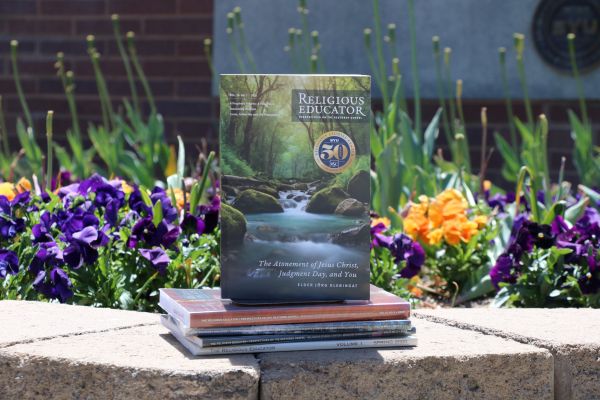 The fiftieth anniversary issue of the Religious Educator. Photo by Bekah Black.
Silver gains value through craftsmanship and preservation, and likewise Church history enriches gospel understanding by connecting the past to the present. Editors of the Religious Educator have consistently treated historical inquiry as a sacred endeavor—one that refines faith, deepens perspective, and strengthens testimony. By presenting well-researched articles and thoughtful analysis in each issue, editors have showcased messages that aid educators and learners in appreciating the spiritual significance of historical context. Elder Bruce R. McConkie once asked, “What histories shall we believe where Mormon history is concerned?” In their article “A Method for Evaluating Latter-day Saint History,” professors of Church history and doctrine Anthony Sweat and Kenneth Alford outline five criteria for answering Elder McConkie’s question and assessing the reliability of historical claims:
- Is it a primary account?
- What is its relationship to other sources?
- Is it a contemporary account?
- Does it have an objective perspective?
- Are its claims supported by evidence?
Such an approach helps educators and students navigate the complexities of Church history with discernment, embrace faith-promoting scholarship, avoid sensationalism, and reduce the spreading of false information.
The Growth of Seminary and Institute Contributions
From its earliest volumes, the Religious Educator has welcomed voices from seminary and institute educators, recognizing their frontline role in gospel instruction. Interest from S&I teachers not only helped drive early subscriptions, but their contributions quickly became a vital part of the journal’s identity.
What began as individual submissions from S&I instructors evolved into a dedicated yearly issue. Recent issues have addressed modern challenges such as integrating Come, Follow Me with Life Preparation lessons, using empathy to teach difficult scripture passages, and navigating the role of artificial intelligence in religious education. These articles demonstrate the journal’s responsiveness to the evolving needs of gospel teachers and its role in refining instruction for a changing world.
A landmark moment in this evolution was including the proceedings from the Church Educational System Religious Educators Conference held on June 19, 2024. This historical event brought together religious educators from across CES, including Seminaries and Institutes, BYU, BYU–Idaho, BYU–Hawaii, Ensign College, and BYU–Pathway Worldwide. Together, these educators serve nearly half a million young adults across the Church. As Elder Clark G. Gilbert noted, this was the first time CES educators had assembled collectively to share insights and strengthen their teaching efforts.[2] This significant development occurred under the direction of assistant publications director Michael A. Goodman, who has served as editor in chief since 2021.
In this way, the Religious Educator serves as a forge where gospel teachers are shaped and strengthened. Their offerings, once comparatively raw and unformed, become polished and purposeful, ready to bless others with light and truth.
Shining Forward
The prophet David declared, “The words of the Lord are pure words: as silver tried in a furnace of earth, purified seven times” (Psalm 12:6). These themes resonate deeply with the mission of the Religious Educator. Each article, insight, lesson, and testimony shared within its pages contributes to the sanctifying work of gospel education—helping readers become more spiritually attuned, doctrinally grounded, and Christlike in their teaching and living.
Like silver purified seven times, the Religious Educator continues to shine with increasing brilliance—reflecting the light of truth and the refining power of the restored gospel of Jesus Christ. Its legacy is not only in the scholarship it preserves, but also in the lives it shapes and the faith it strengthens.
Notes
[1] For a detailed history of the journal, see Brad Wilcox and Timothy G. Morrison, “Twenty Years of the Religious Educator,” Religious Educator 21, no. 1 (2020): 13–29.
[2] Rachel Sterzer Gibson, “How Church Education Is a ‘Sleeping Giant in the Church,’” https://
