
 menu icon in the top, right corner of the screen.
 icon above to close this box.
 icon at the bottom of the screen below the browser—if you don't see it, swipe up to unhide it.
Emma Clark is a student editor at the Religious Studies Center.
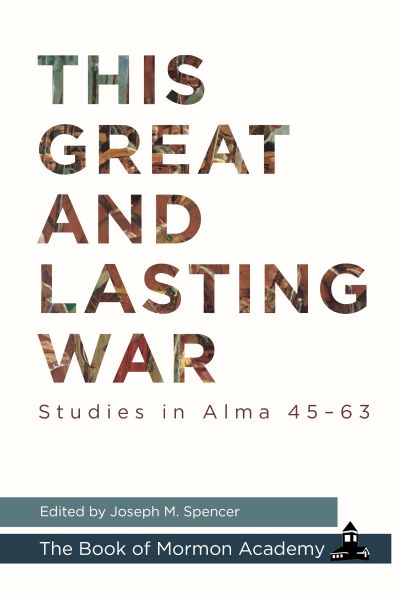
Readers of the Book of Mormon often encounter difficulty in two specific sections: the Isaiah chapters found in 2 Nephi and the so-called war chapters, comprising Alma 45–63. These challenging passages, while commonly associated with reader disengagement, seem to slow readers down for opposite reasons.
While the Isaiah chapters are clearly doctrinally and spiritually rich, interpreting their deeper meanings can be demanding. In contrast, the war chapters are accessible and narrative-driven, but the challenge comes in understanding their relevance in the greater context of a sacred text. Augmenting personal study with scholarly research and commentary can greatly enrich readers’ understanding of these tricky sections of the Book of Mormon. In one of the Religious Studies Center’s latest offerings, This Great and Lasting War, scholars from Brigham Young University’s Book of Mormon Academy focus on Alma 45–63 with hopes to help readers navigate the context and significance of these well-known stories.
Alma 45–63 details the accounts of contention and warfare between the Nephites and the Lamanites. The cunning of Amalickiah, the fight for political power, the foresight of inspired leaders, and the famous title of liberty all play a role in the story of righteousness versus wickedness.
Some readers of the Book of Mormon attempt to use devotional frameworks and metaphors to glean insight from these military accounts, but a deeper analysis of the text reveals that such interpretive leaps might not be necessary to glimpse Mormon’s intention in including these stories. The war chapters possess their own inherent theological, ethical, and literary depth. These seemingly one-dimensional battle stories are much more complex than often assumed, focusing on covenant relationships, the love of God, and human identity. The record draws attention to challenges uniquely faced by women, the struggle of navigating complicated relationships, and the need to make good choices. Within these chapters readers can find the meaning of scripture in different contexts, the intervening role of a prophet on behalf of the downtrodden, and hope for God’s future interventions in the world, as well as what it means to see God in the concrete details of life.
While theological discourse often emphasizes a broad, eternal perspective of God, these chapters invite readers to perceive the divine amid conflict, hardship, and uncertainty. This Great and Lasting War offers readers of the Book of Mormon well-researched, scholarly perspectives on how to do just that. This volume presents fresh takes on the war chapters from ten scholars whose expertise draws out valuable insights to be learned in Alma 45–63.
The volume is divided into three parts. The first places the Amalickiahite wars into the greater context of Nephite history and related scripture. It highlights the intersection of the spiritual and the mundane throughout the wars, considers the significance of Alma’s final prophecy, notes the parallels between Captain Moroni and Old Testament prophets, and acknowledges the Book of Mormon use of the Pauline words “stand[ing] fast . . . in the liberty wherewith Christ hath made us free” (Galatians 5:1).
The second part narrows its focus to specific episodes within Alma 45–63, using literary analysis to uncover doctrinal insights. It shows how carefully Mormon relates the cautionary story of “the great wickedness one very wicked man can cause to take place among the children of men” (Alma 46:9), offers perspectives of interpretation regarding Captain Moroni’s emphatic correspondence with the chief judge Pahoran, and examines the often-overlooked story of the maidservant of Morianton.
The third and final part of the volume explores moral questions that arise across these chapters. It analyzes the Book of Mormon’s treatment of complex questions of justice through a study of the word cause, supports Mormon’s testimony of divine love that endures violence, and testifies of the significance of covenants in the lives of those engaged in conflict.
Each essay in this volume combines scholarly reasoning and evidence with a perspective of faith to aid Book of Mormon readers in their thoughtful study. “We find among these chapters much more than war,” notes volume editor Joseph M. Spencer in affirming the value of this volume. “Indeed, we share among us a witness of the truth of the Book of Mormon, and therefore of its worthiness for every effort we can give to studying it more closely. And we share among us a conviction that these chapters in particular—in all their richness and complexity, positively saturated with relevance—point us toward the love of God in sending a Savior to reach us in all our infirmities and conflicts.”
