
 menu icon in the top, right corner of the screen.
 icon above to close this box.
 icon at the bottom of the screen below the browser—if you don't see it, swipe up to unhide it.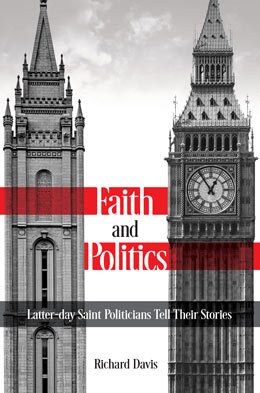
Rob Bishop
Richard Davis, "Rob Bishop," in Faith and Politics: Latter-day Saint Politicians Tell Their Stories (Provo, UT: Religious Studies Center, Brigham Young University; Salt Lake City: Deseret Book), 195‒202.
In this interview, Rob Bishop recounts the influence of his family on his political involvement as well as how he approached his job as a representative. He also relates how he dealt with an instance when he faced intense criticism and a situation where he sought inspiration on an important pending vote. This interview was conducted on July 26, 2021, by Richard Davis, BYU professor emeritus of political science.
Richard Davis: For a little context, tell us about your background: where you grew up, where you went to school, and maybe a little about your family.
Rob Bishop: Well, I was born and raised in Kaysville. So I graduated from Davis High, and then I went to the University of Utah. After graduating from the U, I started teaching and moved up to Brigham City. So I’ve been there all the time. I think where I became involved in politics is obviously back home in Utah. My father was always involved. My grandfather had always been involved in politics. Just after I was born, my father was mayor of Kaysville. I always remembered him sitting at the kitchen table on the phone campaigning for somebody. I think he viewed being involved in civic life and in politics as much part of the gospel as paying tithing.
So only probably in high school, I realized we were the atypical family. But I was involved in National Teen Age Republicans on the county level in high school, and there were students for Bennett, students for Reagan back in ’68 involved in the College Republicans. I was living off campus, and I got a call at one time—I have no idea how they got my number—from the county party that asked me if I would hold the caucus—they were called mass meetings back then—in my apartment. And I was worried because I had been to those with my father in Kaysville and knew the entire town showed up.
So I got all the furniture out of the front room and put as many folding chairs as I could find and waited for the mass to come up, and it turned out to be two elderly ladies from around the corner who showed up. And I coerced my three roommates to stay. And as we started the meeting, I asked if anyone would like to be chairman of the precinct. And everyone looked at the floor, and so I said, “OK, I’ll be chairman of the precinct.” And I asked if anyone would like to be a delegate, and they all looked at the floor, so I said, “OK, I will be the delegate.” I conned one of the ladies to be a county delegate, but I was the state delegate, which means my first vote that I cast at that convention was an illegal one because I was a little shy of twenty-one.
But I realized I was going to go on a mission in between that, so I did everything I could to organize the district when I left. So I got the registrar, and the judges, and everything else. Everything that had to be posted was put in packets with the times when they were going to have to be put out, and I passed them around to other people. So I thought everything was functional when I went into the mission home. Back then we spent a week down in an old hotel [in Salt Lake City] that was the mission home. So that was a week before they went to the LTM. Once again, I have no idea how they found me again, but in the middle of that week I was called to the president of the mission home’s office, and he told me that one of the election judges that I had secured died, and so I think I’ve set a record in the church. I think I’m the only elder that was ever released from his mission for a day to go back to the district and find another election judge.
Richard Davis: So tell us about the governmental positions you’ve served, and when you served, please.
Rob Bishop: I first ran for the state legislature in 1978, and I served there from ’78 to ’94. When I retired, I was Speaker. I went about eight years without an elected office, although four of those eight years I was chairman of the State Republican Party. In 2002 Jim Hansen retired, and so I ran for his seat and stayed there until 2021.
Richard Davis: So you were a part-time legislator, which is true for Utah. What did you do full time?
Rob Bishop: I was a schoolteacher. I started at Box Elder—a high school in Brigham City. Six years in I went down to Ben Lomond in Ogden for five years and then came back to Box Elder and put a grand total of twenty-eight years in as a schoolteacher.
At the end of it when I finally retired to be a full-time congressman, I had a cakey job—it was all Advanced Placement US history, US government, and comparative government. And I was the department chair there in Box Elder. It was a wonderful opportunity with kids who wanted to be there.
Richard Davis: So who’s influenced you in your career? Who influenced you to become involved in politics?
Rob Bishop: Well, obviously I think family is the biggest influence. As I said, my grandfather had been a city councilman and involved in politics, but he died well before I was born. My father, as I said, always was involved in politics. I think that was probably the biggest influence. But as for my political philosophy, clearly, it’s Barry Goldwater. I was in junior high when I read The Conscience of a Conservative. I was very much aware of his election around 1964, and probably more than anyone else that had a profound impact. Obviously, Ronald Reagan did as well, but perhaps not as much as Goldwater did in getting me excited or interested in government for the first time, and especially politics.
I think on the local level there are a lot of people that had some kind of influence as well, sort of significant ones. Probably one of the most bizarre is Carl Buehner, who ran for governor back in ’68. And I volunteered to work on his campaign, and I thought he was one of the most beloved people. He’d been in the presiding bishopric before he ran for governor, and I was so frustrated because never had I seen somebody who, when I talked to him personally, seemed so persuasive. And yet when I saw his TV commercials, I was so disappointed because he could not read a script. And I think that’s one of those campaigns I clearly remember as one of the defining moments of “How you do not run a particular campaign?”—especially with somebody who I thought was such a great person.
Richard Davis: Are there church leaders who particularly influenced you? You got to know some, I’m sure.
Rob Bishop: There are, but not as far as involvement in government. It was after I became involved that I knew well and appreciated James Faust, significantly. My chief of staff was the grandson of Ezra Taft Benson, and so I knew that family. I didn’t know President Benson, but his family I have known very well. Both of those I think were significant influences with me.
I do have to admit, one other anecdote. We did the best we could not to have any kind of negativity in our campaign, and I did get a letter from President [Gordon B.] Hinckley and the First Presidency thanking us for running a very positive campaign, which to me is one of the letters of which I am proudest of having received. And I wanted, at that time, to make sure that I would always be worthy of getting another one in every succeeding campaign.
Richard Davis: Did you have church callings during your time in the legislature, during your time in Congress—probably less so in Congress—and how did you balance those?
Rob Bishop: You just did it. Obviously legislature, being part time, that was not an issue because I was home every weekend. When I went to Congress, I did not move my family back to Washington. There are a whole lot of reasons—probably the most significant one is I couldn’t afford to move them back to Washington. I did not want to give up my home in Brigham City, and my wife’s parents live a few blocks from us. I wanted my kids to be involved in that; I wanted them to stay in Utah schools. So I commuted. I was home most every weekend, not all, but most of the weekends I was here. So I did have a calling in the ward.
I was the Gospel Doctrine teacher through almost all of my time in Congress. And so I would come back every week to do that; find somebody to substitute if I was not. In the last session, or last term, in Congress they also called me again to be the choir director as well as teach Gospel Doctrine, which meant I had to come back every week after that one. It was foolish of me to say yes to them.
Richard Davis: When you were in Congress, how did your religion affect your interactions with other members of Congress? Did it have an impact on how they treated you?
Rob Bishop: No, I really don’t think so. I think there is perhaps a difference in some of the language that’s used around me from some of the others. I will tell you the positive note is that when we would go to workshops or conferences or anything, everyone wanted to sit by me because not only would they get their liquor, but all my alcoholic drinks as well. Because of my religion, I was never without friends at any of those, otherwise I would’ve been alone a lot.
Richard Davis: Did you feel like you got inspiration or sought inspiration to make decisions as a member of Congress, as Speaker of the House, as a state legislator?
Rob Bishop: There was a time as you recall, back probably as late as the thirties, where the church would give recommendations of how members ought to vote on certain candidates, and quite frankly, usually the church members voted the other way, so. Church leaders may endorse Alf Landon, but they still voted for Franklin Roosevelt.
I can understand that becomes a moral issue. The church, though, talks about teaching principles and allowing people to govern themselves, and I think that’s the way they run with most things. The only time in legislature or Congress that I ever interfaced with the church were on what I would consider to be truly moral issues. And even then, I don’t think the church was overbearing in the way they approached it.
One of the years where abortion was going to be one of the issues in the state legislature, I had a meeting with the church’s Public Affairs Committee. Their advice was simply, “We don’t expect you to be the first state to do anything, but we don’t expect to be the last either.” So it was innocuous.
I will tell you, though, there were sometimes when I was confused, especially in Congress, as to what I should do. The one that comes closest to mind is on the vote on TARP [Troubled Assets Relief Program] where I really did not know what was the appropriate thing to do.
As banks were starting to collapse, we were going into a recession. The idea was the government did not want them to totally collapse; therefore, there would be government funds that would be given to institutions to buoy them up, to keep them going. The problem obviously with TARP, at least from my point of view, is that there were very little guidelines or rails on that system. The law basically said, “The Secretary of the Treasury will determine which institutions need help and how much money they should get,” which was a major concern for a lot of people. I really didn’t know what I wanted to do on that, and there is a prayer room in the Capitol that was constructed, I think, in the early 1950s just off the rotunda. And I did on several occasions go in there and try to meditate and pray to find out what would be the appropriate vote for me to take on that one.
So, yeah, there were times when I actually did try and pray for that kind of inspiration. There also was a time, I’ll have to be honest, when I, in my first term, was being accused of something I didn’t do. And it was extremely negative in the press, and I was getting all sorts of pressure from it. I was taking a lot of crap from it, and I felt sorry for myself. And I remember, because it was raining, and I just walked out of my apartment and started walking around Capitol Hill in the rain just feeling downtrodden, and so I was feeling as sorry for myself as I could possibly be. And around the corner passing the Library of Congress, all of a sudden I caught myself, and I thought to myself that I was being a total jerk and a boob. And then I thought of all the people who had had to suffer far more than I was. I thought of the president of the United States, who everyone was criticizing at that time; I think much of it was unfair, and what he had to do. I then thought of Joseph Smith, to be honest with you, and what he went through when even his friends turned on him, and how much he had to do. And finally, what the Savior had to do. And I just decided I was being a total boob and just buck it up and that what I was having to go through was not all that significant when you compare it to what others did to survive.
Richard Davis: What lessons have you learned about politics you’d like to share with any young Latter-day Saints who are considering a career or just being involved in some way?
Rob Bishop: Well, I still believe that being involved in government and politics is part of the religion. It’s a part of the way you help develop a society and move them along. I also have found, especially for members of the church, that some people will gladly take a high-profile office. I know some people, especially when I was a party chairman, who I would approach to run for office, and if I asked them to run for United States Senate, they would be happy to accept the nomination. If I asked him to run for the state legislature, that was beneath them.
But one of the other problems we’ve found out is in every community there are all sorts of boards and commissions that actually make rules and regulations for that community. And that, as I was talking to one of my friends, and we were counting—they were saying that finding active members of my church to serve on those commissions was extremely difficult. Because they would ask somebody to be on the water abatement district, or the mosquito district, or the cemetery district, or the—any of those districts, and they would always say, “Oh. You know I’d like to do that, but my church calling doesn’t give me enough time to do that.” So consequently, many of those positions are not filled with active members of the church. They’re filled with people who may or may not have the same attitude that active members of the church would have simply because church members use their church assignment as a crutch to get out of a civic responsibility. We need good members of the church that have a desire to serve one another in the civic or political position. That’s where we desperately need it, and too many people use their activity in the church as a crutch not to do that.
