
 menu icon in the top, right corner of the screen.
 icon above to close this box.
 icon at the bottom of the screen below the browser—if you don't see it, swipe up to unhide it.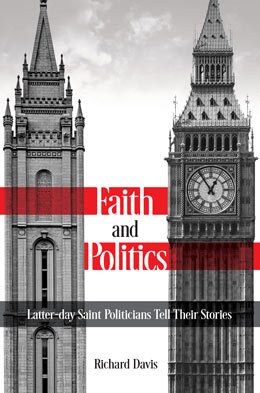
Conclusion
What Do We Learn?
Richard Davis, "Conclusion: What Do We Learn?," in Faith and Politics: Latter-day Saint Politicians Tell Their Stories (Provo, UT: Religious Studies Center, Brigham Young University; Salt Lake City: Deseret Book), 283‒98.
These interviews give us insights into how Latter-day Saints approach politics. They show us how gospel teachings affect the varying (and even contrasting) approaches to public policy. They offer insights on how Latter-day Saint politicians approach partisanship or disagreement within the sphere of politics and how some attempt to restore civility. Fortunately for us, some are quite candid about mistakes they have made and then learned from. They also teach us how church members can become involved in politics. We can begin there.
The Genesis of Involvement
Getting involved in civics and government in the first place is not as difficult as one might imagine. Some people were self-motivated while others simply needed a little nudge from other people or from their own experiences that stimulated them. How these individuals became involved varies, but there are some common factors.
One is the role of missions. Some became highly motivated by mission experiences that shaped their lives. Both Ben McAdams and Andria Tupola, for example, mentioned the importance of their missions to Brazil and Venezuela respectively as transformative moments when they decided they needed to engage in a career of public service. Interestingly, they drew somewhat contrasting lessons from those experiences. After serving among the poor of Brazil, McAdams learned that government needed to play a role in helping people extricate themselves from poverty. Tupola’s take, after serving in Venezuela, was that government was destroying people’s initiative and ruining the economy. Nevertheless, mission experiences became the impetus for their routes to political involvement.
Some politicians took on volunteer roles that made them familiar with government and ultimately ready to run for elective office. For example, Mo Denis was asked to serve on the county library board, which led to his interest in running for the Nevada general assembly. Aimee Winder Newton helped to incorporate her community into a municipality and then took on an appointive position in the new city’s administration.
Initial involvement in politics for many came about simply because they were asked. They were approached by someone who was already politically involved urging them to consider some form of participation in politics and government. For example, Deidre Henderson’s first introduction to politics was someone urging her to become involved in a congressional campaign. Carlton Wing was approached by a state legislative leader who urged him to consider running for office.
Or sometimes, when they already held an office, they were asked to seek a higher office. Harry Reid related that a friend urged him to run for Nevada’s lieutenant governor. Similarly, Deidre Henderson was asked by a gubernatorial candidate to be his running mate.
Even when there was not a specific request to become involved, somebody was instrumental in sparking interest. These could be examples these Latter-day Saint politicians looked to, often someone they knew personally. For Yéah Samaké, it was his father, who, as a tribal chieftain, also had been dedicated to public service. For Rob Bishop, it was Carl Buehner, whose campaign he worked on as a political newbie. Or it could be someone they do not know personally, but whose example impressed them. For example, Karen Hale considered Elder Marlin K. Jensen such an example for her because he was a general authority and a Democrat, allowing her to feel comfortable entering politics as something other than a Republican.
Some of these politicians identified mentors who aided them in becoming involved and then assisted them to “learn the ropes.” For Deidre Henderson and Holly Richardson, it was Becky Lockhart, a late speaker of the Utah House of Representatives. For Carlton Wing, it was another church member who was a state legislator. Nor did the mentor have to be Latter-day Saint. Frerich Görts learned from his state president and particularly from the government minister he worked with directly, while Malcolm Adcock considered a mayor he served with as his mentor. These individuals helped them adjust to politics and government service.
How might these observations help us stimulate political involvement among Latter-day Saints? One method is for members to encourage one another to run for office. People who are contemplating serving often need urging from others before they will take the step of getting involved.
Calls for participation could point to the fact that some of today’s church leaders have served in government. For example, current or recent general authorities who have served in governmental positions include Dallin H. Oaks (Utah Supreme Court justice), Gerrit W. Gong (special assistant to the US Secretary of State), David S. Baxter (local government administrator in London), and Larry J. Echo Hawk (US Assistant Secretary of the Interior). Many local leaders have done so as well, as indicated in this volume. They too can serve as models of civic engagement to those considering running for office.
However, to reinforce the church’s political neutrality, calls to participate need to emphasize nonpartisanship—namely, that members of the church can and should run in differing political parties. The explicit rationale for members could be that no one party represents gospel principles and that members can better be an influence across the political spectrum rather than gravitating to one party. Additionally, in terms of policy influence, the church benefits from having government officials in varying political parties. Since partisan control of most democratic governments rotates among parties (for example, Democrats and Republicans in the US, Labour and Conservatives in the UK, or Liberals and Conservatives in Canada), lopsidedness in partisan affiliation among Latter-day Saints, including politicians, is counterproductive to the institutional church’s and individual members’ aims to influence ongoing public policy regardless of who is in charge. Further, that imbalance tends to discourage those who are in the minority party among church membership from continuing as active members or could well depress missionary work as those in that party decline to become interested in a church whose membership is heavily weighted against their political affiliation and views.
Nor can it be an ideological call that meshes with the policy positions of one party over others. In other words, members should not be recruited to support political conservatism or liberalism or any particular ideology. Such calls only perpetuate a partisan or ideological imbalance that harms the church.
Similarly, members involved in politics cannot be urged to use their positions to defend the church specifically. As was evident in most of these interviews, most Latter-day Saint politicians do not view their roles as serving the church over their constituents, even in Latter-day Saint–predominant communities. Yet messages of encouragement can be directed at the importance of having people in office dedicated to public service over private gain, seeking civility and common ground, and treating others with dignity—all gospel traits.
The Gospel and Partisanship
As is evident, these politicians represent differing political parties. This may come as a surprise to some members, particularly in the United States, who believe that members of the church cannot be Democrats. This attitude occurs even though the First Presidency’s statements repeatedly have included the statement that “principles compatible with the gospel may be found in various political parties,”[1] and despite the fact that President Oaks advised that members “should never assert that a faithful Latter-day Saint cannot belong to a particular party or vote for a particular candidate.”[2]
For this volume, among the politicians located in the United States, I purposely somewhat overrepresented Democrats to assure that members realized there were active Latter-day Saint politicians who were Democrats and that their views were articulated. The reality is that Latter-day Saint politicians are heavily Republican, as are church members generally. In the US, 45 percent of church members identify as Republicans and only 11 percent as Democrats. The rest are independent.[3] The imbalance among politicians is just as acute. For example, nearly all Utah legislators who are Latter-day Saints affiliate with the Republican Party.
This imbalance means the politicians in Latter-day Saint–predominant areas particularly are appealing to a Republican church membership and identifying mostly as Republicans to maintain influence. Given the dearth of Democrats and attitudes against Democrats on the part of many church members, even active Latter-day Saint politicians who are not Republicans have a difficult time getting elected in the first place.
Outside of Latter-day Saint–predominant areas in the United States, the tilt is still heavily towards Republican office holders. One reason is the pool from which Latter-day Saint politicians come—namely, a politically conservative church membership. Also, it may be that church members feel comfortable running in politically conservative states or districts where they feel their social and economic views align with most constituents. This includes Republican states such as Arizona, Idaho, and Wyoming.
However, this imbalance does mean that church presence—in government—is limited in more Democratic areas such as the Northeast and Upper Midwest, as well in metropolitan areas. The perception that Latter-day Saints are conservative Republicans may make it difficult for Latter-day Saint politicians to branch out into other areas where Republicans are not predominant.
This dilemma has not always been the case. For example, George W. Romney was elected and then reelected as governor of Michigan in the 1960s. Romney was a Republican, but he was known as a more liberal Republican in an era when the Republican Party was becoming more conservative. Similarly, his wife, Lenore, ran on a pro-choice platform on abortion during her unsuccessful US Senate campaign in 1970. Their son Mitt ran for the US Senate in Massachusetts as a Republican in 1994 and was elected governor of Massachusetts in 2002—and in both campaigns, like his mother, publicly took a pro-choice position that contrasted with the views of most church members in the United States.[4] Richard Swett won a congressional seat in New Hampshire as a Democrat. However, those examples date back two decades or more.
Outside the United States, there is some imbalance as well. In Canada, members are more likely to belong to the Conservative Party rather than the Liberal Party. And those Conservatives come primarily from one province—Alberta. Similarly, members who identify with the Conservative Party in the United Kingdom far outnumber those who identify with Labour, the left-wing party.[5] Yet, generally members tend to be less conservative outside the US and Canada. The two individuals from the United Kingdom—Terry Rooney and Malcolm Adcock—belong to different political parties: Labour and Liberal Democrat. In the UK, even the Conservative politicians are far less conservative than Republicans in the United States. In other parts of Europe, church members and politicians tend to gravitate to more conservative parties, although, again, those parties such as the Christian Democrats in Germany, are far more liberal than conservative parties in the United States. Interestingly, Yéah Samaké formed his own political party in Mali.
Party affiliation seems to affect how Latter-day Saint politicians react to how the gospel should be applied in government. Republicans talked about the importance of policy issues such as abortion and same-sex marriage. Many viewed those issues as defining their partisan identity, even though some said they were unhappy with the current Republican Party. Indeed, abortion was so important as an issue that some of the Republicans, when asked whether they believed members could belong to a variety of parties, answered that they could not really understand how someone could be a member of a political party that took a pro-choice position—namely, a Democrat. Some like Lyle Hillyard saw self-reliance as a gospel principle that was transferred into their policy approach.
Democrats, however, took from the gospel teachings the importance of compassion, acceptance of others, and social justice. Sue Zwahlen emphasized the need for inclusion and equal rights for all. Brian King admitted that he saw value in Republican principles such as accountability and self-reliance but still believed that government should play a role in helping people economically, something Republicans were more likely to reject philosophically.
Another point was the observation that partisanship was not necessarily connected to religion. Some like Terry Rooney and Sue Zwahlen adopted their party identification before they joined the church. Others who grew up in the church admitted they were strongly influenced by family and tradition.
Latter-day Saints and the Problem of Incivility
One of the problems of our society today, particularly in political discourse, is increasing incivility. President Russell M. Nelson expressed concern over today’s political and cultural environment of hostility in an April 2023 general conference talk: “Civility and decency seem to have disappeared during this era of polarization and passionate disagreements. Vulgarity, faultfinding, and evil speaking of others are all too common. . . . I am greatly concerned that so many people seem to believe that it is completely acceptable to condemn, malign, and vilify anyone who does not agree with them. . . . Anger never persuades. Hostility builds no one. Contention never leads to inspired solutions.”[6] He further counseled, “As disciples of Jesus Christ, we are to be examples of how to interact with others—especially when we have differences of opinion. . . . His true disciples build, lift, encourage, persuade, and inspire—no matter how difficult the situation. . . . Contention reinforces the false notion that confrontation is the way to resolve differences; but it never is. Contention is a choice. Peacemaking is a choice. You have your agency to choose contention or reconciliation. I urge you to choose to be a peacemaker, now and always.”[7]
In a general conference talk in October 2020, President Oaks explained that incivility is not a trait of disciples of Jesus Christ: “In a democratic government we will always have differences over proposed candidates and policies. However, as followers of Christ we must forgo the anger and hatred with which political choices are debated or denounced in many settings.”[8] The First Presidency stated that “individual members should participate in the political process.” But they added an admonition not to become caught up in the unkind contention that is so often part of the political process: “Please strive to live the gospel in your own life by demonstrating Christlike love and civility in political discourse.”[9]
But how can members avoid uncivil political discourse? Several of the politicians interviewed included answers to the problem of incivility. Some included suggestions for Latter-day Saints in their efforts to reduce incivility and polarization in our society.
One suggestion was spending more time talking to others who disagree with us politically. Unfortunately, that becomes difficult for many Latter-day Saints because church members, at least in the United States, tend to gravitate toward one political party and one ideology. In church settings, there may be little opportunity to hear from others who disagree. That doesn’t mean they don’t exist; it just means that when other church members have differing political views from the majority they often suppress those views to avoid conflict. We may not even know they have opposing views.
For church members, that may mean encouraging all to speak up about their views even if they are not popular—and then not ostracizing those who have another ideology or political party affiliation. Rather, we need to listen to what they have to say. By extension, that includes those outside the church as well who Latter-day Saints encounter in daily life, including neighbors, coworkers, or others we may come in contact with. Mo Denis explained that we need not only to listen to others who disagree with us but to understand their point of view. And Brian King offered the suggestion that when we speak to others that we do so in a nonadversarial way. Rather than seeking confrontation and the opportunity to win an argument, we must listen and talk calmly. By doing so, we can reduce tension between people who disagree.
Another suggestion is to seek for common ground rather than forming ideological and party battle lines. Carlton Wing referenced a book he had read by two former US senators—one Republican and one Democrat—who explained how they had found common ground despite their partisan differences. They set an example of cooperation even when they had policy conflicts.
Another solution proffered was to avoid media sources that promote incivility. Carlton Wing suggested, “People need to get out of that rut of listening to angry people speak, on either side of the aisle. And the same thing in social media—we have got to get to our humanity, and that’s what we are not doing.”
Latter-day Saints can set examples to help others see that incivility is not necessary to participate in politics. Dawn Ramsey, the mayor, explained that when she begins the public comment session of city council meetings, she reminds those who speak that they need to be civil toward others. By listening, seeking to understand differing points of view, not ostracizing others who disagree (particularly within the church), speaking calmly and in a nonthreatening manner, and avoiding media that promote conflict and incivility, Latter-day Saints can be a positive force for building bridges and achieving common ground rather than uncivil, destructive political discourse.
Representation and the Church
Latter-day Saint politicians are representatives of the constituency they serve. However, they also become informal representatives of the church in government. This is particularly true in areas where the church is a minor force in society and politics. We saw several examples of these politicians where they were viewed as representatives of the church in their interactions with others.
Moreover, church leaders do interact with these representatives on issues that are important to the church. Yet the church’s institutional role varies across these stories, again based largely on whether the politician represents a Latter-day Saint–predominant area. Church representatives in Utah are directly involved in few issues in Utah, even though the legislature is overwhelmingly Latter-day Saint. But Utah legislators do receive calls or visits on occasion from church lobbyists expressing the church’s views. As Rob Bishop related, they were regarding issues that church leaders considered “moral.”
However, that lobbying on policy issues is less likely to occur outside the western United States since those are areas where church influence is minimal. In those cases, church leaders’ role primarily is limited to nonpolicy matters such as obtaining visas for full-time missionaries, as Terry Rooney described in his story about resolving a visa problem for the church—or settling legal problems for the church, as Yéah Samaké dealt with. And even that institutional influence would be limited to national levels since local Latter-day Saint politicians, such as mayors and council members, would have little interaction with general church leaders.
The Place of Religion in Politics
These Latter-day Saint politicians are not uniform in their approach to policy issues. Who they represent matters in determining how they approach their public service responsibilities. Those in Latter-day Saint–predominant areas are more likely to see their religious faith and their political activity as neatly meshing. Some fit well into a Republican–Latter-day Saint culture, seeing no conflicts between their religious faith and constituents, at least those who are Latter-day Saint. They view themselves as representing their faith in public office because they perceive those values among their constituents as well.
However, more mixed constituencies, as in areas of Utah that have high concentrations of non–Latter-day Saint voters, are more difficult to navigate for Latter-day Saint politicians. Politicians like Ben McAdams and Brian King are active Latter-day Saints who have represented constituencies where a Latter-day Saint–oriented public policy is opposed by large swaths of the district. They walk a fine line between church members and others, some of whom may be hostile toward the church because it is such a potentially powerful force in Utah politics.
Those politicians who represent constituencies outside Utah where Latter-day Saints are a small minority, which constitutes most of the politicians discussed in this book, explain that their religion is generally known among other politicians (if not constituents) but generally does not affect their electoral campaigns or elicit anti-Mormon attacks. Rather, their election or appointment to office represents an acceptance of minority religious groups in areas outside Latter-day Saint–predominant areas. For example, as the stake president, Carlton Wing associated with various Protestant ministers in the area. As a candidate and a legislator, he spoke at several churches and met with people coming from a wide array of religious denominations. While specific religious doctrines he held may have been considered cultish or at least weird to highly religious evangelicals, his religious affiliation was not a barrier to their support and his ultimate electoral success.
Terry Rooney’s experience demonstrates this point. When he ran for a council position, he was publicly opposed because of his religious beliefs. When a prominent singer, Yusuf Islam (formerly known as Cat Stevens), appeared in his city and campaigned against him because Rooney was a Latter-day Saint, one might expect Rooney’s chances of victory were dim. But, despite the large Muslim population in his district that might have responded positively to Yusuf Islam’s message, Rooney was elected—and with Muslim support.
The Role of Inspiration
The approach to inspiration varied. While some felt they prayed frequently about their decisions, others did so only at crisis points. Some felt it was important to listen to the Lord directly to gain inspiration. Others, however, believed they received inspiration by listening to others.
But claiming that God favors one policy choice over another is tricky. Brian King explained this dilemma when he pointed out that he thought that COVID-19 mandates were “aligned with what God would have for his children.” However, he admitted that Utah’s governor would not have felt the same way but that the governor would have considered his own approach to be what God wanted for the people of Utah. However, both could not be correct, as King acknowledged. Yet each might feel they were.
This raises the problem of a Latter-day Saint politician concluding that he or she has received inspiration regarding public policy and not understanding how other politicians, particularly Latter-day Saints, would not have received the same inspiration. As King observed, it is important for politicians, and anyone involved in politics, not to demonize others who don’t agree on what God’s will is.
Latter-day Saint Women in Public Office
Nine of the politicians featured in this book are women. That is far above the actual percentage of Latter-day Saint women in public office. For example, in 2023, only 25 percent of the Utah legislature were women. Granted, that is a much higher percentage than thirty years ago when only 11 percent were women.[10] The county in the United States with the highest population of Latter-day Saints is Utah County, Utah. However, the county, which dates back over one hundred years, elected its first female county commissioner in 2021.[11] But I have purposedly overrepresented women among the ranks of Latter-day Saint politicians to highlight their perspectives. They hold a variety of offices from state legislature to mayor to county council. They include both Republicans and Democrats. And they represent areas in Utah, the western United States, and, in the case of Anne Neu Brindley, outside the West.
Their stories detail how women in the church who run for office face hurdles men do not experience. These include the reaction of some fellow church members who believe women should not even be serving in such offices. These women know they are fighting a culture that does not necessarily see women in leadership positions. Aimee Winder Newton refers to that reality when she relates her experiences running for the Republican nomination for Utah’s governor. She not only had to convince voters of her candidacy but also had to convince some that a woman should even serve in such a position. (Utah has had a female governor—Olene Walker. However, she became governor after the resignation of the incumbent governor, and she lost her own bid for reelection the next year. Utah has never elected a woman to be governor.)
Some of the women related incidents of voters intimidating them because they were women. Aimee Winder Newton recounted that she received emails from people suggesting she should be fixing dinner for her family rather than campaigning for office or asking her husband if he approved of her running for office. Holly Richardson said that she had received threats from people because she was a female politician. Since her district was overwhelmingly Latter-day Saint, these threats most likely came from fellow church members.
The lack of encouragement to run for office can be an obstacle for a woman considering running. A study of candidate recruitment in Utah County found that women were half as likely as men to respond positively to a solicitation to run for office.[12] Women in Latter-day Saint culture face pressure to focus on family life and not engage in other activities beyond church work and limited community involvement such as membership in the Parent Teacher Association. Deidre Henderson related that internal guilt that when she went to the legislature during the session, she cried during her drive from her home to Salt Lake City.
Women also do not see many models of leadership in the church since the leaders who sit on the stand at church services are all men. And therefore, Latter-day Saint women may not see themselves in leadership roles. As Aimee Winder Newton noted, the church is a very patriarchal society. She described the lack of leadership models within the church for young women and speculate that situation depresses interest in taking on leadership roles in government.
The overrepresentation of women in this book was intended to offer models for future involvement by Latter-day Saint women. And at least one of these women explicitly stated that she saw herself as an example. The idea of modeling affected Aimee Winder Newton’s approach to her campaign. She explained how she viewed her run for governor as one that would help young Latter-day Saint girls picture themselves one day as governmental leaders.
Church Service and Public Service
Generally, these politicians were given lighter responsibilities within the church while they served, although some were not. Terry Rooney expressed satisfaction that while he served in the United Kingdom Parliament, he also was an elders quorum president and served in bishoprics. And Richard Swett was a counselor in the bishopric while he was an ambassador. But, typically, others were not given leadership roles while in public service.
One of the barriers to increased community service has been the expectations for service within the church. While raising a family, church members also are expected to fill church callings (some of them in bishoprics and presidencies), engage in ministering assignments, attend the temple regularly, do missionary work, undertake family history work, and so forth. Adding community service may be overwhelming. And since other Latter-day Saints usually are not involved significantly in the community, except in Latter-day Saint–predominant areas, there may be no one there to invite them to participate. It is a conundrum that will result in few politically influential Latter-day Saints and harm the church’s ability to interact with government in these areas.
The Future
None of these Latter-day Saint politicians urged church members to abandon political involvement. Instead, each of them recommended that members become engaged in their own governmental processes wherever they happened to be. Given that their own experiences were not always positive, that counsel is remarkable.
At the same time, some of them did urge members to understand that there are dangers in involvement. It is not always possible to come to agreement. Sometimes it becomes necessary to simply agree to disagree. Motivations will be ascribed to the Latter-day Saint politician that are neither uplifting nor true. For example, Harry Reid knew that he had taken positions that were not in line with the views of most members of the church, but he felt he needed to do what he believed was right regardless of the consequences.
People may dislike a Latter-day Saint politician simply because of church affiliation. Religious prejudice still exists as indicated by survey results showing many Americans still leery of a Latter-day Saint presidential candidate. But in the United States, as well as Europe and Canada, there is growing acceptance of religious affiliations beyond Protestantism.[13] Again, that may bode well for future electoral success of Latter-day Saint candidates outside predominantly Latter-day Saint areas.
A recurring theme in these interviews is the need for civility in public discourse. Some of these politicians candidly admitted that they became caught up in the moment and said and did things that were highly partisan and may have seemed uncivil. The temptation towards partisan bombast against others is real. It is particularly strong when others are engaging in the same behavior and when constituents (particularly fellow partisans) come to expect it. And some Latter-day Saint politicians, although not the ones in this book, may justify extreme partisan rhetoric on the basis of that representation.
Yet, along with disagreement (and sometimes intense disagreement), many recognized there is a need to assign motives to others that are like one’s own. In other words, seeing others as seeking the right solution as they see it rather than viewing them as inherently evil and therefore not worthy of any kind of praise or compromise. In that sense, these politicians can model Christlike behavior. President Oaks urged church members to “love all people, be good listeners, and show concern for their sincere beliefs.”[14]
That kind of recognition of others’ goodness, even amid disagreement, is sorely lacking in politics today. And yet, as some of these politicians expressed, it is so desperately needed. Without it, the fabric of society falls apart and common ground amid our polarization becomes increasingly impossible to achieve.
Latter-day Saints particularly have a role to play. Indeed, perhaps a unique role. The gospel of Jesus Christ teaches church members the divine nature of all individuals, regardless of his or her political affiliation or views. As several of the interviewees stated, it is vital that all of us engaged in political activity see every other person, whether we agree with them or not, as a child of God.
Notes
[1] “First Presidency Encourages Latter-day Saints in the United States to Vote,” October 6, 2020, https://
[2] Dallin H. Oaks, “Defending Our Divinely Inspired Constitution,” Liahona, May 2021, 108.
[3] “Trends in Party Affiliation Among Demographic Groups,” Pew Research Center, March 20, 2018, https://
[4] John Nichols, “Pro-Choice, Anti-Choice, Mitt Romney Cannot Be Serious,” The Nation (blog), June 2, 2011, https://
[5] See “Guest Post: David Michael Morris, United Kingdom Mormon Demographic Survey 2013,” Juvenile Instructor, June 9, 2013, https://
[6] Russell M. Nelson, “Peacemakers Needed,” Liahona, May 2023, 98.
[7] Nelson, “Peacemakers Needed,” 98–100.
[8] Dallin H. Oaks, “Love Your Enemies,” Ensign or Liahona, November 2020, 26.
[9] “First Presidency Encourages Latter-day Saints in the United States to Vote.”
[10] Bryan Schott, “2023 Utah Legislature: Lots of New Faces, but Women Still Underrepresented in Utah Capitol,” Salt Lake Tribune, January 17, 2023, https://
[11] Trent Toone and Tad Walch, “Which County Has the Second-Highest Concentration of Latter-day Saints? Hint: It’s Not in Utah,” Deseret News, July 8, 2021, https://
[12] Jessica Robinson Preece et al., “Run, Jane, Run! Gendered Responses to Political Party Recruitment,” Political Behavior 38 (2016): 561–77.
[13] Justin McCarthy, “Less than Half in US Would Vote for a Socialist for President,” Gallup, May 9, 2019, https://
[14] Dallin H. Oaks, “Loving Others and Living with Differences,” Ensign or Liahona, November 2014, 27.
