
 menu icon in the top, right corner of the screen.
 icon above to close this box.
 icon at the bottom of the screen below the browser—if you don't see it, swipe up to unhide it.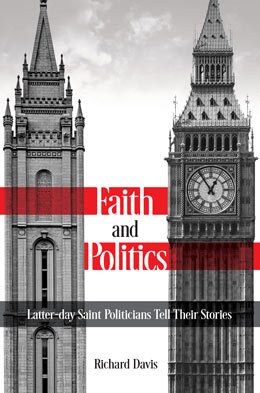
Brian King
Richard Davis, "Brian King," in Faith and Politics: Latter-day Saint Politicians Tell Their Stories (Provo, UT: Religious Studies Center, Brigham Young University; Salt Lake City: Deseret Book), 271‒82.
In this interview, Brian King reminisces about his family’s political discussions that sparked his early interest in politics. He elaborates on his views about the role of religion in politics as well as on his perspective regarding party affiliation and the gospel of Jesus Christ. This interview was conducted by Richard Davis, BYU professor emeritus of political science, on July 9, 2021.
Richard Davis: Thank you very much, Brian, for being willing to take the time to talk to me and vicariously lots of other people in the future. So tell me about your background—you know, where you grew up, where you went to school.
Brian King: Well, I’m pretty old-line Utahn, you could say. I have a lot of pioneer heritage on both sides of my family. My middle name is Smith; Hyrum Smith is my great-great-grandfather on my mother’s side of the family. And on my father’s side is Amasa Mason Lyman, who was my great-grandfather. My father was born in southern Utah down in Teasdale, in Wayne County; my mother was born in Provo. I was born here in Salt Lake. I was raised in Salt Lake, went to Cottonwood High School, went to the University of Utah for a year, served a two-year LDS mission to St. Louis, Missouri—turned me into St. Louis Cardinals baseball fan. I came back, finished my undergraduate career at the University of Utah, went to the U of U college of law, and graduated from that in 1985.
I’ve been practicing law here in Salt Lake ever since. I represent folks who have been denied life and health and disability claims. I sue insurance companies, basically. It’s a very specialized area of law based on federal statutes, and I love it—sort of a David versus Goliath kind of attitude. It dovetails well into my political agenda.
I am the father of four daughters, and they’re all remarkable women who do a variety of things. The youngest is in law school; the oldest is a social worker; there’s a speech therapy tech in there, and there’s also a registered nurse. I’ll be a grandfather in August; I’m excited about that—that’s the first time that’s happened. I’ve served in a variety of callings in the church. In my thirties, I was bishop of our ward and served on high councils and various callings—elders quorum president, you know, various things along the way. Currently up in the Emigration Canyon Ward at the mouth of Emigration Canyon in Salt Lake.
I can tell you in terms of the politics, I was elected to office at the legislature in the 2008 election. Barack Obama was at the top of the ticket. That was kind of fun, and I have served there since. So this is my thirteenth year that I’ve been in office. I started my service on January 1, 2009, which was, coincidentally, exactly one hundred years after my great-grandfather Volney Emery King served in the Utah state legislature. He apparently had more sense than I did and got out after just one term.
But it’s kind of fun. It’s a great heritage, and I love my Utah roots—love Utah, the culture. There are things that make me crazy about the culture right now, but there’s a lot of things that I love about the culture too.
Richard Davis: So when did you first become interested in politics and government service?
Brian King: Yeah, my father was a lawyer too. He had five sons; I’m the youngest of five boys. The influence of my parents and my older brothers was tremendous in my life. We would sit around the dinner table and talk about current events. We’d talk about my dad’s cases; three of the five of us ended up as attorneys. And that was a formative experience, to talk with my parents about current affairs and the law and politics around the dinner table. They were both good Democrats, and I just thought everyone did that. I thought that was the most natural thing in the world, to sit around and talk about these things. It wasn’t until later in my life that I realized it’s not normal at all for most people. But I grew up really sort of having it as the air that I breathed it and loved it. You know, I’d always followed politics, always thought about it, always talked about it; it’d always been a real favorite topic of mine.
And then in the spring of 2008, I’d served as the president of the Utah Association for Justice, which is the trial lawyers association here in Utah. I was just finishing my time serving there. And we were commonly up at the legislature as an organization, some of the key people in the organization lobbying the state legislators about various issues we were concerned about. So, I was familiar with that process. I knew my own representative, knew a lot of other representatives and senators, and my representative at the time, Roz McGee, let it be known that she was going to be retiring and that seat was going to be open.
So I talked to my wife about it and said, “I’m really kind of tempted to do this, but I’ve got a lot on my plate.” And she said, “Well, you’ve always had a lot on your plate, and I know this is something that you love, and you’re interested in. So, if you want to do it, you have my support.” And I appreciated that very much. She was really wonderful to support me, and the girls were wonderful to support me. So I decided to take the plunge. It was part opportunistic in the sense that the open seat was available, and I realized that, you know, there’s a right time, right place kind of situation for a lot of these decisions that you make in terms of when you get in or if you get into politics.
Richard Davis: So you’re currently the House minority leader. How long have you been in that position, and why did you take that position?
Brian King: Yeah. I served on our leadership team in the House from 2011 to 2013 and then was not in leadership for the next two years. But beginning in 2015, I was elected leader, and I’ve served in that capacity since then. So this is the start of my seventh year in that capacity, and if I serve through my term, which I certainly anticipate doing, through the end of 2022 it will have been eight years as the leader of the caucus.
And I did that primarily because I think that it’s important to have good, articulate people at the head of the ticket in both local and national positions. If you’re a Democrat, you want to have people who are able to speak well and specifically and in a way that is persuasive about what our values are, what policies are important to Democrats, what we want to see—what’s our vision, what our priorities are for the future of our state. And my work as a legislator, of course it’s focused on state affairs, but I think it’s no less true for national and for local politics, municipal levels, that people who have a label, a party label on their name, whether it’s Republican or Democrat, have an obligation to tell people what it is—what values and priorities and what kinds of things they want to pursue if they’re elected in the name of the party, as well as in their own name, as an elected official.
So I just thought that was important, and I thought I could do a good job of it, and the members of the caucus have been extraordinarily supportive of me during the entire time. I’ve been on our leadership team, and when I’ve been the leader, we’ve had our ups and downs, we’ve had challenges, we’ve had members of the caucus who got in trouble and we had to call on to resign, and we’ve had tension within the caucus about various policy issues and various personnel issues, and it’s no different than any workplace environment in many respects.
At the same time, you’re obviously trying to focus your message to people who are suspicious, or maybe not caring—don’t know much about what you believe in or don’t really feel the need to understand much about what you believe in. And they don’t understand or really see a need for themselves to be involved in politics. And a big part, I think, of what I have an obligation to do is to persuade folks why it matters. In that sense it’s a little like the gospel and teaching the gospel. There are a lot of people that don’t see a need for religion in their lives, and I think that’s important too. So, there’s a lot of overlap between what I want to do as a member of the church and what I’m trying to do as a Democrat.
Richard Davis: So how have you dealt with the church members, and I’m sure you’ve dealt with them, who say, “I don’t understand how you can be a Democrat and be an active member of the church.”
Brian King: I’ve actually had that question asked of me by very high church leaders and in my role as a legislator. And my response is, “I’m just going to ask you how you can be a Republican and be a member of the church.” Because I think we can ask that of each other. You know, one of the great books that has been enormously influential in my thinking about these issues is this book called The Righteous Mind by a guy named Jonathan Haidt. And the subtitle of The Righteous Mind is Why Good People Are Divided by Politics and Religion. And Haidt’s statement to us is that we have a tendency to view politics and religion through a very similar lens in terms of strongly held moral beliefs. And so I sort of approach this situation in response to your question by recognizing that for myself that’s true—that my feeling about politics is deeply tied to my moral and religious beliefs, my spiritual beliefs, and that I should and must, if I honor other people, even though they feel very strongly about many political issues when they’re on the other side of the spectrum—politically strong Republicans and conservatives—I have to honor them and recognize in them the same good faith, belief, for the same degree I do, that their morals and the principles of the gospel dictate where they are politically. And give them allowance for that and then say to them, “Let’s talk about why without getting angry at each other.”
And, look, I have had plenty of conversations in which I’ve raised my voice a little higher than I should in terms of volume or tone, gotten a little more strident than I should. So I’m by no means this calm voice of deliberate reasoning at all points. But I do have at least some self-awareness to the degree that I recognize, “Calm down. You’ve got to find the common ground with people.” Some of my very best friends are folks on the other side of the aisle up there at the legislature—people that when I talk to my friends who are hardcore liberals or Democrats, I say, “I really like so-and-so. He’s a strong or she’s a strong conservative.” They look at me like, “Seriously? Are you kidding me? This makes me feel differently about you, Brian. You’ve got to hate them the same way I do.”
Well, we have a tendency to want to do that. We have a tendency to go to our corners, circle the wagons, and go to war with each other on these issues that we feel so strongly about. We just can’t afford to do it. I mean, we’ve got to reach out and work really hard—sometimes it is hard. But we’ve got to work hard to understand each other and find some common ground, and if we don’t do that we’re going to be in big trouble in the gospel, in the church, as well as in politics—in terms of where we end up and how we move forward, or whether we can move forward.
And I think that President [Dallin H.] Oaks quite honestly in his general conference talk in April of 2021, just three months ago—that was one of the things he was saying. Look, we’ve got to figure out ways to see above the tribal political views and perspectives that we so often have as individuals. And this is what President Oaks was talking about—when you project onto your religious tribe the perspectives of your political tribe and say they have to be aligned or you can’t be a good member of the religious tribe.[1]
Richard Davis: So have you been in a situation where your religious beliefs conflict with what your constituents want, and, if so, how have you dealt with that?
Brian King: Yeah, sure. Look, my district is a pretty blue district, and by that I mean it’s a pretty safe Democratic seat. It’s the northeast section of the Salt Lake County, everything north of I-80, everything east of 13th East—most of the University of Utah, Emigration Canyon, part of Summit County. I guess I’ve had seven elections now; three of the seven have been uncontested. But the answer to your question is, yeah. I think most of the people in my district would say, “Let’s put in place a lottery or some other mechanism by which we raise significant money for education or some other worthy cause in these tight political times just like most other states have done. The great majority of other states have gambling allowed in some form or another, and the great majority of other states use at least a portion of those proceeds for programs that help the needy and the poor or educating their children or environmental causes, things like that.” And most of the people in my district, I think, would say, “We’d like you to support that, Brian.” And I don’t believe in that. I mean, I just think that that’s a regressive form of taxation. I think that enables bad behavior. I think that panders to our weaknesses rather than our strengths; I don’t like the idea. That’s largely rooted in my religious teachings. It’s largely rooted in my moral beliefs.
Richard Davis: Tell me about your role as a legislator and its relationship with your faith. I mean, do you seek inspiration for the decisions that you have to make?
Brian King: That’s a great question in the sense that I think it sort of taps into how we as individuals seek inspiration. Fasting and prayer are really critically important to me. When I’ve come to some major decisions in my life, on a very personal level, over the past many, many years, fasting and prayer have been really critically important to me. I had a tremendously important personal decision that I had to make a few years ago, two or three years ago, and I made that decision after literally weeks of fasting and prayer. It didn’t have much to do with politics, but it had a lot to do with my own personal life, and it was critically important to me that I get God’s direction on that. And I ended up feeling like I had it in a very unequivocal and clear way.
We just went through COVID. Senator Karen Mayne, who is the minority leader in the senate among the senate Democrats, and I were with some regularity talking to Governor Gary Herbert about what our feelings were as Democrats and what the feelings of our Democratic colleagues were about whether we should do a mask mandate—what we should do to protect Utahns during the time of COVID. And we never did get to see eye to eye with Governor Herbert about COVID and whether there should be a mandatory mask mandate required for the state of Utah. Senator Mayne and I thought that was important. We thought that was in line with what the best thinking of public health officials was, what their advice was, what the experts and medical and public health official experts were saying to us, and we said, “Please do this, Governor.” He didn’t feel that that was the right way to go.
But that was something that, from my perspective, was very, very important to do with a feeling that we were aligned with what God would have for his children. Now, I’m not saying I said to Gary Herbert, “God wants you to do this.” I would never say that to him because I don’t have much doubt in my own mind that Governor Herbert at the time was feeling the same way, that he was thinking to himself, “I think this is in line with the principles of the gospel and what God would want me to do as the governor.” I don’t doubt that he was believing that himself. But this is the beauty about agency, and this is the beauty about tolerance for diversity in thinking about very important issues within the gospel and within our religion and within our world and our state. We’ve got to develop as church members a high level of tolerance, I think, higher than we have right now, tolerance for diversity in thinking.
Richard Davis: So you can accept the fact that Gary Herbert would feel like he’s received inspiration to come to a different conclusion than you when you also felt like you were receiving inspiration?
Brian King: Yes.
Richard Davis: You can deal with that paradox?
Brian King: Well, I’m not saying that we’re both correct. I’m just saying in terms of what God would have for the people to save Utah. But I am saying that I don’t have any doubt that he felt that he was following the dictates of his conscience and what Heavenly Father would have him do as the governor of the state of Utah, while Senator Mayne and I and public health officials looking at different information—focusing and emphasizing different things—nevertheless believe we were also in line with God’s will and wishes for the people in the state of Utah. And I think we’ve got to not demonize each other in saying, “You aren’t listening to God’s will.” Well, it may be that we’re not looking at the same components of what God has in mind in terms of what he would have us do as servants, his servants, and individuals charged with making decisions for the welfare of our brothers and sisters on this earth. But that’s not to say that we don’t subjectively believe we’re doing the right thing. Look, I’m certain that if I had all the information that God has, my position, my feelings about a wide variety of things will change from what they are right now to something else. I think Gary Herbert’s would too.
Richard Davis: What do you think should be the role of religion in government?
Brian King: I’ve pondered that a great deal. I appreciate the question because I think it’s a tough question, and I think that there’s a lot of room for individuals to respond differently. I think that we need to do a better job of recognizing in the state of Utah that we should be diligent to separate our feelings—sometimes very strong feelings—about what’s true and right as a matter of gospel principles from enacting into law those gospel principles and projecting onto all the people in the state of Utah. What is true and right as a matter of gospel principles isn’t necessarily going to be true and right as a matter of good public policy. That doesn’t mean that there can’t be overlap, but I think that we constantly ought to, number one, keep in mind the need to separate the two, and number two, use as the filter and the governing test for whether to enact a particular public policy not whether we believe it or whether it’s taught over the pulpit as a matter of religion but whether it is well grounded and founded as a matter of data, best practices, best evidence, research, and fact in the experience of other states and other communities and how to address particular specific problems—everything from homelessness to education issues and to criminal justice reform to how we deal with mental health issues and substance abuse issues across the state and how we deal with environmental issues.
We’re going to be on much more solid ground if we do that, as a matter of making public policy and keeping in mind that we need to separate church and state. There are people that I call the “Mormon Sharia Law” folks up the legislature. I can think of more than one representative and senator who believe, honestly, that the state of Utah would be much better off with having its laws, as a matter of public policy, aligned to the greatest degree possible with the teachings of The Church of Jesus Christ of Latter-day Saints. I disagree with those folks, and I’ve said so strongly on the floor of the House and in committee hearings, and I’ll continue to do that.
Richard Davis: So let’s talk about incivility. Do you see a lot of incivility? Do you see growing incivility in the political sphere—partisan political polarization—and, if so, can Latter-day Saints play a role in dealing with that and ameliorating that situation?
Brian King: The place I see incivility the most is when people believe that they can say and do things in a silo—that they’re not speaking to another human being, a flesh-and-blood person. It’s so easy to become a keyboard warrior and put stuff on social media and write things in a letter to the editor that are vitriolic—whether it’s about an individual person or whether it’s about a group of people because we don’t see them face-to-face. You know, we’re not looking them in the eye. It’s a lot harder to do that when you’re actually looking at somebody in the eye.
So technology, I think, has played a role in the increasing degree to which we see incivility, because it’s easier to communicate with each other and get your message out without ever facing another human being. And I see that, particularly on the national level. I don’t see it as much on the state level in terms of our political activity, because, whether you’re talking about serving on a city council or a community council, and you meet in person, or whether you’re serving in the state legislature in a committee hearing or in a situation where you’ve got four debates going on, you’re dealing so closely with your colleagues you get to know them. You get to know their kids; you get to know them personally in a way that makes it harder to be black-and-white in terms of an absolute decision about, well, they’re not virtuous or, you know, they are virtuous because they’re a member of my tribe. You see the nuances. You see the subtleties a little better, and that’s critically important. And so I think that what we need to do is, as Latter-day Saints, recognize the need for personal interaction. This is one of the wonderful things about being an LDS missionary—at least when I was a missionary, of course, this was in the ’70s and early ’80s—I was going out talking to people face-to-face, and missionaries to be most effective continue to do that today.
Well, why are they effective? Because they’re able to relate one-on-one to people in a way that touches on emotions that you can’t reach when you’re keyboarding each other across the Twitter sphere. We’ve got to keep doing that. We’ve got to talk to each other in a more personal, friendly, and nonadversarial way. And I think that, to the extent that we do that, we’re enhancing the likelihood that we increase civility, we decrease hostility, we decrease an adversarial nature of communication in a positive direction.
Notes
[1] “We encourage our members to refrain from judging one another in political matters. We should never assert that a faithful Latter-day Saint cannot belong to a particular party or vote for a particular candidate.” Dallin H. Oaks, “Defending Our Divinely Inspired Constitution,” Liahona, May 2021, 108.
