
 menu icon in the top, right corner of the screen.
 icon above to close this box.
 icon at the bottom of the screen below the browser—if you don't see it, swipe up to unhide it.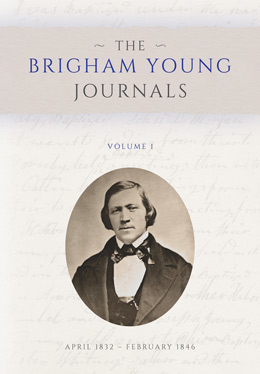
Volume Introduction
Brigham Young could not contain the new hope and purpose he felt. Baptized by authority for the remission of his sins in April 1832, he was now a member of the young Church of Christ, organized only two years before. Growing up in western New York, he had been exposed to an intense religious climate with many contending creeds. He came of age in a strict Methodist household. But he long felt grief, discouragement, and even despair at being unable to satisfy his religious yearnings and independent ideas about faith. That began to change in spring 1830 when Samuel Smith, brother of Joseph Smith, left at least two copies of a new religious text titled “The Book of Mormon” in the Tomlinson Inn neighborhood of Mendon, New York, where Young and many of his relatives lived. Young examined the book and listened to the preaching of missionaries before deciding to join the new faith.[1] As he sat wet after his baptism and ordination to the office of elder in the new church, a fire began to blaze within him. A sense of purpose and urgency replaced his earlier gloom, and he never looked back.
Brigham Young immediately “wanted to thunder and roar out the Gospel to the nations.” He later said that the feeling “burned in my bones like fire pent up. . . . Nothing would satisfy me but to cry abroad in the world, what the Lord was doing in the latter-days. . . . I had to go out and preach, lest my bones should consume within me.”[2] Remarkably, Young, an unlettered man of humble background with unpolished speech who had been uncomfortable addressing the public, eventually launched with abandon into public elocution. “I was but a child, so far as public speaking and a knowledge of the world was concerned,” he later said, “but the Spirit of the Lord was upon me, and I felt as though my bones would consume within me unless I spoke to the people and told them what I had seen, heard and learned.”[3] He could not restrain his zeal to spread the message of the gospel he had embraced. The same impulse that spurred him to travel and to preach prompted the uneducated carpenter for the first time in his life to begin a journal to preserve a record of those labors.
In the pages that follow, readers will see Brigham Young’s life experiences unfold chronologically following his life-changing baptism as a member of the Church of Christ (later renamed the Church of Jesus Christ of Latter-day Saints). Young began his writing with a record of his baptism: “April 9th 1832 I was Baptized under the hand of Elezer [Eleazer] Miller and ordained” an elder. He soon “preacht as opertunity presented,” keeping a brief record of his missionary travels. Over the next thirteen years, Young jotted down entries documenting his ministry (his last handwritten entry was dated 1 April 1845). He wrote in three separate journals and on pages sewn into the first of the three. Rather than filling up one book before moving to a second, he shifted from one book to another several times, in one case turning over the book and writing from the back (a common practice for the time) to begin his record of a new missionary endeavor. Rather than reproducing the three journals as physical artifacts, as they exist today, the editors of this volume have disassembled Young’s personal writings to present them in chronological order, as his life and travels unfolded. Editorial notes orient the reader as to which journal each section came from (that is, where it can be found in the physical artifact). Furthermore, part 2 of this volume provides a detailed physical description of each journal as well as an overview of the content and other texts (outside of journal entries) that Young inscribed into each artifact.
Other than the editors’ chronological reordering of sections and minimal use of transcription symbols, Brigham Young’s writings are presented as he wrote them. With only a few days of formal schooling, Young never absorbed so-called standard spelling for his day. He wrote phonetically according to his understanding, reproducing words the way he heard them. This was true of many others of his day who kept personal records. Only the better educated tended to spell “correctly” most of the time. Many untrained writers tended to write and spell better or more formally over time in a way that Young never did. He was an especially creative speller, and if he spelled a word incorrectly early on, he likely did later as well. To reduce the level of editorial intervention to clarify meaning and spelling, words that can be easily read phonetically are left without comment even if the spelling is far from today’s standard. Only when readers might be puzzled or where a missing vowel or consonant changes a word or otherwise may confuse do the editors intervene editorially to clarify.[4]
These holograph journals (personal journals written in Brigham Young’s own hand) are primarily missionary journals, tracing his travels and preaching activities while he proselytized for his newfound faith. Many entries are terse, sometimes cryptic references to places visited, people taught and baptized, or events observed. Other records, especially newspapers and the diaries of later traveling companions or others in his orbit, expand our view and understanding of Young’s often short entries. While in this volume extensive annotation sometimes dwarfs Young’s writings, the additional information will elucidate the text and thus make the reading more informative and enjoyable. Later, as president of the church, Brigham Young had clerks or scribes to write for him and keep a record of his activities. That may be the primary reason he did not keep a personal journal after April 1845. Of course, records kept in his name provide a less personal glimpse into Young’s life and personality than what he wrote himself, making these three early handwritten journals especially valuable.
Young kept a holograph journal from 8 August 1844 through 1 April 1845, while scribes kept an office journal from 28 September 1844 through 3 February 1846. This “secretary’s journal,” as it has been called, is the fourth and final pre-Utah Brigham Young journal. It was written by clerks in his Nauvoo office after Young took responsibility for leading the church in the wake of the murder of Joseph and Hyrum Smith. Therefore, in addition to Young’s personal journals, this volume contains the first of the journals written for him instead of by him. Although this Nauvoo-era record overlaps Young’s final personal journal for several months, it is not integrated into the chronological unfolding of the personal writings but is presented separately, following them. This is done because of the distinct difference in journal keeping and to avoid confusion where there is overlapping coverage in the holograph journal and the office journal. As with Young’s personal journals, the office journal entries here are also transcribed exactly as the scribes wrote them.
As noted, the first journal entry documents Brigham Young’s baptism almost two years after he first read a copy of the Book of Mormon in the spring of 1830. He later described having spent months pondering, discussing, praying, and considering the implications of the message of this new religious text. Pierced by the testimony of traveling missionary Eleazer Miller, he was finally moved to act—and to record his actions. The thirty-one-year-old Young lived in Mendon, New York, with his wife of nearly eight years, Miriam Works, and their two young daughters. Six years before he first encountered the Book of Mormon, Young had worked for a friend of the Works family in Aurelius, New York, where he became acquainted with Miriam. She was described as “a beautiful blonde with blue eyes and wavy hair; gentle and loveable.”[5] Affection between Brigham and Miriam blossomed into love, and the two were married on October 8, 1824. About a year later the couple welcomed their first child, a daughter named Elizabeth. The Youngs lived in an area at the heart of religious revival and fervor that historians have called the “burned-over district.”[6] Western New York with its cheap land and its transportation highway, the Erie Canal, offered much promise to young artisans, craftsmen, and farmers and their families.[7] Brigham Young, a gifted carpenter and builder, was disciplined and industrious. Styling himself as “painter, joiner and glazer,” he worked a variety of jobs to provide for his family.[8] The year following his marriage, he even worked on the Erie Canal for a time, earning two hundred dollars painting lock houses and canal bridges in the summer and fall of 1825.[9]
With population growing and mobility easier, itinerant Protestant preachers also flocked to the area to spread their spiritual messages. Many hearers, however, found those messages lacking. What was on offer seemed to them to fall short of the simple yet powerful message of the early Christians (the “primitive church,” as it was known) that they sought, and so they remained aloof from those preachers’ churches. Brigham Young was such a religious “seeker,” as they were called, who failed to find a religious home among the many denominations and religious turmoil that surrounded them. Such like-minded people often met on Sundays for song and prayer. Though affiliated with the Methodist faith, Brigham and Miriam were part of one such informal group. One of Young’s closest friends, Hiram McKee, later wrote, “How sweet was our communion in old Oswego, how encouraging our prayers, and enlivening our songs.” McKee had considered Young “one of my early spiritual friends and guides” and, writing decades later, told his old friend, “I have not forgotten your advise, counsel, prayrs. My confidence was great in you in view of your deep piety and faith in God.” In reply, Young acknowledged their shared friendship and spiritual quest. Young reminded his old friend that amid their seeking within the excitement of religion in the area, they had earnestly hoped to hear “truths revealed from Heaven for the salvation of the human family.”[10]
After the Church of Christ was organized under Joseph Smith’s leadership in April 1830, missionaries preaching the restored gospel of Jesus Christ and carrying a new book of scripture that testified of Him preached in the burned-over district of western New York. Only after they encountered the Book of Mormon and such missionaries did Brigham and Miriam find the religious home they had long yearned for. By this time they had moved to Mendon, New York, where their second child, a daughter named Vilate, was born on Brigham’s twenty-ninth birthday, June 1, 1830. Young built a nice home for his family and a woodworking shop near a stream flowing on their property. He and Miriam worked hard and lived simply as they raised their young girls. They continued to seek after religious truth and contemplate the intriguing new book of scripture that had come into their hands. When traveling missionary Eleazer Miller came to Mendon in April 1832, the Youngs were prepared to commit to a new missionary-centric faith. Miller baptized Brigham Young in the stream on his property; Miriam was baptized a few weeks later.
Not long after her conversion, Miriam became seriously ill with “consumption,” medically known as tuberculosis. She had suffered from it before her baptism, and her husband had earned a reputation for caring for his ailing wife. Now more than ever she needed assistance. Brigham, though eager to preach the message of the restored gospel, limited his preaching to the general area around their home in Mendon so he could tend to Miriam and their two young daughters. He did household chores, prepared meals, and otherwise labored to keep the family afloat as his wife’s health declined. According to a later account by his daughter Susa Young Gates and Leah Widtsoe, a granddaughter, Young daily “got breakfast for his wife, himself, and the little girls, dressed the children, cleaned up the house, carried his wife to the rocking chair by the fireplace and left her there until he could return in the evening. When he came home, he cooked his own and the family’s supper, put his wife back to bed and finished up the day’s domestic labours.”[11] A newspaper account similarly highlighted Brigham Young’s devotion to his wife and family:
There could scarcely be a more kind and affectionate husband and father than he was, and few men in his circumstances would have provided better for their families. Mrs. Young was sick. Most of the time unable to do any kind of work, but she was a worthy woman, and an exemplary Christian; she was well deserving his care and attention, and she had it while she lived.[12]
Sadly, Miriam died on 8 September 1832, not many months after her baptism, leaving Brigham to care for seven-year-old Elizabeth and two-year-old Vilate.[13] After Miriam’s death, Brigham moved in with his friend and neighbor Heber C. Kimball and his family. The Kimballs had also converted to the Church of Christ in April 1832.[14] Vilate Kimball, Heber’s wife, often provided care for Brigham’s daughters. Abigail Works, Miriam’s mother, also took in her grandchildren on occasion.[15] Both women’s willingness to care for the girls enabled Brigham Young to fuel his fire to preach.
Young soon extended his missionary travels beyond his region of western New York, traveling as far as Kingston, Upper Canada, by early 1833. But before Kingston came Kirtland, Ohio. With his daughters safely in the care of Vilate Kimball, just weeks after his wife’s death, Brigham, his brother Joseph, and Heber C. Kimball set out with Heber’s horse and wagon for Ohio, where they met Joseph Smith for the first time and visited the headquarters village of Smith’s burgeoning church. Declaring himself satisfied after a few days’ visit that Joseph Smith was the prophet he claimed to be, Young and his party returned to Mendon. Young inscribed in his diary only one line about the historic visit: “Brother Hebor Kimbel and Brother Joseph Young and my self went to Ohio.” He wrote more but still only very briefly about the lengthy missionary trek he and his brother Joseph then made to Kingston from early January until early March 1833. Only with a second journey to Upper Canada that spring, this one without his brother Joseph, did he make regular diary entries—from late April 1833 through his arrival in Kirtland, accompanying Saints from Canada relocating to Ohio, on 11 July of that year. Nor did the entries stop then. He recorded his further travels that summer, including preaching his way home to New York and then around Mendon after his return home. Not until 17 September does his spring and summer diary fall silent.
Young’s second visit to Kirtland, Ohio, was transformative. He knew about the doctrine of the gathering, he preached it, and he accompanied Saints from Canada to Ohio as they gathered with the church there. But not until he was on the ground and heard Joseph Smith’s charge to the elders in Kirtland that summer did he feel that the teaching applied to him. Smith’s instruction to spend no more time building up the kingdoms of this world but come, gather, and build up Kirtland struck home. After preaching in Canada and elsewhere about “the gathering,” Young relocated his girls to Kirtland, a primary gathering place for church members at that time.[16] Certainly he would still preach until the “end times” (as he felt called to do), but he understood plainly that he must also gather, reestablish a household, and contribute to building up the community of the Saints, even a temple city.
After Young completed his 1833 missionary travels in September, his attention turned to other matters, especially his family. With no more missionary travels until 1835, and except for a couple of late-1833 entries, his diary falls silent. Nonetheless, this was a momentous period for him and for his soon-to-be-reconstituted family, a time filled with considerable life events. Perhaps most significantly, on 18 February 1834 Brigham Young remarried. Mary Ann Angell, at thirty-one his junior by two years, had grown up in a family devoted to studying the scriptures. In 1831 she read the Book of Mormon and believed it to be “the everlasting Gospel, revealed by the power of God’s inspiration.” The next year she was baptized by John P. Greene in Avon, New York. A year after that she had relocated to Kirtland, Ohio, to gather with church members there.[17] Mary Ann was described as having extraordinary strength of character and as the “kindest and most benevolent of women.” Having received much attention from gentlemen, she had determined that she would marry only with the assurance that “the one whom she would choose for a life companion would be a man of God.”[18] Mary Ann found that man in Brigham. The two quickly married, and she reestablished his household and provided needed care for his daughters. As he noted in his history, Mary Ann “took charge of my children, kept my house, and labored faithfully for the interest of my family and the kingdom.”[19] To be sure, Mary Ann became a stalwart companion and overseer of home and family as Brigham Young increasingly left home on missionary journeys and other church business.
The first such absence from his new wife—and the reason that he kept no missionary journal in 1834—came less than three months after their marriage. The call was not to preach, nor would the absence be limited to two or three weeks. Brigham Young, his brother Joseph, and Heber C. Kimball were among those who joined a military expedition to Missouri led by Joseph Smith. The men went with the intent to aid church members in Missouri who had been evicted from their lands in Jackson County, the place designated by revelation as Zion. This “Camp of Israel” that trekked the nearly nine hundred miles overland to western Missouri would later be called “Zion’s Camp.” Unable to provide the necessary aid to restore church members to their lands, Brigham Young and others returned to Kirtland in the summer of 1834.[20] Although they returned home without achieving their objective, Young always treasured the opportunity to spend months in the company of Joseph Smith.
In February 1835 Joseph Smith convened the veterans of the Camp of Israel for a conference. According to a record book begun soon thereafter, “The Three special witnesses of the Book of Mormon being present, that part of the revelation given in Fayette N.Y. June 1829 relative to the choosing of twelve apostles, was taken into consideration.” As directed by the 1829 revelation, on 14 February 1835, the Three Witnesses to the Book of Mormon—Oliver Cowdery, David Whitmer, and Martin Harris—named members of a Quorum of the Twelve Apostles.[21] Brigham Young and his good friend Heber C. Kimball were among them.[22]
Over the next ten weeks, the newly chosen apostles were instructed, ordained, and charged to fulfill their new responsibilities to be special witnesses of Christ in all the world and to constitute a traveling high council to regulate the affairs of the church outside the stakes of Zion.[23] They also prepared to serve a quorum mission together. These preparations included a 12 March 1835 meeting in which it was proposed that “during their present mission, Elder B[righam] Young should open a door to the remnants of Joseph who dwelt among the Gentiles which was carrid.” Young’s diary records the fulfillment of this commission. On Sunday, 3 May, the apostles spoke at a farewell conference, and early the next morning they left on their quorum mission. Brigham Young resumed entries in his first journal as he embarked on this important journey. Young and the Twelve preached and held meetings throughout New York, New England, and Upper Canada. Brigham Young’s journal records many of his activities during the nearly five months of this quorum mission.[24] His writings in the entries that follow mention his successes and failures in proselytizing as well as his noteworthy experiences with Native Americans in New York.
In the fall of 1835 and the following winter, Brigham Young remained in Kirtland. He discontinued journaling while he applied his skills as a builder, glazier, and painter to assist in the late stages of construction on the Kirtland Temple. He and his brother Joseph built and installed the temple’s gothic windows in November 1835. In February 1836 Young served as superintendent overseeing the painting of the temple’s interior.[25] He and other members of the Twelve Apostles also met often with Joseph Smith as they sought to resolve differences and become properly unified preparatory to the completion of the temple and the promised endowment of power that would follow. During this period he participated in spiritual ceremonies, notably receiving his washing and anointing in the temple. For a time Young joined the Hebrew school, but the practical, nonacademic apostle soon abandoned that to oversee the “painting and finishing of the Temple.”[26] In March 1836 Joseph Smith dedicated the completed temple building.
Instruction from Joseph Smith accompanied the completion of the temple. Brigham Young and some three hundred other men participated in the long-awaited solemn assembly, a memorable experience in the temple directed at the elders receiving an endowment of power that would prepare them to redouble their efforts to spread the gospel message. Brigham Young’s first journal closes with his record of missionary travels in the summer of 1836 in the wake of his receiving the endowment of power in the Kirtland Temple.
This first journal of Brigham Young’s missionary endeavors often reads like a travelogue. The entries primarily describe the form of travel, the toil of getting from place to place, and the length of each journey. These entries provide insight into overland mobility in the 1830s. Brigham Young and his missionary companions traveled by foot, railroad, steamboat, stage, wagons, and the Erie Canal, covering thousands of miles during the four and a half years covered by this journal.
Brigham Young sometimes traveled with his friend Heber C. Kimball, who later explained the travails of missionary travel and labors at this time: “A considerable portion of this mission was performed on foot, and I suffered severely from fatigue and blistered feet, which were sometimes so sore I could not wear my boots nor proceed without. I was frequently threatened and reviled by unbelievers, and had great difficulty in finding places to sleep and procuring food to eat.”[27] Full of missionary zeal, Kimball, Young, and other elders traveled without purse or scrip and relied on the generosity of others. For Young’s family this was also a time of hardship and privation, in part because of the months he spent preaching and not providing, as documented in these journals.
Despite the financial and physical adversities, Young remained committed to preaching. He taught individuals, families, and various-sized congregations of many faiths. He preached to Native Americans and African Americans. He baptized many people. There are at least one hundred baptisms referenced in his first journal, with women outnumbering male converts by three to one. Even with success, Young felt the toll of leaving his family for extended periods. He missed them and desired to be reunited with them.
In late July 1837, Brigham Young resumed journal keeping when he set out for the eastern United States. He carried with him a new pocket-sized red leather book. All his journaling to date had been on pages of his first small bound journal or in pages sewn into it. Young took this second journal with him on his travels from 27 July 1837 until October 1840, when he purchased a new book in England (and he would return to it in August 1844, after the Saints sustained him and the other members of the Twelve to preside over the church following the death of Joseph Smith).
This summer 1837 travel to the eastern United States was his second such journey that year. Though not recorded in this or any of his other journals, Young and Willard Richards departed Kirtland in mid-March at Joseph Smith’s behest. Smith tasked Young and Richards with a “special business mission to the East” to contact New York merchants about debts that Smith and church businesses had accumulated to build the temple and print the scriptures. While Young and Richards attended to that business, they also preached along the way.[28] When Young returned to Kirtland in May 1837, he found the church community there in turmoil. For much of the spring and summer of 1837, Joseph Smith had been the target of disenchanted church members and vocal opponents. Many called Smith a fallen or false prophet. Many called into question his role and authority and that of other church leaders. Some of the disillusioned were in the Quorum of the Twelve Apostles.[29] Young found his quorum divided.
With dissent and division in the church in Kirtland simmering, Brigham Young set out on a proselytizing mission in late July. He left Ohio with Joseph Smith and others and traveled across Lake Erie, landing in Buffalo, New York, before he and Smith separated. Smith went north into Canada while Young and Albert Rockwood went east, deeper into New York.[30] Young’s diary preserves many of the details of his monthlong travels. By the end of August 1837, both he and Joseph Smith had returned to Kirtland to face the renewed division in the church there.
To address the fracturing church and in hopes of strengthening it, Joseph Smith held a church conference on 3 September 1837. Young’s later history notes his role in preparing for the conference. “I went to the brethren whose votes could be relied on, early in the morning, and had them occupy the stand and prominent seats,” he stated.[31] The conference then voted to reaffirm Smith’s prophetic role as head of the church. Young also received a vote of confidence that he should retain his apostleship even as three other apostles—Luke Johnson, Lyman Johnson, and John F. Boynton—were disfellowshipped.[32] While this meeting momentarily quelled some of the discontent, the fury of apostates and dissenters grew into rage by the middle of December 1837. Young, among the most vocal and prominent defenders of Smith, was threatened because he proclaimed that he “knew, by the power of the Holy Ghost, that Joseph Smith was a Prophet of the Most High God, and had not transgressed and fallen as apostates declared.”[33] On 22 December, Young left Kirtland, fleeing for his life, with the intention of moving to Missouri. It would be months before his family could follow.
With the Kirtland church in disarray, Joseph Smith and Sidney Rigdon left for Missouri on 12 January 1838.[34] Other church leaders and eventually most of the faithful would follow, leaving Kirtland to join the growing body of Latter-day Saints in Far West, Missouri. Near Jacksonville, Illinois, Young met with Joseph Smith, Sidney Rigdon, and George W. Robinson. Young aided his friends and their families as they maneuvered their wagons and horses across icy rivers and streams. They traveled together to reach their Missouri destination.[35]
Once in Missouri, Brigham Young was sustained as an assistant president in the presidency of the church in Missouri, and in that role he may have participated in the April 1838 excommunication of several prominent church members, including Oliver Cowdery.[36] A few days later, a Joseph Smith revelation for Brigham Young dated 17 April 1838 directed him to support his family ahead of other responsibilities.[37] After years so heavily involved in proselytizing and church affairs, Young may have needed a firm reminder to refocus for a season on the well-being of his family, which now included five children, including one-year-old twins.[38] The appearance of a careworn and bedraggled Mary Ann provided another reminder. She very much needed the care he gave her through the summer as they regrouped as a family on their little farm on Mill Creek, a few miles from Far West.[39]
While Young focused principally on his family, relationships between the Saints and other Missourians deteriorated. By fall 1838 violence had erupted. On October 24, Latter-day Saint forces battled the Missouri state militia at the Battle of Crooked River, which ended with death and casualties on both sides. Following this battle in the “Mormon War” in Missouri, Governor Lilburn W. Boggs issued an executive order calling for citizens to drive the Saints from the state or exterminate them. Tension and violence escalated in its aftermath. For example, on October 30, 1838, three days after the executive order was issued, Missourians descended on the settlement of Hawn’s Mill and murdered or wounded more than thirty Latter-day Saint men, women, and children in what was the bloodiest event of the Mormon War. The assaults and threat of extermination forced Latter-day Saints from the outlying areas, including Brigham Young and his family, into Far West. Missouri militia soon besieged the city and disarmed the Saints. Brigham Young’s later history recounts his perspective of the war: “So soon as they obtained possession of the arms, they commenced their ravages by plundering the citizens of their bedding, clothing, money, wearing apparel, and every thing of value they could lay their hands upon, and also attempting to violate the chastity of the women in sight of their husbands and friends, under the pretence of hunting for prisoners and arms. The soldiers shot down our oxen, cows, hogs and fowls, at our own doors, taking part away and leaving the rest to rot in the streets.”[40]
The Mormon War in Missouri ended with the Saints agreeing to abandon their homes and leave the state. With the First Presidency of the church imprisoned at Liberty Jail, management of this difficult winter exodus fell to Brigham Young, the only remaining member of the Missouri church presidency, and his fellow members of the Quorum of the Twelve. Though Young acted without delay and without explicit instructions, a 16 January 1839 letter from Liberty Jail ratified these new leadership arrangements.[41] On 19 December 1838, Brigham Young and Heber Kimball, the two senior apostles after the apostasy of Thomas Marsh and death of David Patten, expanded their quorum by ordaining John Taylor and John E. Page, both of whom had been called to the Twelve by a Joseph Smith revelation that also included the apostolic call of Wilford Woodruff and Willard Richards.[42] Assisted by the Missouri high council and Bishop Edward Partridge, Young and the apostles oversaw the removal of thousands of church members who traveled two hundred miles east across the state and the Mississippi River. The Saints regrouped in Quincy, Illinois, where Joseph Smith, allowed to escape Missouri with his imprisoned associates, rejoined them. From Quincy the church moved north upriver approximately fifty miles, before settling in what would become Nauvoo on the east side of the river in Illinois, while many also settled near Montrose, Iowa Territory, directly west across the river. Though Young’s holograph journals are silent on these momentous events, he and his family were among those who for a time found refuge in the abandoned Fort Montrose, on the Iowa side of the river.
Although Young wrote nothing in his journal about these significant events in Missouri and Illinois in 1838 and the first eight months of 1839, he resumed journal keeping in earnest when he joined with other apostles in traveling to England in fall 1839. An 8 July 1838 revelation had commanded the Twelve to “go over the great waters, and there promulgate” the gospel. The revelation directed that the Twelve were to leave Far West on 26 April 1839 from “the building spot of my house.”[43] The same letter that ratified Young and Kimball’s stepping forward to lead with the presidency in prison reminded them of the need to fulfill both the mission and the revelation—even if it meant retuning to Far West, Missouri.[44] Young and other church leaders did just that. Young and as many of his quorum as he could gather returned to Missouri from Quincy to meet Heber C. Kimball in Far West. In the predawn hours of 26 April, early enough to avoid those who had sworn that this Joseph Smith revelation would never be fulfilled, Young and four additional members of his quorum gathered at the temple site, where they ordained Wilford Woodruff and George A. Smith as apostles and symbolically departed from Far West on the mission abroad.
The apostles spent the summer being taught by Joseph Smith and dealing with sickness as they settled in their new home before their departure for the East. As summer turned to fall in 1839, Brigham Young and his quorum prepared to depart from family and friends, embarking on their transatlantic proselytizing mission to England. Young was ill at the time and so was his wife. In addition to ubiquitous “river sickness” (malaria), Mary Ann was ailing after having just given birth ten days earlier to their daughter Emma Alice Young.[45] With only faith that they would endure without him, Brigham left his sick wife, newborn child, and five other children in difficult circumstances in the run-down ruins of the Montrose fort. Careful to follow revelatory commands, he and his quorum were determined to build on the 1837–1838 success of missionaries Heber C. Kimball, Orson Hyde, and others who had first preached the restored gospel of Jesus Christ in England. Young and Kimball set out from their homes near the Mississippi River, leaving their families in the hands of God (and of the impoverished Saints who could do little for them), and headed east, preaching (when they could) along the way.
From the time Brigham Young left his family in mid-September 1839 until boarding a ship on 9 March 1840 in New York, he made regular entries in this second journal. Though most of the entries are short, the diary documents his travel and experiences, items he later included and sometimes expanded on in creating his history. The men stopped in Kirtland, Ohio, in November 1839, visiting with old friends and preaching to church members still residing there. While in Kirtland, Young washed and anointed John Taylor in the temple, just as Young himself had been washed and anointed three years earlier. After traveling in the eastern United States and visiting with some family members, Young reached New York City in February 1840. There he had a nasty fall that left him impaired and bedridden for some five days. Neither sickness nor bodily injury would stop Young from his mission.[46] He preached in the New York City region with Parley P. Pratt and others before boarding a ship for a long voyage across the Atlantic Ocean. The fire he had for the restored gospel of Jesus Christ raged into an inferno.
Although Young did not record any entries aboard the ship, an entry he wrote when he landed in Liverpool, England, comments on the storms and travails of the nearly four-week crossing. That entry, on 6 April 1840, the ten-year anniversary of the founding of the church, marks the beginning of his work on the great island and the resumption of regular diary entries recording his labors. His journal notes the conferences that opened their work, including the mid-April conference when Willard Richards was ordained a member of the Twelve, and documents many of the places he visited and people he met while in England. From late May through the end of this portion of the journal, Young was deeply involved in matters relating to printing church materials for the members in England. By the end of September 1840, when he finished his missionary writings in his second journal, Young had seen many converts and two shiploads of British Latter-day Saints embark on voyages to America to gather with the American Saints in Nauvoo.[47]
Although Young had filled less than half the pages in his second journal, he purchased a new black leather journal in Manchester, England, in October 1840 and set his second journal aside. He recorded the rest of his missionary experiences in England in his third holograph journal.[48] Perhaps he switched books because the new memorandum book was narrower and therefore easier to slip into a pocket so that it was always with him (2¾ inches wide compared to just under 4 inches). More than three weeks passed between the last entry in his second journal (24 September) and the first in his new, third journal (19 October). Young spent most of this time in and around Manchester, but it is likely during this interval that he and Heber C. Kimball undertook a short preaching mission to Hawarden in Wales. Young wrote of this in a November letter to his wife Mary Ann and also in a letter to Kimball, the editor of the Times and Seasons.[49]
From October 1840 through June 1841, when he had nearly returned home to Nauvoo, Young wrote consistent, often daily entries. Though entries are seldom deeply detailed, the regular recording provides a window into Young’s missionary labors at a time that saw many hundreds of British citizens join The Church of Jesus Christ of Latter-day Saints, as well as the establishment of a large church organization and successful emigration system. By October 1840 church membership in England exceeded thirty-five hundred and missionaries were preaching in Scotland, Ireland, Australia, and the East Indies under the apostles’ direction.[50] During the months covered by this portion of Young’s journal, the proselytizing work continued apace so much so that he penned, “I find Fathers & mothers sisters & Brothers whare ever I goe.”[51]
Much like his earlier diaries, Young’s third journal is a constant travelogue. During this time he journeyed by ferry, coach, omnibus, or rail from place to place—including London, Preston, Manchester, Liverpool, and Bolton—holding many church conferences, preaching dozens of times, and visiting with and giving counsel to the Saints. His early December visit to London is a highlight. Young played tourist in places such as Westminster Abbey, Buckingham Palace, St Paul’s Cathedral, London Bridge, and other points of interest during his eight-day stay in the city. In London and other towns, he observed and noted the opposition he and other Latter-day Saints faced from the Aitkenites and other religious denominations. In a letter to Mary Ann he stated that opposition came in many forms. For instance, he wrote, “Menny of the Bretherin are turned out of worke because of their religion, and those that are instrementle in throwing them out generally get turned out them selves.”[52]
Regular letters allowed Brigham and Mary Ann to maintain communication. News from home buoyed Brigham during his European sojourn. In one letter to Mary Ann, he noted how much he missed her and the children: “I find I am not in America althou there is [s]carsly a night but what I dreme of being in my own native country with some of my old friends. . . . How I long to see my wife and children. When I let my mind mediate upon past scenes and the triels we have past through to gether, I feele as thou I could not concent to be so far from them, and whare I cannot administer to their comfort.”[53] In one letter to her husband just before he boarded ship to return to Nauvoo, Mary Ann penned: “I long to see you at home once more I pray my Heavenly Father in the worthy name of Jesus that he will protect you from all evil and prosper you on you way home. . . . I am glad to hear the work of the Lord is prospering in england it gives <me> much joy . . . I think you will hardly know the children they have grown so much larger since you left home. . . . Little Brigham says tell Father to come home. Mary says I want to see Father and Emma says yes I think she will go to you as you Dreamed when you come home.”[54] Despite Brigham’s nearly two-year absence from Nauvoo, the familial ties remained strong among the Youngs.
While he missed his family back on the Mississippi River, Brigham Young did not deviate from the many tasks at hand in England. One of the more important undertakings for him was printing a British edition of the Book of Mormon. Young’s sense of urgency about getting a British edition of the Book of Mormon into the hands of British Saints becomes abundantly clear from his writings. Parley P. Pratt had told him in May 1840 that it was “Verry much wanted and it is all important to print immediately for why withhold the fulness of the Gospel, in the face of all the prophesies that it Shall go to all nations?”[55] Young shared this vision and, with Pratt traveling back to America to bring his family to Britain, was the one to supervise the efforts. He obtained a bid from John Tompkins & Company that was low enough to allow the apostles to contract for printing five thousand copies for 210 pounds.[56] The contracts were signed on 17 June 1840, and by February 1841 Heber C. Kimball and Wilford Woodruff had secured the English copyright in Joseph Smith’s name.[57] That same month the Latter-day Saints’ Millennial Star—the apostles’ news and information outlet in England—reported to its readers that the Book of Mormon was ready for sale.[58] Brigham Young’s journal records that on 29 and 30 March, copies of the Book of Mormon were “packed up,” ready for shipping to the British Saints thirsty for access to the words of Christ’s living water.[59]
Shortly thereafter, in early April 1841, the apostles met in Manchester for a quorum conference. After several days of meeting and preparing for their return to the United States, the apostles penned an epistle instructing the British Saints about gathering to America and continuing the gospel work in Europe. The epistle explained that men and families with capital should go first to purchase land, erect mills, and produce machinery and manufactured goods so that when the poorer British Saints arrived at Nauvoo they would find employment.[60] It also notified the Saints that Levi Richards and Lorenzo Snow would assist Parley P. Pratt in “the general superintendence of the church in this country” by traveling from conference to conference, where ordaining and licensing of officers would take place “under the care of their respective presidents.”[61] Having set the affairs of the church in order, the apostles were ready to return home.
On 20 April 1841, Brigham Young and more than 250 other Saints boarded the Rochester and departed the next day from Liverpool. Young had left his family in Nauvoo in September 1839 and was now, nearly twenty months later, heading home.[62] His journal offers details of the return voyage. For instance, as the Saints neared New York, Young counted down the miles and depicted the sickness that he and others had experienced on the water.
After an arduous sea journey, they landed in New York on 20 May. Three days later, a Sunday, Young and other members of the Twelve met in council and then gave an account of their mission to the New York Saints in a large meeting in Columbia Hall. They remained another week in the New York area, where on 1 June 1841 Young celebrated his fortieth birthday. Young, Heber C. Kimball, John Taylor, George A. Smith, and others left New York on 4 June and arrived in Nauvoo on 1 July.[63] Just over a week later, on 9 July 1841, Joseph Smith dictated a revelation commending Young for his missionary labors and imploring him to “take special care of [his] family from this time henceforth and forever.”[64]
Eager to put the now-proven and effective Quorum of the Twelve to work in Nauvoo, Joseph Smith chose not to wait for October general conference to announce important changes. On 16 August, six weeks after their return, he convened a special conference to inform the Saints of new responsibilities and authority that he had given the Twelve to manage and administer the affairs of the church in Nauvoo.[65] In essence, the Twelve, led by Brigham Young, had responsibility and authority over a plenitude of church matters both abroad and now at headquarters, a significant development in solidifying the Twelve’s governing authority for the church as a whole. From this date forward, Young and his quorum were involved in all important church initiatives not only “abroad,” their original jurisdiction, but also at church headquarters.
The success of the mission to England no doubt encouraged Joseph Smith to endow the Twelve with greater responsibility and authority. However, when one reads Brigham Young’s journal, the impact of the mission feels understated. He had no grandiose declarations about its significance, unlike others such as Wilford Woodruff. As the Twelve were about to depart England, Woodruff wrote, “It hath truly been a miracle what God hath wrought by our hands in this land since we have been here . . . we have established churches in all the most noted cities & towns in this Kingdom have Baptized more than 5,000 souls Printed 5,000 Books of Mormon 3000 Hymn Books 2,500 Volumes of the Millennial Star, & about 50,000 tracts, & gathered to the land of Joseph 1,000 souls & established a great influence among those that trade in ships at sea & lacked for nothing to eat drink or ware. Truly the Lord hath been good.”[66] Much like the man himself, Young’s entries are often matter of fact, practical, and terse.
Between his return from England in June 1841 and March 1843, Young made only two short entries, dated 6 and 18 January 1842, both penned in his second journal. He had not written in that book since he purchased his third journal in Manchester, England, in October 1840 and finished his British mission account in it. Not until 2 March 1843 did he return to keeping a regular record of his activities. However, rather than continuing in his second journal after the two January 1842 entries, Young now returned to his third holograph journal. His March 1843 entry immediately follows the 26 June 1841 entry in which he recounts reaching the mouth of the Ohio River on his return to Nauvoo from England.
It is unclear what prompted Brigham Young to begin keeping a journal at that time. Rather than marking a return to travel as a minister, the 2 March 1843 entry simply recounts the events of the day. Except for a short mission to the East in fall 1842 to defend the church against negative reports circulated by John C. Bennett, about which Young made no record, he appears to have remained in Nauvoo and Hancock County from the end of June 1841 to early July 1843.[67] Though he was not traveling when he started writing in March 1843, his diary records several short ministerial journeys in Hancock County in March and later that spring. The fact that most of the journal’s entries during this period deal with ecclesiastical affairs, with regular gaps of several days between entries or groups of entries, confirms that Young viewed this more as a journal of his ministry than as a personal journal of daily life. Beginning in early July, when Young again departed Nauvoo for the eastern United States, he returned to the older practice of documenting his ministerial travels. He continued to write in this third journal for over a year, until 30 July 1844.
In spring 1843 Young took short trips to hold meetings with church members living in nearby settlements in Hancock County, Illinois, but outside Nauvoo, such as Ramus, La Harpe, and Augusta.[68] These journeys again took him from his home for brief periods during this time, but never for more than a few days at once.[69] While in Nauvoo, Young met regularly with Joseph Smith and other church leaders, spoke to the Saints in church meetings, participated as a member of the Nauvoo City Council, and provided for his family. By the end of May 1843, he and his family moved into their new house on the corner of Granger and Kimball Streets. After years of sharing homes with others, Young, upon occupying the residence, confided in his journal his praise to “god for the privelege of a house.”[70] The stalwart apostle felt blessed and relieved to provide a comfortable home for Mary Ann and the children.
On 7 July 1843—a little more than four months after recommencing his journal in early March—Brigham Young left Nauvoo with Wilford Woodruff and George A. Smith to visit branches of the church in the eastern United States and collect funds for building the Nauvoo Temple and the Nauvoo House. Traveling by boat, rail, and stage, Young made his way to Pittsburgh, Baltimore, Philadelphia, New York, and Boston, where he and other members of the Twelve presided over a three-day conference before returning to Nauvoo.[71] Tragedy struck Young’s family during his absence. His daughter Mary Ann, aged six short years, died of “dropsy & canker” on 27 August 1843. How and when Young learned of his daughter’s death is not known; the event is not recorded in these journals, though it must have been a devastating source of anguish for him and his family. A scattering of entries between 22 October 1843, when he arrived back in Nauvoo, and 21 May 1844, when he left on another mission to the East, give glimpses into his activities in Nauvoo over the winter of 1843–44, with the emphasis again on ecclesiastical affairs. These included public church meetings held in and around Nauvoo as well as private meetings in which he participated with others in receiving and performing priesthood ordinances that thousands would later receive, under the direction of Young and his quorum, in the Nauvoo Temple.
Young’s mission to the East with other members of the Twelve during late spring and into summer 1844 had a dual purpose: to visit, instruct, and strengthen branches of the church in that region and to promote Joseph Smith’s candidacy for the upcoming 1844 presidential election. Young took the steamboat Osprey from Nauvoo and largely retraced his route of the previous year as far as Pittsburgh, then went north by stage and boat through Kirtland,[72] Buffalo, Albany, and New York before reaching the Boston area.[73] He met with and addressed church members along the route, and on 1 July 1844, following a two-day church conference in Boston, he and others held a “State Convention of Jeffersonian Democracy” and nominated Joseph Smith and Sidney Rigdon as candidates for president and vice president, respectively, of the United States. Delegates to a national convention to be held in Baltimore for Smith’s candidacy were also selected at this meeting.[74]
Joseph Smith had been dead for four days by the time of the 1 July 1844 nominating convention in Boston—murdered with his brother Hyrum in Carthage jail on 27 June. Rumors of his death first reached Young and other members of the Twelve in the East on 9 July, but it was not until 16 July, while he and Orson Pratt were in Peterborough, New Hampshire, that he received word from reliable sources confirming the news.[75] Young immediately left for Boston, where he met other members of the Twelve, and on 24 July he and his party started for Nauvoo, largely retracing the northern route by which they had gone east. Rather than descending the Ohio River, however, Young and his party traveled to Detroit, where they boarded a new, propeller-driven steamship and traveled north up Lake Huron to its confluence with Lake Michigan near Mackinac Island. Descending south down Lake Michigan, the group debarked at Chicago, Illinois, the evening of 1 August 1844, a little more than two weeks after leaving Peterborough. Young’s third journal ends with the entry of that date, five days before he and his companions finally reached Nauvoo. He would not write in that third diary book again.
Brigham Young arrived in Nauvoo on 6 August 1844, roughly six weeks after Joseph Smith’s death. Two days later he resumed writing diary entries, not in his third journal, the one purchased in October 1840 and used since, but in the unused portion of his second journal, which he had with him in England but ceased writing in after September 1840. Young continued to record regular entries in this second journal from 8 August 1844 through 1 April 1845, several months after his clerks had begun keeping a separate journal in his behalf. No holographic journal entries of Young are known after the 1 April 1845 entry. However, a journal kept by his clerks that overlaps with part of his own then continues, replacing the more personal journal in his own hand he had been keeping on and off since April 1832.
Brigham Young and four other members of the Twelve arrived in Nauvoo from the East Coast on 6 August 1844, three days after Sidney Rigdon, counselor to Joseph Smith in the First Presidency, had arrived in the city from Pittsburgh. During those three days, Rigdon, assisted by Nauvoo stake president William Marks, pressed for quick action in appointing successors to the fallen leaders. Learning this, Brigham Young and his associates of the Twelve met with Rigdon and Marks in the late afternoon on 7 August.[76] After Rigdon on his own behalf and Young on behalf of the Twelve each stated their positions, “a conference was appointed for the whole Church to come together on Tuesday next at 10 oclock,” that is, on Tuesday, 13 August.[77]
A complication was that Rigdon and Marks had scheduled a “prayer meeting” for church members on 8 August.[78] Thursday morning prayer meetings were not unusual, but Rigdon and Marks used this occasion as a platform for Rigdon to present his claims, contrary to the decision of the council the night before. Young learned of the meeting and arrived late but before any decisions had been made. He soon detected, in his words, “a spirit to hurry buisness, to get a Trustee & Trust and a Presede[n]cy over the church Priastood or no Priesthood right or rong.” Young took charge of the meeting before a vote had been taken and called for another meeting later in the day to determine who should lead the church—Sidney Rigdon, who was putting himself forward to be the church’s “guardian,” or the Quorum of the Twelve Apostles, over which Brigham Young presided.[79] If Rigdon would not wait until the next Tuesday, neither would Young and the Twelve.
To record his thoughts about that momentous 8 August 1844 meeting, Young again put pen to paper and started a new Nauvoo diary. Of that meeting, he wrote, “The Church with one hart and voice liftid up their hands for the Twelve to Preside.”[80] Subsequent entries in Young’s journal detail some of the activities of Young and the Twelve as they put the church in order. Others provide insight on the deterioration in Sidney Rigdon’s relationship with the church. For example, on 3 September, Young had a long conversation with Rigdon and demanded his ecclesiastical license. Rigdon refused and declared that “the church had not ben led for a long time by the Lord.” Furthermore, the former first counselor in the First Presidency announced his intention to divulge “the secrits of the Church” and “publish all the wickedness & history of Nauvoo.”[81] At a six-hour-long meeting on 8 September 1844, church members voted to excommunicate Sidney Rigdon.[82]
The 8 August 1844 vote of assembled church members in support of the Twelve’s leadership shifted large administrative responsibilities to Young and his quorum. As president of the Twelve and with no First Presidency, he was the person ultimately responsible for the day-to-day operation of the church and its affairs. Brigham Young was, as documents he signed signified, de facto president of the church. He did not assume Joseph Smith’s role as mayor of Nauvoo but continued civil service on the Nauvoo City Council and took on new military duties, including receiving commission as Lieutenant General of the Nauvoo Legion.[83] Rather than handle day-to-day financial affairs as Smith had, Young saw to the appointment of Bishops Newel K. Whitney and George Miller as trustees-in-trust. Most importantly, Young attended to ecclesiastical matters and the needs of church members.
In early October, Young presided over the church’s semiannual general conference. He instructed the church, including emphasizing the importance of the temple and giving a powerful discourse on revelation. “This church has been led by revelation,” he stated, “and unless we forsake the Lord entirely, so that the priesthood is taken from us, it will be led by revelation all the time.”[84] During the conference, just as he had amid dissent in the late 1830s, Young further affirmed the role and prophetic mission of Joseph Smith. He proclaimed it a “test of our fellowship to believe and confess that Joseph lived and died a prophet of God in good standing.”[85] It was a potent and timely discourse delivered by the new leader of the church. Young also reiterated the necessity of completing the temple, saying, “We want you to come on with your tithes and offerings to build this temple, and when it is finished we want you to spend a year in it and we will tell you things you never thought of.”[86] Brigham Young demonstrated determination to continue and, especially in the case of the temple, complete the work his predecessor had started.
Young’s duties kept him tethered to Nauvoo and its immediate surroundings, with the notable exception of a two-week mission he and others took at the end of October 1844 to a branch of Norwegian Saints living near Ottawa, Illinois. The mission’s ostensible purpose was to lay out an additional place of gathering for church members, especially converts from Scandinavia. The mission may also have served as an excuse for leaving Nauvoo during the October term of the circuit court, which was scheduled to hand down indictments relating to the June 1844 destruction of the Nauvoo Expositor and the murder of Joseph and Hyrum Smith. Excitement over both cases, and especially popular opposition to the latter, had resulted in threats of violence against Latter-day Saints in the weeks leading up to the court’s convening.[87] The pressure seemed to intensify so much so that Illinois governor Thomas Ford wrote to Young warning that mobs likely would resist civil authorities to “subvert Justice” and potentially attack “settlements or people.”[88] Young responded with counsel to the Saints on the power of unity. “When we become sufficiently united,” he declared, “our enemes would have no more power.”[89] While mob action continued to threaten the Saints, the religious community pressed forward with building its sacred temple.
Chief among Young’s responsibilities was keeping the construction of the Nauvoo Temple on pace. He moved the project along as quickly as time and resources allowed, and spurred on by unity in the wake of Smith’s death, construction progressed more rapidly than it had in the turmoil of the months leading to the martyrdom. By 23 September 1844, workers had laid the first capital on top of the temple wall. All thirty were in place by 6 December, by which time workers were also finishing the interior. Others continued to quarry additional stone at least into January 1845,[90] with Young and others hoping to have enough rooms finished by the following December to begin using them for religious ordinance work, a goal they would meet. To accelerate the pace of the work, Young instructed missionaries to continue to encourage church members in the East to donate funds for the temple’s construction and to move to Nauvoo, if possible, to provide much-needed labor for the sacred edifice. He also convinced the Nauvoo high priests quorum to lay aside plans to build an assembly hall for their meetings (as the seventies had done) in order to push forward the temple instead.[91]
To better carry on the business of the church, Young effected several significant reorganizations during this period as well. Young and the Twelve assigned Wilford Woodruff to preside over church affairs in England and to direct the emigration of thousands of converts from there to the United States. They also appointed dozens of high priests to preside over church affairs in each of the congressional districts of the United States. Young likewise directed the organization of an additional nine quorums of the seventy.[92] And finally, on 4 February 1845, he reorganized the Council of Fifty, which had not met since 31 May 1844. After unanimously voting to accept Brigham Young as the council’s chairman in place of Joseph Smith, those present purged several disaffected members, including Sidney Rigdon and William Marks, and called others in their stead. The council added more members at a second meeting held the following month and began to revive its efforts to locate a new place of gathering for the church, discussing options ranging from petitioning Congress for a land grant north of Illinois where they could govern themselves to negotiating with American Indian tribes and looking elsewhere in the West before eventually determining to remove “somewhere near the Great Salt Lake.”[93]
Numerous references in Brigham Young’s personal journal in 1845 point to family members, friends, and visits, indicating that as much time as he may have spent with church and civic concerns, life was more than an administrative grind. Significantly, his personal journal for the eight months following his return to Nauvoo in August 1844 also contains several references to women who are known from later sources to have been his plural wives, although the nature of his relationship with them at this point in time is unclear from the entries.[94] Intriguingly, at the top of the pages on which these women are mentioned, the letters “MT” or “ME” have been inscribed, which may stand for “married [for] time” and “married [for] eternity,” respectively.[95]
Brigham Young’s personal journal writing ends on 1 April 1845. Never again, in Nauvoo or later, would Young keep a personal diary. By the time he ceased writing, others in his office had for months kept a sporadic but useful record in his name—an office or secretary’s journal. That continued, documenting some of his movements and actions during his remaining time in Nauvoo. This final volume of Brigham Young’s pre-Utah journals is very different from the personal, handwritten diaries that precede it. Unlike the others, the office journal, which covers September 1844 through early February 1846, was kept by a succession of scribes working for Brigham Young. It does not, therefore, represent the thoughts, often hastily jotted onto the page, of Young himself, but rather is filtered through whatever his current scribe thought was important or compelling enough to capture in the journal. While portions of entries may have been dictated directly by Young to his scribe, most appear to be notes made as the scribe determined what of Young’s statements, actions, and meetings should be recorded. It is not surprising, then, that when Brigham Young was separated from his scribe, such as when he left Nauvoo for two weeks in October 1844, the journal falls silent, with only a brief summary of Young’s trip. Like the holograph journals, his office journal has substantial gaps in the chronology where there is no readily apparent reason for the them.
The period covered in this journal overlaps with the last of Young’s personal journals and of course continues after his own diaries end. These were months fraught with political turmoil. Beginning as it does relatively soon after Joseph and Hyrum Smith’s brutal murders in Carthage, Illinois, the general context is the threatening aftermath in which Latter-day Saints feared widespread violence from anti-Mormon mobs. The changing nature of the Saints’ relationship with Illinois governor Thomas Ford reflects their tenuous political situation. Latter-day Saints believed Ford had violated his pledge to protect Joseph and Hyrum by leaving them alone in Carthage jail at the mercy of growing mob sentiment in order to travel to Nauvoo and harangue the citizens there. Blaming the Saints for all the discord in the area, Ford demanded all the state arms of the Nauvoo Legion, indicating that he thought the real threat to public peace was not the public calls for Mormon extermination and answering Joseph Smith “with powder and ball,”[96] but the perceived menace of the religious community in Nauvoo. Despite this, following the murders and perhaps encouraged by Brigham Young’s call to passive reaction, as the early entries in this journal record, Ford switched to aggressively seeking to prevent a wider anti-Mormon attack. Within months, Ford’s support would grow tepid and then cold as political support for the Latter-day Saints in Illinois evaporated. This culminated in the legislature’s revocation of the Nauvoo charter and then ultimately in the hurried and to some degree forced removal of Saints from the city. The timing of the exodus from Illinois was deliberately influenced by Governor Ford’s false representation to Brigham Young that he knew a federal army was en route to prevent the Mormons from leaving the nation and to arrest the leaders of the movement.
Faced with increasing outside pressure and opposition, Brigham Young redoubled efforts to complete the temple, provide the sacred ordinances therein, and organize the Saints’ departure from Illinois, something the Council of Fifty had long contemplated and prepared for. In September 1845 Young’s office journal noted, “The mob seems to be quieter and the leaders have fled. I pray the Lord to hold them off untill we finish the Temple.”[97] By January 1846 Young was ready to provide special religious ceremonies for the Saints in the temple. On 6 January he and Mary Ann prepared the altar for sealings and anointings in Young’s attic office in the temple. He dedicated the altar the next day so ordinance work could proceed.[98] In the days and weeks that followed, Young spent most of his days and nights in the temple, administering the endowment ordinance to worthy Latter-day Saints. One entry in the office journal describes how he spent many such days. On Monday, 19 January 1846, the journal states that Young “stood at the Alter all day with the exception of time alone to take refreshment.”[99]
While tirelessly performing sacred ordinances, Young also counseled with church leaders and the Council of Fifty about the upcoming departure for their new home in the Great Basin. By mid-January there were twenty-five companies with hundreds of horses, oxen, cows, and wagons ready to start at an hour’s notice.[100] By early February those numbers doubled and Young had nearly the entire citizenry of Nauvoo in a state of readiness to flee westward. Young’s office journal attests to these activities. Its final entry on 3 February 1846 notes that the temple remained “thronged all the day.” It also details Young’s determination to move the Saints to their new location. “The anxiety are so great,” the journal states, “that the Brethren would have us stay here & continue the endowments until our way will be Hedged up & our enemies intercept us.” Young would not allow it. He notified the Saints that “this is not the last Temple that we will build” before declaring that he intended to load his “waggon & be away from this place immediately.”[101] He tried to close the temple and stop the ordinances, but those who had not yet received their temple blessings persuaded him to spend yet another night aiding all who could be accommodated.[102]
The last entries of Brigham Young’s Nauvoo office journal are rich with lengthy descriptions of preparations for the impending exodus as companies were formed and desperate efforts were made to complete and then utilize the Nauvoo temple. The final journal entry foreshadowed the efforts that would be undertaken under Young’s direction both in Salt Lake City and throughout Utah Territory in years to come. The fire that he felt burning in his bones in April 1832 had not and could not be extinguished. It burned hot and bright in the nearly fourteen years covered by the journals presented here, and it continued just as strong as he led the Saints across the plains to settle on the east side of the Great Salt Lake. The fire within Brigham Young became an eternal flame.
Notes
[1] See Esplin, Emergence of Brigham Young and the Twelve to Mormon Leadership, 19–26.
[2] Discourse by Brigham Young, 20 February 1853, in Journal of Discourses, 1:313–14.
[3] Discourse by Brigham Young, 17 July 1870, in Journal of Discourses, 13:211.
[4] For more detailed information, see Editorial Method, p. XXX herein.
[5] Quoted in Palmer and Butler, Brigham Young: The New York Years, 19.
[6] For more on the burned-over district, see Cross, Burned-Over District; and McBride and Dorsey, eds., New York’s Burned-Over District.
[7] For more on the history and significance of the Erie Canal, see Bernstein, Erie Canal and the Making of a Great Nation; and Sheriff, Erie Canal and the Paradox of Progress.
[8] Palmer and Butler, Brigham Young: The New York Years, 33.
[9] Receipt to Brigham Young, 27 November 1825, New York (State), Canal Commissioners, Contracts and Accounts for Construction and Repair, Series A1125, New York State Archives.
[10] Hiram McKee, Brandon, Fond du Lac County, Wisconsin, to Brigham Young, Salt Lake City, Utah Territory, 4 April 1860, box 27, folder 17, Brigham Young Office Files, CHL. Brigham Young, Great Salt Lake City, Utah Territory, to Hiram McKee, Brandon, Fond du Lac County, Wisconsin, 3 May 1860, Brigham Young, Letterbook, vol. 5, Brigham Young Office Files, CHL. In his letter, Young invited McKee to visit him in Salt Lake City so he would “have an opportunity for learning our faith, conduct and conversation as they really are.”
[11] Gates and Widtsoe, Life Story of Brigham Young, 5.
[12] Undated clipping of the Ontario Republican Times, cited in Palmer and Butler, Brigham Young: The New York Years, 30.
[13] See “History of Brigham Young,” Deseret News, 10 February 1858; and Palmer and Butler, Brigham Young: The New York Years, 19–26.
[14] See Heber C. Kimball, “History of Heber Chase Kimball by His Own Dictation,” ca. 1842–1856, Heber C. Kimball, Papers, CHL; and “Obituary,” Deseret News, 25 December 1867.
[15] See Brigham Young, Journal, 26 July 1833, p. XXX herein.
[16] The gathering to Kirtland was called for by revelation. See Revelation, 30 December 1830 [D&C 37], in JSP, D1:226–27.
[17] See “Biography of Mrs. Mary Ann Young,” [part 1], Woman’s Exponent, 1 September 1887, 53–54; Emmeline B. Wells, “In Memoriam,” Woman’s Exponent, July 15, 1882, 28–29; and “Biography of Mrs. Mary Ann Young,” [part 2], Woman’s Exponent, September 15, 1887, 59.
[18] “Biography of Mrs. Mary Ann Young,” [part 1], 54.
[19] Watson, ed., Manuscript History of Brigham Young, 7–8.
[20] For more on the Camp of Israel or Zion’s Camp, see Godfrey, “Insights into the Camp of Israel Expedition, 1834,” 125–46; and Godfrey, ed., Zion’s Camp, 1834.
[21] See Esplin and Nielsen, “Record of the Twelve, 1835,” 4–66; and Revelation, June 1829-B [D&C 18:26–39], in JSP, D1:72–73.
[22] In a history of the Quorum of Seventies, Joseph Young recounted that when Joseph Smith asked him and Brigham Young on 8 February 1835 to gather the veterans of the Camp of Israel, Smith told them that he had received a revelation to call twelve apostles and that Brigham would be one of them, and also that he, Joseph, would be “president of the Seventies.” (Joseph Young, History of the Organization of the Seventies, 1–2.)
[23] For an account of their call, ordination, charge, and instruction, see Esplin and Nielsen, “Record of the Twelve, 1835,” 4–66; see also Minutes and Discourses, 27 February 1835, in JSP, D4:254; and Instruction on Priesthood, between ca. 1 March and ca. 4 May 1835, in JSP, D4:315 [D&C 107:33].
[24] Orson Hyde and William McLellin, appointed clerks for the new quorum, kept minutes of the formal conferences. For those minutes, along with accounts of some of the apostles’ activities outside the formal conferences, see Esplin and Nielson, “Record of the Twelve, 1835,” 9–49.
[25] Robison, First Mormon Temple, 78, 80.
[26] Watson, Manuscript History of Brigham Young, 12.
[27] “History of Brigham Young,” Latter-day Saints’ Millennial Star, 3 September 1864, 26:569.
[28] See Joseph Smith, History, 1838–1856, vol. B-1, 762, CHL; and Willard Richards, Journal, March–July 1837, [13], [14], CHL.
[29] For more on this period of dissent in church history, see the introduction to part 6 in JSP, D5:363–66.
[30] See Joseph Smith, History, 1838–1856, vol. B-1, 767–70, CHL.
[31] Watson, Manuscript History of Brigham Young, 3 September 1837, p. 23.
[32] See Minutes, 3 September 1837, in JSP, D5:420–23.
[33] Watson, Manuscript History of Brigham Young, 23–24.
[34] See Historical Introduction and Document, Revelation, 12 January 1838-C, in JSP, D5:500–502.
[35] See Watson, Manuscript History of Brigham Young, 24–27; and Historian’s Office, Brigham Young History Drafts, 16–17, CHL.
[36] See Minutes, 7–8, 12 April 1838, in JSP, D6:70–74, 83–93.
[37] See Revelation, 17 April 1838, in JSP, D6:107–8. That revelation stated, “Let my Servant Brigham Young go unto the place which he has baught on Mill Creek and there provide for his family until an effectual door is opned for the suport of his family untill I shall command [him] to go hence, and not to leave his family untill they are amply provided for.”
[38] Joseph Angell Young was born to Mary Ann Angell Young on 14 October 1834, and twins Brigham Young Jr. and Mary Ann Young were born on 18 December 1836. At the time of Smith’s April 1838 revelation, Elizabeth Young was twelve years old and Vilate Young was seven.
[39] See Watson, Manuscript History of Brigham Young, 28; and Emmeline B. Wells, “Heroines of the Church: Biography of Mary Ann Angell Young,” Juvenile Instructor 26, no. 1 (1 January 1891): 18–19.
[40] Watson, Manuscript History of Brigham Young, 29–30.
[41] See Sidney Rigdon, Joseph Smith, and Hyrum Smith to Heber C. Kimball and Brigham Young, 16 January 1839, in JSP, D6:311–16.
[42] See Revelation, 8 July 1838-A [D&C 118:6], in JSP, D6:180.
[43] Revelation, 8 July 1838-A [D&C 118], in JSP, D6:176–80. The Twelve were to depart on the date and from the spot identified in a 26 April 1838 revelation for beginning the foundation of a house of the Lord in Far West. (See Revelation, 26 April 1838 [D&C 115], in JSP, D6:112–18.)
[44] The letter to Young and Kimball stated, “Though you take your Families out of the state yet it will be necessary for you to Return and leave as before designed on the 26 of April.” (Rigdon, Smith, and Smith to Kimball and Young, 16 January 1839.)
[45] Emma Alice Young, later referred to simply as “Alice,” was born to Mary Ann Angell Young on 4 September 1839.
[46] See Watson, Manuscript History of Brigham Young, 2 February 1840, p. 67.
[47] For a detailed history of the origins of the Quorum of the Twelve Apostle’s mission to England, see Allen, Esplin, and Whittaker, Men with a Mission, 1837–1841.
[48] Aside from two cryptic entries in January 1842, Brigham Young did not return to writing in his second journal until 8 August 1844. He then regularly wrote in that journal for eight months, until 1 April 1845.
[49] See Brigham Young to Mary Ann Young, 12 November 1840, Blair Collection, University of Utah; and Heber C. Kimball to Times and Seasons, 4 August 1841, in Times and Seasons, 16 August 1841, 2:508.
[50] See “Minutes of the General Conference,” Latter-day Saints’ Millennial Star, October 1840, 1:165–66; and Letter from Heber C. Kimball, 9 July 1840, in JSP, D7:316–31.
[51] Brigham Young, Journal, 21 December 1840, p. XXX herein.
[52] Brigham Young to Mary Ann Young, 16–30 October 1840, Thatcher Collection, CHL.
[53] Brigham Young to Mary Ann Young, 16–30 October 1840.
[54] Mary Ann Young, Nauvoo, Illinois, to Brigham Young, c/
[55] Parley P. Pratt to Brigham Young, 4 May 1840, Brigham Young Office Files, box 41, folder 7, CHL.
[56] Tompkins produced only 4,050 copies. See pXXXnXX herein.
[57] See Wilford Woodruff, Journal, 8 February 1841, CHL.
[58] See Latter-day Saints’ Millennial Star, 26 December 1863, 25:819.
[59] Brigham Young, Journal, 29–30 March 1841, p. XXX herein.
[60] See “An Epistle of the Twelve,” 15 April 1841, Latter-day Saints’ Millennial Star, 1:309–12; and Arrington, Brigham Young: American Moses, 95.
[61] “An Epistle of the Twelve,” 15 April 1841, 1:309–12.
[62] Young landed in Liverpool on 6 April 1840. (See Brigham Young, Journal, 6 April 1840, p. XXX herein.)
[63] See Watson, Manuscript History of Brigham Young, 105; Times and Seasons, 1 July 1841, 463; Times and Seasons, 15 July 1841, 478; and “The Twelve,” Times and Seasons, 2 August 1841, 487.
[64] Revelation, 9 July 1841 [D&C 126], in JSP, D8:187–88.
[65] See Minutes, 16 August 1841, in JSP, D8:222–27.
[66] Wilford Woodruff, Journal, 16 April 1841, CHL.
[67] See Joseph Smith, Journal, 4 November 1842, in JSP, J2:166n548.
[68] As part of his responsibilities to conduct the business of the church as the leader of the Quorum of the Twelve Apostles, Brigham Young traveled to Ramus on 11 March 1843; he went to Augusta, Hancock County, Illinois, on 29 April 1843; to La Harpe on 7 May 1843; to Bear Creek and Knowlton Settlement on 4 June 1843; and to Carthage on 9 June 1843. See journal entries of those dates herein.
[69] See Brigham Young, Journal, 11–14 March; 1, 3, and 29 April; 2 May 1843, pp. XXX–XXX, XXX, XXX, XXX, and XXX herein.
[70] Brigham Young, Journal, 31 May 1843, p. XXX herein.
[71] See Brigham Young, Journal, 7 July–22 October 1843, pp. XXX–XXX herein.
[72] Brigham Young went to Kirtland, Ohio, with Lester Brooks and Franklin D. Richards in early June. On the ninth he “Preached in the Lords house” there but found the people in the area “dead & cold in relegion.” (Brigham Young, Journal, 9 June 1844, p. XXX herein.)
[73] See Brigham Young, Journal, 21 May–16 June 1844, pp. XXX–XXX herein.
[74] Brigham Young, Journal, 30 June–1 July 1844, pp. XXX–XXX herein. Willard Richards had first nominated Joseph Smith as a presidential candidate in a meeting of the Twelve and others in Nauvoo on 29 January 1843. A state convention promoting his candidacy was held in Nauvoo on 17 May 1844. (See Joseph Smith, Journal, 29 January 1843, 17 May 1844, in JSP, J3:169, 253; and “Minutes of a Convention,” Nauvoo Neighbor, 22 May 1844, [2].)
[75] See Brigham Young, Journal, 16 July 1844, p. XXX herein.
[76] See Walker, “Six Days in August: Brigham Young and the Succession,” 161–96.
[77] See Woodruff, Journal, 7 August 1844, CHL; and William Clayton, Journal, 7 August 1844, CHL.
[78] Willard Richards, Journal, 4 and 5 August 1844, CHL.
[79] Brigham Young, Journal, 8 August 1844, p. XXX herein.
[80] Brigham Young, Journal, 8 August 1844, p. XXX herein.
[81] Brigham Young, Journal, 3 and 6 September 1844, pp. XXX and XXX herein.
[82] See Brigham Young, Journal, 8 September 1844, p. XXX herein.
[83] See Thomas Ford, Commission, to Brigham Young, 24 September 1844, MS 9116, CHL.
[84] “October Conference Minutes,” Times and Seasons, 15 October 1844, 5:691–92.
[85] “October Conference Minutes,” Times and Seasons, 15 October 1844, 5:691–92.
[86] “Conference Minutes, October Conference Minutes,” Times and Seasons, 1 November 1844.
[87] See Brigham Young, Journal, 15–25 October 1844, pp. XXX–XXX herein.
[88] Thomas Ford to Brigham Young, 9 October 1844, Brigham Young Office Files, CHL.
[89] Zina Jacobs, Diary, 10 November 1844, as published in Beecher, “Nauvoo Diary of Zina Diantha Huntington Jacobs,” 10.
[90] According to Albert P. Rockwell, sixty-two men and six teams were engaged at the quarry. The day before, 14 January 1845, Brigham Young and the Twelve had written a letter to church members indicating that the capitals for the temple were all in place and that by spring they anticipated “that every stone will be cut to complete the Temple.” In addition, they wrote, “as soon as the stone cutters get through with the cutting of the stone for the walls of the Temple, they will immediately proceed to cut the stone for and erect a font of hewn stone” to replace the temporary wooden font the Saints had been using in the temple’s basement to perform baptisms for the dead. (See History of the Church, 7:357–58; and “An Epistle of the Twelve,” Times and Seasons, 15 January 1845, 6:779.)
[91] See “An Epistle of the Twelve,” Times and Seasons, 1 October 1844, 5:668; William Clayton, Journal, 23 September and 6 December 1844, CHL; “A Voice from the Temple,” Times and Seasons, 1 December 1844, 5:729; “An Epistle of the Twelve,” Times and Seasons, 15 January 1845, 6:779; The Twelve, Nauvoo, IL, to Jedediah M. Grant, 21 January 1845, Brigham Young Office Files, box 16, folder 2, CHL; High Priests Quorum Record, 26 January 1845, CHL; and Allen, Story of William Clayton, 432.
[92] See Brigham Young, Journal, 9 and 19 August, 8 October 1844, pp. XXX, XXX, and XXX herein.
[93] See Brigham Young, Journal, 4 February and 1 March 1845, pp. XXX and XXX herein; William Clayton, Journal, 4 February and 1 March 1845; and Council of Fifty, Minutes, 4 February 1845, 1 March 1845, 9 September 1845, in JSP, A1:215–45, 251–76, 464–65, 472–75.
[94] On 4 May 1842 Joseph Smith introduced “washings & anointings, endowments, and the communications of keys . . . & all those plans & principles by which any one is enabled to secure the fulness of those blessings which has been prepared for the church of the first-born, and come up, and abide in the presence of Eloheim in the eternal worlds.” Brigham Young had received an anointing on 4 May 1842 when he received “certain instructions concerning the priesthood.” (Joseph Smith, Journal, 4 May 1842, in JSP, J2:53.) About one year later, he prepared some of his closest associates for the additional ordinance of being sealed to their wives. On 29 May 1843 Brigham Young was sealed to his wife Mary Ann Angell Young. (See JSP, J3:XXI; Joseph Smith, Journal, 29 May 1843, in JSP, J3:25.) Later that year, Brigham Young received a second anointing with his wife Mary Ann. (See Brigham Young, Journal, 1 November 1843, p. XXX herein; Joseph Smith, Journal, 22 November 1843, in JSP, J3:132.)
[95] Brigham Young, Journal, pages containing journal entries for 10 and 18 September; 3, 8, 10, and 31 October; 7 November 1844; 15 January 1845. See pp. XXX herein.
[96] Warsaw Signal, 12 June 1844, 2.
[97] Brigham Young, Journal, 20 September 1845, p. XXX herein.
[98] See Brigham Young, Journal, 6 and 7 January 1846, pp. XXX–XXX herein.
[99] Brigham Young, Journal, 19 January 1846, p. XXX herein.
[100] See Brigham Young, Journal, 18 January 1846, p. XXX and nXXX herein; and Hosea Stout, Journal, 18 January 1846, CHL.
[101] Brigham Young, Journal, 3 February 1846, p. XXX herein.
[102] See Brigham Young, Journal, 3 February 1846, p. XXX herein.
