
 menu icon in the top, right corner of the screen.
 icon above to close this box.
 icon at the bottom of the screen below the browser—if you don't see it, swipe up to unhide it.
Second Personal Journal
27 July 1837 - 1 April 1845
Source Note
Brigham Young. Journal, 27 July 1837–1 April 1845. Handwriting of Brigham Young. Brigham Young Office Files. CR12341. Church History Library. Salt Lake City, Utah.
Brigham Young’s journal for 27 July 1837–1 April 1845 is a red leather, pocket-size blank book measuring 5⅝ × 3¾ × ½inches (14 × 10 × 1cm) The textblock consists of sixty-four faintly lined, cream-colored leaves. The bound volume contains white paste downs and two matching fly leaves, which Young inscribed, on each side of the text block. At some point in the nineteenth century, two archival paper labels were pasted onto the spine of the volume, though neither remains intact. Young inscribed the volume using several media, including graphite and black, brown, and blue ink. Some of the graphite has faded and become illegible.
―――――――― ◊ ――――――――
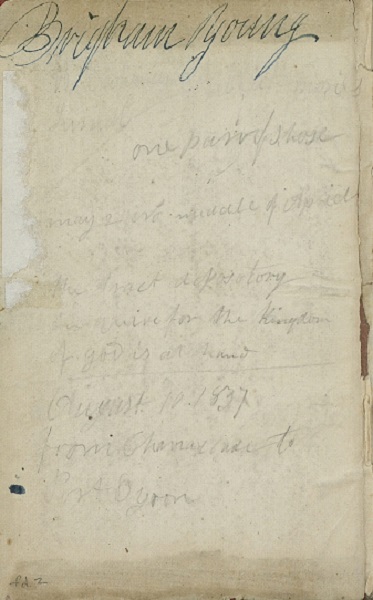 Brigham Young inscribed his name at the top of the flyleaf of his second personal journal. Courtesy of the Church History Library, The Church of Jesus Christ of Latter-day Saints, Salt Lake City, Utah.
Editorial Note
The following notations are found in the beginning pages (the front pastedown, first flyleaf, and following two leaves of the text block) of Brigham Young, Holograph Journal, 27 July 1837–1 April 1845. The notations are written in ink and graphite, suggesting that Young used whatever medium was most readily available to inscribe them. Brigham Young began recording journal entries on 27 July 1837, following the pages containing these notations, some of which predate his journaling.
―――――――― ◊ ――――――――
[1] Brigham Young
[about five illegible words in graphite]
[2] one pair of shose
may 2 No middle of Apriel
the tract deposotory
inquire for the Kingdom
of God is at hand
------------------
Mr John Bullen lives
in South Port [Southport, Racine County, Wisconsin] or Pike River
West Conson [Wisconsin][3]
---------------------------------
Comstock Hotell
at Loerend of
Albaney Bason [Albany, New York]
I am to Leve A. P.
Rockwoods [Albert P. Rockwood] trunk and
a Letter for him
--------------------
I Promis to wright
J. Heibner[4] when
I arive at Home J. Heibner[5]
[6] Peter Rose lives in
William street No 130
Cutler and Surgeons
instruments
-----------------------
Mrs. Fordham [Mary Baker Fordham]
lives corner of Pirl [Pearl] and
Frnkford [Frankfort] St[7]
----------------------
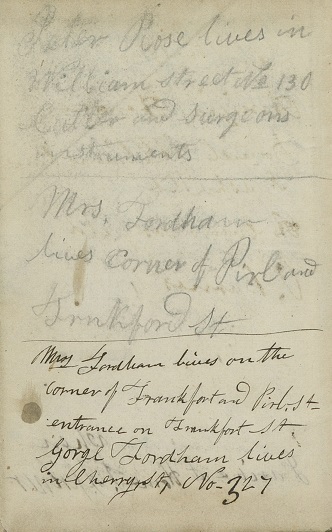 Example of Brigham Young's notations in the pasteboards and flyleaves of his second personal journal. Courtesy of the Church History Library, The Church of Jesus Christ of Latter-day Saints, Salt Lake Utah.
[8] Mrs Fordham lives on the
corner of Frankfort and Pirl. St [New York City]-
entrance on Frankfort St.
Gorge Fordham lives
in Cherry St, No- 327 [New York City][9]
Levi Rodgers Proprier
Amizia Henderson
Daniel Williams lives
at ashville
A. Evans [Abel Evans] westfield
O. Barnes 4
----------------
Stages Proprieriters
H. J. Rece
Hall of Northeast[10]
-----------------------
Roys at Singsing[11]
Mrs Fordham lives on
the corner of Frankford
and Pirl. St- the entrance
on Frankford. St-[12]
------------------------
Rufus Merick lives in
Adrean County of -
Kineway Mishagan [Keweenaw Bay, near Houghton County, Michigan][13]
-----------------------
[14] Ruben Buck lives
in Wesconson in the
town Belvedere [Belvidere, Buffalo County, Wisconsin][15]
[16] May the 4 1837
L Richards [Levi Richards] - - Dr
Syringes - 1.16
May <the> 12 [1837?] Joseph Young Dr
to cash for house $30.00
15
Joseph Young Crd [credit]
17 by 11 lt of shugger
-----------------------
[17] Spencer Cowart
on west hill town
niles or mord
Cortright
---------------------
[18] Miss Pratt [Thankful Halsey Pratt] Nov 69
Water Street N. Y
July 27 1837
T. B. Marsh [Thomas B. Marsh][19] crd by cash $3.00
Montrose July 14 1839
the daughter of Rodgers[20]
that lives in London
B. Sangiovanna,[21]
Sculptor,
No. 21, Nassau Street. [London, England]
Middlesex Hospital[22]
[23] Croton oil or tiglum
―――――――― ◊ ――――――――
Editorial Note
The following short and vague writing was apparently recorded in late 1838. It is written in graphite on page 10 in Brigham Young’s second personal journal and appears to denote a trip that Simeon Dunn apparently took in Michigan (presumably in late 1838). Because the text is undated, appears totally disconnected from surrounding text, and is of unknown context, it is presented here as a miscellaneous text.
―――――――― ◊ ――――――――
[24] from Detroit [Detroit, Wayne County, Michigan] to I Ypsilanti [Ypsilanti, Washtenaw County, Michigan] then 7 down the Huren [Huron] river town Van Buren[25] Symian A Dunn [Simeon Dunn]
―――――――― ◊ ――――――――
Editorial Note
The following notations are found in the later pages of Brigham Young, Holograph Journal, 27 July 1837–1 April 1845. Brigham Young’s last entry in this journal, 1 April 1845, is found on page 99 of the artifact. Young left three blank leaves of paper before inscribing the following notations. This series of writings concerning letters, documents, and people appear to relate to the 1840–1841 mission of the Quorum of the Twelve Apostles in England.
―――――――― ◊ ――――――――
[26] March the 15 - 1841 Letters to the Bishops & Clergy By Sir Charles Wobseley Bart Presented by a Bible Reader
Letters to Charles Daniel by a Bible Reader
Mr Daniels letters to the Rev. Mr. Powell a church minister
A letter to the Rev Mr Powell Feb the 12 1840
the controvercy betwen the Rev. H. T. Powell Vicar of Stretton-on-Dunsmore; and C. Daniel, Shoemaker in the Same Parish nov 1837 .. Doubts w<h>ether Matthew Parker,s consecration did ever take Place.. Doubts whether the Lambeth Register, be of enny authority
[27] the names of those to be Baptized
Adeline Garrow
―――――――― ◊ ――――――――
Editorial Note
Following the previous two lines of text, the remainder of the page and the following three pages in the holograph journal are blank. Brigham Young then turned this journal over and began writing notations from the back pastedown and last flyleaf toward the front of the artifact. The three following pages, moving back to front, contain miscellaneous notes, names, mathematical equations, and other writing. Some of the inscriptions are in graphite and others in ink; much of the penciled notes have faded and are now illegible.
―――――――― ◊ ――――――――
Expences[28]
[illegible] watch
Br 0.50 do do 05
075 [illegible]
433 vest 13
075
025
013
412
----------------------------------
43 Norfalk st
John Taylor Liverpool[29]
Modesitte[30]
[31] Charles Baker
Joseph Baker
---------------
Kenion & Williams[32]
[33] Schenectady
from Port Byrom
to Buffaloo
Boat Capt
Marion
----------------
[34] D Doct. Modsitt
Terre Hute
[35] L,
From all that
----------------------------
C,M
Jerusalam my happy home
L -
in god let all his
-----------------------------
James Gifford Samyersfield
45 lb 6 oz of butter from
one cow in 22 days
-----------------------------
[36] James Giffard at waterville his wife made from one cow in 22 days 45lb 6 oz of butter
[37] Brother David Nelson
lives in Warren County [Ohio]
Franklin township
works for worley
[38] Trates in B. Young in his chara[c]tor[39]
A grate atachment deg - 17
Love of children - do - 12
ConCentrativeness - do - 1.0
Self esteme - 13
approbativeness - 13
Coutiousness - 12
firmness - 18
Consciatiousness - 13
veneration 13
hope - 12
benevolence - 13
imitation - 12
mirthfulness 13
Causdity 15
comparison 13
eventuality 13
individuality - 12
bacality 13
form - 12
Combativness - 12
Distructiveness - 12
Secritiveness 10
mechanical 12
Order 10
study or imaginat<i>on 10
cal[c]ulation - 13
time 12 tune - 12
alamentativeness - 12
amativeness - 13
language - 13
―――――――― ◊ ――――――――
Editorial Note
In the back of his second holograph journal, Brigham Young copied a few significant documents: a letter from Orson Hyde and two revelations directed toward members of the Twelve Apostles. These texts are presented as they appear in the physical journal, not in chronological order. Each document is preceded by a brief historical introduction.
―――――――― ◊ ――――――――
30 March 1839: Letter from Orson Hyde
The following letter from Orson Hyde to Brigham Young, inscribed on pages 100 through 104 in this journal, depicts Hyde’s repentant and contrite feelings in the spring of 1839. Orson Hyde served the first mission to England with Heber C. Kimball in 1837 and 1838, but upon his return he grew discontented with Joseph Smith and church leadership. In Missouri, at the time of the Mormon War in that state, he sided with dissenters against Smith. Hyde, along with Thomas B. Marsh, made statements against the church presidency to Missouri state officials, which, according to Wilford Woodruff, “was a leading cause of the Governour’s calling out thirty thousand of the Militia against the Church of Jesus Christ of Latter Day Saints.”[40] His betrayal did not sit well with Joseph Smith as he languished in Liberty Jail. “Marsh & Hyde whose hearts are full of corruption,” Smith wrote from the jail to church members notifying them that “we deliver these characters unto the buffetings of Satan.”[41] Hyde wrote this letter to Brigham Young seeking forgiveness from him and by extension the Quorum of the Twelve for his actions in Missouri. In early May 1839, a general church conference held at Quincy, Illinois, voted to temporarily suspend apostles Orson Hyde and William Smith from acting in their office, though Hyde would be reinstated in late June 1839 after he made a public confession of contrition and wrongdoing at a conference of the Twelve. Hyde’s humility and penitence proved sufficient, and at that time he was “restored to the Priesthood again.”[42]
This letter was mailed on 3 April and arrived in Nauvoo, Illinois, shortly thereafter. It is likely that Young transcribed it in his journal sometime before his departure overseas in the summer of 1839.
―――――――― ◊ ――――――――
[43] New Franklin [Howard County, Missouri] March 30th 1839
Dear Sir
I now attempt to wr◊◊◊ write you a few lines to express, in short, the feelings and desires of my heart. I saw Brother Kimball at Far west soon after you left that place, and he invited me very strongley to come back and go with him to England. I asked him if he Could forgive me, and he said yes. I asked him if the Church would for give me, and he said yes. and I told him I would come and go with him. and so I will (if the Lord permit).
When I see you and the Church I will give you a full history of my course, and and the reasonings of my mind; and freely confess all my sins; and as to the terms upon which I can be recived back into my place I shall not be pocticlar; for to live in this way I cannot; and to join any of other society, I have no more disposition then to eat when I am full. I talked of writing to England. but have not don it. I saw I was pl[a]ced in a situation that I could do no good, and felt disposed to do as little harm as possible. Sometimes, during the past winter, my mind had ben so exercised that I could nether work nor sleep, and would frequently find my self myself weeping before I was a ware of it; and asking myself this qu[e]stin why in God,s name is it so. what have I don that I am left in this situation, or rather that I have ben suffered to fall into this dilemma. when I returned from England, my spirit was pure and my soul loved virtue. I was uncoscious of guilt. When I lay sick ◊ at Farwest I thaught if I could but depart. I should be at rest. I felt like taking no part whatever in the Danite movements.[44] the Convictions of my own mind ware, that it was not a good and virtuous institutioun, and these Conv[i]ctions ware strengthend by the tales of some who had been initiated into the mysteries & &&c, &c.
But these things do not rest upon my mind with that weight which they did at that time, I may say, they are no more in my mind n now then a feather in the wind. I had engaged a school which would have been worth three hundred dollars a year or more before I started for Far West. I however, would not bind my self for only a Quarter at a time. when in the upper Country I intended to have gone to Liberty to see the prisoners, But their had ben an attempt made to rescue them a few days before, and for this reason they would admit no one into the prison; theirfore I did not go. I spoke with Parlay through the Cracks and thaught If I had ben a Sampson.[45] the prisoners should go free.
Bro. Kimball told me I had better get clear of my school if I Could. I have done so since I returned, and expect Bro. Oliver Olney to send a team here for my family in the Course of two or three weeks. He will take them to the Iowa Territory, there is a fine chance for me in a wholesale Grocery here, Can get good wages and am now in the owners employ until the team coms. Had I better remain here a time in order to fit myself for a mission or a campaine campaign, or had I better leave as soon as the team Coms for my familey, and if I leave here whare shall I find the authorieties of the Church; the chastning hand of the Lord has don for me that which nothing else would, I think, If the Church will accept me as a minister, or a sol[d]ier, or a d◊◊◊ door-keeper, they can have me. I need not write to you that I have litterally died and ben rased from the ded dead since I was last at Far West, But I will tell you more about it when I see you face to face. Keep this part to yourself, if you please -
Brigham, will you forgive me: will you the Church forgive me? If So, God will for give me. Please write me immeditly on rct of this and tell me all you think to be for my good Direct to New Franklin Howard County Mo whatever the church may Decide upon respecting my case, they may rest assuard that the feelings of following are the real wishes of my hart.
"I trully truly wish Mount Zion well What eve ere becoms of me,"
With a fresh remambrence of formar times, and formar times sceans. with feelings of tnderest Kind towards you, and all all with whome you and are conneceted, I Subscribe myself your Younger Brother in a distant land feeding swine
Brigham Young
Oroson Hyde
―――――――― ◊ ――――――――
8 July 1838: Revelation for the Twelve
The following revelation, inscribed on pages 105 through 106 in this journal, was one of five revelations Joseph Smith dictated on 8 July 1838. Of the five this one seems to have had particular relevance for Brigham Young, who was about to undertake a journey across the ocean to proselytize in England. This revelation made “known the will of the Lord concerning the Twelve” at a time when four apostles had been removed from their office (John F. Boynton, Luke and Lyman Johnson, and William E. McLellin) for disaffection, dissent, or apostasy. The revelation called John Taylor, Wilford Woodruff, John E. Page, and Willard Richards as replacements; the latter was ordained an apostle in England in April 1840.[46] The revelation also provided an important promise for Young and the apostles about to embark on a transatlantic proselytizing mission: that the families of the apostles would be cared for and that an “effectual door” would lead to a great harvest of souls in England. It is likely that this revelation was not copied until at least April 1839 given its placement following the transcript of Orson Hyde’s 30 March 1839 letter above. Young received that letter in Illinois in April 1839.[47]
―――――――― ◊ ――――――――
Revelation given July 8th. 1838 at Far West Caldwell Co Mo[48]
------
Shew unto us Thy will O Lord concerning the Twelve. = Ans= Verily thus saith the Lord let a conference be held immediately let the Twelve be organized and let men be appointed to supply the place of those who are fallen let my servant Thomas remain for a little season in the Land of Zion to publish my word let the remainder continue to prech from that hour and if they will do this in all lowliness of heart in meekness and pureness <and>[49] long suffering. I the Lord God give unto them a promise that I will provide for their families[50] and an effectual door shall be opened for their families them henceforth and next spring let them depart to go over the great waters[51] and there promulge my gospel the fulness thereof and to bear record of my name let them take leave of my saints in the City Far West on the 26th. day of April next on the building spot of my house saith the Lord let my servant John Taylor and also my servant John E. Page and also my servant Wilford Woodruff and also my servant Willard Richards be appointed to fill the places of those who have fallen and be officially notified of their appointment[52]
―――――――― ◊ ――――――――
23 July 1837: Revelation for the Twelve
The following revelation, inscribed on pages 107 through 112 in this journal, was dictated by Joseph Smith on 23 July 1837 to then-president of the Quorum of the Twelve Apostles Thomas B. Marsh.[53] It provides guidance for the Twelve as well as insight into their role. The revelation, spoken at approximately the same time Heber C. Kimball and Orson Hyde began preaching in England for the first time, demonstrates the importance of the Twelve’s commission to spread the gospel to all nations and people and to do so under the direction of the church’s First Presidency. It also clearly notes the position and authority of the Twelve relative to the First Presidency. Finally, it gives encouragement to the apostles, indicating that “whethersoever they shall send you. go ye and I will be with you and in whatsoever place ye shall proclame my name an effectual doore shall be opend unto you. that they may receive my word.” Given the important content of this revelation as it pertained to the Twelve Apostles (in particular their work to spread the gospel overseas), it is not surprising that Brigham Young copied this revelation into this journal about the time he departed for his first overseas mission. Several other apostles did as well. For instance, Vilate Kimball wrote a 6 September 1837 letter to her husband Heber in England and included a transcript of the revelation she received from “Elder Marshs book as he wrote it from Josephs mouth.”[54] Heber C. Kimball then copied the revelation into his own journal. Later, in connection with their mission to Britain, Wilford Woodruff inscribed the revelation into his “Book of Revelations” before leaving Illinois in August 1839, while Willard Richards copied it into his “Pocket Companion” between 13 January 1840 and 20 April 1841.[55]
―――――――― ◊ ――――――――
A Revelation given Kirtland July the 23. 1837
------
the word of the Lord unto thomas B. Marsh concerning the twelve Apostles of the Lamb. verely thus saith the Lord unto you <my> servant thomas. I have heard thy prayors and their alms have come up as a memorial before me in behalf of those thy Brotherin whoe who ware chosen to bare testamona of my name and to send it abroad among all nations kindred,s tongues and people, and ordained through the instrumentality of my servents.[56] Verely I say unto you there have been som fue things in thine hart; and with the, with which I the Lord was not well pleased, nevertheless, inasmuch as thou hast abased thy self thou shalt be exalted, therefore all thy sins are forgiven the; let thy heart be of good chear before my face and thou shalt bear reccord of my name not only unto the Gentiles but also unto the Jews, and thou shalt send forth my word unto the ends of the Earth. Contend thou therefore morning by morning and dayafter dafter day, let thy worning v[o]ice go forth, and when the night cometh let not the inhabitance of Earth slumber; because of thy spech, let thy habitation be known in zion and remove not thy house; for I the Lord have a grate work for the to do in pub[l]ishing my name among the children of men; therefore gird up your loins for the work, let your feet be shod also for thou art chosen and thy path lyeth among the mountians. and among meny Nations, and by thy word meny high ones shall be brought low and by thy word meny low ones shall be exalted thy voice shall be a rebuke unto the transgressors[57] and at thy rebuke, let the tongue of the slanderer cease its preverseness, be thou humble and the Lord thy God shall lead thee by thy hand and give thee an answer to they prayers. I know they hart and have heard they prayers concerning thy Brotheren; be not partial to wards them in lov above many others but let your lov be for them as for yourself; and let your love abound unto all men. and unto all who love my name, and pray for your Brothern of the twelve. Admonish them sharply for my name sake. and let them be admonished for all their sins and be ye faithful before me unto my name, and after their temptations & much tribulations behold I the Lord will feele after them & if they harden not their harts and stifen not their necks aganst me they shall be converted and I will heal them. Now I say unto you. and what I say unto you I say unto all the twelve; arise gird up your loins take up your cross. follow me and feed my sheep; exalt not your selves, rebel not against my servent Joseph for verily I say unto you I am with him and my hand shall be over him, and the keys which I have given him and also to you ward shall not be taken from him untill I com. Verily I say unto you my servant Thomas thou art the man whome I have chosen to hold the Keys of my Kingdom as pertaining to the twelve abroad among all Nations that thou mayest be my servant to unlock the dore of the Kingdom in all places wheare my servant Joseph and my servant Sidney and my servant Hyram cannot com; for on them have I layed the burden of all the Churches, for a little season. wherefore wether whethersoever whethersoever they shall send you. go ye and I will be with you and in whatsoever place ye shall proclame my name an effectual doore shall be opend unto you. that they may receive my word. whosoever reciveth my word reciveth me, and whoesoever <reciveth> me reciveth those the first Presedent Presedency whome I have sent, whome I have made Councillars for my ◊ name sak unto you: and again I say unt[o] you that whoesoever ye shall send in my name by the voice of your Brotherin the Twelve duly recommended and autherised by you shall have power to open the door of my Kingdom unto any Nation whithersoever ye shall send them: inasmutch as they humble themselves before me and abide in my word and harken to the voice of my spirit. Verily: Verily I say unto you darkeness covereth the Earth and gros darkness the mind,s of the People, and all flesh has becom corrupt before my face: behold vengence cometh speedely upon the inhabitence of the Earth; a day of wrath day of burning; a day of distruction of weeping, of morning and of Lamentation; and as a whirlwind it shall com upon all the face of the Earth; saith the Lord, and upon my House shall it begin, and from my House shall it go forth saith the Lord, first apon those among you saith the Lord who have profesed to know my name and have knot not kn[o]wn me and have blasphemed aganst me in the midest of my house saith the Lord.[58] therefore see to it that ye trouble not your selves concerning the affairs of my Church in this place saith the Lord. but purify your harts before me, and then go ye into all the world and Preach my gospel unto every Creature who have nor recived it & he that beleiveth and is baptised shall be saved, and he that beleiveth not and is not baptised shall be damned - for unto you (the twelve) and those of the first presedency who are appointed with you to be your Councellars and your leaders is the Power of this Priesthood given for the last days and for the last time, in the which is the dispensation of the fulness of times. which power you hold in conn[e]ction with all those who have recived a dispensation at eny time from the beginning of the Creation; for Verely I say unto you the Keys of the dispensation which ye have recived have com down from the Fathers. and last of all bring sent down from Heven unto you. Verily I say unto you: behold how grate is your caulling. Clense your harts and your garments lest the blood of this generation be required at your hands; be faithful untill I com for I come qu[i]ckley and my reward is with me to recompence every man according as his works shall be I am ◊ Alpha and Omega Amen
―――――――― ◊ ――――――――
Editorial Note
The remainder of the writings in Young’s second holograph journal includes a genealogy of Willard Richards’s ancestors written in an unidentified hand.
―――――――― ◊ ――――――――
[59] William Peirson was born May 2. 1793.
Nancy Peirson November 22: 1792
Edwin Dwight born Dec. 10th 1819
Aliza Ann - April 14th 1822
Amelia Elizabeth April 16th 1825
Levi Richards March 29th 1827
Albert Howe June 8th 1829 died Oct. 15th 1839.
Susan Sanford Dec. 13th 1831
Joseph Richards, born March 17th 1762
Rhoda Richards - July 8th 1762
Were Married Dec 20th 1781
Joseph Richards born Sept. 29th 1782
Rhoda Richards - Aug 8th 1784
Susan Richards - Aug 13th 1786
Phinehas Richards - Nov 15th 1788
Levi Richards - Dec 7th 1790
Nancy Richards - Nov 22 1792
Hepsy Richards - July 28th 1795
Betsey Richards - May 17th 1797
Levi Richards - April 14th 1799
William Richards - May 2nd 1801
Willard Richards - June 24th 1804
Notes
[1] TEXT: Signature in blue ink.
[2] TEXT: Young wrote this and the following notes in graphite.
[3] TEXT: This address inscribed in brown ink.
[4] TEXT: Written lightly in graphite.
[5] TEXT: Written in ink, in an unidentified hand, possibly the signature of “J. Heibner.”
[6] TEXT: Young wrote this and the following note in graphite.
[7] This address is located near the waterfront of the East River in southern Manhattan.
[8] TEXT: Young wrote this and the following two notes in black ink.
[9] George Fordham was the father of Elijah Fordham, a church member in New York. Heber C. Kimball had lodged at the residence of Elijah’s sister-in-law (known only as Mrs. Fordham) but could not afford the fare of one dollar per night. George Fordham gave Kimball shelter for six cents a week. Kimball described George Fordham as “very wealthy,” having many storehouses and buildings. Kimball helped him raise a building in exchange for lodging before his departure for England in 1837. Fordham’s address on Cherry Street is in southeastern Manhattan near the shore of the East River. (Heber C. Kimball to Vilate Kimball, 27 June 1837, Kimball, Correspondence, CHL; and Bloxham, Moss, and Porter, Truth Will Prevail, 40–42.)
[10] TEXT: The preceding text was written in ink.
[11] TEXT: The preceding text was written in graphite.
[12] TEXT: The preceding text was written in ink.
[13] TEXT: The preceding text was written in ink.
[14] TEXT: The following text was written in graphite.
[15] Belvidere is located on the west-central edge of Wisconsin along the Mississippi River.
[16] TEXT: The following text was written in ink.
[17] TEXT: The following text was written in graphite.
[18] TEXT: The following text was written in ink.
[19] Four days earlier on 23 July 1837, Joseph Smith dictated a revelation to Thomas B. Marsh, who then served as the president of the Quorum of the Twelve Apostles. That revelation reminded Marsh and the apostles of their responsibilities to spread the gospel abroad “unto every creature who have not received it.” It also cautioned Marsh and the apostles against dissent and discord, which was rampant in the church in the summer of 1837. Marsh eventually withdrew from the church in 1838 before he was excommunicated in 1839. (Revelation, 23 July 1837, in JSP, D5:410–17; and Thomas B. Marsh, Biography, in JSP, D5:578–79.)
[20] Susanna Rogers Sangiovanni, daughter of David W. Rogers and Martha Collins. (Memoirs of Susanna Rogers Sangiovanni Pickett Keate, USHS; “Life Sketch of Susanna Rogers Sangiovanni,” USHS; and “The Biography of David White Rogers,” 34A, vol. 2, 17, Seventies Quorum Records, CHL. For more on David W. Rogers, see Williamson, “David White Rogers of New York,” 73–90. For more on Susanna Rogers Sangiovanni, see note XXX [first sentence of that note reads, “Susanna Rogers Sangiovanni, daughter of David W. Rogers and Martha Collins.”] in part 1. )
[21] Originally from Italy, Benedetto Sangiovanni, husband of Susanna Rogers Sangiovanni, used his skills as a clay modeler and sculptor to provide a living for himself and his wife in England. (Memoirs of Susanna Rogers Sangiovanni Pickett Keate, USHS; and “Life Sketch of Susanna Rogers Sangiovanni,” USHS.)
[22] Middlesex Hospital served as a medical teaching hospital in London’s Fitzrovia district. It was founded in 1745 and moved to its location on Mortimer and Nassau Streets in 1757. (For more on the history of this hospital, see Shaw and Winterton, Middlesex Hospital.)
[23] TEXT: The following text was written in graphite.
[24] TEXT: The following entry is written in graphite pencil. This enigmatic entry is undated and appears to be unconnected to Brigham Young’s travels at this time, though he did travel to Detroit in 1844.
[25] Van Buren Township was located on the Huron River, just east of Ypsilanti.
[26] TEXT: Black ink commences.
[27] TEXT: Graphite commences.
[28] TEXT: This is written sideways alongside the numerals below.
[29] TEXT: Written sideways in ink on inside of back pastedown.
[30] TEXT: Written in brown ink.
[31] TEXT: graphite begins.
[32] TEXT: This text is followed by five illegible lines of faded graphite.
[33] TEXT: This text is inscribed upside down at the bottom of the page.
[34] TEXT: Written in brown ink.
[35] TEXT: graphite begins.
[36] TEXT: Blue ink commences.
[37] TEXT: Graphite commences.
[38] TEXT: Brown ink commences.
[39] The following is evidently a phrenological chart for Brigham Young, although it is unclear whom he received it from and when. Young was examined by a phrenologist in Nauvoo sometime before 16 July 1842, and by another in Boston on 20 September 1843, but these used scales ranging from 1 to 12 and 1 to 7, respectively, whereas the scale here went at least to 18. Phrenologists measured the subject’s head and used those dimensions to create two different charts to understand the person’s personality or character traits: one displaying the measurements of and the other recording the numeric value of different character traits based on those measurements. Phrenologists believed that physical features of the head and different regions of the brain, which they designated as individual “organs,” corresponded to characteristics of a person’s personality. Different phrenologists apparently used their own numeric systems, making a comprehensive or comparative understanding of the charts quite difficult. (“A Phrenological Chart,” The Wasp, 16 July 1842, [1]; Woodruff, Journal, 20 September 1843, CHL; Watson, Manuscript History of Brigham Young, 20 September 1843; Fowler, Synopsis of Phrenology, CHL; Butcher, Oxford Handbook of Personality Assessment, 6; Riegel, “Introduction of Phrenology to the United States,” 73–78; and Colbert, Phrenology and the Fine Arts in America; for a comparison see Joseph Smith’s phrenological chart available in Phrenology Charts, 14 January 1840, in JSP, D7:115–24.)
[40] Woodruff, Journal, 25 June 1839, 1:340, CHL; and Thomas B. Marsh and Orson Hyde, Affidavit, Richmond, MO, 24 October 1838, Mormon War Papers, MSA.
[41] Joseph Smith to the Church in Caldwell County, 16 December 1838, in JSP, D6:308–9.
[42] Woodruff, Journal, 4–6 May 1839, 27 June 1839, CHL; General Church Minutes, 3 and 4 May 1839, CHL; and Joseph Smith, Journal, 4 May and 27 June 1839, in JSP, J1:338, 343.
[43] TEXT: Brown ink commences.
[44] The Danites, also known popularly as the “Avenging Angels,” were an oath-bound military society organized among the Latter-day Saints to protect church members during their conflict with Missourians in 1838. (“Danites,” Joseph Smith Papers, Glossary, http://
[45] See Judges 14–16.
[46] See herein p. XXX.
[47] For more on Young’s copying of this revelation, see JSP, D6:178–89.
[48] For a full treatment of this revelation, see Revelation, 8 July 1838-A [D&C 118], in JSP, D6:175–80; and JSP, J1:284–85.
[49] TEXT: This word is written over an illegible word.
[50] On 17 April 1838 Joseph Smith dictated a revelation for Brigham Young that similarly stated that he should “provide for his family until an effectual door is opened for the support of his family until I shall command to go hence.” (Revelation, 17 April 1838, in JSP, D6:108.)
[51] Heber C. Kimball and Orson Hyde had reported that their proselytizing had great effect and opened the church “on the other side of the great waters” in 1837 and 1838. (Letter from Heber C. Kimball and Orson Hyde, between 22 and 28 May 1838, in JSP, D6:147.)
[52] This is the second of two consecutive manuscript pages numbered “106.”
[53] Revelation, 23 July 1837 [D&C 112], in JSP, D5:410–17.
[54] Vilate Murray Kimball, Kirtland, OH, to Heber C. Kimball, Preston, England, 6 September 1837, copy, Kimball Correspondence, CHL.
[55] Woodruff, Book of Revelations, 11–19; Willard Richards, “Willard Richards Pocket Companion written in England,” ca. 1838, 4–9, Willard Richards, Journals and Papers, CHL; and Kimball, Journal, 1840–1845, 62–72, CHL.
[56] Refers to the Quorum of the Twelve’s calling to “travel from nation to nation.” (See Minutes and Blessings, 21 February 1835, in JSP, D4:237–47.)
[57] TEXT: This word is written over one wipe-erased illegible word.
[58] This likely refers to dissenters who spoke against Joseph Smith and the church in the Kirtland temple in mid-June 1837. (For more on this dissension, see Part 6: 20 April–14 September 1837 Introduction, in JSP, D5:363–65.)
[59] TEXT: Brigham Young handwriting ends; unidentified handwriting in blue ink begins.
