
 menu icon in the top, right corner of the screen.
 icon above to close this box.
 icon at the bottom of the screen below the browser—if you don't see it, swipe up to unhide it.
Personal Journal Entries in Chronological Order
2–5 March 1843 - 13–14 July 1844
Editorial Note
Though he recorded the two January 1842 entries above in his second (small red) journal, Brigham Young switched to writing his 1843 activities in his third journal, the narrow black book that he purchased in England in October 1840. Following entries concluding his journey home to Nauvoo in late spring 1841, Young resumed writing on the next page in his third journal with an entry for 2 March 1843, more than twenty months later. This marks the return to his regular recording activities, and he continued to write in this same book for over a year, until early August 1844. It is unclear what prompted Young to resume journal keeping in March 1843 or why he chose to write in his third journal rather than in the blank pages that followed the January 1842 entries. Earlier diaries mainly record his travels and ministry, but the 2 March 1843 entry that begins this portion of his journal simply recounts the events of the day.[1]
During the roughly yearlong interval between his January 1842 writings and his 2 March 1843 inscription, Brigham Young found himself busy and active alongside Joseph Smith in managing the affairs of the church and the city of Nauvoo.[2] On 23 January 1842, for example, Joseph Smith and Brigham Young censured Latter-day Saint Daniel Wood for purportedly teaching false doctrine.[3] Young occasionally traveled to nearby church branches to instruct and manage the Saints.[4] He continued his fundraising efforts for temple construction, reminding church members of the importance of building that sacred edifice. He likewise wrote epistles and preached to the Saints on the importance of gathering, consecrating, paying tithing, and helping the poor and needy.[5]
In addition to his ecclesiastical management, Brigham Young continued serving on the Nauvoo City Council. He participated on committees and worked to ensure the protection and safety of the city.[6] On 22 July 1842, the city council assigned John Taylor, William Law, and Brigham Young “to prepare a Petition to lay before the Governor of this State,” asking him to protect Joseph Smith “from arrest under any Writ from Missouri, and the Inhabitants of this City and its vicinity from the intrigues of evil designing Men.”[7] The city council further appointed Brigham Young, John Taylor, and Orson Spencer as a select committee on 9 November 1842 to prepare a new bill to regulate habeas corpus proceedings in the city of Nauvoo, another protective measure for Joseph Smith and the Saints.
By 1842 Brigham Young had gained firsthand knowledge of the practice of plural marriage. It appears that Joseph Smith taught Young, Heber C. Kimball, John Taylor, and a few other members of the Quorum of the Twelve Apostles about the doctrine of plural marriage. Young later declared that “when Joseph revealed that doctrine, provided that it would not diminish [his] glory, [he] would have said, ‘let me have but one wife.’” Though he could hardly get over the teaching “for a long time” and felt for the first time in his life that he “had desired the grave,” Young did as he was commanded and began to practice plural marriage, believing that Saints “who live their religion will be exalted.”[8] On 31 March 1842 Joseph Smith and Brigham Young sent a letter to Emma Smith and the newly established Female Relief Society of Nauvoo “to prevent iniquitous characters from carrying their iniquity into effect.” The letter cautioned the society’s women to watch out for immoral men, such as John C. Bennett, who claimed that church leaders authorized any sexual relations outside of marriage. Smith and Young apologized to society members “that we are obliged to make mention of any such thing” and told them, “We want a stop put to them, & we want you to do your part & we will do ours part for we wish to keep the commandments of God in all things 〈as〉 given 〈directly from heaven〉 to us from heaven, living by every word that proceedeth out of the mouth of the Lord.”[9]
Young was present with nine other people, including three of the Twelve Apostles, on 4 May 1842 during Joseph Smith’s daylong instruction about temple ceremonies. Smith taught those present “in the principles and order of the priesthood, attending to washings & anointings, endowments, and the communications of keys, pertaining to the Aronic Priesthood, and so on to the highe[s]t order of the Melchisedec Pristhood, setting forth the order pertaining to the Ancient of days & all those plans & principles by which any one is enabled to secure the fulness of those blessings which has been prepared for the chu[r]ch of the first-born, and come up, and abide in the prese[n]ce of Eloheim in the eternal worlds. In this council was institutd the Ancient order of things for the fir[s]t time in these last days.”[10] This early instruction and initiation in 1842 was part of his preparation to later officiate and oversee ordinances in the Nauvoo temple prior to the exodus of the Saints to the Great Basin.
Brigham Young’s attachment to Joseph Smith was somewhat severed in late 1842. Smith spent much of the last half of that year in hiding while attempting to avoid arrest or in legal proceedings related to another effort to extradite him to Missouri. In the first week of January 1843, a ruling by US District Court judge Nathaniel Pope and an order of discharge signed by Governor Thomas Ford finally released him from the threat. During part of this time, from late November 1842 to mid-January 1843, Brigham Young was at home, incapacitated by a serious illness.[11] In early 1843, though he remained bedridden, Young and the Quorum of the Twelve issued a proclamation to the Saints that a fast was to be held on 17 January to thank the Lord for the defeat of Missouri officials’ attempt to extradite Joseph Smith. The Saints were also asked to make contributions to assist the poor and to help defray the legal and travel expenses Smith had incurred.[12]
Though freed from one immediate peril, Young’s friend and church president Joseph Smith faced continuing financial pressure and the frustration of spending so much time on “temporal affairs” that he could not attend to other aspects of his office in early 1843. The hard work of providing for his family in frontier Nauvoo and his various roles in city government and the church left him unable to devote as much time as was needed to spiritual matters. Knowing of Smith’s temporal struggles, Brigham Young wrote a letter on behalf of the Twelve Apostles to church members in the communities surrounding Nauvoo on 18 February 1843. Young implored the Saints to provide for their church president. He wrote, “This is the point brethren, whether you will do your duty in supplying the president with food, that he may attend to the business of the church and devote his whole time to the spiritual affairs and interest thereof, or shall he attend to business by running here and there for a bushel of wheat or a pound of beef and pork while the Revelation to the church cease?”[13] Young, in his usual direct manner, ended the letter by imploring the Saints to provide this temporal help to allow Joseph Smith to attend to the Lord’s work and “bring about your salvation.”[14] Within a month, groups of church members from communities surrounding Nauvoo answered Young’s call. Teams from Ramus, Augusta, Lima, and Iowa came in and delivered at least ten loads of provisions including corn, pork, oats, flour, and wheat to sustain President Smith.[15]
With the exception of a short mission from 9 September to 4 November 1842, primarily to defend the church against negative reports circulated by John C. Bennett, Young appears to have remained with his family and in Nauvoo from July 1841 to March 1843, when he resumed writing in his journal.[16] After recovering from illness in January 1843, Young made only short trips to hold meetings with church members living in nearby settlements in Illinois but outside Nauvoo (such as Ramus, La Harpe, and Augusta) that took him from his family for brief periods but never for more than a few days at once.[17] While in Nauvoo during these two years, Young met regularly with Joseph Smith and other church leaders, spoke to the Saints in church meetings, participated as a member of the Nauvoo City Council, and provided for his family.
The 2 March 1843 entry that begins this portion of his journal simply recounts the events of the day. This lack of an explanation for the journal’s rebirth at this time and the straightforward tone of the entry suggests that it may be a continuation of a journal Young was keeping somewhere else, though no such journal has been located. In any event, the fact that most of the journal’s entries deal with ecclesiastical affairs, with regular gaps of several days between entries or groups of entries, suggests that Young viewed this more as a journal of his ministry than as a personal journal of daily life. While most of his earlier journals were records of missionary labors, with this journal he expands his purview to include other aspects of his ministry and ministerial travels. For the most part, the entries in this portion of his journal give few details about the events he records. Most merely mention where he traveled or held a meeting. The entries say relatively little about what he might have said or done at the time. Other sources, however (other journals, city records, newspaper articles, and the like), often provide such details, giving us a much better understanding of his activities than the journal alone can provide. Journals kept by Wilford Woodruff, Heber C. Kimball, George A. Smith, William Clayton, Willard Richards, and other associates of Young help flesh out his frequent report that he “had a good time” on this or that occasion.
This section of Brigham Young’s third holograph journal contains entries beginning on 2 March 1843 and covers events in Young’s life through 2 August 1844. Young inscribed all these writings in graphite. An unknown person later numbered these pages starting with “page 1” in black ink, beginning with the March 1843 entry, though the 1843 through 1844 entries begin approximately eighty pages into the journal, following the unnumbered pages that recorded travels associated with the second half of his British mission, from October 1840 through June 1841.
―――――――― ◊ ――――――――
2–5 March 1843 • Thursday–Sunday
March 2th 1843 paid a visit at Br [Heber C.] Kimballs - their was present Ed [Elder] Hyde Fa[the]r [Joseph Bates] Nobles - there wifes[18] my wife[19] was with me 5 day went to meeting at Fathers Alles[20] herd Elder [Heber C.] Kimball Preach[21] then went to Br Joseph Young
11 March 1843 • Saturday
Saterday the 11th 1843 Left Nauvoo at 9 a m arived at Ramos at 1/
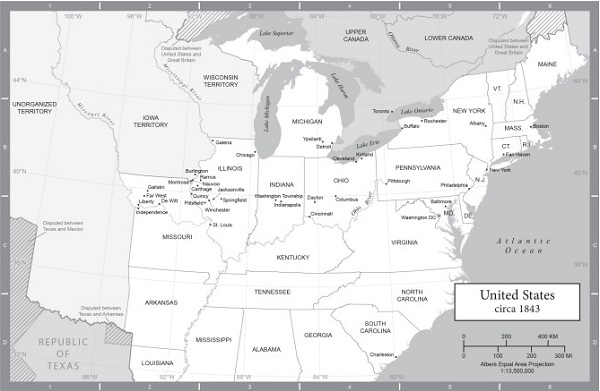 Based on map research and cartography for the Joseph Smith Papers; used by permission. RESEARCH: Richard L. Jensen, Brent M. Rogers, Gerrit J. Dirkmaat, Jeremy S. Lofthouse, and Brett D. Dowdle. CARTOGRAPHY: Jonathan West and Blake Baker. © Intellectual Reserve, Inc.
12 March 1843 • Sunday
Sunday morning the 12 - 1843 Br. J[oseph]. Smith feeles unwell we found the Brethern well Br Joseph Preachd from the 14 Chapter of St John[23] at 10 - o c - a m he taut menne grait and glorious things - I Preachd at 2 o c P.m from the 15 c. of st John[24] I visetd Br W. Purkins [William G. Perkins][25] in the evening Br Joseph & I staed at Br B[enjamin]. Johnsons all night
13 March 1843 • Monday
monday 13 had a church meeting at 2 o.c. P m A. Babbet [Almon Babbitt] Presiding Elder[26] Br J[oseph]. Smith Blest 27 children
14 March 1843 • Tuesday
Came home on tusday 14 [March] in a severe snow storm[27] found my famely well
26–28 March 1843 • Sunday–Tuesday
26 of march 1843 mared Ca[r]oline Frances Angel[l] to David Davis[28]
viseted Br G[eorge]. A. Smith on tusday 28[29]
1–3 April 1843 • Saturday–Monday
went [to] LaHarp on saterdy the first Apriel Br J[ohn]. Taylor with me we preached 4 times returnd on monday the 3
20 April 1843 • Thursday
Apriel 20 marr[i]ed B[rother]. Artemes [Artemus] Millet[30]
29 April–2 May 1843 • Saturday–Tuesday
on Saterday 29 went to Agusta with H[eber]. C. Kimball Joseph Young G[eorge]. A. Smith W[ilford]. Woodruff[31] held a meeting had a good time returned on monday 2 of may[32]
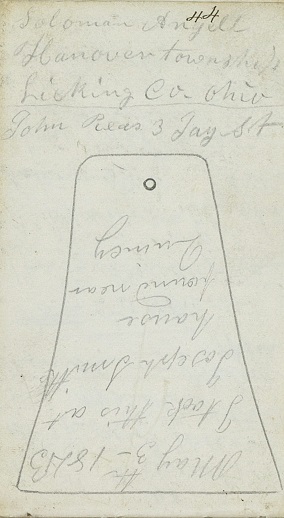 While at Joseph Smith's home, Brigham Young drew one of the Kinderhook plates on a page of his third personal journal on May 3, 1843. Courtesy of the Church History Library, The Church of Jesus Christ of Latter-day Saints, Salt Lake City, Utah.
3 May 1843 • Wednesday
[drawing of Kinderhook plate]
[33] May 3th 1843
I took this at
Joseph Smiths
house
found near
Quincy[34]
6 May 1843 • Saturday
on the 6 I staid at home maried a copple by the name of William inscoug [Ainscough] and Mary Wakefield[35]
7 May 1843 • Sunday
on Sunday 7 ord[a]ined a Bro to the office of an Elder by the name of O – F. mead [Orlando Fish Mead][36]
7–8 May 1843 • Sunday–Monday
Sunday may 7 - 1843 preach at Layharp [La Harpe] in the morning, Brs Nickles & Tufts spoke in the afternoon menny of the Brether spoke we had a good meeting - Vilate [Young] and Mary ann [Young] was with me staed at Br Hampton Last night Came to Br Holman[37] Sunday evening Staed all night Came home on monday
10 May 1843 • Wednesday
wensday evening went to Br Pearses to here a Lector on anenmal mg magnatisem, went up to the Landing to see the Bretherin that was goning East namly W[illia]m Smith J. Grant E. Robenson[38]
14 or 21 May 1843 • Sunday
14 [21?] herd Br Joseph Smith Preach[39]
21 May 1843 • Sunday
Sunday 21 was at home
23 May 1843 • Tuesday
tusday 23 meet in councel with the 12 set a part Brs Rodgers [Noah Rogers] & [Addison] Pratt for a forren mision to the Sandwich Island with others - Brs Hadlock [Reuben Hedlock] and John Ca[i]rnes for England[40]
28 May 1843 • Sunday
Sunday 28 at home & at Br Joseph Smith in Councel in Brs J[oseph] Smith H[yrum] Smith H[eber]. C. Kimball N[ewel]. K Whitney Judge [James] Adams & W[illard]. Richards[41]
31 May 1843 • Wednesday
We moved in to our new house on wensday the 31 of may in the year 1843 I prase my god for the privelege of a house[42]
4–5 June 1843 • Sunday–Monday
June 4 Went to Bair Crick [Bear Creek] at Br Smith from their to Nolton naborhood [Knowlton Settlement][43] Came home on munday

 Top: The Young home in Nauvoo, Illinois, as it appeared in 1977. Library of Congress, Washington, DC, HABS-ILL,34-NAU, 7-5. Bottom: The Young home in Nauvoo, Illinois, as it appeared in 1904. Library of Congress, Washington, DC, LC-DIG-stereo-1s46111.
9–12 June 1843 • Friday–Monday
June 9th went to Cartheg [Carthage] then to Br L[orenzo]. youngs[44] went to Laharp on Saterday preached sunday morning in L.harp went to the south [s]chool house in the afternoon held a meeting Staed at Br Hamptons all night Came home on monday. Br P[hineas]. H. young was with me he preached in the morning at L-harp with me found my famely well
13 June 1843 • Tuesday
June 13 tusday at Br Deckers[45] with Brs L[orenzo] D. & P[hineas]. H. young
―――――――― ◊ ――――――――
Editorial Note
On 7 July 1843—a little more than four months after recommencing his journal in early March—Brigham Young left Nauvoo with Wilford Woodruff and George A. Smith to visit branches of the church in the eastern United States. Just over a month earlier, Joseph Smith had authorized Young and the other apostles to serve as formal agents of the church to raise money for the construction of the Nauvoo House and the temple, which the Saints had been directed by revelation to build.[46] On 1 July 1843, just before his departure, Young and others testified before the Nauvoo Municipal Court in support of Joseph Smith, who had been arrested on a charge of treason against the state of Missouri.[47] With the church president safely discharged from that legal concern, Young felt ready to leave for his mission. Traveling by boat, rail, and stage, Young and his companions made their way to Pittsburgh, Baltimore, Philadelphia, New York, and Boston, where they and other members of the Twelve presided over a three-day conference before returning to Nauvoo. A scattering of entries between 22 October 1843, when he arrived back in Nauvoo, and 21 May 1844, when he left on another mission to the eastern United States, give glimpses into his activities in Nauvoo over the winter of 1843–44, with the emphasis again being on ecclesiastical affairs. These included public church meetings held in and around Nauvoo as well as more private meetings in which he participated with others in performing priesthood ordinances that would later be given in the Nauvoo temple.
―――――――― ◊ ――――――――
July 1843
July 1843
Rapids Steam Boat[48]
7–8 July 1843 • Friday–Saturday
Frida 5 m[inutes]. to 3 o c P.M. Left Nauvoo[49] was at the mouth of the Illinois 15 m[inutes] past 10 the next morning[50] we have had a good time so far in[joying] our selves well
8 July 1843 • Saturday
arived at St Lewis on saterday 8 at 2 o.clock P.M[51] - took the Steam Boat Lancet[52]
9–10 July 1843 • Sunday–Monday
Left Sunday morning at 9. o.c. 10 minits[53] was at the mouth of the ohio river at 2 o.c. next morning. we have had a good passeg so far
12 July 1843 • Wednesday
at the foot of the ohio falls wensday 7 o.c 35 minits 12 day of July
16–17 July 1843 • Sunday–Monday
Sunday 16 tended meeting in the morning at the home of Father Hewits[54] Br [Wilford] Woodruff and I went to Kentuckey in the after noon to Licking Branch[55] Staid over night found Br John Youtsey and James Cobbertson [Colbertson] in a cold Backen state[56] Staed with Br Colens Pembetton [Collins Pemberton][57] mondy nigh[t].[58]
18–27 July 1843 • Tuesday–Thursday of the following week
tusday came to Cincinati[59] - on wensday to see Br Marton [David Martin] found him at home, we asked for him found him and that was all he did not say Brother nor ask our names.[60] we went to see Br Burch the next morning [20 July] and found a Brother,[61] we returned to Cincin<n>ati. Started for Pitsburgh on saterday 22 on bord of steam Boat Ad Elaide [Adelaide] Capt Boughar[62] Johnson Clark. we left the Boat on thursday morning [27 July] 2 miles below Bevor [Beaver] town[63] we came up to Bri<d>gewater took the stage at 11 o.c. am - had a verry ruf ride. arived in Pitsburgh at 7. P.M[64] - Br [George A.] Smith and my self went to find the Brethern we found Br Small[65] in a bout 1/
28–29 July 1843 • Friday–Saturday
had a meeting frida evening at Br [Jeremiah] Coopers I ockepied the most of the time had a meeting at Br Savory[67] Saterday evening for to instruct the Elders[68] had a good time
30–31 July 1843 • Sunday–Monday
30th Sunday morning Br [Wilford] Woodruff and Br [George A.] Smith preached[69] Brs [John E.] Page & [Orson] Pratt in the afternoon[70] Br [Heber C.] Kimball and my self in the evening[71] - monday 31 we went to visit the glass works[72] water works[73] iron Boats nale factory[74] and came home to Br McDowels[75] - Brs John Smith [Charles] Beck[76] and Anderson was with us
3–18 August 1843 • Thursday–Friday two weeks later
August 3th took the Stage for Pheledelpha at 6 a.m. in company with H[eber]. C. Kimball, O[rson]. Pratt J[ohn]. E. Page W[ilford]. Woodruff and G[eorge]. A Smith Came to a viledge cald Washington (Br [Charles] Beck came with us 18 miles.) 25 miles from Pits here we came to the national road[77] Came to Cumberland (125 m[iles]. from Pits) at 6 o.c. the next morning took the cars for Boltomore[78] at 8 o.c. arived there at 6. P.M 180 mils. then took a Steam Boat at 7 P.m. Came 51 m[iles].[79] took cars 18 m[iles] then Steam Boat 65 [miles] Came to Pheledelpha[80] arived there at 5 o Clock on Saterday morning the 5[81] - staed there and Preached to the Brethern[82] visited the old state house [10 August][83] waterworks[84] and menny other places.[85] in coredegd [encouraged] the Bretherin[86] - left them with good feelings menny are going west[87] left yesterday frida the 18 Came to Br Wm Richards in mount Holley[88] Br [Heber C.] Kimball came with me & B. Winchester[89]
20 August 1843 • Sunday
Sunday the 20 Came to a place cauld rising 10 miles,[90] here I met with Br W[illia]m Smith Br. [John E.] Page & G[eorge]. A. Smith was there[91] Br Joseph A Stratton was with us in Pheledpha and here he bids fare fore a good man
21–22 August 1843 • Monday–Tuesday
Monday 21 Came to New York[92] Stopd at Br Mc Lane 182 Canal St - found Br Davis and Br Carnes.[93] I was sick with the head ake and in my joys jows [jaws] a grate pane here this morning
29 August 1843 • Tuesday
tusday 29 went to the arlington House in Company with Br. L[ucian]. R. Foster[94] the Janeral [General][95] was not at home soon came. Staed all night had a plesent visit
30–31 August 1843 • Wednesday–Thursday
wensday he took his caredg took us to Coney Island we went in to the water a swiming Mr [James Arlington] Bennet said to us coud Baptise me we did so and confirmed [him] in the water[96] Came home to his house he felt well. we staed till the next day had a plesant visit
26 August–4 October 1843 • Saturday–Wednesday six weeks later
held our confrence in new York[97] tar[ri]ed Some days Came to Boston [5 September, Tuesday][98] had a good visit at linn [Lynn] hed our Confrence acording to a pointment[99] Staed till Septmber 29[100] then Started home with Sisters Alley & [Augusta Adams] Cobb Came to New York staed one day [30 September, Saturday][101] Came to Pheledelpha oct 1 - on Sunday stad till tus wensday [4 October, Wednesday][102] started with Elders [Heber C.] Kimball and G[eorge]. A. smith[103] and margret Adams
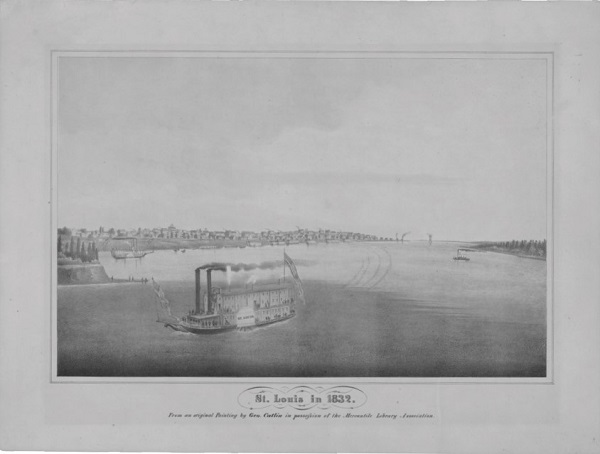 Drawing showing a paddle-wheel steamer headed up the Mississippi River with a view of Saint Louis, Missouri. Steamboats transported Brigham Young and other Latter-day Saint missionaries from city to city along the nation's waterways. Library of Congress, Washington, DC, LC-DIG-pga-08971.
8–22 October 1843 • Sunday–Sunday two weeks later
arived in Pittsburgh[104] on Sunday 1 o.c A M[105] took the steam Boat Rariton [Raritan][106] at 11 am found Bradford Eliott[107] Capt John McCloy Sister Cobbs Babe[108] was sick we arived in Cincinata on Thursday [12 October] 4. P.M. when a bout one [h]our from the Boat hir Babe Died of the consumpsion[109] we staed till saterday morning [14 October] had hir Babe put in to a tin coffin tooke it with us - we left Cincinatee 11 a m Saterday on the Boat nautilus Capt John Miller lay in [at] Luaville [Louisville] on Sunday [15 October].[110] M Marton we had a good pasedge to St Lewis [Louis] arived there thirsday [19 October] at 10 a m left in the evening arived at nauvoo Sunday 22 a bout 12. m.[111] found my famely perty well Br J. Smith fealt well was glad to see us went in to counsel with the Bretherin in the afternoon[112]
―――――――― ◊ ――――――――
Editorial Note
Much had transpired in Nauvoo since Brigham Young departed in early July. Though Joseph Smith was freed from his arrest on a charge of treason against the state of Missouri on 1 July, the threat of his extradition remained palpable. Some two hundred disgruntled Hancock County citizens became so enraged by Smith’s release from arrest on a writ of habeas corpus by the Nauvoo Municipal Court that they met in Carthage, Illinois, in mid-August 1843. A few weeks later, in early September, the “great meeting of anti-Mormons” reconvened to adopt strong resolutions condemning Joseph Smith and the Latter-day Saints.[113] These Hancock County residents claimed that Smith shamelessly disregarded all forms of the law. They then vowed that “if Governor Ford would not surrender Joe Smith on the requisition of the Governor of Missouri—which he had refused to do from political considerations—that they would call in aid from other counties and other States to assist them in delivering him up.”[114] Echoing the resolutions of Jackson County citizens intent on evicting the Latter-day Saints from their county a decade earlier, the Hancock County citizenry resolved to resist all future wrongs imposed by the Saints, as they stated, “peaceably, if we can, but forcibly, if we must.”[115] The anti-Mormon resolutions arrived in Nauvoo on 15 September and immediately concerned Smith, who wrote quickly to Illinois governor Thomas Ford about his lingering fear of extradition to Missouri and his grave concern that Hancock County residents might conspire with Missourians to capture him. Ford assured Smith that, as governor, he would “prevent any such invasion.”[116]
Others became concerned about the Saints in Nauvoo as well. Newspaper editors in Illinois, Missouri, and Iowa Territory published the resolutions; reports printed in those newspapers reached media outlets farther east including the New York Herald, Philadelphia North American and Daily Advertiser, and Cleveland Herald.[117] The New York Herald reported, for example, an article headlined “Joe Smith in Danger,” which noted that “critical indeed is the position of the Mormon prophet becoming, and it is just possible that some fine morning we may receive intelligence of an attack on the holy city” of Nauvoo.[118] Concerned by what he was learning about the growing opposition to the Latter-day Saints, land speculator and benefactor Horace Hotchkiss wrote from New York City to Joseph Smith. “I feel an interest in the prosperity of Nauvoo,” Hotchkiss wrote, “and an interest also in the success of the mormon enterpise and a deep interest in the wellfare of your people and the more so certainly as their pecuniary interest is identified with my own.”[119] As Hotchkiss and others became aware of the festering threats in Hancock County in the summer and early fall, distrust and fear grew in Nauvoo.
Extradition and external threats of violence were not the only developments during Brigham Young’s three-month absence. On 12 July 1843, Joseph Smith dictated a revelation on eternal and plural marriage.[120] Though, as Brigham Young well understood, this practice had already started—by summer 1843, Smith had entered at least twenty-five confidential sealings, or plural unions—the written revelation codified the divine origin, authority, and eternal duration of marriage. During the previous year, Smith officiated in temple-related instruction and the eternal sealing of others.
Since a 19 January 1841 revelation designated Nauvoo as a temple city and explained why that was essential, the Saints had looked forward to additional priesthood blessings and authority in connection with the temple. A temple must be built, the revelation declared, because “there is not a place found on earth that he [the Lord] may come to and restore again that which was lost unto you, or which he hath taken away, even the fulness of the priesthood.”[121] The purpose of the gathering, Wilford Woodruff explained, is “to build unto the Lord an house to prepare them for the ordinances & endowments washings & anointings &c. . . . If a man gets the fulness of God he has to get in the same way that Jesus Christ obtained it & that was by keeping all the ordinances of the house of the Lord.”[122]
As noted earlier, Joseph Smith first initiated new temple-related ordinances on 4 May 1842 with a small group of men. Brigham Young and fellow apostles Heber C. Kimball and Willard Richards were among those who received an “endowment” on that date, along with “certain instructions concerning the priesthood.”[123] That was likely to have been followed with additional small gatherings toward preparing men and women to later officiate in the temple, but because of unwelcome events, including scandals associated with Nauvoo mayor John C. Bennett and another attempt to extradite Joseph Smith to Missouri, 1842 did not unfold according to plan. A little over a year later, Joseph Smith tried again. On 26 May 1843 he reassembled the same group (only two were missing) and repeated the earlier ceremony and instruction. This served to prepare them for being sealed to their wives and for additional temple-related teachings. Several couples, including Brigham Young and Mary Ann Angell Young, were sealed together for eternity a few days later.[124] Not long afterward, Brigham Young left Nauvoo for his assigned summer travel.
While Young was away on his mission to the East, Joseph Smith dictated the revelation on eternal and plural marriage and taught the Saints about its tenets. On 16 July 1843 he preached a public discourse on “the law of the priesthood,” describing eternal marriage without mentioning plural marriage specifically. Smith explained “that a man must enter into an everlasting covenant with his wife in this world or he will have no claim on her in the next.” Although he did not explicitly acknowledge the existence of a new written revelation on the subject, he indicated that “he could not reveal the fulness of these things untill the Temple is completed.”[125] On 23 July 1843, Joseph Smith further taught the importance of receiving the “full blessings of the priesthood and of becoming priests and kings ‘not to the kingdom of this earth but of the most high god.’”[126] In August, Hyrum Smith read the revelation to the Nauvoo high council and elaborated on its claims for “about an hour” before testifying to them that the revelation was true.[127] Later that month, in a letter from Nauvoo to Brigham Young, Willard Richards spoke of the “New Revelation,” though he stated that he had “not seen it yet.”[128]
When Brigham Young returned to Nauvoo in late October, he found the group of those men who had received temple-related ordinances had expanded to include women for the first time. As Willard Richards recorded in Joseph Smith’s journal on 28 September 1843, Joseph Smith “was by common cons[e]nt. & unanimous voice chosen presid[e]nt of the quorum [of those who had received temple ordinances]. & anointed & ordd. [ordained] to the highest and holiest order of the priesthood” with his companion, Emma Hale Smith.[129] This event marked the formal organization of the quorum that met thereafter with men and women regularly participating in prayer meetings and in receiving temple-related instructions and ordinances. Immediately upon arrival in Nauvoo, Young once again became engaged with the activities of this quorum. As his diary records, Young’s wife Mary Ann joined “this order of the priesthood” on 1 November. Later that month he and Mary Ann received the fulness of priesthood ordinances.[130] This prepared them and a select group of others who received the same ordinance in preparation for the temple to officiate once the temple was finished so that all worthy Saints could receive temple ordinances.
On 23 October 1843, the day after he returned, though he had become ill, Brigham Young wrote a letter to Joseph Smith reminding him of a previously contracted loan from Josiah Mainwaring and notifying him that Mainwaring’s wife, Elizabeth Henry Mainwaring, needed some help, presumably financial assistance.[131] Elizabeth Mainwaring apparently knew Young well enough to request that he write Joseph Smith, apparently requesting repayment on the year-old loan.[132] Young began recording entries in his journal again on 29 October.
From this point until the end of January 1844, Young focused on these temple-related activities as one of his primary preoccupations and responsibilities. The first three entries after he returned home refer to these activities. Although he met with this temple-related quorum thirteen times in January 1844, some of the meetings taking place in his home, none of his early 1844 entries mention the quorum or the ordinances, but Wilford Woodruff does mention those gatherings. In meetings beginning 20 January and ending on the thirty-first, many of which were held at his home, Young carried out his assignment to have each of the apostles then in Nauvoo receive all the priesthood ordinances.[133]
―――――――― ◊ ――――――――
29–30 October 1843 • Sunday–Monday
Sunday 30 [29 October] Sisters [Thirza Stiles] Cahoon [Lois Lathrop] Cutler & [Phebe Watrous] woodworth was taken in to the order of the Priesthood[134] - monday evening [30 October] Baptised Sisters AugustaAdamsCoobbCobbHarittHarrietCook] &[135]
1 November 1843 • Wednesday
[136] Nov 1th - 1843 Mary A. Young admited in to the hiest orderer Preast hood[137]
2 December 1843 • Saturday
December 2 - 1843 Recived into the Quorum Orson Hyde P[arley]. P. Pratt W[ilford]. Woodruff G[eorge]. A. Smith Orson Spencer Runald [Reynolds] Cahoon Thadas Cutlar[138]
this night had a dream thaught I was traveling to the East with my wife in a caredge Coverd, it storamed I let the curtins down travel safe along though muddy we turned to come back. Br Joseph Smith sat on the Back seat with my wife he whisperd to hir sead it was wright if she was a mind to nothing more past betwen them as I drove a long the Caredge [carriage] droad [drawed] out to be so long I cauld not see my wife Br J Smith was an the seat with me I looked Back to see my wife but could not Br Joseph said we must goe and get the caredg or part of it that had Mary ann in it we got the Caredge but saw nothing of Mary ann. for she was in side and the Caredge closed in with curtin and they war Black we was puling it over a Bridg the last I remember
3 December 1843 • Sunday
Sunday 3 had a meeting in the upper r[o]om[139] Br [William W.] Phelps read Joseph[’s] a Peal to the G[r]eene mountn Boys[140]
7 December 1843 • Thursday
December 7 - 1843 went to Br Joseph Smiths with Br James Moses tenderd Sister Hambleton[141] 26.55 Cents for L. Robers dead [deed]
16 December 1843 • Saturday
Lett all men know that <on the> 16 day of Dec - 1843 the Citty Councel of <the> Citty of Nauvoo Conferd the office of occener [auctioneer] for said citty wher by he can get a Penny for his famely[142]
Henary Barton and[143]
1 January 1844 • Monday
Janury 1th 1844 Spe[n]t the day at Br. E[dwin]. D. Woolley
2 January 1844 • Tuesday
tusday Sister Cobb[144] - Came from Mosura [Missouri]
5 January 1844 • Friday
friday 5 went [to] L. Harp [La Harpe] Brs Wolley[145] & Rule went with me[146] Reuben Hadlock [Hedlock] No 36 Chapel St L.Pool [Liverpool][147]
15 January 1844 • Monday
Janunary 15 - 1844 Br. Joseph Smith had a lee for cutting and halling wood[148] in the evening at Br W[illard]. Richards my wife [Mary Ann Angell Young] and Sister Cook[149]
24 January 1844 • Wednesday
24 day of Jan had a good party at my house a bout 16 copple[150]
4 February 1844 • Sunday
Feb 4 held a meeting at Br Chamblins [Chamberlain][151] in comp - with Brs Joseph [Young] P[hinehas]. H[owe Young] & L[orenzo]. D. Young & John Pack[152]
15 February 1844 • Thursday
Thursday Feb 15 - 1844 this day viseted Father Lews or Lous [Malatiah] Luce[153]
9–13 February 1844 • Friday–Tuesday
Last Friday went to Bare Crick [Bear Creek] with Br L[orenzo]. Young met Brs John Pack & Joseph Young on Sunday at meeting staed til Tusday[154] the Brethern gave me som corn & Pork a little Butter & hunny had a good time with the Br-in – [Brethren]
24 February 1844 • Saturday
24 went to Bare crick Noltons [Knowlton’s] setlement Br P[hinehas]. H Young went with me held 2 meetings the Bretherin ware all well and in good spirits[155]
26 February 1844 • Monday
Bonday [Monday] 26 it was lowery[156] & rany the Brethern gave me som provision
2 March 1844 • Saturday
march Saterday the 2 went to masadona [Macedonia] L[orenzo]. D. Young went with me St[ay]ed over the Sabath[157]
7 March 1844 • Thursday
thursday March 7 1844 had a general meeting at the temple[158] J[oseph]. & H[yrum]. Smith H[eber]. C. Kimball P[arley]. P. Pratt O[rson]. Pratt W[illard]. Richards J[ohn]. Taylor G[eorge]. A. Smith W[ilford] Woodruff and my Self - had a good meeting spock [spoke] on meny things[159]
13 March 1844 • Wednesday
Wensday March 13 1844 met in councel at Br J[oseph]. Smith store in company a bout 20 to orginise our Selves into a compacked Boddy for the futher advenment of the gospel of Christ[160]
―――――――― ◊ ――――――――
Editorial Note
The foundation for the organization of the Council of Fifty had been laid at least three weeks earlier. Joseph Smith met in council with the Quorum of the Twelve and others on 20 February 1844 to discuss inquiries received from Lyman Wight about preaching to Native Americans. After concluding to let Wight use his own best judgment, Joseph Smith “instructed the 12 to send out a delegation” to investigate various locations where the Saints could move and establish a government of their own.”[161] The council met twice more to discuss what they variously referred to as the California or the Oregon expedition.[162] Contemporary accounts confirm that the purpose of the exploration was to “pitch upon a spot to build a city,” a place of refuge to which the Saints could remove after the completion of the Nauvoo temple.[163] Smith had initially given this major assignment to Brigham Young and the Quorum of the Twelve Apostles. However, upon the organization of the Council of Fifty the responsibility for this assignment shifted, though Young and the apostles remained closely involved.
Joseph Smith formed the Council of Fifty with several concurrent goals, including managing his campaign for president of the United States, continuing the effort to obtain redress for the wrongs suffered in Missouri, locating unoccupied territory where they could enjoy their religious rights and civil liberties, and furthering the interests of the kingdom of God.[164] The new council became the venue for preparing for the Saints a new home. “All seemed agreed to look to some place where we can go and establish a Theocracy either in Texas or Oregon or somewhere in California &c.”[165] It also became a central committee for Joseph Smith’s presidential campaign—the very endeavor that led Brigham Young and others to leave Nauvoo at a critical time. As summarized in Brigham Young’s later history: “We prepared several memorials to congress for redress of grievances, and used every available means to inform ourselves of the unoccupied territory open to settlers. We held a number of sessions, and investigated the principles upon which our national government is founded; and the true foundation and principles of all governments.”[166]
Although Brigham Young attended Council of Fifty meetings and participated in them regularly over the next two months, his journal is silent about the work of the council.[167] Along with seeking redress and a new home, much of the council’s discussion revolved around governments. In a 5 April 1844 meeting, Young spoke about the “imperfection and corruption of the governments of the earth.” He proceeded to explain his thoughts on the way to fix corruption and create the ideal government. The president of the Twelve expounded upon the point, declaring, “No line can be drawn between the church and other governments, of the spiritual and temporal affairs of the church. Revelations must govern. The voice of God, shall be the voice of the people.”[168] In another meeting council members spoke of governing by laws calculated for the universal good, which principles emanated from God. Brigham Young again articulated that revelation from God was the starting point and foundation for good government and especially for the kingdom of God.[169] Based on their past experiences with governments, the Council of Fifty and its members wanted to drive away “every species of intolerance” and to promote principles of liberty.
The Council of Fifty worked behind the scenes for Joseph Smith’s presidential campaign but also promoted his candidacy in public. At a meeting on 9 April 1844, Young “requ[e]sted all who were in favor of electing Joseph to the presidncy to raise both hands . . . – 1100 Elde[r]s and commncd [commenced] clapping their hands and gave many loud cheers”[170] Afterward the Quorum of the Twelve Apostles scheduled conferences at forty-seven different locations and called some 380 missionaries to preach the restored gospel and electioneer for Smith. At a 25 April 1844 meeting, Joseph Smith called on members of the Council of Fifty to disperse in the nation and said, “Those of this council who could, should go forth immediately to electioneer.” Therefore, Smith announced, “we must suspend out meetings for the time being and keep silence on the subject, lest by our continual coming together we raise an excitement. We can call the council together again when necessary.”[171] Brigham Young himself departed for this electioneering and preaching mission on 21 May, when he resumed writing in his journal. Among the other high-profile members of the council involved in Smith’s campaign was Sidney Rigdon. At Joseph Smith’s direction, the council unanimously nominated Rigdon to run for vice president and to become a permanent resident of Pennsylvania to broaden out Smith’s presidential ticket. On 17 May 1844, at the Illinois nominating convention held in Nauvoo, the Latter-day Saints declared their support for Rigdon as the vice-presidential candidate.[172] Rigdon left Nauvoo in early June for Pittsburgh.
That both Brigham Young and Sidney Rigdon left in the weeks before Joseph Smith’s death was significant, foreshadowing a showdown between them in August 1844. Evidence suggests that at the 26 March 1844 meeting of the Council of Fifty, less than two weeks after organizing the council, Joseph Smith spoke to those present about the restored keys and power by which he led the Saints. He also spoke of the great relief he felt to have now shared the keys and burdens of leadership with others, thus ensuring that the work could continue no matter what befell him.[173] In the words of Orson Hyde in statement he presented to the Council of Fifty a year later, “Joseph Smith did declare that he had conferred upon the Twelve every key and every power that he ever held himself before God.”[174]
After mentioning the organization of the Council of Fifty in the 13 March 1844 entry above, Brigham Young wrote just one entry in his journal before he left nine weeks later for electioneering and preaching in the East. His departure from Nauvoo ended his involvement in the Council of Fifty during Smith’s lifetime—although he would reorganize the council in February 1845—and was the last time he would see the church president alive.
Young traveled east to Pittsburgh, Kirtland, Buffalo, Albany, and New York City before arriving in the Boston area. He visited, instructed, and strengthened church members along the way. While in Boston he and other members of the Twelve held a two-day church conference before holding a political convention on 1 July 1844 to nominate Joseph Smith and Sidney Rigdon as candidates for president and vice president of the United States. Delegates for Smith’s candidacy who would attend a national convention for the upcoming 1844 presidential election in Baltimore were also selected at this meeting.[175]
Joseph Smith had been dead for four days by the time of the 1 July 1844 nominating convention in Boston, having been murdered with his brother Hyrum in Carthage jail on 27 June. Though rumors of Smith’s death first reached Young and other members of the Twelve on 9 July, Young received news confirming the tragedy on 16 July while he was in Peterborough, New Hampshire, with Orson Pratt.[176] Young immediately left for Boston, where he met other members of the Twelve and waited several days for Lyman Wight to join them. On 24 July he, Heber C. Kimball, Wilford Woodruff, Orson Pratt, Orson Hyde, and Lyman Wight started for Nauvoo, largely retracing the route by which they had gone east.[177] Young’s journal provides the details of their travel back to Nauvoo. This portion of the journal ends on 1 August 1844, five days before Young and his companions finally reached Nauvoo.
―――――――― ◊ ――――――――
20–23 April 1844 • Saturday–Tuesday
Apriel 20 1844 went to Yelarome to Father Morleys settlement Br W. Woodruff went with me Preached on Sunday had a good time Came home on Tusday
21–26 May 1844 • Tuesday–Sunday
May 21th 1844 took the steam Boat Ospry[178] Cap[tain] [George] Anderson[179] had a good pasedge to St Lewis[180]
held a meeting in the of Wensday with the Brethe[r]in[181] Left St L[ouis]. thursday 23 at 12 a.m.[182] on Steam Boat Lewis Phillippe [Louis Philippe][183] Capt[ain] J. J. Worman a fine Boat good cap[tain] and matt [mate][184] arived at Cincenata Sunday 26 [May] - at 5 pm[185]
David Thompson[,] Clark [clerk] for the union Fir Comp[186]
----------[187]
Dr P. C. Hovaker[188] St Louis Mo
----------[189]
1 June 1844 • Saturday
June the first <1844> held a confrence in Pitsburgh [Pittsburgh, Pennsylvania][190] with Elder J[ohn]. E. Page[191]
2 June 1844 •Sunday
on Sunday Preached in the morning to the Saints and Spectators had sacrment in the after noon Br Leste[r] Brooks[192] Preached in the evening
3 June 1844 • Monday
on monday left Pits[burgh] for Beavor [Beaver, Pennsylvania] I Pr[e]ached in the evening in old Bri[gh]ton[193] to an atentive Congr[eg]ation
4 June 1844 • Tuesday
tusday 4 started in company with Br [Lester] Brooks & F[ranklin]. D. Richards for Kirtland at 4 in the afternoon[194]
5 June 1844 • Wednesday
wensday 5 arived in warren a bout 9 o.c. a.m. took on a large Party going to Acron [Akron] to an ablishnest [abolitionist] convension - the sperit manifested by som was to put down every body but them selves[195]
6 June 1844 • Thursday
June 6 - 1844 Br F[ranklin]. D. Richards & my self are on the Publick square of Ravenna Portage County Oh[196]
8–9 June 1844 • Saturday–Sunday
arived in Kirtland on the 8[197] found B G. Young[198] & sister [Nancy] Kent[199] well I Preached in the Lords house in the morning Br F[ranklin]. D. Richards in afternoon. I gave them a lector [lecture] in the evening on the Location of Nauvoo[200] - the people are dead & cold in relegion here in Kirtland[201]
12–14 June 1844 • Wednesday–Friday
wensday morning went to Fairport took steame boat arived in Buffalo the next morning[202] took the cars at 8.o. a.m. on Friday morning at 10 a.m. arived in Albany. took Steam Boat at 5 p.m. arived in New York
15–16 June 1844 • Saturday–Sunday
the next morning 15th[203] Saterday evening 5 oc took Steam Boat for Boston arived there the next morning which was Sunday the 16 stayd[204]
18 June–1 July 1844 • Tuesday–Monday two weeks later
I went <to> salen on tusday the 18 Saw Vilate [Young][205] Spe[n]t 2 or 3 days then went to Lowel spent the Sabeth (23) went [to] Boston[206] met the Bretherin on the 30 of June and the first of July met Bro [Heber C.] Kimbal[l] [Lyman] Wight W[ilia]m Smith[207] O[rson] Hyde[208] O[rson] Pratt W[ilford]. Woodruff[209] we had a good meeting[210] held a political meeting on Monday [1 July][211]
6–7 July 1844 • Saturday–Sunday
held a Confrenc in salem July 6 - 7 had a good time[212] the[n] came to Boston then to Lowel[l] with Br Orson Pratt.
10–12 July 1844 • Wednesday–Friday
wensday 10 came to Lowel 11 Came to Peterborro [Peterborough, Hillsborough County, New Hampshire]. this is 12 at Br Livin[g]ston[213]
13–14 July 1844 • Saturday–Sunday
13 had a good Confrence[214] with the Bretherin ordained 28 to the office of Elders the Brn was glad to see us we injoyed our selves we taught them meny good things had meeting friday night [12 July] all day Saterday 3 meetings on Sunday the 14
Notes
[1] Brigham Young’s second holograph journal contains writings that date to 24 September 1840, followed by a time gap until he inscribed the two January 1842 entries above. Young recommenced writing in his second journal on 8 August 1844. His third holograph journal contains his writings beginning on 20 October 1840 with nearly daily entries until 26 June 1841. For unknown reasons, Young began writing again in this third journal in March 1843 with consistent journaling until 30 July 1844, after which he returned to writing in the blank pages of his second holograph journal.
[2] Joseph Smith, Journal, 29, 31 January, 4 May 1842, in JSP, J2:31–32, 53; and Joseph Smith, Journal, 10 February 1843, in JSP, J2:259.
[3] Notification to Daniel Wood, 23 January 1842, in JSP, D9:106–9.
[4] Letter from Brigham Young and Heber C. Kimball, 12 September 1842, in JSP, D11:84–86.
[5] Brigham Young, “Notice to the Elders Preaching Abroad,” Times and Seasons, 15 February 1842, 3:700; Brigham Young, Open Letter to the Church, 21 February 1842, in Times and Seasons, 1 March 1842, 3:715–16; “An Epistle of the Twelve,” 20 March 1842, in Times and Seasons, 1 April 1842, 3:735–738; “Epistle of the Twelve,” Times and Seasons, 2 May 1842, 3:767–69; and Joseph Smith, Journal, 26 June 1842, in JSP, J2:68.
[6] “Of Balloting,” Times and Seasons, 1 February 1842, 3:686; Minutes, 19 May 1842, in JSP, D10:72–76; Account of Meeting and Discourse, 18 June 1842, in JSP, D10:167; and Joseph Smith, Journal, 29 June 1842, in JSP, J2:71.
[7] Nauvoo City Council Minute Book, 22 July 1842, 95–97, CHL; and Joseph Smith, Journal, 22 July 1842, in JSP,J2:79.
[8] “Provo Conference,” Deseret News, 14 November 1855.
[9] Letter to Emma Smith and the Relief Society, 31 March 1842, in JSP, D9:304–10.
[10] Historian’s Office, Joseph Smith History, draft notes, 4 May 1842; see also Joseph Smith History, vol. C-1, 1328–29.
[11] Young experienced a terrible fever and a “fit of apoplexy,” or symptoms similar to a stroke, beginning on 26 November 1842. According to Webster’s 1845 dictionary, apoplexy was the “abolition of sense and voluntary motion, from suspension of the function of the cerebrum.” Young remained debilitated and bedridden until 18 January 1843. (Watson, Manuscript History of Brigham Young, 26 November 1842–18 January 1843, 124–25.)
[12] Brigham Young, “Proclamation to the Saints in Nauvoo,” The Wasp, 14 January 1843, [3].
[13] Brigham Young, Nauvoo, IL, to “the church,” Ramus, IL, 23 February 1843, draft; and Brigham
Young, Nauvoo, IL, to “the church,” La Harpe, IL, 18 February 1843, draft, Brigham Young Office Files, CHL.
[14] Brigham Young, Nauvoo, IL, to “the church,” Ramus, IL, 23 Feb. 1843, draft; and Brigham
Young, Nauvoo, IL, to “the church,” La Harpe, IL, 18 Feb. 1843, draft, Brigham Young Office Files, CHL.
[15] Joseph Smith, Journal, 3–4, 7, and 24 March 1843, in JSP, J2:293–24, 299, 316.
[16] Joseph Smith, Journal, 4 November 1842, in JSP, J2:166n548.
[17] Brigham Young, Journal, 11–14 March; 1, 3, 29 April; 2 May 1843, pp. XXX–XXX, XXX, XXX, XXX, and XXX herein.
[18] Vilate Murray Kimball, Marinda Nancy Johnson Hyde, and Mary Adeline Beman Noble, respectively.
[19] Mary Ann Angell Young.
[20] Probably John Alley. John Alley’s twenty-three-year-old daughter Sarah Alley married Joseph Bates Noble as a plural wife approximately one month later, on 5 April 1843. Given the mention of Joseph Bates Noble in this entry, John Alley is probably the “Father Alles” to whom Brigham Young referred. However, this may also refer to George Alley, another Latter-day Saint living in Nauvoo at the time. George was later a captain of ten in the Brigham Young Company that traveled to the Salt Lake Valley in 1848. He was fifty-five years old at the time of that departure. (See Winter Quarters Sexton’s Records, 1846–1848, p. 5, CHL, s.v. Sarah Nobles, https://
[21] Heber C. Kimball also gave a discourse at his home on 8 March 1843. According to William Clayton, “[T]he house was crowded to suffocation.” Kimball “made use of the figure of the Potter & clay,” Clayton recorded, “and showed that O[rson] P Pratt was stiff & had to be cast off the wheel & A[masa]. Lyman put on it.” This was a reference to Lyman’s having replaced Pratt in the Quorum of the Twelve for a time after Pratt’s excommunication in August 1842. It is possible that Kimball spoke on a similar topic on this occasion. (William Clayton, Journal, 8 March 1843, in JSP, J2:255n354.)
[22] Brigham Young went to Ramus with Joseph Smith, who had been asked by members of the Ramus branch to settle a conflict relating to leadership there, particularly whether the branch’s president, John Lawson, should continue in his position. According to Smith’s journal, Young and Smith “had a pleasant and delightful ride” and arrived in Ramus at the home of Smith’s brother-in-law, William McCleary, husband to Sophronia Smith, at 3:45 p.m. Young boarded at Benjamin Johnson’s home. Johnson and his brother Joel had advocated for the removal of Lawson in favor of the leadership of Almon Babbitt. (Macedonia Branch Record, CHL; Benjamin Andrews, Ramus, IL, to Brigham Young, Nauvoo, IL, 5 March 1843, Brigham Young Office Files, CHL; and Joseph Smith, Journal, 11 March 1843, in JSP, J2:306–7.)
[23] Joseph Smith evidently took John 14:2, “In my Father’s house are many mansions,” as his text. (Joseph Smith, Journal, 12 March 1843, in JSP, J2:307.)
[24] Brigham Young may have preached about love to the branch, which was divided over its leadership. It is possible that in referencing John 15, Young drew on the Savior’s law of love in vv. 9–13 as he reminded the fractured branch of Jesus’s great commandment, “That ye love one another, as I have loved you” (v. 12).
[25] Macedonia Branch Record, 32, CHL; and Perkins and Perkins, “A Legacy of Blessings,” 43–48.
[26] At the meeting, Joseph Smith proposed that Almon W. Babbitt “was just such a person as should preside” over the Ramus branch and that the current presiding elder, John Lawson, “was not A Fit Person For the Station.” Following “some Considerable Deliberation,” Babbitt was appointed presiding elder of the Ramus branch “by the unanimous voice of the church,” replacing John Lawson. (Macedonia Branch Record, 32–33, CHL; and Joseph Smith, Journal, 13 March 1843, in J2:307; for more information on the Ramus branch meeting, see Minutes, 13 March 1843, in JSP, D12:41–43.)
[27] Joseph Smith and Brigham Young returned to Nauvoo “abo[u]t 4. P.M.” (Joseph Smith, Journal, 14 March 1843, in JSP, J2:308.)
[28] Caroline Frances Angell was the youngest sister of Brigham Young’s wife Mary Ann Angell Young. According to the Nauvoo city marriage record, “David Davis and Caroline Frances Angel were joined together in marriage, in the City of Nauvoo, Ills., upon the 26th day of March 1843, by Brigham Young, Elder.” (Marriage Record, 9, CHL; and Holbrook, Autobiography, CHL.)
[29] According to the Brigham Young’s later history, George A. Smith was ill at the time. (Watson, Manuscript History of Brigham Young, 28 March 1843, 127.)
[30] The Nauvoo City Marriage Record states that “Artemus Millet and Almira Okely were joined together in marriage” by Brigham Young on 20 April 1843. Millet’s wife was Catherine Almira Prichard Oaks; she had previously been married to in 1816 James Selah Oaks, with whom she had several children; James passed away in 1835. Catherine Almira had lived with the Saints in Missouri before purchasing a lot of land in Nauvoo in 1840. Artemus had also been married and was a widower with children when they married. (Marriage Record, 10, CHL; Almera Oaks, Affidavit, 6 May 1839, Mormon Redress Petitions, CHL; and Nauvoo Community Project, s.v. Catharine Almira Prichard, http://
[31] According to Wilford Woodruff, Peter Haws was also a member of the party going to Augusta, Hancock County, Illinois. (Woodruff, Journal, 29 April 1843, CHL.)
[32] Young’s date is incorrect. Monday was 1 May, a return date that Woodruff’s diary confirms. A day before, a special conference of the church had voted “that the twelve be appointed a commite[e] to receive & gather funds to build the Nauvoo House.” The meeting—or “conference,” as Wilford Woodruff called it—in the Hancock County village of Augusta was called for that purpose. The conference was held on Sunday, 30 April, and many present “promised to assist in building” the Nauvoo House. (Joseph Smith, Journal, 6 April 1843, in JSP, J2:333; and Woodruff, Journal, 29 April–1 May 1843, CHL.)
[33] TEXT: Brigham Young wrote the following text upside down within his tracing of the outline of one of the Kinderhook plates.
[34] Using graphite, Brigham Young made this drawing of one of the Kinderhook plates—six brass plates found on 23 April 1843 by Robert Wiley, Wilbur Fugate, and others in a mound near Kinderhook, Illinois, about twenty miles southeast of Quincy, Illinois. Each bell-shaped plate was approximately 3 inches long and flared from 1¾ inches wide at the top to 2¾ inches at the bottom. In Brigham Young’s drawing the plate is 2 7/
[35] William Ainscough was born in Eccleston, Lancashire, England, in 1820 and immigrated to the United States by 1843. He married Mary Clarke Wakefield on 6 May 1843. Mary had previously married Thomas Wakefield on 25 March 1837 in Wheatfield, Pennsylvania. They had three children together. Thomas Wakefield died on 1 November 1842. William Ainscough and Mary Clarke Wakefield Ainscough had seven children together; they eventually moved to Smithfield, Utah Territory, where they both died in the 1890s. (Nauvoo Community Project, s.v. Mary Clarke and William Ainscough, http://
[36] Orlando Fish Mead received an elder’s license on this date. (See General Church Recorder, License Record Book, 109, CHL.)
[37] Probably James S. Holman or Joshua S. Holman, both of whom lived in the Nauvoo area. (Joseph Smith, Deed for property in Nauvoo, Hancock County, Illinois, to James Holman, 9 November 1843, Book B, Nauvoo Record of Deeds, 60–61, CHL; and Black, Black, and Plewe, Property Transactions, 3:1874.)
[38] According to William Clayton, Horace K. Whitney was also a member of the group going east at this time. Clayton noted that the boat that was to pick them up did not arrive. William Smith was probably accompanied by his wife, Caroline Grant Smith, who was suffering from dropsy, or edema; they were moving to Philadelphia, where she eventually received treatment from a physician. Smith was also going east in his capacity as a member of the Twelve Apostles responsible for collecting funds for building the Nauvoo House. “E. Robenson” was probably Ebenezer Robinson, who had been called on a mission to Pierpoint, St. Lawrence County, New York, on 10 April 1843. “J. Grant” was probably Jedediah M. Grant, who began presiding over a branch of the church in Philadelphia in June 1843. Alternatively, “J. Grant” may have been Joshua Grant, who, like Jedediah, held the office of seventy in the Melchizedek Priesthood. Both Joshua and Jedediah Grant appear in the minutes of the 10 April 1843 conference in which the Twelve assigned men to serve missions (although the minutes do not identify a specific field of labor for either one), and Joseph Smith mentioned both by name on 19 April 1843 when discussing missionary work with the Twelve. (JSP, J2:459; see also Woodruff, Journal, 8 August 1843, CHL; Clayton, Journal, 10 May 1843, CHL; Joseph Smith, Journal, 19 April 1843, in JSP, J2:369–70; Letter from William Smith, 28 October 1843, in JSP, D13:229–33; Joseph Young, History of the Organization of the Seventies, 2–3; and Historian’s Office, General Church Minutes, 10 April 1843, CHL.)
[39] This entry, which Brigham Young appears to have written retrospectively, is probably misdated. Joseph Smith, in company with Wilford Woodruff, George A. Smith, and “B Nobles” (probably Joseph Bates Noble), preached near Lima, Illinois, on 14 May, where they had gone to hold a meeting concerning the Nauvoo House. Young appears to have been in La Harpe that day (some fifty miles from Lima) for a similar meeting, although Woodruff placed him in Ramus. Young may have been referring to the address Joseph Smith gave in Nauvoo on 21 May in which he spoke “about two hours” on the “more sure word of prophecy” and having one’s calling and election made sure—the same topic he had addressed in Lima on 14 May and again in Ramus (also in Young’s absence) on 17 May. (Woodruff, Journal, 13, 14, 21 May 1843, CHL; and Joseph Smith, Journal, 13 and 21 May 1843, in JSP, J2:17, 19–22; Watson, Manuscript History of Brigham Young, 12 May 1843, 128; Levi Richards, Journal, 21 May 1843, CHL; and Clayton, Journal, 16 and 17 May 1843, CHL.)
[40] On 19 April 1843, Joseph Smith had instructed the Twelve to send Reuben Hedlock to England on a mission. Nearly a month later, at an 11 May 1843 meeting of the Twelve, those present voted to send Hedlock and others to England, John Cairns to Scotland, and still others to Ireland and Wales. They also voted that when Hedlock arrived in England, he would “preside over the church in England &c.” In the same 11 May meeting, members of the Twelve also appointed Noah Rogers, Addison Pratt, Benjamin Grouard, and Knowlton Hanks to serve a mission. Though Young’s journal and others state that the mission was to the Sandwich Islands, known today as Hawaii, the missionaries went to the Society Islands, known today as Tahiti and French Polynesia. Brigham Young “said to Bro Pratt. & his associates that we commit the Keys of opening the Gospel to the sandwich <Society> Islands – to you.” Young then counseled them to “keep union among yourselves. be servants to each other.” He also urged them not to contend with the Protestant missionaries already there. “When you arrive,” he counseled, “never say that the [Protestant] missionaries are wrong. —attend their meetings.—get the hearts of the people. go help build up a methodist church & till you get the hearts of the people,—tell the Methodist the Presbyterians [they] are right.” Of the setting apart of these missionaries, Wilford Woodruff’s journal notes, “The spirit of the Lord was with us while we lade hands upon them & blessed them & we also set apart Elders Hedlock & J. Carnes to go to England Elder Hedlock to preside.” Less than a month into their journey, tragedy struck the elders. On 3 November 1843 Knowlton F. Hanks died from an undisclosed illness. He was buried at sea. Rogers, Pratt, and Grouard completed proselytizing missions of varying length. Rogers left the mission field in November of 1845, while Grouard and Pratt served into 1847. Pratt arrived in San Francisco on 11 June 1847. (Joseph Smith, Journal, 19 April 1843; 11 and 23 May 1843, in JSP, J2:368 and J3:15, 22; Woodruff, Journal, 23 May 1843, CHL; Ellsworth, Journals of Addison Pratt, 115–18, 124–25, 328; and Rogers, Journal, 9 November 1845, CHL.)
[41] This council, which met at 5:00p.m. in the upper room of Joseph Smith’s red brick store, was the continuation of a council that had met on 26 May in which Smith had given “instruction on the priesthood. the new and everlasting covenant. c.c.” According to Brigham Young’s manuscript history, at this earlier meeting Smith also “administered” to those present “the first ordinances of the endowment.” At this 28 May council, which was attended by everyone who had been present at the 26 May meeting except William Law, those present prayed that Judge James Adams would be delivered from his enemies—possibly political enemies—and for Orrin Porter Rockwell, who was then in jail in Missouri awaiting trial for allegedly trying to kill former Missouri governor Lilburn W. Boggs. They also prayed that the Twelve would be successful in collecting funds for the Nauvoo House. In addition, Joseph Smith’s journal notes in shorthand that Joseph Smith and Adams “were married”—a probable reference to their being married for eternity to their wives Emma Smith and Harriet Denton Adams. Young’s later history says nothing about women being present or marriages being performed at this 28 May meeting, but simply reports that those present “administered to br. Joseph blank the same ordinances of endowment, and of the holy priesthood which administered unto us,” presumably at the earlier 26 May meeting. All the men who attended these two meetings had participated in the endowment ceremony a year earlier, on 4–5 May 1842.(Joseph Smith, Journal, 26 and 28 May 1843, in JSP, J3:23–25, and accompanying notes; and Watson, Manuscript History of Brigham Young, 26 and 28 May 1843, 129; and Joseph Smith, Journal, 4 and 5 May 1842, in JSP &&, J2:53–54, and accompanying notes.)
[42] Young had lived in Montrose, Iowa Territory, before moving to a log cabin on the southeast corner of Granger and Kimball Streets. His new home, located on the same lot, was a two-story brick house, twenty-two by sixteen feet, with a “good cellar under it.” (Watson, Manuscript History of Brigham Young, 31 May 1843, 130; JSP,J2:436–37; and JSP, J3:382–83.)
[43] According to Brigham Young’s later history, at Bear Creek he “visited the Saints, held a meeting, and preached on the subject of the building of the Nauvoo House and temple.” He spoke on the same subject at the Knowlton Settlement. (Watson, Manuscript History of Brigham Young, 4 June 1843, 131.)
[44] Lorenzo Young lived approximately sixteen miles east of Nauvoo.
[45] Possibly Isaac Decker, father of Lucy Ann Decker, whom Brigham Young had married as a plural wife the previous year.
[46] Authorization for Brigham Young, 1 June 1843, in JSP, D12:367–71; and Revelation, 19 January 1841, in JSP, D7:516–17, 520 [D&C 124:22–23, 31, 62].
[47] Municipal Court, Minutes, 1 July 1843, Extradition of Joseph Smith for Treason [Nauvoo Municipal Court, 1843], Joseph Smith Collection, CHL; Docket Entry, 1 July 1843, Extradition of Joseph Smith for Treason [Nauvoo Municipal Court, 1843], Nauvoo Municipal Court Docket Book, 55–56, 60–87, 116–50, Historical Record Book, CHL; Joseph Smith, Journal, 1 July 1843, in JSP, J3:48; and Clayton, Journal, 23 June 1843, CHL.
[48] Brigham Young would board the steamboat Rapids on 7 July 1843 to begin his travels to St. Louis, Missouri, and then to the eastern United States. The Rapids apparently serviced Montrose, Iowa Territory, and Nauvoo, taking passengers and goods to St. Louis and back. According to Wilford Woodruff’s journal, he, Young, and others went to “A Morrisons wharf” and boarded the steamer at 3:00 p.m. Arthur Morrison, an agent for steamboats, had a wharf just off lot 3 of block 11 in Nauvoo. (Willard Richards, Draft Notes, March and April 1842, in JSP, J3:345; Woodruff, Journal, 7 July 1843, CHL; and Nauvoo Public Revenue and Taxation, Book of Assessment, First Ward, Nauvoo Records, CHL.)
[49] Brigham Young was traveling east to collect funds for building the Nauvoo House, as he and other members of the Twelve had been appointed to do in April 1843. He left Nauvoo on the steamboat Rapids accompanied by Wilford Woodruff, George A. Smith, Eli P. Maginn (who had been appointed to preside over church members in Boston and Lowell, Massachusetts, and Peterborough, New Hampshire) and Maginn’s sister Anna (or Hannah). (Joseph Smith, Journal, 6 and 19 April 1843, in JSP, J2:33, 369.)
[50] According to Wilford Woodruff, Young and his party reached the mouth of the Illinois River at 9:45 a.m. (Woodruff, Journal, 8 July 1843, CHL.)
[51] Wilford Woodruff reported that they reached St. Louis at 3:00 p.m. (Woodruff, Journal, 8 July 1843, CHL.)
[52] The Lancet had been recently built in Murraysville, Virginia, for a Captain Hicks (possibly William Henry Hicks). (Bob Krepps, “Steamboats Built at the Flesher Boatyard, Murraysville, WV,” http://
[53] Wilford Woodruff reported that they left at 9:30 a.m. (Woodruff, Journal, 9 July 1843, CHL.)
[54] This was in Cincinnati, Ohio, which Brigham Young reached on 13 July 1843. He and Wilford Woodruff spoke at the meeting of 16 July; Woodruff noted that it the first time he “ever attempted to preach in Cincinnati.” That meeting took place “at the home of Father Hewit,” which may have been Richard Hewitt, who had been baptized into the church in May 1840; he had previously lived in Shawnee Prairie, Indiana, before moving to Hancock County, Illinois, by September 1844. (Woodruff, Journal, 13, 16 July 1843, CHL; Letter from Richard Hewitt, 24 May 1840, in JSP, D7:284–87; and Richard Hewitt et al., Letter to Brigham Young, 20 September 1844, Brigham Young Office Files, CHL.)
[55] According to Wilford Woodruff, he and Brigham Young rode eight miles on horseback after crossing the Ohio River to Kentucky. (Woodruff, Journal, 16 July 1843, CHL.)
[56] Brigham Young may have intended the phrase “backward state” here, as that phrase appears in his later history. Young’s later history notes that the Saints generally were in a backward state, but his entry here and Wilford Woodruff’s account specifically name John Youtsey and James Colbertson. Youtsey and Colbertson resided in Kentucky and were cultivating more than ten acres of raspberries and strawberries there. According to Wilford Woodruff, Colbertson “professed to be a saint & an Elder in the Church” but had lost his faith. Apparently Youtsey also had been a church member who lost his faith in the work of Jesus Christ. Woodruff further explained that these men were more interested in their berries than in the “high calling in Christ Jesus.” Colbertson gave Young and Woodruff a tutorial on berry cultivation before Young and Woodruff headed back toward Cincinnati on foot. (Watson, Manuscript History of Brigham Young,16 July 1843, 137; and Woodruff, Journal, 16–17 July 1843, CHL.)
[57] Almost certainly Collins Pemberton. In his journal, Wilford Woodruff wrote “Collins Penberton” in his 17 July entry but then “Pemberton” in his 18 July entry. Collins Pemberton is referenced in other sources. (Woodruff, Journal, 17–18 July 1843, CHL; and Saunders, Dale Morgan on the Mormons, Part 1, 1939–1951, 469.)
[58] Wilford Woodruff and Brigham Young had walked “about half way” back toward Cincinnati when they ran into Pemberton, who was returning home to Kentucky from Kirtland, Ohio. Pemberton invited the two men to spend the night at his home, located two miles from where they met. Young and Woodruff held a meeting at Pemberton’s home and blessed the children of “three or four families” who were staying there on their way to Nauvoo. (Woodruff, Journal, 17 July 1843, CHL.)
[59] Brigham Young, Wilford Woodruff, and Collins Pemberton took a skiff down the Licking River to its confluence with the Ohio River, then crossed the Ohio to Cincinnati. (Woodruff, Journal, 18 July 1843, CHL.)
[60] Brigham Young and Wilford Woodruff took a canal packet some ten miles to Lockland, Ohio, where David Martin lived. According to Woodruff, Martin “had been baptized into the Church but was fearful & unbelieveing” when they visited him. The two men spent the night with Martin, sleeping “upon a patent Bedstead upon which it is said that neither a Bedbug or flea will stay on it But the reason why yet remains a secret.” According to Woodruff, Martin did not ask them their names until they left the next morning. (Woodruff, Journal, 19 July 1843, CHL.)
[61] Wilford Woodruff reported that he and Young met a “Br. Jackson,” who gave them a sovereign to help defray their traveling expenses. (Wilford Woodruff, Journal, 20 July 1843, CHL.)
[62] The steamer Adelaide, operated by “Capt. Bougher, struck a rock on Petticoat, Bar about fifty-four miles below Wheeling” and sunk on 13 September 1844. Before its sinking, the Adelaide transported people and dry goods along the Ohio River. (“Summary of News—Steamer Sunk,” New World, 28 September 1844, 411.)
[63] Brigham Young and his companions disembarked from the boat after the captain told them he could go no farther up the river, evidently because of low water. (George A. Smith, Pittsburgh, PA, to Bathsheba Smith, Nauvoo, IL, 2 August 1843, George A. Smith Papers, CHL.)
[64] Wilford Woodruff reported that they arrived in Pittsburgh at 6:00 p.m. He stated that “Pittsburgh resembles the English Cities in Consequence of their burning so much Stone Cole which covers the Cities with smoke soot & Blackness.” Woodruff also noted that Pittsburgh’s population at the time was 35,000 and that the city had 95 churches representing 21 different denominations. The number of members of The Church of Jesus Christ of Latter-day Saints in Pittsburgh was 75. (Wilford Woodruff, Journal, 27, 28 July 1843, CHL.)
[65] Possibly William Small, who lived in Pittsburgh since at least 1841. (“Spaulding Story Refuted,” True Latter Day Saints’ Herald, 15 October 1876.)
[66] According to Wilford Woodruff’s journal, Small informed Brigham Young and his companions that the Latter-day Saints were holding a meeting at the Temperance Hall. Upon arriving at the hall, Young found apostles Heber C. Kimball and Orson Pratt, who had been in Pittsburgh “near fore weeks wating” for other members of the Twelve to arrive from Nauvoo. Apostle John E. Page, who was preaching to the congregation, had previously presided over the Pittsburgh Saints and had recently returned there from a mission to Washington DC. “He Hammered the sects during his discourse,” Woodruff wrote of Page’s remarks, “& at the close He informed the people of our arrival.” In a meeting of the apostles the following day, Young reminded Page and the others present of Joseph Smith’s instructions “to be gentle & mild in our teachings not to Battle the Sects any more at present but win the affections of the people.” (Woodruff, Journal, 27 and 28 July 1843, CHL; and Kimball, Diaries of Heber C. Kimball, 53.)
[67] Likely Richard Savary, who lived in Pittsburgh. At this meeting Brigham Young reproved John E. Page for reorganizing the church in Pittsburgh contrary to what three members of the Twelve had previously done in the area. Young also further elaborated on Joseph Smith’s instruction to be “gentle & mild” in teaching and to not “Battle the Sects any more at present but win the affections of the people.” Later on the twenty-eighth, at Jeremiah Cooper’s house, Brigham Young gave another address to the gathered Saints in Pittsburgh imploring them to obey the counsel of the prophet and to “instill into their minds to be prepared to Harken to the word of the Lord & obey his commandments.” He was followed by Kimball and George A. Smith, each of whom “bore testimony of the work of God.” (Woodruff, Journal, 28 July 1843, CHL; and Letter from Richard Savary, 2 February 1842, in JSP, D9:138–42.)
[68] At this meeting Brigham Young taught that a man must be able to preside over himself, and then his family, before he can preside over a branch of the church; that Joseph Smith, having been called to be a prophet by God, is accountable to God and not to other people; and that the Twelve are accountable to the prophet. (Woodruff, Journal, 29 July 1843, CHL.)
[69] Six members of the Twelve Apostles—Brigham Young, Wilford Woodruff, George A. Smith, John E. Page, Orson Pratt, and Heber C. Kimball—held a meeting in Temperance Hall for church members in the Pittsburgh area. Woodruff “bore testimony of the work,” he wrote, “and spoke of things that were given by the Spirit of God.” This included the argument that the existence of prophets and apostles in the church was itself “a proof of Revelation and gifts.” According to Woodruff, George A. Smith also “bore testimony of the work of God & among other things said that whenever God sent a witness or messenger to the inhabitants of the earth he does not require that messenger to prove the truth of his assertion but deliver his message as God has commanded him.” (Woodruff, Journal, 30 July 1843, CHL.)
[70] According to Wilford Woodruff, John E. Page “bore testimony of the work” and Orson Pratt “reasoned soundly upon the prophesyes.” (Woodruff, Journal, 30 July 1843, CHL.)
[71] The evening meeting was held at early candlelight. Heber C. Kimball related some personal experiences and bore his testimony, while Brigham Young, who also testified of the work, questioned why people would “oppose the gifts & graces” of God when such gifts do no harm. “Among the many remarks he made,” Wilford Woodruff reported, Young also spoke on the importance of the Saints being gathered to one place under the direction of Joseph Smith, who Young said was “the greatest man on the earth.” (Woodruff, Journal, 30 July 1843, CHL.)
[72] Wilford Woodruff identified these as “Mr Curlings Glass works,” probably the glassworks of Curling, Robertson & Co., which advertised in 1841 and 1844 its location at “No. 14, corner First & Market sts” or “Warehouse 14 Market Street, Corner of Front,” Pittsburgh. While there, Woodruff wrote, “we saw them make pressed, stamped & ground or cut & plain tumblers & large jars &c.” (Woodruff, Journal, 31 July 1843, CHL; and Hawkins, Glasshouses and Glass Manufacturers, 161–64.)
[73] Wilford Woodruff described the waterworks as a Roman-style building 150 feet long and 110 feet wide containing two 200-horsepower engines that were to be used to pump water from the Allegheny River into a basin on a bluff overlooking the city. From there, the water would be distributed throughout the city. The project was still under construction at the time. (Woodruff, Journal, 31 July 1843, CHL; see also “Documentary History of American Water-Works, Pittsburgh, Pennsylvania,” http://
[74] According to Wilford Woodruff, Young and his companions went “through each branch” of “Miltonbergers Iron Works,” where they saw a 140-foot iron keel laid for “an iron steam ship of war” intended for use on Lake Erie. What they visited was probably the rolling mill and nail factory of Mason, Miltenberger & Co., which had been established in January 1830. (Woodruff, Journal, 31 July 1843, CHL; Mason, Miltenberger & Co.’s Rolling Mill and Nail Factory, Pittsburgh, Penn., Document 14—No. 9, Documents Relative to the Manufactures in the United States, 249–51; and Boucher, Century and a Half of Pittsburg, 2:21.)
[75] Probably James McDowell, who is mentioned as residing in Pittsburgh in 1844. (See History of the Church, 7:326.)
[76] According to Wilford Woodruff, Charles Beck was the designer and builder of the structure housing the waterworks that Young and his companions had visited earlier in the day. Two days later, on 2 August, Beck paid $48 for the apostles’ passage to Baltimore. (Woodruff, Journal, 31 July 1843, CHL.)
[77] Built between 1811 and 1837, the National Road ran from the Potomac River at Cumberland, Maryland, in the East to the Ohio River at Pittsburgh, Pennsylvania, and on to Vandalia, Illinois, in the West.
[78] Baltimore, Maryland.
[79] From Baltimore, Brigham Young and the five other apostles (Heber C. Kimball, Orson Pratt, John E. Page, Wilford Woodruff, and George A. Smith) took passage on the steamboat George Washington to Frenchtown, Maryland, located on the Elk River at the northeastern end of Chesapeake Bay. (Woodruff, Journal, 4 August 1843, CHL.)
[80] Young and his companions took a train from Frenchtown, Maryland, to New Castle, Delaware, where they boarded a steamboat and traveled up the Delaware River to Philadelphia. (Woodruff, Journal, 4 August 1843, CHL.)
[81] In his journal Wilford Woodruff recorded that they arrived in Philadelphia at 4:00 a.m. on Saturday, while George A. Smith reported that it was at 6:00 a.m. (Woodruff, Journal, 4 August 1843, CHL; and George A. Smith, Philadelphia, PA, to Bathsheba Smith, Nauvoo, IL, 14 August 1843, George A. Smith Papers, CHL.)
[82] According to Wilford Woodruff’s journal, Brigham Young spoke at considerable length to approximately three hundred Saints on the afternoon of Sunday, 6 August 1843. Young “said that a man or woman may ask of God & get a witness & testimony from God concerning any work or messenger that is sent unto them. But if a person asks for a thing that does not concern him, such as governing the Church what shall the prophet or the Twelve do &c? He will not get an answer. If he does it will not be from God.” Young also remarked on the fulness of the Melchizedek Priesthood and stated “that if any in the Church had it he did not know it. For any person to have the fulness of that priesthood must be a king and a Priest. A person may have a portion of that Priesthood the same as Governors or Judges of England have power from the King to transact business but yet he is not the king of England. A person may be anointed king and priest before they receive their kingdom.” (Woodruff, Journal, 6 August 1843, CHL.)
[83] On 10 August, Brigham Young in company with Wilford Woodruff, Orson Pratt, and George A. Smith visited the State House, or Independence Hall, where the Declaration of Independence was signed and the Constitutional Convention was held. A “P. Hesse,” likely Peter Hess, also joined the apostles on this outing. Hess had provided lodging for Young during at least part of his stay in Philadelphia. After climbing the building’s steeple for a view of the city, Young and his companions viewed the artwork inside the hall and “set in the chairs that John Hancock sat in at the time he signed” the Declaration. (Woodruff, Journal, 5 and 10 August 1843, CHL; Ward, “Philadelphia Branch Membership,” 78; and General Church Minutes, 10 April 1843, CHL.)
[84] The Fairmount Waterworks brought water from the Schuylkill River to Philadelphia. Situated amid extensive gardens and tree-lined walkways, the site was a popular tourist attraction in the 1840s. (Gibson, “Fairmount Water Works.”)
[85] Brigham Young attended a Millerite meeting on 6 August, and on 8 August he went on a boat excursion with the other members of the Twelve and some 150 or 200 church members to Gloucester Point in New Jersey. On 11 August the apostles also visited Peale’s Museum and the Philadelphia mint. (Woodruff, Journal, 6, 8, 11 August 1843, CHL; Watson, Manuscript History of Brigham Young, 11 August 1843, 142–45; and George A. Smith, Philadelphia, PA., to Bathsheba Smith, Nauvoo, IL, 14 August 1843, George A. Smith Papers, CHL.)
[86] Brigham Young and other members of the Twelve spoke at a meeting of elders on 12 August and attended and spoke at other meetings of the Saints on 11 and 13 August. On 14 August, George A. Smith wrote that the Twelve had “held Meetings Almost Every Night Since We arived & Some Nights A Number.” (Woodruff, Journal, 6, 11–13 August 1843, CHL; and George A. Smith, Philadelphia, PA, to Bathsheba Smith, Nauvoo, IL, 14 August 1843, George A. Smith Papers, CHL.)
[87] On 27 May 1843, after dealing with problems among the Philadelphia Saints for more than a year, Joseph Smith instructed the Twelve to “call up the whole philade[l]phia church” to Nauvoo. Pursuant to these instructions, Brigham Young and other members of the Twelve voted two days later to counsel the Saints in that area to make the move. They also prepared a written notice in which they “instructed and counselled” the Philadelphia saints “to remove from thence without delay, and locate themselves in the city of Nauvoo, where God has a work for them to accomplish.” The notice was later published in the Times and Seasons. (Joseph Smith, Journal, 22 and 27 May 1843, in JSP, J3:22, 24, and accompanying notes; and “Special Message,” Times and Seasons, 15 June 1843, 4:232.)
[88] Brigham Young and his companions first went to Burlington, New Jersey, by steamboat, then to Mount Holly by stagecoach. Heber C. Kimball identified William Richards as “Judge Richards.” (Kimball, Diaries of Heber C. Kimball, 54; see also Clayton, Journal, 24 April 1844, CHL.)
[89] On 27 May 1843, Joseph Smith met with the apostles in Nauvoo, Illinois, to consider the conduct of Benjamin Winchester, a key—albeit divisive—figure in the history of the church in Philadelphia during the early 1840s. In April 1841 Winchester was appointed presiding elder over the Philadelphia branch, though Winchester clashed with presiding authorities such as John E. Page that visited the area. A rift in the branch developed in early 1842. A faction led by Winchester began meeting at a location separate from the rest of the branch. The rift deepened in April 1842 when a conference of the Philadelphia branch met to consider a petition regarding difficulties between Winchester and other branch members. The conference cleared Winchester of all charges against him. Difficulties continued. The Philadelphia branch of the church had become divided because of contention created under Winchester’s influence. On 23 April 1843, church member Eliza Nicholson had written a letter from Philadelphia to Smith and the high council in Nauvoo to complain about Winchester’s conduct. Under Smith’s direction, the May 1843 council of apostles stripped Winchester of his priesthood license—his authorization to preach and represent the church publicly—and ordered him to relocate with his wife and children to Nauvoo. Jedediah Grant was selected to preside over the church in Philadelphia, and he had stepped into that role by this time in August 1843. (Minutes, 27 May 1843, in JSP, D12:343–50; Letter from Eliza Nicholson, 23 April 1843, in JSP, D12:228–34; Letter from Isaac Stathem, 10 May 1843, in JSP, D12:296–300; Letter from Jedediah M. Grant, 17 August 1843, in JSP, D13:57–64; and Joseph Smith, Journal, 27 May 1843, in JSP, J3:24 and 24n82.)
[90] Brigham Young’s later history identifies this as “Rising Sun, near Bordentown,” New Jersey. (Watson, Manuscript History of Brigham Young, 19 August 1843, 146; see also George A. Smith, New York, NY, to Bathsheba Smith, Nauvoo, IL, 30 August 1843, George A. Smith Papers, CHL.)
[91] George A. Smith had left Philadelphia on 14 August. (George A. Smith, New York, NY, to Bathsheba Smith, Nauvoo, IL, 30 August 1843, George A. Smith Papers, CHL.)
[92] Assuming he traveled with Heber C. Kimball, Brigham Young reached New York at 6:00 p.m. (Kimball, Diaries of Heber C. Kimball, 54.)
[93] Probably John Cairns, who had been set apart in Nauvoo on 23 May 1843 to serve a mission to Scotland. (Brigham Young, Journal, 23 May 1843 and accompanying note, p. XX herein.)
[94] Lucian R. Foster had been serving as a conference clerk and branch president in New York City. (Joseph Smith, Journal, 27 April 1844, in JSP, J3:238n1070.)
[95] James Arlington Bennet, an influential New York attorney and newspaper publisher who had been appointed inspector general of the Nauvoo Legion in April 1842. (JSP, J3:390, 473.)
[96] On 29 August 1843, Brigham Young and Lucian R. Foster visited James Arlington Bennet at his home in New Utrecht, Long Island, New York; Young baptized Bennet at nearby Coney Island beach the following day. Bennet later made light of his baptism, referring to it as “a glorious frolic in the clear blue ocean . . . without a moments reflection or Consideration.” In a letter to Joseph Smith, Bennet stated of his baptism that “nothing of this kind would in the least attach me to your person or cause.” (James Arlington Bennet, Arlington House, New Utrecht, Long Island, NY, to Joseph Smith, Nauvoo, IL, 24 October 1843, Joseph Smith Collection, CHL.)
[97] This conference, held in the Columbian Hall on Grand Street, took place on 26 and 27 August 1843. Brigham Young spoke in the morning of the first day on the principle of the gathering, building the Nauvoo House and Nauvoo temple, and the priesthood as “a perfect system of goverment.” In the afternoon, among “many other useful remarks,” Young spoke on the scriptures and the necessity of having the Spirit of God in order to understand spiritual phenomena. Heber C. Kimball and George A. Smith also spoke in the afternoon, and the apostles present answered several questions relating to church policy and practice. Wilford Woodruff, Kimball, John E. Page, and Orson Pratt spoke over the course of three sessions the following day, several children were blessed, and George T. Leach was sustained as president of the New York branch in place of Lucian R. Foster, who was leaving for Nauvoo. By the end of the conference, Young felt that his “health was feeble, never having wholly recovered from [his] last winter’s illness.” (Watson, Manuscript History of Brigham Young, 26 August 1843, 146–48; and Woodruff, Journal, 26 and 27 August 1843, CHL.)
[98] Traveling with Heber C. Kimball, Orson Pratt, George A. Smith, and John E. Page, Brigham Young left New York on 4 September and arrived in Boston the next day. The men reportedly traveled by boat to Providence, Rhode Island, and then on to Boston, where they “called on Mr. Tewkesbury, 82, Commercial-street” before heading to the Dudley residence. (Kimball, Diaries of Heber C. Kimball, 54; and Watson, Manuscript History of Brigham Young, 4–5 September 1843, 149.)
[99] The conference, held in Boylston Hall, took place on 9–11 September. Eight members of the Twelve were present: Brigham Young, Heber C. Kimball, Parley P. Pratt, Orson Pratt, Orson Hyde, John E. Page, George A. Smith, and Wilford Woodruff. Young, who spoke at least three times—the morning and afternoon of 9 September and the morning of the eleventh—urged the people to gather to Nauvoo, to provide men and means to help build the Nauvoo temple and Nauvoo House, and to assist Addison Pratt and others on their mission to the Society Islands. The other members of the Twelve who spoke addressed the same themes, especially the need to gather to Nauvoo and assist in building the temple and Nauvoo House. According to George A. Smith, one thousand people attended the conference. (Woodruff, Journal, 9 and 10 September 1843, CHL; Boston Conference Minutes, 9–11 September 1843, CHL; Brigham Young, Journal, 23 May 1843 and accompanying note, p. XXX herein; and George A. Smith, Boston, MA, to Bathsheba Smith, Nauvoo, IL, 18 September 1843, George A. Smith Papers, CHL.)
[100] During his stay in Boston, Young visited the Boston Harbor, the Charlestown Navy Yard, and the Bunker Hill Monument, among other locations in the region. (Watson, Manuscript History of Brigham Young, 6–22 September 1843, 149–51.)
[101] Brigham Young spent the night of 30 September in New York with Wilford Woodruff. (Woodruff, Journal, 30 September 1843, CHL.)
[102] Brigham Young attended a meeting on the evening of 1 October and visited church members with other members of the Twelve on 3 October. (Watson, Manuscript History of Brigham Young, 1 and 3 October 1843, 153; and Woodruff, Journal, 3 October 1843, CHL.)
[103] Heber C. Kimball and George A. Smith left Boston on 23 September, six days before Brigham Young did. Kimball, who appears to have been writing retrospectively, reported leaving Philadelphia on 3 October, but Wilford Woodruff’s journal indicates that it was 4 October, as Young also recorded. (Kimball, Diaries of Heber C. Kimball, 54; and Woodruff, Journal, 4 October 1843, CHL.)
[104] Brigham Young and his companions made the trip to Pittsburgh “by canal and railway.” They likely traveled on the Pennsylvania Canal and connecting railroads. (Watson, Manuscript History of Brigham Young, 4 October 1843, 152; see also Brigham Young, Journal, 4–6 June 1841, p. XXX herein and note XXX.)
[105] Heber C. Kimball recorded that he arrived in Pittsburgh on 7 October. (Kimball, Diaries of Heber C. Kimball, 54.)
[106] For the spelling of and more information on the steamboat, see Steamboat Raritan vs. John McCloy,in Stringfellow, Reports of Cases Argued and Decided in the Supreme Court of the State of Missouri, 10:534–35.
[107] For more information on Bradford Elliott, see Elliott, Correspondence, CHL; and Elliott, “Short History of Bradford White Elliott,” CHL.
[108] Brigham Cobb. (“Deaths,” Nauvoo Neighbor, 8 November 1843, 3.)
[109] According to the obituary, Brigham Cobb was five months and twenty days old when he died. (“Deaths,” 8 November 1843, 3.)
[110] Heber C. Kimball reported reaching Louisville at 3:00 Sunday morning and leaving “the same day in the after Noon.” (Kimball, Diaries of Heber C. Kimball, 54–55.)
[111] Writing in Joseph Smith’s journal, Willard Richards reported that Brigham Young arrived in Nauvoo “about 11 A. M.” on the steamboat Anawan in company with Heber C. Kimball, George A. Smith, Daniel Spencer (who had been serving a mission in Canada), and “many saints.” The Anawan ran on the Mississippi River, servicing towns between St. Louis, Missouri, in the south and Nauvoo, Illinois, in the north. (Joseph Smith, Journal, 22 October 1843, in JSP, J3:118.)
[112] Joseph Smith had recently returned from Ramus, Illinois. Willard Richards reported in Smith’s journal that this meeting, which he referred to as an “all day prayer meeti[n]g,” was held at the Mansion House at 2:00 p.m. Twenty-four people attended, and William Marks and his wife Rosanna Robinson Marks were “anointed.” (Joseph Smith, Journal, 22 October 1843, in JSP, J3:118; see also JSP, J3:xx–xxi; and Watson, Manuscript History of Brigham Young, 22 October 1843, 154.)
[113] Joseph Smith, Journal, 19 August 1843, in JSP, J3:82; “Great Meeting of Anti-Mormons!,” Warsaw Message, 13 September 1843; and “Joe Smith in Danger,” New York Herald, 27 September 1843.
[114] “Great Meeting of Anti-Mormons!”
[115] Letter from John Whitmer, 29 July 1843, in JSP, D3:186; “Great Meeting of Anti-Mormons!”; and “Joe Smith in Danger.”
[116] Letter from Thomas Ford, 13 September 1843, in JSP, D13:106–9; Joseph Smith, Journal, 15 September 1843, in JSP, J3:99; and Letter to Thomas Ford, ca. 20 September 1843, in JSP, D13:115–17.
[117] The Burlington Weekly Hawk-Eye, St. Louis Ariel, and St. Louis New Era published the resolutions and proceedings of the Carthage anti-Mormon meetings. Their reports reached newspapers in the East, including the New York Herald, Philadelphia North American and Daily Advertiser, and Cleveland Herald. (“The Mormons,” New York Herald, 23 September 1843; “Joe Smith in Danger,” New York Herald, 27 September 1843; “The Anti-Mormons,” Philadelphia North American and Daily Advertiser, 27 September 1843; and “Mormon War Brewing,” Cleveland Herald, 23 September 1843.)
[118] “Joe Smith in Danger.” A few days earlier the New York Herald also printed an article about the Carthage anti-Mormon resolutions: “The Mormons.”
[119] Letter from Horace Hotchkiss, 27 September 1843, in JSP, D13:129–33.
[120] Revelation, 12 July 1843 [D&C 132], in JSP, D12:457–78.
[121] Revelation, 19 January 1841, in JSP, D7:517 [D&C 124:28].
[122] Woodruff, Journal, 11 June 1843, CHL. Young also anticipated the promised fulness of the priesthood and on 6 August briefly mentioned it in a discourse in Boston; see footnote to the 3–18 August 1843 entry above.
[123] Joseph Smith, Journal, 4 May 1842, in JSP, J2:53; see also Brigham Young, Journal, Editorial Note, p. XXX herein.
[124] JSP, J3:xxi; and Joseph Smith, Journal, 29 May 1843, in JSP, J3:25.
[125] Discourse, 16 July 1843, in JSP, D12:486–88.
[126] Joseph Smith, Journal, 23 July 1843, in JSP, J3:66.
[127] Jane Silverthorn Law and William Law, Affidavits, Hancock Co., IL, 4 May 1844, in Nauvoo Expositor, 7 June 1844, [2]; David Fullmer, Affidavit, Salt Lake Co., Utah Territory, 15 June 1869, Joseph F. Smith, Affidavits about Celestial Marriage, 1:27, CHL; and Thomas Grover, Affidavit, Salt Lake Co., Utah Territory, 6 July 1869, Joseph F. Smith, Affidavits about Celestial Marriage, 1:42, CHL. See also William Clayton, Affidavit, Salt Lake Co., Utah Territory, 16 Feb. 1874, p. [4], copy, Joseph F. Smith, Affidavits about Celestial Marriage, CHL.
[128] Willard Richards, Nauvoo, IL, to Brigham Young, New York City, NY, between 23 and 28 August 1843, Brigham Young Office Files, CHL.
[129] Joseph Smith, Journal, 28 September 1843, in JSP, J3:104–5.
[130] Joseph Smith, Journal, 22 November 1843, in JSP, J3:132.
[131] Josiah and Elizabeth Mainwaring were born in England in 1817 and 1822, respectively. They married in 1839 and immigrated to the United States in 1842. (Wanamaker, History of Harrison County, 565; 1900 U.S. Census, Bethany, Harrison Co., MO, 22A; and Black, Black, and Plewe, Property Transactions in Nauvoo, 4:2501.)
[132] Brigham Young, Letter, to Joseph Smith, 23 October 1843, in JSP, D13:212–13.
[133] Woodruff, Journal, 20–21, 23, 26–28, 30–31 January 1844, CHL; and Joseph Smith, Journal, 22, 25–28, 30–31 January 1844, in JSP, J3:167–69, 172.
[134] That is, they received temple ordinances. This meeting was held at Joseph Smith’s Mansion House somewhat before 4:00 p.m., with twenty-five people in attendance. (Joseph Smith, Journal, 29 October 1843, in JSP, J3:122.)
[135] Assuming these identifications are correct, these baptisms were probably either rebaptisms or baptisms for health, as both Cobb and Cook had already been baptized as members of the church; they are not known to have been involved in the performance of baptisms for the dead on this date.
[136] TEXT: There appears to have been text on much of this page that was crossed out, erased, or smudged above the 1 November 1843 entry. The text is illegible, and its content is not known.
[137] In late May 1843, Joseph Smith gave instruction to several people in preparation for them to be sealed to their wives. Several, including Brigham Young and Mary Ann Angell Young, were sealed together for eternity on 29 May 1843. In late October, Young had returned from a trip to the eastern United States and found that the group of those who had received temple-related ordinances had expanded. At a prayer meeting on the evening of 1 November 1843, “Sis – Fielding Richards Taylor Young. Kimball [were anointed].” Later that month, Brigham and Mary Ann received the fulness of priesthood ordinances, including a second anointing (JSP, J3:xxi; Joseph Smith, Journal, 29 May 1843, in JSP, J3:25; Joseph Smith, Journal, 1 November 1843, in JSP, J3:123; and Joseph Smith, Journal, 22 November 1843, in JSP, J3:132.)
[138] Brigham Young’s reference to “Thadas [Thaddeus] Cutlar” seems to be in error. In the context of the meeting of the quorum of men and women who received ordinances before the temple’s completion and in preparation for officiating therein, only Alpheus Cutler, and not Thaddeus, had documented involvement in the quorum. Writing in Joseph Smith’s journal, Willard Richards identified this person as “A. Cutler,” referring to Alpheus Cutler. Richards wrote that Hyde, Pratt, Woodruff, Smith, and Spencer were “anointed preparatory” and that Cutler and Cahoon were “present.” Woodruff wrote that he, Hyde, Pratt, Smith, and Spencer were anointed “preperitory for further Blessings” but said nothing about Cahoon and Cutler. According to Young’s later history, Hyde, Pratt, Woodruff, Smith, and Spencer received “ordinances of endowment” and Joseph Smith gave “instructions on the priesthood.” Those in attendance—some thirty-five people, according to Richards—also “conversed upon a variety of subjects among which were the progress of the work of God & the emigration of the Saints,” as well as the blessings that awaited those who kept the laws of God. The meeting was held in the assembly room on the second floor of Smith’s store and lasted from 1:00 to 6:00 p.m. (Joseph Smith, Journal, 2 December 1843, in JSP, J3:138; Woodruff, Journal, 2 December 1843, CHL; and Watson, Manuscript History of Brigham Young, 2 December 1843, 155–56.)
[139] The previous day’s meeting had adjourned to 10:00 a.m. on this day. “Upperrom” referred to the assembly room on the second floor of Joseph Smith’s store. (Joseph Smith, Journal, 2 and 3 December 1843, in JSP, J3:138.)
[140] On 21 November 1843, Joseph Smith asked William W. Phelps to write an appeal to the citizens of Vermont, whom they labeled the “Green Mountain Boys” after a Vermont Revolutionary-era militia group that protected property rights, for help in obtaining redress for losses church members had suffered in Missouri in the 1830s. With direct appeals for redress to the state of Missouri and the federal government having failed, the appeal to Vermont was an effort to increase public pressure on state and federal officials to recognize the church’s claims. During a meeting of Nauvoo citizens on 29 November 1843, Smith “motioned that every man in the meting who could w[i]eld a pen write an address to his mother count[r]y.” While Smith considered Vermont the state of his nativity, other Saints wrote appeals to various states, including New York, Maine, Pennsylvania, Massachusetts, and Tennessee. At least part of Smith’s appeal had gone to press by 30 November. Formally titled General Joseph Smith’s Appeal to the Green Mountain Boys, the document was completed and published in its entirety in December 1843 by Wilford Woodruff and John Taylor in the Times and Seasons office. (Joseph Smith, Journal, 21 and 30 November, 3 December 1843, in JSP, J3:132, 136, 138; Minutes, 29 November 1843, in JSP, D13:290–94; General Joseph Smith’s Appeal to the Green Mountain Boys, 21 November-circa 3 December 1843, in JSP, D13:308–22; and Rogers, “To the ‘Honest and Patriotic Sons of Liberty,’” 36–67)
[141] Possibly Nancy Hamilton or Chelnecha Hambleton. Nancy Hamilton obtained a deed to a parcel of land in Nauvoo (lot 2 of block 15 in the Wells Addition) from James and Eliza Moses on 8 June 1843 for $50. Chelnecha Hambleton relocated to Nauvoo, Illinois, from Cass County, Indiana, in 1843 with her husband Madison and their two daughters. (James and Eliza Moses to Nancy Hamilton, deed, 8 June 1843, Nauvoo Record of Deeds, Book B, no. 346, 112–13, CHL; and Hambleton, Genealogical Record of the Hambleton Family, 96.)
[142] Brigham Young had served on the Nauvoo City Council since September 1841. At this meeting he offered the opening prayer before the council conducted much business. The council had created a committee, consisting of John Taylor, Orson Spencer, and Orson Pratt, to draft a memorial requesting federal assistance for redress for Missouri losses and ongoing protection for the Saints. On 16 December the committee read a prepared draft to the city council, after which councilors suggested amendments, and Joseph Smith stated, “We wished to ask the privilege of calling on U. S troops to protect us in our privileges, which is not unconstitutional,— but lays in the breast of congress.” Smith and the council debated the constitutional merits of the memorial and then referred it back to the committee for revision. The council appointed Heber C. Kimball to replace Charles Warner, who was “removed” from the office of auctioneer the same day. Among other business, Young also spoke on “the measures of the City,” stating “that he had tried a pint cup by measuring it twice in a quart measure, and found it larger in proportion than the quart.” The British pint was 20 percent larger than the American pint, perhaps creating the proportional difference. (Nauvoo City Council Minute Book, 16 December 1843, 194, CHL; and Memorial, Nauvoo, Hancock Co., IL, to the United States Senate and House of Representatives, Washington DC, 21 December 1843, NARA.)
[143] TEXT: Brigham Young’s writing for 16 December 1843 abruptly ends here. There are approximately five blank lines on the page before Young resumed writing on 1 January 1844.
[144] Probably Augusta Adams Cobb, whom Brigham Young had married as a plural wife on 2 November 1843.
[145] Probably Edwin D. Woolley.
[146] According to his later history, Brigham Young “councelled with and preached to the Saints” in La Harpe. (Watson, Manuscript History of Brigham Young, 5 January 1844, 158.)
[147] In May 1843, the Quorum of the Twelve Apostles sent Reuben Hedlock to preside over The Church of Jesus Christ of Latter-day Saints in “England, Scotland, Ireland, and all places connected with the English mission.” The apostles further instructed Hedlock to “send the worthy poor Saints” from Great Britain to Nauvoo, Illinois. Hedlock and a few other Latter-day Saint missionaries left Nauvoo in the summer and arrived in Liverpool, England, on 30 September 1843. Shortly after arriving in Liverpool, Hedlock wrote detailed letters about the church in Britain to the First Presidency and Quorum of the Twelve Apostles. He notified them “that the church is in general a good state and on the increase, it numbers some where between Eight and nine thousand members.” To combat a growth in antagonism against the church in England, Hedlock pleaded with church leaders in Nauvoo to strengthen the Saints with accurate news, correct doctrine, and general instruction via official church publications. (Brigham Young, Journal, 23 May 1843 and accompanying note, p. XXX herein; “Extracts from the Record of the Twelve, for the Use and Benefit of Elder Reuben Hedlock, and through Him to the Parties Concerned,” ca. 28 June 1843, 1–2, Willard Richards, Journal, CHL; and Reuben Hedlock, Liverpool, England, to the First Presidency and Quorum of the Twelve Apostles, 4 October 1843 and 16–17 October 1843, CR 1234 1, Brigham Young Office Files, CHL.)
[148] On 11 January 1844, the Quorum of the Twelve Apostles “issued notices to the Saints at Nauvoo. to cut & draw 75 or 100 cords of wood” for Joseph Smith on 15 and 16 January. Willard Richards wrote one of the notices to “cut and haul wood for the President.” “Upwards of two hundred choppers assembled” on 15 January, the Nauvoo Neighbor reported, “and from forty to fifty teams.” Some one hundred loads were taken to Smith’s house, while a comparable amount was left on the ground to be hauled another day. Workers cut and stacked the wood the following day. (Joseph Smith, Journal, 11 and 15 January 1844, in JSP, J3:162–64; Willard Richards, Journal, 11 January 1844, CHL; “Wood Chopping,” Nauvoo Neighbor, 17 January 1844, [2]; and Woodruff, Journal, 15 January 1844, CHL.)
[149] Probably Harriet Cook, whom Brigham Young had married as a plural wife on 2 November 1843.
[150] Willard Richards estimated that there were “about 35 present” at the party, “mostly of the Mendon brethren.” These were probably people from Mendon, New York, where Brigham Young lived when he joined the church in 1832 and began preaching. (Arrington, American Moses, 16–35.)
[151] Probably Solomon Chamberlain, who lived north-northeast of Nauvoo and had owned land in the Nauvoo area with Phinehas Young in May 1839. Brigham Young preached at this meeting; the content of his message is not known. (Tangren, “Solomon Chamberlain,” 9–10, 12, CHL; Joseph Smith, History, 1838–1856, vol. E–1, 4 February 1844, p. 1875, CHL; and Watson, Manuscript History of Brigham Young, 4 February 1844, 159.)
[152] John Pack married Julia Ives in Watertown, New York, on 10 October 1832. The Packs were baptized into The Church of Jesus Christ of Latter-day Saints on 8 March 1836 by James Blakeslee. John and Julia moved to Kirtland, Ohio, then to Far West, Missouri, before reaching Nauvoo in the early 1840s. In August 1843, John Pack and Julia Ives were sealed for time and all eternity by Hyrum Smith, the Patriarch, at Nauvoo, Illinois. The sealing was repeated in the Nauvoo temple on 16 December 1845. In October 1843, John Pack was commissioned to the office of Major in the first regiment of the second cohort in the Nauvoo Legion. On 1 January 1844, Pack obtained property in Nauvoo from Robert D. and Sarah Foster. (Pack, “Life of John Pack,” 16, CHL; and Thomas Ford to John Pack, Commission to Office of Major 1st Regiment of 2nd Cohort, of Nauvoo Legion, 28 October 1843, Pack, Papers, CHL; and Robert D. Foster and Sarah Foster, deed for property to John Pack, 1 January 1844, Pack, Papers, CHL)
[153] Malatiah Luce was seventy-one years old at the time. In 1841 he obtained a lot of land (lot 3 on block 158) in Nauvoo, Illinois. He was married to Ruth Grant Luce, and they later traveled to the Great Basin in 1848. Malatiah filed for a lot of land in Salt Lake City that year. He died in February 1849. (Joseph Smith and Emma Smith, Deed for Property in Nauvoo, Hancock Co., IL, to Malatiah Luce and Daniel Luce, 1 November 1841, Hancock County Recorder’s Office, Deed Book K, 94–95, FHL; List of Individuals Filing for Lots,1848 in Salt Lake County Recorder’s Office L and Records, CHL; and Journal History of the Church, 20 January 1848, 25, CHL.)
[154] According to his later history, Brigham Young returned to Nauvoo on 13 February from Bear Creek, where he “had been preaching for a few days” and had “spent a pleasant time.” (Watson, Manuscript History of Brigham Young, 13 February 1843, 160.)
[155] As was his custom when traveling, Brigham Young noted in his journal short trips to Bear Creek and Knowlton’s settlement. However, he fails to mention an important assignment he and his associates of the Twelve received from Joseph Smith on 20 and 21 February 1844. Smith instructed Young and the apostles to oversee an expedition to “investigate the Locations of Californnia & mex oregon & find a good Location where we can remove after the Temple is completed.- & build a city in a day – and have a governme[n]t of our own – in a hea[l]thy climate.” Smith “wanted an exposition of all that country” done by at least twenty-five men. Young likely spoke to church members in the Bear Creek and Knowlton settlements about volunteering for this expedition. His brother Phineas had already volunteered. According to the president’s council, Wilford Woodruff wrote on 21 February 1844, he in company with the Twelve “selected a company to go on an exploring expedition to California + pitch upon a spot to build a city.” Woodruff named the following persons as volunteers: “Jonathan Dunham, David Fulmer, Phineas Young, Alphozo Young, [David D.] Yearsley, [James] Emmet.” Samuel H. Rolfe and Daniel Avery also volunteered. Many men volunteered in the coming days to go west. By mid-March 1844, the Council of Fifty became involved in the planning and responsibility of this exposition. An undated and unofficial list titled “Names to go west with Daniel Spencer” listed twenty-five names. Only Spencer, George Watt, and Alphonso Young are included in the latter list. Many of the men who volunteered early were not included in the unofficial list. (Joseph Smith, Journal, 20 and 21 February 1844, in JSP, J3:180, 182; Woodruff, Journal, 21 and 23 February 1844, CHL; Minutes of the Twelve, 21 and 23 February 1844, CHL; and “Names to go west with Daniel Spencer,” supplement, folder 14, Joseph Smith Collection, CHL.)
[156] Webster’s 1841 Dictionary defined “lowery” as an adjective meaning “cloudy; gloomy.”
[157] According to his later history, Brigham Young preached to the Saints in Macedonia on Sunday, 3 March. (Watson, Manuscript History of Brigham Young, 2–3 March 1844, 161.)
[158] According to Wilford Woodruff, the 7 March 1844 meeting, which was held at the temple site and attended by “six or eight thousand saints,” was “for the purpose of advancing the progress of the Temple, &c.” Three days earlier Joseph Smith had called for this meeting. During a meeting of the First Presidency, the Quorum of the Twelve Apostles, and the Nauvoo Temple Committee on 4 March 1844, Smith told those assembled that they needed to complete the temple “more than any thing Else.” The church president wanted the people of Nauvoo to gather together on 7 March to hear from their leaders and to “fill up the box,” or, in other words, make a donation of money for materials to continue construction on the temple. (Woodruff, Journal, 7 March 1844, CHL; and Joseph Smith, Journal, 4 March 1844, in JSP, J3:189–90.)
[159] Hyrum Smith spoke at the 9 a.m. session of the meeting on building the Nauvoo Temple. He implored the brethren of the church to act with the same proactive vigor as the women. “I will proclaim in publick & in private,” Smith asserted, “that the Sisters bought the glass & nails by penny subscription. Chuse ye this day wholm ye will serve. We shall call upon this vast multitude for a donation to buy powder & fuse rope. We want the brethren to do as much as the sisters.” Joseph Smith followed his brother and spoke on the same topic as well as others. The church president denounced individuals who violated the laws of the city and attacked the church in the press. Brigham Young spoke at the 2:00 p.m. session on the importance of the Saints being unified and building the temple. Young addressed the congregation to give his views on lawyers. He stated, “I am a Lawyer in Israel. My busin[e]ss is to make peace am[o]ng the people,— and man who takes any other course is out of the line of his duty.” The president of the Quorum of the Twelve Apostles further told the meeting attendees, “If your bro[ther] mistreats you let him alone. if your enemy cheats you. let it go.— cease to deal with men who abuse.” In addition, Young echoed the sentiments expressed by the Smith brothers about the importance of the temple. In his remarks, he expressed his expectation that “the saints are so anxious to Work and so ready to do right that God has whisperd to the prophet. build the Templle, and let the N[auvoo] House alone at present.” Young further declared, “The grand object we have before us is to build the Temple this season. . . . The ownly thing the Saints now want to know is what does the Lord want of us & we are ready to do it. Well then build the temple of the Lord.” John Taylor and Joseph Smith also spoke in the afternoon meeting, mostly on political matters, after which $60 was collected from the congregation to purchase blasting powder and fuse rope to quarry stone for the temple. (Woodruff, Journal, 7 March 1844, CHL; Joseph Smith, Journal, 7 March 1844, in JSP, J3:191–98; see also Brigham Young, Journal, 4 March 1844, p. XXXnXX herein.)
[160] The “compacked Boddy” was the Council of Fifty that met in the assembly room over Joseph Smith’s store on 13 March 1844. The Council was actually organized on 11 March 1844 following a meeting of the First Presidency, Quorum of the Twelve, and others held in Smith’s store on 10 March in which they discussed the possibility of establishing a Latter-day Saint settlement in Texas. Brigham Young was present at the organizational meeting on 11 March and was a charter member of the council; he was also probably present at a related 10 March meeting as well as another held on 12 March. The council’s stated purpose was to find a place where they could “establish a Theocracy either in Texas or Oregon or somewhere in California &c.” and to create a constitution “according to the mind of God” that would be a “‘standard’ to the people an ensign to the nations &c.” William Clayton’s journal suggests that the council actually met three times on 13 March—the first at 11:00 a.m., then “again” in the “P.M.” and “also in the evening.” At the morning meeting, which Willard Richards reported as running from “9. to 12 A M.,” Orson Hyde, Wilford Woodruff, and James Emmett were admitted as members of the council. Young may have been writing retrospectively and confused the date of the organizational meeting; alternatively, he may have considered the council incompletely organized until the meetings and admissions on this date. (Council of Fifty, “Record,” 10, 11, 13 March 1844, in JSP, A1:17–47; Joseph Smith, Journal, 10–13 March 1844 and accompanying notes in JSP, J3:200–204; and William Clayton, Journal, 10, 11, 13 March 1844, CHL.)
[161] Joseph Smith, Journal, 20 February 1844, in JSP, J3:180.
[162] Joseph Smith, Journal, 23 February 1844, in JSP, J3:182.
[163] Woodruff, Journal, 21 and 23 February 1844, CHL.
[164] Council of Fifty, Minutes, 10–11 March 1844, in JSP, A1:17–45; Watson, Manuscript History of Brigham Young, 11 March 1844, 164; Brigham Young, Journal, 13 March 1844, p. XXX herein; Woodruff, Journal, 11 March 1844, CHL; and Clayton, Journal, 11 March 1844, CHL.
[165] Council of Fifty, Minutes, 11 March 1844, in JSP, A1:40.
[166] Watson, Manuscript History of Brigham Young, 11 March 1844, 164.
[167] The Council of Fifty met fourteen times from 11 March to 13 May 1844, the last meeting the council held before Brigham Young’s departure for the eastern United States. See JSP, A1, Table of Contents and 40–165.
[168] Council of Fifty, Minutes, 5 April 1844, in JSP, A1:83–84.
[169] Council of Fifty, Minutes, 18 April 1844, in JSP, A1:114, 119–20.
[170] Joseph Smith, Journal, 9 April 1844, in JSP, J3:225–26; “Special Conference,” Times and Seasons, 15 April 1844, 5:504–6; “and General Conferences,” Times and Seasons, 15 April 1844, 5:506–7.
[171] Council of Fifty, Minutes, 25 April 1844, in JSP, A1:133.
[172] “Minutes of a Convention Held in the City of Nauvoo, Hancock County, Illinois, May 17th, 1844,” Nauvoo Neighbor, 22 May 1844, [2]; Council of Fifty, Minutes, 6 May 1844, in JSP, A1:157 and 159.
[173] Discussion a year later, in the 25 March 1845 meeting of the Council of Fifty, confirms that this occurred in a March 1844 council, and there are good reasons to believe it was at the 26 March meeting. However, Clayton’s minutes of this council do not record Joseph Smith’s remarks. He captured details of business transacted in the morning meeting but then concluded his record with the intriguing but uninformative declaration that Smith “continued his instructions on heavenly things and many other important subjects.” (Council of Fifty, Minutes, 26 March 1844, 25 March 1845, in JSP, A1: 66, 371–80.)
[174] Council of Fifty, Minutes, 25 March 1845, in JSP, A1:378–80.
[175] Brigham Young, Journal, 30 June–1 July 1844, pp. XXX–XXX herein and accompanying notes. Willard Richards had first nominated Joseph Smith as a presidential candidate in a meeting of the Twelve and others in Nauvoo on 29 January 1843. A state convention promoting his candidacy was held in Nauvoo on 17 May 1844. (Joseph Smith, Journal, 29 January 1843, 17 May 1844, in JSP, J3:169, 253; and “Minutes of a Convention,” Nauvoo Neighbor, 22 May 1844, [2].
[176] Brigham Young, Journal, 16 July 1844 and accompanying note, p. XXXnXXX herein.
[177] Orson Hyde left the traveling party to visit family in Ohio, but the other five apostles traveled together and arrived in Nauvoo on 6 August 1844.
[178] The Osprey ran a weekly route on the Mississippi River between St. Louis and Bloomington, Iowa Territory. (“Osprey,” Nauvoo Neighbor, 17 April 1844, [4].)
[179] George Anderson is listed as the captain of the steamboat Osprey in Green’s Saint Louis Directory, 12.
[180] Brigham Young left Nauvoo in company with Heber C. Kimball, Lyman Wight, and Franklin D. Richards to proselytize, attend conferences, and campaign for Joseph Smith as a presidential candidate. Kimball reported that “about 50 or sixty of the Elders of Isreal” were also in the group that left, while Willard Richards put the number at “about 100.” Smith had been nominated as a candidate in January 1844 when it appeared that none of the leading Whig and Democratic candidates, if elected, would help church members obtain redress for the losses they had suffered in Missouri in the 1830s or explicitly guarantee to protect their rights in the future. By 15 April 1844, 339 of the electioneering missionaries assigned by the Quorum of the Twelve to visit each state and the Wisconsin territory had departed Nauvoo; ultimately, some 380–390 elders participated.
According to Willard Richards, Young and his companions left Nauvoo at 7:00 a.m.; Franklin D. Richards reported the time as 6:30 a.m. Several members of Young’s party discussed politics and Joseph Smith’s candidacy with other travelers while en route to St. Louis, and even took an informal poll in which Smith won with sixty-seven votes. The Osprey reached St. Louis at 9:30 a.m. on 22 May 1844, according to Franklin D. Richards, while Kimball recorded the time as 10:00 a.m. (Joseph Smith, Journal, 29 January, 21 May 1844, in JSP, J3:169–70, 255–56, xvi–xvii; Franklin D. Richards, Journal, 21 May 1844, Richards Family Collection, CHL; “Special Conference,” Times and Seasons, 15 April 1844, 5:504–6; Robertson, “The Campaign and the Kingdom,” 177–80; Heber C. Kimball, La Grange, MO, to Vilate Kimball, Nauvoo, IL, 21 May 1844, Heber C. Kimball Papers, CHL; Kimball, Diaries of Heber C. Kimball, 60; see also Sainsbury, Storming the Nation.)
[181] The meeting was held in St. Louis, Missouri, on the evening of 22 May, with some three hundred people present. Both Brigham Young and Heber C. Kimball spoke. (Heber C. Kimball, La Grange, MO, to Vilate Kimball, Nauvoo, IL, 21 May 1844, Heber C. Kimball Papers, CHL; and Kimball, Diaries of Heber C. Kimball, 61.)
[182] Franklin D. Richards reported that it was “about noon” when they left St. Louis; Heber C. Kimball recorded the time as 12:30 p.m. (Franklin D. Richards, Journal, 21 May 1844, [p. 3], Richards Family Collection, CHL; and Kimball, Diaries of Heber C. Kimball, 61.)
[183] The Louis Philippe was a new 296-ton boat built in Cincinnati at a cost of $19,000; it had been in service only since January 1844. Heber C. Kimball referred to it as “a b[ea]utifull boat” and “the best one on the River”; Franklin D. Richards reported that it averaged fifteen miles per hour until they reached the Ohio River. (“Railroad and Steamboat Statistics,” 290; Kimball, Diaries of Heber C. Kimball, 61; Heber C. Kimball, La Grange, MO, to Vilate Kimball, Nauvoo, IL, 21 May 1844, Heber C. Kimball Papers, CHL; and Franklin D. Richards, Journal, 21 May 1844, [p. 3], Richards Family Collection, CHL.)
[184] Heber C. Kimball recorded that he and Brigham Young shared a stateroom on the boat and that the “passengers and crew [were] all sivel and kind.” (Kimball, Diaries of Heber C. Kimball, 61.)
[185] According to his later manuscript history, Brigham Young “deliver[ed] a lecture on the principles of the Church” while aboard the Louis Philippe on 23 May, and William Smith preached on 24 May. Franklin D. Richards reported the Young also delivered “an excellent discourse” Sunday morning, 26 May 1844. Heber C. Kimball reported reaching Cincinnati at 6:00 p.m. Young and his companions held a conference in Cincinnati on 27 May before leaving the same day aboard the Neptune. (Watson, Manuscript History of Brigham Young, 23 and 24 May 1844, 167; Franklin D. Richards, Journal, 21 May 1844, [4], Richards Family Collection, CHL; Kimball, Diaries of Heber C. Kimball, 62; and Heber C. Kimball, Pittsburgh, PA, to Vilate Kimball, Nauvoo, IL, 31 May 1844, Heber C. Kimball Papers, CHL.)
[186] The Union Fur Company operated on the Upper Missouri from 1842 to 1845. Brigham Young may have been referring to the famous explorer and surveyor David Thompson, who worked as a clerk for the Northwest Fur Company (rather than the Union Fur Company) earlier in the century. (Sunder, Fur Trade on the Upper Missouri, 54, 81–82; Chittenden, American Fur Trade of the Far West, 1:369–371; and Gottfred and Gottfred, “Life of David Thompson,” 1–19.)
[187] TEXT: Represents a line that Brigham Young drew across the page.
[188] Hovaker was a wholesale druggist located on Main Street in St. Louis, Missouri. (“Still More Evidence!!,” Shepherd of the Valley, vol. 2, no. 24 (20 March 1852), 3, https://
[189] TEXT: Represents a line that Brigham Young drew across the page.
[190] Brigham Young and his companions arrived in Pittsburgh about 6:00 p.m. on 30 May and attended a meeting. (Kimball, Diaries of Heber C. Kimball, 62; and Heber C. Kimball, Pittsburgh, PA, to Vilate Kimball, Nauvoo, IL, 31 May 1844, Heber C. Kimball Papers, CHL.)
[191] Page, who had presided over the Saints in Pittsburgh in 1843, had recently returned there from Washington, DC, where he had been called to serve a mission in November 1843. Heber C. Kimball, Lyman Wight, and William Smith—who may have joined his fellow apostles in Portsmouth, Ohio—left Brigham Young at Pittsburgh for Washington, DC. Kimball and Wight had been appointed by the Council of Fifty to take petitions to Congress and to deliver a letter to Orson Hyde and Orson Pratt instructing them not to make any changes in the memorials they were presenting to government officials regarding the Saints’ losses in Missouri and Joseph Smith’s efforts to raise to raise an army of volunteers to protect the interests of the United States in the West. They left Pittsburgh presumably about 2:00 p.m. on 31 May 1844. (Brigham Young and the Quorum of the Twelve Apostles, Nauvoo, IL, to John E. Page, Boston, MA, 25 November 1843, Brigham Young Office Files, CHL; Heber C. Kimball, Pittsburgh, PA, to Vilate Kimball, Nauvoo, IL, 31 May 1844, Heber C. Kimball Papers, CHL; Kimball, Diaries of Heber C. Kimball, 62–63; JSP, J3:433; Joseph Smith, Journal, 13 and 16 May 1844, in JSP, J3:249–50, 252, and notes 1129, 1132, 1143; Orson Hyde, Washington, DC, to the Council of the Church of Jesus Christ of Latter Day Saints, Nauvoo, IL, 25 April 1844, Joseph Smith Collection, CHL; and Council of Fifty, Minutes, 13 May 1844, in JSP, A1:162.)
[192] Lester Brooks had served for a time as president of the Kirtland branch of the church. (See, for example, Letter from Lester Brooks and Others, 16 November 1841, in JSP, D8:368–73; and “Kirtland, October 28, 1842,” Times and Seasons, 15 December 1842, 4:39.)
[193] Old Brighton was on the west bank of the Beaver River. Brigham Young traveled from Pittsburgh to Beaver in company with James M. Greig, a machinist and church member who lived in Old Brighton, Pennsylvania, some three miles north of Beaver. Young and Greig met Franklin D. Richards in Old Brighton; Young and Richards stayed at Grieg’s home that night. (Franklin D. Richards, Journal, 1 and 3 June 1844, Richards Family Collection, CHL; and Richard, History of Beaver County, 408.)
[194] According to Franklin D. Richards’s journal, Richards and Brigham Young remained in Old Brighton and “associated together until about 4” in the afternoon, when they boarded the packet ship Erie on the Pennsylvania and Ohio Canal. They remained on the boat all night until they arrived at Warren, Trumbull County, Ohio. (Franklin D. Richards, Journal, 4 June 1844, Richards Family Collection, CHL.)
[195] Franklin D. Richards reported arriving in Warren, Ohio, at 9:30 a.m. There a “large Party” consisting of about sixty passengers chartered the boat to take them to Akron, where the state convention of the Liberty Party—a political party devoted to ending slavery—was to be held the following day. (Franklin D. Richards, Journal, 5 June 1844, Richards Family Collection, CHL; and “The Plantation Song,” National Anti-Slavery Standard, 8 August 1844.)
[196] Brigham Young and his companions reached Ravenna, Ohio, “about 9 PM” on 5 June. Young probably recorded his 6 June entry in the morning, as Franklin D. Richards reported traveling to Salmon Gee’s home in Shalersville, Portage County, Ohio, that day. On the 6th Lester Brooks “made a political speech in the Town House.” According to Brigham Young’s later history, they addressed the people “on Joseph Smith’s views of the powers and policy of the government” that evening. (Franklin D. Richards, Journal, 5 and 6 June 1844, Richards Family Collection, CHL; and Watson, Manuscript History of Brigham Young, 6 June 1844, 168.)
[197] Brigham Young and Franklin D. Richards had met Lorenzo Snow, Thomas King, and “br Brooks”—probably Lester Brooks—in Mantua on Friday, 7 June. According to Richards, the time spent in Mantua was effective as “Lawyers & Doctors called to talk of & obtain Gen Smiths Views in the afternoon.” Young, Richards, and the other men then traveled east where they held a meeting at 5:00 p.m. that evening “in sight of the House in which br Joseph & Sidney were when they were drugged out by the heels & beaten & left for dead” in Hiram, Ohio. All five, evidently, rode in church member John King’s wagon to Kirtland, where they arrived Saturday about 6:00 p.m. (Franklin D. Richards, Journal, 7 and 8 June 1844, Richards Family Collection, CHL.)
[198] This almost certainly refers to Brigham Young’s brother, John Young, who was then serving in the Kirtland stake presidency. Brigham often confused spellings of “g” and “j.” For example, he often wrote “jeneral” when meaning “general.” Franklin D. Richards, one of Brigham’s companions, wrote of “brs B and J Young,” and in his 10 June journal spelled out John’s full name. (“History of Brigham Young,” Latter-day Saints’ Millennial Star, 16 May 1863, 25:311; “Death of President John Young,” Deseret News, 4 May 1870, 148; and Franklin D. Richards, Journal, 8 and 10 June 1844, Richards Family Collection, CHL.)
[199] Both Franklin D. Richards’s journal and Brigham Young’s later history mention Nancy Kent, Young’s oldest sister who had married Daniel Kent in January 1803. Franklin D. Richards’s journal makes it clear that they visited the Kents, who lived some seven miles outside Kirtland in Chester, Ohio. In addition to visiting the Kent family, Young also called on “Father Angle,” who was likely James W. Angell, the father of Mary Ann Angell Young. Brigham stayed the night of the eighth at the home of Reuben McBride (Franklin D. Richards, Journal, 8 and 10 June 1844, Richards Family Collection, CHL; Watson, Manuscript History of Brigham Young, 8 and 10 June 1844, 168–69; and Brigham Young, Fairport, OH, to Mary Ann Young, Nauvoo, IL, 12 June 1844, CHL.)
[200] Brigham Young likely spoke about the need to gather to Nauvoo in support of the temple, a frequent topic for him. Perhaps his encouragement for the faithful to migrate was a “lecture” more than a sermon. Franklin D. Richards reported that Young also spoke on baptism for the dead and the “progress of the Church.” (Franklin D. Richards, Journal, 9 June 1844, Richards Family Collections, CHL.)
[201] Brigham Young’s assessment of the situation in Kirtland may have been influenced by—or perhaps reflected—the fact that church members in the area had been repeatedly counseled by church leaders in Nauvoo to gather with the Saints in Illinois and had not done so. Young poured out more of his feelings on the people of Kirtland in a letter to Mary Ann Angell Young. He mourned that the Lord’s house “once crow[d]ed with saints” was now occupied by only a few good Saints and more “Devels in human Boddes.” Young further lamented that in Kirtland “there ware scores of Devels around me,” and he worried that they designed to do “something of mischef a ganst” him. According to his letter to Mary Ann, he prayed to “Hevenly Father to preserve [him] till [he] got away from Kirtl[and].” Young thanked “the good Lord that I am safe away from that place.” (See Joseph Smith, “To the Saints Abroad,” Times and Seasons, 1 June 1841, 2:434; “Conference Minutes,” Times and Seasons, 1 November 1841, 1:589; “Conference Proceedings,” Times and Seasons, 1 August 1843, 4:284; and Brigham Young to Mary Ann Young, 12 June 1844, CHL.)
[202] According to Franklin D. Richards, he and Brigham Young arrived at Fairport, Ohio, about sunset, having done some sightseeing in Mentor, Painesville, and Richmond. They left Fairport onboard the “splendid & rapid” steamboat Illinois around 10:00 p.m. and arrived in Buffalo at 2:30 a.m. on 13 June. After breakfast in Buffalo, the two men separated: Richards to go to Niagara Falls on his way to England and Young to go to Boston via Vermont. (Franklin D. Richards, Journal, [12–13] June 1844, Richards Family Collection, CHL; and Brigham Young to Mary Ann Young, 12 June 1844, CHL.)
[203] Brigham Young met Parley P. Pratt and Orson Pratt in New York City on 15 June 1844. Parley had been assigned in January 1844 to campaign for Joseph Smith in New York, although he apparently spent more time in Boston. Orson had left Nauvoo in March 1844 with a memorial asking congress once again to redress church members for losses they had suffered in Missouri in the 1830s. During his time in the East, he also spent time in New York City. On 8 June, a notice was printed in The Prophet, the church’s New York City publication, indicating that he would address the Saints there the following day, 9 June. (Brigham Young, Salem, MA, to Mary Ann Angell Young, Nauvoo, IL, 8 July 1844, Brigham Young Letters, CHL; Joseph Smith, Journal, 29 January and 12 February 1844, in JSP, J3:169, 177n791, 792; Pratt, Autobiography, 290; and Untitled, The Prophet, 8 June 1844, 2.)
[204] In a July 1844 letter to Mary Ann Angell Young, Brigham Young wrote that on Sunday, 16 June, he “stayed with the saints through the day had a good meeting.” (Brigham Young, Salem, MA, to Mary Ann Angell Young, Nauvoo, IL, 8 July 1844, Brigham Young Letters, CHL.)
[205] Brigham Young’s fourteen-year-old daughter was studying music in the Salem area. Young stopped in Lynn, Massachusetts, five miles short of Salem, where he evidently visited Vilate before continuing to Salem in the evening. (Arrington, American Moses, 110; and Brigham Young, Salem, MA, to Mary Ann Young, Nauvoo, IL, 8 July 1844, Brigham Young Letters, CHL.)
[206] According to his later history, Brigham Young went to Lowell, Massachusetts, on 22 June and preached there before returning to Boston the next day, Sunday, 23 June. (Watson, Manuscript History of Brigham Young, 22–23 June 1844, 169.)
[207] In an 8 July 1844 letter to Willard Richards, Brigham Young provided his assessment of Lyman Wight and William Smith. He wrote, “The twelve have ben faithful in all things Br William Smith is a grate man in his cauling in this contry. Br Lyman Wight has never ben with us before. he is a grate good noble harted man I love my Bretherin more and more.” (Brigham Young, Salem, Massachusetts, to Willard Richards, Nauvoo, Illinois, 8 July 1844, Willard Richards Journals, CHL.)
[208] Hyde had left Nauvoo on 4 April 1844 and had been in Washington, DC, petitioning congress and US president John Tyler to make Joseph Smith a member of the United States Army and authorize him to raise an army to protect the country’s interests in the West. (Joseph Smith, Journal, 31 March, 4 April 1844, in JSP, J3:210–11, 213, and accompanying notes.)
[209] Woodruff left Nauvoo on 9 May. After holding several conferences and meetings on his way to Detroit, Michigan, he had traveled by steamship, train, and canalboat through Cleveland, Buffalo, and Albany on his way to Boston, where he arrived on 27 June and met with Brigham Young. (Woodruff, Journal, 9 May–27 June 1844, CHL.)
[210] Brigham Young appears to have written this part of his journal retrospectively and to have telescoped some of the events he seems to be recounting. Heber C. Kimball’s and Wilford Woodruff’s journals provide some clarification. The seven apostles met in Boston on 28 June, within a few hours of Kimball’s, Lyman Wight’s, and William Smith’s arrival in the city and the day after Woodruff had arrived. Woodruff, Young, and the other apostles met with the Boston Saints in conference in Franklin Hall on 29 and 30 June 1844. Young, who presided over the proceedings, preached during the afternoon meeting of 29 June. The other members of the twelve who were present also addressed the conference over the course of the two days. With the exception of William Smith, who was preaching, the members of the Twelve who were present also met in council the evening of 29 June. (Kimball, Diaries of Heber C. Kimball, 71; and Woodruff, Journal, 27, 29, 30 June 1844, CHL.)
[211] On the morning of 1 July, in the Melodeon concert hall, Brigham Young and others convened the “State Convention of Jeffersonian Democracy” and nominated Joseph Smith as a candidate for president of the United States, with Sidney Rigdon as his running mate. Young presided over the convention and spoke during the evening session. Although it was ultimately broken up by a mob, the convention adopted a preamble and “many important resolutions” and appointed Heber C. Kimball and George B. Wallace as delegates to the “Baltimore National Convention”—a national convention in support of Smith to be held on 13 July 1844 in Baltimore, where both the Whig and Democratic 1844 national conventions had been held in May. Kimball, along with Orson Hyde, Orson Pratt, Lyman Wight, and David S. Hollister, had also been appointed to be a delegate to the national convention by the “state convention” that nominated Smith as a presidential candidate on 17 May 1844 in Nauvoo. Kimball reported arriving in Baltimore with Lyman Wight on 12 July “in Company with delegates from Pensyvania, Deliware, and Meriland,” but given news of Joseph Smith’s death, the national convention never convened. (Woodruff, Journal, 1 July 1844, CHL; Kimball, Diaries of Heber C. Kimball, 71, 73–74; “Whig National Convention,” Daily National Intelligencer, 2 May 1844, [2]; “Democratic National Convention,” Daily National Intelligencer, 1 June 1844, [3]; “Democratic National Convention,” Weekly Ohio Statesman, 5 June 1844, [2]; and “State Convention,” Nauvoo Neighbor, 22 May 1844, [2].)
[212] Four members of the Twelve—Brigham Young, Heber C. Kimball, Lyman Wight, and Orson Pratt—were present at the conference, which began at 10:00 a.m. on 6 July in the Concert Hall. Young and Kimball, and possibly the others, had traveled there from Boston by train. All delivered discourses, with Young speaking during the morning session of 7 July. Kimball reported that a “Great stupor” seemed to be on the “few S[ain]ts present” for the opening session and that “but few of the world” were in attendance. Orson Pratt preached to a full house, however, during the evening session of 7 July. Young remained in Salem on 8 July, when he and others held a “political meeting.” (Kimball, Diaries of Heber C. Kimball, 72–73; and Brigham Young, Salem, MA, to Mary Ann Angell Young, Nauvoo, IL, 8 July 1844, Brigham Young Letters, CHL.)
[213] Most likely Jonas Livingston but possibly his brother Frederick. Jonas Livingston apparently lived in Peterborough since 1843. (Brigham Young, Journal 3, p. XXX herein [“Jones Levingston” mentioned there]; and Joseph Smith, Journal, 10 June 1843, in JSP, J3:31 and note 113.)
[214] Peterborough, New Hampshire, became a center of church activity in the northeastern United States in the 1840s. At this conference, Brigham Young and other members of the Twelve preached to the Saints there. According to the history of the church, “the Lord gave [the members of the Twelve] many good things to say” to the Peterborough Saints. In particular, Young explained to them “the organization and establishment of the kingdom of God upon the earth; that the death of one or a dozen could not destroy the priesthood, nor hinder the work of the Lord from spreading throughout all nations.” The next day, 14 July, Young and the apostles “ordained twenty-eight to the office of Elder.” A little over a month after this conference, Young wrote a letter to Jesse Little to thank the Peterborough Saints for their kindness during their visit, to provide more information about the leadership of the church in Nauvoo following Joseph Smith’s death, and to assure them that some of the Twelve would visit again in the fall or the following spring. (Watson, Manuscript History of Brigham Young, 13 July 1844, 170; Joseph Smith, History, 1838–1856, vol. F-1, 266, CHL; and Brigham Young, Nauvoo, IL, to Jesse C. Little, Peterborough, NH, 25 August 1844, Little Collection, CHL.)
