
 menu icon in the top, right corner of the screen.
 icon above to close this box.
 icon at the bottom of the screen below the browser—if you don't see it, swipe up to unhide it.
Office Journal
31 August 1845 - 3 February 1846
31 August 1845 • Sunday
Aug. 31. Sunday went to the stand heard brothers Parley and Geo.[1] A. Smith, preach on the nature of true prophets declaring the word of the Lo
rd.[2] Then met with the Elders Qorum Quorum, then with the Seventies, then with the High Priests quorum.[3]
1 September 1845 • Monday
Sep. 1st this morning bros. Charles Shumway & Daniel Spencer, who left here, on a mission to the natives, the 4th August, came home called at my house, and brought a letter anouncing the death of Bro. Jonathan Dunham which to[ok] place the 28th of July a little before day light at the house of Joseph Rogers Newton Co. Mo.[4] After breakfast I went to Father John Smiths. from thence on to the hill and returned home about 1 oclk spent about two hours with Geo. Grant & wife E.[van] M. Greene and wife Sisters H. Kimball and Wm Kimball’s wife. rode to Sister Fannys[5]
2 September 1845 • Tuesday
Sept 2nd This morning went to Dr. Richards office and heard history, in the afternoon met Bro Kimball there for the same purpose,[6] but soon Bro. Joseph Cane came in and told me he had purchased James Ivins clover lot for me in case I could raise $100, he was to have it for 200, & Ivins would wait for 100, so I started off and got him the money and secured it
3 September 1845 • Wednesday
Sept 3rd this morning went to Dr. Richard and spent the day in hearing history[7] about 6 oclock had a tremendeous hail storm which smansh out th all the glass on the north side my house and nearly all in the city.[8]
4 September 1845 • Thursday
4th this morning went to the Temple committee with the mare that Foulk turned in on tithing. at Dr. Richard’s read history[9]
5 September 1845 • Friday
Sept 5 went [to] the big field and took dinner with the proprietors[10]
6 September 1845 • Saturday
6 this day paid James Ivins for his clover lot[11]
7 September 1845 • Sunday
7 went to the stand and met with the saints in the forenoon,[12] and in the afternoon the quorums all met at the stand[13]
8 September 1845 • Monday
8 went to the Temple & met the committee Bro. Daney [Lewis Dana] came in from the West
9 September 1845 • Tuesday
Sept 9 this morning I was sick having spent a restless night. I continued in bed all the forenoon[14] in the afternoon met in council at the seventies hall[15]
10 September 1845 • Wednesday
10 was sick in the morning mother Smith came to see me. In the afternoon rode up to see brother Shumway. This evening[16] news came from the Morley settlement that the mob were at work[17]
11 September 1845 • Thursday
Sept 11 this morning the news of last evening was confirmed by another messenger. At 9 oclock met in council.[18] about sundown two messengers arrived stating that five houses had been burned by the mob and the goods that were in them.[19] In the evening I received orders from the Sherif J B Backenstos to have our men ready <organise> as malitia[20]
12September 1845 • Friday
Sept. 12 this morning another message arrived stating that five house more had been burned during the night. at 9 oclock met in council.[21] and started a mesage to bro. [Solomon] Hancock, and before we adjourned brother Earls[22] came in with a letter from brother Hancock stating that five more houses had been burned, the brethren on the west side of the creek had been obliged to leave and come on to the East side many were sick, and their goods were scattered about the corn fields[23] in council A. Babbit Esq proposed our organizing into militia companies, according to instructions of Gov. Ford last fall, and Col. J. B. Backenstos I then ask Gen. Rich & Col. Markham & other officers present if they wish such a move they all declared they would not act in such a capacity at all,[24] I then told them I should feel myself more degraded in the eyes of the Lord to be acting under a commission from Gov ford, than I should to be changed into an affrican in the evening I went to visit some sick returned home and found bro. Joshua Holman very sick at my house.
13 September 1845 • Saturday
13 This morning brother H. C. Kimball & Andrew Perkings Perkins came to my house to see me, brother Perkins wanted to know something like about our going west, and I told him who went on that Expedition must expect to come upon the Apostles doctrine; and no man say ought that he has is his own but all things are the Lords and we his studards stewards, and every man receive his stewardship. At 9 oclock went to Dr. Richards office & brother George W. Langley came from Lima, and reported that the mob did nothing yestarday the brethren had proposed selling to them but received no reply that he had learned <from Esq Hill of Lima> that the intentions of the mob were to drive the out branches into Nauvoo, but no[t] to kill any body unless driven to the it[25]
spent the afternoon in visiting the sick brethren, and at bro. Daniel Spencers with the committee of emigration.[26] in the evening met the council at bro. W. Richards, recd. a letter from Col. J. B. Backenstos in which he stated his intentions to quell the mob.[27] Bro. Joseph Cane [Cain][28] gave a short sketch of his trip to St Louis, on board the steamer Boerus, there being near a hundred mobers on board, they laid a plot to kill bro. Cane but failed in the attempt. got to St Louis they had a general meeting of delegates from all parts. The leading mobers were there, the Governor[29] & Col [Nathaniel] Buckmaster[30] I then told the brethren not to fear, the Lord had said he would fight our battles, and they need not fear, and I with the rest of my brethren will pray the Lord to open the way that we may go by our selves. and let this nation have their way.[31] as we are not in debt to them if they have no more preaching done. I believe this will do good <for this people have forgotten their prayers, the Temple & Nauvoo House)> It will prepare our people to receive and obey the celestial law, and those Elders who have not yet learned enough must be sent out to preach. and where they will have to suffer and there by learn obedience. and those abominable creatures who cannot learn by precept or example shall be cast away &c. I then proposed, as brother Haywood wish our council [counsel], that he bring his goods up here, and help get the brethren ready for their trip.[32] also that he and [Hiram] Kimball, make an arangement to enter largely in the mercantile business on the California Coast and it was sanctioned by the council.
14 September 1845 • Sunday
Sept. 14. this morning met at brother W. Richards, and J. B. Backenstos was present. bro. Geo. Miller related the proceedings of the mob in arresting him in Carthage the day before. the sherif made a request for a possee of 300 men to be sent imediately to the scene of action, and quell the mob.[33] I told him to call out the militia and use his influence to put down the insurection and then we should know who our friends were and how to use them, and also we should no more act as we had hither to done. but when we act we shall not ask for a commision of Thomas Ford or of the governor Sherif but should act perfectly independant, for we had learned from former proceedings the isue of such a course as they had cried for us to hold still and let the law give us redress.[34] we intend to hold still, untill the Lord is satisfied -- therefore advised him to isue a proclamation calling for the Law & order men to come forth. also to say to the Mormons not to join in the scrape only those who have suffered, Present of the 12 H. C. Kimball W. Richards P. P. Pratt. J. Taylor G. A. Smith A. Lyman & myself.
in the afternoon met all the quorums at the stand, and called for the teams to go again, and to continue going untill they had brought in all the goods families & grain of the brethren and they all agreed to it. received word from L.[evi] Williams that if we would agree to leave in the spring we might live in peace during the winter.[35]
In the evening met in council at the Dr.s and I propose to the brethren that in this exigency we send an agent to confer with the able well disposed in St Louis and Cincinnatti and propose to sell them our property here, and it was agreed to by all[36]
15 September 1845 • Monday
Sept 15.[37] this morning 7 oclock the police met at my house and put me up a stable. I went with brother Grant onto the hill got a load of poles from thence I went to council. returned home found bro. Grant sick. rode up to the Temple & there from Mr. Gridley [Thomas Gridley, Jr] recd. a letter from Col. Backenstos.[38] rode around town some with Dr. Richards & bro [Joseph L.] Haywood[39]
16 September 1845 • Tuesday
Sept 16. I met at Dr Richards office in council to prepare a message for Col. Backenstos which we sent by the hand of Mr Gridley [Thomas Gridley Jr.]. I proposed to the council that we seek peace for the present by agreeing with the mob to leave in the spring.[40] the council agreed to it.[41] we then appointed bro Geo. Miller to see all that part of the city north of Knight St guarded & C. C. Rich to see all south guarded we agreed to put all the carpenters to work in the Temple and all others to getting in the families grain &c of the brethren out also said to the brethren put a stop to the mobs burning your property shoot the first man who attempts.[42] we also agreed to appoint agents to confer with the leading Catholic priests and sell our property to them. Uncle John Smith stated before the council that Wm Smith said, he was agoing East this fall and this people should know before spring who their leader was by God.--[43]
ln the afternoon Mr Gridley [Thomas Gridley Jr.] returned. Col. Backenstos, the mob having pursued the col[44] and he with two other men resisting one of the mob was killed a man by the name of Franklin World[45] [Worrell].[46] a posse commatitus [comitatus] of upwards of one hundred men was then summoned and sent with the col. to quell the mob. and all necessary preparations made to defend the city in case of an Emergency[47]
17 September 1845 • Wednesday
17 Spent the day in Council. in the afternoon bro. Stephen Markham started out in pursuit of the mob with about 80 men. and soon after bro. Geo. Miller came in from his scout the company having killed two of the mob and wounded others who were surprised in the act of firing buildings.[48]
18 September 1845 • Thursday
18 this day was spent in council and in raising a company for Col. J. B. Backenstos, and about 4 o’clock the company was ready and given in charge to Gen. Geo. Miller. In the evening a note was received from col Markham stating that the enemy were about 300 strong and were rendervouzed at Col. Levi Williams, that they had boats at Warsaw and at a point below.[49] the Sherif also sent in an order for six hundred more men and the 4 pieces of ordinance, 300 with 2 pieces to march directly to Warsaw and take possession of the town and boats, as a possee commatitus in the name of the Sherif and the other 300 to come directly to him and march down to the assistance of Markham and thus endeavor to cut them all off[50]
19 September 1845 • Friday
19 From the movements it appears the time to favor Zion has come for our men have had perfect success, every shot the brethren have made has taken effect and not a gun missed fire. This morning 5 oclock the alarm gun was fired calling the men togather to draft a possee[51] according to the sherifs orders[52] after mature deliberation I was satisfied that it would not answer for us to send according to that order. I therefore went up to the parade ground sumoned the officers: to deliver my orders, at that moment Bro. [Chester] Loveland[53] came up with orders from Gen. Miller for us to hasten our moves for he had expected to see us by sun rise I told the officers that if the sherif and Gen. Miller were to give orders and be the chief counselors it was best for them to come back and stay here and we would go and fill their commands, stated I knew Gen Miller to be a good man only wanted his memory joged and he would send no more orders,[54] and that Backenstos would do as we said.[55] I gave orders that when the officers were wanted we should hoist a striped flagg on the Temple. and when all the companies were wanted. we would hoist a white flagg in the day time and untill we could fix to raise a light we should fire a gun in the night.[56] told the officers to take especial care of their men, and not run into danger. neither destroy any property. if the mobers flee and leave their houses and other property disturb them not neithe distress their families, and if they wished to flee let them flee, and when we can we will take them and bring them to justice for the time will come that they may be be taken and dealt with according to law, or that they may be cut off and not endanger the lives of the saints[57]-- Let all other work be stoped (except the Temple, let the hands that are at work there continue if they have to cary the sword in one hand while they work with the other) and devote a time to our protection and safety. we have been enabled to labor all summer in peace now we can have a respit and take time for a little fun this is fun for us.[58] Let the companies be now dismissed and every man go home and prepare himself for an expedition, and return here in an hour and a half or two hours with his blanket tin cup and journey cake let ther be tents pitched here and this be a general place of rendezvoux that when men are wanted we need not have to run all over town and take three or four hours, get ready for an emergency. Gen. Miller came in day before yestarday in time that his men could have 12 hours and he ready to march at eight yestarday morning and they did not get off untill 5 in the evening then sends to us orders for six hundred men[59] to be at Warsaw this morning at sunrise which could not be consistant the man did not reflect that men who had been up night after night as well as himself would have to be called from their beds in the night [I] gave orders for the quartermaster to have blacksmiths engaged to do that kind of work, and to act as commissary as Esq. Wells was absent, and appointed Jesse D. Hunter to assist him in procuring flour and beef to sustain the men. From there I went to the Temple in company with H. C. Kimball W. Richards & A Lyman met John Taylor there soon heard that one of the brethren was shot on the parade ground through accident went to see him it was Isaac Fippen [Isaac Clark Phippen] found him badly wounded yet I think he will recover[60] went to brother Geo. Millers house and procured a room to hold as an office during the time of the trouble. In the evening[61] a message came in from Gen. Miller requesting 50 teams with wagons and 8 men besides the driver to a wagon to meet him at the ½ way house between Carthage & Warsaw and orders were isued to Gen. Rich to have all in Redyness[62]
20 September 1845 • Saturday
Sept 20. this morning went on to the parade groung [ground] and saw the men start who had been drafted to fill the sherif’s order.[63] attended council at brother Taylors in the afternoon brother Empy [William Empey] came in with his team bringing two brethren who had been wounded in the camp through carelessness[64]-- I learned that brother Fippin [Isaac Clark Phippen] who was wounded yesterday on parade died last night[65] The mob seems to be quieter and the leaders have fled.[66] I pray the Lord to hold them off untill we finish the Temple.
21 September 1845 • Sunday
Sept 21 sunday this morning recd. a line from brother [Howard] Egan[67] in regard to his company sent an answer and then went up on the hill.[68]
22 September 1845 • Monday
Monday Sept. 22nd this morning the council convened and met a delegation from McDonough Co. learned their buisness was to ascertain if we determined to leave in the spring according to our proposition to [Levi] Williams, to which we replied we were under no obligations on those propositions as Williams had not acceeded to them. But we proposed that we would leave in case the people of the several counties would unite and give their aid & influence in assisting us to dispose of our property so as to enable us to do so.[69] And to this end appointed A. W. Babbit D. S. Wells & E. A. Bedell Esq’s a committee to attend a meeting of the citizens at McComb to certify that if the people would use their influence to assist us to dispose of our property and to have all vexatious lawsuits stayed so we could spend our time in preparing to remove that we would quit these parts a[nd] go so far away that our peculiar tenets of religion need interfeer with no one.[70]
22 September–9 December 1845 • Monday–Tuesday three months later
From this ’till Dec. 9th I spent my time counciling with the brethren, to ward off, or prepare for, the calamities that seemed to await our people: and assisting about the Temple which was pushed forward in mighty faith.[71]
―――――――― ◊ ――――――――
Editorial Note
The summary of this ten-week period from late September to early December 1845 in the office journal belies significant developments in Nauvoo and for the Saints. By the end of September, Brigham Young had revived meetings of the Council of Fifty amid renewed anti-Mormon violence in Hancock County.[72] The council discussed arrangements to move west and find a safe harbor for the Saints. Young had requested Illinois governor Thomas Ford to intervene to protect the Saints. Ford responded by sending General John J. Hardin with the state militia to occupy the region.[73] Fearing the ravaging mob, church leaders prayed earnestly that they would be preserved until they could complete the temple and receive their endowments therein.[74] In early October church leaders met with Hardin and Stephen A. Douglas to discuss the Saints’ removal from the state to end the violence in the county.[75]
Just after meeting with Illinois leaders, Brigham Young presided over the church’s semiannual general conference. During the sustaining of church authorities, William Smith’s standing in the Quorum of the Twelve and as the church’s patriarch was objected to by Elder Parley P. Pratt. For months Smith had aspired to undermine the leadership of the church, hoping to occupy the leader’s role himself. He had not relented or changed his course, forcing Pratt to object to his position. After Pratt’s objection received a second, a vote was taken to sustain William Smith, which “was lost unanimously.”[76] The church periodical Times and Seasons summarized the vote with a notice to all that Smith had been “cut off from the Quorum of the Twelve for apostasy.”[77]
William’s mother, the revered Lucy Mack Smith, spoke later at the conference. According to conference minutes, “She warned parents that they were accountable for their children’s conduct; advised them to give them books and work to keep them from idleness; warned all to be full of love, goodness and kindness, and never to do in secret, what they would not do in the presence of millions.”[78] She told the congregation of the early history of her family along with their hardships, trials, privations, persecutions, and sufferings. Her words moved many in the audience to tears.[79]
Parley P. Pratt also addressed the conference. He spoke about moving west. “The Lord designs to lead us to a wider field of action,” he opined, “where there will be more room for the saints to grow and increase, and where there will no one to say we crowd them, and where we can enjoy the pure principles of liberty and equal rights.” The Saints would flourish in this land of liberty, Pratt declared. President Brigham Young then stood and moved that the Saints move en masse to the West; Heber C. Kimball seconded the motion and the conference agreed unanimously. Young then told the gathered church members, “If you will be faithful to your covenant, I will now prophesy that the great God will shower down means upon this people, to accomplish it to the very letter.”[80] As the conference concluded, he laid to rest Olive Frost, one of his plural wives, who had been ill. The toll of the vicissitudes of life had worn down the church leader; he spent a few days in October unwell from fatigue.[81]
The indefatigable labors of the Saints had brought the temple near to completion. By the end of November 1845, Brigham Young had met with other members of the Twelve and church leaders in the attic story of the temple to dedicate it in preparation for religious ordinances.[82] In a circular to the Saints, Young and the Twelve implored church members to arrange their affairs and come with their families to Nauvoo to finish the temple and receive their endowments before the great migration to the West the following spring.[83] On 7 December several men and women gathered in the temple for the sacrament and instruction from President Young. Before they joined in ceremonial prayer, Young reminded them of the power and promise of prayer: “If this quorum and those who shall be admitted into it will be as dillegent in prayer as a few has been I promise you in the name of Israels God that we shall accomplish the will of God and go out in due time from the gentiles with power and plenty and no power shall stay us.”[84] From this time until the Saints departed Nauvoo for the West, Brigham Young spent most of his waking hours attending to the Lord’s work inside the temple.
―――――――― ◊ ――――――――
10 December 1845 • Wednesday
Dec. 10. This morning I came to the Temple, the weather was plesant but cold engaged in fixing the curtains at the East window. assisted by bro. Kimball and wife & bro’s Pratt & Whitney.[85] about 10 ½ oc. I learned that H.[ilary] Tucker, catholic priest was in town, and his associates as a committee to learn our terms of sale: at 11 ¼ Oc. brother J. L. Heywood aided them into the upper room of the Temple and <gave> us an introduction.[86]
In the afternoon I put up the vail and completed the celestial room,[87] and in company with bro. H. C. K. washed and anointed bro. Richards and 20 m. to 8 oclk P. M. found all things ready and 9 ½ O. we entered the Celestial room for prayers.[88]
11 December 1845 • Thursday
Dec. 11 This morning I came early to the Temple went and took breakfast with bro Joseph Kingsbury[89] returned to the Temple found several of the brethren there, learned that bro. O. Pratt had come home bring $400, worth of six shooter spent some time acting as Eathloheim[90] having joined been occupied with bro H. C. K until 3. O. P M. in anointing the brethren in the [evening] met in council and laid before the the brethren S. Brannons letter & other matters[91] staid in the Temple this night
12 December 1845 • Friday
Dec. 12. 1845. This morning bro. H C. K. & I anointed bro Joseph Young. had a council at 12. O. I acted as Ealohiem took dinner if at bro. J. Kingsbury’s returned to the Temple officiated at the vail. at about 20[92]
13 December 1845 • Saturday
13 Rules of order drawn. Up[93] -- In the evening went out with bro. A. Lyman returned about 10. O. the bret. assembled about 12 ½. O. I accted as Elohiem.
14 December 1845 • Sunday
14. 4. O. A. M. recd. news that Lucian Adams, son of Judge A., had wrought quite a revelation in the minds of the people of Springfield relative to bro. Turley.[94] I spent the day in superintending the work about 11. O. the breth. met for service & I presented the rules of order after singing & prayer accepted. We then partook of the sacrament spent the rest of the day with the brethren in giving them instruction and offering prayer’s to the most high:[95] at 2. o. met in my room with H. C. Kimball & others deputed W. W. Phelps & P. P. Pratt to address the people which they did and Bro Taylor dismissed with a blessing[96]-- we then read some letters and J. B. Backensts trial went into the lower room gave some instruction relative to the pulpits.[97]
―――――――― ◊ ――――――――
Editorial Note
Scribes did not make daily entries in Brigham Young’s Office Journal from 15 December 1845 through 5 January 1846. Sources indicate that Young worked tirelessly in the temple attending to the endowment and temple ordinances for the Saints during this interim.[98] Leading up to the departure of many of the Saints from Nauvoo in early February, the journal entries that follow show that Brigham Young’s focus at this time was administering the temple ordinances to the Saints.
―――――――― ◊ ――――――――
6 January 1846 • Tuesday
Jan 6) 1846)[99] This morning I came to the Temple with my wife[100] spent the day in assisting her about preparing the alter.[101] In the evening met the council[102]
7 January 1846 • Wednesday
7) spent this day also in assisting about the alter which completed & arranged my room.[103] In the evening the council met after sing & prayers[104] we put on our robes & proceeded to dedicate the alter, and I pronounced the following <dedication> prayer,[105] Bro. H. C. K and then received the ordinces[106] according to the law of the Lord upon the alter. followed by John Taylor and N. K. Whitney.[107]
8 January 1846 • Thursday
8. Spent the morning at home conversing with bro. D. Kent. came to the Temple about 10. o. A. M. Had a council with the brethren about the place of our destination[108] about three oclock.[109] little Brigham[110] came to the vestry with his company where I married him to Miss Cedenia Cyphrona Clark[111] -- In the evening the council met at my Where after prayers we consecrated fourteen bottles of oil,[112] anointed bro. H. C. K. & wife and bro. O. Pratt attended to the ordinancies on the alter-—
9 January 1846 • Friday
9. spent the former part of the day in and about the Temple with the brethren. about 11. oc. bro. Jno. Wooley came to my room and was married to Sister Lucy Dewey.[113] In the evening. Bro’s Wm Crosby. Wm Mathews. Jno. Brown A. O. Smoots [Abraham O. Smoot] & G. P. Dykes [George P. Dykes] attended to the ordinances upon the alter[114] -- I then went home
10 January 1846 • Saturday
Jan. 10 This morning I rode out with bro Lorenzo Young came to the Temple about 11. oc. spent the afternoon and evening in attend the business of the alter staid at the Temple this night
 Page in Brigham Young's office journal showing the transition in scribes from Evan M. Greene to John D. Lee. Courtesy of the Church History Library, The Church History Library, The Church of Jesus Christ of Latter-day Saints, Salt Lake City, Utah.
11 January 1846 • Sunday
11 I spent the day in the Temple[115] about 3. o. my family came up into the Temple, also Bro. Kimballs Bro. O Hyde’s & N. K. Whitney’s we had a good visit in they met in my room togather with others & I received my last anointing[116] under the hand of brother H. C. Kimball
12–17 January 1846 • Monday–Saturday
12 about 2. O. a report came in that the troops were in town I got up went down but learned nothing more with regard to. 4. O. retired again to bed in the morning learned they were after two of the Coltrins [Coltons].[117]
[118] The remaind[er] of the day I spent at the alter officiating in the ordinances of Sealing[119]-- In the evening Evan M. Greene: My clerk through sickness was compelled to retire from his labour--[120] Br. John D. Lee I appointed to take his place.[121] these[122] being Tem[ple][123] records to be kept-- sepperately & apart -- containing the first Sealings of the living & of Proxy -- of adoption & also that of the 2d anointings-- which I found to be great a task for one man to perform therefore I employed Bro. Franklin D. Richard[s] to assist in keeping those Records above aluded too[124] -- Such was the anxiety manifested by the Saints to receive the ordinances of Endowments-- & no less on our part to have them get the Keys of the Priesthood -- that I gave myself up entirely to the work of the Lord in the Temple almost night & Day[125] I have spent not taking more than 4 hours upon an average out of 24 to sleep --- & but seldom ever allowing myself the time & opportunity of going home once in a week
18 January 1846 • Sunday
18 Sunday Jan. 18th 1846 at 10 morn[ing] a meeting of the commandants of Co[mpanies] that were appointed – to lead [a] company West assembled in the atic story of the Temple[126] -- this meeting calld◊◊◊◊ the better to assertain the number that are ready & willing to start at a moment warning warning Should neccessity require it at our hands[127] -- as I well knew that evil is intending towards us-- & that our Safety alone will depend on our Safe elopement from this place[128] -- before our enemies Should intercept & prevent our escape[129] in order to effect this we Shall have to use Policy & economy - that we & by the help of Almighty God may be delivered from this untoward generation[130] -- general interest was manifested by the whole council & every man felt willing to yield to the circumstances that Surrounded us - & do what ever was considered best for the common Interest of all.-- we are willing Say they to be used & to let our property also be use[d] for the purpose of acomplishing this wise & deep preconcerted elopement-- for the Safety of this people the Subject having been delibrated & the members present - having freed their minds to Some considerable extent I made the following Selections that were to tarry & act -- as a commity to dispose of our property & effects & aid Such in emigrating -- as Shall have to go & give them a Power of Eternity [attorney] to act for us & represent us -- also to complete the Temple & Nauvoo House -- the Names of this commity were A. W. Babbitt Jos L. Heaywood John S. Fulmer Henry W. Miller & John M Bernhisel[131] -- I then dismised the council with instructions to learn the exact amount of cash & Such article as will be requiset for our tour in contemplation -- The No of men who can leave their families comfortable & go with us & look out a location for the church to come-- also the No. of Horses waggons Mules & So on
 Omnibus in New York City, circa 1865. Birgham Young and others used omnibuses to travel in cities. Library of Congress, Washington, DC,LC-DIG-stereo-1s04975.
19–23 January 1846 • Monday–Friday
Monday 19. I stood at the Alter all day with the exception of time alone to take refreshment.[132] about 30 minets to 9 at Night I left the Temple & attended a concert held in the concert Hall I also attended a concert at the Same place the Saturday evening previous & I will Say that it was & so is this decidedly the best concert that I ever attended before I will here observe that an accident took place on Saterday last evening last that was of a sceirous [serious] nature after having returned home from the concert with 14 Persons in my New Omnerbuss [Omnibus][133] leaving the Passengers at their respective homes - Except one besides the driver while crossing a Bridge on Parley’s Street both Horses fell through but lucklily without recieving any Serious injury -- & that injury alone is was confined to the Horses who remained some thing near an hour down between the timbers of the Bridge -- the circumstance reached me by Sister Woodard-- the Person that was in the carriage I was in bed I when the information reached me but immediately put on my clothes & hastened to the rescue of my team on arriving at the scene I <found> them totally unable to extrecate themselves from their distressed condition & not withstanding that they were dumb animals they were Sensible of their condition However by putting my thoughts a Jogging I with Bro. G. D. Grant (the driver) & Some few others <tore> the timbers away & let down the Horses one at a time on the bottom & roling [rolling] them over placed them where they could help themselves (the depth of the bridge was about 6 feet) this was certainly americle [a miracle] almost-- I returned home & washed them all over with spirits used about ½ gallon of whiskey in bathing them which prevented Stifniss & Colds so that in a few days they <were> able for servise again-- Through the week my labours were entirely confined to the Sealings & anointings of the Saints.[134]
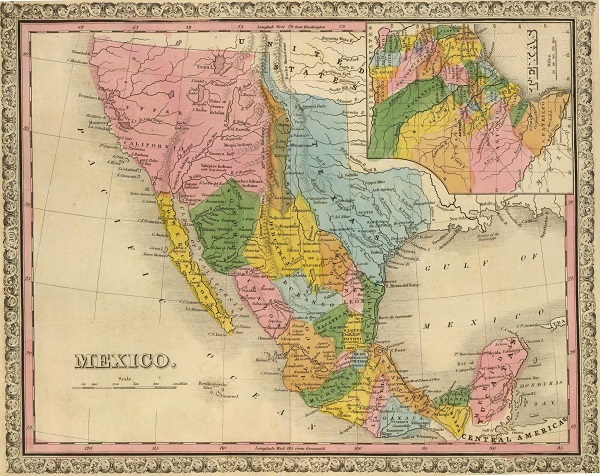 Samuel Augustus Mitchell produced this map at nearly the same time the Saints were contemplating leaving the nation. Mitchell shws the Republic of Texas and its Rio Grande claims as well as a boldly delineated Great Salt Lake region contained within the bounds of "Upper or New California." S. Augustus Mitchell, A New Map of Texas, Oregon, and California. Philadelphia: S. Augustus Mitchell, 1846. Library of Congress, Washington, DC.
24 January 1846 • Saturday
Saturday Jan 24th. 1846 at 1/I I sent for that purpose. O[rson]. Pratt was nominated to take the chair & D[avid]. Candland[136] Clerk of this Meeting. Carried by unanimous Consent of the assembly The object of the meeting had also ben Stated but in order that entire Satisfaction Should be produced I arose & said I wish the Brethren to understand correctly the design of appointing those Trustees[137]-- we do not intend dropping the presant Trustees[138] but we appoint 5 More to act in concert with Bishop [Newel K.] Whitney & [George] Miller & take charge of the church as well as individual property & this we do for the accommodation & convenance of those that are obliged to leave for safety[139] also to have them (these Trustees) take the place of Bishop Whitney & Miller in their absence that the work of the Lord may continue here -- that is the finishing of the Temple[140] & Nauvoo House[141]-- & the disposing of Property & fitting of <the> Saints & Sending them over after us[142]-- but to return as regard the old Trustees (Whitney & Miller) I will never give them a quit claim or Suffer them to resign their commission by my consent-- Where ever we go-- we want them with us & they shall be the Trustees wherever we go but it is wisdom to take the course that we are proposing to you -- the old Bishops will leave Soon in all problity [probability], & it is advisable to appoint & leave Some good Substantial Eficient Men to act for & in behalf of the church & people-- I want Br Whitney & Miller here [in Nauvoo]-- & while we are I will Speak designs relative to our Journey West -- we intend to Start a company of young men & Some few Families -- perhaps within a few weeks This company will go untill we can find a good logation location beyond the borders of the united States[143] & there stop & put in a sumer crop that we me may have Something to Subsist upon - & there remain until we Shall can make further discoveries[144] -- We have been forced to take this Stept & that too by Men that holds the Keys of Power. I find no fault with the Law or constitution under which we live it is good enough-- but I despise the abuse of those Laws[145] -- God? Men & Angels abhor it. I hop[e] to find a place, where no Self righteous Neighbors can Say that we are obnoxious to them. I exhort you not to be Self important -- we have covenanted to remove the Poor that are worthy[146] this we will do God being our helper-- walk Humbly before the Lord be upright & Sustain yourselves & learn that you are engaged in an important move-- If any should want to stay let them do it Peace-- & sho[u]ld any want to go with us that are not Members let them have the prevelege & bid them welcome -- for I consider every man that is a true republican as Bone of my Bone of my Bone & flesh of my flesh.[147] & if anyone wishes to follow Sidney Rigdon [148] Wm Smith.[149] J[ames]. J. Strang[150] I Say go away & well all cut them off from the church & let them take their course for Salvation-- I know where the Power of the Priesthood lies-- But now I will <drop> the Subject of the out laws & refer to the enemy of all righteousness[151] who seek our downfall-- he has Sent bogas Factory[152] & lying circulating[153] Medium, through the county by wholesale that we [are] making Spurious Coin & exchanging it by waggon Loads as Land office money -- & a thousand other lies all of which I pronounce to be a base fabricated lie-- Nevertheless we may have to Suffer repeated wrongs in consiquence of those falsehoods that are & will be circulated about us -- but my Faith is that God Rule the elements & the Prince & Power of the air will be Stayed[154] while the Lord will fight our batles as in the days of Moses -- we will See delilerance deliverance brought to pass although there may be blood Shed frequently Still this must needs be that the Scriptures might be fulfild it is but a smawel mater for as ask to lay his Life down if he is only prepared to recieve his change-- when he takes his exit from this world he goes into the Society of disemboided Spirits-- & there become one of those that wait the reseruction of the body if Humility and Faithfulness has characterized your lives you will find your State much better then the presant. I say the time will come & many of you Shall <see> it when the purposes the Lord will be carried out upon the Heads of those who has commited ungodly deeds upon his Saints they[155] will not be permited to run at large as they now do neither will you be permited to use the Name of the Deity in vain as yow have in times done[156] the more knowledge that you will have the less inclination you will to have to diveation from the law of God. This Nation is fearful that we will turn the world upside down[157] & accomplish wonderful things in the Land & in fact they have reason to fear for their Kings & Nobleman & the wise among them have been confounded by the [confusion?] in our Ministerial Body -- though confounded it is hard to convince them of the Truth-- When we leave here fear & Terror Seezis them least when we leave them that we will convert the Savages of the Forest & Say that we shall not teach them the principle of civilization & demestical usuages or not I say we will & further we would yet bring Salvation to this Nation if they would ceace their hostilities & repent. The Lord has Said, that he would fight our Battles.[158]& if this Nation does Still continue to be actuated towards [us] with a persecuting Spirit -- vengence Shall come from the Lord! & not from me upon this Nation until they Shal be uterly wasted-- but I intend to Preach & do all the good that I can-- I was informed this morning that Some persons were advocating the folly & nonsence of J[ames]. J. Strang-- Now if they wish to follow him let them go. they are at liberty to as they please -- I want no person to us <follow> contrary to there wishes -- theirfore let no one go off & Say that they are in danger of their lives[159]-- amongst us because that we differ in opinion this is not So. Mr J. Strang represent Jos Smith as the Stone & Shephrd of Iseral[160] of Jos & that he Strang is his Sucssessor in office -- This is certainly an obserd [absurd] Idea & comes in contact with Joseph’s views relative to the matter (He Jos) Saiys in the Book of Doctrine & covenants & So does the scriptures-- that christ is the Shepherd & Stone of Iseral & not Jos[eph] nor Strang. However I will not consume time in talking Such nonsence it is not worth the Short Jorney of a man’s Nose Yet there are those that tire on the way & wish to rest they thigk think that they have gone far Enough, but those that endure to the End I think will get the crown-- When the time comes our Pioneers to Start then there will be no cesation of gathering for we must gather up the House this of Iseral & every man will have his Penny for his Servises[161] -- let there be no feelings about this matter Should you not be first -- we are laying a Foundation for you all that will bring you all up in rememberence before the Lord[162] -- in his own due time & none of you will be neglected.
I have one request to make of all the Saints that expect to emigrate with us & that is that they do Just as they are asked by their leaders with thire Property & means They are apointed to arrainge that matter & if you will do this thing I tell you now there Shall never be a lack in this church we want the captains of (100) to borrow or raise out of there $1.000 out of their companies remember that from the head you are nourished -- If any man can Say that he has been wronged out of his Money by the bishops let him Speak & it Shall be restored to him again but I know that is not So -- Keep your money in circulation & you will do good & will be blesst in So doing -- retain it when the poor are crying for bread & it will prove a curse to you -- be honorable in all your dealings promp[t] & punctual to pay all your debts & restore confidence & let promptness & Punctuality be the Standard with you & the very God of Peace[163] will pour out blessings upon that cannot have room enough to receive.[164]
The chairman then arose & proceded to the nominations of the Trustees At this Junction A[lmon]. W. Babbitt proseed to me that we drop J. B. Backenstos one of the proposed committee & take an other (not by objection however) & let a part of the committee act as Trustees for the Nauvoo House. upon which I spoke a few words more we intend to finish the Temple & the Nauvoo House as far as putting on the Roof & putting in the windows & we shall drop all political opperations & church government after (we the 12 leaves here) by so doing we can preserve our public buildings from the torch--[165] I propose that all the Saints will lay down their property![166] for the building the Temple & the Nauvoo[167] House & help, the Poor away such as must go in the first company --I then nominated Almon W. Babbitt & Joseph L. Haywood and John S. Fulmer be the Trustees for the Temple -- & Henry W. Miller & John M. Bernhisel be the Trustees & committee for the Nauvoo House -- Carried without a desenting vote--
on Motion the Meeting adjourned -- at 2. P. M.[168] after which I assended the Stairs which led up into the Celestial departments --caled at the Dining room & took some refreshments then repaired to room No. 1. where I continued at the Alter till near midnight[169]
25 January 1846 • Sunday
Sunday Jan 25 1846-- at 10 in the Morning I with a number of the 12 & others assembled in the Celestial Room of the Temple where I attended to the Sacred ordinance of Sealing by adoption and also anointed Williard Richards & Wife[170] the Spirit of allmighty god attended the administration & filled our hearts to overflowing & many wept for Joy that were addopted into my Family -- we continued in the Temple in attending to those ordinances until near Night -- when I went home & Spent the night --[171]
26 January 1846 • Monday
26 Jan 26. Monday at 9 I went into[172] the Templ & commenced the ordinances of Sealings & anointing in diferent apartments that were Set a part for that purpose[173] -- the washing & anointing in the first department suspended to the morrow-- that hands that labored might have one days Rest
27 January 1846 • Tuesday
27 Teusday morning the washing commenced in both departments The Sealings were attend[ed] to day by myself Heber C. Kimball and A. Lyman -- The 2nd anointings was likewise carried on in Room No 2 & 4. O. Hyde P. P. Pratt O Pratt officiating in No. 2 & 4—G. A Smith & W. Richards are absent on account of Sickness about noon Bro Benj. Morgens’s[174] & Lady called me. I took my clerk J. D. Lee & we repaired to the North vestry where I had an interview with the 2 forementioned Persons Setting fourth to them the Law of God relative - - - - - - -to his case & returned-- I will observed that I recied a leter from Lawyer Jos[Josiah] Lamburn Maled at Springfield Stating in it that the Govenor was decidely in favor of General Harden the commander of the mob Militia that have had been Sent here by the Gov. & who has been in Favor of Suspended all civil officers & Suspended the collection of Tax. & pacing the county under Marshal Law which of cours will Soon be the case as Harden is expectd here every day, & when he comes he is to address us on this Subject & will no doubt te renew those writts that had been isued for the 12. & others & thereby commence harrassing us again ---[175]
Br Heber Said that he was glad that the Govenor had turned against us & the President also for he had feared that the Lord would not have let us go until this would first be done about 3 o. clock in the evening Br. G.[eorge] D.[avis] Grant came after me to go & see my litle Son Brigham that had been [kicked] on the chin by a horse I god [got] in my carriage & Rode home but found him less hurt then what I had expected his chin was considerably Brused & 2 of his teeth broken out his Mother having bathed the wound had him quite easy[176]-- So I returned back to the Temple-- & assumed my labors which lasted to 10. o.clock eve after which I walk to A. P. Rockwood & Spent a few hours then went back to the Temple & Spent the Night.
28 January 1846 • Wednesday
28 I spent officiating at the Holy Alter or most of the time -- through the day – a[t] ½ after 9 at Night the opperations of the Day closed I staid over Night in the Temple the evening being remarkably Rainy. blustery--
29 January 1846 • Thursday
29 it continued to rain-- as usual I continued the work of the endowment in the temple in connection with my Brethren the 12 & Such others, as we have appoin[te]d & Set apart to assist us. This mor[n]ing as I am informed quite a number of the Governors Troop are in prowling arround our city Seeking an acquisation [accusation] against Some of the leading men of this church.[177] This evening I read a letter from I S.[amuel] Brannon in which he Said that he asscertained from Mr Kindall [Amos Kendall] of Washington the celebrated Postmaster General that Govement intended to intercept our movements in placing by placing Strong forces in the way to take from us all fire arms on the grounds that we were going to another Nation -- this Jeolasy he Brannon Said originated from Arlington Bennet’s Letter in relation to our moves-- This However was no more then what we expected the fulness of the Gentiles could never have been brought in without the united [States] first rejecting us as a People[178]-- we now ask God our Heavenly Father to exert his power in our deliverance that we may be preserved to establish Truth upon all the face of the Earth - - -
about 9. o.clock at Night I rode home in my carriage & Spent the Night
30 January 1846 • Friday
Jan 30th is Still Stormy though warm at 10. o.clock I entered the Temple where I confined my Servises through the day in attending to the Sealings & Anointings at 20 minets past 7 eve the work Stoped in Sealing department after which I rode home & Spent the night by this time the roads are tremendous mudy - having been a though of four days acompanied by occasionals Showers of Rains[179]
 Print of the Nauvoo Temple created in the 1840s. Brigham Young spent most of his waking hours in the temple during the first weeks of 1846. Library of Congress, Washington, DC,LC-USZ62-30942.
 Daguerreotype of Brigham Young, circa 1846. It is unknown if this image is the same being described in the journal entry of 31 January 1846. This is the earliest known likeliness of Brigham Young taken from life. The daguerreotype is attributed to Lucian R. Foster, who had been in Nauvoo and taking daguerreotypes since at least mid-1844. Courtesy of the Church History Library, The Church of Jesus Christ of Latter-day Saints, Salt Lake City, Utah.
31 January 1846 • Saturday
31. st. the face of the Earth is under a light mantle of Snow the Wind having Changed arround to the North West produced quite different atmosphere making it much better traveling under foot as the ground was considerably frozen at 19 minets Past 10. I came into the Temple -- The work in the Sealing department had not commenced as yet -- no, however commenced with unwearried dilligence to redeem if possible the fleeting moments that we had suffered to pass by without being improved in this department the work in the other department were in lively opperation -- yesterday I had some conversation with Reuben Miller of Ottoway, he being considerably bewildered by Strang[’s] new fangled Revelation rendered him almost devoid of Reason although apparently honest in what he was doing & Said that the word of the Lord would be decidedly Satisfactorily to him where upon I Said thus Saith the Lord unto Reuben Miller through Brigham Young that Strang is a wicked & corrupt man & that his revelations are as false as he is -- therefore turn away from his folly & never let it be Said of Reuben Miller that he ever was led away & entangled by Such nonsense Thus Saying I left him my time being to[o] precious to be <Spent> in hearing and even talking about Such trash[180] -- This mor[n]ing I recieved 2 Letters the [first] was from Sarah Lincoln of Nauvoo <Ills> Dated Jan 31st. 46.[181] The other was from A. W. Brown of this city though not a resident without date both of which was Nod [Noted] & filed[182]--- about noon Set while the artificialest immitated the works of Nature from my Person[183] about the Sametime Amasa Lyman came into the Temple being quite Feeble. Bro. H. C. Kimball administered to him he appearently Seemed much relieved-- at 39 minets past 10. o.clock--evening-- when after calling the House to order Bro. C. C. Rich Supplicating the Thorone of Grace by Prayer-- I then with Bro H. C. Kimball & F. D. Richards retired to my Room No 1. & Slept in Silent repose till 7. in the Moring when I arose & washed & changed clothes & walked out into the cook Room & took Some refreshments at 11 in the morning I attended a Publick meeting in the 2nd Story of the Temple -- Elder O. Pratt & myself addressed the meeting -- at the close of our remarks one Moses A. Smith an Apostate from our Faith arose and claimed the liberty of defending or rather investogate what he calld Strangism & after holding his claims to the Presidency forth to the assembly which was that Jos gave him (Strang) the Keys & Right of Presidency over the church by a letter directed to him from Jos Smith previous to his Martyrdom[184] & So on all of which was a Simple fabricating thing without the least Shadow of evidence to Sustained his position. Bro. O. Hyde & myself then arose gave Strangism an entire blowing up & also excluded M.[oses] A. Smith & Samuel C. Shaw from the church. and also an action was taken upon J. J. Strang & Aaron Smith[185] who had been cut off Previously for attempting to palm of[f] a deception uppon the church by this Pretended Revelation all of which was Sa[n]ctioned by a hearty Amen.[186] The meeting closed at 3 o clock evening. I then walked up into the atic Story of the Temple & took Some refreshments after which I walked into the celestial Room where I in company with my wife remained assisting to make ready for attending to the adoption of persons into my Family-- The alter having been placed into my the ce[le]stial Room the better to Suit the convenance of all presant-- at candle light the ordinance of adoption comenced & ended at 33 minets past 8 in the evening during which time about 65 Persons were adopted to Elder H. C. Kimball A. Lyman, & to myself 48 of that No were adopted into my Family
1 February 1846 • Sunday
February lst. 1846
2 February 1846 • Monday
Feb. 2nd we Suspended the work in the Sealing department for the purpose of bringing up the record which were yet in the rear[187] -- The washings & anointings were continued with all Possible Speed in the other departments. at 10 o.clock A. M. I met in council in Room No 1. with the 12 the Trustees & Some few others-- The Topic of our council was to assertain the feelings of the Brethren that were expecting to Set out Westward the feelings of the council were undivided with regard to our Move -- my advice to them was to procure boats & hold them in readines to convey our waggons & teams over the River & let every thing nessary for the Journey be had in readiness that when a Family is called to go that all things may be in the waggon within 4 hours at least[188] for it is my opinion that if we are here 10 days that our way will be Hedged up[189] -- they are calculating to intercept our way & whenever we Start but we want to be 500 miles from here before they are aware of our move & in order to have this circulated privately & effectually we had better Notifiyd the Captains of Fifties & 100s to meet at 4. o. clock this evening at the house of Father Cutler & then & there lay the matter before them (the captains of 100s) & let all coroberate [cooperate] togeather & move as one Man-- at this Juncture 3 messengers were Startd to notified the capt. of companys & by the time this council closed -- at 4 I met with the capts of cos & layed the plan before them they all assented to my proposials & all dispersed the better to bring about our proposes as but little time was to [be?] lost. I here received a package of Letters & Papers Some of them were from England & Some of them were from the Eastern States -- The Sun was near down when the meeting adjourned. we then returnd to our labors in the Temple & continued them till near 9. o. clock before leaving gave instructions to my Clerks not to Stop until the records of the endowments are brought up So that no,thing may escape the Notice of us for the want [of] recording in a legable & intelegable [legible & intelligible way] Then to let the work of <the> Sealings & anointings & if any one wants to be Sealed & we have the time to attend to it let them make out the records them Selves & that will [be a] better way[190]
3 February 1846 • Tuesday
Feb 3d 46
Notwithstanding I gave out word that we would <not> attend to these matters-- yet the House was thronged all the day. The anxiety are so great that the Brethren would have us Stay here & continue the endowments until our way will be Hedged up & our enemies intercept us but I tell you Brethren that it will not do -- this is not the last Temple that we will build-- in this house we have been payed well if we were to recive no more & I tell that there will be double the anxiety manifested to build the next that there was to Erect this[191]-- then be Satisfied-- I am going to load up my waggon & be away from this place immediately-- I walked off Some little distance from the Temple Soposing the crowd would disperse but on retur[n]ing to the Temple again I found the House thronged to over flowing -- looking upon the multitude & knowing the anxiety of the Brethren that were thirsting & hungering for the word we commenced Sealing & anointing & continued & continued also the washings Night & Day-- putting through from 2 to 300 Persons within 24 hours & Spent the night.
―――――――― ◊ ――――――――
Editorial Note
The following day, 4 February, was a day of celebration for those who had worked long hours day after day to officiate in the temple for their fellow Saints. Norton Jacob found the “Brethren & Sisters recreating themselves with music & dancing after their Labors as the Endowments were adjourned for two days.” The temple work resumed in the evening of 6 February and on 7 February George A. Smith recorded, “Upwards of six hundred received the ordinance of first anointing of the Priesthood: This being the last day for administering them for the present.”[192]
On Sunday, 8 February 1846, Young presided over the last ordinances in the Nauvoo temple. Norton Jacob recorded that “at 9 O clock A.M. the Endowments were stoped in the House of the Lord & the vails were taken down – the people were then called out into the grove West of the Temple.”[193] With the temple no longer thronged with people, the Quorum of the Twelve met in the upper story of the temple, and “kneeling around the alter we dedicated the building to the Most High and asked his blessings upon our intended move to the West also asking him to enable us some day to finish the lower part of the Temple and dedicate it to him and to preserve the building as a monument to Joseph Smith. We then left it.”[194]
The Sunday meeting in the grove was also significant. Jacob wrote that “the gathering was addressed by President Joseph Young who is the President of all the Seventies there being 32 Quorums,” and that “Brethren Hide [Orson Hyde], Taylor, P.P. Pratt & Brigham Young gave vent to their feelings by addressing the people for the last time in Nauvoo. Br. Brigham warned them grieveious wolves would come in among the sheep when they [the Twelve] were gone not sparing the flock. That from among themselves men would Spring up Speaking perverse things to turn men away from the truth – he said they would start tomorrow. Some of the Brethren have crossed over three or four days ago – and they are crossing all the time.”[195]
A week later, on Sunday, 15 February 1846, Norton recorded in his journal, “Br Brigham Young with his family crossed the river and went out to Sugar Creek where the Brethren who are going West in this first Company have formed a camp.”[196] Young and his family joined thousands of Latter-day Saints headed west where they would eventually gather at the base of the Rocky Mountains and renew their effort to build Zion.
―――――――― ◊ ――――――――
Notes
[1] TEXT: This abbreviation is written over at least two illegible, wipe-erased characters.
[2] George A. Smith recorded that they preached to “a large congregation.” (George A. Smith, Journal, 31 August 1845, CHL.)
[3] In addition to meeting with the quorums, Young met with his own quorum and several others in another of their frequent sessions for business and prayer. Clayton explained, “The subject of the Oregon expedition was again talked over and the Twelve seem to think it important that they should go with the company to select a location and plant the standard. They would leave their families here and return when they had succeeded in finding a place. Prayers were offered up for quite a number of sick. . . . It is truly grievous to see the many sick in our midst especially in the north part of Town.” Willard Richards recorded that in this later meeting the council “voted that Brigham Young be next Gov.” of California and Heber C. Kimball as “Vice Gov.” (Clayton, Journal, 31 August 1845, CHL; and Willard Richards, Journal, 31 August 1845, CHL.)
[4] William Clayton wrote in his journal, “Daniel Spencer has returned from the West. He brings word that brother Jonathan Dunham died of a fever.” Willard Richards also reported meeting with the returned emissaries to the Native Americans, particularly the Stockbridge Nation. Spencer and Shumway had learned from Lewis Dana that “Bro Jonathan H. Dunham died about five weeks ago with a fever.” (Clayton, Journal, 1 September 1845, CHL; and Willard Richards, Journal, 1 September 1845.)
[5] Fanny Young, older sister of Brigham Young.
[6] Willard Richards recorded, “Revised history with Bro Young. in the P.M. with Young and Kimball.” (Willard Richards, Journal, 2 September 1845, CHL.)
[7] Brigham Young and Willard Richards were joined by Amasa Lyman, Heber C. Kimball, and George A. Smith in revising the church history.
[8] The ferocity of the hailstorm, which lasted about thirty minutes, was reported by several Nauvoo residents. Willard Richards lamented that the hail had “beat in every pane of glass on the north end of my house except 1.” William Clayton also detailed the destruction wrought by the storm: “The hail stones were so large they broke the windows in the office every light but about six.” Once Clayton arrived home, he found twenty-nine windowpanes destroyed. He observed that neighboring houses sustained similar damage. In addition to the devastation to buildings, flooding occurred, and orchards and crops suffered harm. John Taylor, editor of the Nauvoo Neighbor, also recorded the violence of the storm in his journal. He observed that the “hail stones fell nearly as large as hen’s eggs.” The storm stirred in Taylor images of an impending divine judgement: “If the household of faith scarcely escapes the cold drops of the Lord, what shall the ungodly and the sinner do when he pours both cold and hot drops upon them without mercy to chasten and reward them for martyring the Prophet and their evil deeds?” (Willard Richards, Journal, 3 September 1845, CHL; Clayton, Journal, 3 and 4 September 1845, CHL; Taylor, Journal, 3 September 1845, CHL; and “Rain and Hail,” Nauvoo Neighbor, 3 September 1845.)
[9] Richards noted that a council meeting was held in the afternoon at which some financial matters for the Nauvoo House were decided and Brigham Young determined to call for the Council of Fifty to meet the following Tuesday, 9 September. (Willard Richards, Journal, 4 September 1845, CHL.)
[10] The Big Field Association was a joint farming cooperative that had pooled resources to farm 3,840 acres outside Nauvoo. The recent harvest had been a spectacular one, boasting 30,000 bushels of corn and 30,000 bushels of wheat, as well as many other crops raised on the land. A celebratory dinner was held by the trustees of the association to which the Twelve and many others were invited. Willard Richards placed the attendance at 616 adults and an unspecified number of children. “Elders Young and Kimball,” Richards recorded, “advised them to gather their corn and store it in the city and put in what wheat they could. And let the association remain at present as it is and not multiply their company.” (“Big Field Dinner,” Nauvoo Neighbor, 10 September 1845; and Willard Richards, Journal, 5 September 1845, CHL.)
[11] See Brigham Young, Journal, 2 September 1845, p. XXX herein.
[12] George A. Smith recorded that he, George Miller, and Reynolds Cahoon all spoke at the early meeting. (George A. Smith, Journal, 7 September 1845, CHL.)
[13] The meeting apparently focused on organizing more labor and supplies for the Nauvoo House. George A. Smith urged the attendees to provide teams to haul building materials for the Nauvoo House the next day, and they unanimously voted to do so. (George A. Smith, Journal, 7 September 1845, CHL.)
[14] Hosea Stout noted in his journal that Young was sick on the eighth as well. Stout wrote, “Went to Brigham Youngs to see him but he was gone to bed being unwell.” (Stout, Journal, 8 September 1845, CHL.)
[15] This meeting of the Council of Fifty commenced in the upper room of the Seventies Hall at 2:00 p.m. in the afternoon. The meeting focused heavily on the reports garnered from Lewis Dana and others of their negotiations with various Native American groups. Dana had just returned to Nauvoo from his mission the previous day. The reports indicated that “the Cherokees had given permission for any number of our people to settle by them, and offered to lend us any assistance they could either to locate or to go West to explore.” William Clayton, the scribe for the Council of Fifty, summarized in his journal, “The subject of sending a company of Saints to the West next spring was talked over, and on the following motion by W.W. Phelps- ‘Moved that the President select such a portion of this Council as he may choose to remove west, and they select and organize the company subject to the final revision of the President’ a vote was taken and the motion was carried unanimously. The following motion was also put and carried unanimously. ‘That a committee of five be appointed to gather all information relative to emigration and impart the same to this Council and those about to emigrate when called upon.’” (Council of Fifty, Minutes, 9 September 1845, in JSP, A1:468; and Clayton, Journal, 9 September 1845, CHL.)
[16] Clayton recorded that Young and several others had climbed to the top of the tower of the temple this evening: “I went on the Tower with Prest. B. Young, H.C. Kimball and Geo. D. Grant where I read Orson Pratts message to the Eastern church from the New York messenger.” (Clayton, Journal, 12 September 1845, CHL.)
[17] George A. Smith recorded under this date, “The mob went to Edmund Durfeys and commenced throwing his things out and firing the Morley settlement Yell Rome.” Young had a few days earlier asked Hosea Stout to station picket guards outside Nauvoo apparently over fears of threatened mob violence. (George A. Smith, Papers, 10 September 1845, CHL; and Stout, Journal, 7 September 1845, CHL.)
[18] The report of the mob attacks of the previous night apparently affected Young, who related at this meeting that he had dreamed the night before of being chased into a barn by a mob and then confronting and battling them. (Willard Richards, Journal, 11 September 1845, CHL.)
[19] Willard Richards recorded, “2 messengers have arrived, and stated that a mob of about 100 collected at Lima yesterday and last night” and commenced burning homes. In an afternoon council, Brigham Young outlined a policy of conciliation and nonviolence in response to the house burnings. Clayton recorded, “It was decided to dispatch a messenger to the Lima Branch and advise the brethren to propose to sell their possessions to the mob, and bring their families and grain here. It was also decided to send a messenger to Michigan to advise the brethren to sell their farms for Stock, wagons, sheep &c. Also to send a messenger to Ottawa & advise the brethren to gather all the hay they can. Prayers were offered up for the usual subjects and also that the Lord would give us wisdom to manage affairs with the mob so as to keep them off till we can accomplish what is required.” (Willard Richards, Journal, 11 September 1845, CHL; and Clayton, Journal, 11 September 1845, CHL .)
[20] Hancock County Sherriff J. B. Backenstos wrote to Brigham Young on 10 September to inform him that former sheriff and friend to the Saints Miner Deming had unexpectedly passed away. On 24 June 1845 Deming had killed a man in self-defense as he was being beaten by him. Not only did this cause Deming extreme personal guilt, but his wife, Abigail Deming, related that they would awake multiple times a night for fear his enemies would try to enter his house and murder him before his trial. Abigail, devastated, lamented to Deming’s parents the cause of his death: “He brought on his disease by working at a fence one afternoon when the sun was very hot. He was seized most violently & although we had the best medical advice nothing could break the fever.” Though he lived for several days afterward, he eventually died at 10:00 a.m. on 10 September 1845. While such a description may indicate a possible heat stroke, Abigail believed that his condition was greatly exacerbated by the mental stress he had from the violent threats against himself and his family. She bitterly reflected that “there never was a man more shamefully belied” than was her husband and that the only reason was because “he thought the Mormons should be treated like other people.”
As Backenstos related Deming’s death to Brigham Young, he, too, lamented it as a “great calamity” and eulogized Deming as “one of our best spirits in defense of liberty and equal rights.” Deming’s death not only occasioned grief but also precipitated “an important crisis.” Deming had served as the brigadier general of the third brigade of the fifth division of the Illinois state militia. This brigade encompassed Hancock, McDonough, Mercer, and Warren Counties. Deming’s amicable relations with the Mormons ensured that state militia forces could not be readily used to aid and abet the violence of the mob against the Mormons in the district. His death now opened the generalship of the brigade to an uncertain future.
Illinois state law mandated that brigadier generals were to be elected by the officers serving as regimental commanders within the brigade area. Backenstos urged Brigham Young to have his people “organize themselves into independent companies, under the militia law of this state, elect their officers, in order that they may be commissioned, so we can control the election of a Brigadier General, unless this is done a mob Genl. will be elected, I much fear.” Backenstos pressed the point: “None but commissioned officers can vote for a Brigadier Genl. hence you will see the importance of immediate action, I cannot urge this question too strong upon your considerations.” A council would be held the next day to determine whether or not to act on Backenstos’s suggestion. (Brigham Young, Journal, 12 September 1845, p. XXX herein; J. B. Backenstos to Brigham Young, 10 September 1845, Brigham Young Office Files, CHL; Abigail Deming to Stephen and Sarah Deming, 23 September 1845, Deming Correspondence, University of Illinois at Urbana-Champaign Library and Archives; Revised Statutes of the State of Illinois, 356–60; and Clayton, Journal, 11 September 1845, CHL.)
[21] Clayton recorded of the morning meeting: “A.M. met at Dr Richards with the Twelve & others. A messenger has arrived bringing news that the mob have burned four more houses and 2 oat stacks, and that they are still threatening to burn property and kill the brethren. It was decided to send immediately all the teams that can be got to fetch the families to Nauvoo.” (Clayton, Journal, 12 September 1845, CHL.)
[22] James Earl. The previous day, Charles C. Rich noted that Sylvester and James Earl had been sent out “as messengers to the Brethren.” The Earls were members of the Lima branch of the church that included the Yelrome settlement. (Rich, Diary, 11 September 1845, Charles C. Rich Collection, CHL; and Platt, “Early Branches of The Church of Jesus Christ of Latter-day Saints,” 23–34.)
[23] Charles C. Rich recorded in his diary that they received reports from James Earl that “thare was 12 houses burnt and 2 [hay] stacks[;] teams was sent off to bring the families and corn.” George A. Smith also explained that “eleven houses and three out houses” (barns, sheds, etc.) had been burned by the mobs. He noted that the members there were “offering no resistance.” At the close of this meeting, Young sent a message “to the brethren in and about Nauvoo” requesting “every man who has a team to go immediately to the Morely settlement, and act in concert with Pres. Sollomon Hancock in removine the sick, women, children, goods and grain to Nauvoo.” To Hancock, Young explained that the council had decided that “it is wisdom for you to remove the women & children from Yelrome as fast as you can with what teams you have got & we will send you men as fast as we can& not only remove the women & children but your grain, & let all the brethren stay there . . . and watch the movements of the mob.”
Young explained the reason for evacuating rather than fighting the arsonists and mobbers: “The object of our enemies is to get opposition enough to raise popular excitement, but we think it is best to let them burn up our houses while we take care of ourselves, families & grain.” Such broader violence could threaten the city of Nauvoo itself, the efforts to provide temple ordinances to the members, and ongoing preparations for the faithful to leave the city the following spring. Recognizing the material sacrifices he was asking of these Latter-day Saints, Young advised, “Be calm and patient until all things are ready. What is a little property or a few lives compared with the properties & lives of a good people & the House and ordinances on which the salvation of that people depend.” (George A. Smith, Journal, 12 September 1845, CHL; Rich, Diary, 12 September 1845, Charles C. Rich Collection, CHL; and Brigham Young to Solomon Hancock, 12 September 1845, Brigham Young Office Files, CHL.)
[24] Backenstos had urged Latter-day Saint leaders to form independent militia regiments so the regimental officers could vote for a sympathetic brigadier general of the local brigade of the Illinois state militia. Young and the Latter-day Saints felt indignant at the suggestion given the fact that the Nauvoo Legion, which had been their duly authorized militia body, had been disbanded with the revocation of the Nauvoo city charter earlier that year. To organize independent companies would be a humiliating acceptance of what they deemed to be an extralegal, punitive action taken against the religious community. Additionally, commissioned officers reported ultimately to Governor Ford as commander-in-chief of the state’s armed forces. This command structure had allowed antagonists to accuse and arrest Joseph Smith on allegations of treason, an incarceration that ended in Smith’s murder. Young was unwilling to submit to such terms under Governor Ford again.
[25] In his journal, Charles Rich inscribed the following: “G W Longely and others returned and returned and stated that the mob was intending to continue to burn out the brethren ntil they had driven in all the branches that lived out. Teams was sent to bring in families and grain.” Willard Richards wrote that Langley “had been among the mob about green plains & Lima. Esq Hill of Lima told him they did not design to gather in large bodies but go on as they had done, & finish Lima, then attack some other place & drive the Mormons all into Nauvoo, then they had further plans to move them from there.” (Rich, Diary, 13 September 1845, Charles C. Rich Collection, CHL; and Willard Richards, Journal, 13 September 1845, CHL.)
[26] According to Willard Richards, though they were at Daniel Spencer’s house, Spencer himself was sick and did not participate in the discussions that surrounded the organization of Samuel Bent’s company of one hundred to go to Oregon. (Willard Richards, Journal, 13 September 1845, CHL.)
[27] Backenstos explained in his letter, “Every good citizen will & does deplore this outbreak; my policy is to quell the mob peaceable if I can, & forcibly if we must.” (Jacob B. Backenstos to Brigham Young, 13 September 1845, Brigham Young Office Files, CHL.)
[28] Joseph Cain, an English convert from the Isle of Man, lived in the home of John Taylor and occasionally worked in the printshop.
[29] While Latter-day Saints regarded Governor Thomas Ford with great suspicion, his political opponents continued to attack him in the press on the basis of some supposed alliance with “his right hand friends, the Mormons.” Ford seems to have been in St. Louis on legitimate state business. State records indicate that Ford was reimbursed twenty-five dollars on 19 August 1845 to defray his expenses for a trip to St. Louis regarding the school fund for the state of Illinois. The state legislature questioned the necessity of such a state-funded trip, prompting a written explanation from Ford that he had been unable to get any bank in Illinois to loan the government money against the anticipated collection of taxes for the state school fund and he had therefore traveled to St. Louis to secure funding for the school fund. This attempt, however, was also unsuccessful. (“Horrid Murders,” Quincy Whig, 2 July 1845; and Thomas Ford to Select Committee of House of Representatives, 25 February 1847, Reports Made to Senate and the House of Representatives of the State of Illinois, 348.)
[30] Buckmaster had served as the quartermaster general of the Illinois militia. In the aftermath of the arrest of Joseph and Hyrum Smith, he had traveled with Governor Ford to Nauvoo to confiscate the state arms of the Nauvoo Legion. In Nauvoo he delivered a speech to the residents expressing his “gratitude at the peacable conduct of the citizens of Nauvoo, and said that while they thus conducted themselves, they would protect them.” Buckmaster owned and operated a ferry service in north St. Louis, which likely accounts for his presence there. (Historian’s Office, History of the Martyrdom Account, CHL, 6; and Governors’ Letter-Books, 93.)
[31] This response from Young was likely precipitated by a report that arrived that evening with news that, contrary to Young’s council of pacifism in the face of the increasing mob violence, “William Allen & others were about to start for Lima to operate against the mob.” (Willard Richards, Journal, 13 September 1845, CHL.)
[32] According to Willard Richards’s account of the meeting, Heywood was also instructed to begin shipping goods from Boston to “Bay St. F[r]ancisco” in anticipation of the removal of the Saints to Mexican California. (Willard Richards, Journal, 13 September 1845, CHL.)
[33] Willard Richards recorded in his journal that Sheriff Backenstos had “said he had been to Lima & could not get enough help to quell the mob & had come to Nauvoo to get 2 or 3 hundred men for a posse to go to Lima to stop the mob burning grain, etc.” Charles C. Rich explained that “Backenstos was in to raise a posse” and “teams was sent again to Lima to hall [haul] grain.” (Willard Richards, Journal, 14 September 1845, CHL; and Rich, Diary, 14 September 1845, Charles C. Rich Collection, CHL.)
[34] To this end, Young sent an order to Charles C. Rich instructing him to use the various organized church quorums to defend the Mormons if necessary and to carry out “all duties that shall be necessary in all emergencies.” (Brigham Young to Charles C. Rich, 14 September 1845, Brigham Young Office Files, CHL.)
[35] According to Willard Richards’s account of the various meetings throughout the day, after learning of the new attacks, Sheriff Backenstos made a public appeal “calling for all law abiding citizens to help him & let the Mormons alone.” Backenstos issued a proclamation explaining the violence of the mob and his actions related to them. After appealing for peace, he commanded “the mobbers and rioters throught this couty to disperse, desist, and forthwith go to their homes under the penalty of the laws of the country.” Further, Backenstos publicly assailed Levi Williams as leading the lawless house burners. He stated in a postscript to his proclamation that “the Mormon communite have acted with a more than ordinary forbearance – remaining perfectly quiet and offereing no resistance when their dwellings, other buildings and stakcs of grain, etc., were set on fire in their presence, and they have foreborne until forbearance is no longer a virtue.” In the afternoon, apparently having spoken with Williams in the interim, Backenstos related that Williams and the mob “had offered peace on conditions the Mormons all leave Hancock next Spring.” (Willard Richards, Journal, 14 September 1845, CHL; and J. B. Backenstos, “Proclamation No. 2,” Nauvoo Neighbor, 17 September 1845.)
[36] The following men met in council with Brigham Young: Heber C. Kimball, Willard Richards, John Taylor, Parley P. Pratt, Amasa Lyman, George A. Smith, Newel K. Whitney, George Miller, Joseph Young, and Joseph C. Kingsbury. The council took place at 5:00 p.m. at Richards’s home. Richards recorded that it was decided to “send a messenger to Quincy – St. Louis – etc. to get rich men and merchants to by[buy] & rent our buildings so as to help us to Oregon & save our buildings after we are gone.” The council discussed other business, including the arrest of Miller in Carthage, mob activities, and a writ against Young, Kimball, Orson Hyde, Orson Pratt, and several others on the charge of treason “for colleaguing with the Indians, building an arsenal, and making Cannon.” The council ended with prayers, especially for the sick, and an agreement that they would allocate more laborers to the temple “even if it have to hinder the Nauvoo House.” (Willard Richards, Journal, 14 September 1845, CHL; and Clayton, Journal, 14 September 1845, CHL.)
[37] Though not mentioned in this entry, a constable from Carthage was in Nauvoo attempting to serve writs against several church leaders. John Taylor noted that he “ascertained that there was an officer with writs for me and some others, in the City; and the Counsel was to keep out of the way.” After he heard that the officer had left, Taylor returned home at about 9:00 p.m. (Taylor, Journal, 15 September 1845, CHL.)
[38] A frustrated Backenstos wrote to Brigham Young about how the latter’s message attempting to maintain peace had “caused all the forces which I had collected to defend the Bear Creek Settlement to disband and go to their homes.” Backenstos lamented, “If the Mormon Community are unwilling to Stand the ground & protect their own protery in conjunction with such other aid as can be furnished, you must not expect nor can you reasonably look for any considerable support from those citizins commonly called jack-Mormons.” Backenstos wanted the Saints ready for a full-scale war and pressed the point: “I must call upon you to hold in readiness at the least 2000 well armed men for the immideiate service at any hour that I as the executive officer may need them to quell the Mob, Col Williams has called out this Brigade of the Ill. Militia, I am certain the turnout will be slim.” Trying to urge Young to more action, he ended his letter with, “We must whip them.” (Jacob B. Backenstos to Brigham Young, 15 September 1845, Brigham Young Office Files, CHL.)
[39] Young also penned a letter on this date to Samuel Brannan, president of the Eastern States Mission, responding to some of Brannan’s inquiries and informing him that “we have troubles again around. The mob have commenced burning the brethren’s houses in Morely Settlement and have nearly burned the settlement out the brethren have been obliged to come in here for safety. The Sherif has called on the militia to quell the mob and put a stop to such work but what his success will be is yet doubtful. The Sherif is not a mormon but is a friend to equal rights. The mob are holding meetings and soliciting help from other parts but I think they will fail of success. I think they will not be able to do any more than burn a few houses, and some grain, although they threaten a great deal. But the Lord will make the wrath of man praise him and remainder of wrath he will restrain. This has put the gathering spirit into the hearts of the brethren in the affected part of the county and they will bring their grain and all their substance.” (Brigham Young to Samuel Brannan, 15 September 1845, Brigham Young Office Files, CHL.)
[40] Sheriff Backenstos had related two days earlier that the alleged leader of the mob, Levi Williams, had said he would make peace with the Latter-day Saints if they agreed to leave by the following spring. (Willard Richards, Journal, 14 September 1845, CHL.)
[41] According to Willard Richards, Young first proposed to send a force to “surround Williams & company & destroy him, root & branch.” This direct departure from passive resistance caused some to demur as “some objections were made.” Thereafter, Young “proposed to send to the mob a delegation & agree to [leave] here in the spring if they will let us live in peace till spring.” With these two starkly contrasting proposals, Young seemed to be attempting to demonstrate that the only effective decisions were to either fight the mob directly and violently or leave the nation. The council agreed to “send a committee to make peace with the mob by preparing to leave in the spring.” William Clayton recorded, “A committee of five viz. Peter Haws, Andrew H. Perkins, Erastus H. Derby, David D. Yearsley and Soloman Hancock were appointed to carry a letter to Col. Levi Williams stating to him that if the mob would cease their destructive operations, it is our calculations to leave the country in the spring, and requesting Williams to return a written answer, whether they would desist or not. The letter was signed by Prest. Young & others.” (Willard Richards, Journal, 16 September 1845, CHL; and Clayton, Journal, 16 September 1845, CHL.)
[42] Young sent “an epistle” to the Saints in Ramus giving this same council: “If the mob come to disturb you, at the first aggression on yourselves or property give them the cold lead or obey the Sheriff’s council.” Willard Richards similarly noted, “Br. Young wrote to Ramus, Laharpe, & camp creek to obey the Sheriff & the Sheriff wrote on the same sheet that the citizens defend their lives & property from the mob & alos to Montebello, Bear Creek.” William Clayton recorded, “Soon as B[ackenstos]. arrived at Dr Richards’ Prest Young wrote a short epistle to the Macedonia Branch, advising them to defend themselves on the first aggression of the mob. Backenstos wrote an order in the same communication to the precinct calling upon the citizens to defend themselves by force of arms. A similar letter was sent to the La Harpe, Camp Creek, and Montebello settlements.” (Brigham Young to the Saints in Ramus, 16 September 1845, Brigham Young Office Files; Willard Richards, Journal, 16 September 1845; and Clayton, Journal, 16 September 1845.)
[43] Willard Richards’s account of this conversation was that John Smith stated that William Smith “told him he was going East. & he would let him know more before next spring. By God he let this people know who their ruler is.” Amid rising tensions in Nauvoo, following the death of his wife, William Smith had suddenly fled from Nauvoo, dispatching a letter to Young in which he cited a conspiracy to kill him (William). At the same time Smith had adamantly asserted his fealty to Young’s leadership of the church, writing emphatically, “I have moved in all things by your Council & I am your friend till death & any man that says to the contrary is a damned liar & god almighty will damn him.” John Smith’s statement suggests William believed otherwise. (William Smith to Brigham Young, 25 June 1845, Brigham Young Office Files, CHL; and Willard Richards, Journal, 16 September 1845, CHL.)
[44] Clayton recorded, “At 2 P.M. Col. Backenstos rode in in great haste and went to Dr Richards. Prest. Young had just sent for me and I followed Backenstos down. He reported that the mob drove him from his home in Carthage yesterday and from thence he went on to Warsaw where he stayed over night. He ascertained there that there was little possibility of getting away alive, but finally prevailed on one of the influential mobocrats to escort him out of Warsaw this morning.” (Clayton, Journal, 16 September 1845, CHL.)
[45] TEXT: There is a later insertion on the left side of “World” that reads “to be correct,” likely indicating the need for correcting the name.
[46] The two other men who assisted Backenstos as he was chased by a violent mob were Orrin Porter Rockwell and Return Jackson Redden. The two men had been helping move Latter-day Saints that had been displaced by mob violence from the outlying settlements. While the main party of refugees had moved on, Rockwell and Redden stopped to rest and eat. Rockwell then heard the rumbling of carriage wheels and saw Backenstos racing at full speed. Backenstos alerted Rockwell and Redden that the mob, chasing just two hundred yards behind him, sought to kill him. Rockwell and Redden prepared their firearms to protect Backenstos. Willard Richards recorded that Backenstos and Rockwell explained that they had been “chased by about - 40 armed men. When he was closely persued he snapped a pistol when one man fell from his horse & the mob stopped.” Following this encounter, Backenstos, Rockwell, and Redden returned to Nauvoo as fast as they could reporting to church leaders what they had just experienced. Brigham Young then wrote an epistle and Backenstos wrote an order to the branches and precincts in Macedonia, La Harpe, Camp Creek, and Montebello, advising them to defend themselves by force of arms in case of mob aggression. (Clayton, Journal, 16 September 1845, CHL; and Willard Richards, Journal, 16 September 1845, CHL.)
[47] Clayton explained some of the preparations: “On yesterday a Resolution was passed at the East end of the Temple to appoint 8 of the police to guard the Temple alternately night & day, four to stand at a time. They are ordered not to suffer any stranger to come within the Temple Block nor the Block below.” (Clayton, Journal, 17 September 1845, CHL.)
[48] William Clayton recorded a detailed account of the violent and deadly encounter in his journal. Around 6:00 p.m. Jacob B. Backenstos and George Miller returned to Nauvoo with their companies. They had left from Carthage early that morning and first encountered a mob setting fire to church member houses near Warsaw. Backenstos’s and Miller’s companies pursued the mob on their horses at full speed. Joshua Miller, Alpheus Haws, and others fired at the mob, hitting three. Clayton noted, “Haws shot the first man who fell from his horse and Joshua Miller rode up, dismounted just as the man was rising to his feet and stabbing him through with his sword killed him.” Clayton put the number of mob members who died at three. The Saints’ forces “escaped without accident except Isaac Allred who was thrown from his horse and badly hurt,” but, Clayton wrote, “some of the company laid hands on him and he again mounted and continued the Chase.” This encounter did not dissuade the mob from its former activities. Reports reached Nauvoo that the mob returned to the Highland Branch near Warsaw and “again commenced firing houses.” (Clayton, Journal, 17 September 1845, CHL.)
[49] Markham’s note read, “They have about three hundred at Col. Wm [Levi Williams] well armed, got boats etc. below Warsaw, with an intent to go over to Mo. [Missouri] if they are not sufficiently strong. P.S. if you think proper to send us more help, you can, we are about eighty strong, but if you say go ahead we will attack them as we are.” (Stephen Markham to Brigham Young, 18 September 1845, Brigham Young Office Files, CHL.)
[50] Backenstos’s letter to Brigham Young informed the latter that he intended operate strongly against the mob forces and “attack their stronghold and fortifications,” including occupying the town of Warsaw. He called on Young to “raise Me an additional posse of 600 men and two pieces of the lightest artillery, and to plant our standard in the town of Warsaw with 300 men to hold that position as the Sheriff’s posse with the artillery, and the other three hundred men to march down the river and secure the boats of the enemy and cut off their retreat.” (J. B. Backenstos to Brigham Young, 18 September 1845, Brigham Young Office Files, CHL.)
[51] Clayton recorded that “soon after six the big cannon was fired twice to call the companies together. The news from abroad is favorable.” Richards recorded that “some 500 men under arms assembled” in response to the cannon signal. (William Clayton, Journal, 19 September 1845; and Willard Richards, Journal, 19 September 1845.)
[52] Sheriff Backenstos’s request for a posse from the night before urged Young to hastily raise and march out the force “as soon as you can possibly do, to night if you can and certainly by the rising sun of tomorrow.” Willard Richards explained that the signal to fire a cannon to gather the men together was made the previous night. (J. B. Backenstos to Brigham Young, 18 September 1845, Brigham Young Office Files, CHL; and Willard Richards, Journal, 18–19 September 1845, CHL.)
[53] Loveland was a captain in the Nauvoo Legion.
[54] Young drafted a letter to George Miller, marked “confidential,” impressing on Miller his “great desire to preserve the lives of our brethren, and the welfare of this people. We wish to take every precaution; therefore we think it impolitic to take the cannon from this place . . . wish you to use your influence with Col. Backestos to rpeverse [preserve] the lives of the brethren.” In another letter sent to Miller the same day, Young pressed this point: “All things are working well for public peace and we cannot be too particular and express in our counsels that the officers be wise in all their movements and save the lives of their men. The life of one good man is worth 1000 murderers.”(Brigham Young to George Miller, 19 September 1845, Brigham Young Office Files, CHL.)
[55] After receiving this message from Young, George Miller reported the posse’s activities in Carthage the next day and struck a conciliatory tone: “Your orders and advise we will promptly obey so far as in us lies, under our circumstances.” (George Miller to Brigham Young, 20 September 1845, Brigham Young Office Files, CHL.)
[56] Willard Richards went to the temple to convey Young’s instructions on which flag to raise to call the men or officers alone together. (Willard Richards, Journal, 19 Journal 1845, CHL.)
[57] Sheriff Backenstos had urged Young to charge his men with no extralegal violence in the posse actions: “In the name of god let me ask of you to instruct the posse that no illegal violence be committed by any of the posse, we are ruined if they do. They must take no property, hurt no man, unless he is engaged in mobbing.” (J. B. Backenstos to Brigham Young, 18 September 1845, Brigham Young Office Files, CHL.)
[58] The Saints’ willingness to leave and the timing of any departure were inexorably linked to the temple. William Clayton and Willard Richards recorded the visit from a delegation from the Latter-day Saint settlement at La Harpe that evening led by one of the founders of the community, Dr. George Coulson. Coulson, who had joined the church after Latter-day Saints began to settle in the area, believed that “the mobocrats in La Harpe are scared and want peace” and seemed unhappy with the “proposition made to the mob to leave next spring.” Clayton recorded Young’s response: “Prest. Young would not give him any satisfactory answer but give him to understand that as soon as the Temple and Nauvoo House were finished he should leave this cursed mobocratic community. Others said the same. But he said we shall finish those houses if we have to hold the sword in one hand and the Trowel in the other. He advised Coulson to sell out to the mob and advise the branch to do it if they will pay a fair value for the property.” (Clayton, Journal, 19 September 1845, CHL.)
[59] TEXT: The word “men” is written over one illegible, wipe-erased word.
[60] Willard Richards recorded that Phippen was “shot by accident though the right hand the ball entering his abdomen a little at the right & above the naval.” William Clayton provided further explanation: “This afternoon a young man was shot on the parade ground by accident. One of the men was doing something with a musket and it went off. The ball struck the ground and rising again struck the man at about 300 yards distance. The ball passed throw his hand, and thence throu his body near his naval. The ball was taken out near his back bone.” (Willard Richards, Journal, 19 September 1845, CHL; and Clayton, Journal, 19 September 1845, CHL.)
[61] Brigham Young spent the entire evening in a lengthy council and prayer meeting. According to Clayton, the council that received the LaHarpe delegation about 5:00 p.m. did not break up until about 10:00 p.m: “Before council broke up Prest. Young and the company kneeled down and he offered up prayers that the Lord would preserve his servants and deliver those who had been active in the mob that killed Joseph and Hyrum into our hands that they might receive their deserts.” (Clayton, Journal, 19 September 1845, CHL.)
[62] Although the journal indicates that this message was from George Miller, William Clayton reported that it was from Sheriff Backenstos: “The news from Backenstos and his company is favorable. They are intending to take possession of Carthage to night and have sent for a company of 50 teams, with 8 men in each wagon besides the driver, also a big cannon to meet them at the half way house between Carthage and Warsaw tomorrow at 12 o clock, when they intend to go to Warsaw.” Richards also noted the receipt of a letter from Backenstos that night, rather than from Miller. The contents of the letter recorded here reflects the letter to Young from Backenstos in which he acknowledges he has changed his plans “upon your suggestions.” Backenstos instead requested that “you should send a reinforcement of 50 wagons with infantry with 8 to wagon beside the driver also a Cannon well manned to meet us at the half way house between Carthage & Warsaw on tomorrow at between 10 & 12 O’clock.” The previous request had been for six hundred men to divide into two groups for several planned attacks or occupations of mob hotbeds in places like Warsaw, whereas this one amounted to only four hundred men in a single, unified body. Backenstos, though not a Latter-day Saint, also requested Young to “ask that the blessings of Heaven may rest upon us, protect & guide us in our Campayne, and give us wisdom that our enemies may not fall upon us in ambush.” Young took this last request very seriously and “prayed with the counsel according to Backenstos request.” (Clayton, Journal, 19 September 1845, CHL; Willard Richards, Journal, 19 September 1845, CHL; and J. B. Backenstos to Brigham Young 19 September 1845, Brigham Young Office Files, CHL.)
[63] Richards noted that two hundred troops “marched to meet the Sheriff” at 6:00 a.m. (Willard Richards, Journal, 20 September 1845, CHL.)
[64] Richards marked Empey’s arrival at 3:15 p.m. (Willard Richards, Journal, 20 September 1845, CHL.)
[65] William Clayton recorded that Isaac Phippen died at about 9:00 p.m. on 19 September. On 20 September, Young spoke at his funeral. (Clayton, Journal, 20 September 1845, CHL; and Rich, Diary, 20 September 1845, Charles C. Rich Collection, CHL.)
[66] William Empey brought with him a letter from George Miller detailing the situation vis-à-vis the posse and the mob. Miller related that “many of the monocrats have fled from this place and we have just learned certain inteligence from the Mob party. They have all left Warsaw and the vicinity on yesterday . . . and crossed over to Missouri.” The firebrand antagonistic newspaper editor Thomas Sharp was among those that had fled. (George Miller to Brigham Young, 20 September 1845, Brigham Young Office Files, CHL.)
[67] Egan had served as a Nauvoo policeman since Jaunary 1844 and was now captain of a company of troops seeking after mobbers near Pontoosuc, Illinois, just across the river from Fort Madison, Iowa Territory. He had received orders from Brigham Young on 19 September and reported to Young that he had not been able to locate the purported gathering of the mob in the area because “a number of the Mob has left there homes & taken a large lot of provisions with them the[y] swear the[y] take to the bushes and shoot every damn Mormon that passes on the road.” Taking this threat seriously, Egan reported that he had placed a guard on the two most heavily traveled roads between there and Nauvoo in order to prevent such threatened and indiscriminate violence. He also reported that one of the men in his company was sick and had been sent home. Charles C. Rich received this communique happily and noted in his journal that Egan had stated that all was well. (Captain Howard Egan to Brigham Young, 20 September 1845, Brigham Young Correspondence, CHL; Rich, Journal, 21 September 1845, Charles C. Rich Collection, CHL.)
[68] Young’s response to Egan commended him for his efforts guarding against mob violence in the area and explained, “Gen. Miller has returned with the Sherif’s posse. The Sherif keeps a constant posse for an emergency, and you are herby instructed to place a guard such as you think proper for the occasion of good spirited men that will keep a good look out and . . . return with the rest and prepare for an expedition in case of an emergency.” (Brigham Young to Howard Egan, 21 September 1845, Brigham Young Office Files, CHL.)
[69] Brigham Young received a note from the Saints in Macedonia on this date with the information that they had received information that the local mob had selected that night “for the burning of this place” and asking for support to defend themselves. (William G. Perkins to Brigham Young, 22 September 1845, Brigham Young Office Files, CHL.)
[70] Not only were counties outside Hancock County aware of and concerned about violence in Hancock; the anti-Mormon mob violence had begun to be widely reported outside Illinois as well. As one St. Louis newspaperman who had traveled to Illinois to witness the events explained, the anti-Mormons had “determined to drive the Mormons out of the county.” They had been “out burning the Mormon houses, barns, stacks, etc. In this war of extermination, they include not only the Mormons, but all who are suspected of favoring the Mormon cause or harboring Mormons about them.” (“Mormon War,” Indiana Palladium, 4 October 1845.)
[71] At the 6 October Church conference, Parley P. Pratt and Brigham Young spoke about preparing to leave the United States. William Smith, whose relationship with the Twelve and the church had soured over the past several months, was not sustained as a member of the Quorum of the Twelve on the negative motion made by Pratt. Pratt accused Smith of seeking to make himself the leader of the church and provided multiple examples. A subsequent motion to sustain Smith as the patriarch to the church also failed. Young spoke of the need for people to share their resources so that both rich and poor could escape Nauvoo together. He had promised the attendees that if they did that “the Great God of Heaven will shower down means upon this people to accomplish it to the letter.” (Historian’s Office, General Church Minutes, 6 October 1845, CHL)
[72] “Great Persecution of the Church of Jesus Christ of Latter-day Saints in Illinois,” Times and Seasons, 1 November 1845, 6:1016; and Council of Fifty, Minutes, in JSP, A1:477, 479.
[73] Council of Fifty, Minutes, in JSP, A1:479; and Clayton, Journal, 1 October 1845, CHL.
[74] Clayton, Journal, 7 and 10 October 1845, CHL.
[75] Council of Fifty, Minutes, 4 October 1845, in JSP, A1:484.
[76] “Conference Minutes,” Times and Seasons, 1 November 1845, 6:1015–16.
[77] “Notice,” Times and Seasons, 1 November 1845, 6:1019; and Clayton, Journal, 6 October 1845, CHL.
[78] “Conference Minutes,” 1 November 1845, 6:1015–16.
[79] “Conference Minutes,” 1 November 1845, 6:1015–16.
[80] “Conference Minutes,” 1 November 1845, 6:1015–16; and Clayton, Journal, 6 October 1845, CHL.
[81] Clayton, Journal, 8, 11, 25 October 1845, CHL.
[82] Clayton, Journal, 30 November 1845, CHL.
[83] “Circular,” Times and Seasons, 1 November 1845, 6:1018–19.
[84] Clayton, Journal, 7 December 1845, CHL.
[85] William Clayton recorded, “President Young and Er Kimball engaged themselves by fitting up the curtains over the large Window in the East end of the Temple, Sisters Kimball, Whitney and Pratt also assisted.” (Clayton, Journal, 10 December 1846, CHL.)
[86] William Clayton made an extensive account of this negotiation with representatives of the Catholic Church to purchase or lease the Nauvoo temple. The two Catholic priests, Hilary Tucker from Quincy, Illinois, and George A. Hamilton from Springfield, Illinois, met Brigham Young and several members of the Twelve at 11:15 a.m. in the upper room of the temple. As the men observed and discussed elements of the temple’s interior, they also spoke of the logistics of raising a significant amount of money quickly. Young expressed his desire and intent to raise enough money to comfortably take the poor members of the church to their destination in the West. As further discussions were held about the logistics of raising the funds and making the sale, the Catholic leaders conveyed a great interest in the plan. Despite these positive indications, no serious attempt was ever undertaken by the Catholic Church to purchase the temple. (Clayton, Journal, 10 December 1845, CHL.)
[87] Willard Richards recorded that “Pres. Young, labored constantaly to complete the arrangements of the rooms, preparatory to the endowments.” (Willard Richards, Journal, 10 December 1845, CHL.)
[88] Richards explained that “the brethren commenced washings and annointings at 5 P.M.” But while Richards left and went home at 7:00 p.m. that evening, Brigham Young stayed and continued to administer temple ordinances throughout the night. Young related to those assembled that “all things were now ready to commence and go through with the ordinances.” The next morning, William Clayton arrived at 9:00 a.m. at the temple only to find Young and Heber C. Kimball just departing it on their way to get breakfast. They had continued working until 3:30 a.m. and then slept in the temple. Young then devoted many hours, day and night, in an attempt to administer ordinances of the temple to the Latter-day Saints over the next two months. (Willard Richards, Journal, 10 December 1845, CHL; and Clayton, Journal, 10–11 December 1845, CHL.)
[89] This is an example of Brigham Young’s scribe not knowing Young’s whereabouts, but assuming the leader must have gone to the temple very early. Young had actually slept at the temple and was just leaving in the morning.
[90] TEXT: A misspelling possibly meant to be “Father Eloheim.”
[91] Clayton noted that he, eight of the Twelve, and Bishops Whitney and Miller were in this council held in Heber Kimball’s room in the temple. According to Clayton, the letter from Samuel Brannan stated that he had learned at Washington that “the Post Master General and Secretary of War were making preparations to prevent our going West, alleging that it is against the Law for an armed body of men to go from the States to another government. They say the Mormons must not be suffered to remain in the States and neither will it do to let us go to California and there is no other way but to exterminate them and obliterate them from the face of the earth.” The men in the council prayed that night for deliverance. (Clayton, Journal, 11 December 1845, CHL.)
[92] Clayton remarked after listing all of those who received temple ordinances, “Prest. Young presides and controls the whole business and takes a very active part himself.” (Clayton, Journal, 12 December 1845, CHL.)
[93] William Clayton kept a record of the Nauvoo temple work for Heber C. Kimball in Kimball’s journal during these months. Clayton there recorded that the following rules of order for the temple were dictated by Brigham Young to William W. Phelps, who recorded them. “Rule 1st. No person allowed to enter these apartments without changing or cleansing shoes in the Vestry. Rule 2nd. No person allowed to wear his hat or cap, while in these rooms. Rule 3rd. No person allowed to enter further than the reception or washing and anointing rooms till he or she has been washed and anointed. Rule 4th. No person allowed to pass from one room to another while receiving the ordinances without being conducted by a superintendant.” Separate rules of order were also dictated for those who had already received their ordinances: “Rules for those who have received the ordinances. Rule 1st. No person allowed in the rooms without an invitation while in the hours of labor, excepting at the hour of prayer. Rule 2nd. All persons who are invited are requested to remain in their rooms during the hours of labor. Rule 3rd. At the ringing of the bell, all walking about, and loud talking, must cease. Rule 4th. No person allowed to remove things from one room to another without permission of the owner, and to be returned immediately when done with.” (George D. Smith, Intimate Chronicle, 211.)
[94] On 13 October 1845, Theodore Turley was arrested in Alton, Illinois, on the charge of counterfeiting currency. Burdened with an excessive bail, Turley remained in custody for months, and his case was transferred to Springfield for trial. Lucian B. Adams, the son of the late James Adams who was a member of the church and a great friend to Joseph Smith, served as his defense council. In November, Willard Richards wrote on behalf of the Council of the Twelve to the imprisoned Turley and expressed how they were “sorry to hear of your persecution.” On 1 December the leadership in Nauvoo received another letter from William Nixon, who had first alerted the church leaders of Turley’s arrest. Nixon requested “a councillor and friends to attend brother Turleys trial at Springfield.” On 18 December, Turley arrived in Nauvoo having finally been released from his months of imprisonment. Clayton noted that Turley’s return was “a cause of rejoicing to all the brethren.” (William Nixon to Willard Richards, 14 October 1845, Willard Richards, Journals and Papers, CHL; and Clayton, Journal, 1 and 18 December 1845, CHL.)
[95] Clayton left this account of the meeting: “Quite a number of the quorum assembled in the Temple and clothed at 11 o clock. After singing and prayer the sacrement was administered by Isaac Morley and Charles C. Rich. President Young instructed the quorum concerning a number of items and proved that the office of seventies are higher than the office of High Priests or high Council. At half after one we offered up the signs and prayers Elder Orson Hyde being mouth.” (Clayton, Journal, 14 December 1845, CHL.)
[96] Clayton described the instruction given: “They were especially instructed more fully into the nature and importance of the blessings and powers of the Holy Priesthood which they have received, and it was enjoined upon them not to talk out of doors, but to be wise and prudent in all things. They were also informed that no one will be admitted into these rooms during the time we are to work except those who are called to assist, unless they are invited by those who have authority.” (George D. Smith, Intimate Chronicle, 215.)
[97] Clayton read “a number of letters from different individuals to Prest. Young on various subjects. One from a Mr Scovil of Washinton offering his services to us for our emigration if we will furnish him money. Also one from Selah Lane begging to be restored into the Church. Also a letter from Major Warren to Bishop Miller offering to sell us at a reasonable price one of their cannon which has bursted to make our waggon boxes &c.” (Clayton, Journal, 14 December 1845, CHL.)
[98] Clayton, Journal, 15–20 December 1845, CHL.
[99] Evan M. Greene, Brigham Young’s nephew and scribe, recorded in his personal journal, “This day I resumed the office of clerk for Pres. B. Young <having been absent since the 22 of Sept> rode with him to the Temple and Received his papers from the hand of Bro. David Candland: Spent the day very agreeably in the Temple returned home about dark.” (Greene, Journal, 6 January 1846, CHL.)
[100] Mary Ann Young.
[101] The altar for sealings and anointings was in Brigham Young’s office in the attic of the temple. The attic story had been dedicated on 30 November 1845, and Latter-day Saint leaders began administering ordinances in early December. From that time forward, Young spent most of his time in the temple administering ordinances and meeting with other church members and leaders. Young oversaw endowment ceremonies for hundreds and eventually thousands of men and women. (Kimball, Journal, 2 January 1846; and JSP, A1:507, 512–17.)
[102] This is likely the same council that Hosea Stout wrote of in his journal, a meeting that took place either at John Taylor’s office or his residence. Stout “had been cited to appear with John Scott to settle some difficulty which had arisen with Cyrus Daniels. It was done in presence of Brigham Young, Heber C. Kimball & John Taylor of the Quorum of the 12. The matter was droped and all concerned agreed to lay aside all hardness.” It seems likely that this council also discussed news of a letter from Governor Ford. Clayton wrote of news of a letter shared with Mormon-friendly emissaries “from Governor Ford stating that it was probable that there would be two regiments of United States troops here very soon to arrest the Twelve and prevent our removing West. It is thought he has a knowledge of the facts and has given the hint because he is opposed to the movement, on account of his having promised that all old grievances shall not be prosecuted providing we move away in the spring according to agreement.” This day Young also decided to convene the Council of Fifty on 11 January, the first gathering of the council since the 4 October council just before general conference. Clayton noted: “Evening went to notify some of the council of fifty to meet next Sunday morning.” (Stout, Journal, 6 January 1846, CHL; and Clayton, Journal, 6 January 1846, CHL.)
[103] Brigham Young occupied the southeasternmost room on the attic floor of the temple. See Brigham Young, Journal, 10 December 1845, p. XXX herein.
[104] A 1 January 1846 editorial in the Times and Seasons stated, “The great persecution which has been carried on with unabated zeal against the leading men and the church, for fifteen or sixteen years, is being clothed as in the days of Nero, with stately authority; and wicked men, to screen themselves from their own noble doings, are preferring charges against many of our most prominent men, in cool blood, to frustrate the designs and purposes of God in the salvation of Israel. To meet such a state of the passions and evil purposes of men, the Latter Day Saints, have an alternative, which statesmen, officers, lawyers, judges, jurors, priests and people, have never been able to cope with: They can pray in secret, and their Father in heaven will reward them openly! The consuming vengeance of fire; the devouring appetite of lions, and the violence of heathens, have found prayer a cure all. . . . By prayer we conquer.” (“MDCCCXLVI,” Times and Seasons, 1 January 1846, 6:1080.)
[105] According to Evan M. Greene’s journal, “In the evening the council met and dedicated an alter which they had prepared, there being present of the (Twelve) Brigham Young, H.C. Kimball, Orson Hyde, P.P. Pratt, O. Pratt, W. Richards, John Taylor, Amasa Lyman, (Bishops) Geo. Miller Newel K. Whitney (Sisters) Mary An Young, Vilate Kimball, Leonora Taylor & Elizabeth Ann Whitney.” Greene further described the proceedings: “after singing (Bis.) N.K. Whitney <offered> a prayer; the brethren sang ‘Amen, amen my soul replyes’ = (Pres) B. Young in company with his brethren proceeded to dedicate the alter which they had prepared.” According to one source, the prayer of dedication was delivered as follows: “Our Father in Heaven in the name of the Lord Jesus Christ we ask thee to forgive us of our sins and cleanse our hearts from every impure spirit that we may offer unto thee an acceptable offering. We present ourselves before thee and bow down upon this altar which we have been enabled to prepare for thy servants and handmaidens to receive their sealing blessings. We present it unto thee with ourselves and dedicate and consecrate it in the name of the Lord Jesus Christ unto thy most holy name; and we ask thee to receive this our dedication and sanctify this altar to thy servants and handmaidens and that all those who come unto it may feel the power of the Holy Ghost resting upon them and realize the covenants they enter into upon this altar; unto this end we ask thee to dedicate, consecrate, and sanctify this holy altar that our covenants and contracts that we enter into with each other may be dictated by thy Holy Spirit and sacredly kept by us and accepted of thee, and all these blessings be realized by all the saints who come unto this altar in the morning of the resurrection of the just, and all the glory, honor, praise and power be unto God and the Lamb, forever and ever. Amen and Amen.” (Greene, Journal, 7 January 1846, CHL; and McBride, House for the Most High, 297.)
[106] Sealing ordinances.
[107] According to Greene’s journal, following the dedication of the altar, “B. Young & his wife H.C. Kimball & his wife John Taylor & wife, & N.K. Whitney & wife were sealed according to the holy order of God.” The services concluded by 9:00 p.m. (Greene, Journal, 7 January 1846, CHL.)
[108] Since early 1844 when Joseph Smith “instructed the 12 to send out a delegation - & investigate the Locations of California & mex Oregon & find a good Locations where we can remove after the Temple is completed. - & build a city in a day – and have a government of our own – in a healthy climate,” the Latter-day Saints had sought a new destination west of Nauvoo. By the end of August 1845, reports by traders and explorers led Brigham Young and other church leaders to identify “Lake Tampanagos” in Upper California, then Mexican territory, as the location of their future home. By 9 September 1845, however, Young announced to the Council of Fifty that the Saints planned to remove “somewhere near the Great Salt Lake.” (Joseph Smith, Journal, 20 February 1844, in JSP, J3:180; and JSP, A1:464–65, 472–75.)
[109] Between the time of the meeting at 10:00 a.m. and 3:00 p.m., Evan M. Greene noted that “a scaffold gave way in the lower story of the Temple with four men upon it who were injured more or less.” (Greene, Journal, 8 January 1846, CHL.)
[110] Brigham Hamilton Young, son of Phineas Young and Brigham Young’s nephew.
[111] Her name is alternately spelled Cedenia Ceyphonia Clark.
[112] Consecrated oil was first used to anoint church leaders ahead of the dedication of the Kirtland Temple. In January 1836 they were “anointed with the same kind of oil and in the manner that were Moses and Aaron, and those who stood before the Lord in ancient days.” The Nauvoo Neighbor later described the scent of the oil as a “rich perfume from the consecrated oil that was poured upon the head of Aaron.” (Cowdery, Diary, 21 January 1836, CHL; Visions, 21 January 1836 [D&C 137], in JSP, D5:157; Exodus 40:9–15; and “A Friendly Hint to Missouri,” Nauvoo Neighbor, 8 March 1844.)
[113] John Mills Woolley married Maria Lucy Dewey. William Clayton wrote in his journal that he “went up into the Temple and witnessed president Young marry John M. Woolley to Mariah L. Dewey for time and eternity.” (Clayton, Journal, 9 January 1846, CHL; see also Lee, Journal, 9 January 1846, 78, CHL.)
[114] According to John D. Lee’s journal, “225 persons passed the ordinance to day.” (Lee, Journal, 9 January 1846, CHL.)
[115] Young’s “day in the Temple” this Sunday included four hours with the Council of Fifty, which met between 11:00 a.m. and 3:00 p.m. Clayton’s terse note in his journal reads, “A.M in the Temple with the Council of Fifty arranging to make an early start West.” John D. Lee wrote that the council met in the temple’s attic, which was “60 feet above the Surface of the Earth” because it “enabled us to breathe Pure air = & also placed us out of the reach of cowans or evedroper.” The object of the Council of Fifty meeting that day, according to Brigham Young, was to “take into consideration our present situation and removal and what is best to be done in regard to our property.” Young further stated, “Now if we go between the mountains to the place under consideration there will be no jealousies from any nation, but if we stop this side the mountains there will be complaints which will reach us. . . . If we can get to this place we can strengthen ourselves and be better able to grapple with our foes.”
Two days later, at one of the final meetings of the Council of Fifty, Brigham Young expressed further urgency for the Saints to be ready to “start for California in six hours notice.” He conveyed even greater frustration with the United States, its people, and its government, as Clayton recorded: “He then went on to state, that the Government of the United States, are determined to stop our going away, as much as the mob are to have us go: They calculate to stop us, and then aid the mob, and screen them while working our destruction. They speak in the name of their God, which is his devil, and he [BY] speaks in the name of Israel’s God and says, ‘we will go and leave them’. Some will say they are not ready to go, but if we have to wait till we get ready, we shall never go till we are burned up and destroyed. We want to go whether we are ready or not. ‘The Lord is going to find this nation something to do, besides hunt after the blood of the saints and innocent men; They have had that priviledge for years past, but will soon have something else to do.’” John D. Lee recorded that Brigham Young declared on 12 January that “the House of the Lord should be reared in the Tops of the Mountains & the Proud Banner of liberty wave over the valley’s that are within the Mountains &c I know where the spot is & I no how to make the Flag.” (JSP, A1:510, 518, 522; and Lee, Journal, 11–12 January 1846, 77–78, CHL.)
[116] Brigham Young and his wife Mary Ann had first received their anointings under the hand of Joseph Smith on 22 November 1843. (Joseph Smith, Journal, 22 November 1843, in JSP, J3:132.)
[117] Because of deliberately false information given to them by Governor Ford, Young and his associates feared that federal troops might descend on Nauvoo at any moment. On 6 January 1846, William Clayton wrote in his journal: “The Bishops say that Babbit or Backenstos has received a letter from Governor Ford stating that it was probable that there would be two regiments of United States troops here very soon to arrest the Twelve and prevent our removing West.” While fear of federal intervention clearly worried Young most, these troops, arriving unannounced as they had and thus causing such an anxious response, were part of the Illinois state militia commanded by Major William B. Warren.
Other Nauvoo residents wrote about the events of the early-morning hours of 12 January. Evan Greene was “waked about 2. O. A. M. by a report that the troops were gathering in town.” Hosea Stout captured more detail in his journal: “This morning about 2 o’clock A. m. I was awoke by Joseph Taylor who had come from the Temple to let me know that the troops from Carthage were coming in and I immediately arose and went to the Temple and found some of the guard present. The Twelve were some of them up and on the ground and so I sent out spies to see where they had gone to. Near daylight I was informed that they had taken Andrew Colton and sent him to carthage and a party remained till day for what we knew not. In the mein time I had sent for all the guard to be called together at the Temple and there be ready for an emergency. . . . At last we told them that we considered ourselves abused and insulted by them for coming in the way that they did & that no gentlemen would do it.” Norton Jacob wrote that the officers went to the house of Andrew Colton “and took him out of his bed, under a charge of horse stealing. They went also to Brother Eatman’s stable and broke it open looking for the stolen horse, but found him not. But they took their prisoner off to Carthage.” (Clayton, Journal, 6 January 1846, CHL; Greene, Journal, 12 January 1846, CHL; Stout, Journal, 12 January 1846, CHL; and Jacob, Journal, 12 January 1846, CHL.)
[118] TEXT: Handwriting of Evan M. Greene ends; handwriting of John D. Lee begins.
[119] An editorial in the church’s newspaper spoke of the importance of sealing. “Besides repentance, baptism, reception of the Holy Ghost, and many other essentials,” the Times and Seasons article declared, “UNION of male and female, both temporal and spiritual, is of as much importance before God as all the rest; for the man is not without the woman, neither is the woman without the man in the Lord. And again, what God hath joined together, let not man put asunder, for the especial reason, that all contracts for time and eternity, have to be made while we sojourn in the flesh: ‘In the resurrection they neither marry, nor are given in marriage, but the great lineage, through the priesthood, and the everlasting Covenant sealed on earth, and sealed in heaven, continues throughout all generations.” (“Remarks,” Times and Seasons, 1 January 1846, 6:1084.)
[120] Over the previous few days, Evan M. Greene spent considerable time at the temple attending to his clerical and scribal duties. He spent the night in the temple on both 8 and 9 January. On 10 January, Greene woke up with stomach pain, and though he “was exceeding tired” he continued his scribal labors. The next day Greene continued to feel “quite poorly” but determinedly persisted with his writing work in the temple. Greene “went home feeling quite unwell” on 13 January; he did not record an entry in his journal for the thirteen days following, presumably owing to ongoing illness. (Greene, Journal, 8–13 January 1846, CHL.)
[121] John D. Lee recorded his feelings on his new appointment. “Pres. Brigham Young – called & set me apart for the purpose of Keeping the records of Sealings & anointings which were sacred & precious.” (Lee, Journal, 12 January 1846, 78–79, CHL.)
[122] TEXT: This word is written over one illegible word.
[123] TEXT: This word is written over one illegible word.
[124] Franklin D. Richards also wrote in his personal journal his feelings about this assignment: “On Tuesday evening I went to the Temple called in to the President’s room <(No 1 attic story)> found that Evan M. Greene, who had been his clerk was ill and unable to serve brother John D. Lee was serving in stead and while sitting by was requested to assist in recording which I did & the President (Brigham Young) wished me to come the next day which I did & continued to write the labors of sealing so long as the ordinances were administered <in> the Temple in Nauvoo much of the time writing from morning till midnight & sometimes until 2 & even 3 o clock in the morning seldom getting an opportunity to go home to see my family.” Richards described his gratitude for the opportunity to record the sealing ordinances and for “the privilige of assisting in this part of the endowment I know not how to be so thankful as I desire & I pray that the knowledge which I have here obtained of the laws of the kingdom of God <may> prove an eternal blessing unto me and redound to my salvation, Redemption, & Exaltation to a far more exceeding Crown of glory[.]” (Franklin D. Richards, Journal, 12–13 January 1846, CHL.)
[125] Among those receiving their temple ordinances during these days were George A. and Bathsheba Smith on 13 January. George recorded that Brigham Young sealed him and Bathsheba together “in the present of witnesses which were duly Recorded.” Smith continued that he and his wife “then received a Second anointment under the hands of Elder Orson Hyde.” (George A. Smith, Journal, 13 January 1845, CHL)
[126] This meeting of the Council of Fifty and another the next morning were set in the meeting of the council in the temple on 13 January: “the Council adjourned to next Sunday at 10 A.M.73 And the whole with captains of 50s to meet on Monday at 10 A.M.” This entry by Lee in Young’s journal is the only extant account of the meeting. At the 11 January 1846 meeting, Young directed “every man of this council to select his fifty men who can be prepared to start immediately either night or day when the word is given.” These companies, many of them led by members of the council, were to take the lead in finding and preparing places for the Latter-day Saints that would follow them “where we could all live comfortable & happy.” (JSP, A1: 515, 519; company rosters that ultimately formed can be found in Camp of Israel Schedules and Reports, CHL, and in the Mormon Pioneer Overland Travel Database.)
[127] Hosea Stout wrote in his journal that the Council of Fifty “decided among other things that the Capt of the different emegrating companies should arrainge & prepare as many of their men to Start for the West and leave their families as could with[out] leaving them to suffer.” Days earlier, some 70 teams with 916 horses, 639 wagons, 18 buggies, 227 yoke of oxen, and 251 cows were reported to be in a state of readiness to start at an hour’s notice. There had been 25 companies organized. The leaders included Parley P. Pratt, Amasa Lyman, Samuel Bent, Alpheus Cutler, Isaac Morley, Shadrach Roundy, Reynolds Cahoon, Daniel Spencer, Peter Haws, Joseph Fielding, John D. Parker, Daniel Fullmer, Charles Shumway, Charles C. Rich, Jedediah M. Grant, Erastus Snow, Benjamin F. Johnson, Andrew H. Perkins, George Coulson, David Evans, Daniel C. Davis, Jonathan H. Hale, George P. Dykes, Mephibosheth Sirrine, Hosea Stout, and William Huntington.
On the composition of the companies, Brigham Young had stated that “the capns of 100s & 50s to use their influence to have as few women and children as possible, go with the first company, but let us go and prepare a place for them, so that they can follow in the spring, bringing their cows and other things to make themselves comfortable. He shall want all those men who are in danger and who are likely to be hunted with writs, to go and take their families.”
A 20 January 1846 circular from the Nauvoo high council confirmed “that we intend to send out into the Western country from this place, some time in the early part of the month of March, a company of pioneers, consisting mostly of young, hardy men, with some families.” The circular then announced to the public details of the plan. “These are destined to be furnished with an ample outfit; taking with them a printing press, farming utensils of all kinds, with mill irons and bolting cloths, seeds of all kinds, grain &c. The object of this early move, is, to put in a spring crop, to build houses, and to prepare for the reception of families who will start so soon as grass shall be sufficiently grown to sustain teams and stock. Our pioneers are instructed to proceed West until they find a good place to make a crop, in some good valley in the neighborhood of the Rocky Mountains, where they will infringe upon no one, and be not likely to be infringed upon. . . . We agreed to leave the country for the sake of peace, upon the condition that no more vexatious persecutions be instituted against us.” (Stout, Journal, 18 January 1846, CHL; JSP, A1:522–25, 546–47; “Captains of Companies,” Circular, October 1845; Historian’s Office, General Church Minutes, 2 and 4 November 1845, CHL; Roll of Compy No 1, 4, 5, 7, Camp of Israel Schedules and Reports, CHL; Bullock, Journal, 16 November 1845; and Samuel Bent et. al., “A Circular of the High Council,” 20 January 1846, in Times and Seasons, 15–20 January 1846, 6:1096–97.)
[128] These fears and resolves were shared by average members of the Church as well. John Needham wrote to his parents of fear of violence and the need to leave the United States: “they will not let us live in peace, and so we must go elsewhere, at least they say we must, or they will drive us. This has hastened the move; but whether they did so or not we intend to go away for a time, and leave this abominable people of blood.” (John Needham, letter to parents, 17 November 1845, reprinted in the Latter-Day Saints’ Millennial Star, 3 February 1846.)
[129] Brigham Young believed that federal troops would come to Nauvoo to arrest Latter-day Saint leaders and prevent the religious group from moving west of the Rocky Mountains. On 13 January 1846, Young had stated: “The Government of the United States, are determined to stop our going away, as much as the mob are to have us go: They calculate to stop us, and then aid the mob, and screen them while working our destruction.” In his later history, Illinois governor Thomas Ford confirmed, “With a view to hasten their removal they were made to believe that the President would order the regular army to Nauvoo as soon as the navigation opened in the spring. This had its intended effect; the twelve, with about two thousand of their followers, immediately crossed the Mississippi before the breaking up of the ice.” (JSP, A1:522; Thomas Ford to Jacob B. Backenstos, 29 December 1845, Brigham Young Office Files, CHL; and Ford, History of Illinois, 413.)
[130] Acts 2:40; Revelation, 9 December 1830, in JSP, D1:225 [D&C 36:6]; and Minutes and Prayer of Dedication, 27 March 1836, in JSP, D5:203 [D&C 109:41].
[131] In the 11 January meeting of the Council of Fifty, Brigham Young proposed that council members Almon Babbitt, Joseph L. Heywood, John S. Fullmer, and John M. Bernhisel, as well as Hancock County sheriff Jacob B. Backenstos, remain in Nauvoo to finish work on the temple and the Nauvoo House. These men were also appointed to act as “agents or a committee to transact business for and in behalf of this council.” At a public church meeting on 24 January, the men chosen by the council were sustained by a vote of the congregation, except for Backenstos. According to Young’s journal, during the meeting Babbitt suggested to Young that Backenstos be dropped from the committee; church member Henry W. Miller was appointed to take Backenstos’s place. (JSP, A1:520; and Brigham Young, Journal, 24 January 1846, p. XXX herein.)
[132] Brigham Young spent “all day” in the temple but only part of it at the altar. At 10:00 a.m. he met with the Council of Fifty, a meeting “with the whole [of the council] with captains of 50s” that Young had set as he adjourned the 13 January session. Hosea Stout wrote that the council “decided among other things that the Capt of the different emegrating companies should arrainge & prepare as many of their men to Start for the West and leave their families as could with [out] leaving them to suffer.” Norton Jacob recorded that Young called the meeting to ascertain the ability of the companies “to be ready to depart on short notice.” Norton also wrote that, in the evening, Brigham Young officiated as he and his wife Emily were “according to the holy order of the Priesthood Sealed together for time and all eternity.” (Stout, Journal, 19 January 1846, CHL; JSP, A1:544–48; and Jacob, Journal, 19 January 1846, CHL.)
[133] An omnibus was a large carriage capable of carrying many people, often having seating both atop the carriage and inside of it.
[134] Despite this entry, Brigham Young did have to take breaks to attend to other pressing matters. Clayton recorded that on 23 January Young “went to a council in the Temple with the Twelve, Bishops &c concerning raising money to pay some debts.” (Clayton, Journal, 23 January 1845, CHL.)
[135] Official members of the church were those men who had been ordained to a priesthood office. See “Official Members,” Glossary, Joseph Smith Papers, https://
[136] Candland, a convert from England, began clerking for Brigham Young on 11 November 1845. (Candland, Autobiography, 3, HL.)
[137] On 18 January 1846 Brigham Young selected Almon W. Babbitt, Joseph L. Heywood, John S. Fulmer, Henry W. Miller, and John M. Bernhisel to remain in Nauvoo for a time and serve as a committee to dispose of property, aid emigrating Saints, and complete the temple and Nauvoo House. (Brigham Young, Journal, 18 January 1845, p. XXX herein.)
[138] Newel K. Whitney and George Miller, who were appointed trustees for the church on 9 August 1844. (Brigham Young, Journal, 9 August 1844, p. XXX herein.)
[139] Over several months, enemies of the church had attempted several times to charge members of the Twelve and other church members with various crimes and have them arrested. In writing about the move west in his journal the previous day, 23 January 1846, William Clayton recorded that “the Twelve & some others have to go to save their lives for their are plans laid for their destruction.” (Council of Fifty Minutes, in JSP, A1:508–9; and Clayton, Journal, 24 September, 27 October 1845, 23 January 1846, CHL.)
[140] The Nauvoo temple was nearing completion. The temple’s “attic story” was finished, the floor of the second story had been installed, the stone font was “about ready,” and it was anticipated that the first story would be completed sometime in February. The complete edifice was dedicated on 30 April and 1 May 1846. (“January,” Times and Seasons, 15 January 1846, 6:1096; and JSP, J3:372.)
[141] Joseph Smith suspended work on the Nauvoo House in March 1844 in order to devote more resources to finishing the temple. Under Brigham Young’s direction, church members recommenced work on the Nauvoo House on 18 August 1845, at which time the first bricks were laid. Work continued until 14 September 1845, when Young and other leaders decided to once again focus their efforts on completing the temple “even if it have to hinder the Nauvoo House.” Progress on the Nauvoo House essentially ceased at that point, just as work was beginning on second-story walls. Despite the impracticality of laboring on the house given the circumstances, Young remained committed to try because, like the temple, its construction was directed by revelation. (Doctrine and Covenants 124; Joseph Smith, Journal, 4 and 7 March 1844, in JSP, J3:189, 193; Clayton, Journal, 18 August 1845, CHL; Willard Richards, Journal, 18 August 1845, CHL; and Alex D. Smith, “Nauvoo Boarding House,” 131–33.)
[142] In a series of meetings held over the course of the previous several months, church leaders and others had resolved on a plan to send a “Pioneer Co[mpany]” of about one hundred men who would go west “beforehand to prepare a place for the rest.” Once the pioneers found and prepared a place, “the church” would follow. (Council of Fifty Minutes, 9 September 1845, 13 and 19 January 1846, in JSP, A1:471–75, 525, 548; and Clayton, Journal, 23 January 1846, CHL.)
[143] In the initial meetings of the Council of Fifty, Joseph Smith had urged the necessity of leaving the United States, and sites suggested were Mexico, the Republic of Texas, or the Oregon Territory, which was jointly ruled by Great Britain and the United States. Governor Ford’s deliberately deceitful information arguing that the federal government planned to directly intervene and prevent the Saints from leaving the country only furthered Brigham Young’s resolve to escape US sovereignty. Young had concluded that their flight from the United States needed to take them outside US territory. Two weeks earlier in a meeting of the Council of Fifty, Young had told the group that “the Government of the United States, are determined to stop our going away, as much as the mob are to have us go: They calculate to stop us, and then aid the mob, and screen them while working our destruction. They speak in the name of their God, which is his devil, and he speaks in the name of Israel’s God and says, ‘we will go and leave them’. Some will say they are not ready to go, but if we have to wait till we get ready, we shall never go till we are burned up and destroyed. We want to go whether we are ready or not. The Lord is going to find this nation something to do, besides hunt after the blood of the saints and innocent men; They have had that priviledge for years past, but will soon have something else to do.” (Council of Fifty Minutes, 11 January 1846, in JSP, A1:522.)
[144] At this point, Brigham Young was planning to initially settle “just beyond the Rocky mountains, somewhere on the Mexican claim . . . on the vallies of the Bear River, near to the beer springs,” or today’s Soda Springs in southeastern Idaho. Once established there, Young planned to “send scouts to explore the whole country to the coast and seek out” additional places for settlement. (Council of Fifty Minutes, 11 January 1846, in JSP, A1:513–14.)
[145] Young’s sentiments regarding the US Constitution echo those that Joseph Smith had expressed earlier in meetings of the Council of Fifty—that is, that the Constitution should have required government officials to enforce the “principles of liberty” that it contained. (Council of Fifty Minutes, 11 April 1844, in JSP, A1:101.)
[146] Brigham Young was adamant that the rich should aid the poor in order to allow them to leave Nauvoo. At the church’s semiannual general conference held on 6–8 October 1845, George A. Smith spoke on the move west and reminded his audience that when they had left Missouri in 1839, “the saints entered into a covenant not to cease their exertions until every saint who wished to go was removed.” After Smith indicated his desire “to see the same principle carried out now, that every man will give all to help to take the poor; and every honest industrious member who wants to go,” Young made a motion “that we take all the saints with us, to the extent of our ability, that is, our influence and property.” Heber C. Kimball seconded the motion, and the assembled church members voted “unanimously” to carry it out. Despite this, as fears grew and rumors swirled, Clayton recorded, “It is also rumored that many are dissatisfied because the Twelve & some others are going West without taking the whole Church. This is a matter of impossibility and the saints have no cause for complaint. Amongst the rest are many of the Temple hands who are complaining much. The arrangements are made by which the whole church can go comfortably, but it is necessary that some men should go beforehand to prepare a place for the rest and the Twelve & some others have to go to save their lives for there are plans laid for their destruction.” Young’s explanation here appears to be intended to calm such false rumors. (“Conference Minutes,” Times and Seasons, 1 November 1845, 6:1011; and Clayton, Journal, 23 January 1845, CHL.)
[147] Genesis 2:23.
[148] Rigdon was excommunicated from the church on 8 September 1844 for failing to act in concert with the Twelve on a variety of issues. (Brigham Young, Journal, 8 September 1844, p. XXX and accompanying notes herein.)
[149] At the church’s semiannual general conference held on 6–8 October 1845, Parley P. Pratt had charged William Smith with “aspir[ing] to uproot and undermine the legal Presidency of the church, that he may occupy the place himself,” and with improper conduct while living in the East. On the basis of these observations, Pratt moved that the church “no longer sustain” Smith as a member of the Twelve. The motion was seconded, after which “a vote was then taken to sustain him, but was lost unanimously.” On 19 October 1845, Smith was excommunicated from The Church of Jesus Christ of Latter-day Saints after the examination of evidence that demonstrated he had “turned away from the truth.” Smith had written a letter to a former friend, Lewis Robbins, in November 1845 in which he denounced the Twelve and their leadership in the church, asserting his own lineal priesthood rights and that the true leader of the church would eventually be Joseph Smith’s eldest living son, Joseph. (“Conference Minutes” and “Notice,” Times and Seasons, 1 November 1845, 6:1008, 1019; and William Smith to Lewis Robbins, 7 November 1845, Brigham Young Office Files, CHL.)
[150] James Strang was excommunicated on 26 August 1845 for “circulating a ‘revelation,’ (falsely called) purporting to have been received by Joseph Smith on the 18th of June, 1844,” on the basis of which he was trying to establish a stake of the church in Wisconsin Territory, “thereby leading the saints astray.” Clayton recorded that a day earlier, more reports had arrived in Nauvoo of the success of Strang in leading people away from the church: “R. Miller reports that Strang is making heavy breaches in the churche, and drawing many after him. In one place 30 families have left the church and gone with him. It is also rumored that many of the saints here are full of Strangism and talking hard in his favor. Among the rest are John Gaylord and Wm. A. Sangor who are openly advocating his rights to the presidency. I read a copy of a letter preporting to be wrote by Prest. Joseph Smith on the 18th June 1844 in which he appoints Strang as his successor. The letter is a base forgery and is well calculated to deceive the simple minded and unfaithful.” (“To the Saints,” Times and Seasons, 2 September 1844, 5:631; and Clayton, Journal, 23 January 1846.)
[151] A reference to Satan. See Moroni 9:6 and Mosiah 4:14.
[152] “Bogus making” was the nineteenth-century term for counterfeiting currency, the charge with which Theodore Turley had been imprisoned and awaiting trial for months before his December release. (Brigham Young, Journal, 14 December 1845, p. XXX herein; see also Jessee, “John Taylor Nauvoo Journal,” 24, where the term appears in two related forms and is defined in context.)
[153] TEXT: This word is written over one illegible word.
[154] Another reference to Satan; see Ephesians 2:2.
[155] TEXT: This word is written over one illegible, knife-erased word.
[156] In a Sunday meeting in the temple in December, Brigham Young had strongly urged this point after the gathered men and women had taken the bread and wine for the Lord’s Supper: “Prest. Young then addressed the company. He said the time would come when the Celestial law would be put in force and that law forbids any man taking the name of God in vain. But we have men in our midst who do not scruple to say by God, by Jesus Christ, God damn you &c and the time will come when the law will be put in force on all such. He gave much good instruction and the spirit of God rested upon him.” (Clayton, Journal, 7 December 1845, CHL.)
[157] See Acts 17:6.
[158] See Doctrine and Covenants 105:14.
[159] Strang’s influence in certain branches of the church was apparently growing during that winter. Only days later Brigham Young received a letter from the leader of the branch in Knoxville, Illinois, Isaac Paden. Paden was incredibly alarmed that some followers of Strang had proselyted to his branch while Paden was absent, and even worse, most of the branch had been apparently convinced by Strang’s claims. “Without some assistance,” he begged, “I am persuaded the most if not all go for Strang.” Paden than gave a dire warning: “I am convinced that Strang under the present situation of the Church will cause the greatest Split that ever has been made.” (Isaac Paden to Brigham Young, 26 January 1846, Brigham Young Office Files, CHL.)
[160] See Genesis 49:24.
[161] See Matthew 20:1–16.
[162] See Doctrine and Covenants 133:26.
[163] “God of peace” is a scriptural phrase unique to the New Testament. See 1 Thessalonians 5:23; Hebrews 13:20; Romans 15:33; Philippians 4:9.
[164] See Malachi 3:10 and 3 Nephi 24:10.
[165] Governor Thomas Ford later blamed many of the anti-Mormon actions and sentiments on the unwillingness of Latter-day Saints to abandon voting in local and national elections. Young seems to have ascertained the political roots of much of the antagonism toward the Saints by early 1846. (Ford, History of Illinois, 362.)
[166] TEXT: There is a symbol here that resembles a lightning bolt with a bold dot underneath. It has been rendered here as an exclamation point.
[167] TEXT: This word is written over one illegible, knife-erased word.
[168] Norton Jacob left this account of the meeting: “Satterday 24 a meeting of the People was caled in the house of the Lord to elect three Trustees to assist the Trustees in Trust N.K. Whitney & George Miller – when they shall leave here that the business may be done in their absence – Brethren Almon W. Babbit, John Fulmer & Br. Haywood were chosen, Br. Henry Miller & Doct. Bernhisel were nominated to assist the Nauvoo house committee, it being the in[t]ention to proceed with that work & the Temple the ensuing season so as to employ the Brethren until they can sell their property & prepare to move.” (Jacob, Journal, 24 January 1846, CHL.)
[169] TEXT: Written sideways on this page in the right margin are the following words: “Temple Trustees & Nauvoo House.”
[170] Willard Richards recorded eleven people adopted into his family at this meeting. (Willard Richards, Journal, 25 January 1845, CHL.)
[171] George A. Smith recorded that he “went to the Temple and annointed our children, George Albert and Bathsheba to the birthright and they were sealed to us upon the alter by Prest. Brig. Young, Heber C. Kimball, and George Miller and a great many other present. We were also sealed to the Father in the same manner.” (George A. Smith, Journal, 25 January 1846, CHL.)
[172] TEXT: This word is possibly rendered as “unto” or “nnto.”
[173] William Clayton recorded in his diary his family’s experience at the temple that day with his family, including plural wives: “Also went up into the Temple and was notified to take my folks up at 1 o clock. Rode to H. Kimballs to buy some goods and at 1 went to the Temple with Ruth, Margaret and Diantha. We waited till about 8 o clock before we could be waited on. We then dressed and went into room No 1 and were sealed to each other on the alter by Prest. B. Young. Afterwards in No 2 We received our anointing by H.C. Kimball and a number of others. And afterwards Heber blessed us.” (Clayton, Journal, 26 January 1846, CHL.)
[174] TEXT: The last name is difficult to read. A possible alternative spelling is Wengrens’s.
[175] Lamborn, a prominent Springfield attorney who had previously served as Illinois attorney general, sent a letter to Young only ten days earlier in which he proposed writing his own history of the Latter-day Saints and publishing it as a means to “correct public opinion” of the Saints and “do much good.” The negative report offered by Lamborn of the intentions of the governor and the state militia leaders was corroborated that same day by Jacob Backenstos. Clayton recorded, “Backenstos has returned from Springfield and says the Governor has turned against us and [Major] Warren is making calculations to prevent our going away.” (Josiah Lamborn to Brigham Young, 17 January 1846, Brigham Young Office Files, CHL; and Clayton, Journal, 27 January 1846, CHL.)
[176] Brigham Young, Junior, had just turned nine on 18 December 1845.
[177] Hosea Stout recorded in his journal that he had “learned that Major Warren and some troops and a man from Warsaw was in the city and had not learned their business. . . . About one [a.m.] I learned that there were twelve of the troops in the city.” (Stout, Journal, 29 January 1846, CHL.)
[178] Samuel Brannan had for the past several months been in contact with former postmaster general and Democratic Party insider Amos Kendall and his business associate Alfred Grenville Benson, shipping magnate. Benson and Kendall had concocted a scheme to leverage their political and business connections to defraud the Latter-day Saints. Kendall falsely asserted to Brannan that he knew the federal government was going to take an active role in preventing the Latter-day Saints from leaving the country and going to Mexico or Oregon Territory. He offered to intervene on their behalf if the Saints would agree to cede fully half of all the territory they settled in to Kendall and Benson for the purposes of land speculation. To badger Brannan into a concession, Kendall argued that the Secretary of War was even openly advocating exterminating the Saints. Kendall’s insider connections with Democratic Party politicians and personal audiences with President Polk himself gave credence to the dire tale he spun for Brannan. Fearful of a coming federal intervention that would be potentially bloody, Brannan signed the agreement, which he termed the “covenenant with death” on behalf of the church and forwarded the signed agreement to Brigham Young. Young absolutely rejected the proposed contract as “a plan of Political Demagogues to rob the Latter-Day Saints of millions and compel them to submit to it, by threats of Federal bayonets.” Nevertheless, while he rejected the proposed solution, Young seemed to take very seriously the threat of federal intervention, a narrative that Governor Thomas Ford had already been introducing in his own right. In actuality, President Polk had rejected requests for federal intervention that had, hypocritically, been made by Thomas Ford himself. Ford knew that Polk did not intend to send federal forces but continued to lie to Latter-day Saint leaders that such an intervention was imminent.
A year later, Brigham Young dictated a revelation at Winter Quarters in which the rejection of the Saints by the United States was declared by the voice of the Lord: “Thy brethren have rejected you and your testimony, even the Nation that has driven you out; and now Cometh the day of their Calamity, even the days of sorrow like a woman that is taken in travel; and their sorrow shall be great, unless they spedily repent! Yea very spedily. For they killed the prophets, and they that were sent unto them. And they have shed innocent Blood, which crieth from the ground against them.” (For more on the Kendall/
[179] William Clayton recorded that the previous day (28 January) it had “rained very heavy all the day.” (Clayton, Journal, 29 January 1846, CHL.)
[180] Miller, who had previously been ordained as a bishop of the Ottawa Branch of the church by Brigham Young, persisted in his belief that the revelation Strang had claimed to receive and his appointment from Joseph Smith were both legitimate. The following month, Miller published a pamphlet that included Strang’s purported appointment letter and other supporting documents as well as denouncing the leadership of Young and the Quorum of the Twelve over the church. Miller appealed directly to the Saints who did not want to make the hazardous trek to some unknown destination in the distant West as well as directly challenged Young’s claim to authority, writing in part: “Did God say, go west, east north, or south, NO. Who then said go west? Ans. Brigham Young, and his brethren of the Twelve. By revelation? NO. . . . To those who are resolved on following B. Young into the wilderness,” he exhorted, “in the name of Jesus Christ, to stop a moment and soberly think of this one thing; ask yourselves this one question. Who is the pro[p]het though whom God has required it at your hand, that you should sacrifice life, health, and every other endearment of life, to seek a home in the savage haunts of the wilderness? Remember this, unless you have the positive assurance that god, and not mere man, requires it at you[r] hands, that you wives, children and friends, who are under your control, will rise up in judgment and testim[on]y against you, and charge you with being the means of their untimely death.”
Miller’s belief in Strang was short-lived. In November he wrote a pleading letter to Young asking to be restored to the church and denouncing Strang. Miller wrote, “I have sinned and fell from a high and a responsible station in the kingdom and my apostasy is doubtless recorded. In the name of god what shall I do to secure a restoration to my priesthood and my station in the kingdom. . . . Can I be restored? If I can Let me know – Council me as in days past by, and in the name of Israels god I will indeavor to obey you. . . . I was over powered by the Spirit of the evil one.” (Miller, Defence of the Claims of James J. Strang; and Reuben Miller to Brigham Young, 17 November 1846, Brigham Young Office Files, CHL.)
[181] Sarah Lincoln had been an active member of the Relief Society and received her endowment on the same date as this letter was written, though its contents are not known. (Relief Society Minute Book, CHL, 43; and Nauvoo Temple Endowment Register, 243, FHL.)
[182] In his letter, Brown claimed to come to Nauvoo “with the strongest prejudices against you which I am pleased to say I found false. My heart has felt for you my sympathies . . . for a peopel that I believe has been most shamefully abused.” Brown claimed to have developed the cure for several diseases and offered to give them to Brigham Young as long as he agreed to not share them with others, but only use them to treat the sick. (A. W. Brown to Brigham Young, undated, Brigham Young Office Files, CHL.)
[183] Likely a reference to sitting for a daguerreotype.
[184] Strang and his followers asserted that just before Joseph Smith’s murder, Smith had dispatched a letter to Strang that gave a premonition of Joseph’s impending death and declared Strang to be his successor. The letter declared that the Saints should gather in Voree, Wisconsin, under Strang’s new prophetic leadership. Moses Smith, the Strang adherent addressing this meeting, was also mentioned directly in this purported letter and given the charge to proclaim its message: “And I command my servant Moses Smith, that he go unto the saints with whom he is acquainted and unto many people, and command them in my name to go unto my city of Voree and gain an inheritance therein, and he shall have an inheritance therin for he hath left all for my sake and I will add unto him many fold if he is faithful; for he knows the land and can testify that it is good.” (Miller, Defence of the Claims of James J. Strang.)
[185] Aaron Smith had gone on record as one who purportedly found three brass plates where they were directed to dig by James Strang. Strang then proceeded to produce what he asserted was a translation of the plates they discovered via the Urim and Thummim. (Miller, Defence of the Claims of James J. Strang.)
[186] Norton Jacob gave this account of the meeting in his journal: “There was meeting in the Temple Br. Orson Pratt spoke to the people when Br Brigham Young said that Moses Smith wanted to set forth the doctrins & claims of James J Strang[.] Moses then arose & read some of Strang’s priductions & made some comments & warned the people to flee to Voree[,] Strang’s new city in Wisconsin where he promised them Peace & Safety he however recognized the authority of the Twelve. After he had done Br Brigham said he would make no comment but Simply ask the people is [if] they had heard the voice of the Good Shepherd in what had been advanced when NO!! resounded all over the house [it was] proposed that Moses Smith be cut off from the church wich was carried unanimously. Strang & Aaron Smith was also cut off, many have been deluded by Strangism & one of them a President of the Seventies.” Samuel Richards left a shorter account: “Attended meeting at the temple. Preaching by Orson Pratt, followed by Moses Smith, who presanted the claims of ‘strang,’ as president of the Church. He was followed by Brigham Young and Orson Hyde, who used him up, by tearing down the Principles of his foundation. When by vote of church, Moses Smith, and Samuel Shaw, (who was in company with him) was disfellowshiped by the Church and J. J. Strang, given over to the Devil.” (Jacob, Journal, 1 February 1846, CHL; and Samuel Richards, Journal, 1 February 1846, CHL.)
[187] Hosea Stout had arrived with his wife Louisa to be sealed in the morning, but they were informed that there “was no sealing going on today.” They returned later that night, and the sealing was performed. (Stout, Journal, 2 February 1846, CHL.)
[188] The fear that a federal army would descend on Nauvoo with little notice spurred these instructions to be ready to leave at a moment’s notice, ostensibly as soon as news of such troop movements arrived in Nauvoo. In a 13 January 1845 meeting of the Council of Fifty, Brigham Young had similarly stated that families needed to be “ready to start for California in six hours notice.” Another example of the sense of urgency felt by Brigham Young and the Saints is in a letter that Young wrote from the temple on the date of this journal entry, 2 February 1846. He told David Evans: “We want you to gather up all the waggons & Horses & Mules to geather with all the guns ammunition Provisions Clothing & in fine every thing in the line of an out fit for our Journey as I expect but few days will be allowed us here – Now we want you to do & act in wisdom & let not thy left hand know what thy right hand doeth -- & let all things be conveyed to Nauvoo withint 48 hours – Do & say but little - ask no questions & dont Stop to answer Questions.” (JSP, A1:521–26; and Brigham Young to David Evans, 2 February 1846, Brigham Young Office Files, CHL.)
[189] Young clearly remained concerned by the false information that Governor Thomas Ford and former postmaster general Amos Kendall conveyed that the US army was en route to Nauvoo to prevent the Latter-day Saints from leaving the nation, arrest the leaders of the Church, and to possibly “destroy” them.
[190] According to Willard Richards, after a day attending to ordinances and the imminent departure of a vanguard of leaders and others from Nauvoo, Young, Kimball, and Richards counseled together “about matters at 10pm until 1 or 2 am.” During this time they “made enquiries of the Lord as our circumstances & the circumstances of the Saints & received satisfactory answers.” (Willard Richards, Journal, 2 February 1846, CHL.)
[191] Wilford Woodruff recorded his public remarks to the Saints in the Salt Lake Valley a year and a half later, when Brigham Young reflected on the completion of the Nauvoo temple and the intent to build another: “As soon as we get up some doby [adobe] Houses for our families we shall go to work to build another Temple & as soon as A place is prepared we shall Commence the Endowments long before the Temple is built & we shall take time & each step the Saints take let them take time enough about it to understand it. Evry thing at Nauvoo went with a rush. We had to build the Temple with the trowel in one hand the sword in the other & mobs were upon us all the while and many crying out O the temple cant be built. I told them it should be built, this Church should not fall & the Lord Said if we did not build it we should be rejected as a Church with our dead . . . But we went at it & finished it & turned it over into the hands of the Lord in spite of earth & Hell & the Brethren was so faithful at it that we laboured day [and] night to give them their endowments.” (Woodruff, Journal, 15 August 1847, CHL.)
[192] George A. Smith, Journal, 7 February 1846, CHL.
[193] Jacob, Journal, 7-8 February 1846, CHL.
[194] George A. Smith, Journal, 8 February 1846, CHL.
[195] Jacob, Journal, 7–8 February 1846, CHL.
[196] Jacob, Journal, 15 February 1846, CHL.
