
 menu icon in the top, right corner of the screen.
 icon above to close this box.
 icon at the bottom of the screen below the browser—if you don't see it, swipe up to unhide it.
Office Journal
28 September 1844 - 30 August 1845
Editorial Note
The final volume of Brigham Young’s pre-exodus journals stands in stark contrast to the others that precede it. Unlike the others, this journal was kept by a succession of scribes working for Brigham Young. It does not, therefore, represent the thoughts jotted onto the page by Young himself, but rather is filtered through whatever his current scribe thought was important or compelling enough to capture in the journal. While portions of entries may have been dictated directly by Young to his scribe, most appear to be notes made as the scribe determined what of Young’s statements, actions, and meetings should be recorded. It is not surprising, then, that when Brigham Young was separated from his scribe, such as when he left Nauvoo for two weeks in October 1844, the journal falls silent, with only a brief summary of Young’s trip. Similar to the holograph journals, substantial gaps in the chronology also exist where there is no readily apparent reason for them. The annotation of this journal focuses on the material contained therein. Occasional editorial notes help fill in gaps where Young’s activities are known but not documented in this journal.
The time period covered in this journal is fraught with both political and religious turmoil. Beginning as it does in the relatively recent aftermath of Joseph and Hyrum Smith’s brutal murders in Carthage, Illinois, the general context is one in which Latter-day Saints in Hancock County feared wider threats and actual violence from anti-Mormon mobs. The tenuous nature of the Saints’ political situation can be readily represented in the character of Illinois governor Thomas Ford. In the eyes of the Saints, Ford violated his pledge to protect their leaders. For his part, Ford blamed the Saints for the strife in Hancock County, but after the murders of the Smiths he switched gears and aggressively sought to prevent a wider anti-Mormon attack on church settlements, as is represented in the earliest entries in Young’s journal here. Within months, Ford’s support would again grow tepid and then cold as political support for the Latter-day Saints in Illinois evaporated. This culminated in first the revocation of the Nauvoo charter by the legislature and then ultimately in the forced and hurried removal of Saints from the city, the timing of which was deliberately escalated by a dishonest Governor Ford’s false representation to Brigham Young that he knew a federal army was en route to arrest Young and the other leaders and totally prevent the Saints from leaving the boundaries of the United States.
The last days of the Nauvoo journal are therefore rich with lengthy descriptions of the efforts being made to prepare for the impending exodus as companies are formed and desperate efforts are made to both complete and then utilize the Nauvoo temple. Young will devote entire days to giving the endowment, considered a holy temple ordinance, to thousands of Latter-day Saints before their departure. In fact, the final entry in the journal confirms that the fear of not receiving the holy ordinance was greater among some church members than fear of being confronted by their enemies for lingering too long. To this fear, Young responded, “This is not the last Temple that we will build,” foreshadowing the efforts that would be undertaken both in Salt Lake City and throughout Utah Territory in years to come.
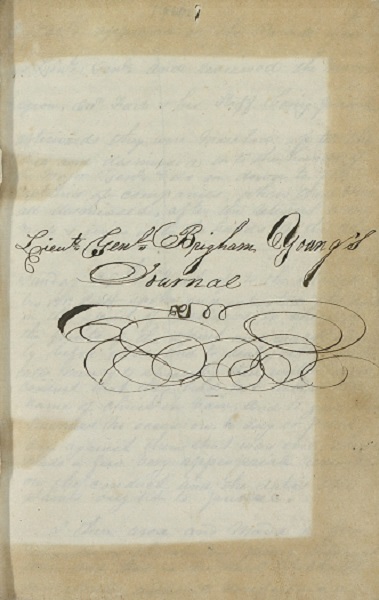 Interior title page of Brigham Young's first office journal. Young's clerk, John P. McEwan, inscribed this title and large flourish likely around the time he began writing in the journal in late September 1844. Courtesy of the Church History Library, The Church of Jesus Christ of Latter-day Saints, Salt Lake City, Utah.
―――――――― ◊ ――――――――
[1] Lieut Genl Brigham Young’s Journal 1844
28 September 1844 • Saturday
Sept 28th Appeared on the Parade ground as Lieut Genl[2] and reviewed the Nauvoo Legion, Govr Ford & his Staff being present.[3] Afterwards they were Marched up on to the hill and dismissed in to the hands of the Major Genl[4] & so on down to the Captains of companies, when they were all dismissed, after the returns was made & given in to the hands of the Colonel[5]
29 September 1844 • Sunday
Sunday 29th Went up to the stand, bro P. P. Pratt spoke and exhorted the Saints in the spirit of Meekness to cherish the fruits of the spirit[6] and walk uprightly before God and to deal justly with all Men & to show by their walk and conduct that they had not taken the name of Christ in Vain, And to give their enemies No occasion to say or print any against them that was evil. And Made a few Very appropriate remarks on the conduct and the duties the saints ought to pursue.[7]
I then arose and Made a few remarks on the Sisters penny subscription,[8] and that on the next Sabbath our Semi-annual Conference would take place, and requested the brethren and sisters to prepare themselves to be able to take in some of the Elders who may come from abroad to attend the conference May be accomodated[9]
Afternoon went to the Seventies hall and ordained the first quorum of Seventies to be presidents over the different quorums in rotation.
30 September 1844 • Monday
Sept 30. Breakfasted at Elder H. C. Kimball’s laid hands on the Sick,[10] went and Visited Old Mother Smith.[11] In the evening went to the Military school held at the Masonic hall, afterwards held a Council along with My brethren the Twelve[12] the conclusion of which was, that we were to use our[13] influence to prevent the brethren & Sisters from attending the Ball which was in contemplation to be held at President Marks in the dining room of the Mansion house on Wednesday evening.
1–2 October 1844 • Tuesday–Wednesday
Oct. lst & 2nd. Went and visited thee brethren[14] and laid hands on the Sick
―――――――― ◊ ――――――――
Editorial Note
On 6 October 1844 Brigham Young opened the semiannual conference of the church, the first general conference he presided over following the death of his friend and church president, Joseph Smith. Young’s first sermon at a general conference after being sustained as president was a memorable statement of faith.[15] Though the church had gathered two months earlier to sustain the leadership of the Quorum of the Twelve Apostles, Young considered this conference the correct venue to affirm the quorum’s leadership over the church. At the outset he stated, “It has not been the Twelve who desired to have business which pertains to this conference, transacted previous, it was others who urged it on. Some elders who have known the organization of the church from the beginning, have faultered and become darkened. We feel to give the necessary instruction pertaining to the church, and how it has been led.”[16] Young was referring to the machinations of Sidney Rigdon and others that led to the early August meeting of the Saints. Young then proceeded to provide instruction before calling for a sustaining vote for the apostles. Brigham Young was again nominated as the president of the Twelve; the church members present ratified him in this position. Young continued the day’s instruction speaking on revelation. He affirmed to the audience that the church had been and continued to be led by revelation. The Twelve stood next to Joseph Smith during his life, Young declared, “and now he has stepped behind the vail, he is not here, and the Twelve are the presidents of the whole church,” which Young stated had been acknowledged by the church’s collective sustaining vote. “You are not going to be led without revelation,” he proclaimed boldly before reminding the church members present that they each had “the right to obtain revelations for [their] own salvation.”[17]
The next day during the afternoon session of conference, speakers focused on the temple and priesthood authority. Heber C. Kimball taught specifically of the necessity of the endowment. “Joseph never rested till he had endowed the Twelve with all the power of the priesthood,” Kimball told the audience. “He designed that we should give it to you and you cannot be saved without it.” Stressing the importance of finishing the construction of the temple, Kimball further remarked, “You cannot obtain these things until that house is built. I and my brethren are willing to do all that lays in our power to finish that house for your benefit, that you may go where Joseph is gone.”[18] Kimball and other speakers encouraged the Saints to bring in their tithes and offerings and to finish building the temple so that priesthood leaders could properly teach them about exaltation and administer saving ordinances.[19]
Additional instruction and messages were given during this conference. Brigham Young, for example, taught about missionary work and the effort to take the principles of truth from sea to sea. “It is your privilege to go and preach the gospel to the world,” he asserted, “and to go by the power of the Holy Ghost, and you have no right to go without it.” Preaching the gospel by the power of revelation, Young stated, would “build up the kingdom to a certain extent.”[20] Young wanted those missionaries to gather seekers to Zion, but not before the Saints finished the vital work of the temple. Latter-day Saint Joseph Fielding offered the following summary of the conference in his journal: “Much instruction was given by Elder Brigham Young on the priesthood, etc. and the high priests were appointed to seek out new locations, i.e. many of them, all through the country, and make gatherings of people. Together they came forward readily in expectation of going out at once but Brother Young told us they need not be in a hurry about it, and it appears they will not go out until the temple is finished, but he felt a burden on him and he wished to get it off. I never attended a better conference for union and business.”[21] Though Young wrote a minimal note about the conference, the gathering of Saints and the messages delivered were powerful. The October 1844 general conference of the church was a signal moment in Young’s leadership.
―――――――― ◊ ――――――――
6–8 October 1844 • Sunday–Tuesday
Octr. 6th[22] 7th[23] & 8th[24] attended the Semiannual Conference of the Church of Jesus Christ of Latter day Saints.[25]
When the Saints was instructed in those Subjects which immediately concerned them and the building up of the Kingdom of God upon the face of the earth, and Zion established Never More to be thrown down, also upon the necessity of the saints living together in union and to finish that[26] Temple, so that you May receive your endowments their washings, Anointings & so forth & where the power of God shall be Made known, and the Elders be endowed with power from on high to go forth into all the Nations of the world and spread forth & build up the Kingdom of our God[27]
The different quorums of the church was put in order and about 4 or 500 Elders was ordained into the quorum of Seventies.[28]
The different quorums of the Seventies was Called to order & commanded to go to different places apart from each other, and their pres[iden]ts at their head; and they were to choose their own Clerk and fill up their quorums if any was lacking, whereupon Eleven quorums was organised and filled up.
14–28 October 1844 • Monday–Monday two weeks later
Oct 14. Went away in company with Elders H. C. Kimball and P. P. Pratt the distance of two hundred miles and located another place of gathering for the Saints of God in a short time,[29] but Nauvoo will be the head Stake for the Saints to come to and receive their endowment, their Anointings, washings &c &c in the house of the Lord which he has commanded to be built unto his holy Name; there will also be many more stakes or places of gathering for the Saints of God. And after they had accomplished the Necessary things and their purposes executed in the way and Manner they desired they returned safely home again[30] on the 28th of Octr And found their families well and in good spirits And all things well.[31]
29 October 1844 • Tuesday
29th was at home the Most part of the day in company with Elder Richards and others of the brether who came to pay him a visit
30 October 1844 • Wednesday
30th Went and visited some of the brethren[32]
31 October 1844 • Thursday
31st Went Upon the hill to see the Temple Committee.
COPY
Of a Letter from Govr Thos Ford to Lieut. Genl. Brigham Young[33]
State of Illinois, Executive Department
Springfield Octr 9th 1844
To Lieutenant General
Brigham Young
of the Nauvoo Legion
Sir
It may be propable that there may be further disturbances in Hancock County by those opposed to the prosecutions against the murderers of Joseph and Hyrum Smith. They may combine together in arms to subvert Justice and prevent those prosecutions from going on. They may also attack or resist the civil authorities of the State in that county and they may attack some of the settlements or people there with violence.
The sherriff of the county may want a Military force to guard the Court and protect it or its officers or the Jurors thereof or the witnesses attending Court from the violence of a mob.
In all these cases you are hereby ordered and directed to hold in readiness a sufficient force under your command of the Nauvoo Legion to act under the direction of the said Sherriff for the purposes aforesaid; and also to suppress mobs which may be collected in said County to injure the persons or property of any of the citizens.
[34] In testimony whereof I have hereunto set my hand and affixed the Seal of State the day and Year first herein above written.
Thos Ford, Governor
& Commander in Chief
1 November 1844 • Friday
Novr lst Went up to the Temple, and visited some of the brethren.
2 November 1844 • Saturday
2d at Home most part of the day[35]
3 November 1844 • Sunday
3rd wash Went to the Seventies hall in the forenoon. High Priests Quorum in the afternoon and Met with the Seventies in the evening.
4–7 November • Monday–Thursday
4. 5. 6 Visited the brethren[36] and on the 7 went upon the hill along with Elder John Taylor & Geo A. Smith and Visited the Trustees in trust afterwards[37]
8 November 1844 • Friday
8 Went out the length of Fishers Brick yard, laid hands on the sick,
9 November 1844 • Saturday
9-- attended City Council[38]
10 November 1844 • Sunday
10-- at the stand and prechd to the brethren[39]
11 November 1844 • Monday
11. attended council along with My brethren the Twelve and the High Council and the Trustees in Trust at the Masonic Hall-- also the Police[40]
12–16 November 1844 • Tuesday–Saturday
12. 13. 14. 15. 16. went and visited Elder Heber C. Kimball. and the Trustees in trust, also Dr Richards.[41]
17 November 1844 • Sunday
17. Went to the High Priests quorum and in the evening went to the Seventies Hall.[42]
18 November 1844 • Monday
18. Went away in company with Bro Lorenzo Young
19 November 1844 • Tuesday
19 Went <away> in company with Elder Orson Hyde to Bro Robt Sander’s -- from thence to Bro Stoddards, then visited the sick.
20 November 1844 • Wednesday
20. Visited Bro H. C. Kimball, and in the afternoon went away in company with Bro L[orenzo] Young[43]
21 November 1844 • Thursday
21. Visited Bro H. C. Kimball
23 November 1844 • Saturday
23d Visited Bro Amasa Lyman & Bro H. C. Kimball -- attended at the High Council.
28 November 1844 • Thursday
28. Visited Bro Daniel Spencer and in the Evening-- went to see Bro Sloan
29 November 1844 • Friday
29.- Went to Bro W[illiam]. W[arner]. Majors--
11–12 December 1844 • Wednesday–Thursday
Decr 11. At home sick. 14 12[44] Do. held council in the west room with Elders O. Hyde Amasa Lyman, Geo. A. Smith, & John Taylor, and in the evening went upon the hill to Sister Greens.[45]
13 December 1844 • Friday
13. Went away in company with Elder H. C. Kimball, Visited Bro. W. Richards and the Trustees in trust for the Church of Jesus Christ of L.D.S.[46]
14 December 1844 • Saturday
14.[47] Attended the City Council--[48]
15 December 1844 • Sunday
15. Preached in the Masonic hall in the forenoon. then went up to the house of Elder P. P. Pratt
16 December 1844 • Monday
16. Went to Bro H. C. Kimballs -- and from thence to the Trustees in trust[49]
17 December 1844 • Tuesday
17. The Twelve in council assembled along with some others at the office of Prest B. Young[.] In the Evening went to see Bro Williard Richards
18 December 1844 • Wednesday
18. Went out hunting
19 December 1844 • Thursday
19. Went to the Trustees[50]
23 December 1844 • Monday
[51] 23. Went to Bro C. H. Webb’s.[52]
24 December 1844 • Tuesday
24 " " " [Went to Bro] J. [onathan] H. [arriman] Hale[53]
25 December 1844 • Wednesday
25 " " " [Went to Bro] J.[oseph] W.[ellington] Coolidge[54]
26 December 1844 • Thursday
26 " " [Went to] the Dedication of the Seventies Hall.
27 December 1844 • Friday
27 " " [Went to] the Hall, afterward in the afternoon went to Bro J[ohn] D. Lee -- And in the Evening assembled at the Sevties Hall with the High council -- City Council, and the officers of the Nauvoo Legion[55]
28–29 December 1844 • Saturday–Sunday
28 & 29 Was at Bro Evans Ward[56]
30 December 1844 • Monday
30 -- at home.
31 December 1844 • Tuesday
31 -- Went upon the Hill -- and in the afternoon -- preached at the Sev[enties]. Hall.
1845
1 January 1845 • Wednesday
Jan. 1.[57] Went in company with Elder H. C. Kimball to [David] Evans Ward.[58] and performed the ceremony of Marriage[59] Afternoon went to dine at Bro Hiram Kimballs.[60]
2–4 January 1845 • Thursday–Saturday
2. Went upon the hill.[61] 3 Do [Ditto] -- 4th Do [Ditto]
5–6 January 1845 • Sunday–Monday
5th Preached at the Stand -- 6. Went upon the Hill -- to the office of the Trustees.
7 January 1845 • Tuesday
7. Went to see Dr Richards -- thence to see the Trustees.[62] thence to see Bro Lorenzo Young. thence to Bro. Browns.
8 January 1845 • Wednesday
8. Met at the Seventies Hall in company with all belonging to the Young’s family or kindred.[63]
―――――――― ◊ ――――――――
Editorial Note
From 9 January until 4 July 1845, no clerk wrote in Brigham Young’s office journal. Young’s personal journal covers some of this period, but he discontinued his diary entries on 1 April 1845.[64] During the nearly six-month gap in writing in the office journal, Young was busily engaged in leading the church.
At the end of February, the Saints felt threatened by the mob and the state of Illinois, which had taken away the Nauvoo charter and left the church members there unprotected. As uncertainty settled on the Saints in Hancock County, Brigham Young made a short visit to Macedonia, more than twenty-five miles east of Nauvoo. While there on the twenty-sixth, he addressed some of the Saints. He encouraged them to “seek after wisdom & prudence.” Though their enemies seemed determined to drive them away by force, Young reminded the residents of Macedonia that they still had work to do before they could leave and find a place to worship God in peace. They had to finish the temple and “carry out all of Josephs measures.” The leading apostle told the Saints to keep themselves quiet as they went about their business and to wait for further instructions before acting, especially as it pertained to “military concerns.” A feeling of unity rested among the Macedonia Saints as they listened to Brigham Young’s instruction. As February closed, church members in Hancock County were determined to go about their work peacefully but to protect themselves if necessary.[65]
Even as external threats felt closer, Brigham Young continued to teach the gospel. On 6 April 1845 he spoke on several topics. First, he lectured about baptisms for the dead and ensured their validity and recognition in heaven. As a part of his efforts to carry out Joseph’s measures, Young announced “that you never will see a man go forth to be baptized for a woman, nor a woman for a man.” He further declared that when baptism for the dead “was first revealed all the order of it was not made known, afterwards it was made known, that records, clerks, and one or two witnesses were necessary or else it will be of no value to the Saints.” In addition to speaking about the importance of recording baptisms for the dead, Young articulated his belief in the plan of salvation as a perfect system. “It is a plan of salvation to all men both male and female,” he taught, and “it is a system that can save, redeem, honor and glorify all who are willing to apply themselves to it.”
Young’s early April speech also touched on the universality of the gospel of Jesus Christ. “The gospel is adapted to the capacity of all the human family,” the church leader proclaimed, “whether they be high or low, rich or poor, bond or free, black or white, young or old, it is adapted to their capacities, all can understand and be saved.”[66] Finally, Brigham Young instructed the Saints about marital and family relations. He taught, “I would say, as no man can be perfect without the woman, so no woman can be perfect without a man to lead her, I tell you the truth as it is in the bosom of eternity; and I say so to every man upon the face of the earth; if he wishes to be saved he cannot be saved without a woman by his side.” Young then pointedly outlined the scope of male authority. He declared, “Lest these my sisters should think I give power into the hands of their husbands to abuse them, I would say there is no man has right to govern his wife and family unless he does it after the order of the church of Christ, unless he does it upon this principle he need not expect to receive a celestial glory. He that does not govern as Jesus governs his church, breaks his bonds and solemn obligations to his family.”[67]
In addition to guiding the Saints in spiritual matters, Young convened the Council of Fifty more than a half-dozen times in April and May 1845.[68] Council meetings covered a litany of topics during this time. However, it was business pertaining to the safety of the church and its members and the sending of missionaries to American Indians that was most pressing.[69] The fear of the mob and renewed violence pervaded council discussions. Illinois governor Thomas Ford had sent a letter on 8 April 1845 to the Saints, concerned that they would never enjoy peace in their current location. He wrote, “If you can get off by yourselves you may enjoy peace; but surrounded by such neighbors I confess that I do not foresee the time when you will be permitted to enjoy quiet.”[70] The council initiated a letter-writing campaign to the governors of the states of the Union requesting their assistance to preserve the rights of the Latter-day Saints and informing them of their possible emigration west. These letters were ready by the end of April and signed on 10 May 1845.[71] Young dissolved the council for a time following the 10 May 1845 meeting, only to reconvene it on 9 September 1845.
Young attended an array of other meetings, including frequent prayer meetings.[72] Throughout this period he met often with the Twelve and other church leaders to petition heaven in a pattern of priesthood prayer.[73] At one meeting the leaders prayed “that the plans of the mob might be frustrated that the might have no influence nor power to disturb nor trouble us . . . that we may be preserved in peace to finish the houses and see the Elders endowed and fulfil all that the Lord has commanded us in this place.”[74] The church leaders manifested in their prayers a great anxiety to finish the temple and attend to the necessary religious ordinances therein.[75]
The Saints in Nauvoo saw good progress on the temple and, after four years of difficult labor, were gratified to witness the laying to the capstone on the southeast corner of the temple on the morning of 24 May 1845. Brigham Young and other church leaders were present for this momentous occasion. After he helped secure the capstone in place, Young instructed the congregation on the Hosanna shout and then said, “The last stone is laid upon the Temple and I pray the Almighty in the name of Jesus to defend us in this place and sustain us untill the Temple is finished and we have all got our endowment.”[76] The church president concluded the morning’s event with the following words: “This is the seventh day of the week, on the Jewish Sabbath. It is the day on which the Almighty finished his work and rested from his labors. We have finished the walls of the Temple and we may rest to day from our labors. He said he would take it upon him to dismiss the workmen for to day, and requested the people to hallow the day, and spend it in giving thanks to God.”[77]
As the Saints celebrated the placing of the temple’s capstone, church leaders faced a new challenge. Opposition had emerged within the ranks of the Quorum of the Twelve Apostles. William Smith, the younger brother of the martyred prophet and a longtime member of the Twelve who was still grappling with the death of his wife Caroline, was creating a stir among the church leadership. Smith had earlier sustained Brigham Young and the Twelve in their new roles,. Yet he seemed no longer to consider himself accountable to Brigham Young or the Twelve.[78] On 23 May, the evening before the temple capstone ceremony, Young and other church leaders discussed William Smith’s conduct. According to William Clayton’s journal, it appeared that Smith was “determined to rule the church and monopolize the whole to himself.”[79] Despite Smith’s behavior, on 24 May, the same day as the capstone ceremony, Young and the Twelve ordained him the church’s patriarch in the place of his murdered brother Hyrum. Regardless, relations between Smith and his fellow apostles remained strained.
The tension simmered over the next month before heating to a boil over William Smith’s proposition that he had the right to administer all ordinances in all the world as the church’s patriarch. In a letter dated 30 June 1845, William Smith wrote to Young, “It was my wish that you should stand as the President of the church, but I claim to be patriarch over the whole church, this gives me my place and proper standing, and what I inherit. . . . I want all men to understand that my fathers family are of the royal blood and promised seed and no man or set of men can take their crown or place in time or in eternity.” Smith demanded that only his being named “patriarch over the whole church” would settle “all difficulties and restore peace and good order.”[80]
Brigham Young met with a majority of the Twelve and other church leaders at Lucy Mack Smith’s house to discuss William’s proposition and to determine Lucy’s feelings toward the church. After a “considerable talk with mother Smith,” Young and the others found her “her possessing the best of feelings towards the whole church.” Regarding William’s request, Young wrote in reply, “We would say that we are perfectly willing, and wish to have all things right, but there are some ordinances in the church that cannot be administered by any person out of this place at present, but must be done here. As to your having the right to administer all ordinances, in the world, and no one standing at your head we could not sanction, because the president of the church stands at the head of all the officers in the church, and each one of our quorum are amenable to the quorum, of which you are a member. But as to your right to officiate in the office of Patriarch, we say you have the right to officiate in all the world, wherever your lot may be cast, and no one to dictate or control you excepting the Twelve, which body of men must preside over the whole church in all the world.”[81] The struggle between William Smith and Young and the Twelve continued through the summer and into the fall and culminated in a vote on his standing in the quorum and in the church at the October general conference.
Brigham Young’s office journal recommences in early July just days after the letters Young and William Smith exchanged. No scribe had written in the office journal since 8 January. Evan M. Greene had recently returned to Nauvoo from a monthslong mission and took a job as a clerk for Young to provide for his destitute family. He penned the next entry in this office journal on 4 July 1845.
―――――――― ◊ ――――――――
4 July 1845 • Friday
[82] July 4. Evan M. Greene commenced clerking for me.[83] Spent the forenoon in hearing Church history read.[84] The afternoon about the Temple.[85]
5 July 1845 • Saturday
July 5. Bro. Peter Maclin, called on me, from <of> Otowa,[86] on his way from Council Bluff-- In the morning had an interview with Messrs. M[iner] R[udd] Deming & J[acob]. B[enjamin]. Backenstos.[87] In the evening got home my well curb and set it up.[88]
6 July 1845 • Sunday
Sunday July 6 This morning went to the Stand and heard Bro’s Wm Smith and H. C. Kimball preach.[89] In the afternoon met with the High priests,[90] and a donation was taken up to finish off a house for Silas Smith’s widow. [Mary Aikens Smith]
7 July 1845 • Monday
Monday 7th July This morning went to the seventies hall; where Bro. [Selah] Van sickles was taking my likeness[91] -- met Bro’s W. Richards & Geo. A. Smith -- In the afternoon went to Bro. Richards office to hear church history read[92] -- Had an interview with Bro. Joseph Toronto[93]
8 July 1845 • Tuesday
8 Tuesday This morning went to the Temple found the hands were making the west wall wrong and set them to work on the East wall and then went and lay at the feet of the Bishops Whitney and Miller $2600, in gold that I had received of brother Toronto.[94]
9 July 1845 • Wednesday
Wed -- 9th[95] Went to the Temple, and then called to see Bro. Phinehas found him better saw bro. S. Carter and Sister Hannah Dunam[96] -- Sister Jennetta Richards died at 9h 45m A. M.[97] attended the party made by the trustees for Mother Smith and family Mother Smith was pleased.[98]
10 July 1845 • Thursday
Thursday, 10. this day was spent in fasting and prayer-- had a good time at the stand. Bro. Kimball and myself visited Bro’s Winchester and Morley <Elisa Babcock and Sister was at Father [Isaac] Morleys> took supper at home and went to meeting at Dr. Richards[99]
11 July 1845 • Friday
Friday 11 this evening we assisted in burying Sister Richards she was much mortified.[100]
12 July 1845 • Saturday
Sat.[101] 12. this morning Bro’s D & O [Alpheus] Cutler D[aniel]. & O[rson] Spencer & Hiram Kimball came to my house to council with regard to settling the claims of Fosters Laws Higbees &c for the old printing press[102]-- and to form ordinancies relative to Showmen and Auctioneers <pd. Sister Clark $80 in gold and $20 -- paid H. Kimball $500, on our land trade Baptised C Granger[103] In the afternoon rode with G. A. Smith on to the hill in the evening attend the funeral of Sister Jennetta Richards at Bro. Benj. Browns saw Sister Wright[104] came to the Temple laid hands on several sick which I do daily and thereby keep myself nearly sick[105]
18 July 1845 • Friday
18 July this morning Brother Joseph Herring, a native American came in from a mission to the East to visit some of <his> friends on his way home, (cow skin river, Arkansaw, country) he is a believer in the gospel,[106]
19 July 1845 • Saturday
19 brother George A. Neal called to see me -- Sister Mary[107] and others spent the afternoon at my house and I was at home[108]
―――――――― ◊ ――――――――
Editorial Note
Brigham Young spent much of the ten-day period between the last entry and the next holding business and prayer meetings and attending to the sick.[109] At one meeting he attended with William Clayton and others, along with business, “prayers were offered for general matters especially that the Lord would turn away the sickness now prevailing amongst the children in the City.”[110] Two Native American men from the Mohawk tribe, Joseph Herring and his nephew Moses Otis, arrived in Nauvoo in late July; Brigham Young would baptize them in early August.[111] Work on the Nauvoo temple also occupied some of Brigham Young’s time and attention. The Saints finished shingling the roof of the temple and raised timbers for sections of the tower during this time between 19 and 29 July 1845.[112]
―――――――― ◊ ――――――――
29 July 1845 • Tuesday
July 29 this morning went to the hall with Bro’s Richards and Kimball[113] -- in the afternoon[114] went to Bro R’s office and company with Bro’s R[ichards]. & K[imball]. & G.A. Smith heard church history
30 July 1845 • Wednesday
30 went to attend the funeral of Sister Thompson
31 July 1845 • Thursday
31 this morning went on to the hill to the Temple-- In the afternoon took a ride with my family in my new coach[115] then met in council with the Brethren[116] and Gen. Deming to make arrangements with regard to our coming Election[117]
 Lithograph of the Nauvoo Temple created about 1857. Library of Congress, Washington, DC,LC-USZ62-33772.
1 August 1845 • Friday
Aug. 1 This morning met the Brethren at the <stand> to hold a caucaus on the coming Election. In the afternoon went to the Temple then rode out in the carriage.[118] the weather is quite warm and dry tho not so hot as it has been heard from Kirtland there it is exceeding dry
2 August 1845 • Saturday
Aug. 2 Went out to brother Chases and got my colt and brot it into town
3 August 1845 • Sunday
3rd this day sunday I went to the stand to meeting and preached to the brethren to awake up from their stupor[119] in the evening Baptised bro’s Joseph Herring and Moses Otis two Lamanites that called to see us when on their way from New York to Mo. Territory they are quite inteligent men and will do us good.[120]
4 August 1845 • Monday
1845[121] Aug 4 this day Brothers Daniel Spencer and Charles Shumway were appointed to a mission to the west,[122] to accompany Bro’s [Joseph] Herring and [Moses] Otis and their papers being made out they started about two oclock -- I furnished these Lamanites bro’s with guns clothing and money to bear their Expenses and may the Lord Bless them and Keep them in the pathes of virtue and truth.
5 August 1845 • Tuesday
August 5th this morning after visiting some sick brethren I went with my family to brother [John] Benboes on a party ride, made up of Brothers H. C. Kimball and others had a fine time[123] this night had a hard shower, the lightning struck brother Wickes house and tore out the door post.
6 August 1845 • Wednesday
Aug. 6 this morning met in council with Bro’s H. C. Kimbal, A Lyman W. Richards G. A. Smith and took up J[acob]. B. Backenstos in stead of Deming for Sherif[124] and went to work to fit up a company to go with Jas. Emmet to the west.[125] In the afternoon went to Brothe[126] Lotts[127] to do some business with the trustees[128] and spent the Evening very agreeable
7 August 1845 • Thursday
Aug 7 this morning father [Samuel] Bent and Bro. [John S.] Fulmer came to see me[129] after they were gone Bro. Luslee Lyme[130] delivered to me thirty dollars in deposit for the benefit of the church. And Bro Lewis Gaulter Eighty more.[131]
8 August 1845 • Friday
Aug. 8 This morning I am quite unwell. Bro’s W. Richards[132] L.[orenzo] Young. G. A. Smith Jos. Coolidge & father [Samuel] Bent came to see me before I left my room. my health was so poor that I kept my room all day. Recd. letters from S[amuel]. Brannon & A[mos]. Fielding[133] <in the evening went to Wm Smiths and sealed to Miss Rice.
9 August 1845 • Saturday
9 this morning brothers G. Miller. & A. Lyman called on me to go with them and hold a consultation on the walls of the Nauvoo house as there was a dispute between L. Woodworth the architect[134] and Peter Haws one of the building committee. came home and went to bed quite feeble[135] In the afternoon a sister called to see what I would give her with regard to leaving her husband as he did not belong to the church. Recd a letter from Wm Smith desiring to have the church pay certain store debts that he had contracted for himself.[136] I addressed letters to Brothers C. Tucker[137] A Fielding[138] S Brannon--[139]
Aug. 9 this Evening we started some Brethren out with tickets to the various precincts for E[lection][140]
10 August 1845 • Sunday
10 This morning went to Bro. W. Richards office met with brothers W & L Richards. H. C. Kimball G A Smith A. Lyman N. K. Whitney Geo. Miller Wm Clayton Jos. Young I. Morley O. Spencer and E M Greene[141] in the afternoon met the H Priests quorum at the Music Hall.
11 August 1845 • Monday
Aug. 12 11 Tended Election for sherif and coroner[142] was at the Temple and among the Brethren during the day
12 August 1845 • Tuesday
12 this day I spent with the brethren mostly in counsel for the benefit of the Church and to assist in the removal of some difficulties that still existed between the Nauvoo House Committee and L. Woodworth[143]
13 August 1845 • Wednesday
Aug. 13 I rode up to the temple then to several other places
14 August 1845 • Thursday
14 Spent the forenoon in company with brother H. C. Kimball in laying hands on the sick The afternoon attended prayer meeting at Brother W. Richards[144]
15 August 1845 • Friday
15 Spent the forenoon at home had some company in the afternoon went to the Temple and to Bro. W. Richards, then returned home in the Evening and prepared the map of Nauvoo and title page to the history of the Church for Col. J. B. Backenstos to take to Springfield to obtain a coppy right for me.[145]
16 August 1845 • Saturday
16 This morning after breakfast while I was preparing to go on to the hill I was taken with the cramp had a sick day just at night rode out felt better this evening two Brothers by the name of <Nowlin> came to my house from Miss[issippi][146]. & another man.
17 August 1845 • Sunday
Aug. 17 sunday. This morning I dreamed I saw brother Joseph Smith and as I was going about my business he says brother Brigham dont be in a hurry -- this was repeated the second and third time, when it came in a degree of sharpness.[147] Spent the forenoon in business at the Temple office. Went to the stand found brothe[r] Wm Smith preaching a spiritual wife sermon[148] -- in the afternoon had a fine shower of rain[149]
18 August 1845 • Monday
18 met the brethren of the council and committee at the Nauvoo house on the walls and there dedicated it to the Lord and asked his blessing to attend the work.[150] in the afternoon had a council at my house.[151] after which I went up to Sister [Rhoda] Greenes and met Dr. A.[lpheus] S.[mith] Greene
19 August 1845 • Tuesday
19 this morning had much comp[any]. at my house. 10 oclock started into the prairie in comp[any]. with E[van]. M. Greene, our wives & Dr A[lpheus]. S[mith]. Greene and brother J[ohn]. P[ortinus]. Greene’s widow[152] had a plesant time, all enjoyed themselves well. returned to my house got supper. and the Dr. sat for a sketch. by bro’s [William W.] Major & [Robert] Campbell.
20 August 1845 • Wednesday
Aug. 20th this morning brother Bryan Ward Nowlin paid me in thirty five dollars on tithing for the Temple I spent the day in visiting the sick. Brother Lorenzo [Young] was very sick. in the evening a boat came up and Dr. [Alpheus] Greene left us.
21 August 1845 • Thursday
21st I passed this day in visiting the sick and at the Temple, and at home[153]
22 August 1845 • Friday
22nd this morning quite unwell after breakfast went to Dr. Richards office and heard history.[154] in the afternoon rode out with Bro. [Jedidiah] Grant. visited some sick this day
23 August 1845 • Saturday
23rd had some company. after breakfast went down to Bro Maudsley’s and set for him to take a sketch for my likeness in lethograph came home to dinner, after which I went out and bought some flour. In the afternoon went with Sister Sary Ally to the river and Baptized her for her health.[155] in the evening Bro’s Solomon Hancock & Moses Clawson came to my house to council some with regard to the affairs of the Branch in Father Morleys Settle[ment]. <The dome for the Temple was completed and all rejoiced[156]>[157]
24 August 1845 • Sunday
24 Sunday. this morning went to the stand, Brother Joseph Young preached a funeral sermon for old Sister Redfield after which I spoke a short time.[158] In the afternoon met all the quorums at the stand and gave them instructions about building the houses the Lord had commanded.[159] after which went with Brother Kimball ◊◊◊◊to the Temple office, and took supper at Bro. [Joseph] Kingsburys then went to Dr. Richards office to our prayer meeting.[160]
25 August 1845 • Monday
25. this morning went with Brother Grant up to the Temple office and got my steel and moss for my carriage[161] returned home, and then went with brother Lorenzo [Young] to see some land. then up to the road job where the brethren were at work between Nauvoo and Appanoose. in the evening returned home & had a visit with Dr. W Richards <This afternoon Baptised Sisters Sary [Sarah] Ally, old Sister Hess and Mary Ann[162] <that> worked for us.>
26 August 1845 • Tuesday
26th I spent this day, after setting a while at Bro. Maudsleys,[163] with the brethren at Bro. W. Richards correcting history.[164] in the evening went to see some sick and administered to them. Bro. Parley came home.[165]
27 August 1845 • Wednesday
Aug. 27. This morning came to Brother W. Richards and spent the day with Brother Parley and others in council,[166] in the evening went to visit the sick.
28 August 1845 • Thursday
Aug. 28. (I went out to the prairie Orson, with my team and carried brother Parley.) I went on to the hill got brother Parley, came down to Geo.[167] A. Smiths, from there to the Nauvoo House then, to Bro. Nickersons, and then to Edward Meacham’s found him possessed of the devil, laid hands on him. then to Dr. Richards to council where I spent the afternoon.[168]
29 August 1845 • Friday
Aug. 29. I spent this day in council hearing history[169] and visiting the sick.
30 August 1845 • Saturday
30 went to see brother Foulk who had been a Sidneyite but being sick concluded to return, he gave in a horse and some other property for the Temple. heard history in the forenoon[170] and in the afternoon visited the sick in the evening Sherif Backenstos came directly from Springfield, brought my copy rights which he had got enterd in Clerks office.[171]
Notes
[1] TEXT: John McEwan handwriting begins.
[2] For the background to the Nauvoo Legion review this day, see Brigham Young’s holograph journal entry of 27 September 1844, p. XXX herein.
[3] Brigham Young had been commissioned Lieutenant General of the Nauvoo Legion by Illinois governor Thomas Ford on 24 September 1844, taking the rank Joseph Smith had held before his murder. Ford had delivered this commission with that date on 27 September 1844, the day before entries in this journal begin. In December 1844 Ford revised the effective date of Young’s commission backward to 31 August 1844, reflecting the day Young had actually been elected to the position pursuant to the regulations outlined in the Nauvoo City Charter. William Clayton reported of the arrival of the governor and his troops that “Prest. Young has got his commission as Lieut. General and C. C. Rich as Major General, and I was informed yesterday that the Governor intends to restore our arms. The troops appear very civil and friendly although some of them are known to be bitter against us.” In a letter sent earlier this same day, Young had formally invited Ford and his entourage to “accept an escort from the Legion & be present at the review,” which was scheduled for noon. (Clayton, Journal, 27 September 1844, CHL; Ford, Commission to Brigham Young, CHL; Nauvoo Legion Commission, 14 December 1844, Brigham Young Office Files, CHL; Brigham Young, Journal, 31 August 1844, p. XXX herein; and Brigham Young to Governor Thomas Ford, 28 September 1844, Brigham Young Office Files, CHL.)
[4] Charles C. Rich was Major General of the Nauvoo Legion. (Nauvoo Legion Minute Book, 20 October 1844, 82, CHL.)
[5] Heber C. Kimball recorded that the Nauvoo Legion “was reviewed by Governer Ford, Genrall Harden and others. The day went of[f] well. We are desmised at 5 in the after noon.” At the time, great fears existed of renewed mob violence. William Clayton wrote, “There are yet many rumors concerning the movements of the mob. They seem determined to rout us if possible, but the feeling of the brethren is to stand firm & defend ourselves till we build the Temple.” (Kimball, Journal, 28 September 1844, CHL; and Clayton, Journal, 20 September 1844, CHL.)
[6] See Galatians 5:22 and Ephesians 5:9.
[7] William Clayton recorded in his journal, “I attended meeting and heard P. P. Pratt lecture us on our conduct as Mormons. He advised all the drunkards, thieves and fighters to either quite their wickedness or leave the city and disown the name of Mormon and Christian altogether.” (Clayton, Journal, 29 September 1844, CHL.)
[8] In 1843 biological sisters Mercy Fielding Thompson and Mary Fielding Smith began the “Ladies Subscription for the Temple,” which Mercy explained was the result of revelation she received. After praying to know what she could do “for the building up of the Kingdom of God,” she had a powerful spiritual experience that she described as “a most pleasant sensation” that came over her and the words “try to get the Sisters to subscribe one cent per week for purpose of buying glass and nails for the temple.” Encouraged to act upon her prompting by Joseph Smith and supported by Hyrum Smith (whom she would be married to as a plural wife in August 1843 after the death of her husband Robert Thompson), Mercy Thompson made great efforts to see the temple subscription succeed, gathering more than five hundred dollars through the program. In the 1 October 1844 issue of the Times and Seasons, Brigham Young published this notice: “To the saints in Nauvoo and abroad: We would say that the penny subscription by the sisters, which has always been conducted and carried on by Mrs. Hyrum Smith, and Mrs. Thompson will still continue, and the payments be made and enclosed as usual with the persons names signed, and for which the Twelve will be responsible.” (Thompson, Autobiographical Sketch, CHL; and “Notice,” Times and Seasons, 1 October 1844, 5:670.)
[9] George A. Smith noted in his account that he also spoke at this meeting. (George A. Smith, Papers, 29 September 1844, 27, CHL.)
[10] Heber C. Kimball noted they “viseted sevrel houses Sister Closens, Sister Bullards.” (Kimball, Journal, 30 September 1844, CHL.)
[11] TEXT: The phrase “Visited Old Mother Smith” was edited in graphite by another scribe at a later date. The change appears to be in the handwriting of John D. Lee. With the later edit, Lee changed the phrase to “visited Prest Jos Smiths Mother.”
[12] According to Heber C. Kimball, this meeting was also held in the Masonic Hall. (Kimball, Journal, 30 September 1844, CHL.)
[13] TEXT: The phrase “the Twelve the conclusion of which was, that we were to use our . . .” was later stricken in graphite, likely by John D. Lee. It was altered to read simply “the Twelve & concluded to use our . . .”
[14] William Clayton recorded in his journal more of what occurred during Young’s “visit” with the brethren on 1 October: “Evening met the Twelve at Brother Kimballs and offered up prayer for the Governor and Emma and sundry other things. We had a very interesting season of conversation. A man has a right to be baptized for his acquaintances who are not relatives and sealed to them only by the consent and authority of him who holds the keys.” (Clayton, Journal, 1 October 1844, CHL.)
[15] For the text of Brigham Young’s momentous opening sermon at conference, see Young, Journal, 6 October 1844, footnote XXXX p. XXX herein.
[16] “October Conference Minutes,” Times and Seasons, 15 October 1844, 5:682.
[17] “October Conference Minutes,” Times and Seasons, 15 October 1844, 5:683.
[18] “Conference Minutes, October Conference Minutes,” Times and Seasons, 1 November 1844, 5:693–94.
[19] See Editorial Note for October 1844 in Young’s personal journal, p. XXX herein.
[20] “October Conference Minutes,” Times and Seasons, 15 October 1844, 5:683.
[21] Fielding, Journal, 8 October 1844, CHL.
[22] Brigham Young addressed the conference on the morning of 6 October. He informed the assembled Saints that “this day will be devoted to preaching and instruction.” Young explained how the church had been led by revelation. “The church is built up by revelation,” he taught, “given from day to day according to the requirements of the people. The Lord will not cease to give revelations to the people, unless, the people trample on his laws and forsake and reject him.” The church, Young declared, would always be led by revelation so long as its apostles and members did not “forsake the Lord entirely.” In addition to apostolic and prophetic revelation for the church, Young also spoke about personal revelation. “Every member has the right of receiving revelations for themselves, both male and female,” he reminded the congregation. Young instructed church members at length about the nature of revelation, both prophetic and personal, and the succession of keys and authority for revelation for the church. “If the Twelve do not apostatize they carry the keys of this kingdom wherever they go,” he solemnly and powerfully proclaimed. (“October Conference Minutes,” Times and Seasons, 15 October 1844, 5:682–83, 684.)
[23] Conference focused on church business on 7 October. “The first business that we shall attend to,” Brigham Young told the Saints, “will be to present the several quorums before the conference, for the purpose of taking an expression of the brethren and sisters, whether they will sustain the officers according to their several appointments.” The church first voted unanimously to “receive and acknowledge Joseph Smith as a Prophet of God; being called of God and maintaining his integrity and acceptance until death.” After calling for sustaining votes of dozens of church officers, Young became “fatigued” and had Parley P. Pratt preach a sermon before the morning session concluded. The afternoon session featured singing and prayers. Heber C. Kimball spoke on salvation and the celestial law. Asahel Smith, an uncle of Joseph Smith, was sustained and ordained to the office of patriarch. In that afternoon session Brigham Young also spoke on the law of tithing. (“Conference Minutes, October Conference Minutes,” Times and Seasons, 1 November 1844, 5:694; see also editorial note in Young’s personal journals, p. XXX herein.)
[24] John Taylor opened the conference sessions for 8 October 1844 with a discourse on temporal economy. Brigham Young then selected dozens of men from the high priests quorum to settle in different congressional districts of the United States to preside over and build up the branches into stakes. Hundreds of men were ordained to various priesthood offices as Young organized and properly filled the quorums. Young closed the conference with the following remarks: “The elders, young men who are capable of preaching, will be ordained; but do not be anxious. You must now magnify your calling.” Young further exhorted “all who go from this place to do right and be an honor to the cause. Inasmuch as you will go forth and do right you shall have more of the spirit than you have heretofore.” Grateful for a good conference with beautiful weather and no accidents, Young then closed the meeting. (“Conference Minutes, October Conference Minutes,” Times and Seasons, 1 November 1844, 5:696; and Clayton, Journal, 8 October 1844, CHL.)
[25] The Times and Seasons reported that the conference was attended by thousands of members and opened by Parley P. Pratt at 10:00 a.m. on the 6th. (“October Conference Minutes,” Times and Seasons, 15 October 1844, 5:682.)
[26] TEXT: This word is written over two illegible characters.
[27] In the 7 October afternoon session of the conference, Heber C. Kimball taught specifically of the necessity of the endowment: “Joseph never rested till he had endowed the Twelve with all the power of the priesthood, because he was about to pass within the vail. He designed that we should give it to you and you cannot be saved without it. You cannot obtain these things until that house is built. I and my brethren are willing to do all that lays in our power to finish that house for your benefit, that you may go where Joseph is gone. We have got to carry out Joseph’s measures and you have got to assist us. When Jesus was upon the earth his time was spent in endowing the twelve apostles that they might do the things he had left undone and carry out his measures, and upon the same principle we carry out Joseph’s measures.” Brigham Young followed Kimball and among other instructions reiterated the necessity of completing the temple, saying, “We want you to come on with your tithes and offerings to build this temple, and when it is finished we want you to spend a year in it and we will tell you things you never thought of.” (“Conference Minutes, October Conference Minutes,” Times and Seasons, 1 November 1844, 5:694.)
[28] In his private journal Young wrote, “This day ended our confrence we have organized eleven Quorams of Seventis. have had a first rate conference.” (Young, Journal, 8 October 1844, p. XXX, herein.)
[29] The group also eventually consisted of Lorenzo D. Young, Jacob Anderson, George P. Dykes, and Phillip Brusard. They traveled to Ottawa, Illinois, where a group of dozens of Norwegians had converted to the church and been formed into a branch, primarily through the missionary efforts of Dykes. After arriving at Brusard’s home in Ottawa, Parley P. Pratt preached a Sunday sermon on the twentieth, and on the twenty-third Kimball recorded that “we concluded [to] set of a town, and call it Norway. We dedicated it to the Lord.” The hundred-acre plot was purchased from Anderson and another church member, and Dykes was appointed the presiding high priest of the members in the area, with Brusard appointed to assist him. This new settlement, several miles outside Ottawa, was designed to be a gathering point for Scandinavian Saints. Less than a week later, Dykes wrote to Brigham Young to inform him that “the Brethren here are well pleased with the Idea of having a settlement made here under the Direction of the twelve, & I want you to be mindful of my necessities to send me on good & efficient man to assist in the organising building up etc. as you promised me. . . . Some of the Brethren here think that $75 is rather high to begin with for a lot where there is not a city alredy, I want you if you please send us some direction how & when to proceed in our little settlement, as many of the saints are ready to buy a lot.” In his private journal Young recorded, “Came to the Norwegon settlement had a meeting in the evening with the Bretherin.” (Brigham Young, Journal, 15 October 1844, herein, p. XXX herein; Kimball, Journal, 15–27 October 1844; Erekson, “‘Gathering Place for the Scandinavian People,’” 23–28; and George P. Dyke to Brigham Young, 29 October 1844, Brigham Young Office Files, CHL.)
[30] The men departed during a time of renewed fear that the Saints would need to defend themselves against violent attacks. In late September, William Clayton recorded in his journal, “Reports came from Warsaw that the citizens have all crossed to Missouri and are all well armed & prepared for defence and calculate to fight the Governor if any attempt is made to arrest them.” These tensions, centered on Warsaw, had only increased, and a few weeks later Clayton recorded a new report that there was “a company of mobocrats opposite Warsaw preparing to assualt us. Col. Williams is trying to raise a mob but we dont fear any danger for God is with us.” Fearing the veracity of such rumors, the Saints were focused on stockpiling weapons for their own defense. On 14 October, Theodore Turley arrived in Nauvoo with two hundred muskets in addition to the gun parts purchased by Lorenzo Young on 12 October. (Clayton, Journal, 29 September, 12 and 14 October 1844, CHL.)
[31] Kimball noted that they returned to Nauvoo at 2:00 p.m. (Kimball, Journal, 28 October 1844, CHL.)
[32] William Clayton also recorded that he had met with Brigham Young that morning to discuss a growing rift between the temple committee and the trustees, as well as some of Clayton’s “own matters.” As a result, later in the day the “Twelve came up to the office and talked over the matters between the Committee and [William] Weeks. There was nothing done of much consequence but the parties expressed themselves partially satisfied.” (Clayton, Journal, 30 October 1844, CHL.)
[33] A copy of this letter is also found in collections of Brigham Young’s incoming correspondence; see Brigham Young Office Files, CHL.
[34] TEXT: There is a large drawing on the left side of this word with the enclosed initials “L.S.” in large letters, standing for locus sigilli, a Latin term literally meaning the place of the seal denoting the area on a contract where the seal is to be affixed.
[35] William Clayton recorded that when he went to see Brigham Young that evening, Young was not home. (Clayton, Journal, 2 November 1844, CHL.)
[36] The date of the national presidential election was 4 November, and according to Hosea Stout, “the brethren all concluded to vote for Polk and Dallas for President and Vice-President of the United States,” implying a decision made to that effect by Brigham Young. “However, it was with peculiar feelings,” Stout continued, “that I went to the polls. I thought of the man whom we had elected as the man of our choice for President of the United States: our beloved Prophet Joseph Smith whose voice seemed yet to sound in the air, teaching this nation the way they might be saved and the means to pursue to avoid a disunion and overthrow of our government.” Stout wrote of “the never to be forgotten 27th of June, 1844 when [Joseph] fell a sacrifice to the violence of a mob while the constituted authorities of this state winked at their deeds, after the honors of the governor and faith of the state had been pledged for his protection and his blood, is now to be seen on the floor of the jail at Carthage.” Stout explained that he voted with “little confidence.” (Stout, Journal, 4 November 1844, CHL.)
[37] In his private journal, Young recorded that he had spent the day “at Br J. B. Nobles Br A. Lymon Sister Olive Frost & my self & others was there.” (Brigham Young, Journal, 7 October 1844, p. XXX herein.)
[38] Among several items addressed by the city council, the minutes of the meeting explain that “Councillor Brigham Young motioned that a Petition from Charles C. Rich and 101 others to open Warsaw Street, South to the River, be reconsidered, which was done, when he proposed that a Committee be appointed, to go see and locate the Street which would be the best to open, when Brigham Young, Orson Pratt and Heber C. Kimball were appointed the Committee to view which Road would be the best.” (Nauvoo City Council Minute Book, 9 November 1844, CHL.)
[39] Zina Diantha Jacobs recorded in her journal some of Young’s words: “Went to meeting. Pres Youngs spoke. It was truly comforting to the sole that is thirsting for knoledge. He spoke of Union and said that it must be by this principle we are saved, by this the Saviour would come and reign, by union the authority of the Priesthood Stands, and holds its Dominion, and when we become sufficiently united our enemes would have no more power, nether shall we see such maraculous displays of the Power of God as some antisipate until after the Thousand years reign, union will cause the Menlenean [Millennium]. It is not a momentary work.” (Zina Jacobs, Diary, 10 November 1844, as published in Beecher, “Nauvoo Diary of Zina Diantha Huntington Jacobs,” 10.)
[40] Hosea Stout, the chief of police, wrote of this meeting, “At nine met with a General Council at the Masonic Hall composed of the Twelve, the High Council of the Church, Trustee in Trust of the Church, mayor of the city, the police and some of the officers of the Legion, to take into consideration the general welfare of the city and regulate the police, etc. And when it was agreed that the Trustees in Trust for the Church should pay the police all that was due them from the city and redeem or pay up all the treasurer's orders which had been issued to pay the police heretofore. Also, that there be 400 policemen raised in the city and that it be guarded in future by said police force, at twelve adjourned one hour and met again and continued in council till dark.” (Stout, Journal, 11 November 1844, CHL.)
[41] In his personal diary Young indicated that part of the reason for his visit to Heber C. Kimball and Willard Richards was that both had been sick. Though he may have visited them on any of the days listed here, Young’s journal confirms that he visited them on 12 November. (Brigham Young, Journal, 12 November 1844, p. XXX herein.)
[42] Brigham Young also spent two hours this evening with Bishop Newel K. Whitney and William Clayton debriefing Clayton, who had been in St. Louis for the previous week. Clayton was in St. Louis on church business purchasing materials for the temple. (Clayton, Journal, 17–18 November 1844, CHL.)
[43] Though not mentioned in this journal, Young also sealed William Clayton to his fourth wife, Jane Hardman, on this date. Clayton recorded: “Went with President Young to see Sister Jane Hardman. President Young blessed her with the blessings of the everlasting covenant and she was sealed up to eternal life and to W[illiam] C[layton] for time and for all eternity.” (Clayton, Journal, 20 November 1844, CHL.)
[44] TEXT: The “2” in “12” is written over a “4,” making the number “14” before the overwrite.
[45] Likely the home of Mary Eliza Greene, widow of John P. Greene.
[46] Newel K. Whitney and George Miller had been appointed trustees-in-trust the previous August. See 9 August 1844, p. XXX herein.
[47] TEXT: The “4” in this number is written over two illegible characters.
[48] At this city council meeting, Brigham Young became a member, along with others, of the new Seventies Library and Institute association. Young was among nearly two dozen men appointed at this meeting as regents of Nauvoo University. On more pressing matters, Brigham Young had just been informed by Almon Babbitt of the impending passage in the state senate of a bill for the “unconditional repeal of the Nauvoo City Charter” and that Babbitt would make whatever efforts he could to stop it in the state house, but he was not hopeful. When Young shared this information with the city council, they reportedly “expressed their views in relation to the illegality of the Legislature interfereing with the chartered rights of the City of Nauvoo; When those rights had never been excercised to the hurt or the prejudice of the innocent.” (Nauvoo City Council Minutes, 14 December 1844, CHL; Almon Babbitt to Mr. Kane, 8 December 1844, Brigham Young Office Files, CHL; and Historian’s Office, History of the Church, 14 December 1844, CHL.)
[49] Newel K. Whitney and George Miller.
[50] Newel K. Whitney and George Miller. William Clayton indicated in his journal that he also met with Brigham Young on this date and read two recent letters to him from Wilford Woodruff “concerning Wm Smith & G. J. Adams showing that they are in opposition to the Twelve and have collected money in the east for the Temple & have used it. There are warrants out for them in N. York and Boston and all seems confusion and sorrow wherever they go.” (Clayton, Journal, 19 December 1844, CHL.)
[51] Though the secretary made no notation for 20 December, Young was home and was visited by Jeanetta Richards. At noon Young and George A. Smith visited Willard Richards at his home and had a piece of pie. (Willard Richards, Journal, 20 December 1844, CHL.)
[52] Possibly Chauncey Griswald Webb, but the middle initial does appear to be an “H” in the manuscript journal.
[53] Hale was serving as bishop of the Nauvoo Ninth Ward and an assistant temple recorder.
[54] William Clayton recorded that he attended a Christmas party with Brigham Young, Heber C. Kimball, George A. Smith, Amasa Lyman, and John Taylor and their wives at Joseph Coolidge’s home after 2:00 p.m. Young addressed the party expressing his good feelings and love. Amid news that the Nauvoo charter would be repealed, Young said, “The Lord would never suffer us to overcome our enemies while we cherish feelings of revenge. When we prevail over our enemies it must be from a sense of duty and not of revenge.” (Clayton, Journal, 25 December 1844, CHL.)
[55] William Clayton reported expansively on this meeting in his journal. After noting that Brigham Young had received favorable news that the Nauvoo charter might be sustained, Clayton wrote that Governor Thomas Ford’s message in relation to the disturbances in Hancock County was read in the meeting at the Seventies Hall. Clayton labeled the message a garbled misstatement of fact. “It is better than we expected from him,” Clayton wrote, “but it is far from doing justice to our cause.” Almon Babbitt reported that “tremendous prejudice” existed in both houses of the Illinois legislature against the Saints. He believed there was a determination in the legislature to destroy the church, but that the governor’s message tended to soften their feelings. After Babbitt spoke, several others gave speeches, including Brigham Young. As the meeting drew to its conclusion, the assembled men voted unanimously to sustain the Nauvoo charter and instructed Babbitt to do all he could to fight to prevent its repeal. (Clayton, Journal, 27 December 1844, CHL; and Ford, Message of the Governor of the State of Illinois, in Relation to the Disturbances in Hancock County, CHL.)
[56] Bishop David Evans, leader of the Nauvoo Eleventh Ward.
[57] Brigham Young authored on this date an appeal to Latter-day Saints in Nauvoo and elsewhere to subscribe to the Times and Seasons and Nauvoo Neighbor, the two church newspapers published in Nauvoo. He urged, “A unity of effort, to circulate these papers, not only among the saints, but among the people at large, will greatly facilitate the labors of traveling elders, while it disseminates correct principles, sanctioned by the highest authorities in the church, and at the same time, opens a channel of communication, best calculated to win the good feelings of the community, while the affections, and zeal of the brethren, are harmonized, by the same doctrines, the same rules; and the same laudable purpose.” The Times and Seasons published the appeal in its 1 January issue. By the end of the month, Young wrote a letter to be published in the Nauvoo Neighbor providing an explanation for why so many outside Nauvoo did not resubscribe to the papers. Many subscribers failed to receive most or any of the issues they paid for, which Young attributed to the problems of the postal system. (Brigham Young, “A Word to the Churches Abroad,” Times and Seasons, 1 January 1845, 5:762; and “Communications,” Nauvoo Neighbor, 5 February 1845.)
[58] The Nauvoo Eleventh Ward.
[59] Probably the marriage between Lorin Farr and Nancy Chase, which Brigham Young is recorded as having performed on this date. (Marriage Record, [28], CHL.)
[60] George A. Smith described this New Year’s Day dinner in greater detail: “I went with the twelve <and their wives> to <mr.> Hyrum Kimball’s and feasted on turkey and chicken; spent a pleasant day and came home late in the evening. <We> Conversed on the subject of settling a new country and many amusing anecdotes were related on that subject. Much instruction was given by Elder H. C. Kimball and others.” Willard Richards wrote of the dinner that they “had a pleasnt time.” (George A. Smith, Papers, 1 January 1845, 30, CHL; and Willard Richards, Journal, 14, CHL.)
[61] Division and feelings within the temple committee that Brigham Young and others had tried to smooth over continued, resulting in an important council on 2 January, an event for which the clerk made no entry in this office diary. According to William Clayton’s journal, Young spent the afternoon in council with the trustees, temple committee, and Heber C. Kimball and Orson Pratt of the Twelve. Clayton’s record states, “Bro. Cutler denied being dissatisfied with the Twelve or any of their movement although we could see plain he felt very different to what he appeared. Cahoon came out in blank opposition to prest. Young but said he was willing to abide council. They are both very bitter against Weeks and said many hard things and seem irreconcileable.” (Clayton, Journal, 2 January 1845, CHL.)
[62] Willard Richards recorded in his journal that Brigham Young and Heber C. Kimball had come to visit him on the sixth rather than the seventh. However, Richards also recorded that the Twelve “met to consult” on the seventh; Young’s journal may be referencing that meeting that apparently took place at Richards’s office. (Willard Richards, Journal, 6–7 January 1845, CHL.)
[63] The large gathering brought together the “Young and Richards” families for a lengthy meeting beginning at 10:00 a.m. Phineas Richards conducted the proceedings and may have selected the date purposefully to coincide with the thirtieth anniversary of the Battle of New Orleans in the War of 1812, in which he served as a Sergeant Major, telling the attendees that “30 years [ago] this day there was a grand achievement made at New Orleans in which we thought of our protections as citizens under our laws. Times have greatly changed.” Citing the murder of his fifteen-year-old son at Hawn’s Mill as well, Richards explained that he had called the meeting to “ascertain how many there are present who hold the Priesthood of the Lord . . . and how many there are who have apostatized.” Richards further stated that one purpose was to receive instructions relative to the redemption of their deceased family members and relatives.
Brigham Young then arose and addressed the assembly: “I will first set in order before these relations the true order of the Kingdom of god, and I will shew how to make King of Kings and Lord of Lords, and how they will be organized, you have heard Joseph say that the people did not know him – he had his eys on the relation to blood some have supposed that he mean Spirit, but it was blood. This is it that he referred to, it was pure in him and that is why the lord chose him and we shall be pure when this comes pure – the decrees of the Almighty will be exalted – that blodd was in him pure and he had the sole right and lawful power, and he was the legal heir to the blood that has been on the Earth, and must be some where – the Union of that blood made it pure – there is a great deal the people do not understand and many of the Latter Day Saints have to learn all about it – in all the Kingdoms of the World you will find that there will be only one King, and all will be governed as one family – every man will preside over his own.”
Young then turned to the subject of Lucy Mack Smith, who was in attendance at the meeting, saying that “she is actually our mother, we have her three fold, we hold her by blood, by the Spirit, and by the Gospel – we are connected together.” Young offered council to Phineas Richards, who in his remarks had referred to Joseph Smith as a type of savior of the people. Young cautioned that such references could cause “fools to run away with their ideas.” Young nevertheless asserted his sure knowledge of Joseph Smith as “the man on whom the Keys of the Kingdom rest[ed].”
After a break in the meeting and a discourse by Joseph Young about how he came to embrace the gospel and his efforts to preach it, Brigham Young again addressed the assembly, stating in part, “I have seen, and I know why the nations of the Earth have been left in the darkness – they have rejected the Priesthood of god and have gone in the dark themselves and the rising generations have come up in darkness, in obedience to their traditions.” Continuing his instruction about work for the dead, Young explained how married couples could perform proxy baptisms, washings, anointings, and sealings for their departed relatives and friends. (Historian’s Office, General Church Minutes, 8 January 1845, CHL.)
[64] See Brigham Young, Journal, 9 January–1 April 1845, pp. XXX-XXX herein.
[65] Clayton, Journal, 28 February 1845, CHL.
[66] “Speech,” Times and Seasons, 1 July 1845, 6:953–57.
[67] “Speech,” Times and Seasons, 1 July 1845, 6:955.
[68] The Council of Fifty met on the following dates: 5, 11, 15, 22, 29 April 1845 and 6 and 10 May 1845.
[69] Council of Fifty, Minutes, in JSP, A1:390.
[70] Letter from Thomas Ford, 8 April 1845, in Council of Fifty, Minutes, in JSP, A1:428–29.
[71] Council of Fifty, Minutes, in JSP, A1: 389; Brigham Young, Nauvoo, IL, to John H. Steele, Concord, NH, 24 April 1845, Brigham Young Office Files, CHL; Brigham Young to James McDowell, 31 April 1845, CHL; and Willard Richards, Journal, 10 May 1845, CHL.
[72] Clayton, Journal, 3 April; 1, 7, 11 May; 29 June 1845, CHL.
[73] Early church historian B. H. Roberts referred to this as the greatest period of prayer in the history of the church. See Esplin, “Brigham Young and the Power of the Apostleship,” 102–22.
[74] Clayton, Journal, 3 April 1845, CHL.
[75] Clayton, Journal, 29 May 1845, CHL.
[76] Clayton, Journal, 24 May 1845, CHL; and “The Capstone of the Temple,” Times and Seasons, 1 June 1845, 6:926.
[77] Clayton, Journal, 24 May 1845, CHL; and “Capstone of the Temple,” 6:926.
[78] Clayton, Journal, 23 May 1845, CHL; and “Funeral of Mrs. Caroline Smith,” Times and Seasons, 1 June 1845, 6:918–20.
[79] Clayton, Journal, 23 May 1845, CHL.
[80] Letter of William Smith to Brigham Young and the Twelve, 30 June 1845, in Clayton, Journal, 30 June 1845, CHL.
[81] Brigham Young to William Smith, 29 June 1845, in Clayton, Journal, 4 July 1845, CHL.
[82] TEXT: John McEwan handwriting ends; handwriting of Evan M. Greene begins.
[83] Only a few months earlier Greene had returned home from a monthslong mission that had taken him nearly one thousand miles. He arrived back in Nauvoo to find his wife sick and “the family destitute of provisions.” (Greene, Journal, 2 April 1845, 18, CHL.)
[84] George A. Smith recorded that he spent “the forenoon revising history” with Brigham Young. (George A. Smith, Papers, 4 July 1845, 87, CHL.)
[85] Unlike previous years, there appears to have been no attempt to celebrate the Fourth of July in Nauvoo. Irene Haskell, a nineteen-year-old Mormon woman living in Nauvoo, indicated in a letter she wrote to her parents that the Mormons had deliberately refused to celebrate Independence Day to protest their persecutions. She wrote, “The fourth of July is just past. I suppose there were balls, teaparties and the like in east, but here there were nothing of the kind. The Mormons think the liberty and independence of the United States has been too long trampled upon to be celebrated.” (Irene Haskell to her parents, July 6, 1845, Haskell, Papers, LoC.)
[86] TEXT: The awkward wording apparently should read: “Bro. Peter Maclin, from <of> Otowa, called on me, on his way from Council Bluff.”
[87] Deming had served as a general in the Illinois militia since 1842 but was elected sheriff of Hancock County in 1844. A few weeks earlier Deming had been assaulted by an antagonist and in the process of the scuffle had pulled his weapon and shot the assailant. Deming had been indicted for murder and had been granted release on a $5,000 bail awaiting an October trial. (Nauvoo Neighbor, 2 July 1845.)
[88] The wording here apparently is meant to convey that Brigham Young made or set up the form. A well curb, or barrel curb, was the form used to help keep a well cylindrical as it was being dug. A mechanical glossary from the time provided this definition: “In well-sinking, an open cylinder of horizontal circular ribs, (usually of elm) set round with upright spars of deal, about four feet in length; designed to keep the well perpendicular and cylindrically true during the progress of sinking. As the well increases in depth the barrel-curb descends, the sides being made good with brickwork above, until the required depth having been attained, the open spaces between the ribs of the barrel-curb are filled in with brickwork, and it remains to form the foundation of the well.” (Chambers and Tattersall, Laws Relating to Buildings, 411.)
[89] Kimball recorded that he was called on to speak and “spoke a chort time.” Though not noted here, Young also spoke to the “very large, and interreseted” congregation. (Kimball, Journal, 6 July 1845, CHL.)
[90] This meeting took place in the Masonic Hall according to Kimball. (Kimball, Journal, 6 July 1845, CHL.)
[91] Van Sickle was a portrait artist whose abilities had recently been advertised in the Nauvoo Neighbor alongside artist William Warner Major. The painting Van Sickle created for Brigham Young was a “life-size portrait of Brigham Young, in an attitude selected by the subject, which he styled ‘Delivering the Law of the Lord.’” This painting would be hung in the Nauvoo temple and is now in the possession of the Daughters of the Utah Pioneers. Young’s journal refers to Selah Van Sickle as “Bro.,” indicating he was a church member, which his endowment in the Nauvoo temple on 6 January 1846 confirms. However, it is not known when he was baptized, and his biographers never mention his membership in the church. The biography of Van Sickle published by family member John Van Sickle in 1880 simply affirmed that he had moved to Nauvoo “in the Spring of the year 1845.” Neither that biography nor academic articles on Van Sickle mention his church membership, and in fact assert that he was not a member.
In any case, Van Sickle did not follow the main body of the church west and apparently left Illinois in 1846 to settle in White Pigeon, Michigan, where a Universalist newspaper claimed him as one of their own: “Br. Selah Van Sickle, of White Pigeon, an artist has commenced proclaiming the truths of the everlasting gospel to the children of men. Those who have heard him speak well of his preaching, and we understand that his moral character is unexceptionable. May he be a faithful laborer in the vineyard of his Master.” His biographer described him in 1880 as a “Panthiest” who specifically believed there to be a male and female nature to God. (“Fine Arts,” Nauvoo Neighbor, 4 June 1845; Van Sickle, History of the Van Sickle Family, 208–9; Major, “Artworks in the Celestial Room of the Nauvoo Temple”; and “Another Laborer in Michigan,” Primitive Expounder, 29 June 1848.)
[92] George A. Smith recorded that they spent the afternoon revising the church history and “finished the second volume.” (George A. Smith, Papers, 7 July 1845, 88, CHL.)
[93] Born in Sardinia, Giuseppe Taranto, whose name was anglicized as Joseph Toronto, is the first known Italian convert to The Church of Jesus Christ of Latter-day Saints.
[94] This massive donation from Joseph Toronto was recorded in William Clayton’s journal as well. According to Clayton, Toronto brought his gold carefully wrapped in old rags and “freely and voluntarily” gave it to Brigham Young as trustee-in-trust for the church. Toronto declared that “he should henceforth look to Prest. Young for protection and council.” (Clayton, Journal, 8 July 1845, CHL.)
[95] Though not recorded here, Young also wrote a letter to a “Brother” Blackburn or Blackmon, refuting accusations of dishonesty leveled against John Smith and Isaac Morely. The copy of the outgoing letter was copied with the address line listing “Mr. Blackburn” and the letter itself addressing “Bro Blackburn.” (Brigham Young to Bro Blackburn or Blackmon, 9 July 1845, Brigham Young Office Files, CHL.)
[96] Simeon Carter and Hannah Dunham would be sealed six months later in a plural marriage.
[97] Willard Richards recorded the time of the death of his wife Jennetta Richards as 10:15 a.m. In his history, George A. Smith initially recorded the time as 10:15 a.m. as well but then redacted it and changed it to 10:30 a.m. William Clayton wrote a solemn note in his journal: “Sister Richards died this morning at about 1/
[98] William Clayton described the party in his journal: “Went with the Band to the dinner given by the Trustees for the Smith’s family at the Mansion. Near all the connexions of brother William either by birth or marriage were present, besides a number of Wms particular friends. The evening was spent cheerfully although the spirit of Wm. & his associates was very different from the spirit of the Twelve. The company broke up about 8 o clock.” George A. Smith, also an attendee, recorded of the party: “Our friends went to a feast at the expense of the Church for the Smith family. Nearly all the Smith connections were there. The band was in attendance. Also a number of Wm. Smith’s particular friends. Mr. John Pack the Land Lord furnished a splendid dinner. Spent the evening very agreeably. The company dispersed at about twelve o’clock in good spirits.” The Nauvoo Neighbor also published a lengthy account of the meal, its participants, and toasts that were offered, explaining, “At about 2 P. M. the families were seated at the table and served by the Twelve . . . Elder Young at one table and Elder Kimball at the other.” (Clayton, Journal, 9 July 1845, CHL; George A. Smith, Papers, 9 July 1845, CHL; and “Dinner to the Smith’s,” Nauvoo Neighbor, 16 July 1845.)
[99] This is likely a reference to the 4:00 p.m. funeral service for Jennetta Richards held in the Richards’s home. (Willard Richards, Journal, 10 July 1845, CHL.)
[100] This burial took place at the Richards home. (Willard Richards, Journal, 11 July 1845, CHL.)
[101] TEXT: This word is written over four illegible characters.
[102] Robert and Charles Foster, William and Wilson Law, and Chauncey and Francis Higbee were, along with Charles Ivins, the copublishers of the Nauvoo Expositor newspaper. The first and only edition railed on Joseph Smith for introducing “false and damnable doctrines into the Church,” such as a plurality of gods and the plurality of wives. Using charged language from notorious apostate John C. Bennett to describe plural marriage, the Expositor relegated plural marriage to “spiritual wifery,” suggesting a profligate sexuality, immorality, and adultery. The Nauvoo City Council declared the Expositor to be a nuisance and ordered its destruction. The destruction of the press quickly led to the imprisonment of Joseph Smith, during which he was murdered by an armed lynch mob. The editors of the paper were still demanding remuneration for their destroyed press a year later. For a detailed explanation of the destruction of the Expositor and the events that followed, see Oaks and Hill, Carthage Conspiracy.
[103] Possibly Carlos Granger.
[104] Possibly Alta Wright, wife of Phineas R. Wright. On 28 July 1845 Willard Richards recorded that he blessed Alta’s newborn infant, Allen Rudolphus Wright. (Willard Richards, Journal, 28 July 1845, CHL.)
[105] During these weeks Brigham Young regularly administered blessings to the sick, often commencing in the afternoon and into the evening. William Clayton commented in his journal that a few days later in a meeting with Young and several members of the Twelve “prayers were offered for general matters especially that the Lord would turn away the sickness now prevailing amongst the children in the City.” (Clayton, Journal, 20 July 1845, CHL.)
[106] Though listed as “Brother” in this entry, Joseph Herring was apparently not baptized until several weeks later on 3 August 1845. Clayton did not record the arrival of Herring until 22 July: “Two Lamanites came in who are on their way from Canada to their friends in the South west part of Missouri. Their names are Joseph Herring and his nephew Moses Otis of the Mohawk tribe.” (Brigham Young, Journal, 3 August 1845, p. XXX herein; and Clayton, Journal, 22 July and 5 August 1845, CHL.)
[107] Possibly Mary Fielding Smith, widow of Hyrum Smith.
[108] Willard Richards recorded that Young had also ridden out with Richards to see Young’s land. For those working on the temple, this day was a milestone. According to William Clayton, “At 8 this morning the last stone was set on the Temple, being the last stone on the East chimney on the north side. The brethren are also very busy laying the shingles.” (Willard Richards, Journal, 19 July 1845, CHL; and Clayton, Journal, 19 July 1845, CHL.)
[109] Clayton, Journal, 20, 24, 28 July 1845, CHL.
[110] Clayton, Journal, 20 July 1845, CHL.
[111] Clayton, Journal, 22 July 1845, CHL; and Brigham Young, Journal, 3 August 1845, p. XXX herein.
[112] Clayton, Journal, 23, 24, 28 July 1845, CHL; and Brigham Young and Willard Richards, letter to Alpheus Cutler and Reynolds Cahoon, 31 July 1845, Brigham Young Office Files, CHL.
[113] Willard Richard’s recorded that they went to the Seventies Hall in Heber C. Kimball’s wagon. (Willard Richards, Journal, 29 July 1845, CHL.)
[114] Richards’s journal indicates they began reading at 2:00 p.m. (Willard Richards, Journal, 29 July 1845, CHL.)
[115] Willard Richards recorded that Brigham Young arrived at 10:00 a.m. “with his new carriage & I rode to Kimball’s.” (Willard Richards, Journal, 31 July 1845, CHL.)
[116] Aside from the matter of the upcoming election, this meeting focused on shifting some resources away from the temple and toward the Nauvoo House. William Clayton recorded, “It was decided in council that the Nauvoo House committee get tithing teams to haul their wood, and grain from the country. Also that they have 2000 feet of Lumber from the Trustees, also that they collect all the scaffolding poles and take them to the Nauvoo House. A letter was written to the Temple Committee rebuking them for abusing brother Reese and teaching them their duty. During the conversation brother Miller insulted brother Whitney very meanly. Brother Whitney felt angry but governed his feelings and merely said he felt above such insinuations. Prayers were offered for a number of the sick and for several other general subjects.” Willard Richards, also present for the meeting, recorded similar discussions surrounding the Nauvoo House. (Clayton, Journal, 31 July 1845, CHL; and Willard Richards, Journal, 31 July 1845, CHL.)
[117] Minor Deming, who had acted in defense of the Latter-day Saints though not himself a member, had by this time chosen to not stand for reelection to the office of Hancock County Sheriff. When members of the anti-Mormon element in the county assailed Deming on 24 June 1845, Deming shot and killed one of the attackers and was then indicted for the action. Awaiting the trial, Deming resigned his office and decided not to stand for reelection. This same day, Young sent a letter to J. B. Backenstos explaining that Deming had “plead strongly for” Backenstos’s election to the office. Young wrote of Deming, “He has warred a good warfare against mobocracy.” A notice of Deming’s intent to demur on his nomination was sent on 1 August 1845 and was published in the Nauvoo Neighbor. However, the Latter-day Saint intent, according to a letter Brigham Young wrote a few weeks later, was to have Backenstos occupy the office only until Deming could be acquitted of the charges against him. (Oaks and Bentley, Carthage Conspiracy, 193; Brigham Young to J. B. Backenstos, 31 July 1845, Brigham Young Office Files, CHL; Nauvoo Neighbor, 6 August 1845; and Brigham Young to Orson Pratt, 20 August 1845, Brigham Young Office Files, CHL.)
[118] This newly built carriage quickly became a source of controversy. William Clayton referred to it as “the Church carriage,” and it appears to be understood by the leaders of the church that the carriage was designed to be used by Brigham Young and the church leadership. On 2 August, Clayton recorded that he had accompanied Brigham Young, Heber C. Kimball, Newel K. Whitney, and George Miller in the carriage to show lots to Lucy Mack Smith and inquire which parcels of land she would like deeded to her and her daughters. They were surprised when Lucy Smith, Lucy Mack Smith’s youngest daughter, stated her belief that the new carriage was to be owned by her, apparently a confusion originating from a promise that it would be used to convey her when she needed it. Clayton attributed the misunderstanding to Arthur Millikin, Lucy’s husband, or William Smith, who had exhibited “ill feelings and jealousy” toward Young. Out of respect for the elderly “mother Smith,” Young and the others determined that they would “strive to do all they can to comfort her” and lend her the use of the carriage, but they remained firm that the carriage was church property. (Clayton, Journal, 2 August 1845, CHL.)
[119] Young had apparently given a powerful Sunday sermon. Zina Jacobs wrote in her journal that “Pres B Young spoke to the People in the name of the Lord. Told us as a People to arise and shake our selves, be more diligent in our prayers and prayer meetings. If we did not it would not be well with us. He says can you not bare [bear] Prosperity without being slothful? Sayed if we would be faithful we should be Blesed. O may diligence ever be pen[n]ed on my heart and this warning, he that holdeth out to the end shall be saved, if ye love Me keep my command. He spake many things worthy of all attention and must be pa[i]d heed to by this People if we continue and I firmly believe we shall.” Heber C. Kimball recorded, “President Brigham Young preached in the forenoon, and warned the Saints to beware and not forget their God.” (Zina Jacobs, Diary, 3 August 1845, as published in Beecher, “Nauvoo Diary of Zina Diantha Huntington Jacobs”; and Kimball, Journal, 3 August 1845, CHL.)
[120] Willard Richards recorded that the baptisms took place at 8:00 p.m. near Joseph Smith’s red brick store and that Richards “assisted in confirming these two Lamanites.” (Willard Richards, Journal, 3 August 1845, CHL.)
[121] TEXT: Evan M. Greene wrote the year as a running head on the top left of each page that he inscribed in Brigham Young’s office journal. It is presented here as an example; the year 1845 is silently omitted for the remainder of Greene’s entries as Young’s scribe.
[122] This day’s council also concerned the report of James Emmett and his negotiations with some American Indian tribes to the west. These negotiations were seen as critical in case the Saints were forced to flee the United States and Nauvoo more rapidly than anticipated, so that refuge might be sought among the Indians. According to Clayton, Emmett reported that “his company are settled among the Sioux Indians about 200 miles beyond Council Bluffs. His company have planted about 60 acres of corn and appear to be doing well. He says the old chief told him the United States government had promised to send white men amongst his tribe to learn them to raise grain &c but had fail’d and he was determined now he had the opportunity to have the white people settle amongst them to avail himself of the priviledge. It seems this is a favorable prospect for our having a home amongst that tribe if the United States should drive us.” (Clayton, Journal, 4 August 1845, CHL.)
[123] George A. Smith explained, “Went with my wife and about fifty others to Bro. John Benbows and had a good ride and a fine dinner. My wife was well pleased with the ride and visit.” (George A. Smith, Journal, 5 August 1845, CHL.)
[124] Willard Richards explained that J.B. Backenstos agreed to be elected sheriff in place of Minor Deming, who was facing criminal charges, with a promise to resign as soon as Deming was acquitted. (Willard Richards, Journal, 6 August 1845, CHL.)
[125] Two days earlier, James Emmett had been granted forgiveness for his unauthorized movement of several dozen Latter-day Saints into an encampment in Iowa. Emmett was rebaptized and had his priesthood restored. Willard Richards recorded that the decision made in this meeting was to send John Fullmer and Samuel Bent back to Emmett’s camp. (Willard Richards, Journal, 4 and 6 August 1845, CHL. For a more detailed explanation of the James Emmett controversies, see Council of Fifty, Minutes, in JSP, A1:462–64.)
[126] TEXT: This word is written over one illegible word.
[127] Cornelius Lott.
[128] Richards noted that the topic surrounded the “church farm.” It is likely that the farm under discussion is the one visited by Brigham Young earlier and administered by Cornelius Lott. Lott farmed Joseph Smith’s farm outside Nauvoo and appears to have continued with the farm, now in church hands, after Smith’s death. (Willard Richards, Journal, 6 August 1845, CHL.)
[129] It is likely this meeting concerned the previous day’s appointment of both men to travel to the Emmett company. William Clayton recorded that, “it was decided to send John S. Fullmer and H.G. Sherwood with James Emmett to his company, to council and instruct them,” apparently substituting Sherwood for Bent. (Clayton, Journal, 7 August 1845, CHL.)
[130] Leslie Lyme was also credited fifty cents in tithing two days later. (Whitney, Papers, box 2, folder 31, BYU.)
[131] A French-born recent convert to the church, Gaulter was an officer on merchant ships by trade. (“Statement of Louis Gaulter,” Journal of History 10, no. 3 (July 1917): 326–49. This journal was published by the Board of Education of the Reorganized Church of Jesus Christ of Latter Day Saints, Lamoni, Iowa.)
[132] Richards recorded in his journal that when he arrived at Brigham Young’s home he “found him sick in bed.” (Willard Richard, Journal, 8 August 1845, CHL.)
[133] The letter from Fielding was published in the Nauvoo Neighbor. Fielding described a very contentious meeting with excommunicated former apostle William McLellin in the street in Pittsburgh, Pennsylvania. McLellin had been appointed an apostle in Sidney Rigdon’s breakaway sect located in Pennsylvania. He threatened both legal action and physical violence against Amos Fielding. (Amos Fielding to Brigham Young, 25 July 1845, in Nauvoo Neighbor, 13 August 1845.)
[134] TEXT: The word “architect” is written over an illegible word.
[135] George A. Smith, part of the Nauvoo House committee, recorded that the committee had measured the foundation for the house with William Weeks since Lucien Woodworth had “never done it though repeadtedly requested to so.” Woodworth “seemed much offended,” and Young had arrived to try to settle the matter. They had planned to convene at 10:00 a.m. at Young’s office, but Young had become suddenly very ill and was unable to meet. (George A. Smith, Journal, 8 August 1845, CHL.)
[136] The original letter from William Smith is not extant. Brigham Young addressed a brief note to William Smith telling him he was “quite sick” and unable to respond yet because of his health. On 10 August 1845 Young dictated a letter in response to Smith. He explained that the church did not have the funds to pay the bills for Smith because they “had not one dollar on hand, and very little or no money coming in.” He also reminded Smith that he had “already received more assistance from the church funds than all the rest of the Twelve, put together.” Despite this rebuff, Young seemed willing to accede to Smith’s request that the church purchase his house for him and then allow him to live in the home. Young also responded to Smith’s claim to exercise the sealing power independent of Young and his quorum. “Joseph said that the sealing pwer is always vested in one man, and that there never was, nor never would be but one man on the earth at a time to hold the keys of the sealing power in the church, that all sealings must be performed by the man holding the keys or by his dictation, and that man is the president of the church,” Young wrote. (Brigham Young to William Smith, 8 and 10 August 1845, Brigham Young Office Files, CHL.)
[137] Chandler Tucker had written a June letter requesting Young repay a debt contracted with him. (Chandler Tucker to Brigham Young, 3 June 1845, Brigham Young Office Files, CHL.)
[138] Amos Fielding was on his way to England by assignment from the church and wrote to Brigham Young on 25 July 1845 to give an update on Rigdonism and other matters from Philadelphia. (Brigham Young to Amos Fielding, 9 August 1845, Brigham Young Office Files, CHL.)
[139] Brannan’s most recent letter to Young concerned Brannan’s ongoing financial difficulties in New York. Young’s response letter of this date declared, “I say unto you dear brother be not discouraged or disheartened, but lift up your head and rejoince that you are accounted worthy to suffer for Christ’s sake: and know that thou shalt obtain a victory over all your trials and shalt arise above them and be made glad that you were bro’t low, and made to feel and see and realize the pains of necessity and hard struggles and may the Lord bless you and raise you above the present necessities: Amen.” (Samuel Brannan to Brigham Young, 22 July 1845, Brigham Young Office Files, CHL; and Brigham Young to Samuel Brannan, 9 August 1845, Brigham Young Office Files, CHL.)
[140] A countywide special election was to be held to elect a sheriff and coroner. (“Special Election,” Nauvoo Neighbor, 13 August 1845.)
[141] On weekdays, such councils for business and prayer generally convened at Willard Richards’s office at 4:00 p.m., but not this Sunday. William Clayton recorded, “At 9 A.M. met at Dr Richards with Prest. B. Young, H.C. Kimball, W. Richards, A. Lyman, G.A. Smith, a letter was read from Pittsburgh from Amos Fielding dated July 25th 1845 giving an account of Wm E. McLellan abusing him &c. Also that Sidney Rigdon has had a revelation requiring his followers to sell their property and give him the avails of it to purchase land in the East to build up the kingdom. This letter is published in the Neighbor of August 13th. After reading the letters prayers were offered up.” (Clayton, Journal, 10 August 1845, CHL.)
[142] Though the official vote had not yet been revealed, the Nauvoo Neighbor reported that more than eighteen hundred votes were cast in the city of Nauvoo and that those votes, coupled with the other votes of the county, would elect Jacob B. Backenstos and Henry W. Miller as sheriff and coroner, respectively. (“Special Election,” Nauvoo Neighbor, 13 August 1845.)
[143] According to William Clayton, the council focused on preparing “the brethren who are going west” and on the failure of James Emmett’s group that had previously left Nauvoo to abide by the council given them. The other matter, the conflict between Lucien Woodworth and the Nauvoo House Committee, stemmed from Woodworth’s feeling that the committee had insulted him on 9 August 1845 by measuring the foundation of the Nauvoo House in order to have William Weeks draw up building plans. As the architect, Woodworth was incensed. The church had agreed to pay for the plans, which might have further upset Woodworth now that the job was now falling to Weeks. George A. Smith explained that Woodworth had been repeatedly asked to draw up the plans and had not produced anything. By 12 August, Woodworth had told George Miller that if he could not have full control of the architectural planning, “he would have nothing to do with the Nauvoo House.” Young made the decision to “tell Mr. Woodworth that we could dispense with his services.” (Clayton, Journal, 12 August 1845, CHL; and George A. Smith, Journal, 9–10, 12 August 1845.)
[144] Richards noted that it was at 1:00 p.m. that “the brethren began to assemble for prayer.” (Willard Richards, Journal, 14 August 1845, CHL.)
[145] Willard Richards recorded that he “prepared a Map of Nauvoo and Temple for Backinstos to carry to Springfield” to get a copyright in the name of “Brigham Young, President of the Church of Jesus Christ of Latter Day Saints.” He also sent “the title page of the History of the Church of Jesus Christ of Latter Day Saints, al the Law of the Lord, & Biography of Joseph Smith, the founder, First Apostle, & President of the Church.” (Willard Richards, Journal, 15 August 1845, CHL.)
[146] Bryan Ward Nowlin and Jabez Townsend Nowlin. Bryan Nowlin was listed as living in Itawamba County, Mississippi, in the 1840 census. (United States Census, 1840, NARA.)
[147] A few months earlier Brigham Young had told the Council of Fifty, “While Joseph was living it seems as though he was hurried by the Lord all the time, and especially for the last year. It seemed he laid out work for this church which would last them twenty years to carry out. I used to wonder why it was, that he used to be hurried so, not supposing he was going to die, but now I understand the reason.” (Council of Fifty, Minutes, 1 March 1845, in JSP, A1:257.)
[148] William Clayton was unimpressed. In his journal he wrote the following: “At the stand to day Wm. Smith preached to the saints ‘the first chapter of the gospel according to St Wm’ as he termed it. It was just a full declaration of his belief in the doctrine of a plurality of wives &c. The people appeared disgusted and many left the ground. His object was evidently to raise an influence against the Twelve especially Brigham and Heber for he intimated in strong terms that they were practising such things in secret but he was not afraid to do it openly. His course to day will evidently hurt him in the estimation of the saints more than any thing he has done before.” Willard Richards also noted William Smith’s discourse and that John Taylor had followed him and responded. John Taylor wrote of this at length in his journal: “I felt pained and distressed when William was speaking so did a great many of the congregation, and many of the people left, being disgusted at the remarks he made; it was not so much on account of some of the principles advanced by him as the manner in which they were stated, and the unfitness of the congregation to receive such teaching, in the crude manner in which it was thrown forth: it was calculated to lead astray many of the young men, elders and women, and to lead to corruption adultery and every other wicked thing both in men and women letting loose the reins of government; if not exactly licensing such things, throwing out such insinuations as to encourage them; whatever his intentions might be this must necessarily be the result of such teaching. After he got through as none of the rest of the twelve were present I felt that it was a duty devolving upon me to make some remarks on that subject. I felt exceedingly pained at being under the necessity of doing so as he was one of the Twelve my brother in the Quorum and the brother of Joseph; if Elder Young had been there it would have been his place necessarily to have corrected him.” His attempt at correction was met with interjection and anger by William Smith, but after Taylor explained that many false ideas were in circulation because of Udney H. Jacob’s recent publication of his “corrupt book” on the topic of plural marriage, William Smith apologized and the two left amicably. (Clayton, Journal, 17 August 1845, CHL; Willard Richards, Journal, 17 August 1845, CHL; and Taylor, Journal, 17 August 1845, CHL.)
[149] Clayton also recorded that afternoon and evening meetings took place. Brigham Young presided over these meetings “to enquire whether it would be agreeable to the council to let brother [Benjamin] Johnson rent the Mansion.” (Clayton, Journal, 17 August 1845, CHL.)
[150] George A. Smith wrote, “The Twelve went into the south east cornor of the foundation. There Elder Kimball made a few remarks and offered a prayer dedicating the building to the most High asking him for his blessing to rest upon the workmen the architect and the Trustees and also that the building might be spedily finished and no means be wanting to complete the work.” William Clayton declared that Kimball’s prayer “was good and evidently dictated by the spirit.” Following the prayer, Latter-day Saints Alonzo H. Raleigh and Daniel H. Keeler laid the first bricks on the southeast and southwest corners, respectively. (George A. Smith, Journal, 18 August 1845, CHL; and Clayton, Journal, 18 August 1845, CHL.)
[151] John Taylor explained, “In council with Twelve and Bishops at Pres. B. Young’s. It was counselled that Bro. Benjamin Johnson from Macedonia, should take the Mansion House, or the Masonic Tavern. I also counselled with my brethren about sending two men, Bro’s. Sam. Bent and Charles C. Rich, in the counties around to collect subscriptions for the papers and the support of the press.” William Clayton added that it was “decided that B.F. Johnson can have the priviledges of one of the Taverns, but he must pay the rent in cash. And in regard to his interest in the large Tavern in Macedonia we will give him property in Nauvoo for it, but not apply it on the rent.” (Taylor, Journal, 18 August 1845, CHL; and Clayton, Journal, 18 August 1845, CHL.)
[152] Greene’s widow was Rhoda Young, Brigham Young’s older sister.
[153] William Clayton described an afternoon council and prayer meeting that Young presided over at Willard Richards’s home. Among other matters, the council recalled an elder preaching in New Hampshire to answer in Nauvoo for alleged misconduct. After this business was finished, those who were not part of the quorum (who had received temple ordinances) withdrew and “the remainder clothed, offered up the signs of the Holy Priesthood and prayer for the usual subjects especially for the sick. There are a great many sick in the north part of town, so many that it is greivous to see their sufferings.” (Clayton, Journal, 21 August 1845, CHL.)
[154] Brigham Young apparently provided corrections to the history of the Zion’s Camp expedition because Willard Richards recorded that he “re-wrote the history of Zion’s Camp in Co with Geo. A. Smith” later that afternoon. (Willard Richards, Journal, 22 August 1845, CHL.)
[155] Likely Sarah Alley Noble, the plural wife of Joseph Bates Noble.
[156] The celebration included a feast of newly ripe watermelons, which had been sent for the occasion of finishing the temple dome. During the celebration, William Clayton ascended the dome to take in the scene. After commenting on the astonishment of the continual stream of strangers coming to view the temple, Clayton wrote of the temple, “It is truly the most beautifull piece of architecture I ever witnessed and every addition of labor on it adds to its beauty and grandeur.” John Taylor also participated in the celebration. In his journal, he recorded, “I went up to the Temple, and ascended to the top of the tower, while there I partook of some melons they had there, I returned thanks to God, who had enabled us to do so great a work.” (Clayton, Journal, 23 August 1845, CHL; and Taylor, Journal, 23 August 1845, CHL.)
[157] TEXT: This insertion is made in the journal’s left margin just under the date.
[158] Triphens Redfield, a sixty-six-year-old woman, had died early that same day from “typhus fever.” (“Sexton’s Weekly Report,” Nauvoo Neighbor, 3 September 1845.)
[159] Willard Richards recorded that Brigham Young addressed “all the Quorums on building the Nauvoo House & saving all kinds of produce. The Quorums voted to suspend bricklaying on all buldings till the Nauvoo House was put up.” (Willard Richards, Journal, 25 August 1845, CHL.)
[160] They met at 5:00 p.m. and prayed for twenty-two sick persons. (Willard Richards, Journal, 24 August 1845, CHL.)
[161] Moss was regularly used as stuffing in the upholstery of carriages. (Hazen, Panorama of Professions and Trades, 224.)
[162] Likely Elizabeth Foutz Hess, age forty-eight, and her twenty-four-year-old married daughter, Mary Ann Hess Johnson.
[163] Brigham Young had sat for a lithograph with Maudsley three days earlier as well. (See Brigham Young, Journal, 23 August 1845, p. XXX herein.)
[164] Willard Richards noted that they were working on the history of Zion’s Camp. (Willard Richards, Journal, 26 August 1845, CHL.)
[165] Parley P. Pratt arrived back in Nauvoo that afternoon from New York. Clayton recorded that he “looks well and is quite fat.” (Clayton, Journal, 26 August 1845, CHL.)
[166] Pratt “gave a relation of his mission” to the eastern branches of the church where he urged them to pay tithing for the temple, gather with the Saints, and “let the Gentiles alone.” As the Saints gathered from the eastern branches, those churches were left “weak in men and means.” Brigham Young responded that “it was all good” and spoke of the impending move to California, who they would support in the presidential election and looked forward to the day when the Saints could “throw off this yoke.” Young relished the idea that California was one thousand miles outside the United States and expected that just over a year from that time the Saints would be there and “there would be a regular governor of California.”
William Clayton recorded that the meeting also discussed William Smith: “On Sunday last the council decided to let Wm. Smith go East by the authority of the church to give Patriarchal blessings, but on the representation of brother Parley to day of Wms course and the feelings of the people in the East towards him it was decided that he had better not go and Er Richards wrote him a letter to that effect. A notice had been written to publish in the next ‘Times & Seasons’ informing the saints that Wm would go East &c but brother Taylor was ordered not to insert the notice.” (Willard Richards, Journal, 27 August 1845, CHL; and Clayton, Journal, 27 August 1845, CHL.)
[167] TEXT: This abbreviation is written over at least two illegible characters.
[168] The council decided to raise a party of three thousand men “able to bear arms to prepare this winter to start to California next spring with their families.” As usual, the gathering ended with ceremonial prayer. (Clayton, Journal, 28 August 1845, CHL.)
[169] Richards noted that Young and George A. Smith were revising the history of Zion’s Camp. (Willard Richards, Journal, 29 August 1845, CHL.)
[170] Young had continued to hear and revise the history of Zion’s Camp. (Willard Richards, Journal, 30 August 1845, CHL.)
[171] Backenstos had been sent with the materials to secure a copyright on 15 August 1845; see journal entry of that date p. XXX herein.
