
 menu icon in the top, right corner of the screen.
 icon above to close this box.
 icon at the bottom of the screen below the browser—if you don't see it, swipe up to unhide it.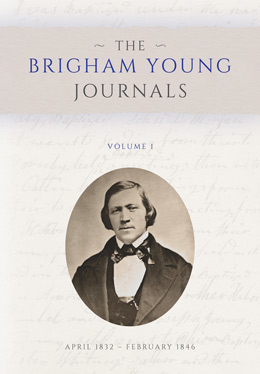
Editorial Method
The Brigham Young Journals present verbatim transcripts of Young’s holograph and office journals in their entirety, making available these most essential sources of his life and work while preserving the content of aging manuscripts from damage or loss. This first volume presents Young’s pre-Utah journals, including his only holograph journals, or those written in his own hand. From 1832 to 1845 he wrote his personal journal in three separate volumes, shifting from one to another over the years, thereby upsetting the chronology. These writings are presented here in chronological order. The text of Young’s office (or secretary’s) journal, covering the years 1844–1846, is presented separately from the holograph journals and precisely as it appears in the physical artifact, without any rearranging of texts. Thus there is overlapping coverage in the holograph journal and the office journal for parts of 1844 and 1845.
Interested readers may wish to compare the transcripts herein with images of the original journals at the Brigham Young Center Foundation website (brighamyoungcenter.org) to better understand how our transcription rules have been applied to create these transcripts. Viewing the originals also provides other information that cannot be conveyed by typography.
Rules of Transcription
Because of aging and damaged texts, as well as imprecise orthography and penmanship, not all handwriting in historical documents is legible. As with other writers of his time, Brigham Young occasionally rendered words carelessly by adding unnecessary letters, omitting other letters, or otherwise forming words imperfectly and incompletely. In addition, he often wrote phonetically, reproducing words the way they sounded to him. Nearly every journal entry written by him contains phonetic spellings. For example, for parade he typically wrote perade, for called he often wrote cauld, for purpose he might write purpis, for General he usually wrote Jeneral, and for every direction he wrote (and may have spoken it as) evera derecttion. Readers will find these and numerous other examples of Young’s idiosyncratic writing. To reduce the level of editorial intervention to clarify meaning and spelling, words that can be easily read phonetically are left without comment even if the spelling is far from “standard.” Only when readers might be puzzled or where a missing vowel or consonant changes a word or otherwise may confuse do the editors intervene editorially to clarify.
Even with rigorous methods, transcription and verification are not an exact science. Judgments about capitalization, for example, are informed not only by looking at the specific case at hand but also by trying to understand or reproduce the usual characteristics of the writer. The same is true for interpreting original spelling and punctuation. If a letter or other character is ambiguous, deference is given to the author’s or scribe’s usual spelling and punctuation. Where this is ambiguous, modern spelling and punctuation are favored. Even the best transcribers and verifiers will differ from one another in making such judgments.
To ensure accuracy in representing the texts, transcripts were verified three times, each time by a different set of eyes. The first two verifications were done using high-resolution scanned images. The first was a visual collation of the document images with the transcripts, while the second was an independent and double-blind image-to-transcript proofreading. The third and final verification of the transcripts was a visual collation with the original journal.
The journal transcripts here render most words letter by letter as accurately as possible, preserving the exact spelling of the originals. This includes incomplete words, variant spellings of personal names, and idiosyncratic grammatical constructions. Canceled words are typographically rendered with the strikethrough bar, while inserted words are enclosed in angle brackets. Cancellations and insertions are also transcribed letter by letter when an original word was changed to a new word simply by canceling or inserting letters at the beginning or end of the word—such as “sparingly” or “attend〈ed〉.” However, for cases in which an original word was changed to a new word by canceling or inserting letters in the middle of the word, to improve readability the original word is presented stricken in its entirety, followed by the revised word in its entirety. For example, because “falling” was revised to “failing” by canceling the first “l” and inserting an “i,” the revision is transcribed as “falling 〈failing〉” instead of “fal〈i〉ling.” Insubstantial cancellations and insertions—those used to correct only spelling and punctuation—are silently emended, and only the final spelling and punctuation are reproduced. For example, a manuscript entry reading “on Thirsday 31th〈st〉 arrived at Buffalo” will be rendered “on Thirsday 31st arrived at Buffalo.” Repeated words or punctuations appearing in the text have been silently deleted.
The transcription of punctuation differs from the original in a few other respects. Single instances of periods, commas, apostrophes, and dashes are all faithfully rendered without regard to their grammatical correctness, except that periods are not reproduced when they appear immediately before a word, with no space between the period and the word. Also, in some cases of repetitive punctuation, only the final mark or final intention is transcribed, and other characters are silently omitted. Dashes of various lengths are standardized to a consistent pattern. In the office journal some scribes wrote many additional or unnecessary dashes. John D. Lee was one such scribe. When his dashes do not appear to have any punctuative purpose, they are silently deleted in the transcript. Another element occasionally found in the office journal is the use of ditto marks to represent the month or year of an entry. These ditto marks are silently deleted from the transcript. The short vertical strokes commonly used in early American writing for punctuating abbreviations are transcribed as periods, except that this punctuation is not reproduced when an abbreviation is expanded in square brackets. Punctuation is never added silently. When the original document sets off a quotation by using quotation marks at the beginning of each line that contains quoted matter, the quotation is formatted as a block quote, without the original quotation marks preserved. Parentheticals written in Young’s hand are presented as such in the text. Any square brackets found in the transcript are editorial insertions made by the editors of this volume. Flourishes and other decorative inscriptions are not reproduced or noted.
Incorrect dates, place-names, and other errors of fact are left to stand, though occasional text and other notes are added to clarify or correct the inaccuracy. The intrusive sic, sometimes used to affirm original misspelling, is never employed, although where words or phrases are especially difficult to understand, editorial clarifications or corrections are inserted in brackets. Correct and complete spellings of personal names are supplied in brackets when incorrect or incomplete names appear in the journal. Place-names that may be hard to identify are also clarified or corrected within brackets. Young occasionally ran together certain words. When two or more words were inscribed together without any intervening space and the words were not a compound according to standard contemporary usage or the writer’s consistent practice, the words are transcribed as separate words for readability. In other words, run-together words are silently emended or separated. For example, if Young wrote “aprair” it will be rendered “a prair [prayer].”
Standardized editorial datelines before each entry clarify dates, identify date spans, and provide the days of the week. These are set in italics to be typographically distinguishable from the text. Original paragraphing is retained. All paragraphs are rendered in a standard format, with indention regularized and with empty lines between paragraphs omitted. Block quotations from other documents within the texts are set apart with block indentions, even when such items are not set off in the original. Horizontal rules and other separating devices inscribed or printed in the original are not reproduced. Line ends are not represented. Because words may be broken across a line at any point in the word and may appear with or without a hyphen, end-of-line hyphens are not transcribed.
Because ink color of the original text can change often, even in the middle of sentences, not all such changes are noted. Where ink color changes mid-entry to match the ink color of the following entry, indicating that the latter portion of an entry likely was added at the time the subsequent entry was inscribed (and in other cases where the change in ink may be significant), color changes are noted. In addition, changes in writing medium, typically ink to graphite and vice versa, are generally noted.
Transcription Symbols
Transcription symbols aid in understanding the text and the order and ways in which the words were inscribed. Even though transcription and typesetting can never represent all the visual aspects of a document, a conservative transcription method that identifies many textual elements—especially cancellations and insertions—rather than just the result more faithfully represents the process by which the text was inscribed.
The following symbols are used to transcribe and expand the text:
| [roman] | Brackets enclose editorial insertions that expand, correct, or clarify the text. This convention may be applied to the abbreviated or incorrect spelling of a personal name, such as Brigham Yo[u]ng, or of a place, such as Westleville [Wesleyville]. Bracketed editorial insertions also provide reasonable reconstructions of badly miss[p]elled worsd [words]. Missing or illegible words may be supplied within brackets when the supplied word is based on textual or contextual evidence. Bracketed punctuation is added only when necessary to follow complex wording. |
| [roman?] | A question mark is added to conjectured editorial insertions, such as where an entire word was [accidentally?] omitted and where it is difficult to maintain the sense of a sentence without some editorial insertion. |
| [illegible] | An illegible word is represented by the italicized word [illegible] enclosed in brackets. |
| ◊ | An illegible letter or other character within a partially legible word is rendered with a diamond. Repeated diamonds represent the approximate number of illegible characters (for example: sto◊◊◊◊s). |
| superscript | Superscription is typographically reproduced. |
| A single horizontal strikethrough bar is used to indicate any method of cancellation: strikethrough, cross-out, wipe erasure, knife erasure, overwriting, or other methods. | |
| 〈inserted〉 | Insertions in the text—whether interlinear, intralinear, or marginal—are enclosed in angle brackets. |
| text | The word text begins textual footnotes describing significant details about the text. Text notes are used to describe unique or noteworthy elements from the physical artifacts, including placement of text on the manuscript pages as well as writeovers, cross-outs, illegible letters and words, and lines drawn across the page. Text notes are also employed when the reproduced text was written by someone other than Brigham Young, which is rare. |
Annotation Conventions
Brigham Young’s journals do not constitute a unified narrative. Annotations—including historical introductions, editorial notes, and footnotes—supply background and context to help readers better understand the journal text. Editorial notes throughout the journals provide essential historical context and analysis to bridge the gaps in Young’s entries and to provide additional textual analysis when necessary. The aim of the annotation is to serve scholars and students of early Latter-day Saint history and American religious history generally, whose familiarity with these fields may vary widely.
The Journals cite original sources where possible and practical. Many of Brigham Young’s contemporaries, including Wilford Woodruff and other members of the church’s Twelve Apostles, wrote journals, letters, and other documents that provide additional details, information, and insights into Young’s journals. These sources are prominently featured in the annotation. Secondary sources of sound scholarship are cited when they distill several primary sources or provide useful general context. Quotations from primary sources preserve original spelling but silently emend cancellations and insertions (unless judged highly significant).
Certain conventions simplify the presentation of the annotation. The terms Saint, Latter-day Saint, and Mormon—all used by mid-1834 in reference to members of The Church of Jesus Christ of Latter-day Saints—are employed interchangeably in this volume. Most sources are referred to by a shortened citation form, with the complete citation given in the Works Cited. This volume uses a citation style that lists all source citations at the end of the footnote. This detailed approach may best serve researchers using this volume as a reference work. Source citations in this volume identify Joseph Smith’s revelations by their original date and by a citation of the version most relevant to the instance of annotation (usually the version published in the Documents series of The Joseph Smith Papers). Smith’s revelations and revelatory translations published outside of the Doctrine and Covenants, such as the Book of Mormon, are referenced in The Joseph Smith Papers to an early published or manuscript version, with references to modern Latter-day Saint publications added in brackets. When the Bible is used in annotation, the King James Version—the version read by Smith and also by Brigham Young and their followers and contemporaries, as well as by English-speaking Latter-day Saints today—is referenced.
Many of the people whose names appear in the journals have been identified. In some cases, information about people named in the journals appears directly in the annotative notes. First or last names supplied in square brackets with no documentation cited have been inferred from the historical context. Some names have silently been left without identification when no adequate information on an individual could be located.
