
 menu icon in the top, right corner of the screen.
 icon above to close this box.
 icon at the bottom of the screen below the browser—if you don't see it, swipe up to unhide it.
Waiting for Help From Zarahemla
D. Bryce Baker
D. Bryce Baker, "Waiting for Help from Zarahemla," in Book of Mormon Insights: Letting God Prevail in Your Life, ed. Kenneth L. Alford, Krystal V. L. Pierce, Mary Jane Woodger (Provo, UT: Religious Studies Center, Brigham Young University; Salt Lake City: Deseret Book), 198–209.
D. Bryce Baker is an independent gospel scholar living in Springfield, Virginia, who recently completed five years of service as a seminary teacher.
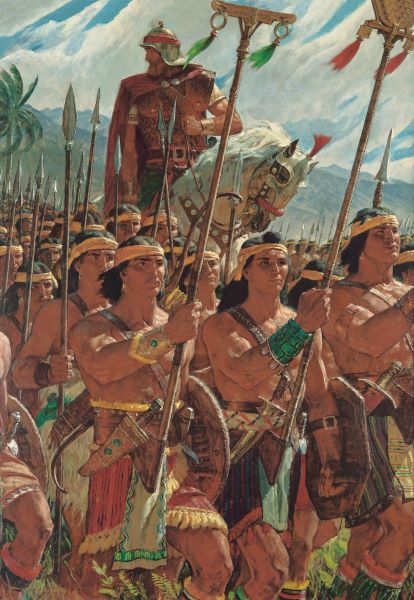 A stunning battlefield victory for Helaman's army after near defeat models for us how to confront prolonged adversity. Stripling Warriors, by Arnold Friberg. Courtesy of Intellectual Reserve, Inc.
When facing difficult and prolonged challenges, we can sometimes feel helpless. We may identify potential sources of help only to have them end up failing us. Where do we turn? The story in Alma 58 of the army of Helaman facing the daunting challenge of retaking the city of Manti contains valuable lessons for us.[1] Unlike the earlier stories of Helaman’s triumphs, here there was no quick and miraculous victory. Instead, we have a story of overcoming doubt and fear while facing prolonged afflictions and of turning toward and trusting the Lord to provide deliverance. The army of Helaman was looking for help from the land of Zarahemla that did not materialize, paralyzing the men with fear and doubt. Finally they recognized the need to fully trust in God, who gave them assurances, blessed them with greater faith and hope, and guided them to victory. We likewise can rely on the Lord amid trials by exercising faith and trusting in his ability to strengthen, lead, and deliver us.
The Backstory
The Book of Mormon describes many armed conflicts between the Nephites and Lamanites over centuries. Perhaps the most memorable conflicts occurred during a twelve-year period (see Alma 48–62). The Lamanites were led by rebellious Nephites who had taken control of the Lamanite throne by murder and intrigue—first Amalickiah and then his brother, Ammoron. On the Nephite side we had major characters such as Captain Moroni, Lehi, Teancum, Helaman, and Pahoran. In talks and lessons we often tell the story of the two thousand stripling warriors who served in the army of Helaman, who was not only the head of an army but also a prophet, chief high priest of the church, and custodian of the sacred scriptural records. The young warriors were of Lamanite heritage, the sons of Lamanite converts of an audacious Nephite missionary team led by the four sons of King Mosiah. The converted Lamanites joined the Nephite nation and were known as the people of Ammon (or Ammonites).
When the Lamanites attacked the Nephites, the people of Ammon were unable to assist in defending their country because they had covenanted with the Lord to never again use weapons to harm others—a covenant marked by burying their swords deep in the earth (see Alma 24:16–18). Since their young sons were not bound by this covenant, those young men were able to join the Nephite army and help defend their country against the Lamanite attack (see 53:13–22). We often recount the miraculous way in which the lives of the two thousand stripling warriors were preserved despite their engagement in fierce battles. We share how the stripling warriors were taught the gospel by their mothers, who promised that God would deliver them (see 56:47). They were described as being exceedingly valiant, having great courage, being true at all times in all things in which they were entrusted, obeying every word of command with exactness, being firm and undaunted in battle, and having exceeding faith (see 53:20–21; 56:45; 57:20–21, 26–27; 58:40).
The first battle fought by Helaman’s stripling warriors occurred after they joined the army of Antipus in the city of Judea in the western part of the Nephite land, where the Nephites had lost several cities to the Lamanites. As part of a strategy to retake the city of Antiparah, the stripling warriors acted as decoys leading the Lamanite army away into a trap. When the time came to fight, they fought with courage and miraculous strength and were the key to victory. To the astonishment of Helaman, not one of the stripling warriors had been killed (see Alma 56:9–56). When Antipus was killed, Helaman took command of the entire army.
The army of Helaman received additional troops from Zarahemla, including sixty young Ammonites. They retook the city of Cumeni without a fight by cutting it off from provisions of support. However, now facing the problem of guarding numerous Lamanite prisoners, Helaman sent part of the army to escort prisoners to the land of Zarahemla. Unexpectedly, the renewed forces of the Lamanite army attacked Cumeni. But for the valiance of the stripling warriors and the timely return of the military escort, the Nephite army would have been defeated. Although Helaman retained Cumeni, his army suffered great loss. In seeing to the care of the wounded, he discovered that none of the two thousand sixty stripling warriors had been killed, even though they all had received many wounds. The entire army of Helaman recognized the hand of God in miraculously preserving the stripling warriors (see Alma 57:6–35).
These are wonderful faith-promoting accounts of miraculous victories that occurred quickly—in a single battle on a single day. Owing to the salience of those accounts, we may pay less attention to what happens to Helaman’s army in the next chapter. Indeed, in Alma 58 there is no quick miracle, but instead a prolonged struggle during which the faith of Helaman’s army is tested. Yet we may find more applications to our personal lives in this account than in the one-day-miracle stories found in previous chapters.
Alma 58
After stunning victories, the army of Helaman turned to the next objective—retaking the stronghold city of Manti, the last Nephite city in the western lands possessed by the Lamanites. The retaking of Manti was a daunting task. Helaman saw that the Lamanites had strong forces that greatly outnumbered his own. He also realized that the Lamanites had learned from past experiences and were not going to be fooled by recycled Nephite strategies. Despite having witnessed miracles by the hand of God, Helaman’s soldiers lacked confidence in their ability to retake Manti. They were filled with doubt that seemed to temporarily overpower their faith. Consider the expressions of that generalized doubt recorded by Helaman in Alma 58 (with negative language italicized):
There was no way that we could lead them out of the city by our small bands (v. 1).
We could not decoy them away from their strongholds (v. 1).
They were so much more numerous than was our army (v. 2).
We durst not go forth and attack them in their strongholds (v. 2) .
We could not come to battle with them, because of their retreats and their strongholds (v. 6).
The army of Helaman felt “small” compared to their enemy (vv. 1, 12) and in need of outside help if they were to prevail. They naturally looked to the capital city of Zarahemla for help in the form of more warriors and provisions. They decided they needed to wait for help from Zarahemla:
It became expedient that we should wait, that we might receive more strength from the land of Zarahemla (v. 3).
We did wait to receive provisions and strength from the land of Zarahemla (v. 4).
As they waited for help from Zarahemla, they focused on maintaining the lands they had already recovered. But waiting seemed to make their situation more precarious since the Lamanites were “receiving great strength from day to day, and also many provisions” (v. 5). Moreover, it was the Lamanites who seemed to be on the offensive, regularly “sallying forth” against Helaman’s army (v. 6). Helaman records that they “did wait in these difficult circumstances for the space of many months” and “were about to perish for the want of food” (v. 7). They finally received some assistance from Zarahemla—two thousand soldiers and some food—but it was totally inadequate to meet their needs. At this point they “were grieved and also filled with fear” (v. 9).
Surely the army of Helaman, led by a prophet, had been praying to God during this extended trial, but now they prayed with more energy. They did “pour out” their souls in prayer that God would “strengthen” them and “deliver” them from their enemies (v. 10). It seems reasonable to suppose that their previous prayers focused on God’s facilitating the deliverance of assistance from Zarahemla. Now they prayed for direct strength for themselves, for deliverance with the resources they already had.
In response to this act of faith, God visited them “with assurances that he would deliver” them. God, not Zarahemla, would provide deliverance. Helaman also records that God “did speak peace to our souls” (v. 11). While Helaman does not mention the Spirit or the Holy Ghost, who else visits the faithful with assurances and peace? Paul wrote in an epistle to the Thessalonians about how the gospel came to them “in power, and in the Holy Ghost, and in much assurance” (1 Thessalonians 1:5). Various scriptures address the role of the Holy Ghost in bestowing peace (see Romans 15:13; Galatians 5:22; Helaman 5:44–47; Doctrine and Covenants 111:8).
Helaman also reported that God granted unto them “great faith” and caused them to “hope for our deliverance in him” (Alma 58:11). With this magnified faith and hope, the army of Helaman “did take courage” and “were fixed with a determination” to go forth against their enemies “with all [their] might” (vv. 12–13). In an act of grace, God blessed Helaman’s warriors with the Spirit, which gave them increased faith, hope, courage, and determination. The strength they had long sought came—not from Zarahemla but from the Lord. He did not give them more outside resources but instead magnified their inner strength. With their small force, they went on the offensive. The details of their victorious engagement (see vv. 13–30) will not be reviewed in this essay, but it is important to point out that, at a critical stage, the army of Helaman made an extraordinary effort to secure victory by taking “another way” and marching all night—an inspired stratagem that allowed them to outflank the Lamanite army (see vv. 26–27). And so they prevailed, retaking the city of Manti without the shedding of blood and driving the Lamanites completely out of the land.
After their great victory, Helaman and his warriors acknowledged that it was “our God who has given us victory” (v. 33). They also declared a firm, forward-looking testimony saying, “We trust God will deliver us, notwithstanding the weakness of our armies” (v. 37). They trusted God, and he inspired them, guided them, supported them, and strengthened them. Miraculously, not one of the two thousand sixty stripling warriors was slain during all their battles; however, they had received many wounds. Those young warriors stood strong and firm in their faith and obedience. They remembered the Lord day-to-day (see vv. 39–40).
Principles
The Alma 58 story teaches gospel principles we can apply to our own lives when we face challenges—short-lived or prolonged—and need help to overcome them. Some of those principles are described below along with connections to other scriptures.
- Mighty Prayer. A first step is to turn to God and engage in mighty prayer to invite God’s help, which is an act of faith and humility (see Alma 58:10). King Mosiah taught that, “in all cases,” God delivers people when they humble themselves, cry mightily to him, and put their trust in him (Mosiah 29:20). For example, the people of Alma the Elder and the people of King Limhi were delivered from bondage after they cried “mightily to God” (Mosiah 21:14; 24:10). Likewise, Enos engaged in “mighty prayer” before he was delivered from his sins (Enos 1:4–6).
- Bestowal of Hope and Comfort through the Spirit. In response to our faith and prayers, God will send his Spirit, which will deliver assurances, peace, and hope for deliverance (see Alma 58:11). This was also the experience of the four sons of Mosiah, who were discouraged as they traveled to the land of Nephi to begin their mission to the Lamanites; “the Lord did visit them with his Spirit” and bestowed comfort and encouragement (17:9–12). As Mormon taught, the Holy Ghost is a “Comforter” who “filleth with hope” (Moroni 8:26). As Paul taught, we can “abound in hope, through the power of the Holy Ghost” (Romans 15:13). President Henry B. Eyring affirmed the role of the Spirit in providing deliverance from trials, declaring that such deliverance “always requires and invites the Holy Ghost” and that “as you are delivered in trials, the Holy Ghost comes to you . . . to comfort and to guide you.”[2]
- Gift of Greater Faith. As an act of grace, God will magnify and strengthen our faith when we turn to him (see Alma 58:11). The enhancement of one’s faith is a spiritual gift (see Moroni 10:11). We remember how the faith of Enos grew and became “unshaken” as he persisted in prayer and received revelation through the Spirit (Enos 1:11). Alma the Younger taught that the choice to receive the word of God will result in increased faith (see Alma 32:28–30).
- Deciding to Act. After God blesses us with his Spirit, giving us greater faith and inspiration, we need to act with courage and determination (see Alma 58:12)—to be willing to take action, not just think about action. Lehi explained that God’s plan of mercy gives men agency to act and choose spiritual liberty and eternal life (see 2 Nephi 2:26–27). Elder David A. Bednar taught that when we are faced with burdens we should “pray for the strength to learn from, change, or accept our circumstances rather than praying relentlessly for God to change our circumstances according to our will” and “become agents who act rather than objects that are acted upon (see 2 Nephi 2:14).”[3] That describes the choice the army of Helaman made—inspired by the Spirit, they chose to act.
- Acting with All Our Might. We need to “go forth with all our might” against the obstacles we face and courageously go on the offensive rather than remain in a defensive posture (Alma 58:13). Satan wants us to choose inaction or half-hearted action in resisting his captivity (see 2 Nephi 2:27–29). He lulls us to slowly surrender to him by not fighting him (see 28:21). If we want to be successful in fighting Satan, we must “put on the whole armour of God”—that is, use all the spiritual gifts God has made available to us—and fight him “in the power of [the Lord’s] might” (see Ephesians 6:10–18). We must choose to use the sword of the Spirit, a weapon of offense, which can “divide asunder all the cunning and the snares and the wiles of the devil” and lead us to victory (Helaman 3:29).
- Letting God Guide Us. We need to let God guide our steps and follow the promptings he gives us. When we have leaders who are called of God, we need to trust that they are being led by the Spirit in the inspired stratagems they ask us to follow to overcome the obstacles we face (see Alma 58:16–28). Nephi was successful in obtaining the brass plates from Laban because he was “led by the Spirit.” He did not have a detailed advance plan, but God revealed his plan step-by-step through the Spirit as Nephi went forward with faith (see 1 Nephi 4:6, 10–12, 18). Nephi later testified that the Holy Ghost “will show unto you all things what ye should do” (2 Nephi 32:5).
- Making Extraordinary Efforts. We need to be willing to make extraordinary efforts as directed by the Spirit or our God-chosen leaders, akin to the army of Helaman’s all-night march (see Alma 58:26–27). This may mean being willing to “march forward by another way” that differs from the normal or expected way (v. 26). Consider how Enos was inspired to engage in an unusually long prayer (see Enos 1:4), how the people of Ammon buried their weapons deep in the ground (see Alma 24:11–18), and how Samuel the Lamanite chose to climb a wall when he was blocked from entering the city of Zarahemla (see Helaman 13:2–4).
- Trusting God despite Our Weaknesses. We need to trust that God can help us overcome the obstacles we face despite our weaknesses (see Alma 58:37). God can compensate for our weaknesses with his power (see 26:12; Exodus 14:13–31) or turn our weaknesses into strengths (see Ether 12:27; Doctrine and Covenants 52:17). On their way to their mission field in the land of the Lamanites, the sons of Mosiah became depressed and were tempted to turn back (see Alma 26:27). It seems logical to conclude that they were focused on their weaknesses. But they chose to trust God and fasted and prayed for his help. God sent his Spirit, which comforted them and assured them he would make them instruments in his hands. They trusted those assurances and went forward with courage (see 17:9–12).
- Demonstrating Our Trust in God. The extent to which we receive the Lord’s support is tied to the extent to which we trust the Lord, as demonstrated by our obedience to his commandments (see Alma 58:39–40). This principle was also taught by Alma when he advised his son Shiblon that “as much as ye shall put your trust in God even so much ye shall be delivered out of your trials, and your troubles, and your afflictions” (38:5). In Psalm 37:39–40 we likewise learn that the Lord helps and delivers the righteous who trust in him—“he is their strength in the time of trouble.” This principle that the Lord’s help is linked to our demonstration of trust through obedience is also evident in the story of King Limhi’s people, who had to pray and repent over an extended period; the Lord then blessed them to “prosper by degrees” before providing the deliverance from bondage they were seeking (see Mosiah 21:14–16).
Applications Today
It is possible to read Alma 58 and perceive it as a dramatic war story without much application to our personal lives. However, when it is closely examined, we can see that it provides powerful lessons that can be applied to people experiencing all types of prolonged adversity, including the adversity of overcoming sin. The story may be especially relevant to those who are engaged in an extended struggle with addictive sin and who may be searching for someone or something to help them but may not be looking enough in the Lord’s direction. Alma 58 teaches that the source of deliverance may be greater trust in the Lord.[4]
We all have times in our lives when we doubt our ability to overcome a weakness or sin. Just as Helaman’s army waited for strength from Zarahemla, we may wait for strength from external (but nondivine) sources. We may find those sources to be helpful but not sufficient, just at the army of Helaman found the meager supplies from Zarahemla to be insufficient. We too may find ourselves filled with fear and discouragement. We need to follow the example of the army of Helaman and humbly choose to turn to God. We need to pour out our souls in prayer that he will strengthen us and deliver us by his power. President Henry B. Eyring taught that God may not give relief from our trials “until we develop faith to make choices that will bring the power of the Atonement to work in our lives.” He further observed that the choice to be humble and ask in faith for the Lord’s deliverance allows the Lord to lead us by the hand through our troubles.[5]
Just as God blessed Helaman’s warriors with the Spirit, which gave them increased faith, hope, courage, and determination, God will bless every penitent soul in like manner. With the Spirit’s help, we feel empowered to go on the offensive and fight against the evil one who is behind all temptation and sin. We do not just defend against Satan and sin in a hunkered-down posture, but instead we press the fight by taking positive actions that fill our lives with practices that invite the Spirit’s expanded presence. We “go forth with all our might” (Alma 58:13). We are fully committed and willing to make extraordinary efforts akin to the army of Helaman’s “march in the night-time” (see vv. 26–27). We put our trust in God. And when victory comes, we will give credit to him for delivering us notwithstanding our weakness. The battle may be difficult, and we may receive many wounds, but we will prevail and “stand fast in that liberty wherewith God has made [us] free” (v. 40).
Remember that the men in Helaman’s army had the capacity all along to defeat their enemies—with the Lord’s help—but they were paralyzed by lack of confidence and fear. Sometimes we too can feel that way. We need to put our trust in the Lord, believing that he will help us. If we do our part, the Lord’s grace will flow into our lives and fill us with strength beyond our own. Lack of trust in God blocks the flow of grace. We can choose to trust and invite the flow of grace.
Elder Kyle S. McKay testified of Christ’s power of deliverance: “I bear witness that Jesus Christ is the Great Deliverer, and in His name, I promise that as you turn to Him with real intent and full purpose of heart, He will deliver you from everything that threatens to diminish or destroy your life or joy.” He cautioned that the deliverance we seek “may take longer than you would like—perhaps a lifetime or longer,” but he assured us that Christ will give us the comfort, courage, and hope we need to endure until we are granted ultimate deliverance.[6]
In an October 2020 general conference address, President Russell M. Nelson promised that God will give the Saints today the same blessings given to the army of Helaman in Alma 58:11 to deal with our turbulent times if we have faith and work to prepare ourselves spiritually.[7] God will give us assurances through his Holy Spirit and, through that same Spirit, bestow the increased peace, faith, and hope we need to prevail against sin and all other adversities we face. Our loving Heavenly Father will give us the succor or help that our days and life conditions demand.[8] He is the helper that will not fail or flee.[9] Let us make sure that we are not failing to turn enough to the Lord in our time of trouble because we are waiting for help from the “Zarahemlas” in our lives. Let us trust him and look first to him to provide the support and deliverance we need.
Notes
[1] Some information in this chapter previously appeared in D. Bryce Baker, Things of Great Worth: Soul-Illuminating Insights from the Book of Mormon (Springfield, VA: self-pub., 2021), 171–73.
[2] Henry B. Eyring, “The Power of Deliverance,” Brigham Young University devotional, January 15, 2008, https://
[3] David A. Bednar, “Bear Up Their Burdens with Ease,” Ensign or Liahona, May 2014, 90.
[4] An Old Testament story also teaches this principle. Asa, king of Judah, had relied on the Lord when the army of Judah faced a much larger army of Ethiopians; the Lord helped the army of Judah to miraculously prevail (see 2 Chronicles 14:8–13). However, when facing the army of Baasha, king of Israel, Asa sent “silver and gold out of the treasures of the house of the Lord and of the king’s house” to purchase the support of the king of Syria. Hanani the seer criticized Asa for foolishly relying on the king of Syria instead of on the Lord, reminding him how the Lord had delivered the mighty Ethiopians into his hand. Hanani described how the Lord searches for those who will allow him to “shew himself strong” in their behalf. Because Asa had chosen to not rely on the Lord, Hanani prophesied, “From henceforth thou shalt have wars” (see 2 Chronicles 16:7–9).
[5] Eyring, “The Power of Deliverance.”
[6] Kyle S. McKay, “The Immediate Goodness of God,” Ensign or Liahona, May 2019, 107.
[7] Russell M. Nelson, “Embrace the Future with Faith,” Ensign or Liahona, November 2020, 76.
[8] “How Firm a Foundation,” Hymns, no. 85.
[9] “Abide with Me!,” Hymns, no. 166.
