
 menu icon in the top, right corner of the screen.
 icon above to close this box.
 icon at the bottom of the screen below the browser—if you don't see it, swipe up to unhide it.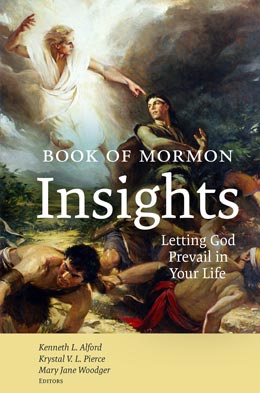
Joshua M. Matson, "Training Up a Child: Parenting in the Book of Mormon," in Book of Mormon Insights: Letting God Prevail in Your Life, ed. Kenneth L. Alford, Krystal V. L. Pierce, Mary Jane Woodger (Provo, UT: Religious Studies Center, Brigham Young University; Salt Lake City: Deseret Book), 228–40.
Joshua M. Matson is an assistant professor in the Department of Ancient Scripture at Brigham Young University.
 The Book of Mormon gives hope and proper perspective to disappointed parents through stories of wandering youth who recall their parents' indelible gospel instruction and are moved to return to the faith. Courtesy of Intellectual Reserve, Inc.
For generations parents have committed to memory and trusted in the promise of the proverb “Train up a child in the way he should go; and when he is old, he will not depart from it” (Proverbs 22:6). While this verse of scripture often brings motivation and hope to parents who are diligently seeking to teach their young children to walk in the way of the Lord, it can bring equal heartache and undue anxiety to the parent whose child has chosen to exercise his or her agency to wander from the covenant path, even after a childhood of diligent training. Adding to this anxiety, some may erroneously conclude that if a child chooses to wander from the gospel, the parents are the ones who are to bear the burden for inadequate training.
Such conclusions are dispelled on a closer examination of this proverb through examples of rearing children from the Book of Mormon. When the Book of Mormon is studied in this way, we obtain insights into how to better approach training up children in the way of the gospel, how parents can find satisfaction in this training as children grow, and how to interpret the promise that they “will not depart from it” in their older years, even in cases where a child wanders. The Book of Mormon teaches its modern audience that God respects the agency of all his children and will never interfere with one’s ability to choose (see 2 Nephi 2:27). Yet righteous parents can act throughout their children’s lives in ways that bring to remembrance the experiences of their youthful training, encouraging them to allow God to prevail in their lives.
Parenting in the Book of Mormon
The Book of Mormon presents numerous examples of parents instructing their children in the way of the Lord. These include Jacob (Enos 1:1), Jarom (Jarom 1:15), King Benjamin (Mosiah 1:2, 7), Alma the Elder (Alma 36:17), Alma the Younger (Alma 39:1–2), the anonymous mothers of the young Lamanite warriors in the army of Helaman (Alma 56:47), Helaman (Helaman 5:9–12), and Mormon (Mormon 8:1–3). Commenting on Mosiah 1:4 and the examples of parents in the Book of Mormon training up their children in righteousness, President Ezra Taft Benson stated, “Why did righteous [parents] in the Book of Mormon go to so much trouble to teach their [children] the word of God? King Benjamin said it was to fulfill the commandments of God.”[1] Indeed, the injunction in Proverbs 22:6 to train up a child in righteousness is not only wise counsel but also a commandment of the Lord (see Doctrine and Covenants 68:25–28; 93:40). This commandment has been reiterated in our present day by President Russell M. Nelson: “Scriptures make it clear that parents have the primary responsibility to teach the doctrine to their children.”[2] A close reading of the Book of Mormon shows that this parental obligation was a central focus of the ancient inhabitants of the Americas and a central part of Mormon’s prophetic editing of the Nephite records.
What exactly is the way in which parents are to train up their children? Looking at how figures in the Book of Mormon speak of the training received from their parents affords insights into what they were taught. For modern readers these ideas can serve as a productive template of the things that should be of most worth when we are training up our own children in the way of the Lord.
The Teachings of Jacob
Jacob’s teachings to the Nephite people are only partially recorded in the Book of Mormon (see 2 Nephi 9:1–11:1; Jacob 1–7). While these teachings focus on topics such as the life and sacrifice of Jesus Christ, the scattering and gathering of Israel, chastity, and virtue, Jacob’s son Enos provides glimpses of what Jacob taught his children. In recording the events of his life, Enos recounts that his father “was a just man—for he taught me in his language, and also in the nurture and admonition of the Lord” (Enos 1:1). Enos’s reference to the language of his fathers has connections with the teachings of Lehi to his children, namely, that they were taught to read and write in the language of their records (see 1 Nephi 1:3; 3:19). This teaching was essential in two ways. First, knowing how to read the plates of brass was essential to the spiritual survival of the Nephites, allowing them to know and follow the commandments of God. The necessity of preserving language skills for the study of scripture is demonstrated by the spiritually destitute state of the Mulekites that is implicitly linked to their lack of scriptural records, which in turn appears to have facilitated the corruption of their language (see Omni 1:17). Second, the preservation of language was essential for Jacob’s posterity to maintain their own history, a record that would be kept and handed down from generation to generation and provide a source of knowledge concerning both secular and spiritual matters (see Jacob 1:2–3).
Enos also observed that his father had taught him in “the nurture and admonition of the Lord,” as noted above. In his study of the meaning of this phrase, David Seely concludes that “the word nurture does not occur elsewhere in the Book of Mormon, but it is possible that the concept Enos refers to with nurture may be found in its English cognate nourish (both terms derive from the Latin root nutrire), which occurs 25 times (in various forms) in the book of Jacob [45 times in the Book of Mormon]. . . . Enos’ use of ‘nurture of the Lord,’ as taught him by his father Jacob, might refer to the Lord’s care for his children.”[3] Seely continues by arguing that the word admonition in its various forms occurs only eight times in the Book of Mormon and “means ‘to exhort,’ usually with the connotation of repentance (see Mosiah 26:6, 39 [twice]; and Alma 1:7).”[4]
Enos also recalled that his father had spoken “concerning eternal life, and the joy of the saints” (Enos 1:3), outcomes of righteous living. Mentioned frequently in the Book of Mormon, the topic of eternal life is preserved in Jacob’s sermons to the Nephites. He emphasizes that to obtain eternal life one must repent “and enter in at the strait gate, and continue in the way which is narrow” (Jacob 6:11). When this theme is read alongside the teachings of Nephi, it becomes apparent that Jacob is referencing the ordinance of baptism (see 2 Nephi 31:17–18). All the while, Jacob maintains that “ye are free to act for yourselves—to choose the way of everlasting death or the way of eternal life” (10:23). This emphasis on moral agency is also the focus of Lehi’s final discourse to Jacob and likely impressed him so much that he passed it on to his children (see 2:27–28).
The joy of the Saints, referenced by Enos, also emphasizes the outcome of living a life consistent with the way of righteousness. The term saint is used in the King James Version of the Old Testament thirty-six times and is translated from one of two Hebrew words: qōdęsh (קדש), meaning “holy,”[5] or ḥesed (חסד), meaning “godly.”[6] Jacob likely taught his children to live holy or godly lives but emphasized equally that the outcome of such living was joy. Joseph McConkie and Robert Millet recognize that joy and eternal life are often referenced together in modern-day scripture (see Doctrine and Covenants 51:19; 52:43–44). They observe that “joy is the fruit one plucks from the tree of life. It matters not the age or the people; if they live gospel principles theirs will be the spirit of rejoicing. . . . So fully is the concept of joy associated with the plan of salvation that the crown of eternal life is referred to as the crown of glory.”[7]
From Enos’s recitation of the teachings of his father Jacob, we learn that parents who seek to train up their children in righteousness will focus on teaching language skills that will provide them with access to the holy scriptures and the records of history, the loving and nurturing nature of God, the necessity of repentance and baptism, the promise of eternal life, and the joy experienced by living a life after the manner of godliness. All the while, Jacob also emphasizes that these principles are to be lived by choice and not compulsion.
The Teachings of Jarom
Very little is preserved of the ministry of Jarom. In his record he openly states, “I shall not write the things of my prophesying, nor of my revelations. For what could I write more than my fathers have written?” (Jarom 1:2). Although little is written of his teaching directly, he emphasizes that “the prophets, and the priests, and the teachers, did labor diligently, exhorting with all long-suffering the people to diligence” (v. 11). Such teaching appears to have been at the center of Jarom’s training of his children. According to his son Omni’s account of his own life, he acknowledges an awareness of the importance to “preserve our genealogy” and keep the “statutes and the commandments of the Lord” (Omni 1:1–2). The importance of these two principles of the gospel was impressed on him by the teachings of his father in such a way that he felt to preserve them on the limited space provided on the small plates of Nephi (see Jarom 1:14).
The emphasis on knowing and preserving a genealogy is an important theme in the Hebrew Bible and the early books of the Book of Mormon. One reason the Lord commanded Lehi to send his sons back to Jerusalem to obtain the plates of brass was that the record contained Lehi’s genealogy (see 1 Nephi 3:2–3). Lehi’s later study of it caused him to be “filled with the Spirit” and to “prophesy concerning his seed” (1 Nephi 5:17). While proceeding generations appear to take seriously the charge to preserve this genealogy (see 1 Nephi 19:2; Omni 1:1), little is recorded concerning genealogy in the Book of Mormon after the book of Omni, on account that such things “are written, but not in these plates” (Omni 1:18). Church leaders in our day have reiterated the importance of genealogy. For example, Elder David A. Bednar promises that “the joy and the protection and the power [that come from involvement in temple and family history work] help you traverse the bumps [of life]. It doesn’t eliminate them but gives you the strength to press forward and deal with them.”[8]
Omni records that his father also emphasized the necessity of keeping the statutes and commandments of the Lord. This is likely connected to Jarom and Omni’s great concern with the social and political environment of their day. One of the most frequently quoted promises by the Lord to the peoples of the Book of Mormon is “Inasmuch as ye will keep my commandments ye shall prosper in the land” (Jarom 1:9; also 2 Nephi 1:20; 4:4; Mosiah 2:31; Alma 9:13; 36:1). An equally stark warning usually follows: “If they did not keep the commandments, but should fall into transgression, they should be destroyed from off the face of the land” (Jarom 1:10). Omni would have been particularly drawn to this warning due to his profession as a warrior[9] and his concern “to preserve my people, the Nephites, from falling into the hands of their enemies” (Omni 1:2).
Overemphasizing the temporal blessings for keeping the commandments of the Lord can be problematic, however, if we put the desired blessing ahead of the commandments themselves. Elder D. Todd Christofferson offered this caution in the April 2022 general conference: “If life doesn’t fall out precisely this way or according to an expected timetable, [we] may feel betrayed by God. But things are not so mechanical in the divine economy. We ought not to think of God’s plan as a cosmic vending machine where we (1) select a desired blessing, (2) insert the required sum of good works, and (3) the order is promptly delivered.”[10] Omni’s written recollection of his father Jarom’s teachings can encourage self-reflection on how we teach our children to keep the commandments. Do we teach them obedience to the commandments only so they might receive specific temporal blessings? If so, we may be teaching our children to walk the covenant path from a mere transaction perspective rather than from a perspective that increases their love for and desire to become like God.
The Teachings of Alma the Elder
As with Jacob, the Book of Mormon preserves only a portion of the teachings of Alma the Elder (see Mosiah 18; 23–26). Yet the focus of those teachings—the atoning mission of Jesus Christ—is of utmost important when teaching children. Instructing his son Helaman, Alma the Younger (son of Alma the Elder) recounts his experience with an angel of the Lord that caused him to be “racked with eternal torment” because of his sins (see Alma 36:12–13). During that harrowing experience he “remembered also to have heard [his] father prophesy unto the people concerning the coming of one Jesus Christ, a Son of God, to atone for the sins of the world” (v. 17). At that time Alma the Younger’s key memory of his father’s teachings came not so much from personal teachings in his home as from the public sermons and teachings given to the people concerning Jesus Christ. The son remembered that his father emphasized the atoning mission of Jesus Christ and applied that teaching in a time of desperation. For his part, Alma the Elder understood that the central doctrine of all teaching within the gospel is the atoning sacrifice of Jesus Christ.
We are all under a similar obligation to teach our children of Jesus Christ, who is “the way” (John 14:6). Along this line, the Church’s handbook Teaching in the Savior’s Way states, “There are many things to teach about in the restored gospel of Jesus Christ—principles, commandments, prophecies, and scripture stories. But all of these are branches of the same tree, for they all have one purpose: to help all people come unto Christ and be perfected in Him (see Jarom 1:11; Moroni 10:32). So no matter what you are teaching, remember that you are really teaching about Jesus Christ and how to become like Him.”[11] We can likewise follow the example of Alma the Elder by putting Jesus Christ at the center of our children’s training.
Wandering from the Way: Different Outcomes of Book of Mormon Parenting
Although righteous parents consistently strive to teach their children about the Savior Jesus Christ and other gospel truths, the outcome of such training does not always follow the ideal pattern of Proverbs 22:6 in which youth do not depart from “the way [they] should go.” The parents discussed in the previous section were chosen not only because they provide beautiful insights into the doctrines that should be central to parental teaching, but also because their diligence in teaching their children did not directly result in the expected outcome. Because of the divine gift of agency, each of these parents saw their children choose to depart from the covenant path.
A close reading of Enos’s account reveals that he, like all of us, had sins that needed to be forgiven. President Dallin H. Oaks explained that “sins result from willful disobedience of laws we have received by explicit teaching or by the Spirit of Christ, which teaches every man the general principles of right and wrong.”[12] Enos had been amply taught by his father and at some point in his life had chosen to sin against the light and knowledge he had received. As parents, we can find comfort in knowing that although our children will commit sin (like us and all who have gone before), the gospel truths taught to them in their childhood will continue to exert an influence for good that (as with Enos) can eventually win out.
After receiving the plates from his father Jarom, Omni openly admits, “I of myself am a wicked man, and I have not kept the statutes and the commandments of the Lord as I ought to have done” (Omni 1:2). As with Enos, and as McConkie and Millet suggest, “it need not be supposed from such an admission that [Omni] was guilty of any gross immorality, but rather that he was not zealous in honoring the law of Moses and in keeping other religious obligations.”[13] Such lack of religious commitment or zeal can sometimes be seen in the lives of people today. Omni clearly reflected on the teachings of his youth from his father concerning the statutes and the commandments of the Lord but exercised his agency to not follow them. Parents can take heart in the instruction President M. Russell Ballard gave to BYU students in 2017. When asked how far one should go to attempt to bring back those who are less active in the Church, President Ballard responded, “Please do not preach to them! Your family members or friends already know the Church’s teachings. They don’t need another lecture! What they need—what we all need—is love and understanding, not judging. Share your positive experiences of living the gospel. The most powerful thing you can do is share your spiritual experiences with family and friends. Also, be genuinely interested in their lives, their successes, and their challenges. Always be warm, gentle, loving, and kind.”[14] Even when a child wanders, the parents should be the ones to whom the child runs to find place, belonging, and love.
Alma the Younger is characterized by Mormon as “a very wicked and an idolatrous man” (Mosiah 27:8). Alma himself confessed to his son Helaman, “I had rebelled against my God, and . . . had not kept his holy commandments.” (Alma 36:13). Such a path contradicted the teachings of his father highlighted above concerning the Savior and living after his example. As Elder Jeffrey R. Holland observes, “Perhaps no anguish of the human spirit matches the anguish of a mother or father who fears for the soul of a child. Through this travail the elder Alma, and undoubtedly his beloved wife, waded—and waited.”[15] While parents may earnestly desire that their children not stray, and certainly not to the extent that Alma the Younger did, because of the agency granted to humanity from God, there is always the possibility that such wandering may happen.
Letting God Prevail in the Life of a Wanderer: Insights from the Book of Mormon
This discussion has outlined two primary aspects of Proverbs 22:6 and how the Book of Mormon provides valuable insights into the faithful execution of those teachings. First, we discussed specific doctrines and principles that children should be taught so they will learn the way of the Lord. Then we highlighted how the Book of Mormon shows that even when parents faithfully execute this duty, children have agency to choose a divergent path. Further, we explored how parents can follow the examples of faithful figures in the Book of Mormon by honoring their own children’s poor choices. This invites the question, “If parents have taught a child the gospel and he or she chooses to leave the covenant path, what is left for parents to do?” This question can be answered by returning to the text of the Book of Mormon.
I have long been impressed by the connection between the experiences of Enos and Alma the Younger. Both, to varying degrees, committed sin and wandered from the path they had been taught to follow. While their sins differed, their journeys back to faithfulness have one striking similarity. Enos recalled that while he was in the forest hunting beasts, “the words which I had often heard my father speak concerning eternal life, and the joy of the saints, sunk deep into my heart” (Enos 1:3). Enos remembered what he had been taught in such a way that he felt it in his heart. Similarly, Alma the Younger recounted, “Behold, I remembered also to have heard my father prophesy” (Alma 36:17). Alma then chose to act on that knowledge and “cried within [his] heart” (v. 18). Both Alma and Enos remembered not only what they had been taught but also how they had felt when applying their fathers’ teachings in times of need, feelings brought about by the workings of the Holy Ghost (see Doctrine and Covenants 9:8; Joseph Smith–History 1:11–12; Moroni 8:26; Romans 15:13). For Alma these feelings came because “the Lord hath heard the prayers of his people, and also the prayers of his servant, Alma, who is thy father; for he has prayed with much faith concerning thee that thou mightest be brought to the knowledge of the truth” (Mosiah 27:14). Those prayers did not seek to compel Alma the Younger to change or make different decisions but help him come to a knowledge of truth.
Similarly, parents of wandering children today can seek for their children to remember not only what they were taught but also how they felt while being taught those things. Elder Holland emphatically proclaims, “Parental prayer is an unfathomable source of power. Parents can never give up hoping or caring or believing. Surely they can never give up praying. At times prayer may be the only course of action remaining—but it is the most powerful of them all.”[16] Praying for wayward children to recapture lessons learned and feelings felt from the training of their youth invites God to intervene in their lives and, while still honoring their agency, prompt them to make a course correction. Elder David A. Bednar poignantly counsels, “The influence of parents who honor covenants and obey commandments indeed can have a decisive spiritual impact upon children who stray. . . . However, righteous parental influence (1) does not replace in the life of an individual the need for the redeeming and strengthening power of the Atonement of Jesus Christ, (2) does not overrule the consequences of the unrighteous exercise of moral agency, and (3) does not negate the responsibility of an individual as an agent ‘to act . . . and not to be acted upon’ (2 Nephi 2:26). . . . Thus, faithful parents can invite the power of heaven to influence their children. Nevertheless, those children remain agents unto themselves, and the choice to repent or not ultimately is theirs.”[17]
The message of the Book of Mormon is that parents are primarily responsible for teaching their children to walk in the covenant path. These teachings should include gospel truths such as the atonement of Jesus Christ, the plan of salvation, repentance, baptism, and the rewards of righteousness (including joy and eternal life). It is also important to teach children reading and writing skills so they can, in addition to other useful applications, study the scriptures and record their own histories. Once that training has been faithfully given, it eventually becomes the grown children’s responsibility to choose the paths they will walk. If their children choose to stray from their gospel upbringing, parents fervently and unceasingly love and pray for them and seek to let God intervene as only he can and to ultimately prevail in their children’s lives. As difficult as it can be for disappointed parents to honor their children’s poor exercise of agency, they can trust in the promise of Proverbs 22:6—that children will carry with them (even into old age) the true and wholesome teachings they received in their youth. With that comes the hope that they will one day recall and feel anew the warm, uplifting feelings of the Holy Ghost that accompanied those early lessons until they are ready to exercise their agency to return to a life of covenant faithfulness.
Notes
[1] Ezra Taft Benson, “Worthy Fathers, Worthy Sons,” Ensign, November 1985, 36.
[2] Russell M. Nelson, “Opening Remarks,” Ensign or Liahona, November 2018, 8.
[3] David R. Seely, “Enos and the Words concerning Eternal Life,” in The Book of Mormon: Jacob through Words of Mormon, To Learn with Joy, ed. Monte S. Nyman and Charles D. Tate Jr. (Provo, UT: Religious Studies Center, Brigham Young University, 1990), 241n3, https://
[4] Seely, “Enos and the Words concerning Eternal Life,” 241.
[5] Ludwig Koehler and Walter Baumgartner, The Hebrew and Aramaic Lexicon of the Old Testament (Leiden, Netherlands: Brill, 2001), s.v. קדש; hereafter HALOT.
[6] HALOT, s.v. חסד.
[7] Joseph F. McConkie and Robert L. Millet, Doctrinal Commentary on the Book of Mormon (Salt Lake City: Deseret Book, 1997), 2:96.
[8] David A. Bednar, “2022 Temple and Family History Leadership Instruction” (broadcast, March 2022), https://
[9] D. Kelly Ogden and Andrew C. Skinner, Verse by Verse: The Book of Mormon (Salt Lake City: Deseret Book, 2011), 1:295.
[10] D. Todd Christofferson, “Our Relationship with God,” Liahona, May 2022, 78.
[11] “Teach about Jesus Christ No Matter What You Are Teaching,” in Teaching in the Savior’s Way: For All Who Teach in the Home and in the Church, https://
[12] Dallin H. Oaks, “Sins and Mistakes,” Ensign, October 1996, 67.
[13] McConkie and Millet, Doctrinal Commentary on the Book of Mormon, 100.
[14] M. Russell Ballard, “Questions and Answers,” Brigham Young University devotional, November 14, 2017, https://
[15] Jeffrey R. Holland, “Alma, Son of Alma,” Ensign, March 1977, 80.
[16] Holland, “Alma, Son of Alma,” 81.
[17] David A. Bednar, “Faithful Parents and Wayward Children: Sustaining Hope While Overcoming Misunderstanding,” Ensign or Liahona, March 2014, 32–33.
